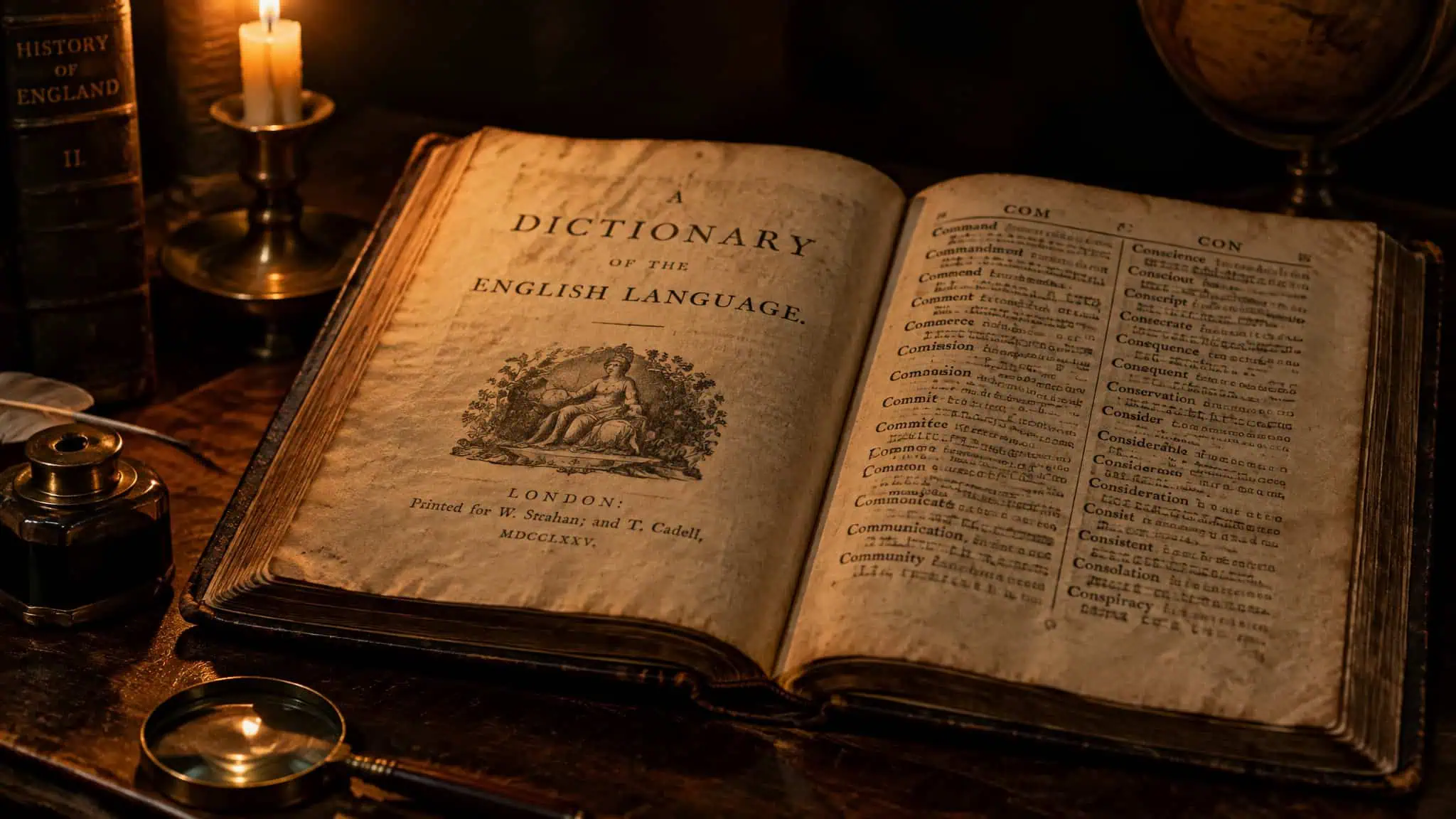
A headline calls some unmarried man’s partner a “mistress” and something feels off about it, like a jacket cut for someone else’s shoulders. That instinct is right, and the reason is stranger than you’d guess: the word spent most of its 700 years in English meaning something that had nothing to do with affairs at all. Before it meant the other woman, it meant the missus.
Key Takeaways
A mistress is a woman involved in an ongoing sexual and romantic bond with a man who is married to another woman; the word requires his marriage, not hers.
The affair meaning is an early 17th-century overlay on a 14th-century title of respect, and Samuel Johnson’s 1755 Dictionary still listed six senses with no marital meaning among them.
Mrs, Miss, and Ms all abbreviate “mistress,” and Mrs signaled money and standing, not marriage, until roughly 1900.
Table of Contents
A mistress is a woman involved in an ongoing sexual and romantic bond with a man who is married to another woman. Four things have to be true for the word to fit. It lasts: stable, at least semi-permanent, not a one-off fling. The two of them keep separate households: her life and his, joined by the one arrangement they share.
It’s often secret, but not always, because history is full of arrangements everyone at court knew about and nobody said out loud. And she’s the person people mean when they say “the other woman.”
The word carries a second, older meaning that most people have half-forgotten. Historically, a mistress was a kept woman: her lover paid all or some of her living expenses, sometimes lavishly, and the role blurred into courtesan territory often enough that the lines weren’t clean. That money-on-the-table arrangement was central to the word for centuries. Today it’s optional. A modern mistress might not see a cent beyond dinner.
Here’s the surprise: open Merriam-Webster and the affair sense isn’t first. The primary definition is a woman holding power, authority, or property. Headmistress and mastery of a field come next, the extramarital sense after that, with archaic senses (sweetheart, courtesy title) trailing behind. The synonyms run to concubine and lover, which tells you how wide the word’s range actually is.
So the affair meaning is a 17th-century overlay on a title of respect centuries older. The rest of this piece is the story of how that happened, and what the language lost when it did.
Mistress vs. Girlfriend vs. Lover: Where the Word Ends
A mistress is not a girlfriend, since the word only fits when the man is married. That’s the working rule, and it’s cleaner than most people assume. If the man is unmarried, the word for his partner is girlfriend or partner. If the woman herself is married, the old rule said “lover,” and that part stuck: lover is still the go-to when she’s the married one. Mistress is reserved for the man’s side of the ledger, and the kept-woman aspect that used to define the role is optional now.
What separates a mistress from a casual fling is duration, commitment, and usually secrecy. This is a standing arrangement, semi-permanent, often hidden. It’s not a weekend.
Register matters too. “Mistress” imports centuries of kept-woman connotation; slang like “side piece” carries none of it. The formal word is the loaded one, which is a strange inversion when you think about it. The old novels policed a line here: a kept woman was not a prostitute, and the difference between those two states was the whole plot of more than one 18th-century novel. The word still drags that history around.
| Mistress | Girlfriend | Lover | |
|---|---|---|---|
| His marital status | Married (required) | Unmarried | Either |
| Her marital status | Either | Either | Married (the old rule) |
| Duration | Long-term, semi-permanent | Open-ended | Varies |
| Kept-woman baggage | Yes (historically central) | No | No |
In practice, the rule leaks. News stories and fiction routinely stretch “mistress” onto an unmarried man’s partner, and usage guides flag it as an error whenever it turns up. The word keeps getting pulled toward a job it was never cut for, mostly because English doesn’t offer a better one for the formal register. If you want the full breakdown of overlapping terms, we’ve got a separate mistress vs side chick vs lover comparison that goes deeper on the slang end.
From Master to Mistress: How the Word Drifted
Mistress entered English in the 14th century as the feminine of master, arriving by way of Middle English maistresse from Anglo-French mestresse. It was originally the feminine counterpart of “mister”: a respectful way of addressing the woman running a household, whether or not she was married to the man who owned or rented it. In effect, the lady of the house.
The timeline
By the 15th century the word could mean a man’s beloved or sweetheart, the sort of thing you find in old love poems, nothing scandalous about it. Then the pivot: by the early 17th century, “mistress” meant a woman involved in a clandestine affair with a married man, and that’s the meaning the modern word still runs on. Title meaning and lover meaning are the same word at different dates. The word did not always mean the other woman.
No male equivalent
Master never developed the illicit sense. English has no good word for a man in an affair with a married woman, which means “mistress” for a man means nothing, and the opposite of a mistress doesn’t exist in the language either. The sexualization ran one direction only, and that lopsidedness is why some people argue the word shouldn’t be used at all. Delete the aside entirely; the preceding sentence already carries the dry tone. Master, for its part, kept its authority senses: skilled craftsman around 1300, employer or owner by the mid-1300s.
Johnson’s Dictionary: The Word Before the Affair Sense Won
Samuel Johnson’s 1755 Dictionary defined “mistress” with six senses, and not one of them is marital. The list, as he gave it: one who governs; one skilled in any art; one who teaches; a beloved and courted woman; a contemptuous form of address; a whore or concubine. For Johnson, neither “mistress” nor Mrs said anything about marriage, a far cry from what defines a mistress today. The modern baggage simply wasn’t there yet.

The 1755 entry is the snapshot before the affair sense crowded out the rest, and the residue survives in dictionary ordering today: Merriam-Webster still leads with authority and ownership before the extramarital sense. The authority meaning isn’t dead, either. One dictionary channel’s example sentence reads, Despite pleading and begging, the evil karaoke mistress would not budge. That example is doing a lot of work, and I mean that as a compliment.
The Royal Mistress: An Office, Not a Scandal
Being a man’s mistress meant, in practical terms, a durable relationship with a married man who had money, and historically he covered her living expenses. Modern usage doesn’t require the kept money. Why both sides entered these arrangements is its own question, the psychology of being a mistress covers that, but at the top of the social ladder, it was practically a civil service.

The French had a title for it: maîtresse-en-titre. A king might keep many mistresses but only one official favourite, and Louis XV with Madame de Pompadour is the textbook case. At Versailles and Whitehall in the 1600s and 1700s these were open secrets, and the women wielded real influence, not just company. Eleanor Herman’s Sex with Kings is the source for the court material.
The best-documented names are royal ones: Agnès Sorel, Diane de Poitiers, Barbara Villiers, Nell Gwyn. Pick two and you’ve got the pattern.
The practice ran down the ladder. Any man who could afford it, merchants and young nobles included, might keep a mistress as one more item of expense. For the women, historian Eric Ives notes, it often functioned as a livelihood: a young woman who might one day marry her lover, or some other man of standing. The exceptions deserve their own mention: Pope Alexander VI kept mistresses.
George II kept Mrs Howard for life even after the romance had cooled, which was the exception, not the template. Catherine the Great, a widowed ruler, took successive partners and refused to share power with a husband. Sometimes the mistress outranked the lover.
Henry Fielding put his finger on the ubiquity in Pasquin (1736), where Lord Place declares: every one now keeps and is kept; there are no such things as marriages now-a-days, unless merely Smithfield contracts. The joke lands without help.
The Mistress in Literature: Kept Woman, Victim, Free Agent
The 1611 ballad \”The Three Ravens,\” possibly older, gives its loyal-burial role to the slain knight’s mistress, not his wife. She is described as his leman, the era’s common word, and she buries him and dies in the effort, heavy with child. The ballad pays her tribute.
The arc compresses hard from there. The kept-woman-versus-prostitute line is the whole ballgame in Fanny Hill (1748) and Moll Flanders (1722); 18th-century novelists like Richardson wrote being kept as the horror ending, while defenders cited Old Testament concubines as precedent and Dryden’s Annus Mirabilis spun royal mistress-keeping as generosity of spirit. George Eliot flipped it, living with a married man as independence from middle-class morality and insisting she not be kept. Lady Chatterley’s Lover (1928) marks the reverse shock: a woman taking a socially inferior lover scandalized more than the other way around.
Where the Word Fails: Mistress and Consent
“Mistress” doesn’t belong anywhere consent is impossible, and enslaved women are the clearest case; the archaic term concubine is the safer choice. The documented example: the New York Times apologized for using “slave mistress” in its Julian Bond obituary, which referred to his great-grandmother, an enslaved woman in Kentucky.
Ben Zimmer’s point is the structural one: the word implies consent and commitment that cannot exist under slavery, and it risks romanticizing a situation that deserves no romanticization. Some historians do still use “slave mistress,” and that disagreement is honest to acknowledge. But the failure isn’t a style quibble. The word presupposes an arrangement, so it breaks precisely where power was absolute.
Mistress’s Other Legacy: How Mrs, Miss, and Ms Split Apart
Mrs, Miss, and Ms all abbreviate the same word: Mistress. That’s the core finding of Dr Amy Erickson’s paper “Mistresses and Marriage” (History Workshop Journal, autumn 2014). Delete, or fold into the previous sentence: ‘…autumn 2014, and nearly everything below flows from it.’
For centuries, Mrs meant money, not marriage. It was the exact female equivalent of Mr: someone who governed servants or apprentices, a person with capital, more likely a businesswoman than a wife. Erickson’s household example shows how it worked in practice: Mrs Green was the housekeeper, Molly the scullery maid, and Betty Black the laundress, the mistress of the house was Mrs, whatever her marital status. The receipts are the best part.
The 1793 Bocking parish listing records 25 female heads of household as Mrs, two-thirds of them farmers or business proprietors, and exactly one Miss: the schoolmistress. Mrs didn’t reliably mean married until around 1900, and genealogists who read “Mrs” in old records as “married” have mislabelled single businesswomen because of it.
Ms is a revival, not an invention. It was one of several abbreviations of Mistress in the 1600s and 1700s, showing up for the unmarried Mary Prince in the 1698 Shrewsbury tax list, and it was proposed as a neutral title as early as 1901. The objection to Miss and Mrs is that each ties a woman’s title to the man in her life: Miss to the father, Mrs to the husband. That split is newer than it looks: Miss was only adopted by adult women in the mid-18th century, and before that calling an adult woman Miss implied she was a prostitute. The extreme version ran the other way: from Sense & Sensibility (1811), the Mrs John Dashwood convention, where a married woman took her husband’s full name. Early 19th-century England was the only place in Europe where that happened, and it later got mocked as “Mrs Man.”
The 20th Century: Divorce, Job Vacancies, and a Word in Retirement
\”Mistress\” was historically the female master, and the title has been retired; nobody reaches for it even where it would be correct. Once divorce became acceptable, men could marry former mistresses and the institution’s reason thinned, though keeping hung on in wealthy circles, and now and then a mistress ended up as the wife. Hence Sacha Guitry’s line about how marrying your mistress creates a job vacancy, endlessly credited to James Goldsmith, who said he’d merely quoted Guitry at dinner and got stuck with the credit (Mary Riddell interview, Daily Mirror, 7 March 1997). The title side retired too: when composer Judith Weir was named the first female Master of the Queen’s Music, a post created in 1626 when master and mistress were direct equivalents, neither the palace nor Weir suggested \”Mistress.\” France banned \”mademoiselle\” in Cesson-Sévigné in 2012, the same collapse in a different language, with some women protesting the loss of a compliment.
The word that used to mean the woman of the house now means the other woman, and the authority meanings survive only in Mrs, Miss, and Ms, retired in living memory. That’s the trade the language made. Whether it got the better end is not a question this article answers.
Frequently Asked Questions
What are the rules of being a mistress?
The working rule is that the word fits only when the man is married to someone else — his marriage is required, not hers. The relationship must be stable and semi-permanent rather than a one-off, with separate households. If the woman is the married one, the traditional term is lover instead, and mistress is reserved for the man’s side of the ledger.
What is the difference between Mrs, Miss, and Ms?
All three abbreviate the same word: Mistress. For centuries Mrs signaled money and standing, not marriage — it was the female equivalent of Mr, marking a woman who governed servants or ran a business, and it didn’t reliably mean married until around 1900. Ms is a revival, not an invention: it was one of several abbreviations of Mistress in the 1600s and 1700s and was proposed as a neutral title as early as 1901, precisely because Miss and Mrs each tie a woman’s title to the man in her life.
What’s the difference between a mistress and a kept woman?
For centuries the two were essentially the same thing: being a man’s mistress meant he paid all or some of her living expenses, sometimes lavishly, and the role blurred into courtesan territory often enough that the lines weren’t clean. Today the kept-money aspect is optional — the word now runs on his marital status and the relationship’s duration, not her finances. The old novels policed a different line: a kept woman was not a prostitute, and that distinction was the whole plot of more than one 18th-century novel.