You’re at checkout. Two tickets in the cart, or maybe four, and the little voice asks: should I have booked these together? Here’s the honest answer before you close the tab: it depends on what “at once” means.
If you mean several passengers in one purchase, bundling never saves money and can cost you more. If you mean several flight legs in one itinerary, it sometimes saves serious cash, often $1,500 or more, but only in specific situations, and miles play by completely different rules than cash. Most articles lump these two questions together. They’re different questions, and they get different answers. So let’s straighten this out before you pay.
Key Takeaways
Booking for multiple passengers in one purchase never discounts the fare; the group gets priced at the scarcest cheap seat, so search one passenger first to find the real floor.
Domestic two one-ways usually match a round-trip (American Newark-Miami: $278 either way), but international one-ways can cost $1,300+ extra (United Dulles-Frankfurt: $3,110 vs. $1,783 round-trip).
With miles, two one-way awards usually win on price and flexibility, but Delta and Europe-originating awards flip the math, so price the award both ways before booking.
Table of Contents
What “booking multiple flights at once” actually means
First, let’s separate the two things people mean when they say this, because they get priced completely differently.
Several passengers, one transaction. You and three buddies all flying the same route. The search result looks like one price, and buying it together feels efficient. It’s about convenience. It is never a discount, and next section I’ll show why it can actually cost more.
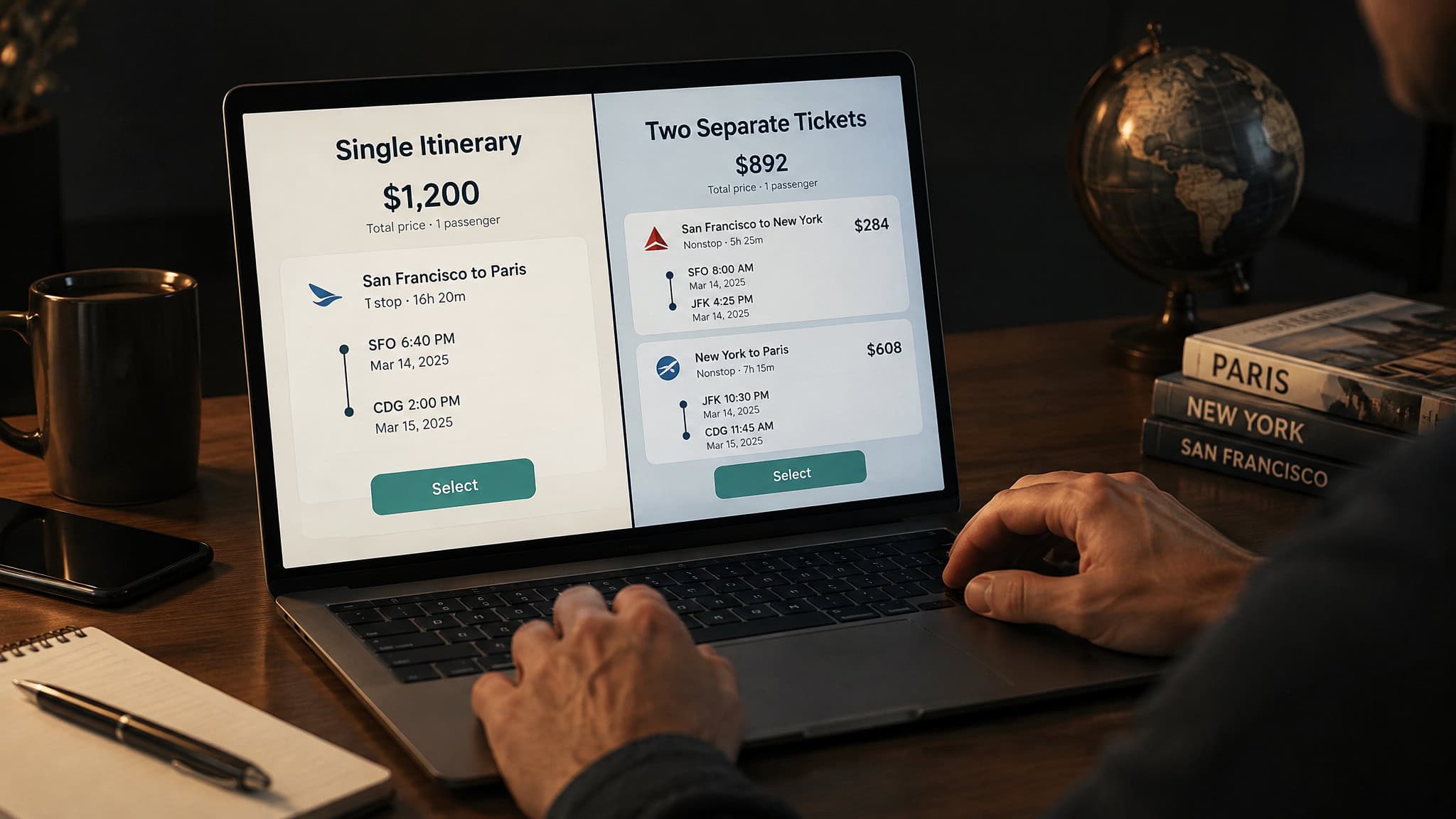
Several legs, one itinerary. This is the round-trip vs. one-way decision, or the multi-city vs. stacked one-ways decision. Here it actually matters what you click. A round-trip is both flights on one ticket, one payment, one chain.
A one-way is a single direction, and you buy the return as a separate ticket. Two tickets, two chains. That chain detail comes back later in the risk section.
Quick heads-up: airlines price seats in what they call “fare buckets.” I’ll explain that in a second, because it’s the whole reason bundling passengers never saves money.
Booking flights for multiple passengers in one purchase
No, booking for several people in one purchase doesn’t save money, and it can cost more. Here’s the mechanism: airlines only sell a handful of seats in each fare bucket at the lowest price. When you search for four travelers, the airline prices every ticket at the highest bucket that has enough seats for the whole group. One cheap seat left?
Doesn’t matter. Everyone in your cart pays the next bucket up.
The tell is that the per-person fare jumps mid-checkout when you add passengers, not at search. That’s a common pattern when booking for a group, and it’s annoying every time.
The fix: search for one passenger first to reveal the true floor, then compare the group total against buying solo seats one by one. Booking separately means separate reservations, so know the trade-off: after a delay, the airline may not rebook your group as a unit. There’s a fuller breakdown of the group-booking math in our guide to booking flights together.
Paying cash: when two one-ways match a round-trip, and when they cost far more
Two one-way domestic flights usually price the same as a round-trip. American Newark-Miami runs $154 out, $124 back, $278 total, and the round-trip was also $278. No penalty either way.
That’s because budget-carrier competition, from the likes of Breeze, Allegiant, and IcelandAir, killed the old one-way premium on most domestic routes. Buy two one-ways domestically and you’ve lost nothing. Freedom to split them whenever.
International is a different animal
Yes, two international one-ways often cost much more. United Washington Dulles-Frankfurt is the ugly one: two one-ways ran $3,110, the round-trip $1,783. That’s $1,327 wasted at checkout. Lufthansa backs it up on the same route: a July nonstop round-trip at $1,355 versus $2,875 in one-ways, a $1,520 difference. Airlines still gouge one-ways on uncontested routes where business travelers pay whatever’s on the screen.
So the cash rule, stated plainly: book whichever is cheaper, assuming comparable flights. If prices tie, take the one-ways. They’re easier to change or cancel, and separate tickets stay independent even though most airlines dropped change fees.
One caveat, because it trips people up: cheapest only counts when the flights are actually comparable. Don’t price a red-eye with a connection against a nonstop and call the lower number a win.
Paying with miles: where the bundling logic inverts
Most U.S. programs price one-way awards at half a round-trip, so when prices tie, two one-way awards win, because you can change or cancel one leg without touching the other. That flexibility is free on most programs. One catch worth knowing: some mileage programs never dropped change fees, and if yours still charges, a round-trip award can limit your exposure to them.
Delta flips the math
New York to Paris: a round-trip award runs 50,000 SkyMiles plus $85. Two one-ways run 74,000 miles plus about $220 (37,000 + $6 out; 37,000 + roughly $220 home). Delta charges more in fees when the award originates in Europe, and it often prices round-trip awards below two one-ways. Here, the round-trip award is the right call. No hedging.
Search one-way at a time
Round-trip award searches can hide partner availability, return nothing when one-way space exists, and price both legs at the priciest cabin. That last one stings: 250,000 points searched as a round-trip versus 50,000 for each one-way. Singapore Airlines is the well-known exception, requiring round-trip award bookings, and United’s award calendar green dates flag around-30,000-mile saver awards bookable via transfer partners. The habit: price the award both ways.
Two minutes, occasionally saves thousands of miles. And a warning about bundled awards: cancel a United round-trip award after flying the first leg and the miles become a future flight credit, not miles back in your account. Your miles got downgraded. One-way awards sidestep that. Program rules change, so treat these as observed examples, not permanent policy.
Multi-city ticket vs. stacked one-way tickets
It hinges on alliance membership and whether you’re mixing carriers. A multi-city ticket is one reservation, all your flights, fly into one city and home from another. Skyscanner handles up to six legs and mixes carriers across alliances. Airline sites like United only return their own inventory, which is fine for one ticket and limiting for anything weirder.
The real data cuts both ways. On Skyscanner, Chicago-Quito-Lima (11-day trip, economy, searched June 17, 2026): solo one-ways ran $800 versus $891 multi-city, and a family of four saw $3,393 versus $3,707. Roughly 10% cheaper stacked separately, in that search, on those routes. Don’t take it as universal, and remember stacked one-ways stay independent if your plans change, while one missed flight on a multi-city ticket can void the rest.
Then the counterexample: Chicago-Frankfurt-London-Chicago on United and Lufthansa, same Star Alliance, June 2025. Multi-city $1,874 versus $3,436 in one-ways. Saving $1,562 and collapsing three reservations into one, and whether splitting bookings matters more gets even sharper on expensive international tickets like these. That’s what same-alliance multi-city does when it works.
Miami-London-Athens in July 2025 landed somewhere in between: multi-city roughly equaled the one-ways, and flying home from Athens beat backtracking through London. Convenience justified the single ticket.
The pattern: separate one-ways win when you’re mixing budget carriers; same-alliance multi-city wins big. If you’re waiting on better one-way fares, set a Skyscanner Price Alert per route and book when it hits your number, and if the whole booking process feels like a labyrinth of outrageous rates and confusing rules, smart airport flight booking strategies can help you navigate it. If you want the tool-by-tool breakdown, see Google Flights vs. Skyscanner compared.
Open-jaw flights: the overlooked third structure
An open-jaw ticket flies into one city and home from another on one ticket, and it’s priced like a round-trip, not two one-ways. Most people have never heard the term, which is a shame, because it quietly solves a common problem.
Say you’re taking a Europe cruise. You board in Budapest, disembark in Munich. Your options: a round-trip to one city plus an intra-Europe hop, two one-ways, or one open-jaw ticket, into Budapest and home from Munich. The open-jaw captures round-trip pricing, exactly in the international situations where round-trip pricing wins, so it beats two one-ways there.
It can also be booked as a multi-city award. Price the open-jaw award against two one-way awards before you commit; if your trip ends somewhere different from where it starts, this is usually the move.
When booking separately wins: mixing carriers and convenience
Mixing one-ways across airlines can beat any one airline’s round-trip by $100 or more, because no airline wins every day on every route. Delta out, American back is the classic play. Different carriers run their best fares on different days, and where you book matters too booking a flight at the airport can sometimes beat online prices, since budget airlines like Spirit and Frontier tack on fees that add up to $18 or more. Southwest’s Wednesday sales are the classic example. Allegiant only flies certain days, and one-way legs let you build around that.
The worked example: Indianapolis to Fort Myers, April 8-11, 2025. Cheapest round-trip was $416. But Allegiant flies Indy to Punta Gorda and skips Tuesdays, so a Monday-night Allegiant out plus a Friday Delta return saved $167.
Paying a little more for the better flight
Separate one-ways also let you pay for the schedule you actually want. New York to LA: $89 for two connections and 14 hours, or $149 for a 9am nonstop around 6 hours. I’m paying the $60. You might not, and that’s fine, but at least you’re choosing.
One-ways also fit the trips with no fixed return, one-direction trips, and open-ended plans. Honestly, on a domestic cash fare I split into one-ways almost every time; on international cash fares I check the round-trip first, every time.
When bundling wins: long-haul, fixed dates, and loyalty earning
The round-trip is the default winner on transcontinental routes, business class, peak season, and low-competition routes on traditional international carriers. Add simplicity when your dates are locked between major hubs, one ticket and you stop thinking about it. And for points loyalists on one airline: more miles earned, better upgrade odds, easier elite tracking, and cleaner minimum-spend progress.
What each structure costs when it fails
Bundling backfires in a specific way: multi-airline bundled tickets carry mixed change and cancellation policies. One ticket, several rulebooks, which is why each flight can have a different cancellation policy. Miss one flight and the rest of the itinerary can vanish. Separate one-ways stay independent; botch one ticket, the others don’t care.
If you book multi-city through an OTA, call the airline first and ask what happens if you need to change. Ten minutes of phone time beats a stranded itinerary.
Red flag: Before booking separate tickets, ask what happens if the first flight is late. No airline owes you a rescue on the second one.
Separate-ticket connections carry their own risk: if the first flight runs late and you miss the second, no airline owes you anything. Only advisable with 6+ hour domestic or 12+ hour international buffers, traveling with carry-on only, and a fat savings gap. Normal layovers: 1.5-2 hours is typical, 45-60 minutes minimum domestic same-airline, up to 3 hours international with customs. And the extreme version of unbundling you’ll see online: hidden-city ticketing. Nonstop New York-Miami at $300 versus New York-Orlando “via” Miami at $180.
Skip the last leg, save $120, and airlines suspend accounts, revoke status, and ban flyers over it. Skip the trick.
Sticker fare vs. real price: the fees that flip the ranking
A Spirit fare that looks $100 cheaper than Southwest can end up costing more once bag fees count. Fly with three kids and that gap evaporates fast. The specifics: carry-ons run $30 to $60 per direction on some budget carriers, and basic economy gate carry-on fees run $50, $65. United basic economy may allow only a personal item. The math that matters: upgrading to standard economy for $40 at booking beats a $60 charge at the gate. Pay at purchase, not at the gate.
Cost check: Price the fare with your real bag count before comparing. A “cheaper” ticket with gate fees isn’t cheaper.
Google Flights has a bag filter that shows the true fare with your carry-on or checked bag included, plus a fare-class filter that excludes basic economy, which is the fare with no seat selection, last boarding, and no changes. Run every comparison with bags set to your actual count and basic economy excluded, or the ranking you see isn’t the ranking you’ll pay.
How to actually run the comparison
Before booking a multi-city trip, price the multi-city ticket and the stacked one-ways in both Google Flights and Skyscanner. Then run everything below.
- Know what Google Flights is: a search engine, not a seller. It checks 300+ airlines and OTAs in real time, then hands you off to the airline or OTA. Refunds and cancellations go through whoever you bought from, not Google.
- Respect the limits: multi-city up to five legs, and airport searches that accept as many as seven airports on each end. The underused wins come from multi-airport search, the date grid, and the price graph, per Going’s deal-sourcing experience.
- Sort honestly. “Cheapest” is the lowest number. “Best” weighs price against travel time, connections, and schedule. New York-LA: $89 with two connections and 14 hours versus $149 nonstop around 6 hours is exactly what “Best” exists for.
- Distrust the baseline. Google’s “typical” price runs high; off-peak New York-Paris gets pegged around $1,050, though fares closer to $750 do appear. And green calendar dates just mark the lowest fares within the window you’re currently viewing, tied to trip length.
- Handle ghost fares calmly. Sometimes the airline changed the price before the results updated. Check the airline’s site, try Skyscanner or Kayak, shift dates a day, set an alert, move on.
- Use the new stuff with eyes open. In August 2026, Google added fare tracking and mile/points route pricing to AI Mode, launching with Alaska/Hawaiian and American, then LATAM, Lufthansa Group, and Flying Blue. AI Flight Deals lets you describe a trip in plain English across 200+ countries. Good for discovery, won’t catch mistake fares.
- Know your undo button. The DOT 24-hour rule: book direct with the airline at least seven days out and cancel for a full refund within 24 hours. The price-guarantee badge refunds the difference via Google Pay, but only when shown and booked through Google.
- Time it roughly. About 1-3 months out domestic, 2-8 international. Rules of thumb, not prophecy.
The full checklist, then: price round-trip, two one-ways, multi-city (if the legs share an alliance), and open-jaw, plus a solo-passenger check if you’re booking for a group. Check dates plus or minus 3 days and alternate airports; Punta Gorda versus RSW is the classic. Factor transfer costs when the cities differ. On top of the search engines, Going is the deal-surfacing layer: 10 million+ members, 99% of its sample-search deal links run through Google Flights, every deal hand-checked.

The company claims members generally save 40-50%, about $200 domestic and up to $550 international, with mistake fares up to 90% off; those are its own claims, not mine. The distinction matters: Google shows prices, Going surfaces deals. Use both.
Myths, the real decision rule, and the bottom line
Kill the absolutes. Round-trips aren’t always cheaper; Breeze, Allegiant, and IcelandAir price one-ways competitively. One-ways aren’t always pricier per leg; domestic hub-to-hub matches round-trips. Budget airlines don’t always win one-way deals; Delta sometimes literally beats Spirit.
The durable rule: for multiple passengers, bundling never saves money. For multiple legs, it can, often by $1,500+ within one alliance or on international cash fares. Fares are dynamically priced, so the winner changes route by route and prices may vary. Run the five-structure check per trip. That’s the only honest answer there is.
Frequently Asked Questions
Is it cheaper to book two flights together or separate?
For multiple passengers, booking together never saves money — the whole group gets priced at the scarcest cheap fare bucket, so everyone pays the higher price. For multiple legs, it depends: domestic two one-ways usually match a round-trip, but international one-ways can cost $1,300+ more. Price both structures before you pay.
Should I book award flights as one-way or round-trip with miles?
Usually two one-ways, since most U.S. programs price one-way awards at half a round-trip and you can change or cancel one leg without touching the other. Delta is the big exception — it often prices round-trip awards below two one-ways and charges higher fees on Europe-originating awards. Round-trip award searches can also hide partner availability, so price the award both ways every time.
What are the risks of booking separate one-way tickets for connecting flights?
If your first flight runs late and you miss the second, no airline owes you a rescue — they’re separate contracts. Only attempt it with 6+ hour domestic or 12+ hour international buffers, carry-on only, and a fat savings gap. Normal layover minimums are 45-60 minutes domestic same-airline, up to 3 hours international with customs.
Is it cheaper to book multi city flights within the same airline alliance?
Often yes, sometimes by a lot. A Star Alliance multi-city on United and Lufthansa priced at $1,874 versus $3,436 for the same legs as one-ways. When one reservation covers partner carriers in a single alliance, the multi-city ticket captures round-trip-style pricing; mixing budget carriers flips it back toward separate one-ways.
Cheapest way to book multi city flights
Price the multi-city ticket and stacked one-ways in both Google Flights and Skyscanner (which handles up to six legs and mixes alliances). Separate one-ways tend to win when mixing budget carriers; same-alliance multi-city tickets win big on international routes. Filter by your real bag count and exclude basic economy, or the ranking you see isn’t the one you’ll pay.
What is an open-jaw flight and when should I book one?
An open-jaw ticket flies into one city and home from another — say, into Budapest and home from Munich — on a single ticket. It’s priced like a round-trip, not two one-ways, so it captures round-trip pricing in exactly the international situations where round-trips win. If your trip ends somewhere different from where it starts, it’s usually the move.

