
No, booking international flights together isn’t automatically cheaper, and past a certain group size it can actually cost more. Airline pricing doesn’t have one “group discount.” It has three completely different systems, and which one you land in depends on your headcount.
At two people, a weird fare rule called P2 pricing can make two tickets cheaper than one. At three to nine, the standard fare-bucket math applies, where adding a passenger can bump your whole transaction into a pricier fare class. At ten or more, you’re into formal group contracts with averaged fares and deposits.
The stakes are real. On a $2,000 long-haul ticket, each of these mechanisms moves hundreds of dollars, not tens. Here’s how each tier works and which one you’re in.
Key Takeaways
Ten passengers is the magic number almost everywhere: Delta, United, Hawaiian, and Aer Lingus all run formal group programs at 10+, with Delta letting you lock fares 240 days out for the Americas/Asia-Pacific and 331 days for Europe, Africa, and the Middle East.
Groups of 2-9 face fare-bucket risk: if only two cheap seats remain in the lowest fare class and you’re booking four, all four tickets can reprice upward, so price the search at each passenger count before committing.
On some tested routes, couples beat solos: Delta MSP-MIA was $199 solo versus $118 per person for two (about 69% more to fly alone), but every documented example is short-haul domestic, with no evidence the pattern extends to international long-haul.
Table of Contents
How airline group bookings work for 10 or more passengers
Once you hit ten people sharing at least one common flight segment, group booking stops being a search-filter question and becomes an actual program. That “at least one shared segment” part is a useful loophole, by the way: not everyone needs the same return flight for the group rate to apply. Four guys can fly out together and scatter home separately.

Delta’s version runs through a Group Contract. You don’t pay full fare up front; seats are held with a booking fee plus a deposit. You’re reserving, not buying yet. Delta wants one named point person, a Group Lead or travel agent, who handles calls for everyone when flights go sideways, and that lead books by phone at 800-532-4777, Monday through Friday, 8 A.M. to 8 P.M. EST.
Pick someone reliable, not the guy who loses his passport in an airport bar. The group fare is confidential, so only the lead sees the math, which is handy if you’re charging people back different amounts. There’s also a possible nonrefundable booking fee, so a dead trip can still cost you that part.
The practical details, delivered like a sticky note:
- Delta Group Specialists: 800-532-4777, Monday through Friday, 8 A.M. to 8 P.M. EST, weekdays only, so don’t wait until Saturday to call.
- Web booking only covers US/Canada travel. International groups call or email. Annoying extra step, but that’s the deal.
- Using a managed travel agency? You go through your Sales Account Executive instead.
How group fares are priced
Here’s the mechanic almost nobody explains: a group quote is typically the average of the several fare classes needed to seat the whole party. It’s an averaged rate, not a magic discount. That’s why the same group size can beat published fares on a tight long-haul route and lose on one with deep cheap inventory. You’re not being gifted a deal; you’re buying the middle of the bucket distribution.
Two catches. Touch the contract after signing and the price can move, since changing the deal reopens fares and terms. And the buddy who RSVPs late might pay a different fare than everyone else.
Delta vs United
Delta’s advance windows are the plan-early-for-the-big-trip pitch: 240 days out for US/Canada, Caribbean, Central America, and Asia-Pacific; 331 days ahead for travel to Europe, North Africa, Southern and West Africa, and the Middle East. Nearly a year of lock-in. Peak seasons like holidays and spring break may carry extra restrictions, so check before assuming.
United’s version is slightly more concierge-ish where it exists: guaranteed group fares for 10+, an airport coordinator on the ground plus group check-in at some locations, and name-change flexibility for roster shuffles. United also runs a separate sports-team tier: 6+ players on US, Puerto Rico, and Canada routes, with names and ticketing due within 24 hours of booking (weekdays only), one free name change per passenger until the day before departure, $100 for a day-of change, and a guaranteed base fare so nobody pays more because they booked on a different day. Great for leagues. Brutal if the roster isn’t locked.
Note the pattern: Delta, United, Hawaiian, and Aer Lingus all land on ten as the minimum. Ten is the magic number almost everywhere.
When does booking a group flight cost more than booking separately
Booking together costs more in three specific situations, and the first one bites hardest.
- Fare-bucket collapse. A single transaction pulls all seats from one fare class. If only two cheap seats remain for your party of four, all four can bump to a higher tier. Travelers commonly report the checkout total jumping when the second seat lands in a higher fare class than the displayed price. On a $2,000 international ticket, that jump is hundreds per person.
- Dropping below 10. On a formal group contract, losing members until you’re under the minimum means the booking gets cancelled, the deposit forfeited, and everyone rebooked at whatever fares cost that day. That’s the cost of letting friends flake.
- Missed deadlines. Miss a ticketing deadline or fail to hit your minimum seat usage, and a per-seat cancellation fee comes straight out of your deposit.
The hidden costs of a formal group contract
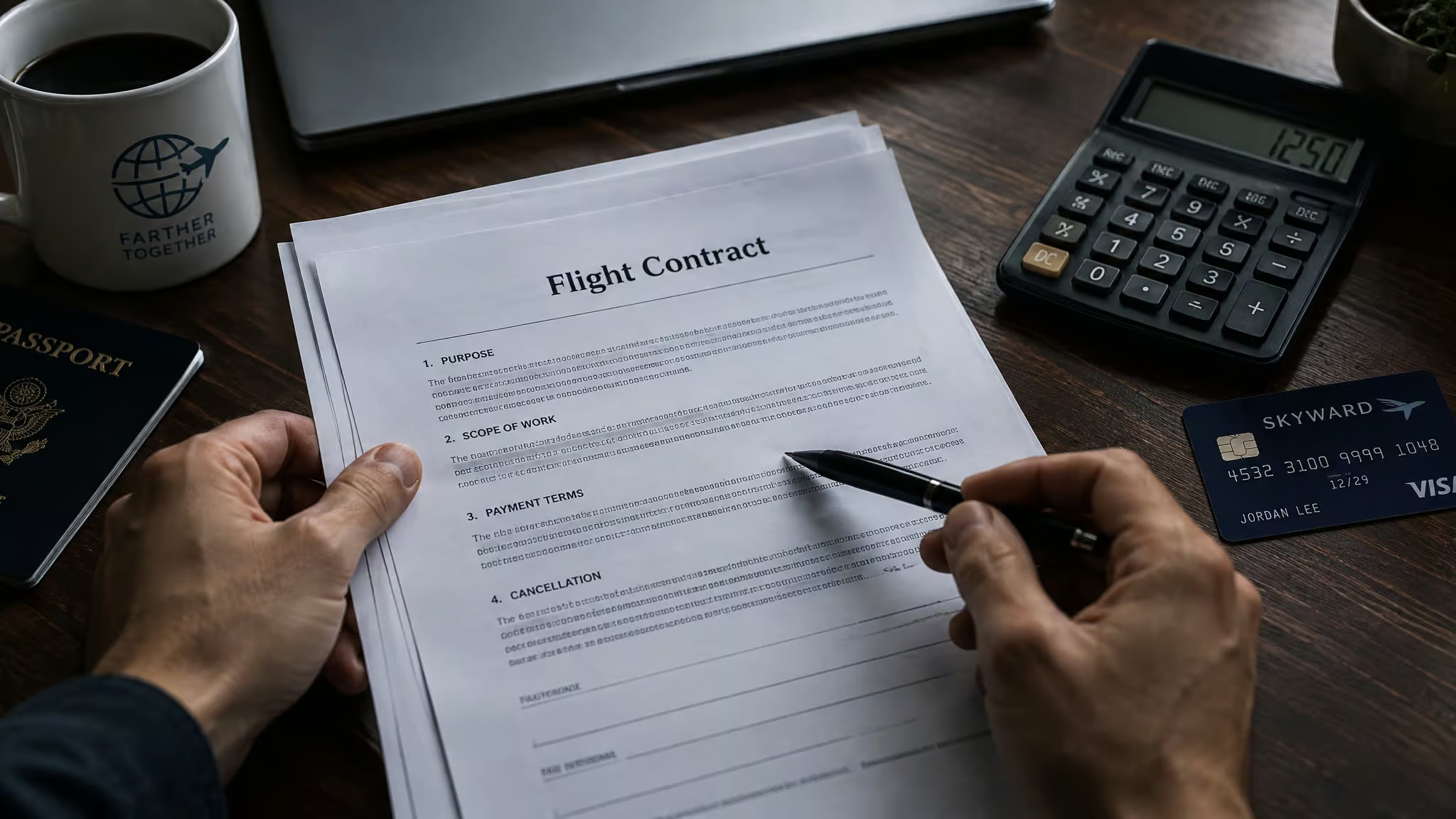
The sticker fare is only part of the story. The contract has its own fee layer, and it hinges on one word most people have never heard: utilization. That’s Delta’s term for did you actually fill the seats you reserved.
Deviation fees and the utilization date
A deviation is any change to date, time, or routing, and it’s the “half the group wants to stay longer” scenario. Before the utilization date, unlimited people can deviate at the group fare with no fee. Change early, pay nothing. After it, only 30% of the group can deviate, and that 30% is calculated from the total number of seats reserved.
Post-cutoff deviations cost $25 per person domestic or $50 per person international, nonrefundable, plus any fare difference. The out-of-towners connecting from another city, what Delta calls feeders, skip the cap entirely. Credit card is the only payment method, so have it ready.
Here’s the proportionality point: a $50 deviation fee stings on a $150 domestic hop and barely registers on a $1,500 international ticket. Which is exactly why the group-contract math improves on the routes you’re probably asking about.
Loyalty and flexibility tradeoffs
The honest trade-offs of the cheap group fare: no SkyMiles upgrades on group tickets, so don’t count on that free bump to first. Mileage earning follows unpublished-fare rules, so assume fewer miles than a normal ticket. Your passport and visa situation is your own problem; Delta won’t bail anyone out.
One dry line on the legal footer: it’s a US contract governed by federal law and, where applicable, Georgia law, the written document is the whole deal, and what a phone agent tells you doesn’t override it. If it’s not on paper, it didn’t happen.
Small groups (2-9): one reservation or split tickets?
No. For two to four travelers, one international reservation isn’t automatically cheaper, and on a $2,000 ticket, the bucket bump runs to hundreds per person rather than tens. This is the tier where the question actually gets interesting.
The classic tradeoff: one PNR, one booking code, keeps the whole party linked during delays and cancellations. One point of truth when things break. But is it cheaper to book multiple flights at once? That question gets at the one-transaction risk of repricing everyone when the cheap bucket runs short. Travelers regularly describe the same failure mode: search shows a price, you add the third or fourth passenger, and the total jumps because a later seat landed in a higher fare class than the displayed one.
The practical move is the split-booking pattern. Price the search at each passenger count first, two, three, four, all the way up. If the total jumps when you add a person, book the remaining low-fare seats in one transaction and the rest separately. Don’t assume the airline will always honor a displayed price or always reprice the whole cart; both outcomes get reported. Test your specific search.
Quick test: Price the same search at two, three, and four passengers before buying. If the total jumps when you add a person, split the booking at the cheap count.
For a family of four, this tier matters most because every ticket is expensive. A fare-class bump that adds $80 on a $200 domestic hop adds $800 across a set of long-haul tickets, which is why booking each passenger’s ticket individually can sometimes beat one lump purchase. Pricing out each passenger count before you commit is the whole game under ten people.
Nobody documents whether an airline will cross-reference or “link” separate confirmation numbers so separately booked travelers get rebooked together during an international disruption. It gets asked constantly; no source we have answers it. Some travelers report calling the airline to link reservations; results aren’t verified. Say it plainly: unverified. Don’t count on it as a guarantee.
When two is the magic number: the P2 fare reversal
Yes, on some tested routes Delta, United, and American charge solo travelers more than couples, up to roughly 70% more for the identical seat. Thrifty Traveler found this in 2025 after crunching large numbers of domestic one-way fares; View From the Wing confirmed it and coined the term “P2” (Passenger 2). American appears to have led the way, and its fare-class behavior on multi-passenger searches has drawn the most scrutiny. United reportedly walked it back after backlash, though that’s unconfirmed.
The airlines haven’t commented. Crickets, naturally.
The receipts, in one tight block:
- Delta MSP-MIA: $199 solo vs $118/person, about 69% more solo
- United ORD-PIA: $269 solo vs $181/person, about 49% more
- American CLT-RSW: $422 solo vs $266/person, about 59% more
The fine print: the cheap fare requires accompaniment by at least one adult 15 or older, on all sectors, in the same cabin. It has to be a real travel companion. You can’t pair with a stranger at the gate.
The workaround: search fares for two even when flying solo, then where allowed, cancel or eat the spare seat. Yes, that’s stupid, but it’s real. Fare trackers like Google Flights and Hopper help, calling the airline occasionally works, and public complaining can too, since the reported United retreat happened after backlash.
The honest limit: every documented example is short-haul domestic. No evidence confirms P2 pricing extends to international long-haul routes. Don’t pretend otherwise.
Booking through intermediaries and agents
Whether an agent gets you cheaper international group fares depends on which intermediary, and the honest answer is: maybe, with marketing attached.

Marketplaces and private contracts
AllFly Marketplace is the do-it-for-you middleman that handles group flights for parties of ten or more, both within North America and overseas. Its angle is private-fare group contracts unlocked by top-tier airline account status; they buy in bulk so you don’t have to. You get dedicated account managers (who claim 25+ years in the business), delayed airline deposit payments so your money stays yours longer while everyone Venmos you back, and a fully online shop/pay/manage workflow. Their Ticket Protection Plan offers cash back on cancelled Delta, United, and American tickets, terms apply.
One case study: a Texas high school ice hockey team that won its division championship booked through the service, and testimonials name staff members Tim, Eric, and Kenny. Treat AllFly’s savings claims as vendor marketing, not verified results.
Airline-specific rules worth a line each: Aer Lingus groups (10+ adults) can book without supplying every passenger’s name, so you can commit before everyone does. Hawaiian’s minimum is ten guests. Sun Country flies to more than 50 destinations spanning the US, Mexico, Central America, and the Caribbean.
Agents, bulk seats, and the foreign-OTA question
There’s a whole YouTube agent ecosystem marketing agent-held bulk seats issued on one PNR as “airlines don’t tell you this” knowledge. A Hindi-language video from BeingUnique Tv (November 23, 2025) walks through the same mechanics, though the description is mostly affiliate links, so weigh it as marketing. Still, it’s a signal the question is global.
Nobody’s documented whether foreign OTAs, their currency pricing, and card fees help or hurt the international group math. No source evidence exists either way. Price it both ways. If the foreign OTA comes out cheaper, take it, just know you’re the test case.
When plans or airlines change: refunds and disruption rights
Delta group tickets carry real refund rights under federal rule 49 CFR 260.6 when a delay, change, or cancellation is significant: unflown tickets and prepaid extras, even bag fees, come back, provided the ticket was Delta’s own stock (DL-006, meaning Delta sold you the ticket, covering Delta Connection and codeshares). Recent tickets, issued on or after October 28, 2024, qualify at three hours domestic and six international; older tickets at 120 minutes. The catch: the Group Lead has 7 calendar days to rebook or cancel after a disruption notice, or Delta auto-cancels and refunds. Seven days sounds long until you’re herding nine other people. What happens after that window isn’t spelled out anywhere, so don’t test it.
Airline failure risk: the Spirit collapse stress test
The cheapest ticket wasn’t cheap if the airline folded holding your deposit, and Spirit did exactly that, ceasing operations in May 2026 after 34 years. Card bookings got automatic refunds; agency bookings had to chase the agents; voucher and points bookings went through bankruptcy. Pay by card, and treat store credit as the riskiest way to hold value with an airline. Competitors rolled out rescue fares fast: Southwest at counters through May 6 with status matching into A-List, United online for up to two weeks, Hertz up to 25% off one-ways.
Every offer had a clock on it. The recovery hierarchy per DOT guidance: Fair Credit Billing Act chargebacks first (your card is your first phone call, not your last), travel insurance covering insolvency second, bankruptcy claims as the slow last resort. A group deposit held with one carrier between deposit and ticketing is concentrated exposure, a risk individual-ticket comparisons never surface.
The decision framework: matching booking structure to group size and ticket price
The best booking structure depends on two things: group size and ticket price. Here’s the matrix.
| Group size | Recommended structure | Fare certainty | Flexibility | Deposit risk | Main tradeoff |
|---|---|---|---|---|---|
| 1 (P2-tested routes) | Search fare for 2, book solo seat if cheaper | Partial (unverified internationally) | Yes (normal ticket rules) | No (no deposit) | Spare seat or cancellation hassle |
| 2-9 | Price search at each count, split if total jumps | Partial (bucket risk stays) | Yes (separate tickets, separate rules) | No (no deposit) | Party may not rebook together in a disruption |
| 10+ | Group contract via airline or marketplace | Yes (averaged fare locked by deposit) | Partial (deviation caps, 30% post-utilization) | Yes (deposit held by airline) | Fees, confidential fares, no upgrades |
Under 10, fare-bucket and P2 logic apply: price the search for 2+, split if the total jumps. At 10+ with mixed itineraries or late name lists, the Group Contract wins on guaranteed space, name-change flexibility, and the 331-day lock-in, weighed against deviation fees, opaque mileage accrual, confidential fares, and deposit risk. For pairs on P2-tested routes, check the two-passenger price even for one seat; on international routes, no data confirms the pattern.
The key insight: the crossover point shifts with ticket price. Fixed group fees barely dent a $2,000 fare but loom large over a domestic hop. The international context flips the usual advice. Foreign OTA pricing remains an untested variable.
The conventional wisdom has inverted twice. Group bookings used to raise prices, and now pairs can beat solos. Neither old rule travels reliably to international routes without testing.
Close: the conditional verdict
No airline guarantees a group discount. Delta promises only “competitive fares.” But the three-tier logic gives you a definite next action: test per-passenger pricing under 10, request a group quote at 10+, and weigh the contract by how well it locks fares and protects your deposit rather than on a promised discount.
On mechanics: group quotes average fare classes, Delta’s windows run 240/331 days out, and watching the buckets is the whole game under 10. For the cheapest way to book an international flight specifically, the honest answer is price transparency on your own search, since no single mechanism wins across routes and dates.
The old rules don’t survive contact with the international version of this question. Test the price at each headcount before you commit, and you’ll know more than the guy who just assumed booking together was cheaper.
Frequently Asked Questions
Is it cheaper to buy two plane tickets together or separate?
It depends on the route. On some tested routes, airlines use P2 pricing that charges solo travelers up to roughly 70% more, so two tickets together beat two singles — Delta MSP-MIA was $199 solo versus $118 per person for two. But on a $2,000 international ticket, fare-bucket risk can work the other way: if the cheap fare class runs short, adding a passenger can reprice the whole transaction. Price the search at each passenger count before committing.
How do airline group bookings work for 10 or more passengers?
At ten or more people sharing at least one common flight segment, you move into a formal group contract. Seats are held with a booking fee plus a deposit rather than full fare, and the quote is typically the average of the several fare classes needed to seat the whole party — an averaged rate, not an automatic discount. Delta, United, Hawaiian, and Aer Lingus all use ten as the minimum, and only one named Group Lead deals with the airline.
When does booking a group flight cost more than booking separately?
Three situations: fare-bucket collapse, where only two cheap seats remain for a party of four and all four tickets bump to a pricier fare class; dropping below ten on a group contract, which can cancel the booking and forfeit the deposit; and missed ticketing deadlines or minimum seat usage, which trigger per-seat cancellation fees out of the deposit. On a $2,000 international ticket, the fare-bucket jump alone runs to hundreds per person.
What’s the cheapest way to book an international flight?
There’s no single winning mechanism — the honest answer is price transparency on your own search. Under ten passengers, price the same search at two, three, and four people and split the booking if the total jumps when you add a traveler. At ten or more, request a group quote and judge it by how well it locks fares and protects your deposit rather than on a promised discount. Foreign OTA pricing and card fees remain an untested variable, so if you’re the test case, price it both ways.
What’s the cheapest way to get a 50% discount on flight booking?
No airline guarantees a group discount — Delta promises only ‘competitive fares’ — so any promised 50% off should be treated with suspicion. The documented savings mechanisms are narrower: P2 pricing can make a two-passenger search cheaper than a solo fare (up to roughly 70% more solo on tested routes), and group contracts can beat published fares on tight long-haul routes because the averaged quote spans multiple fare classes. Savings depend entirely on your route and dates, so test the actual search.

