
Same flight, same day, same seat, one passenger pays $422, two pay $266 each. That’s not a typo or a promo code, that’s American Airlines pricing a solo traveler $156 more per person than a pair, and it happened on a Charlotte to Fort Myers route in 2025.
Whether booking together saves you money on AA now splits cleanly by headcount: two to nine people can actually pay less per ticket than a guy flying alone, thanks to a weird fare-pricing quirk the airlines rolled out. Hit ten passengers and you leave the normal booking system entirely, stepping into American’s formal group program with its own quoted fares and deposit rules. Here’s how both paths work. Your headcount decides which one you’re on.
Key Takeaways
On a Charlotte to Fort Myers one-way in October 2025, a solo traveler paid $422 while two passengers on the same flight paid $266 each, a 58.6% premium for flying alone.
The lowest fare bucket on a flight may hold only one seat, so adding a second passenger can bump everyone up a price tier, which is why a booking total sometimes jumps mid-checkout.
American’s Group & Meeting Travel program covers parties of 10 or more: quoted fares, a $50 to $100 per-person deposit within 14 days, a no-penalty cancellation cutoff around 90 days out, and one free name change per ticket.
Table of Contents
The P2 fare class: why two passengers can pay less than one
P2 is analyst shorthand, not an official American label. It’s airline-internal talk for Passenger 2, and in 2025 analysts noticed that some cheap fares require two or more people on the booking. Solo travelers can pay up to roughly 70% more for the identical seat. The tell is buried in the fare rules: the discounted fare only applies when at least 1 adult aged 15 or older is on the booking for every segment of the trip. Translation: the cheap price only exists if somebody’s flying with you.
How this got found
Nobody announced this. Thrifty Traveler dug it up in 2025 while combing through hundreds of one-way domestic fares. View From the Wing confirmed it and reported that American appears to have led the charge. The airlines themselves haven’t said a word publicly. The pattern isn’t a fluke, either.
Delta priced a one-way Minneapolis to Miami flight at $199 solo versus $118 each for two in early September, a 68.6% premium for flying alone. United ran Chicago O’Hare to Peoria at $269 solo versus $181 per person for parties of up to four, a 48.6% gap.
The analysts’ theory: solo bookings skew toward last-minute business travelers who don’t shop on price, so the airline quotes them like it. That’s a theory, not a confession. So far the pattern shows up mostly on short domestic hops and could be route testing. And note, United reportedly quietly walked it back after the backlash. Nothing here is permanent.
The Charlotte to Fort Myers proof
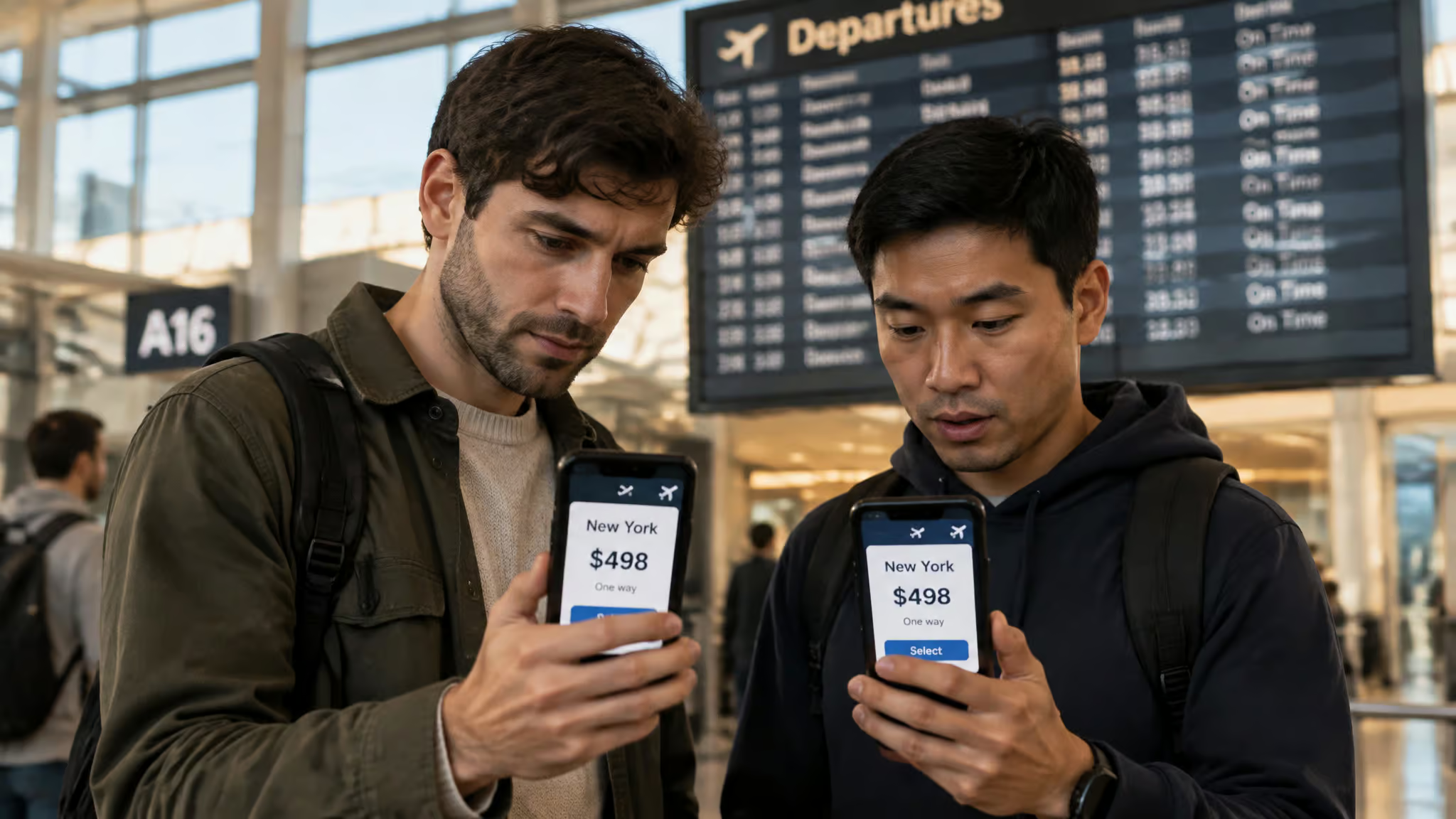
Since this is an American article, here’s the American example. A one-way economy seat on October 13 from Charlotte to Fort Myers ran $422 for one passenger. Add a second and it drops to $266 each. That’s a $156 per-person gap, a 58.6% premium for flying solo, and it fell even further in basic economy.
The practical move costs you nothing: run the same search twice, once with one passenger and once with two, on the same flight. The discount is invisible unless you actually change the passenger count. Fair warning: this is a documented pattern on short-haul domestic fares, not a guarantee on every route or cabin.
Quick test: Search the same flight twice — once for one passenger, once for two. If the pair price drops per person, you’ve found the quirk.
When booking together backfires: the fare-bucket counterweight
Booking two American tickets together is not always cheaper, and sometimes it costs more, because of how fare buckets work. Airlines sell seats in price tiers. A multi-passenger transaction prices all seats in the same fare class, so if one seat is left at $150 and the next tier is $200, a three-ticket booking bumps everyone to $200. The airline won’t sell you two seats at $150 if only one exists at that price.
That’s why a pair search can jump mid-checkout. You search one passenger, see a decent fare, add the second person, and watch the total climb. The symptom to watch for is exactly that: the price per ticket rising after you add a passenger. It means you just emptied the lowest fare bucket.
The classic workaround: search tickets one at a time. Book the first seat at the lowest bucket, then run the search again and grab whatever’s next. You’ll capture the cheap seats individually, at the cost of maybe not sitting in the same rows. For a two-hour hop, most guys will take that trade.
Here’s the twist, though. This penalty direction has flipped, at least partially. For decades, booking together risked raising your price because of that single-lowest-seat problem. The 2025 pair-pricing model reverses it: groups get rewarded, solos get charged extra.
So the old “always book separately” advice is aging out on some routes. The right move depends on your party size and how many cheap seats are actually left in the bucket. Run the search both ways. Book whichever total comes out lower.
American Airlines Group & Meeting Travel: the 10+ program
American Airlines Group & Meeting Travel is the formal program for parties of 10 or more. It means special pricing on fares and amenities, whether you’re filling a big convention or a smaller meetup. If your crew fits, it works like this, though it’s worth comparing how Delta prices multi-passenger bookings, since each airline prices groups a little differently:
- 10 or more passengers on one itinerary
- One or more departure airports, so your group doesn’t need to fly from the same city
- Any cabin, including first class
- Any American or oneworld destination, domestic or international
Business groups get deeper discounts than leisure groups, so set expectations honestly if you’re organizing a bachelor party: it’s a discount, not always a steal. Beyond price, American tries to seat groups together when booked in advance, though possibly across nearby rows rather than side by side, boarding order follows your ticket type rather than your group size, and there’s coordinated boarding help for large outings.
One framing note: group fares are quoted, not automatically the cheapest per-person price you can find. The value is elsewhere.
Deposits, deadlines, and the flexibility dividend
The group contract runs on a timeline worth calendar-ing. The booking window runs from 11 months out down to 48 hours before departure. You won’t find great fares at the 48-hour end, though. You request a quote first, then either buy outright or put down a deposit to lock the price: $50 to $100 per passenger, due within 14 days of signing.

The no-penalty cancellation cutoff sits around 90 days before travel, and after that, penalties are possible. Final names, final balance, and ticketing land 30 to 45 days out.
Name changes as roster insurance
Someone bails. Dave always bails. The organizer swaps in a replacement, and nobody eats an empty seat. One free name change per ticket, official deadline 48 hours before departure.
Some third-party walkthroughs of the contract process cite three days instead, so the numbers vary depending where you look; check your contract. Groups can also add members after booking, with same or adjacent dates, so the guy who waffles for a month isn’t necessarily out.
The contrarian take: the real product here isn’t the discount. It’s optionality. A locked price, a penalty-free exit window, and roster insurance. A quoted group fare beats ten individual tickets when the roster might change, even if the headline per-person price isn’t the lowest.
When an AA group booking is a bad idea
Group booking is a contract with forfeiture risk, and it’s the wrong fit for travelers with divergent plans. The binding rules: everyone shares at least one common flight segment, everyone starts the outbound on the same date, international outbound travel requires the group to fly together, and every traveler must return within a week, a maximum 168-hour spread separating the first and last return. That international requirement also raises the question of whether flying together costs less on international routes, since group fares, long-haul fare buckets, and foreign OTA pricing can shift the math. Break the rules and American can cancel the reservation, and it also reserves the right to cancel if the flight is unavailable or there’s an emergency.
Say it plainly: if half the group wants to stay an extra week or wing their own itineraries, don’t force the group rate.
Air Only fares vs Zone Fares
American’s group desk sells two fare products, and picking the right one matters.
Air Only fares
Air Only fares are a guaranteed group fare for 10 or more people, from one origin or several, all landing at one destination. Before committing, though, it’s worth asking whether booking flights together is cheaper. You can block space up to 330 days ahead, which is basically booking next year’s trip now, return flights can shift within a six-day window, and seats get assigned automatically. The catches: no adding travelers later, and no refunds.
Zone Fares
Zone Fares are for groups of 10 or more coming from two or more countries to the same destination. You buy them from the US or Canada, headed to Europe, the Pacific, North America, or the Caribbean. You get transparent set fares, refundable and flexible options, and you can add names later.
Decision rule: Air Only for domestic-style events with a set roster, Zone Fare for international crews converging from multiple countries. One honest limitation: published sources describe the structure and windows, not dollar rates. You have to request a quote to see actual prices, and I’m not going to make numbers up.
How to request an American Airlines group rate
American Airlines group rate requests go through three channels: the online form, email, or the phone desk. The online form wants Topic set to “Group or Meeting Travel” and Subject “Request quote”. The email is aagmt.internet@aa.com, given exactly as written so you can copy-paste it. The phone group desk is 800-221-2255 for US and Canada. Yes, you can talk to an actual human, and phone booking follows the same quote-then-deposit flow, often faster.
The process itself is two moves. Get the quote first. Then either buy in full or put down the deposit to lock the price and hold the seats. Fares tend to climb toward departure, which is the whole argument for the deposit: it freezes your number while the roster catches up. If you’re a visual learner, AllFly has a YouTube walkthrough covering AA group space bookings for 10+, worth a look even if you shouldn’t treat it as gospel.
Before you request anything, get your headcount right. Nothing torpedoes a group trip faster than a wrong number on the quote.
The ways groups actually lose money, in rough order of how often it happens:
- Missing the deposit deadline
- Wrong passenger details on the name list
- Delayed final payment
- Unconfirmed baggage policies
- Ignored fare conditions
One more freebie: watch fares between deposit and final payment. You locked a price, so the quote protects you, but paying attention costs nothing and occasionally tells you something useful.
Practical tactics for duos and small groups
No, American Airlines fares generally don’t drop closer to departure. They usually rise, which is exactly why locking a group quote early pays. There are exceptions, some basic-economy fares can fall, and the Charlotte example dropped further in basic economy, but plan on upward drift.
The repeatable test: run the identical AA search twice, at 1 versus 2 passengers on one flight, before committing. If the two-passenger price is lower per person, you’ve found pair pricing. Check the fare rules for the accompaniment language before assuming the lower price holds. Fare trackers like Google Flights and Hopper still do real work, as does date flexibility.
Solo workarounds, kept practical: search for two passengers even when flying alone, since the number difference is the proof. Where policies allow, some guys book the cheap pair fare and forfeit the second seat. That’s a gamble, not advice. Call the airline directly and ask, low-tech, sometimes works, costs you five minutes.
And if the pricing feels bogus, say so publicly. That’s literally what got United to back off.
Red flag: If the per-ticket price climbs after you add a passenger, you’ve emptied the lowest fare bucket. Search seats one at a time.
Sidebar: why airline prices bend to behavior at all
Spirit Airlines went under in May 2026 after 34 years, ceasing operations immediately, and United, Delta, American, JetBlue, Frontier, and Southwest all scrambled with limited-window rescue fares for stranded travelers, some windows measured in days. Southwest ran fares at counters through May 6; United kept theirs online for up to two weeks. The point is one sentence wide: airline fares and capacity shift fast when demand shocks hit, so no single fare-comparison rule holds in every market condition.
Two to nine travelers: run the 1-vs-2 search and let the numbers decide. Ten or more: request a group quote and weigh the price against the deposit lock, the 90-day exit, and the free name change. The answer to “cheaper together” has flipped historically and now depends on headcount, fare bucket, and route.
Frequently Asked Questions
Is it cheaper to buy two airline tickets together or separate?
It now depends on headcount and fare buckets. On some American routes in 2025, two passengers paid less per ticket than a solo traveler — a Charlotte to Fort Myers one-way ran $422 alone but $266 each for a pair. But if the lowest fare bucket has only one seat left, booking together can bump everyone into the next price tier. Run the search both ways, one passenger versus two, and book whichever total comes out lower.
Do American Airlines prices go down closer to flight?
Generally no — they rise, which is exactly why locking a group quote with a deposit early can pay off. There are exceptions: some basic-economy fares can fall, and the Charlotte to Fort Myers example dropped even further in basic economy. But plan on upward drift toward departure.
Is it better to book directly with American Airlines?
For group travel, direct is essentially the only path: parties of 10 or more go through American’s Group & Meeting Travel program via an online form, email, or the phone desk at 800-221-2255. For two to nine travelers, the pair-pricing quirk shows up when you search American directly, since the discount is invisible unless you change the passenger count. Booking direct also keeps you in control of fare rules and name changes.
American Airlines group travel vs booking individually: which is cheaper?
Not always the group rate — quoted group fares aren’t automatically the cheapest per-person price you can find. The real value is the flexibility: a locked price, a no-penalty cancellation cutoff around 90 days out, and one free name change per ticket. If your roster might change, a quoted group fare beats ten individual tickets even when the headline price isn’t the lowest. If everyone’s plans are locked, compare the quote against individual fares before committing.

