
You look down at your fingertip and there’s blood on it. You don’t remember starting. Somewhere between the second episode of the show and now, your fingers went to your mouth and went to work on the skin around your thumbnail, and the whole thing happened without a single conscious thought. If that sounds familiar, you already know the annoying part isn’t the damage. It’s that you never catch yourself doing it.
Here’s the good news: roughly 20 to 30 percent of people bite their nails, and a lot of guys never stopped. This is a practical quit plan for how to stop biting your cuticles: what actually works, what backfires, and when it’s more than a nervous habit. The goal isn’t perfection. It’s tools and damage reduction, because the habit runs on autopilot and you can’t stop what you don’t notice.
Key Takeaways
To stop biting your cuticles, start by keeping a brief log of when, where, and what you’re feeling each time you catch yourself biting, most of it happens below conscious awareness, which is why willpower alone fails. Cuticle biting is a body-focused repetitive behavior (the skin-biting version is called dermatophagia), and you can’t stop what you don’t notice.
Next, remove the physical triggers: use hand cream or moisturizer to smooth out the dry, rough skin textures and hangnails your teeth go hunting for, and keep your hands busy with a fidget tool, stress ball, or textured object during the activities where biting usually happens.
Then add barriers scoped to your actual trigger moments, bandages on fingertips, medical tape during high-risk periods, finger cots for specific digits, or gloves while driving or watching movies. The American Academy of Dermatology also recommends tape or gloves to cover nails. Wearing gloves all day kills your typing and feels like Minnie Mouse, so target the moments, not the whole day.
Finally, quit gradually, one set of nails at a time, and stack the log, the substitutes, and the barriers together instead of betting on one trick.
Table of Contents
| # | Step | Key detail |
|---|---|---|
| 1 | Why you bite your cuticles: it’s a coping mechanism, not a character flaw | often functions as a coping mechanism for stress, anxiety, or sensory needs |
| 2 | When it’s more than a habit: the self-assessment threshold | It may be a disorder if urges are compulsive, the same areas are targeted, biting continues despite damage, and tension-relief cycles affect functioning or self-esteem. |
| 3 | What cuticle biting actually does to your body | nails ~1,000 times more absorptive of water than skin (Journal of Investigative Dermatology); wear gloves for wet tasks like dishwashing or gardening |
| 4 | Step 1: Find your triggers with an awareness log | brief log noting when, where, and what emotions accompany biting episodes |
| 5 | Step 2: Put up barriers (and scope them to the right moments) | Use barriers like bandages, finger cots, gloves, or tape during high-risk moments, they’re training wheels, especially useful in the first 6-8 weeks. |
| 6 | Step 3: Replace the habit, hands and mouth (and when substitution backfires) | when the urge hits, play with a stress ball or fidget toy to keep hands busy and away from the mouth |
| 7 | Step 4: Catch the bite you don’t notice, mindfulness and habit interruption | Mindfulness technique: three deep breaths or counting to ten when an urge arises. Conscious-control strategy |
| 8 | Step 5: Heal the damage, cuticle care, wound care, and recovery expectations | Barriers aren’t “cheating.” They’re training wheels. They’re especially useful in the first 6-8 weeks when your nails are vulnerable and your habits are still loud. |
| 9 | Step 6: Build your quit plan, gradual beats cold turkey | stop biting one set of nails (e.g., thumbnails) first |
| 10 | Step 7: Manage the stress underneath, relaxation and lifestyle prevention | Address the root stress with deep breathing, meditation, or yoga, plus lifestyle habits like regular exercise, adequate sleep, and balanced nutrition. |
| 11 | When self-help isn’t enough: professional treatment that actually works | Cognitive Behavioral Therapy and Habit Reversal Training for personalized strategies |
| 12 | Is biting your nails ADHD or anxiety related? | Nail biting (onychophagia) is a BFRB involving self-soothing under stress/anxiety and self-stimulation when bored, existing on a spectrum with anxiety and OCD tendencies. |
Why you bite your cuticles: it’s a coping mechanism, not a character flaw
Cuticle biting is a body-focused repetitive behavior. The skin-biting version has a name, dermatophagia, and the nail-biting version is onychophagia. It’s the brain’s way of coping with stress, anxiety, boredom, or a plain need for something to do. It sits in the same family as skin picking and hair pulling, and per Dr. Czernik it runs on a spectrum with anxiety and OCD tendencies.
The cycle that makes it sticky is simple: tension builds up, biting releases it, and the relief teaches your brain to come back. Most of the time you’re doing it before you realize you’re doing it. That’s the whole reason “just stop” never worked. You were trying to out-willpower something your conscious mind never showed up for.
When it’s more than a habit: the self-assessment threshold
Per Dr. Sanam Hafeez, if you’re not drawing blood or leaving the skin raw and painful, what you’ve got is a nervous habit, not a disorder. For most guys, that’s the answer, and it’s a reassuring one.
There’s a line, though, and it’s worth knowing where it sits. Patterns that warrant a conversation with a professional: urges that feel hard to resist, going after the same spots over and over, continuing even when it bleeds or hurts, that tension-before-relief-after loop, and the whole thing messing with your daily life or how you feel about yourself. If several of those hit at once, it’s past bad-habit territory. That’s not a diagnosis, just a signal that getting evaluated is the smart move.
What cuticle biting actually does to your body
Yes, biting the skin around your nails is harmful. Sore skin gets infected, and per Dr. Hafeez those infections range from pus to permanently deformed nails. Keep it up long enough and nails can actually fall off, biting damages the tissue the nail grows from, so some long-term biters’ nails grow back looking permanently messed up. Warts on your hands can spread there too. Not a myth.
Your mouth isn’t a clean room. Bacteria travel from your mouth to your fingers and back to your face. Warts can spread from your hands too. Discoloration and chronic inflammation around the nail beds build quietly over years. The part most people don’t know: biting can damage the tissue the nail grows from, which is why some long-term biters’ nails look permanently messed up.
Nails aren’t just cosmetic, either. Per Dr. Lipner, try picking up a coin or buttoning a shirt without a nail. Almost impossible. And nails are a window to your health: whitish nails can point to a vitamin deficiency or liver disease, so get discolored nails checked by a dermatologist rather than chewing on them harder.
Step 1: Find your triggers with an awareness log
You can’t fix a habit you can’t see, so spend a week jotting down when each episode happens, where you were, and what you were feeling. A notes app works; no spreadsheet required. The triggers fall into three buckets: emotional (stress, anxiety, boredom, that perfectionist itch to fix or control something), physical (dry or ragged skin, hangnails, idle hands), and environmental (TV, reading, computer work, specific places and times of day).
Step 2: Put up barriers (and scope them to the right moments)
Bitter polish and gloves do work, with conditions. The blunt-force options first: bandages on the fingertips you go after first, medical tape for a rough week you can see coming, finger cots for the one or two digits that get it worst. This isn’t forum folklore. The American Academy of Dermatology itself suggests tape or gloves to cover nails.
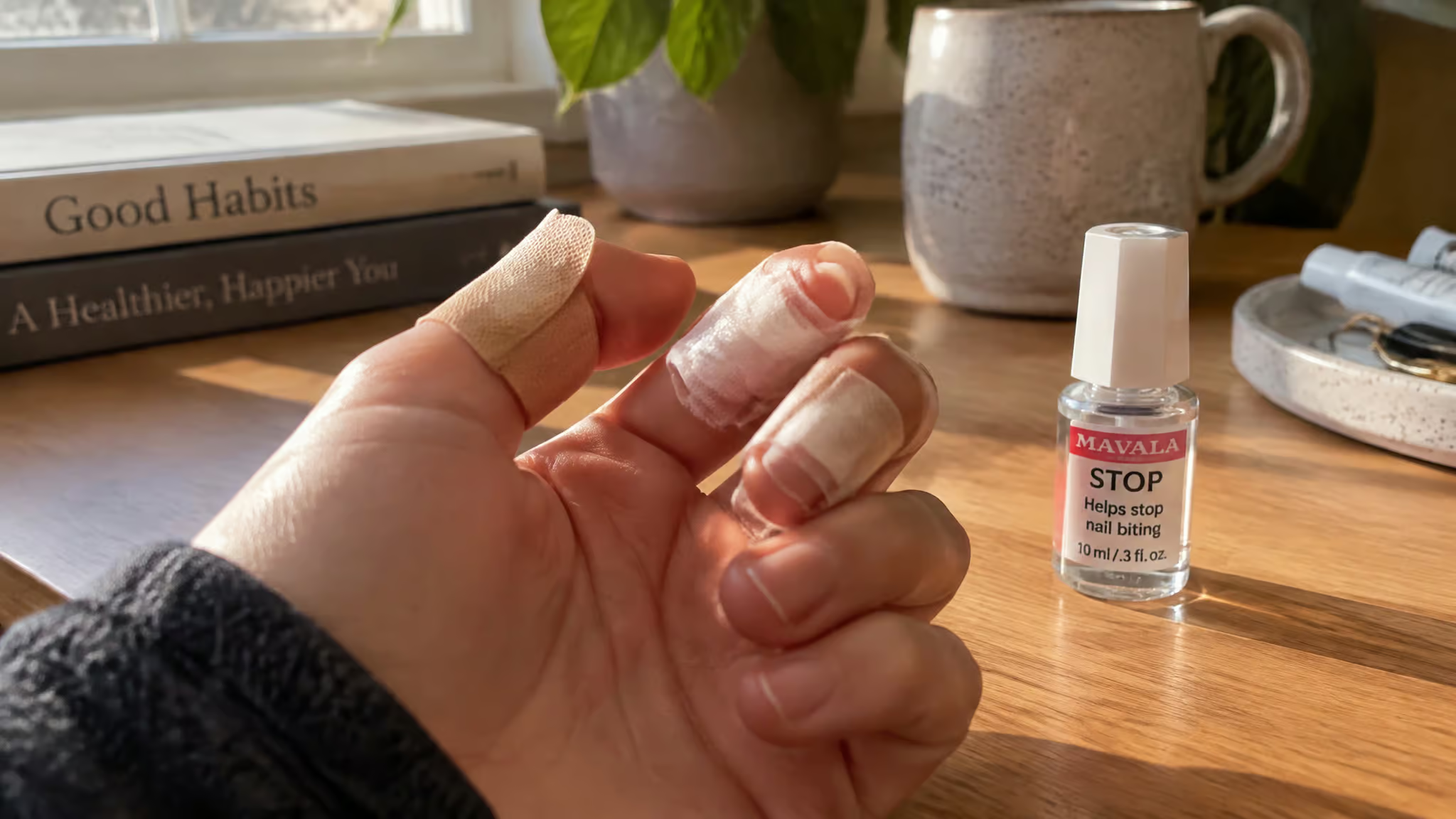
The tradeoff is the whole game here. Barriers fail when you wear them all day. One Glamour writer’s gloves killed her typing and made her feel like Minnie Mouse. They stick when you scope them to trigger activities: driving, movies, dishwashing, gardening. Right tool, wrong moments is still wrong.
Buyer rule: A barrier you wear all day becomes a barrier you take off. Match it to the two or three moments you bite most, and it’ll actually stay on.
Bitter polish is over the counter, safe, and disgusting to taste, which is the entire mechanism and a good one. In that writer’s self-test it scored 8.3 out of 10. That’s one person’s anecdote, not data, but the honest details matter: it stopped the finger-to-mouth move, the behavior shifted to finger-picking instead, and it needs reapplication after handwashing. Also: keep nails trimmed short, and consider painting or covering them. You’re less likely to chew nails you paid to have done.
Step 3: Replace the habit, hands and mouth (and when substitution backfires)
To stop picking the skin on your fingers, give the same urge a harmless outlet the moment it hits. For your hands: stress balls, therapy putty, fidget toys, worry stones, kinetic sand. For your mouth: sugar-free gum, toothpicks, straws, carrots, celery, ice chips, the competing-response move is hands to the stress ball, not the mouth. One caveat: gum can backfire, shifting the habit to finger-picking. Sounds silly for a grown man. Works anyway.
For your mouth: sugar-free gum, toothpicks, straws, carrots, celery, ice chips. The AAD’s competing-response tip is the core move: when the urge hits, hands go to the stress ball, not the mouth.
Now the honest warning nobody else gives you: substitution can backfire. This is the same trap behind replacing bad habits, swapping in a substitute only works if it satisfies the trigger, not just the behavior. In that same self-test, gum scored 5.7 out of 10 and shifted the biting to finger-picking, plus it raised TMJ concerns. A hypnosis CD scored 5 and produced no improvement.
Rewards never got earned. The pattern is clear: when you redirect only the behavior and not the trigger, the urge finds a new outlet. Watch for migration.
Step 4: Catch the bite you don’t notice, mindfulness and habit interruption
This is the section that answers “I do it without thinking,” and it’s the one that matters most. The core problem is automaticity: half the damage happens on autopilot, before your conscious brain is even in the room. So the core skill is inserting a pause between the urge and the action. That gap is where you win.

The named, executable tools:
- Stop, think, redirect. Three steps you can actually remember mid-urge. Catch the hand moving, pause, send it somewhere else.
- Three deep breaths or counting to ten when an urge surfaces. Anything that buys a few seconds between feeling and finger.
- A quick body scan to find where the tension lives, shoulders, jaw, hands. Naming it takes some of the charge out.
- Progressive muscle relaxation for the baseline tension that kicks off episodes in the first place. This is prevention, not just in-the-moment firefighting.
Then there’s the external awareness layer, because you can’t rely on noticing on your own. The habit is unconscious, so you engineer against that:
- Phone alarms a few times a day, just to check: where are my hands, what are they doing? Dumb-simple, and it works precisely because the habit is dumb-simple underneath.
- Sticky notes where the biting actually happens: monitor edge, desk, steering wheel. Annoy yourself into awareness.
- Habit-tracking apps that log the pattern you can’t see in the moment: when, how often, better or worse.
None of this is meditation-guru material. It’s obstacle design. You’re building speed bumps on a road your fingers drive automatically, so the autopilot has to slow down long enough for you to take the wheel.
Step 5: Heal the damage, cuticle care, wound care, and recovery expectations
Healing bitten cuticles is a moisturizing-and-protection routine, not a trimming routine. In practice that means gentle cleansing with mild fragrance-free soap, regular cuticle oil and a thick hand cream, and antibiotic ointment plus a bandage over any open spots, then watching for increased redness, warmth, or discharge, which are your cues it’s infected. Skip harsh products on healing skin, too, it’s already compromised. And instead of trimming, push cuticles back gently with a washcloth after a shower, when the skin is soft. That’s the whole routine: clean, moisturize, protect, and leave the barrier alone. The reframe that changes your motivation: the cuticle isn’t excess skin. It’s a thin layer of clear dead skin cells that seals bacteria, fungus, and dirt out from under the nail. It’s a bouncer, not a blemish. Biting it off removes the barrier and invites infection in.
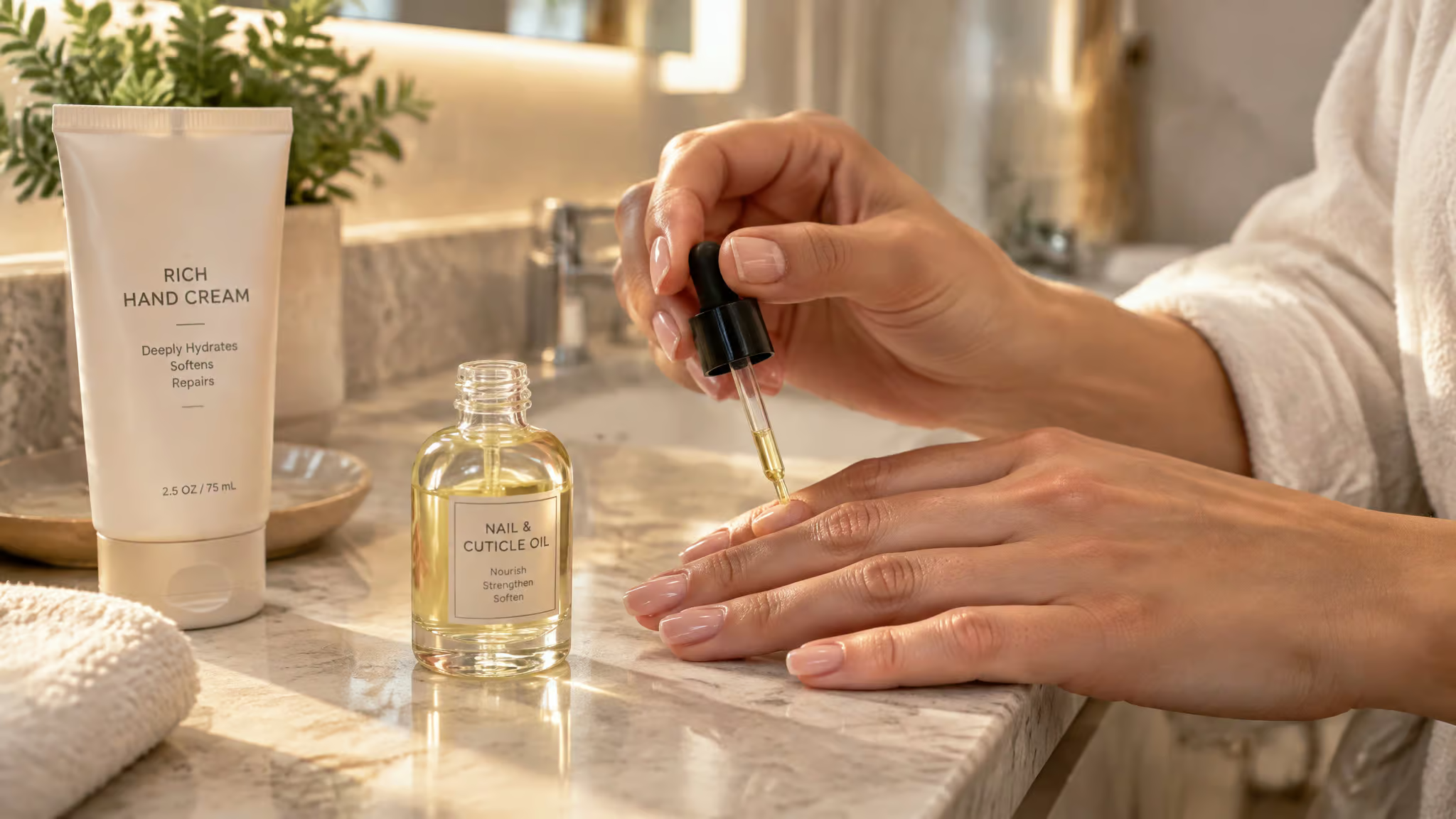
So give it a different job. Per Dr. Stern, push cuticles back gently with a washcloth after a shower, when the skin is soft, instead of trimming them. Daily care is simple: mild fragrance-free soap, cuticle oil, and thick hand cream. Thicker than lotion.
That thickness is the point. Here’s the stat worth remembering: nails absorb roughly 1,000 times more water than skin, per the Journal of Investigative Dermatology. Hence the moisturizing, and hence gloves for dishwashing and gardening.
Wound care: antibiotic ointment on open areas, keep damaged skin clean and covered, skip harsh products on healing skin, and watch for infection. Increased redness, warmth, or discharge means a doctor conversation, not more waiting.
Hangnails are the single most common trigger, so handle them right: clip at the base promptly with clippers. Never bite, never rip. Ripping tears the skin at the base and turns a hangnail into an open wound that can invite infection.
Nail care supports the quit, too. Trim short, cut straight across so you don’t trade a biting habit for an ingrown nail, and smooth the edges with a glass or crystal file, which does a better job than the cardboard emery boards. Take breaks from acetone removers, hard gels, and heavy acrylics, which dry out or weaken nails. One honest product tradeoff: the most hydrating cuticle oil the Glamour writer found, CND SolarOil, smells like an almond cookie.
Which could, in theory, draw a biter right back to his fingers. Know yourself.
The honest recovery answer: nails usually grow back to normal, unless the nail-growth tissue itself was damaged. That’s the part worth protecting now. Help the regrowth along: keep nails trimmed short and cut straight across, work in some cuticle oil, and skip acetone-based removers while the new nail comes in.
Step 6: Build your quit plan, gradual beats cold turkey
Gradual wins, and that’s not a soft opinion. The AAD protocol: stop biting one set of nails first, say your thumbnails, and protect those completely. Then ratchet closed: pinkies, pointers, or a whole hand at a time. The end goal is plain: no biting anywhere.
Cold turkey fails because the behavior runs unregistered, below awareness, so willpower has nothing to grab. In the Glamour self-test it ranked dead last at 1 out of 10. Set expectations honestly: recovery doesn’t go in a straight line, setbacks are normal and don’t erase the weeks you didn’t slip, and every urge you redirect is rewiring the habit. If you’ve been chewing nails for 20 years, this is the version of the plan built for you. Slow still counts.
Step 7: Manage the stress underneath, relaxation and lifestyle prevention
The urges run on baseline tension, so lower it: deep breathing, guided meditation or mindfulness apps (roll your eyes if you want, just try it), yoga or plain stretching, progressive muscle relaxation. Then the boring fundamentals, which quietly run the show: exercise you’ll actually do, decent sleep, because a fried brain has worse impulse control, eating like a functioning adult, and a little daily structure to shrink the uncertainty that sets off episodes.
When self-help isn’t enough: professional treatment that actually works
Two hard triggers for getting help: any skin or nail infection, which means a board-certified dermatologist, no toughing it out. And genuinely trying to quit more than once and still not managing it.
Here’s what treatment actually looks like, which almost no consumer article bothers to say. Habit Reversal Training is the first-line treatment, and its core mechanism is the competing response, the same swap-to-the-stress-ball move from earlier. Alongside it: Cognitive Behavioral Therapy, with Acceptance and Commitment Therapy for managing urges and DBT skills for emotional regulation. Look for a mental health professional who has actually worked with body-focused repetitive behaviors.
That experience matters. A doctor can also screen for underlying anxiety or depression and treat the wounds you’ve been re-opening every week.
Script the appointment: bring how often it happens, how bad it gets, what it’s done to your skin, how it’s affected you, and what you’ve already tried. Honest caveat: some doctors haven’t heard much about dermatophagia, so you may need to bring the information yourself. Support groups and online communities round out the long game.
Is biting your nails ADHD or anxiety related?
No, nail biting is not itself ADHD. But the honest picture has some texture. These behaviors can co-occur with ADHD and anxiety, and per Dr. Czernik they sit on a spectrum with anxiety and OCD tendencies. Co-occurrence is real enough that a professional evaluation for co-occurring conditions is a legitimate part of care if the habit is severe or the other signs are there. There’s no causal or diagnostic claim beyond that, and anyone who gives you one from a blog post is doing armchair psychology.
Can Ozempic or GLP-1 medications stop nail biting?
No, not as an approved or proven treatment. Here’s what the anecdote actually is: a subset of GLP-1 users on semaglutide and tirzepatide, posting on Reddit and among influencers, report their daily nail biting stopped after starting the medication. Some of Dr. Duncan’s patients also reported losing interest in alcohol and cigarettes. The hypothesized mechanism is dopamine and reward-pathway effects that dull cravings broadly.
Now the hard limits: it’s not approved for nail biting, no clinical trials exist, and the effects may soften over time. They’re neither permanent nor universal. What dermatologists actually recommend hasn’t changed: trigger identification, bitter polish, habit reversal training.
Step 8: Assemble your personal action plan
Build a working plan this week with stuff you already own. One trick alone usually loses; barriers plus substitutes plus awareness together usually win. Layer it across three horizons.
In the moment: distraction, the stress ball, leaving the trigger situation, the barrier. Daily prevention: skin care, stress management, a little mindfulness, and fixing the environments where it happens. Long term: provider check-ins if needed, support groups or online communities, and actually noticing progress. Milestones count, even small ones.
The tech layer helps: habit-tracking apps show you the pattern you can’t see in the moment, reminder pings do the awareness work for you, and your phone becomes part of the fix instead of the distraction. Your zero-cost kit: bandages, gum or toothpicks, sticky notes, any fidget object, hand moisturizer, nails trimmed short. Add one habit-tracking app and one milestone to celebrate, and you’ve got a real plan instead of another round of white-knuckling it.
Frequently Asked Questions
Why do I constantly bite my cuticles?
Cuticle biting is a body-focused repetitive behavior — the skin-biting version is called dermatophagia — and it’s the brain’s way of coping with stress, anxiety, boredom, or idle hands. The cycle is self-reinforcing: tension builds, biting releases it, and the relief teaches your brain to come back. Most of it happens below conscious awareness, which is why willpower alone doesn’t work.
Is biting your nails ADHD?
No, nail biting is not itself ADHD. But these behaviors can co-occur with ADHD and anxiety, and dermatologists note they sit on a spectrum with anxiety and OCD tendencies. If the habit is severe or other signs are present, a professional evaluation for co-occurring conditions is a legitimate part of care — anything beyond that is armchair psychology.
Picking skin around nails until it bleeds — when is it a disorder?
If you’re not drawing blood or leaving the skin raw and painful, it’s a nervous habit, not a disorder. It’s worth talking to a professional when several of these hit at once: urges that feel genuinely hard to resist, going after the same spots repeatedly, continuing even when it bleeds or hurts, the tension-before-relief-after loop, or the habit messing with your daily life or self-image. That’s not a diagnosis, just a signal to get evaluated.
Do bitter polishes and gloves actually work to stop nail biting?
They work, but only when scoped to your actual trigger moments. Barriers fail when you wear them all day — gloves kill your typing and come off. Match bandages, medical tape, or finger cots to the two or three activities where you bite most, like driving or watching movies. Bitter polish is over-the-counter, safe, and genuinely disgusting to taste, which is the entire mechanism; just reapply after handwashing and watch for the behavior migrating to finger-picking.
Is biting your nails anxiety related?
Anxiety is often the underlying driver. Cuticle biting is a coping mechanism — the brain’s response to stress, anxiety, boredom, or a need for something to do — and per dermatologists it sits on a spectrum with anxiety and OCD tendencies. The urges run on baseline tension, which is why stress management like deep breathing, exercise, and decent sleep quietly runs the show in a quit plan.