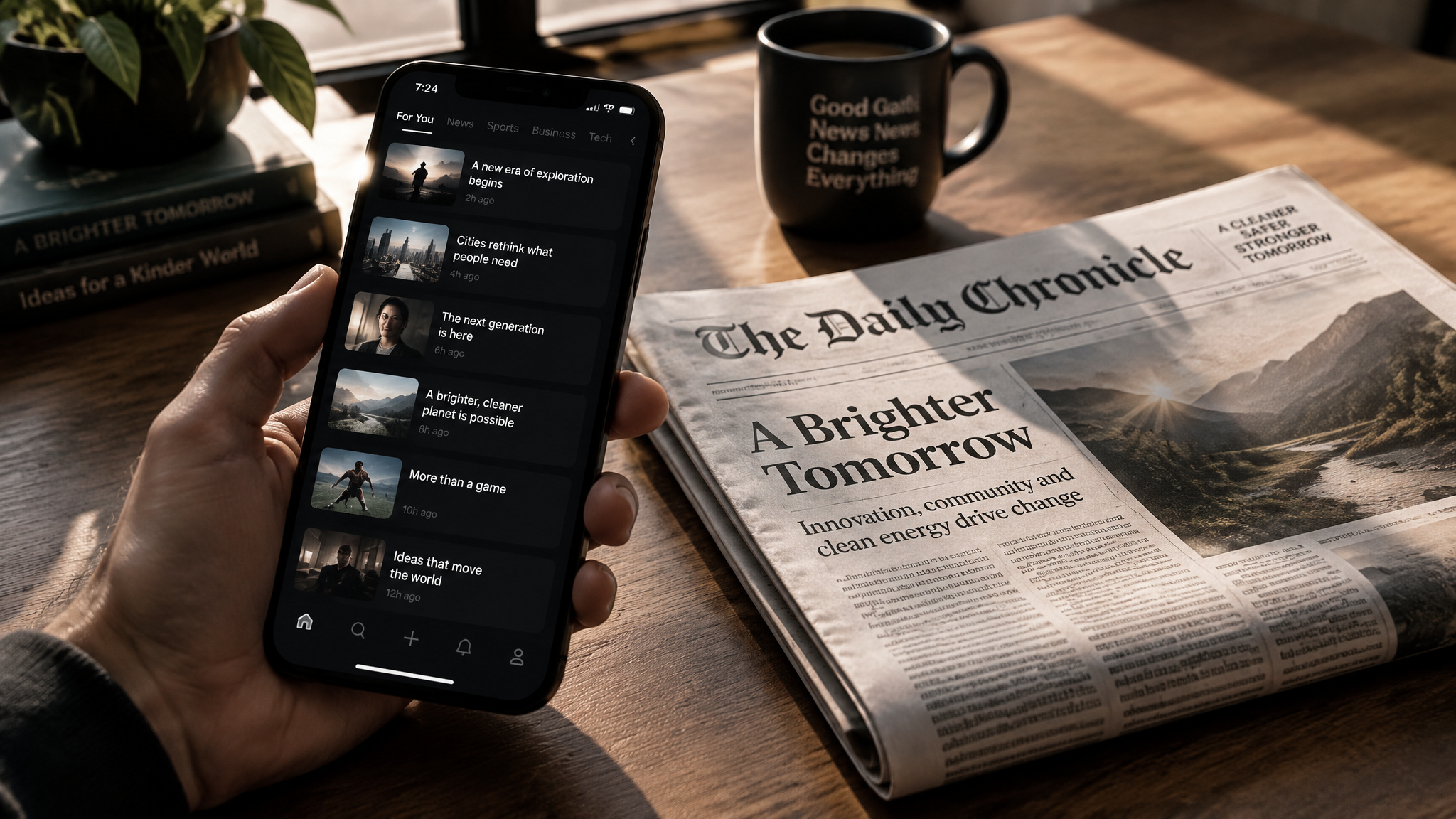
You open Instagram to reply to one message. Twenty minutes later you’ve watched three political TikToks, you’re half-way into an argument about the Constitution, and you couldn’t explain what the bill in the second video does. Daisy Alatorre-Cervantes laid out that pattern in the Daily Californian this past July. The bind most of us are in is simple: we want to know what’s happening in the world without handing our attention and mood to an algorithm that profits from both.
Sophocles got there a few thousand years early: Nothing vast enters the life of mortals without a curse. Having the world’s information in your pocket qualifies. It’s a replacement stack: five named apps with honest free-versus-paid tradeoffs, a real case for print, podcasts and newsletters, a weekly time budget, and a way to tell when a news habit has stopped being heavy and started being a problem.
According to Nuze, staying informed can mean going straight to the data behind the headlines rather than the feed. Here’s how to stay informed without social media.
Key Takeaways
Ground News shows what percentage of outlets covered a story and how the framing leans across the political spectrum, but the comparison and blind-spot tools sit behind the paid Pro/Premium tiers.
PressReader puts 7,000+ newspapers and magazines from 120+ countries behind a print-style interface; free to start, full catalog requires the paid Premium subscription.
Fifteen minutes of quality reporting beats an hour of scrolling; block 20 minutes a few times a week in your calendar and let a 3-to-5-minute morning podcast handle the rest.
Table of Contents
Why social media feeds fail as news sources
Social media feeds are poor news sources for structural reasons, not personal ones. The problem isn’t that you scroll carelessly. It’s that the platform is built in a way that makes careful scrolling irrelevant.
Start with the algorithm itself. It’s closed-source, which means nobody outside the company can predict what it’ll show you next. You’re trusting a black box with your worldview. Echo chambers form the same way, quietly: the feed keeps serving more of what you already agreed with, and nobody signs up for that on purpose. Add bad actors pushing misinformation and disinformation, with AI making the fake stuff cheaper to produce, and the supply side is a mess before you’ve read a word.
Then there’s the speed problem. Feeds reward virality over accuracy, and per the Daily Californian piece, the posts that travel fastest are the ones provoking strong reactions, not the ones carrying the most context. Being first beats being right, and that’s the incentive you’re up against.
Follow the money and the behavior makes sense. Online media companies monetize attention through display advertising, so they profit most when readers feel at their worst, and nobody in that business has any reason to help you spend less time on their site.
Nir Eyal explains the pull in Hooked: How to Build Habit-Forming Products. Fear, he writes, is an internal trigger: a negative emotion that nudges you into habitual use. Companies don’t create the discomfort; they build products that scratch it. Lonely?
Facebook. Uncertain? Google. Bored?
Check the score. Everyone does at least one.
Most people spend more time choosing a playlist than choosing their news sources, then hand their political news to an algorithm. Why should an algorithm pick that for you?
What to use instead of social media for news
You get news without social media by curating a direct media diet, dedicated apps, newsletters, podcasts, print, on a schedule you set instead of a feed that sets it for you. It’s the same audit you’d run before buying any tool, which is roughly how we approach things around Unfinished Man. The stack this article covers:
- Ground News, for seeing bias and blind spots in your coverage
- PressReader, for 7,000+ real newspapers and magazines
- Flipboard, the free, customizable aggregator
- Substack, for following independent writers directly
- Medium, for long-form depth
- Email newsletters paired with a read-later app like Pocket
- Print newspapers
- The World in Brief, a 3-to-5-minute morning podcast
- Regional YouTube news channels
Each tool replaces a specific job the feed did. The rest of the article takes them one at a time.
Ground News: see the bias and blind spots in your coverage
Ground News is a bias-comparison app that shows how different outlets cover the same story. That’s the whole pitch: instead of arguing about whether coverage is biased, you can look.
For any given story, Ground News shows what percentage of publications are covering it, how the framing leans across the political spectrum, and, most useful of all, where your blind spots are: the stories your usual outlets aren’t touching. Bias stops being a vibe and becomes something measurable. If a story got covered by ninety outlets all leaning the same direction, that’s information. If the story you care about got three papers total, that’s information too.
It comes as a standalone app and a browser extension, which means you can use it however you already read. Check a story you saw elsewhere, or browse inside the app.
The app is free, but the tools that actually matter sit behind the Pro or Premium tiers. The free version gives you a taste; the comparison and blind-spot features you’d build a habit around are paid. If this becomes your main news tool, you’ll probably end up paying.
How does it stack against Flipboard, the other low-cost option here? They solve different problems. Ground News diagnoses what you’re missing; Flipboard lets you curate what you see. If your problem is blind spots, stories you never encounter because your outlets don’t run them, Ground News is the fix. If your problem is an algorithm choosing for you, Flipboard is. I’d start with whichever problem is louder, because paying for the wrong tool is how these things end up unused.
PressReader: 7,000+ newspapers and magazines in print-style form
PressReader is for guys who miss actual newspapers and magazines but don’t want a driveway subscription. The number does the selling: over 7,000 publications from over 120 countries, papers and magazines both, in one app.

The differentiator is the interface. You get real print covers and magazine artwork, pages designed by humans to be read start to finish. It feels like reading rather than scrolling, and the bounded page is part of why. A magazine spread has an ending. Your feed doesn’t.
The cost picture for everything on this list, in one place: Flipboard and Substack are free. Ground News is free with Pro and Premium tiers gating the key tools. PressReader is free to start, with the full catalog behind the paid Premium subscription. Medium is free to download with free content and an optional membership.
Flipboard: curate your own magazine instead of taking the algorithm’s
Flipboard is the casual option, the one you’d hand a guy who wants something readable without committing to a routine. It’s a news aggregator you can shape: you follow specific publications and topics instead of letting an algorithm guess what you want.
You can also save articles into your own Flipboard Magazines, which is basically a reading pile that doesn’t live in forty open tabs. And there’s a human layer: alongside the follow and hashtag systems, Flipboard does its own editorial curation, so it’s not purely machine-sorted.
It’s free to download and use. That’s the whole cost story. The design point worth noting: it keeps social-style mechanics but puts the curation decisions in your hands. You’re still flipping through a magazine-like feed. You just picked what’s in it.
Substack: follow independent journalists directly
Substack and Medium both let you follow independent writers, and the split comes down to how you like to consume. Substack suits readers following specific named writers. Medium suits readers wanting broad long-form access under one membership.
On Substack, you pick the people and they deliver on a schedule. It’s not just newsletters anymore: the platform hosts blogs, short-form video, live streams, and podcasts, so don’t picture email-only. It’s popular with independent writers and journalists as well as high-profile public figures, which matters as a credibility signal more than a name-drop.
The platform itself is free, and individual writers choose what to paywall. A real news diet is buildable for zero dollars if you pick well. The power inversion is the point: chosen writers send you their work on their schedule instead of an algorithm deciding what interrupts you.
Medium: long-form news and built-in newsletters
Medium is the depth pick: one good 2,000-word piece over fifty hot takes. It’s long-form writing from independent authors and journalists, and the follow mechanic works the way you already know. Follow writers, see their new work as it lands, minus the doomscroll baggage.
It has built-in email newsletter support too, so the writing can come to your inbox instead of an app. Small detail, big practical difference.
Cost: free to download with free content. An optional paid membership unlocks unlimited access, or you can support individual writers directly. No upsell energy here; it’s a reasonable either/or.
The newsletter-plus-Pocket workflow: subscribe, save, read later
Nir Eyal, the Hooked author, runs a two-step newsletter system he’s documented on nirandfar.com, and it’s low-tech enough to survive contact with real life. Step one: subscribe to email newsletters from a hand-picked set of publications and writers. Step two: never read the linked articles online immediately. Save them to Pocket and read or listen later.
The delay is the mechanism. The save-for-later step adds just enough friction to convert compulsive clicking into deliberate, scheduled reading. You’re not quitting the internet; you’re deciding when it gets your attention. The schedule belongs to you, not the feed.
A substitution map: what to use for each job the feed did
Quitting social media fails when the jobs the feed did go unstaffed, so audit what it did for you and assign each job a specific tool. If you’ve wondered what to do instead of social media on your phone, this hobbies to replace social media map is the answer. One documented example: a creator who uses no Instagram, TikTok, or X at all runs his entire information life on the stack below. It’s a worked example, not a universal prescription.
Morning updates
The Economist’s The World in Brief podcast is a 3-to-5-minute update, made in London, so it’s already refreshed by the time he wakes up in New York. It replaces the morning feed scroll.
Local and regional news
He subscribes to local YouTube news channels for every region he cares about, Singapore and India among them, with TeeAeVee as one of the channels on that list. Follow the places, skip the feed.
Events and community discovery
Email newsletters replace Instagram for finding concerts and following specific communities and companies. Turns out you don’t need a feed to know what’s happening this weekend.
Low-effort connection
He shares his phone location with family and friends, so people can see where he is or call to meet up. Passive presence instead of performance.
Print newspapers: the bounded format no app matches
Print’s advantage over an app is structural, not nostalgic. Three things a paper does that no feed can.
Why print is more trustworthy
Newspapers employ editors and fact-checkers, work under ethical guidelines, and put stories through rounds of review before publication. When they get it wrong, they fix it fast, often with a public correction. That’s a process you can point to, versus an unreviewed post.
Why print feels finished
Editors curate only the top stories, so you don’t drown in incremental updates about the same thing. News writing uses the inverted pyramid: the most important information sits at the top and tapers into background, so you can stop whenever you’ve had enough. Turning the last page gives you a satisfying sense of being done for the day. Online news is never done, and every link pulls you two clicks deeper. Credit where due: the layouts, photos, and headlines are genuine craft.
A worked routine
Joe Zheng, writing in The Campanile, reads the print Wall Street Journal at home after school for about thirty minutes. His reported result: more informed, more empathetic, more engaged. A routine’s payoff, not a transformation.
A time-boxed news routine: how much time you actually need
Fifteen minutes of quality reporting teaches more than an hour of endless scrolling. The problem is never under-consumption; it’s unbounded consumption. Want to keep up with the news without getting overwhelmed? Put it on the schedule:
- A 3-to-5-minute morning podcast (The World in Brief)
- 20-minute catch-up blocks a few times a week, in Google Calendar like any other commitment
- An optional 30-minute print session
Read the article before the comments, compare two or three outlets on the same story, and favor actionable information; passive non-actionable news breeds helplessness. The common failure is installing a news app with notification defaults on.
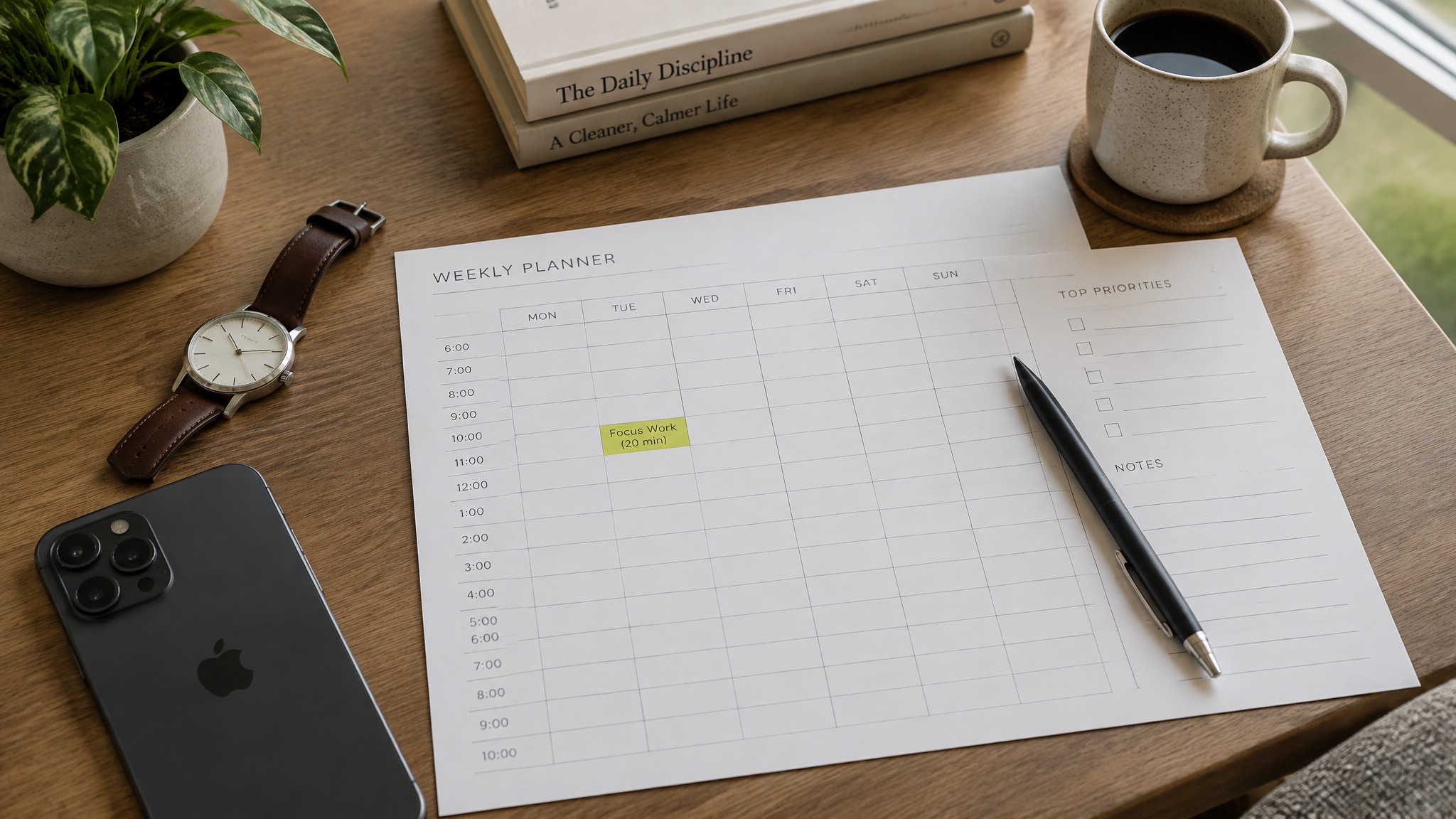
Quick test: If the app pings you, it owns the schedule. Turn notifications off before it earns a spot on your home screen.
Breaking the doomscroll loop: strategy, not willpower
Joel Jin, PhD, puts it plainly: phones are designed to be addictive, so limiting doomscrolling takes strategy, not willpower. The fix is reshaping your surroundings so the healthier option takes less effort than the harmful one. The Hooked author caught himself in an election pull-to-refresh cycle, uninstalled Facebook and Twitter from his iPhone, and now checks both once a day from a desktop. DistractOff blocks news sites, and Facebook Newsfeed Eradicator strips the feed while keeping access to pages of people you actually care about. Physical distance does quiet work too: charging the phone outside the bedroom, screen time limits, grayscale mode.
When the urge hits, a glass of water, a five-minute walk, or a book. One phone-free morning a week is a fine start.
Heavy use vs problematic use: how to tell if your news habit is a problem
Using the news a lot and using it problematically are two different situations. That distinction, from Joel Jin, PhD, in UW Medicine’s Right as Rain (published April 29, 2026, by McKenna Princing), dissolves the false detox-or-you’re-fine binary. The useful question is whether your phone habits are still paying off for you, or whether they’ve started working against you. Not all use is harmful, either: texting friends and guided meditation can help.
Worth noticing, not diagnosing:
- Reaching for the phone the moment you’re unoccupied
- Feeling restless without it
- Being less present with friends and family
- Online purchases straining your finances
- Failed attempts to cut back
- Poor sleep
- Unexplained anxiety, irritability, or low mood
Scrolling runs heaviest when you’re anxious, angry, or bored. The phone buys short-term relief while teaching the brain to sidestep discomfort, and the dodged feelings come back when you’re least ready for them. People already prone to anxiety and worry, with lower self-esteem or higher impulsivity, are more likely to fall into problematic patterns. And the source’s own boundary: if coping strategies fail and the nervousness persists, talk to a mental health specialist or your primary care doctor.
Intentional engagement, not abstinence, and what staying informed is for
Avoiding the news doesn’t make the issues disappear. Politics feeling messy is the reason to dig deeper, not to check out. The Hooked author’s gut-check works on any tool in this piece: “Is this technology serving me, or am I serving it?” Good news consumption gives you what you need plus a sense of done.
If it never feels done, that’s the tell. He isn’t advocating media asceticism; he still consumes news from trusted sources. And it’s not all-or-nothing: even brief exposure to credible content, podcasts, credible YouTube videos, even an informative Instagram post, counts as a step toward awareness, as long as you’re intentional and critical about sources.
The Campanile author has a friend, top of their class, who says “I hate politics” and went blank when asked about a recent controversial event. Not a punchline, just a reminder: being politically informed isn’t the same as constantly consuming. More input isn’t more understanding. Conversations, volunteering, and community meetings build understanding scrolling never will.
The Daily Californian‘s author saw it firsthand during her California State Senate internship: the 2026-27 state budget process, recently approved at her writing, was more detailed and collaborative than social media makes it look. Real government is slower and duller than the feed version, and better. That’s what staying informed is for. Not the feed. The part after it.
Frequently Asked Questions
What can I use instead of social media for news?
Go direct to the sources: bias-comparison apps like Ground News, aggregators you control like Flipboard, newsletters from hand-picked writers, long-form platforms like Medium, print papers, and regional YouTube news channels. Each replaces a specific job the feed did — discovery, depth, local coverage — so audit what you actually used social media for and staff each job deliberately.
How do I get news without social media?
Build a direct media diet on a schedule you set: a short morning podcast, 20-minute catch-up blocks a few times a week in your calendar, and an optional 30-minute print session. Subscribe to newsletters, save articles to a read-later app like Pocket, and turn off notifications so the app never owns the schedule. Fifteen minutes of quality reporting teaches more than an hour of scrolling.
Why is print more trustworthy than getting news from an app or feed?
The advantage is structural, not nostalgic. Newspapers employ editors and fact-checkers, work under ethical guidelines, and put stories through rounds of review before publication — and when they get something wrong, they fix it fast, often with a public correction. Compare that to an unreviewed post, and the process you can point to wins.