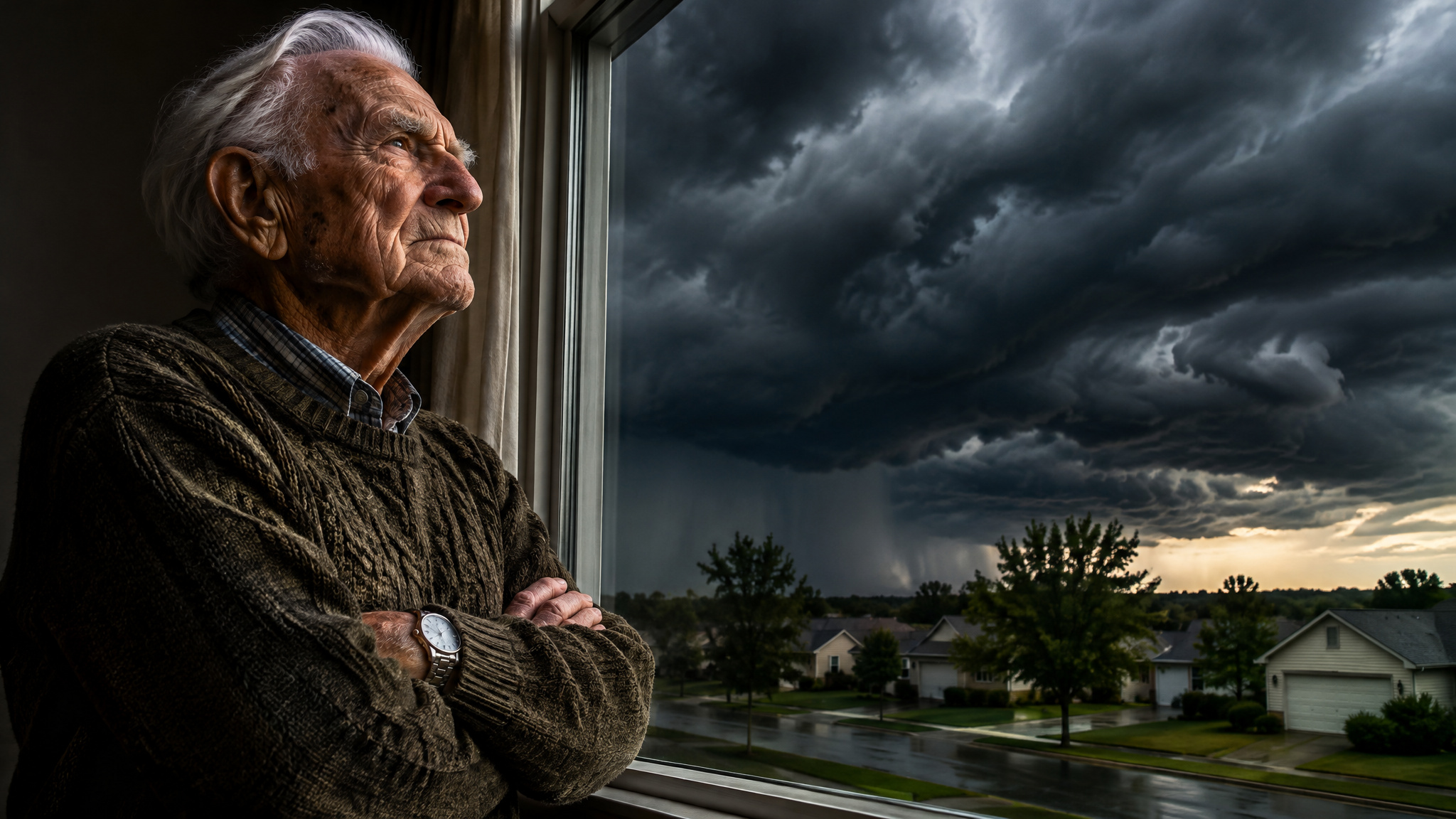
My father-in-law is in his 80s, and he’s ridden out storm flooding at his house more times than anyone in the family wants to count. Every time a bad forecast rolls in, he refuses to leave. So far, he’s survived.
If you have an aging parent living at home with a pill organizer, bad knees, and strong opinions about staying put, you already know how fast a routine weather warning turns into a family standoff. Generic preparedness checklists don’t help much when your parent won’t pack a bag or physically can’t get down the front steps in the dark.
Keeping an older parent safe in a crisis takes a real household operating system. You need a written plan with named roles, two distinct kits, a zero-dollar envelope taped to the fridge for 9-1-1 calls, and an eight-question test that settles whether staying home is defensible.
Key Takeaways
Three days of emergency food per person is the baseline in six of seven preparedness guides, though two of three posters who shared their own stockpiles keep over two weeks on hand.
An older adult in an evacuation zone, a mobile home, a high-rise dependent on elevators, or on electric medical gear like oxygen or CPAP must evacuate, while sheltering in place only holds up with a wind-worthy home, reliable nearby help, and seven days of supplies.
A free, labeled envelope on the refrigerator holding a current medication list, doctor contacts, diagnoses, and a copy of advance directives gives EMTs immediate answers on a 9-1-1 medical call without waiting on flustered family members.
Table of contents
Table of Contents
Why seniors face disasters differently
Older adults don’t just get a harder version of the same storm; they experience a different emergency where a 12-hour power outage can turn into a life-threatening medical event. According to a healthinaging.org tip sheet (last updated September 2019) backed by the National Council on Aging (NCOA) and United Way, older adults are among the most vulnerable people in any disaster because of mobility limits, chronic health conditions, hearing or vision loss, and having no one nearby to step in.
Dr. Melissa Zukowski, emergency department medical director at Banner University Medicine, noted in February 2024 that impaired mobility and chronic conditions change how older adults prepare for a crisis and react once it hits. She also noted that dulled senses and social or financial constraints complicate emergency communication. As she put it: “Plus, decreased sensory awareness and social or economic limitations can make communication more challenging.” When you can’t hear an alert, read a small-print text, or drive yourself out of town, evacuation takes longer and basic mistakes compound fast.
Being homebound without reliable support cuts off food and prescription refills right when pharmacies close, and poor air quality from wildfire smoke quickly worsens existing lung or heart conditions. In 2024 alone, 27 separate weather disasters costing at least $1 billion each hit the United States, including floods, hurricanes, wildfires, and winter storms.
Thinking “that can’t happen here” doesn’t hold up anymore. Wildfire smoke choking New York City, sleet shutting down San Antonio, the 2021 Champlain Towers collapse in Miami, and the 2021 Texas power outages all proved that natural and human-caused emergencies hit places that don’t expect them. The real toll includes injury, illness, displacement, and loss of life, which is why planning around your parent’s local hazards, heat waves, flood zones, power outages, or sudden health emergencies, changes the odds.
Step 1: Build the emergency plan with your parent
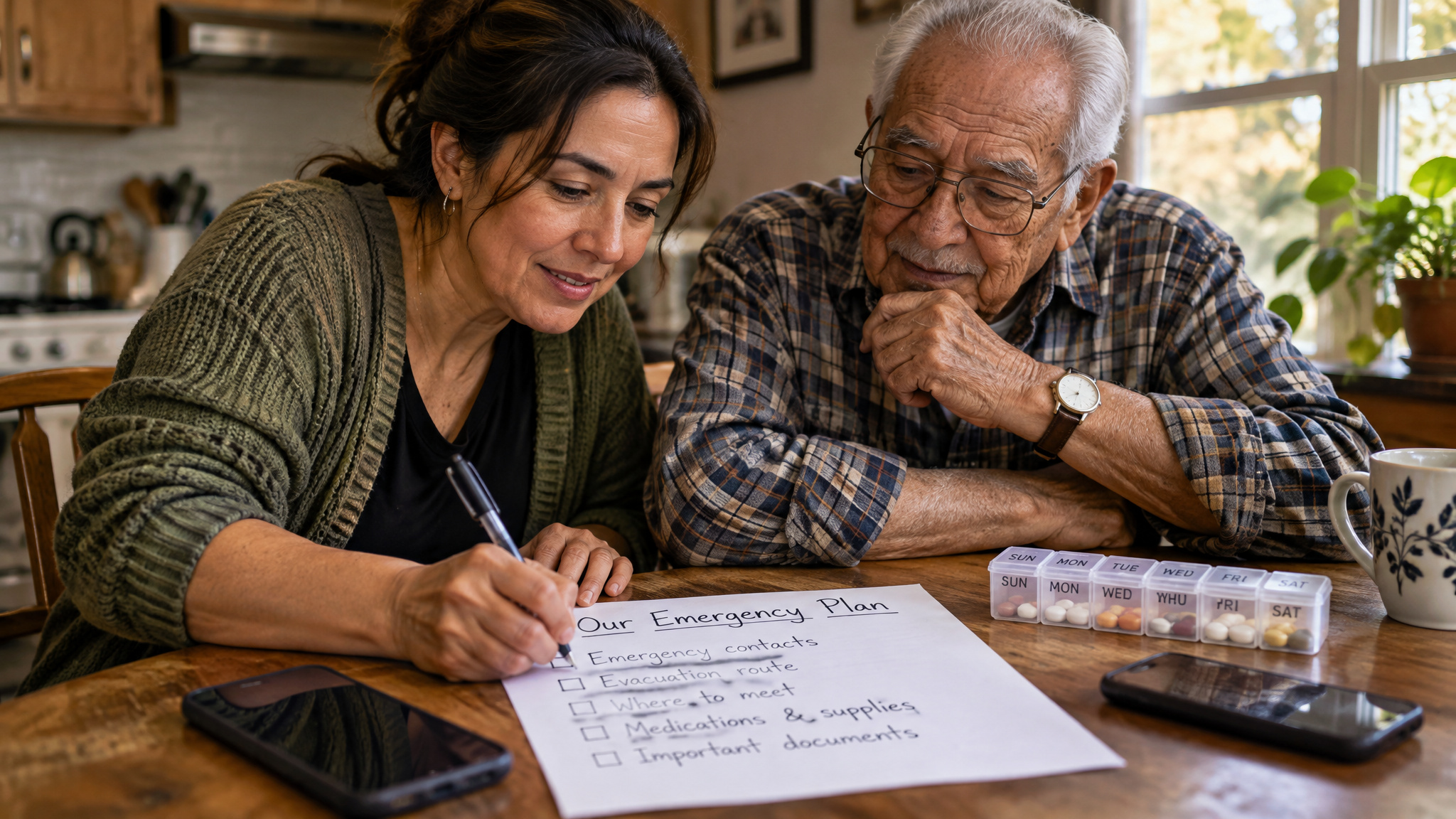
Helping an elderly parent prepare for an emergency at home comes down to three things: a plan with named roles, a stocked medical kit, and a quantified disaster supplies kit. Caregivers and adult children have to build this alongside the parent rather than handing over a pamphlet, because a plan only works when everyone knows their job before the lights go out. In practice, that means assigning specific people to specific tasks, such as naming one designated point of contact to coordinate updates and confirming exactly who picks up your parent if they can’t drive. A few pieces of the plan are non-negotiable:
- A family communication chain using a group text or phone tree with backup apps ready.
- Current contact lists with copies stored outside the house and one point person in charge.
- Confirmed evacuation transport, a backup driver, and two agreed-upon meeting spots.
- Local disaster plans, evacuation-route maps, and emergency medical locations gathered ahead of time.
- Wearable identification, such as an engraved medical ID bracelet or a traveler’s wallet.
- Two separate written plans, one for sheltering in place and one for evacuating, tested through real drills.
Set up the family communication chain
Set up a family emergency communication plan as a group text or a phone call chain where the first call triggers each person to call the next, so nobody gets missed in the confusion. Because cell networks clog up during storms, pick backup channels like WhatsApp, standard texting, or video calls and make sure every account is installed and working on your parent’s device ahead of time. Keep phones, tablets, and laptops charged and within arm’s reach; as Zukowski noted, having access to a working landline or mobile phone can be lifesaving.
Keep contacts current and name one point of contact
Make sure your parent has current numbers for family, nearby friends, neighbors, and health care providers, and keep a matching copy for yourself. Name one person as the single point of contact so relatives aren’t trading conflicting rumors, and keep extra paper copies of the list in a travel wallet, purse, or suitcase.
Arrange evacuation transport and two meeting places
Decide whether your parent can still drive safely or needs a pickup, assign a primary driver, and write down a backup driver’s phone number before the forecast turns ugly. If your parent lives in a senior facility, ask the director to designate staff to stay with very elderly residents during an evacuation and find out exactly where residents will be taken. If your family is handling the evacuation yourself, pick a meeting spot near the house and a second one outside the neighborhood, then share both addresses and phone numbers with everyone on the call chain.
Get local emergency information in advance
Pull your parent’s community disaster plan now while websites are up and phones are answered. Find out where evacuees go for medical care or emergency prescription refills, and put a paper map of local evacuation routes in the glovebox in case GPS drops out.
Medical ID bracelet or wearable traveler’s wallet
If your parent is out of the house or separated from family, responders need their medical basics immediately. Engrave a medical ID bracelet or pendant with chronic conditions, allergies, daily medications, and emergency contacts; for very elderly or disabled adults, put their ID, diagnoses, and medication list inside a wearable traveler’s wallet kept on their body.
Write two plans and practice them
Put two separate plans on paper because staying and leaving require different moves. Build the shelter-in-place plan for events like COVID-19 or days when outside air is unsafe to breathe. It should map out where supplies are stored, how your parent signals they’re safe, who they call if food or meds run low, and what to do when the power cuts out. The evacuation plan, built for hurricanes or a dangerous winter-storm power failure, spells out how to get out, when to leave, where to go, and who helps.
Use NCOA’s checklist to pressure-test both plans: make sure you have enough food and safe water, two weeks of prescriptions, a packed go-bag, clear exits, gas in the tank or a confirmed ride, a destination, a backup way to reach family, and a pet plan. Then run a mock-disaster drill with family, friends, or caregivers so everyone catches the awkward snags before stress turns them into real mistakes.
Evacuation planning for seniors with mobility limits
Seniors with mobility issues evacuate safely by clearing home hazards, checking accessible exit and shelter routes ahead of time, and arranging transportation before an order is issued. As Zukowski pointed out, mobility limits and lacking a personal car stretch out evacuation times, meaning an older parent can’t wait for the last-minute rush. A wheelchair or walker user who hits an unpassable doorway or a blocked sidewalk loses precious hours when roads are already gridlocked. Preparing the house and the route in advance keeps a slow exit from turning into a trapped one.
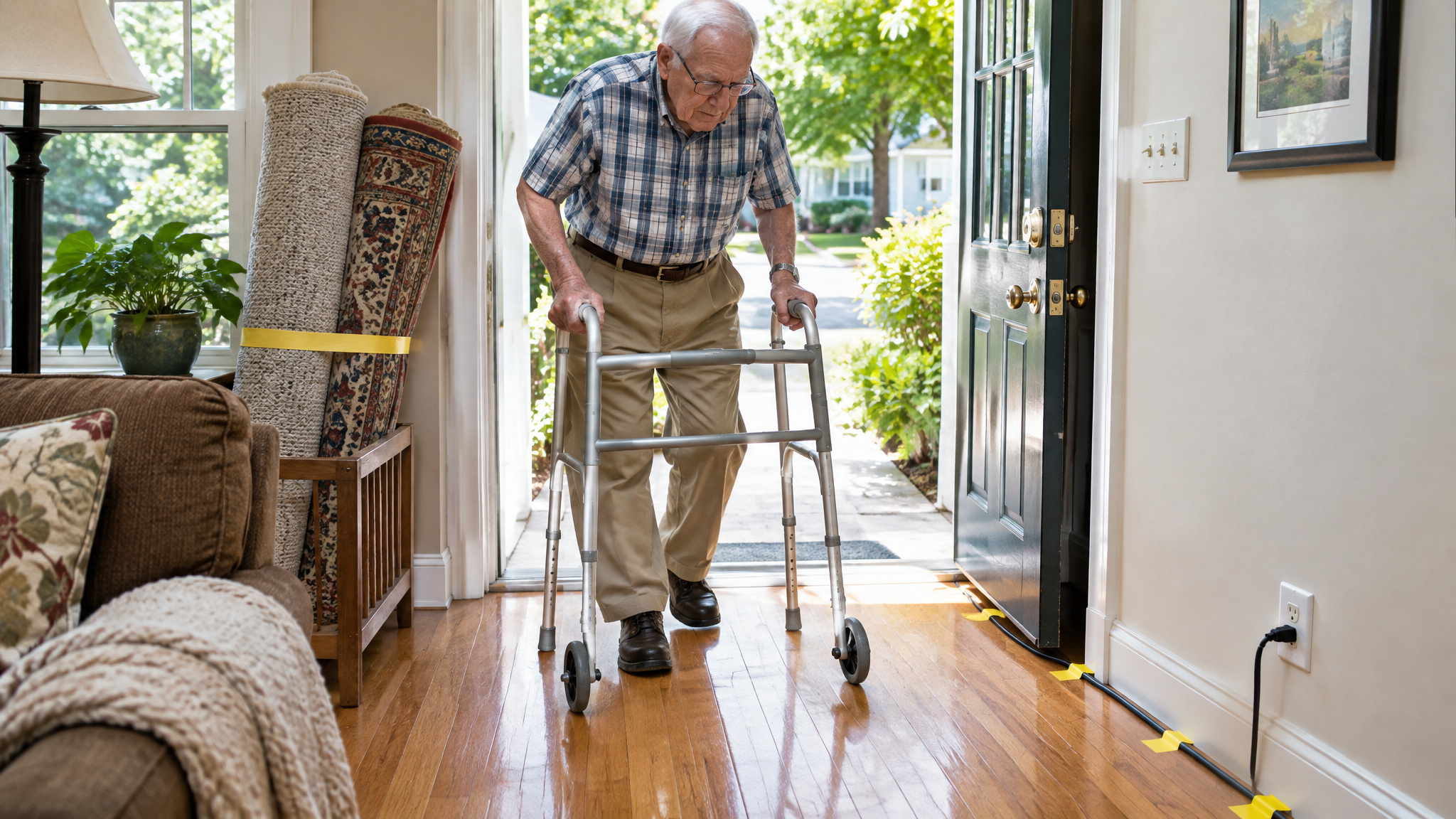
Start inside the house by pulling up loose area rugs and taping down or rerouting electric cords across living areas. Check every exit in the home, not just the front door your parent uses every day, to make sure a walker or wheelchair can clear the threshold, and ask their doctor about assistive devices or backup mobility gear suited for emergencies. Outside the house, verify that routes to nearby shelters accommodate wheelchairs or limited mobility, share those routes with neighbors, caregivers, and family, and lock in a backup ride for any scenario where driving is off the table and public transit has shut down.
Stock the emergency medical kit
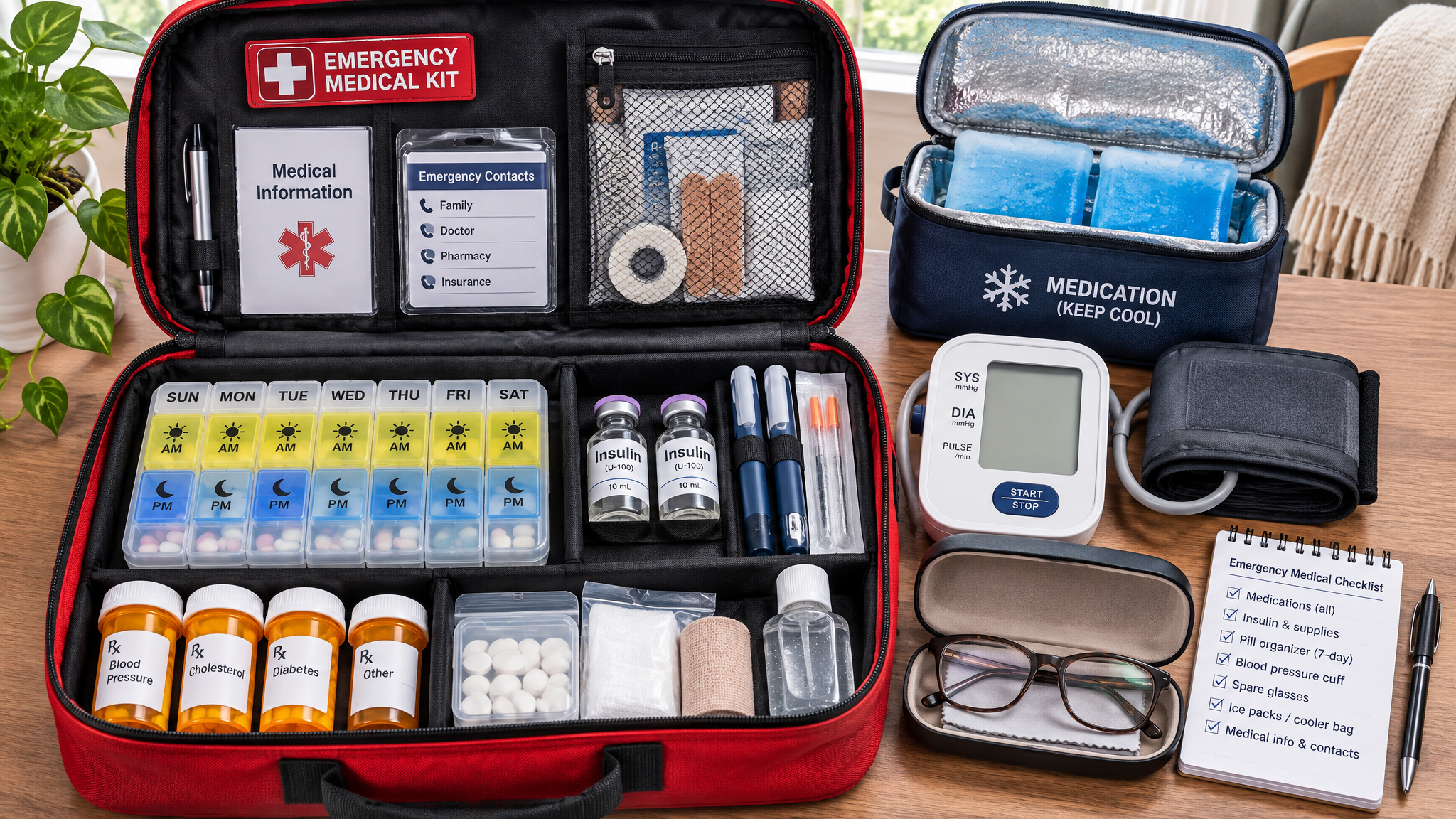
An emergency medical kit for an older adult holds a 3-6 day medication supply, a written medication list, an insulated bag for refrigerated drugs, medical equipment, and insurance copies. Unlike younger adults who can wing it for a few days if a pharmacy closes, an older parent with chronic conditions faces immediate fallout from missed doses, dead hearing aids, or lost eyewear. A standard grocery run won’t replace a specific blood pressure pill or a spare set of dentures, so these items have to be packed and ready in their own dedicated kit:
- A 3-6 day baseline supply of daily medications, paired with a written list showing brand names, generic names, doses, and schedules.
- An insulated bag big enough to hold a two-week supply of refrigerated medications like insulin, with ice packs kept in the freezer.
- Essential medical equipment, including a blood sugar monitor, a blood pressure cuff, hearing aids with extra batteries, and spare eyeglasses or dentures.
- Copies of medical records, active problem lists, current treatments, and Medicare, Medicaid, or private insurance cards.
How many days of medication should you stockpile
Four of seven preparedness sources we reviewed recommend keeping seven days of prescription medications on hand, two recommend two weeks, and one sets the minimum at three days. Among those sources, healthinaging.org uses 3 to 6 days as the kit baseline (while calling for two weeks on refrigerated meds), Banner Health and First Contact point to seven days, and NCOA’s self-assessment targets two weeks. Because insurance refill limits and specific prescriptions vary, confirm the exact buffer you can legally and safely build with your parent’s doctor or pharmacist.
You already know how this goes wrong in real life: a storm watch gets issued on a Wednesday, the weekly pill organizer is half empty, and the next refill isn’t eligible until Friday. Keep a current medication list with both brand and generic names, exact doses, and times where caregivers and responders can grab it, fill the pill organizer on a set schedule, store remaining bottles in one grab-ready box, and refill prescriptions as early as the pharmacy allows.
Refrigerated medications: the insulin problem
Power loss starts the clock on refrigerated drugs like insulin long before a pantry runs empty. Keep an insulated bag sized to hold a two-week supply of refrigerated medications right alongside the medical kit, and leave dedicated ice packs in the freezer so you aren’t hunting for a cooler while trying to get out the door.
Equipment, records, and insurance copies
Pack the everyday gear your parent can’t function without: blood sugar test strips and syringes, a blood pressure cuff, hearing aids with fresh batteries, and spare glasses or dentures. Slip paper copies of active medical records, problem lists, treatment plans, and Medicare, Medicaid, or private insurance cards into a waterproof folder inside the kit.
Build the disaster supplies kit
An emergency preparedness checklist for seniors at home covers six categories: essential documents, medical supplies, communication essentials, comfort items, safety tools, and nutrition and hydration. Keeping a separate disaster supplies kit alongside the medical kit matters because hardware-store basics and pantry staples don’t cover medical hardware like dentures, test strips, or hearing-aid batteries, and you don’t want to dig through canned soup to find an insurance card. Every item in the core kit is easy to quantify and pack in a single afternoon:
- Water and non-perishable food: at least 1 gallon of water per person per day for three days, plus three days of canned and dried foods like soups, juices, and high-protein shakes.
- Cash and essential documents: at least $50 in cash (more if you can spare it), current contact numbers, and copies of credit cards, a driver’s license or passport, and medical and insurance records.
- Tools and communication gear: a flashlight, a non-electric can opener, a radio powered by batteries or a hand crank, extra batteries, waterproof matches, a knife, resealable plastic bags, tin foil, disposable plates and utensils, basic cooking gear, an emergency whistle, a cell phone with chargers, a battery bank or solar charger, and paper local and regional maps for detours.
- Clothing, bedding, and hygiene: one full change of clothes (long-sleeved shirt, long pants, sturdy shoes, and weather-appropriate outerwear) and a blanket per person, along with hygiene basics, soap, toothbrushes and toothpaste, hand sanitizer, sunscreen, toilet paper, baby wipes, and trash bags.
- First aid: a Red Cross comprehensive packing list or a pre-packaged first aid kit stocked with bandages, antiseptic wipes, and pain relievers.
Food is the one place where official checklists and real-world habits part ways. Six of the seven guides we checked set the minimum at three days of food per person (with one advising one to two weeks), whereas two of the three posters who reported their own emergency stashes keep more than two weeks of food on hand and one keeps three to seven days.
As one poster who tailors their stash for snowstorms and utility outages put it, they keep canned goods for several days, while the other two stock freeze-dried backpacking meals or multi-month reserves. Published minimums are built to get you through the first 72 hours of a crisis, while people who’ve sat through long outages build deeper buffers around their local risks.
Treat three days as your floor, especially for water at 1 gallon per person per day, and scale the food upward if your parent lives in an area prone to multi-day power or road closures. High-protein shakes, canned soups, and juices work especially well for older adults with smaller appetites or dental issues. Once the bin is packed, put a reminder on your calendar to rotate expired food, water, batteries, and medications and update contact sheets.
The refrigerator envelope that speeds up a 9-1-1 call
Most families prep for hurricanes and blackouts while ignoring the emergency that actually sends paramedics to a senior’s house: a bad fall or a sudden medical scare. A registered nurse supervisor with New York City home-nursing experience, speaking in a video from The Safety Influencer, recommends a zero-dollar fix that speeds up the chaotic first minutes of a 9-1-1 call.

Grab a plain envelope, write “emergency info for” followed by your parent’s full name on the front, and stick it on the refrigerator, a spot EMTs commonly check first when they walk into a home. That single envelope saves paramedics from burning critical minutes asking a panicked spouse or adult child to recall drug dosages from memory. Inside, include:
- Full name, date of birth, and age.
- All emergency contacts with working phone numbers.
- Power of attorney or health care proxy details.
- Primary care physician’s name and number, plus optional specialists like a cardiologist or urologist.
- Current diagnoses, such as hypertension, diabetes, or anemia.
- A complete list of current medications with exact names, doses, and times, updated every time a prescription changes.
- A copy, never the original, of advance directives or a living will, including DNR or full code status.
Should your parent evacuate or shelter in place?
A parent in an evacuation zone, a mobile home, a vulnerable high-rise, or dependent on electric medical devices must evacuate; sheltering in place is defensible only with a wind-worthy home, reliable nearby support, and 7 days of supplies. First Contact’s hurricane guidance cuts through family arguments by turning “I’ll probably be fine” into a binary safety test. A sturdy single-family house outside a flood zone with seven days of water and a neighbor checking in is a different bet than a third-floor condo where losing elevator power traps a parent in a stairwell for months.
The eight questions that decide it
Before a storm forms, look up your parent’s actual flood and evacuation zone. FEMA flood zone maps cover the entire United States, FLOODSMART.GOV handles flood insurance details, and local county portals, like the Pinellas Flood & Evacuation Zone and Hernando Evacuation Zone lookup tools in Florida, show zone boundaries down to the street. Once you know the zone, run through First Contact’s eight questions:
- Is the home in an evacuation or flood zone? (Must evacuate when ordered.)
- Is your parent’s residence a manufactured home, RV, or mobile home? (Must evacuate; these structures aren’t safe in hurricane winds.)
- Do they live in a high-rise or condo where a power outage shuts down elevators or water? (Must evacuate; stairwells may be impassable for an older adult, condo buildings can go six months or more without working elevators after a major storm, and independent living facilities often don’t provide emergency assistance.)
- Do they depend on powered medical equipment such as oxygen, a CPAP machine, or feeding tubes? (Must evacuate to a special needs shelter or a host who can support their equipment.)
- Do they have limited mobility and need help leaving? (Must evacuate early with pre-arranged transport.)
- Can the home withstand hurricane-force winds?
- Does your parent have reliable nearby support?
- Do they have at least 7 days of food, water, and medications to survive without power or outside help?
The rule is simple: answering YES to any of questions 1 through 5, or NO to any of questions 6 through 8, means evacuation is mandatory. If you’re on the fence, leaving is always the safer call.
The parent who won’t leave
My father-in-law has ridden out storm flooding at home in his 80s multiple times and still refuses to leave. If you’re dealing with a parent like that, you already know how fast repeated warnings turn into white noise.
When a parent digs in their heels, the productive move is shifting energy toward making sure their home meets the criteria to shelter safely: hardening what you can, lining up nearby support, and staging a full seven-day supply of food, water, and medications. At the same time, walking through those eight questions together gives you concrete lines in the sand, like an evacuation zone order or an elevator outage, where staying put becomes a losing bet.
Oxygen, CPAP, and power outages: special needs shelters
Seniors who depend on oxygen, CPAP, or feeding tubes must treat a power outage as an evacuation trigger: register in advance for a special needs shelter or line up a host who can support their equipment. Power failures aren’t just an inconvenience for frail adults; losing electricity turns refrigerated medications, home oxygen, or dialysis schedules into an immediate life-threatening emergency. Public shelters aren’t walk-in hotels with medical staff waiting at the door, which is why registration has to happen weeks before a storm hits the forecast.
When power loss is life-threatening
If your parent needs refrigerated medication, oxygen, or dialysis, losing power can be life-threatening. Under First Contact’s evacuation criteria, anyone relying on electric medical devices like oxygen concentrators, CPAP machines, or feeding tubes must leave before the storm and go either to a registered special needs shelter or to a host with reliable backup power. Wheelchair and walker users also need to get out early so a downed tree or a traffic jam doesn’t trap them at the last minute.
Register before the storm, and know the shelter hierarchy
A special needs shelter is safer than staying home in a blackout when your parent relies on powered medical gear, but it sits at the bottom of the preferred shelter hierarchy. First Contact advises staying with family or friends first and treating public shelters as a last resort, because shelter capacity is limited and exact openings depend on where and when the disaster hits.
If family or friends aren’t an option, register your parent with their county’s special needs shelter program ahead of time, using local programs like Pinellas Special Needs Shelters or Hernando Special Needs Shelters as a model for what your county offers. Once you’re registered, keep a close eye on local evacuation alerts so you know the moment those doors open.
Staying informed: alerts, apps, and backup channels
Free, reliable emergency preparedness guides and printable PDFs for older adults are available through the American Red Cross “Emergency Preparedness for Older Adults” page, ready.gov’s older-adult plan, and local hubs like First Contact. Those guides give you downloadable Essential Supplies for Sheltering in Place, Family Checklist, and Pet Checklist PDFs, alongside home-hardening tips from FLASH (Federal Alliance for Safe Homes) and My Safe Florida Home (561-640-6734). If you’re in Florida, First Contact also maintains regional emergency management numbers for Pinellas (727-464-3800) and Hernando (352-754-4083).
An alert, including a personal medical alert, only works if it reaches a charged device in the hands of someone who can hear or read it. Sign your parent up for local public safety push alerts by text, phone call, and email, and call your local non-emergency police line to find out which community systems they use, such as Alert Pinellas, Alert Hernando, or National Weather Radio. Keep a battery-powered radio in the kit as a backup when cell towers drop.
You can also put the FEMA app on your phone and your parent’s phone through Google Play or the Apple App Store, or by texting ANDROID or APPLE to 43362 (4FEMA). To figure out what’s likely to hit your parent’s ZIP code, run FEMA’s local search tool for past declared disasters, response resources, and recovery centers, and check the Red Cross searchable regional map, which flags baseline threats including floods, heat waves, power outages, thunderstorms, winter storms, and CBRNEs (chemical, biological, radiological, and nuclear emergencies). National Preparedness Month falls every September, though setting up these alerts works any month of the year.
During and after the emergency: act, document, recover
The NCOA breaks emergency response down into simple stages so an older adult doesn’t have to improvise under pressure. Once the warning becomes an active event, the goal shifts from planning to calm execution, followed by smart documentation and claiming the recovery benefits your parent is owed.
When the emergency arrives
If your parent is living alone during a disaster, the job is to stay calm, monitor local news and alert notifications, pick the right written plan (shelter in place or evacuate), and execute it exactly the way you practiced. Having both routines rehearsed ahead of time keeps panic from leading to a last-second drive down a flooded street.
Document damage and dodge the scams
Before your parent locks the door to evacuate, take quick photos of the house and its contents for a clear before-and-after damage record, and save every receipt for hotels, supplies, and repairs for FEMA claims.
After a storm, scammers move in fast with fake relief charities and fly-by-night repair crews that take a deposit and disappear. Never pay a charity or contractor without checking them on Charity Navigator and the Better Business Bureau first, and walk away immediately if anyone asks for payment by gift card or wire transfer, because legitimate organizations never do. Report suspected scams to the Federal Trade Commission (FTC) at 1-877-FTC-HELP (877-382-4357) or online.
Claim the benefits and relief programs
Disrupted utilities and closed clinics leave older adults facing acute gaps in food, medical care, and prescriptions. Lean on local emergency management and aging experts to connect your parent with housing and relocation help, home repair grants (like Pinellas County Hurricane Home Repair or My Safe Florida Home), medical equipment replacement, and legal help such as the Florida Disaster Legal Aid Helpline.
You can also run your parent’s details through the National Council on Aging’s (NCOA) free BenefitsCheckUp Disaster Assistance page, which screens for emergency nutrition aid, tax relief, shelter, energy assistance, and disaster loans. One 68-year-old who used the tool uncovered more than $7,000 in benefits, and it’s worth running even if a neighborhood wasn’t directly hit, since it surfaces everyday aging-well programs too. Pair that online check with local experts who can screen and connect your parent to recovery programs for home repair, food, health care, and prescription medications.
Community support and the Venango House model
You don’t have to carry all of this alone. Before an emergency hits, connect your parent with local senior centers, centers on aging, health departments, the American Red Cross, community centers, nonprofits, neighborhood watch groups, and faith-based organizations. Many run wellness checks, coordinate evacuation rides, hold drills, and share local shelter and route updates.
At Venango House, a 106-apartment senior community in North Philadelphia that evacuated without injury during a 2024 fire, senior community coordinator Arnita DeShields (who joined in April 2026 and whose late grandmother once lived there) teamed up with United Way of Greater Philadelphia and Southern New Jersey to run a Verizon-supported United We Prepare workshop involving the Philadelphia Fire Department. The session walked residents through fire safety, evacuation planning, accessible documents, and alarm response, and handed out kits with flashlights, fire blankets, and masks.
Residents immediately asked for extra kits to give neighbors who had missed the session. DeShields noted that prepared residents “They can respond a little more calmly instead of panicking,” advised other communities to put workshops on the calendar and make them happen, and reframed asking for help: “We encourage them to understand that it’s okay to ask for help and receive it. It’s a form of self-care.”
Preparing a parent with dementia for a disaster
Preparing an elderly parent with dementia for a disaster puts the whole job on the caregiver, because standard evacuation plans fall apart when your parent can’t remember a meeting spot or explain their needs to a stranger. A chaotic shelter or an unfamiliar detour can trigger severe confusion, which means managing your own stress and lining up backup help for yourself are part of the emergency plan.
Download the Alzheimer’s Association Disaster Preparedness for Dementia Caregivers PDF along with their caregiver stress-management tips, and watch or share the First Contact Disaster Preparedness for Seniors video to see how those adjustments work in practice. Print out companion cards that explain your parent’s dementia-related behaviors, triggers, and medical needs so shelter staff and first responders can understand what’s happening without forcing your parent to explain it. Finally, take DeShields’ self-care advice seriously and accept community, family, or special needs shelter support early, before caregiver burnout turns a manageable evacuation into a crisis.
Frequently Asked Questions
How do I help my elderly parents prepare for an emergency at home?
Build the plan alongside your parent rather than handing them a checklist and hoping for the best. Assign specific roles to family members—including one point of contact and a primary plus backup driver—set up a group text or phone tree with backup apps, and pack two separate kits for medical gear and disaster supplies. Write down separate routines for sheltering in place and evacuating, then run a practice drill so everyone catches snags before a real crisis hits.
What should be on an emergency preparedness checklist for seniors at home?
Pack six core categories: essential documents, medical supplies, communication tools, comfort items, safety gear, and food and water. Start with at least 1 gallon of water per person per day and three days of non-perishable foods like canned soups and high-protein shakes, plus $50 or more in cash, a flashlight, a battery- or hand-crank radio, extra batteries, a Red Cross first aid kit, spare clothes, and hygiene basics. Keep this bin separate from your parent’s medical kit so nobody has to dig through canned goods to find insurance cards or hearing-aid batteries.
Should my elderly parent evacuate or shelter in place during a hurricane?
Run through an eight-question safety test before the storm arrives to take guesswork out of the decision. Evacuation is mandatory if your parent lives in an evacuation or flood zone, resides in a mobile or manufactured home or RV, lives in a high-rise where losing power shuts down elevators or water, has limited mobility, or relies on powered medical gear like oxygen, a CPAP machine, or feeding tubes. Staying home only holds up if the house can withstand hurricane-force winds, reliable help lives nearby, and your parent has at least seven days of food, water, and medications.
What should you do during a disaster if you are a senior living alone?
Stay calm, monitor local alerts and news, pick the right written plan—shelter in place or evacuate—and follow the exact steps you practiced ahead of time so panic doesn’t push you onto a flooded road. Keep charged phones and backup communication apps within arm’s reach, and use your family phone tree or designated point of contact to report that you’re safe or running low on supplies. If you haven’t already, lean on local senior centers, neighborhood watch groups, or faith-based organizations that run wellness checks during emergencies.
How can seniors with mobility issues or wheelchairs evacuate safely from home?
Leave early before traffic gridlocks, because mobility limits and waiting on rides stretch out evacuation times. Clear indoor tripping hazards by pulling up loose area rugs and taping down cords, and test every exit—not just the front door—to confirm a walker or wheelchair fits through the threshold. Outside, verify that routes to nearby shelters accommodate wheelchairs, share those routes with caregivers and neighbors, and lock in both a primary and backup driver in case public transit shuts down.