
Every guy past thirty knows the character. He speaks every language you name, he’s caught marlin, he once changed a country’s foreign policy over lunch. Dos Equis built the Most Interesting Man in the World across years of commercials, and half the room can finish the tagline without looking up from the beer.
He’s fictional, though, and he was built on purpose, from parts you can name.That matters if you’ve done the disciplined work, the gym, the career, the routines, and still quietly suspect you’re the bland guy at the party. You’ve been told to be confident and be yourself a hundred times, and it has never once helped, because it isn’t instructions.
This is. The character fascinates because of accumulated stories and experiences, not status, and that’s the working definition underneath everything below: interestingness is assembled, which means it can be assembled by you.
Key Takeaways
The Dos Equis “Most Interesting Man” was deliberately assembled from real parts: Hemingway’s appetite for adventure, Olympic-level capability, and the charm of Fernando Lamas, a personal friend of actor Jonathan Goldsmith. Interestingness has components, which means it can be built.
Harvard neuroscientists found almost half of everyday speech is self-disclosure, and people gave up actual money for the chance to talk about themselves, which makes a genuine listener a scarce resource rather than a polite one.
Becoming interesting takes years of compounded habits, and chasing it directly turns conversation into performance; chase what you actually want and interesting is the side effect.
Table of Contents
Interesting is made, not born
The most famous interesting man in the world was written, not born. Dos Equis didn’t find him; an ad agency built him from parts, and the parts are the point. Being interesting is a learnable skill, not a genetic accident, and the character is standing proof: the agency deliberately amalgamated Hemingway’s appetite for adventure, Olympic-athlete capability, and the charm of Fernando Lamas, who happened to be a personal friend of Jonathan Goldsmith, the actor who played the role.Nobody at that agency was searching for a man born fascinating. They were assembling one from components they could name.
That’s also the answer to what actually makes a person more interesting. Not genetics, not charisma, not an extrovert’s wiring.Accumulated experience, which means it can be built. The character’s appeal was never status or wisdom. It’s decades of gathered life, which is exactly why the role went to an older man. You can’t fake thirty years of stories with a good haircut and a firm handshake.
Which makes interesting a choice and a skill, and it isn’t an extrovert monopoly.Listening and observing, the classic introvert moves, are precisely what produce fascination in a person. And the payoff compounds: live an interesting life and you get better stories, broader topics, more genuine passions, more actual enthusiasm. The traits feed each other.
To become the most interesting man (or woman) alive, one writer at johnmashni.com proposes a nine-part formula: dig deep in one pursuit, see both sides of issues, choose joy, read heavily, channel obsession, embrace your quirks, never settle, spend time alone reflecting, and spend time serving others, with passion and enthusiasm as the final trait. Each trait is anchored by a famous quotation rather than a lab study, so treat it as one guy’s list, not gospel. But every trait on it is testable in your own life, and living them out is how interesting gets compounded: better stories, broader topics, more genuine passions, more actual enthusiasm.
Dig deep: pick one spot and keep digging
Depth beats variety, and an old parable says it better than any productivity book. A son set out to prove his father wrong and dug a dozen shallow holes across a field, looking for water his father knew was everywhere. He found nothing, because he never stayed in one spot long enough to reach it. Pick one spot and dig deep.
Joseph Campbell’s version was to follow your bliss, and he meant it as instruction about meaning, not a poster. Find the thing that pulls you and go deep on it. Most guys never really chase their dreams, and that’s exactly why the ones who do stand out so hard.
You know the type who doesn’t. A little guitar, a little cooking, a little crypto, none of it past thirty seconds of conversation. Try listing your own interests and asking which single one you’ve actually gone deep on. If the answer is none, that’s the work.
See both sides without losing your opinion
Interesting people form real opinions slowly, after hearing multiple sides. That’s the difference between a considered take and a repeated one. F. Scott Fitzgerald called this a first-rate intelligence:
“the ability to hold two opposed ideas in mind at the same time and still retain the ability to function.”
Boring people see only the facts they want to see.
The writer behind that nine-part list had an attorney mentor who put the lawyer’s version bluntly: the best lawyers embrace facts as they are, not as they want them to appear. Good advice well outside the courtroom too.
There’s a practical side benefit. Interesting people keep relationships going even with people they flat-out disagree with, not because they’re saints but because you learn more that way and you don’t burn bridges.Worth testing yourself on: when you look at a contested question, are you seeing the facts or the version you’d prefer?
Choose joy, even after loss
Joy is the one trait you can bring to any situation. New job, new city, bad luck, none of it changes that. The guy who seems genuinely glad to be wherever he is stands out in every room, and it has nothing to do with pretending everything’s fine.This isn’t toxic positivity. It’s the man who shows up anyway.
Joseph Campbell talked about participating joyfully in the sorrows of the world, and the useful part of that is the showing up, not the sermon. Sit with the counterintuitive bit too: the people who’ve lost the most often seem to carry the most joy.Nobody has a clean explanation for that, and it doesn’t need one. It just keeps being true.
Read a lot: why scanning isn’t reading
Reading is the cheapest upgrade there is. No gear, no membership, no program.And the gap matters: most people scan the internet and social media instead of actually reading anything. We all do it. That’s the dry observation, not a lecture.
Teddy Roosevelt read nearly a book a day.Plenty of normal people with jobs manage a book a week, and nobody’s saying match Teddy. Ryan Holiday has argued that reading is one of the most transformative things a person can do, and that holds up. There’s an old Indian proverb that explains why: whatever you are full of tends to fall out of you when you get bumped. What you consume becomes what you’ve got.
The payoff is practical. Constant new input gives you visible energy and actual stuff to talk about, which is most of what conversation runs on.
Channel obsession into a mission
Obsession is a curse until you point it at something. Peter Drucker figured out that real accomplishment tends to come from a monomaniac with a mission, and the line survives because it keeps being true.The honest trade-off: obsession can wreck you, or it can harness energy most people never tap. Same trait, different aim.
Notice the pattern underneath this whole list, because it keeps repeating. The traits that sound like liabilities, obsession, contrariness, weirdness, turn into assets the moment you direct them at something.The guy who can’t stop thinking about one thing is insufferable at a party and unstoppable when that thing becomes a mission.
So the move isn’t suppressing your current obsession. It’s aiming it at a problem that deserves it.
Embrace your quirks by doing something with them
Quirks are only interesting once you do something with them.Owning a weird trait isn’t the point; building on it is. Screenwriter David Freeman put it in a way that sticks:
“The goal of life is to take everything that made you weird as a kid and get people to pay you money for it when you’re older.”

There’s no such thing as normal, and that’s the whole speech.
This is the mechanism the commodity advice never states.“Be yourself” sounds nice and does nothing because it stops at ownership. The version that works takes the thing you apologized for in middle school and turns it into something you build. Think of one childhood quirk, then one concrete action that turns it into an opportunity. It’s smaller than it sounds.
Don’t settle: greatness requires saying no to good
You can always trade greatness for good, and greatness requires saying no to good repeatedly. Every yes to a decent option is a no to a better one somewhere else. George Bernard Shaw framed it as the unreasonable man, the guy who won’t adapt to circumstances, the one all progress depends on. Reasonable people settle.That’s what reasonable means.
This isn’t ambition theater. What you’re saying no to matters, and some of those good things are actually good. Pick one “good” you’re currently settling for, something comfortable and fine, and decline it once to see what happens.Most of the time, nothing bad does.
Spend time alone in real reflection
Spend real time alone. Not monk mode, just the quiet where you actually figure out what you think. Peter Drucker’s point was that effective action should be followed by quiet reflection, and better action follows.Do the thing, then think about it. Most guys skip the second half entirely.
Draw the line clearly, because it matters. Wallowing goes in circles.Self-examination ends in a decision. If three months of working on yourself hasn’t produced a single changed behavior, that’s the first kind.
Interesting guys watch first, then move fast when they do move. Observation isn’t hesitation if it ends in action.Most people never ruthlessly examine their own lives, which is why the ones who do tend to know exactly what they want when the moment arrives.
Spend time with others by serving them
The alone time only pays off if you bring it back to the room, which is why this one exists as the counterweight to the last. Booker T. Washington kept it plain:
“Those who are happiest are those who do the most for others.”
The blunt version, from a guy who’s noticed the pattern: serving other people is how you end up happy. Not a sermon.Just what happens.
Interesting people treat each person and interaction like it matters, and the concrete version is small. Actually remembering what the guy at the shop told you last week. Asking about his daughter’s soccer season because he mentioned it.That’s the whole move, and it costs nothing.
Passion: enthusiasm is the first step to competency
Enthusiasm comes first, competence comes after. You get good at things you actually care about, which is why the order matters and can’t be reversed. Ralph Waldo Emerson said nothing great was ever achieved without enthusiasm, and the line is short because it needs to be.
Keep the definition simple. Intensity is just passion that sticks around for years instead of weeks. That’s the difference between a phase and a trait, and people can tell which one they’re looking at within about a minute of conversation. Worth checking honestly: does your enthusiasm for anything survive past the first month?If it does, that thing is telling you something.
Courage comes before everything
Nothing on this list happens without courage first, which makes it the gating trait. Not movie moments. Small daily versions: saying the thing that might get laughed at, taking on the big problem nobody wants to touch, standing your ground against a small mind.Nothing starts until somebody acts, so courage shows up everywhere, in small stuff, daily.
Napoleon had an image for it: when a brave man stands, the spines around him stiffen. One guy’s nerve changes a room. You’ve seen it happen.
And interesting guys aren’t rattled by other people’s opinions, big problems, or small minds. It’s more of a shrug. The stakes are lower than they feel, and the guy who knows that moves first.
Say less, listen more
Talking too much is one of the fastest ways to be boring, which is a hard thing to notice about yourself from the inside. Robert Greene’s version, minus the power games: the less you say, the more weight it carries.The actual skill is listening hard, asking real questions, and lifting the other person up instead of topping their story. Be the guy who talks last and lands the point. The mechanics of how are next.
Be interested, not interesting: the listening thesis
Being interested beats trying to be interesting, and that inversion is the core of the whole project.How to be an interesting conversationalist starts there: make the other person feel interesting. The evidence for this is unusually stacked. Jonathan Goldsmith, the actor who actually played the Most Interesting Man, has said his secret is that to be interesting you have to be interested.

Jordan Harbinger built his social-skills advice around the same principle.Dale Carnegie wrote it in 1936. Three sources, three eras, one mechanism, landing independently. That’s rare weight for social advice, where most claims can’t survive a week.
The why comes from Harvard neuroscientists who studied self-disclosure.Almost half of everyday speech is devoted to talking about how we think and feel. Talking about ourselves feels about as rewarding as food or money. In one study, people gave up actual money for the chance to talk about themselves.
A genuine listener is offering a scarce resource.That’s why listening more than talking makes you interesting.
Carnegie’s version had math in it: you’ll make more friends in two months by being interested in other people than in two years trying to get them interested in you. The ratio alone sells it.
And Bill Clinton, whatever else you think of him, owns rooms by giving complete attention to whoever he’s with.Attention is the mechanism. Not charisma magic.
One honest adaptation: the sources here are general-audience, but the question quality and listening principles transfer directly to close relationships. A partner who gets real follow-up questions instead of half-attention notices the difference immediately.The three skills below are how it works in practice.
Active listening: what it looks like and what kills it
Active listening is a skill you can practice, not a personality trait you lack. The working version: verbal and non-verbal cues that show engagement. Nod, respond, ask follow-up questions that pull out details a distracted listener would miss.That’s what makes people feel heard.
The failure modes are documented and most guys do at least one: rehearsing your response while they’re still talking, silently judging, interrupting, finishing their sentences, checking your phone. The phone one kills the whole effect on its own.
You’ve seen the composite version in every group setting.The conversation dies the moment the other person finishes speaking, because the “listener” was rehearsing, not receiving. Nobody asks a follow-up, so the topic flatlines and everyone drifts toward their drink.
Talk in terms of the other person’s interests
Everyone talks about themselves. Being the one guy genuinely curious about the other person puts you in rare company, and it works precisely because almost nobody does it.Ask about what they care about, their work, their obsessions, the weekend plans that actually matter to them. This habit opens doors and builds connections you can’t plan for.
Not transactional ones. The kind where someone remembers you a year later and calls you first.
Letting people talk about themselves makes them remember you
The self-disclosure science runs deeper than the speech stat.Those Harvard researchers found talking about ourselves activates the same reward circuitry as food and money, and in that study people forfeited real cash for the chance to do it. When you let someone talk about their favorite subject, themselves, you’re giving them something their brain treats as payment. The memory effect follows: people remember the person who let them talk.
Fondly, and for a while.It’s free, and it works.
Conversation mechanics: exact questions that work
The exact scripts are sourced and testable, so nothing beyond them needs inventing. The core swap: replace “What do you do?” with “Why did you choose your job?” or “What are you most excited about right now?” Same information, better conversation.Then a follow-up chain that keeps it alive: “Why is that important to you?”, “What’s the hardest thing about that?”, “What’s the best thing about that?”, “How can I help?”
“What’s the hardest thing about that?”, “What’s the best thing about that?”, “How can I help?”Ask about passions and you’ll see eyes light up, and that’s also where common ground lives.
One scope note: the sources cover in-person conversation, so for texting only the general principles transfer. Don’t expect these to read naturally over iMessage.
Come prepared with conversation topics
A few ideas in your back pocket keep conversations from dying at the dead-end question.It’s prep, not scripting, like packing a bag. Safe openers: where they live, work, family, hobbies. Boring questions, useful answers. Everyone is an expert on themselves, so the boring question is the one they can actually run with.
Ask open-ended questions
Yes-or-no questions kill momentum. Open-ended ones hand the mic over, and most people love taking it. This is the single easiest upgrade to any conversation you’re in. And if you’re actually curious about the answer, listening gets easy.Fake curiosity doesn’t survive contact.
Better question swaps and the follow-up chain
The full set, deployed verbatim: “Why did you choose your job?” instead of “What do you do?” “What are you most excited about right now?” when you want energy instead of biography. Then the chain: “Why is that important to you?”“What’s the hardest thing about that?”
“What’s the best thing about that?” “How can I help?” Four follow-ups, one conversation, no memorization required.
How to be the most interesting person in the room
Becoming a more interesting person to talk to runs on one mechanism: attention, aimed at other people instead of at yourself. Every technique below works that lever. The proof is the guy at any gathering who says the least and gets remembered the most, because he spent the night handing out attention instead of collecting it. The seven techniques: read the room before you speak, use your body (expressions, tone, posture, and gestures often matter more than words), stay current with news and general knowledge, offer sincere and specific appreciation instead of flattery, tell good stories you’ve tested in advance, talk in terms of the other person’s interests, and let curiosity about others do the heavy lifting. Each gets its own signal below.
Give sincere appreciation, not flattery
People can tell the difference instantly, and the gap is huge and obvious. Specific praise beats “good job”: naming exactly what worked does something, the generic version does nothing. The Carnegie material includes a story about a manager named Chris Caughell, and what his specific, sincere praise did for the person receiving it. Human-sized stuff.One honest compliment with a detail attached outperforms a month of pleasant noise.
Be generous and follow through
Time, advice, attention. Give them freely and it usually comes back. Not a guarantee, a pattern worth betting on.Concrete moves: lend the book, pass along the job tip, share someone’s project with your circle.
All free, all remembered. And do what you said you’d do. It’s unglamorous, which is exactly why it stands out.
Be inclusive
Spot the guy fading into the corner and pull him in. Costs nothing, and he remembers it. The easy technique: introduce him by repeating something he just said, which hands him an instant foothold in the conversation. The whole group notices, not just the guy you helped.
Make others feel important
Humility is genuinely more likable than flexing. Admitting you don’t know something makes people like you more, not less, and most guys are scared of it, which makes it a free win. Skip the lecturing, the one-upping, the knowledge flexing. Everyone recognizes those instantly, including in themselves.
Flip it: ask for advice and opinions. People like being asked, and you might learn something.
Tell good stories
A learnable skill, not a born gift. Prepare a few and test one on a friend before deploying it on a group.The best ones involve human behavior, drama, humor. Skip nasty gossip; it works short-term and costs you long-term.
Keep them short and end them before they die. When eyes wander or questions stop, wrap it.Knowing when to stop is the actual skill.
Do the unexpected
Small deviations from the script, not stunts. Share something embarrassing. Back someone up when nobody else will.Hold a contrary opinion, as long as you’ve actually informed yourself and can argue it without hostility. People gravitate toward the guy who goes deeper instead of recycling small talk.
Read the room and use your body
Listen before speaking. Speaking second is a feature, not a weakness, and the guys with real influence do it on purpose.Read the signals: fast speech can mean passion, crossed arms and dodged eye contact mean discomfort. Stay current on whatever the room’s on about, news, sports, music, and if you can’t contribute yet, shut up and absorb.
Face, tone, posture, gestures often carry more than the words. The honest way to check your own: ask your friends how you actually come across.
Why disciplined men end up boring
The uncomfortable one, and it includes the guy writing it: discipline can make you boring. The argument, and it’s an argument rather than a study, is that variety of experience, not further optimization, is the missing input. It’s the same lesson as the parable of the son who dug a field full of shallow holes and never hit the water his father knew was there, more holes isn’t the answer. Monk mode, dopamine detoxes, disappearing from society entirely. These produce the gym cell whose whole life is the gym and the finance bro whose career is his entire personality, the optimization critique taken to its logical end.
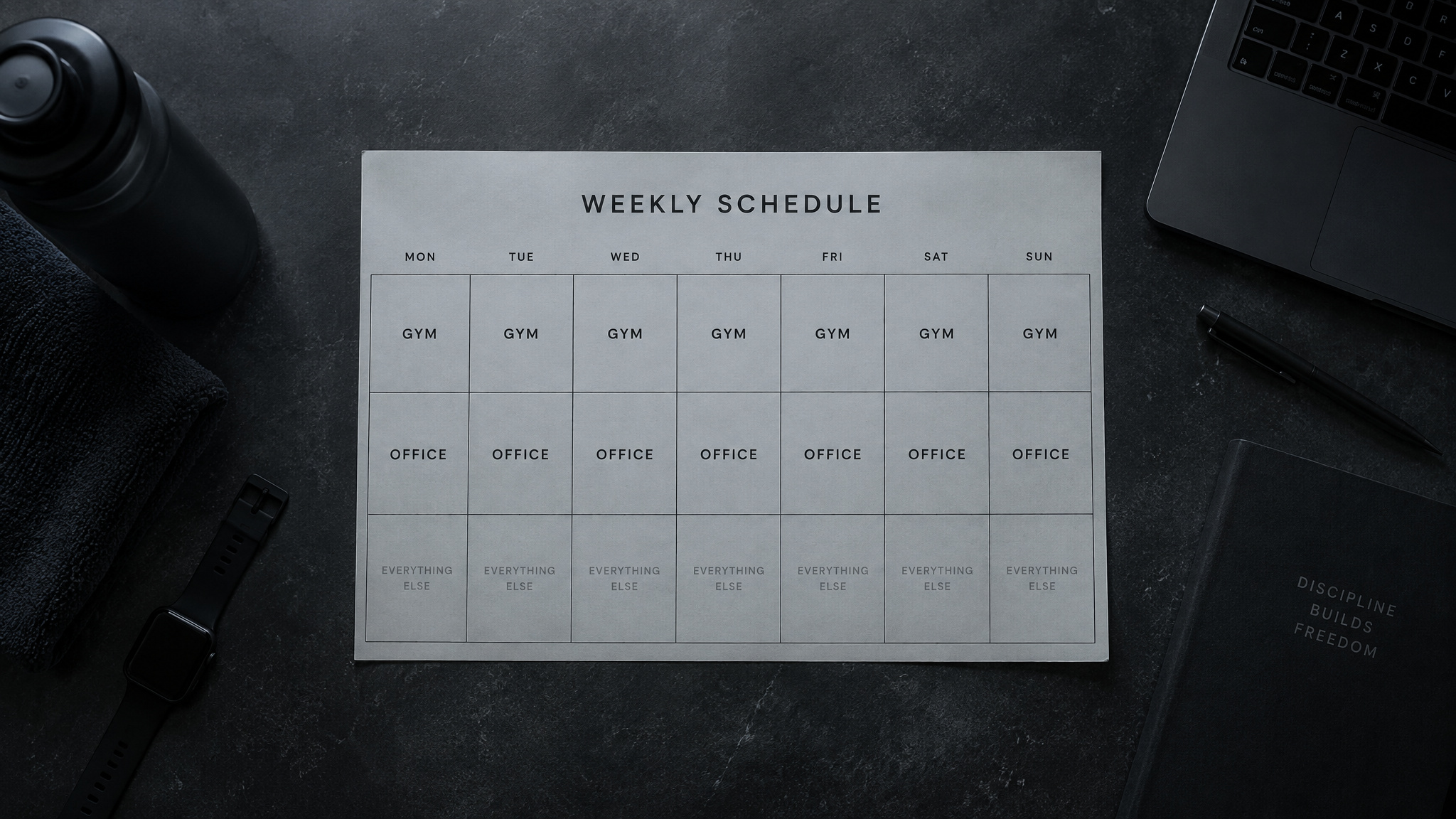
Discipline produced competence. It didn’t produce interestingness. The tell is the optimized guy whose stories all happen in the same three settings, gym, office, apartment, with the same emotional range.
On the dating side, the support here is thinner and the source’s own example comes from the female side, so take it lightly: what lands is evidence of a life.Hobbies, stories, somewhere he’s been. The traits in this article do that work better than any dating-specific tactic would.
Experiences become stories; routines don’t
The debonair man in the nightclub is interesting for what he has done, not who he is right now. That’s the mechanism.The source’s dating contrast, with the edge filed off: a woman who plays guitar and once spontaneously hit the Great Smoky Mountains beats someone with no hobbies who hasn’t left her state in three years. Routines matter, but experiences turn into stories you tell for decades.
That’s the actual return on a skydive or a weekend trip. Squeeze the most out of life instead of riding as a passenger.
Be interested in life: participate, don’t watch
Goldsmith’s secret extends past conversation. Watch life from the couch, or get in and drive your own. Only one of them produces the stories. That’s the fork, stated without scolding, because plenty of guys choose the couch and plenty choose the road, and you can tell within five minutes which is which.
Tim Ferriss as the modern archetype
Tim Ferriss gets cited as the living version of the type: first American with a Guinness World Record in tango, Chinese kickboxing champion, five languages, once sought political asylum. Worth noting those claims are self-reported and unverified, and the caveat is part of the story rather than a flaw in it. The archetype survives the fact-check.
Three habits that build an experience-rich life
What to actually do comes down to three habits that compound into an experience-rich life: start a new hobby, do something out of the ordinary once a month, and swap some self-improvement books for biographies.None of them require money you don’t have or a personality transplant. All three produce the raw material, experiences and stories, that everything earlier in this article runs on.

Start a new hobby
The best immediate move on this entire page: pick something, an instrument, a language, a martial art, and start. Any of the three works.The starting is the point, and it beats another month of researching which one is optimal.
Do something out of the ordinary once a month
Block the time monthly and treat it like an appointment, not a someday idea. The examples scale to budget: a skydive, supercar laps on a track, a quick trip somewhere new. The video creator behind this framework modeled it himself with a first trip to a shooting range, planned for June.That’s the honest scale of the habit. Modest, scheduled, repeated.
Study biographies instead of only self-improvement books
Swap some frameworks for real lives: da Vinci, Mozart, Churchill. While reading, ask how you’d borrow from their lives.Not copying, adapting. It complements the reading habit from earlier, and real lives beat frameworks almost every time.
Depth vs. breadth: you need both
Depth is what you dig; breadth is where you surface. They’re not rivals.The failure modes sit on opposite ends: the shallow-holes man with a dozen thirty-second interests, and the optimized specialist with nothing to talk about outside his domain. This is this article’s own practical synthesis of the two arguments, not a resolved academic debate. You need both, and they feed each other.
Who is the Most Interesting Man in the World?
The Most Interesting Man in the World is a fictional Dos Equis advertising character whose appeal comes from accumulated life experience, not status. The campaign became one of the most successful of the 21st century, skyrocketed Dos Equis sales, and turned into a meme that outlived the ads. Every spot closed with “stay thirsty, my friends,” and the exploits were deliberately absurd: he once caught a marlin, he has changed foreign policy, and “he is the life of parties that he has never even attended.” Fans have been writing their own legend lines, “he parallel-parked a train” energy, for years, and the contest just formalized it.
That contest, the Most Interesting Comment in the World, ran May 11 through July 31, 2026, per the announcement dated May 11, 2026 (White Plains, N.Y., via PR Newswire). Fans submitted legend lines as comments on the official @DosEquis Instagram post across Instagram, Facebook, Threads, X, and TikTok. Three monthly winners got their lines in a TV commercial during college football season, with other prizes including a Phil Rosenthal-curated culinary experience, a Fuerza Regida backstage pass on the This is Our Dream Tour, and a luxury-car arrival at a game. Fine print, compressed: legal residents of the 50 states and D.C., 21+, no purchase necessary, sponsored by Cervezas Mexicanas.
The beer itself dates to 1897, when Wilhelm Haase brewed Siglo XX to mark the turn of the century in 1900; the red XX’s became the nickname. As of that announcement the portfolio had more than doubled in two years, adding Michelada, Ambar, and Lager Lime & Salt to the core Lager, imported by HEINEKEN USA. Alison Payne of HEINEKEN USA made the real point: the most interesting stories are the ones we create together. The culture now co-authors the archetype, which is this article’s thesis wearing a beer logo. Interestingness is narrative, not status.
Time: the final ingredient
Becoming interesting takes years of compounded daily practice, and no honest number can be promised. Dr. Eric Thomas framed it as what you are to be, you are becoming. Today’s habits are the trajectory. One good week doesn’t do it.
Neither does one good year, honestly. The caterpillar doesn’t skip the cocoon, and that’s the last time this article uses that metaphor. The point of it is that the caterpillar-to-butterfly transformation isn’t instantaneous; it happens inside the cocoon, over time. Small things compounded over years add up to something nobody can argue with.
Then the paradox, which is the real close.Stop trying to be interesting. Direct pursuit converts conversation into performance, and everyone can smell it. Chase what you actually want instead: the dreams, the passions, the thing your intuition keeps pointing at. Interesting is the side effect.
It circles back to the opening. The archetype needed an older actor because the role required decades of gathered experiences, and so do you. The only real signal that it’s working: when people start seeking out your company and sharing your ideas, that’s the compounded behavior becoming undeniable. Until then, dig.
Frequently Asked Questions
What makes a person more interesting?
Accumulated experience, not genetics or charisma. The Dos Equis ‘Most Interesting Man’ was deliberately assembled from nameable parts — Hemingway’s appetite for adventure, Olympic-level capability, and Fernando Lamas’s charm — which proves interestingness has components. Because it’s assembled from decades of gathered life, it can be built by you.
How do I know if I’m an interesting person?
The clearest signal is when people start seeking out your company and sharing your ideas — that’s compounded interesting behavior becoming undeniable. A harsher self-test: list your interests and ask which single one you’ve actually gone deep on. If your stories all happen in the same three settings with the same emotional range, that’s the tell you have work to do.