Let’s start with the numbers that should wake you up.
Nearly 4 million people work as home health aides as of 2024. The field is forecast to grow by 17% between 2024 and 2034 — that’s real demand. The Bureau of Labor Statistics is basically telling you there’s no shortage of openings.
The catch? Median pay sits at $34,900. Of the 20 most prevalent jobs in the country, only two pay six figures. Home health aide isn’t one of them.
So here’s the tension you’re dealing with: plenty of jobs, low pay, and a flood of other applicants who also wiped butts and took vitals. Rodriguez took her meds. If your resume reads like everyone else’s, you’re a commodity. You get commodity results.
The lever that changes your position — that moves you from $34,900 toward an RN salary of $93,600 or an NP role pulling $110,000 in long-term care, is how you describe what you actually did. Not the job title. The job description.
Your resume job description is the difference between staying an aide and becoming a nurse, between another year of 24-hour shifts and a role that pays what you’re worth.
Key Takeaways
Home health aide roles are growing 17% by 2034, but median pay is $34,900 — a specific resume is your only lever to move up
Replacing vague duties with quantified context (client load, shift length, outcomes) is the single highest-impact change you can make to your bullet points
Almost 98% of Fortune 500 companies use applicant tracking systems, so matching job description keywords without stuffing is how you get past the software filter
Table of Contents
What to Include in Your Home Health Care Job Description
Here’s the template. You can adapt this directly, swapping in your actual numbers and client types.

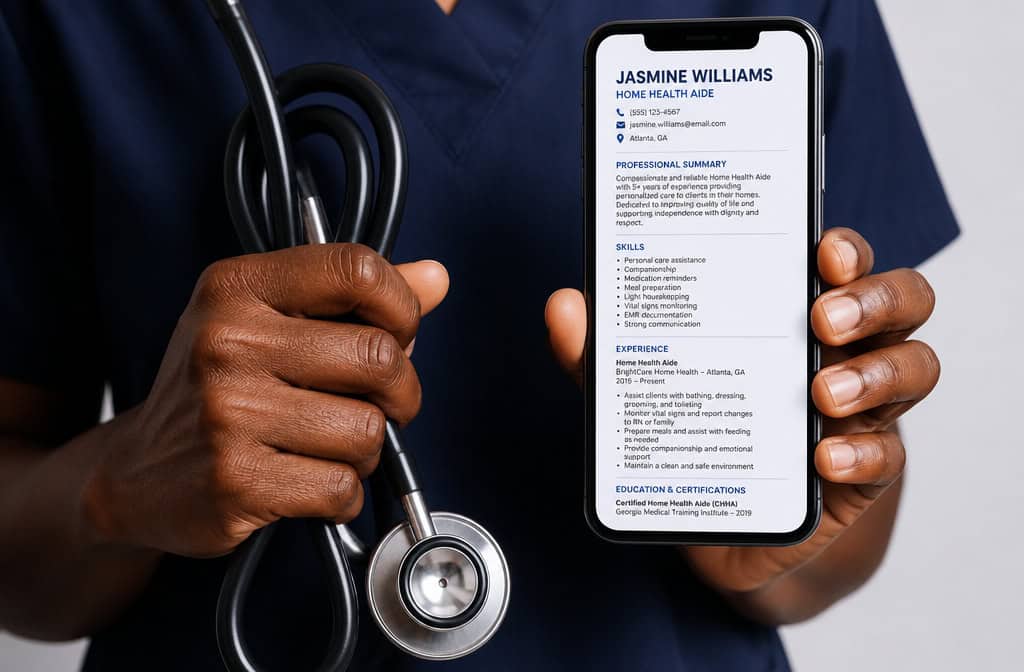
Personal care tasks — bathing, dressing, grooming, toileting, feeding. Don’t just say “assisted with daily living.” Say which clients and how many: Assisted 3 dementia clients with morning care routines across 10-hour shifts.
Volunteer family caregiving — if you provided unpaid care for a family member, frame it as professional experience. Use the same quantified format: Provided daily personal care (bathing, feeding, mobility) for a parent with Alzheimer’s over 2 years, managing medications and monitoring vitals. Example bullet: Administered daily medications and monitored blood pressure for a family member with dementia, ensuring 100% adherence to physician orders over 18 months. This shows hiring managers you have hands-on skills, even if unpaid.
Medication reminders — not just “reminded patients to take meds.” Try: Administered and tracked daily medications for 5 post-surgery clients per shift, ensuring 100% adherence to physician schedules.
Vital signs monitoring — the baseline clinical skill every employer wants to see. Monitored blood pressure, heart rate, and oxygen levels for 8 elderly clients per shift, flagging abnormal readings within 15 minutes.
Light housekeeping and meal preparation — Prepared modified diets for 4 diabetic clients, coordinated meal prep to maintain blood sugar targets.
Client-specific care — this is where you separate yourself. Dementia patients need behavior management. End-of-life clients need comfort measures. Post-surgery patients need mobility support and wound checks.
Name the type: “Cared for 3 hospice clients with 6-month life expectancy, coordinating pain management and family communication.” Prepared, monitored, and maintained 10 dialysis machines for patients in nursing homes and hospice facilities.
The before/after test
Before: “Helped clients with daily activities.”
After: Guided 4 Alzheimer’s patients through morning ADLs (bathing, grooming, dressing) across 12-hour live-in shifts, reducing agitation incidents by 30% over 6 months.
See the difference? The second version tells a hiring manager exactly what you handled, how many, and what happened as a result.
Bottom line: One quantified bullet is worth a dozen vague duties — pick a number per line.
How to Quantify Your Impact to Stand Out to Employers
Numbers grab attention. That’s not a marketing cliché — it’s how human brains process information. When a recruiter scans your resume in six seconds, a bullet with a number stops the eye.
The principle is simple: pick one number per bullet. For example, you might write: Prepared, monitored, and maintained 10 dialysis machines.
Count what you can count:
- Clients per shift
- Hours per shift or week
- Frequency of a specific task
- Incidents prevented or outcomes improved
- Patients you trained or oriented
- Recognitions or awards
Before/after pairs that work
Before: “Monitored patient vitals.”
After: Monitored vitals for 5 post-surgery clients per 12-hour shift, tracking trends and escalating 3 abnormal readings to supervising RN.
Before: “Provided personal care.”
After: Assisted 6 bed-bound clients with bathing and toileting per shift, maintaining dignity and preventing skin breakdown over 8 months.
Before: “Helped with medications.”
After: Administered and documented medications for 8 clients daily, achieving zero medication errors in 2 years.
Quick checklist for revising your own bullet points
- Can I name the number of clients? (3, 5, 8, 12)
- Can I name the shift length? (10-hour, 12-hour, 24-hour live-in)
- Can I name a frequency? (daily, per shift, weekly)
- Can I name an outcome? (zero falls, reduced agitation, 100% adherence)
- Can I name a recognition? (nurse of the month, client family thank-you note)
Pick one number per bullet. That’s it. You don’t need a formula — just a number.
Essential Skills: Technical, Soft, and Technology
Employers look for three buckets of skills. You need all three on your resume.
Technical skills (the hands-on stuff)
These are your hard skills — the tasks you can train someone else to do, but they want to know you’ve done them. Vital signs monitoring, wound care, catheter care, feeding tube management, medication administration. If you’ve done urgent care or emergency room work, say it. If you have experience with specific conditions, oncology, geriatrics, NICU, list it. Nurses make logical, evidence-based decisions for patients and as leaders.
Example: Performed wound care for 3 post-surgical clients, including dressing changes and infection monitoring per physician orders.
Soft skills (the stuff that keeps clients from requesting a new aide)
Empathy, patience, active listening, cultural sensitivity, communication with families. Nurses must communicate effectively and accurately with doctors and staff about patients. They are also expected to discuss sensitive issues and translate medical jargon for patients and families. These matter more in home health than in almost any other healthcare setting because you’re alone in someone’s home, not in a facility with backup.
Don’t just list “good communicator.” Pair it with a concrete example: Communicated daily updates to 5 families about client status, medication changes, and behavioral observations, building trust over 18 months of care. Nurses need to understand body language and be able to empathize, especially when dealing with diverse individuals with multiple changing needs that require nurses to be ready for anything.
Technology skills (the stuff that shows you’re not stuck in 2010)
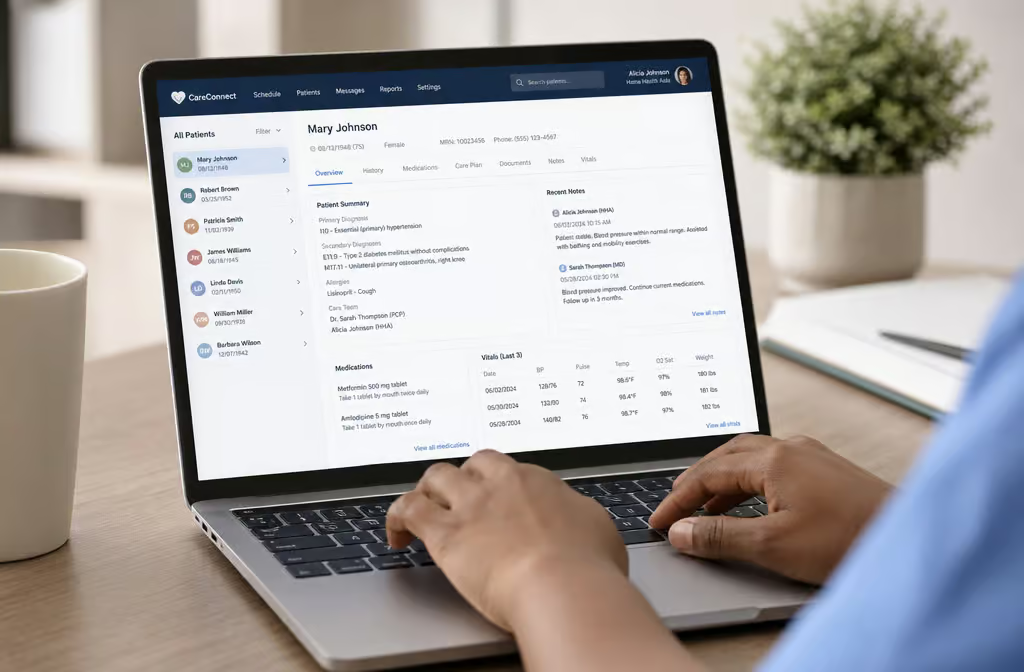
Home health is getting more tech-heavy. Electronic health records (EHR) are standard — everyone uses them, so mentioning them is table stakes. Specific software such as EHR coding programs could be included. But if you’ve used telehealth platforms, portable monitors, automated IV pumps, or wearable devices, say it. Those signals tell employers you can adapt to remote care and monitor clients without being physically present.
Example: Used Epic EHR to document client vitals and care notes for 6 clients per shift; communicated telehealth follow-ups with supervising RN via secure app.
Certifications that add weight
HHA certification, CPR/First Aid (American Red Cross carries credibility), and Home Health Aide certification for gerontology (GERO-BC). List them separately.
Customizing Your Resume for Different Settings and ATS
Almost 98% of Fortune 500 companies use applicant tracking systems (ATS) to filter resumes. That software scans for keywords from the job description. If your resume doesn’t have them, you’re invisible — no matter how good your experience is.
The fix is simple: match the language of the job posting without sounding like a robot.
If the posting says “dementia behavior management” and your resume says “took care of confused patients,” change it. If it says “end-of-life comfort care” and you wrote “helped hospice clients,” update it.
Placement strategy
- Work experience bullets — this is where the keywords carry most weight. Use the same phrasing as the job description naturally: “Managed dementia behavior for 4 Memory Care residents” instead of “Helped people with memory problems.”
- Skills section — optional but useful for packing in keywords without sounding forced. Bulleted list: EHR documentation, dementia care, palliative care, vital sign monitoring.
- Summary section — optional but powerful if you want to front-load keywords.
Example summary for a Memory Care job:
Home health aide with 4+ years of experience in dementia and end-of-life care. Certified in CPR/First Aid. Comfortable with 12-hour and overnight shifts. Pursuing BSN — 18 credits completed, and I’ve learned the ropes of how to be a home health care worker through hands-on work.
Example summary for a Home Health Agency job:
Home health aide with 5 years of experience across post-surgery, diabetes management, and geriatric clients. Proficient in EHR documentation and telehealth communication. Flexible with shifts and live-in care.
Same person. Different keywords. Different audience.
Quick test: Copy a job description’s top 5 requirements and check if those exact phrases appear in your resume — if not, update them.
Career Progression and Salary Benchmarks
This section exists to show you where the road leads.
- The typical path: Home health aide
- LPN
- RN (ADN or BSN + NCLEX-RN)
- Nurse Practitioner (MSN)
The pay difference matters:
- Home health aide median: $34,900
- RN median: $93,600
- NP in long-term care: $110,000
That’s not a career counselor’s dream — that’s real numbers from real sources. The difference between $35K and $110K is a few years of school and the right resume positioning.
What to do with this on your resume
Add one sentence that shows direction. You don’t need to lie. If you’re taking classes, say it:
- Pursuing RN — currently enrolled in ADN program
- “Completed 18 credits toward BSN”
- Certified in gerontology (GERO-BC) — expanding into long-term care NP track
Transferable skills to move up
The skills you use every day as an aide — vital sign monitoring, patient assessment, medication management, communication with families, crisis management, transfer directly to RN roles. Move them to higher-visibility positions on your resume as you progress.
Navigating the Reality of Shift Work: 24-Hour Shifts and the 13-Hour Rule
Here’s the part most resume guides won’t tell you because they don’t know.
Twenty-four-hour shifts are common in home health. The job doesn’t stop when the sun goes down. But there’s a loophole called the 13-hour rule: employers can schedule you for a 24-hour shift but only pay for 13 hours if you get an uninterrupted 8-hour sleep break and 3 hours of meal breaks.
In practice, aides like Luz Estrella, who worked 24-hour shifts for more than a decade, say breaks are rarely uninterrupted. She developed a heart condition from constant sleep interruptions. Trey Good and other New York City workers have been pushing for the No More 24 Act (Intro. 303), which would limit shifts to 12 hours.
How to handle this on your resume
You don’t need to sound angry or bitter. You need to frame it as flexibility and stamina — traits employers want.
Phrases that work:
- “Comfortable with 12-hour and overnight shifts”
- “Experienced in 24-hour live-in care settings”
- Flexible with extended shifts, including weekends and holidays
Phrases to avoid:
- “Worked 24-hour shifts with minimal breaks” — sounds like a complaint
- “Survived 13-hour pay loopholes” — too bitter for a resume
Frame the reality as a strength. You can handle long, unsocial hours. That’s valuable to agencies that need coverage.
Final Thoughts: Your Home Health Resume Is Your Story
Here’s what you should do today.
Open your resume. Find one bullet point that currently says “assisted with daily living” or “helped clients with medications.” Replace it with a version that includes a number — clients per shift, shift length, or an outcome you achieved.
That’s it — one revision that takes five minutes.
The difference between a resume that gets ignored and one that gets an interview is rarely a total rewrite. It’s three or four specific, quantified bullets that tell a hiring manager you’re not just another aide — you’re the one who knows what you’re doing.
If you want more structured practice, Coursera has an Interviewing and Resume Writing in English specialization that runs about three months. It’s practical, not theoretical. Or just keep iterating on your own — Google “resume before and after home health aide” and see what works.
The jobs are there, the growth is real, and your resume is the lever — use it.
People Also ask
What is the job description for home care?
A home care job description covers personal care (bathing, dressing, toileting), medication reminders, vital signs monitoring, light housekeeping, and client-specific care like dementia behavior management or post-surgery wound checks. The key is to name the client type and quantify your tasks — ‘Administered daily medications for 5 post-surgery clients per shift, achieving 100% adherence.’
What skills should I include on my resume as a home care aide?
Three buckets: technical skills (vital signs monitoring, wound care, medication administration), soft skills (empathy, communication with families — backed by examples), and technology skills (Epic EHR, telehealth platforms, portable monitors). Match the exact keywords from the job description to get past applicant tracking systems.
What’s the difference between a home health aide and an RN salary?
The median home health aide salary is $34,900, while RNs earn a median of $93,600 and nurse practitioners in long-term care pull $110,000. The difference is a few years of school and a resume that positions your aide experience as a foundation for clinical skills like vital sign monitoring, patient assessment, and medication management.
How do I handle 24-hour shifts on my home health resume?
Frame it as flexibility and stamina, not a complaint. Use phrases like ‘Comfortable with 12-hour and overnight shifts’ or ‘Experienced in 24-hour live-in care settings.’ Avoid mentioning the 13-hour pay loophole or interrupted breaks — employers want to see you can handle unsocial hours without sounding bitter.