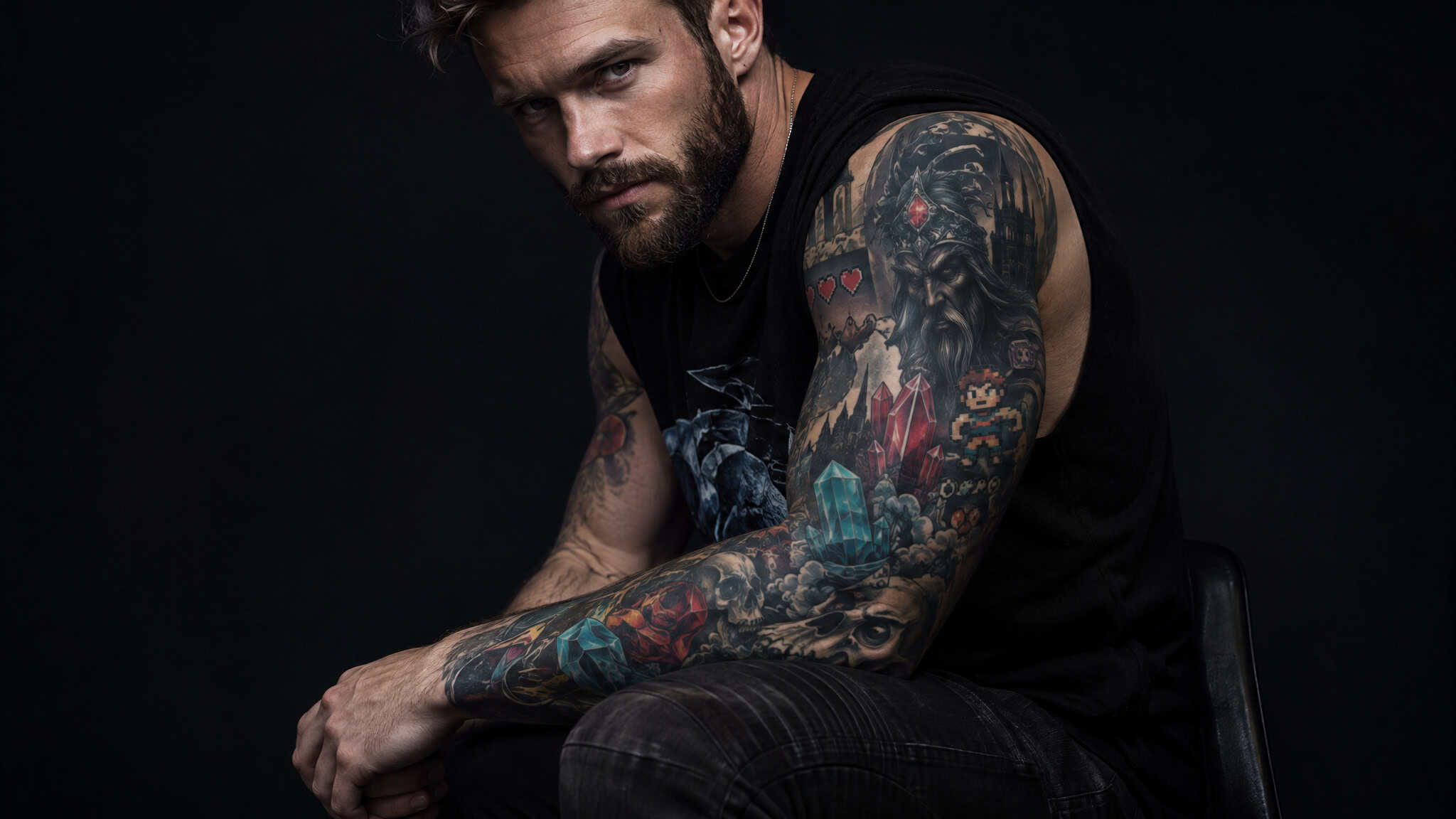
A full gaming tattoo sleeve runs about $4,000 and up to 25 hours in the chair, and the biggest risk isn’t the money. It’s spending a year of sessions and ending up with a cluttered arm of unrelated characters that don’t talk to each other. A gaming sleeve is fan art you wear permanently, and the good news buried in that fear is this: cohesion doesn’t have to be designed upfront. Sometimes you discover it halfway through.
Key Takeaways
A full sleeve covers shoulder to wrist and typically costs around $4,000 across up to 25 hours of sessions, with roughly two months of healing between sessions.
Multi-franchise sleeves work when a visual device ties them together; one documented Crash Bandicoot/Spyro/Sonic sleeve found its unifying theme by accident, because every character collects gems and crystals.
Hand your artist a character list and let them own placement; on the documented sleeve, that trust is what produced a cohesive arm, including a hand tattoo the artist initially refused.
Table of Contents
What counts as a gaming tattoo sleeve
The difference comes down to scope: a full sleeve runs shoulder to wrist as one cohesive canvas. A half sleeve covers less real estate and is the natural first commitment if you’re not ready to hand over the whole arm.
Most sleeves come down to an anchor piece (the big character or scene), filler for the gaps, and connective tissue, dots, florals, background work that makes the arm read as one image. Minimalist pieces can scale up too. The green Sims plumbob on the back of the neck by siwa_handpoke, or a line of Pac-Man dots, are small on their own but give you a starting point.
And if you never commit to one theme? Patchwork sleeves, an unplanned accumulation of individual game tattoos over years, are a recognized style, not a failure state.
Choosing your theme, and discovering it mid-planning
You don’t need the theme locked before you book session one. Shortlist the characters you actually love, then look for the shared trait that becomes your connective tissue.
The proof this works is a sleeve a YouTuber documented across multiple videos: Crash Bandicoot, Spyro, and Sonic/Knuckles on one arm, done by artist Jairo at Monastar Tattoos. Nobody picked a theme upfront. It turned out all three franchises collect gems and crystals, and that accidental shared trait became the filler motif holding the whole arm together.
The unifying devices I see across real sleeves come in a few flavors: shared character traits, a shared art era like 8-bit or pixel, a shared palette, or a connecting visual element like dots or florals. That’s a pattern visible in real sleeves, not industry doctrine. But it’s a useful one, because it means the “pick your theme first” advice is only half right. Sometimes the theme is hiding in the shortlist you already have.
One franchise or many? Blending games without a cluttered mess
Multi-franchise sleeves work when a visual device ties the pieces together. They fail on clashing art style, not clashing subjects. A pixel Mario next to a photoreal Kratos is the problem. Mario next to Pac-Man isn’t.
The proof points are out there. A Slime Rancher x Hollow Knight x Mario mashup by dokidokitattoos reads as intentional, not chaotic. A Pac-Man and burger piece by lorelay_bodyart connects two obsessions with one dot trail. And Jedi Mario, by Rogério Opix at Black Nimbus Tattoo in São Paulo, is crossover proof that mashups can be genuinely good art.
Single-franchise sleeves cohere naturally. An all-Zelda arm with the master sword, Triforce, Majora’s Mask, and 8-bit items doesn’t need a unifying device because the games already share one. If you’re blending franchises, that’s when you need to supply the device yourself: pixel style, color logic, or a connecting element.
Sleeve-scale gaming tattoo designs, franchise by franchise
The most sleeve-worthy gaming designs cluster around a handful of franchises: Mario, Zelda, Final Fantasy, Dark Souls, Pokémon. The art is strong and the nostalgia is shared. Mario, Zelda, and Tetris get cited most as influential games, Final Fantasy for storytelling, Pokémon for competition, Halo for FPS impact, WoW for MMORPGs. Opinion-shaped stuff, but it explains why this imagery shows up on arms constantly. Here’s what sleeve-scale work actually looks like, franchise by franchise.
Zelda
- Master sword with silent princess flowers by Heidi Kaye at Sad Peach Tattoo, London. Game icon blended with in-game botany, the kind of detail only fans catch.
- A row of 8-bit Zelda items by Shane Olds at Studio XIII, Orlando. Pixel icons instead of one big scene, and simple shapes age better than fine detail.
- Majora’s Mask by Billy Tanos at Immerse Tattoo, Brisbane. Pixel plus color, doable but technically demanding.
- Matching sibling Triforce tattoos by Tony at Xclusive Ink, East Hartford. Gaming ink as a shared thing.
- A pixel sword and heart by dbishoptattoo. Worth knowing: the artist noted pixel designs are hard to stencil. Pixel art looks easy and isn’t.
Mario, Pokémon, Final Fantasy
- A pixel pipe and star, shared on r/gaming. Two tiny icons say more than a whole Mario scene would.
- The Jedi Mario crossover by Rogério Opix.
- Pixelated Pokémon arm pieces by kakkoiink, and a battle screen with Japanese text by rika.loli. The battle screen is a deep-cut flex, niche but readable to anyone who played.
- Charizard, artwork by zzizziboy, shared on r/nerdtattoos. Probably the single most common Pokémon choice.
- Vivi from Final Fantasy by Brit at Karmaknife Tattoos, Jackson, MI. The quiet fan-favorite pick that says more about the wearer than a Cloud would.
- Chocobo and Moogle by videogametatts, with whimsical filler elements tying it together.
Dark and atmospheric
- A Dark Souls warrior with a sword by a pedestal, on the thigh, by xcjxtattooer. A single-game piece that isn’t a sleeve, for scale comparison.
- Bloodborne skeletal crown by artesobscurae. Even non-gamers read this as cool art. A stealth gaming tattoo.
- A gauntlet and mace by dots_tattoos. Object tattoos often age better than face portraits.
- Dark Souls 3‘s Dancer of the Boreal Valley as a black-and-grey full-sleeve design. One boss as a whole arm. Ambitious but coherent.
- Diablo IV Inarius vs. Lilith in black and grey. Diablo’s angel/demon imagery is basically pre-made sleeve material.
Dark FromSoftware and Diablo art suits black-and-grey treatment because the source art is already high-contrast and moody. Shading does the work color would otherwise do.
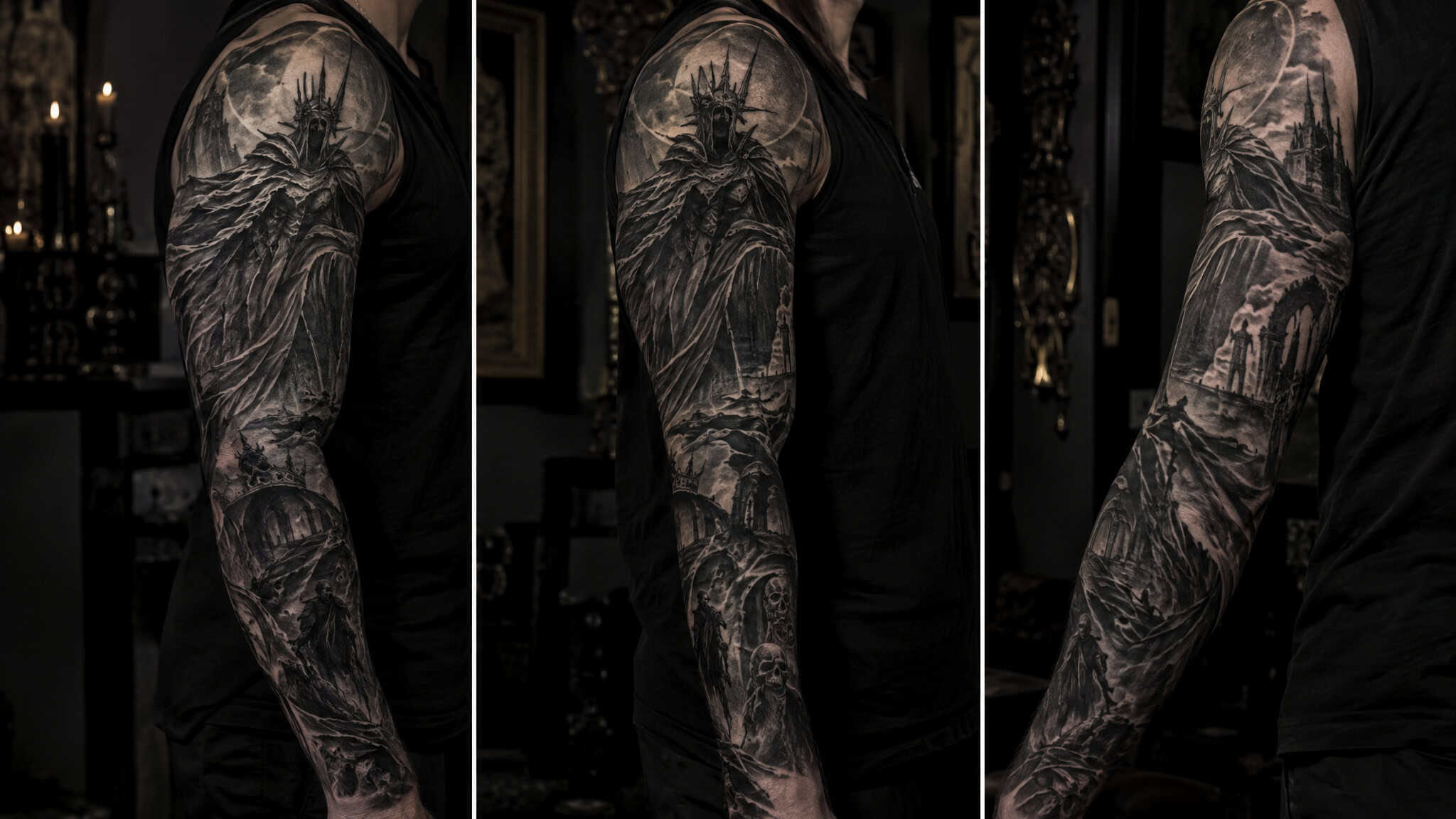
Retro arcade and indie
- Galaga spaceship and alien by zzang.ga_tattoo. Simple, readable at a distance.
- Pac-Man on a leg by polyc_sj, and ghosts-and-pizza connected by dots by youthless_.
- Hollow Knight forearm work by tattoosbykaitlin and feerwho. Newer indie games get permanent ink too.
- A Minecraft character by mint.brain.tattoo. The blocky aesthetic translates surprisingly well to skin.
- A Crash tribal mask by merolbart, Kirby in a bottle by sketchbrooke_, and a Sonic leg tattoo by ink.ray.
Style range
- Two League of Legends pieces by martinkellytattoo and phanny_tattoo. Anime-adjacent gaming ink is its own lane.
- A futuristic warrior in blue and black by dusty_past. Limited palettes are a smart sleeve move.
- D.Va from Overwatch by sareushtattoos, winking and blowing bubblegum. Personality in the pose matters; static portraits can feel stiff.
The style range runs from blackwork through neo-traditional, with black and grey the most common you’ll encounter.
Minimalist gaming tattoos that can grow into a sleeve
Yes, small meaningful pieces are a scaling strategy, not a lesser choice. Patchwork accumulation into a sleeve is a recognized style, so the plumbob, the Pac-Man dots, or a row of 8-bit Zelda items can all be first moves rather than dead ends.
The motivations are whatever they are: tribute to your first game, homage to a character, a symbol that just clicks. One commenter under the Sims plumbob tattoo argued The Sims doesn’t count as “hardcore gamer” material. Nobody’s grading your tattoo. The label is yours to define.
If you want more small-scale starting points, there’s a whole guide to simple gaming tattoo ideas worth a look, and if your passion leans toward games of chance, gambling tattoo ideas offer plenty of ink inspiration too.
Black and grey or colored? The choice that shapes your schedule
Black-and-grey suits cohesive dark themes and coheres through shading depth. Colored sleeves should be one single image or elements from the same universe, and here’s the rarely-stated constraint: color work should be completed within the same year so the ink ages consistently.
That makes color choice a scheduling decision, not just an aesthetic one. Full color means more sessions, more money, more fading risk. If your franchise shortlist is Dark Souls 3’s Dancer of the Boreal Valley or Diablo IV’s Inarius vs. Lilith, black and grey is the natural fit anyway. If it’s Kirby in a bottle, plan your calendar around that same-year rule before you book session one.
Working with your artist: the character list and placement authority
The collaboration model that works is a character list plus free rein on placement. Hand the artist the who. Let them own the where.
The documented case proves it. The Crash/Spyro/Sonic/Knuckles client gave artist Jairo at Monastar Tattoos exactly that: a list of characters and no micromanaging on placement. The results were cohesive, including the accidental gems-and-crystals filler theme that emerged because the artist had room to spot it.
Real trimming looks like this: Banjo-Kazooie was cut for space and proposed as a chest extension. Cutting a beloved character is a feature of good planning, not a loss. The common first-timer failure is arriving with a huge wishlist and no sense of what fits one arm. Artists trim to the canvas in practice, and a good one will tell you where the overflow goes.
Beyond that, the standard advice holds, framed as a guy talking himself through it:
- Pick games that actually mean something to you. A tattoo of a game you liked for a month is how regrets happen.
- Match the style to the game’s feel. Pixel for retro, dark realism for Souls. Mismatched style is the most common miss.
- Think about fit with tattoos you already have. A sleeve is a conversation between pieces, not a pile of separate ones.
- Choose an artist with gaming ink in their portfolio over one who’s merely close. Portfolio over proximity, every time.
For more franchise-specific design thinking, the breakdown of video game tattoos ideas by franchise goes deeper on the individual games.
What a sleeve really costs and how long it takes
Expect roughly $4,000 as the approximate sleeve tattoo cost, along with up to 25 hours across multiple sessions. Those are typical ranges from planning guides, not fixed quotes, and prices vary by artist and region.
The pacing reality is what gets people. The documented sleeve’s second session ran six hours, and the first session took about two months to heal before the next one started. Healing gaps mean a 25-hour sleeve spans most of a year.
For readers mapping $300 or $500 pieces to sleeve scale: those prices buy small standalone pieces, not arm coverage. And the same-year color rule from the style section is really a budget constraint too. If you can’t afford to finish color within a year, that’s an argument for black and grey.
Cost check: A $300 or $500 budget buys a small standalone piece, not sleeve coverage — plan per session, not per arm.
Pain by body area, and the hand-tattoo question
It depends on the zone. One documented multi-session wearer’s reported ranking: shoulder and the front of the arm hurt least. Armpit, elbow pit, front of the wrist, and nerve-connected side areas hurt most. The rough rule is that areas that never see sun hurt worst. Pain tolerance varies, so treat this as one guy’s map, not gospel.
The planning insight: the worst zones are exactly the connective areas a cohesive sleeve must cover. So it’s legitimate to sequence your sessions from the easy zones to the brutal ones.
The hand-tattoo question
It depends on your circumstances and your artist. Pushback is real but negotiable. On the documented sleeve, the artist initially declined a hand tattoo, calling hand tattoos job stoppers, then added the full-face Aku Aku mask after learning the client was self-employed and planning full coverage. Some artists still gatekeep visible placements. Hear them out, but don’t assume every artist refuses or accepts hand pieces.
Finding sleeve-scale references worth bringing to a consultation
The gaming sleeve references worth using live in community galleries sorted by Top, not in generic hashtag scrolling. Real ink on real people beats stock flash sheets.
The pipeline: Reddit (r/tattoos, r/TattooDesigns, r/best_tattoos, plus r/nerdtattoos for gaming-specific work that general tags bury), sorted by Top. Pinterest’s visual search is genuinely good for tattoo browsing. Instagram hashtags like #sleevetattoo and #fullsleeve, which are how you find artists, not just inspiration. And Google Images reverse search to find the artist behind an image you love. Underrated move.
Curated galleries with artist attribution, like the Bored Panda video game tattoo listicle put together by two editors and sourced from Instagram and Reddit, work as starting points. The images there went up between July and December 2023, so it’s recent-ish, not a trend forecast. For a broader browse, our own best gaming tattoo ideas gallery is organized by franchise and style.
Session prep and aftercare across a multi-session sleeve
Each session takes about two months to heal, and every new session restarts the clock. Aftercare is a repeated commitment, not a one-time task.
Prep is simple: sleep well, eat a solid meal, no alcohol for 24 hours before (it thins your blood, and your artist will notice), wear loose clothing. Six hours in the chair on an empty stomach is miserable.
Aftercare: do what your artist tells you. They’ve healed hundreds of these; you haven’t. The basics are gentle cleaning with mild soap, unscented cream, and no scratching, even around day four when everyone wants to. Think of it as saving your game progress before a long session. The first two weeks per session are the critical window, and neglected healing risks scabbing, color loss, and infection, which compounds across a 25-hour sleeve.
Field note: Every new session restarts the two-week healing window, so aftercare discipline matters as much in month nine as it did in session one.
What to avoid with a gaming sleeve
The avoidable failures are specific, and each has a fix:
- Ignoring aging and color contrast. The boring first planning step that saves the most regret. Think about how it’ll look in ten years before you think about how it looks on Pinterest.
- Multi-year color spread. Violates the same-year rule. Finish color within a year or go black and grey.
- Oversized wishlists. One arm only fits what it fits, so trim the list before you book.
- Clashing art styles with no unifying device. Pick the device: pixel style, shared palette, or a connecting element.
- Overriding artist placement authority. Trust the artist on design and placement. They know how ink moves on an arm. You know what you love. Both matter.
One source notes men lean toward bold motifs and women toward floral and script work. It’s a loose tendency at best, and personal taste overrides any norm. Get what you want on your own arm.
A sleeve built from games that defined your childhood and your adult marathons outlasts one built from what looks cool today. Emotional durability matters across a year-long project. And there’s a quiet bonus: inked players recognize each other like a global tribe. A Triforce on a stranger’s arm starts a conversation.
Achievements reset. Ink doesn’t.
Frequently Asked Questions
What is a gaming sleeve?
A gaming sleeve is a full arm tattoo, shoulder to wrist, built from video game imagery as one cohesive canvas rather than a pile of separate pieces. The arm usually combines an anchor piece (the big character or scene), filler, and connective tissue like dots, florals, or background work that makes it read as a single image. Think of it as fan art you wear permanently.
How much does a full sleeve tattoo cost and how long does it take?
Expect roughly $4,000 and up to 25 hours in the chair across multiple sessions — typical ranges from planning guides, not fixed quotes, and prices vary by artist and region. The schedule is the sneaky part: each session needs about two months to heal before the next, so a full sleeve spans most of a year. Budget per session, not per arm.
How big is a $300 tattoo?
A $300 budget buys one small standalone piece, not arm coverage. A full sleeve runs roughly $4,000 and up to 25 hours across multiple sessions. If sleeve coverage is the endgame, treat a small piece as a first move you can build around later rather than a dead end.
How big is a $500 tattoo?
A $500 budget gets you a small standalone piece — think a single character or icon — not sleeve coverage. Sleeve-scale work runs about $4,000 across up to 25 hours of sessions. Plan per session, not per arm.
How do you plan a gaming tattoo sleeve with a cohesive franchise theme?
Shortlist the characters you actually love, then hunt for the shared trait that becomes your connective tissue — shared character traits, a common art era like 8-bit or pixel, a shared palette, or a connecting element like dots or florals. You don’t need the theme locked before session one; one Crash Bandicoot, Spyro, and Sonic sleeve found its unifying gems-and-crystals theme halfway through precisely because the artist had room to spot it. Hand your artist the character list and let them own placement.
What are some gaming tattoo ideas for a full sleeve that blends multiple game franchises?
The trick is a visual device that ties the pieces together. A Crash Bandicoot / Spyro / Sonic sleeve united three franchises through their shared gems-and-crystals collecting, a Slime Rancher x Hollow Knight x Mario mashup reads as intentional rather than chaotic, and a Jedi Mario crossover proved mashups can be genuinely good art. What fails is clashing style, not clashing subject — pixel Mario next to photoreal Kratos is the problem, Mario next to Pac-Man isn’t.
Should a gaming sleeve be black and grey or colored?
Black and grey suits cohesive dark themes — Dark Souls or Diablo art is already high-contrast and moody, so shading does the work color would otherwise do. Color works best as one single image or elements from the same universe, with a rarely-stated constraint: finish the color work within the same year so the ink ages consistently. Full color also means more sessions, more money, and more fading risk, so if you can’t finish within a year, that’s an argument for black and grey.