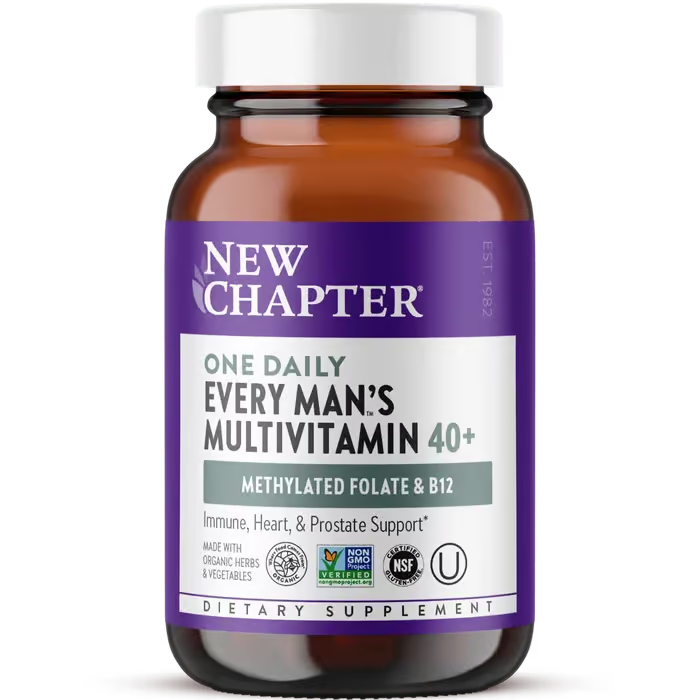
Flip the bottle over and the supplement panel is dense enough to need a coffee break. That’s the situation with New Chapter Every Man’s One Daily 40+ Multivitamin, a fermented one-a-day for guys our age that runs roughly $0.87 to $1.25 per day depending on where you catch it. This review stands on the label, the sourced prices, and one number from actual customers: 4.4 out of 5 stars from 132 reviews at Walgreens. That’s it. No lab, no 90-day log, just reading the back of the bottle so you don’t have to squint at it in the aisle.
Four things decide whether this tablet earns its price: what’s actually in it (doses and forms), what “fermented” really means, who needs to be careful with it, and what it costs per day once the promo codes stop lying to you. Let’s go through all four.
Key Takeaways
The vitamin and mineral panel is legit: 100%+ DV for A, C, D3, E, K, thiamin, and zinc, with methylated B12 at 200% DV and folate deliberately capped at 50%.
The herbal blends are label dressing: the Stress and Energy Support Blend totals 45 mg, less than one capsule of most standalone herbal supplements.
Fruitful Yield sells the 24-count at $20.98 sale ($29.97 regular), which works out to roughly $0.87, $1.25 per day.
Table of Contents
What Every Man’s One Daily 40+ is and who it’s for
It’s a solid pick for guys who want one certified-organic tablet a day instead of a pill handful, and the customer track record backs that up: 4.4 out of 5 stars from 132 reviews at Walgreens. Not spectacular. Solid. The kind of number that says guys buy it and keep buying it, which with a supplement is most of what a rating can tell you.
It sits in an age-tiered line: the base Every Man’s One Daily, this 40+ version, and an Every Man’s One Daily 55+ above it. The “40+” isn’t a birthday checkbox; it’s a formulation decision, with nutrient targets aimed at our age band. You can get it in a 24-count at Walgreens and Fruitful Yield, and there’s a 72-count variant out there for the stock-up crowd.
New Chapter’s positioning is “formulated for absorption” and gentle enough for an empty stomach. We’ll get to how much of that holds up.
The marketed claims run long: Walgreens’s listing pitches immune, cellular energy, stress, and heart support. Fruitful Yield’s version of the pitch adds brain, digestive, bone, eye, prostate, and hair/skin/nails. Same tablet. The claim list just grows depending on who’s selling it, which is worth a raised eyebrow. None of these claims are FDA-evaluated; that’s the usual fine print on any supplement, and it applies here.
One thing I couldn’t verify: Reddit search demand for Every Man’s One Daily 40+ exists, but I found no sourced community discussion to quote. So I won’t invent forum sentiment. The Walgreens rating is the only verifiable word-of-mouth, and it’s 4.4 out of 5 from 132 reviews, solid, but read a few of them yourself before you buy.
The vitamin and mineral panel
Per tablet, the panel delivers 100% or more of the daily value for vitamins A, C, D3, E, K, thiamin, and zinc, with two deliberate exceptions: folate is capped at 50% DV, and B12 is doubled to 200%. That asymmetry is a design choice, not an accident. Older guys often want more B12 and extra folate is deliberately kept modest.
The headline numbers, per tablet:
- Vitamin A: 900 mcg, 100% DV, entirely from beta-carotene
- Vitamin C: 90 mg, 100% DV
- Vitamin D3: 25 mcg (1000 IU), 125% DV
- Vitamin E: 15 mg, 100% DV
- Vitamin K: 120 mcg, 99% DV, as K1 plus K2
- Folate: 200 mcg DFE as L-5-methylfolate, 50% DV
- B12: 4.8 mcg as methylcobalamin, 200% DV
- Zinc: 11 mg, 100% DV
- Selenium: 60 mcg fermented, 109% DV
Fat-soluble vitamins: A, D3, E, K
The vitamin A detail is the interesting one: all 900 mcg comes from beta-carotene, the plant-derived form, not retinol. D3 sits at 125% DV, which is the one most of us actually care about at 40+, and it’s a solid dose. E is a standard 100%.
The K is the notable inclusion. You get 120 mcg as K1 plus K2 in the menaquinone-7 form, and plenty of multivitamins skip K2 entirely. That’s a point in this formula’s favor, with one caveat that matters for a specific group of guys. It’s coming in the safety section.
Methylated B vitamins
Folate comes as L-5-methylfolate and B12 as methylcobalamin. Those are the activated, methylated forms label-readers scan for, since some guys don’t convert the synthetic forms well. The doses: 200 mcg DFE of folate (half the daily value) and 4.8 mcg of B12 (double). Both are reasonable choices for a multi. No chemistry lecture needed.
Minerals
Zinc at 11 mg covers 100% of the DV, and fermented selenium comes in at 60 mcg, 109%. Below those you get copper, manganese, chromium, and molybdenum at partial DVs. Fine supporting cast. Nothing underdosed to the point of being decorative, and nothing overdosed.
The herbal blends: what 45 mg actually means
It depends, and here’s the deciding condition: the prostate and heart ingredients are in the tablet, but the doses aren’t therapeutic, and every support claim on the box carries the FDA disclaimer. If you’re buying this expecting the Cardio Support Blend to do heart work, you’re reading the label wrong.
Red flag: A blend name promising support at 15-45 mg is marketing weight, not a therapeutic dose. Check the milligrams before trusting the claim.
The three blends, milligram by milligram
Here’s the full botanical lineup per tablet:
- Stress and Energy Support Blend: 45 mg total (organic maca, schizandra, chamomile)
- Cardio Support Blend: 16 mg (oregano, hawthorn, grapeseed extract)
- Immune Support Blend: 15 mg (eleuthero, astragalus, European elder)
- Ginger: 4 mg
- Organic turmeric: 3.5 mg
The ginger and turmeric each split between an aqueous extract and a supercritical extract, which tells you the company takes extraction seriously. It doesn’t make 3.5 mg of turmeric a meaningful dose.
Here’s the context that matters: 45 mg is less than one capsule of most standalone herbal supplements. A dedicated maca product might run 500 mg or more per capsule. So the blend name says “Stress and Energy Support” and the dose says “a rounding error.” It’s an easy misread.
Guys see the label, assume there’s a real dose behind the name, and count on an effect the milligrams can’t deliver.
Saw palmetto, pumpkin seed oil, and the prostate story
Saw palmetto and pumpkin seed oil are the classic men-40+ additions, and New Chapter markets them for prostate support alongside that fermented selenium. That’s their claim, and the ingredients are in there. But nothing on this label’s amounts backs a therapeutic prostate claim. If prostate health is your specific concern, a dedicated saw palmetto product will give you a real dose. This gives you a gesture toward one.
Honest read: buy this for the nutrients and the certifications. The botanicals are story, not therapy.
New Chapter’s fermented formulation, explained
The nutrients in this tablet are cultured with yeast (Saccharomyces cerevisiae) and lactic acid bacteria in a whole-food medium: organic soy flour, carrot, alfalfa, orange peel, plus deactivated bromelain and papain in the mix. In plain terms, they brew the vitamins in food before pressing them into the tablet. The pitch is that you’re getting nutrients in a food-based context rather than purely lab-synthesized ones, and that’s what’s happening on the ingredient list.
Here’s the limitation, stated plainly: “formulated for absorption” is marketing. New Chapter says the fermentation helps your body take the nutrients in, and I found no sourced third-party or clinical evidence showing fermentation measurably improves absorption in humans. Doesn’t mean it doesn’t. Means nobody’s shown it in anything I could verify. Take it as their claim, weigh it accordingly.
One tablet daily, even on an empty stomach
Suggested use is one tablet, any time, empty stomach included. That’s the entire routine. No scheduling, no “take with food,” no forgetting whether you took it. For most guys this is the product’s best practical feature, and it’s the one part of the gentleness claim you can test yourself: the brand says it sits fine before breakfast, and guys coming off big multi-tablet or iron-containing routines are often surprised a one-a-day goes down that easily.
Others keep taking it with a meal out of habit. Either works.
The ferment medium is also where the label’s most important fine print hides. The soy.
Blood thinners, soy, and the certification stack
The fine print on this label matters more than any efficacy argument. Two lines especially, and most reviews skip both. The one reassurance worth noting up front: the tablet carries NSF third-party certification, so the label claims aren’t just the company grading its own homework.
Vitamin K and the blood-thinner caution
That 120 mcg of vitamin K (K1 plus K2) is the mechanistic reason the label tells you to consult a healthcare professional before use if you take blood-thinning medicines. Vitamin K and blood thinners have a known interaction, which is why the caution is there. So, one plain sentence: if you’re on blood thinners, any medication, or have a medical condition, run it past your doctor before starting this. That’s the whole note, and it comes from the label, not from me playing doctor.
Fermented soy and the allergen line
The formula contains fermented soy. It’s disclosed inside the ferment media list, not in the marketing bullets, so it’s easy to miss. If you’ve got a soy allergy, that’s a hard pass or at minimum a conversation with your allergist. That’s the entire flag.
What the seals guarantee
The certification stack is legitimately good for this price tier:
- NSF Certified Gluten-Free (third-party verified, which actually means something in a supplement)
- Certified Organic, by Where Food Comes From Organic
- Non-GMO Project Verified
- 100% vegetarian
- No artificial flavors or colors
- Made in the US from globally sourced ingredients
That’s a clean label by almost anyone’s standard. The NSF seal is the one I’d weight most, since it’s independent verification rather than the company grading its own homework. Also on the label: “keep out of reach of children,” which I assume means the company knows exactly what happens when a tablet that looks like a premium chocolate lands in a kid’s sightline.
Where to buy Every Man’s One Daily 40+ for less
At Fruitful Yield’s sale price of $20.98 (regular $29.97) for the 24-count, a tablet runs roughly $0.87 to $1.25 per day, before you stack anything on top. The 24-tablet bottle is the standard pack, with a 72-tablet variant out there for stock-ups. It’s in stock for shipping; store pickup varies by location, so check before driving anywhere.
Cost check: The 24-count at Fruitful Yield’s $20.98 sale price works out to roughly $0.87–$1.25 per tablet. Catch the promo before paying full price.
Cost per day, 24-count vs 72-count
The 24-count is roughly a month. A 72-count variant exists (it shows up at Whole Foods and similar), but I don’t have a sourced price for it, so I won’t guess at one. The practical play is simple: start with the 24-count, and once you know this is your daily, move to the 72 or catch a promo. The composite mistake I keep seeing in how guys buy supplements like this is paying full price for the small bottle, over and over. The per-tablet difference is where the money goes.
Walgreens codes, myWalgreens, and Medicare OTC
Walgreens runs two relevant codes. WAG15 gets you an extra 15% off $35 or more sitewide, which means you’ll need to add an item or two to hit the threshold. MYWAG20 gets you an extra 20% off $50 sitewide, but only if you’re a myWalgreens member, so it’s only better if you already are one or shop there often. Purchases earn myWalgreens cash rewards too, which is a small sweetener.
And if you’re on Medicare Advantage, some plans cover eligible OTC items like this; worth a quick call to your provider. Codes are current as of writing, not permanent.
One aside from the Fruitful Yield page: their cross-sells point at NOW Foods CoQ10, Methyl B-12, Vitamin D3, and Garden of Life RAW B-12/D3. Keep that list in mind. It comes back in the verdict.
How Every Man’s One Daily 40+ compares
What makes a 40+ formula different is mostly positioning: this one sits between the base Every Man’s One Daily and the 55+ in New Chapter’s line, with nutrient targets pitched at our age band. The sources confirm all three tiers exist. What they don’t confirm is the label-level differences between them, so I’ll say that plainly rather than build a table out of guesses.
Vs. MegaFood Men’s 40 One Daily
MegaFood Men’s 40 One Daily is the closest named competitor in related searches, and it’s also an age-targeted once-daily. New Chapter’s differentiator is the fermented whole-food platform, which MegaFood doesn’t do the same way. That’s the honest extent of the comparison, because I don’t have label-level head-to-head data on doses, forms, or certifications. A fabricated comparison table would be worse than no comparison, so: both are age-targeted one-a-dails.
New Chapter ferments theirs. If you want the head-to-head on numbers, that’s a different article with better data.
40+ or 55+?
The practical selector is your age band and each tier’s specific nutrient targets. Both tiers exist; the sources don’t detail how the labels differ. If you’re 55 or older, the 55+ is the one built for you. Otherwise this 40+ tablet is the tier New Chapter actually aimed at you, and the sources don’t show enough label difference to agonize over.
Verdict: who should buy it, and who shouldn’t
There’s no sourced answer to “best multivitamin for a 40-year-old man,” and anyone who claims one is selling something. Within its specific profile, though, this is a strong pick. Here’s the honest sorting:
Strong fit. You want a certified-organic, NSF gluten-free, 100% vegetarian one-a-day with methylated Bs, fermented selenium, and no food dependency, empty stomach included. The 4.4/5 from 132 Walgreens reviews is your sentiment floor. Buy the 72-count or stack a promo code and the per-day cost is reasonable for what the panel actually delivers.
Weaker fit. You’re expecting the herbal blends to do therapeutic work. The 45 mg, 16 mg, and 15 mg blends won’t. If you’ve got a targeted need, the solo-nutrient path is the alternative: NOW Foods CoQ10, Methyl B-12, Vitamin D3, exactly the stuff sitting in the retailer cross-sells. Pick your specific gap, buy a real dose of the specific thing.
Needs sign-off first. Blood-thinner users, because of the vitamin K. Soy-allergic buyers, because of the fermented soy. Both straight off the label.
Two gaps remain, and I’d rather name them than paper over them: no sourced Reddit sentiment to lean on, and no third-party studies backing the absorption claim. So the verdict rests on what it can rest on: a full label read, sourced pricing, and a 4.4/5 rating from 132 Walgreens reviews. On that evidence, the label mostly justifies the price. The botanicals are where the marketing runs ahead of the milligrams, and now you know exactly where that line is.
Frequently Asked Questions
What is the best daily multivitamin for men over 40?
There’s no single sourced answer to that, and anyone claiming one is selling something. That said, New Chapter Every Man’s One Daily 40+ is a strong pick within its profile: a certified-organic, NSF gluten-free, 100% vegetarian one-a-day with methylated B12 and folate, at roughly $0.87–$1.25 per day. It carries a 4.4/5 rating from 132 Walgreens reviews.
Is New Chapter Every Man’s One Daily 40+ worth it?
For guys who want one certified-organic tablet a day with a legit vitamin and mineral panel, yes — the label mostly justifies the price at roughly $0.87–$1.25 per tablet. The caveat: the herbal blends (45 mg, 16 mg, 15 mg) are label dressing, not therapeutic doses. Buy it for the nutrients and certifications, not the botanical story.
Is Every Man’s One Daily 40+ safe to take with blood thinners or medications?
Check with your doctor first if you’re on blood thinners — the tablet contains 120 mcg of vitamin K (K1 plus K2), which has a known interaction with blood-thinning medicines, and the label says so explicitly. It also contains fermented soy, so soy-allergic buyers should skip it or talk to their allergist. Anyone on medications or with a medical condition should run it past a healthcare professional before starting.
Does fermented really mean better absorption in multivitamins?
Fermentation means the nutrients are cultured with yeast and lactic acid bacteria in a whole-food medium before being pressed into the tablet — that part is real and shows up on the ingredient list. But “formulated for absorption” is a marketing claim, and there’s no widely available third-party or clinical evidence showing fermentation measurably improves human absorption. Take it as a brand claim, not a proven benefit.