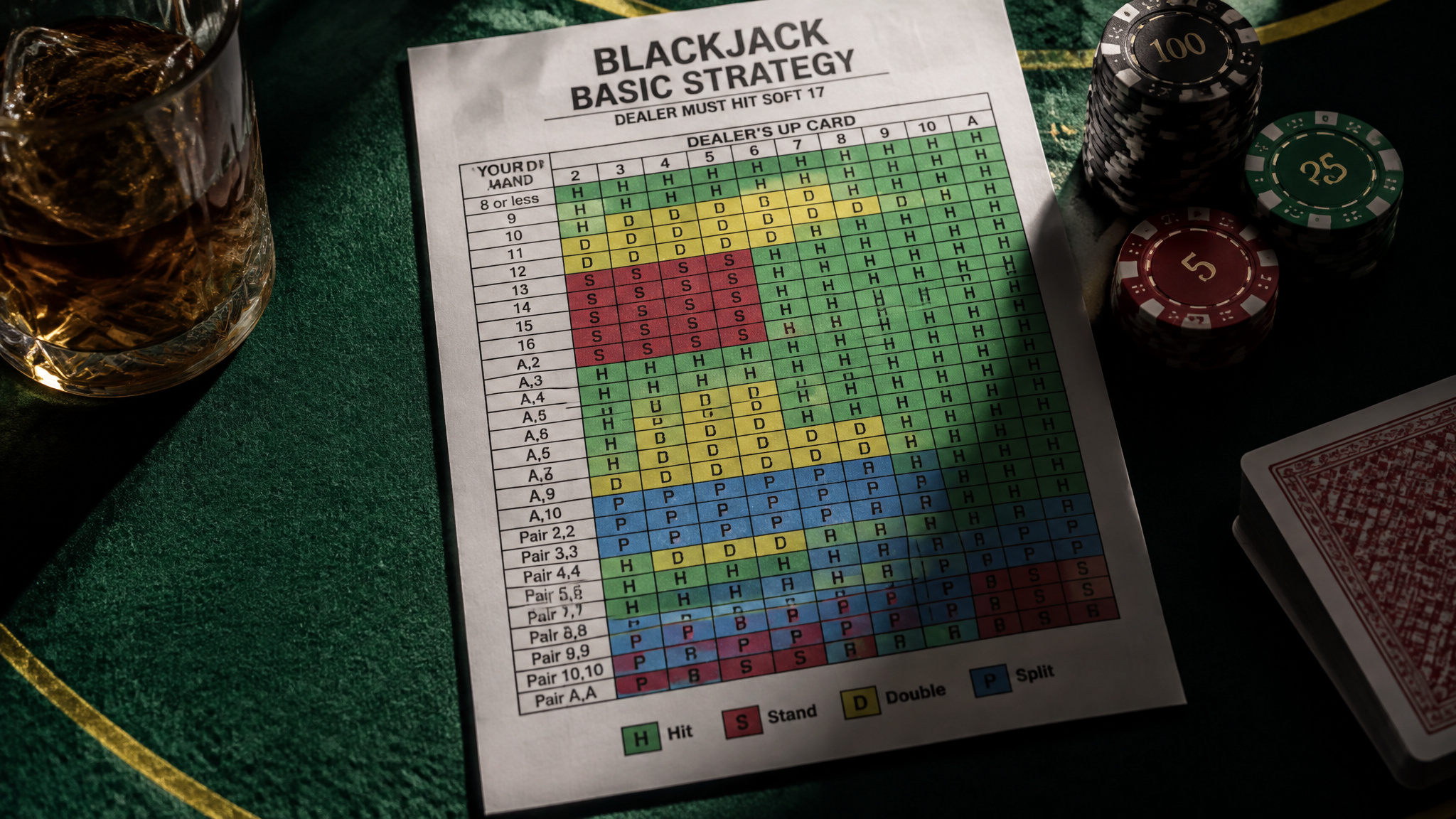
Sitting at a live table holding a hard 12 through 16 against a dealer’s 7 is where most guys donate their stack. Playing by a printed basic strategy chart instead of copying the dealer cuts the house edge from 5.5% down to 0.50%, as Daniel Odeyemi and Heather Ferris at Vegas-Aces pointed out in their April 11, 2026 guide. Because you act first and lose the moment you bust, even when the dealer would have busted right after you, keeping a table-legal strategy card on the felt is the simplest way to get every hit, stand, double, and split decision right.
Key Takeaways
Playing basic strategy cuts the casino’s house edge from 5.5% (what you face if you mimic the dealer) down to 0.50%, and casinos allow you to keep a printed strategy card right on the felt provided you keep the game moving.
Always hit a hard 12 through 16 against a dealer 7 or higher, always split Aces and 8s, never split 10s or 5s, and double down on 10 or 11 unless the dealer shows a 10 or an Ace.
Strategy is only half the math: always play at tables paying 3:2 on blackjack rather than 6:5, and look for tables where the dealer stands on soft 17 to trim roughly 0.22% off the house edge.
Table of Contents
What a blackjack cheat sheet is (and isn’t)
Any player can bring a printed strategy card right to a live casino table, as long as they don’t slow the game down. The real beginner discipline is protecting your bankroll: follow basic strategy math over gut instinct at a 3:2 table and never buy insurance. Despite the name, a cheat sheet isn’t cheating at all, just a table-legal reference card showing the optimal play for every total.
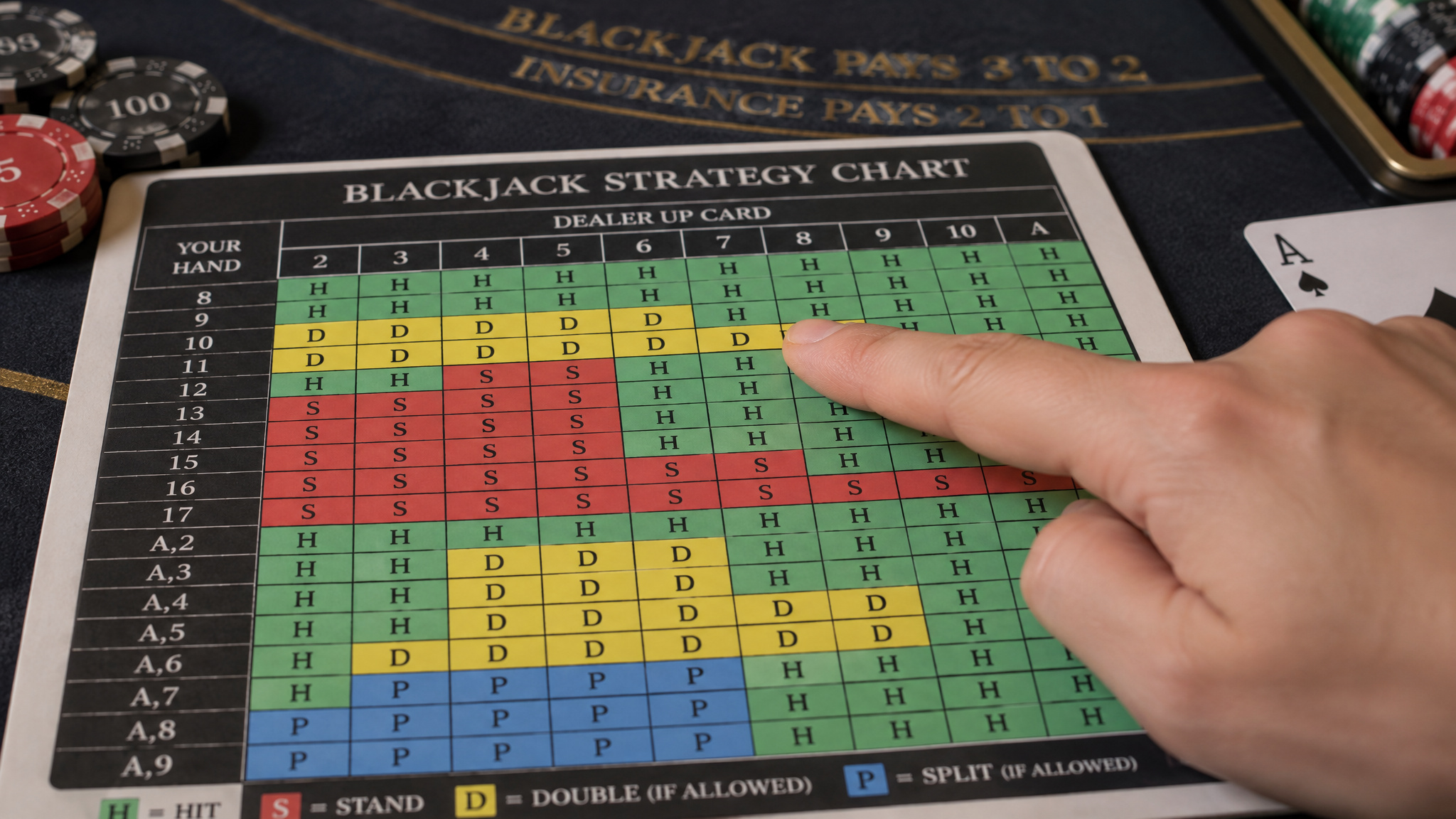
As SiGMA Play Reviews notes, casinos have no problem with you checking a physical card at the felt because the chart is pure probability math rather than a guaranteed winning trick. In fact, casino dealers have to memorize the exact same basic strategy card during their job training so they can answer confused players with, “The book says to…”
The dealer’s own playbook isn’t one single chart, though, because table rules and deck counts change from pit to pit. Your card simply maps the mathematically best move for your two cards against the dealer’s visible up card to shrink the house edge as far as it will go.
Why the house wins, and why copying the dealer loses money
The house wins when you copy the dealer’s fixed rules because the dealer acts last, meaning you take the bust risk first and hand the casino a 5.5% house edge instead of the 0.50% edge you get with basic strategy. When you bust on your turn, the dealer sweeps your chips immediately. Even if the dealer flips their hole card thirty seconds later and busts on the exact same total, your money is already gone.
That turn-order gap is the entire reason the casino holds a mathematical edge in blackjack. The dealer has zero say in how they play their hand, following a rigid script that serves the house only because they go second.
If you play by that same script, standing on 17 and hitting everything 16 or under regardless of what the dealer shows, you give up every tool that makes the game close. Basic strategy claws back 5% of that margin by using options the dealer isn’t allowed to touch: standing early on a stiff total when the dealer shows a weak up card, doubling your bet when you have the best of it, and splitting bad pairs into playable hands.
Blackjack card values: the layer the chart assumes you know
Blackjack card values in a standard 52-card deck are simple: number cards count at face value, face cards (jack, queen, and king) count as 10, and the ace counts as 1 or 11 depending on what keeps the hand from busting. Every decision on the sheet is built around two facts: 10-value cards are the heaviest block in the shoe, and the ace can change its value mid-hand.
Because the jack, queen, king, and 10 all carry the same 10-point value, sixteen out of every fifty-two cards in a standard deck are worth 10. That density is why the chart tells you to double down aggressively on an 11, and why it tells you to stand on a lousy 12 when the dealer shows a 6 and is likely to bust.
The ace’s dual value is what splits every strategy chart into separate sections. When you hold an ace counted as 11, such as an ace and a 6 for 17, you have a “soft” hand. You cannot bust a soft hand on a single hit; if you draw a 10 on that soft 17, the ace simply drops its value to 1 and leaves you with a hard 17.
A “hard” hand either has no ace at all or has an ace that has already been forced down to 1 so the hand doesn’t go over 21. Two 8s give you a hard 16, widely considered the worst total in the game, while an ace and a 5 give you a soft 16 that gets a free swing at a better number.
| Card or Hand Type | Point Value in Blackjack | Can Bust on One Hit? | Chart Section Used |
|---|---|---|---|
| Number Cards (2 through 9) | Face value (2 through 9 points) | Partial (depends on hand total) | Hard, Soft, or Pairs |
| 10, Jack, Queen, King | 10 points each | Partial (if hard total is 12 or higher) | Hard, Soft, or Pairs |
| Ace | 1 or 11 points (player’s benefit) | No (drops from 11 to 1 if needed) | Soft Hands or Pairs |
| Hard Hand (e.g., 10 + 6 = 16) | Exact sum (Ace counted as 1 or absent) | Yes (any draw over 21 busts) | Hard Hands |
| Soft Hand (e.g., Ace + 6 = Soft 17) | Sum with one Ace counted as 11 | No (Ace converts to 1 on high draw) | Soft Hands |
| Pair (e.g., 8 + 8 = Hard 16) | Identical rank cards dealt first | Partial (if played as a hard total) | Pairs (Split decisions) |
Every cell on a cheat sheet is just a quick cross-reference between your hand’s category and the dealer’s single visible up card. Take a hard 12: against a dealer 6, the chart says stand because the dealer is in a high-bust spot, whereas against a dealer 2, the chart tells you to hit.
How to read the blackjack cheat sheet chart
A blackjack strategy chart is a probability matrix for live table play divided into three vertical sections (hard hands, soft hands, and pairs) crossed against the dealer’s visible up cards (2 through Ace) using single-letter action codes. Once you know how the grid is laid out, you can find the right move in about two seconds without holding up the table.
As SiGMA Play Reviews outlines, every standard chart puts your hand down the left column and the dealer’s up card across the top row. You find your hand in the right group (hard totals at the top, soft hands with an ace in the middle, and identical pairs at the bottom), then trace your finger across to the column under the card the dealer is showing.
Four core symbols cover the basic plays:
- H = Hit (take another card).
- S = Stand (keep your current total and end your turn).
- D = Double down if table rules allow it, otherwise Hit.
- P = Split your pair into two separate hands.
That fallback rule on D matters in a live casino. If you hit a three-card 11, or if table rules bar you from doubling on split hands, you aren’t allowed to double down; when the rules block the double, D automatically defaults to a plain Hit. If your chart also includes surrender plays for giving up half your bet against a dealer 10 or Ace, it helps to check what the R symbol and other chart abbreviations mean before you buy in.
| Player Hand (By Section) | Dealer 2 | Dealer 3 | Dealer 4 | Dealer 5 | Dealer 6 | Dealer 7 to 9 | Dealer 10 | Dealer Ace |
|---|---|---|---|---|---|---|---|---|
| Hard 10 or 11 | D | D | D | D | D | D | H | H |
| Hard 12 | H | H | S | S | S | H | H | H |
| Hard 13 through 16 | S | S | S | S | S | H | H | H |
| Hard 17 or Higher | S | S | S | S | S | S | S | S |
| Soft 13 through Soft 18 | H or S (by total) | H or S (by total) | H or S (by total) | D | D | H or S (by total) | H | H |
| Pair of Aces | P | P | P | P | P | P | P | P |
| Pair of 5s (Hard 10) | D | D | D | D | D | D | H | H |
| Pair of 8s (Hard 16) | P | P | P | P | P | P | P | P |
| Pair of 10s (Hard 20) | S | S | S | S | S | S | S | S |
Remember, basic strategy isn’t one single chart for every table on earth; the exact cells shift slightly depending on the table’s specific rules and deck count, though these core plays form the spine of the book.
Hard hands: what to do with 12 through 16 (and beyond)
You should always hit a hard 15 or 16, along with any hard 12 through 14, whenever the dealer’s up card is 7 or higher, and stand when the dealer shows 6 or lower, with the single exception of hitting a hard 12 against a dealer 2 or 3. Watch a live table for ten minutes and you’ll see the same mistake repeat: a player catches a hard 15 against a dealer 7, freezes up out of fear of pulling a 10, and waves their hand to stand on a total the book says to hit.

The stiff-zone rule and its one exception
When the dealer shows a 7 through Ace, they are well on their way to a pat hand, so standing on 12 through 16 is just waiting to lose. When they show a 4, 5, or 6, you stand and let them bust.
A hard 12 against a dealer 2 or 3 is the lone exception where you still hit, unlike 12 against a 6 where you stand. Hitting a 12 feels risky, but the deck math backs it up: 2 out of 3 cards (a 66% chance of drawing a 2 through 9) improve your hand, while only 1 out of 3 (a 33% chance of pulling a 10-value card) busts you.
Standing on 17 or higher
Once your hard total reaches 17 or higher, leave it alone. The odds of busting are way too steep, so you stand every time and make the dealer take the risk of going over.
Splitting pairs: always, never, and why
You should never split 10-value cards (always stand on your 20) and never split a pair of 5s (double down on the 10 instead, unless the dealer shows a 10 or Ace), while you should always split Aces and 8s regardless of the dealer’s up card. You split to escape a garbage total, not to break up a made hand.
Breaking up a pair of 10s throws away a made 20 that already wins almost every time, since the dealer rarely pulls 21 to beat it. Two 5s add up to a hard 10, which is one of the best starting totals on the felt. Splitting them sticks you with two weak hands starting at 5 that easily turn into 15s, whereas doubling down on the 10 gives you a strong shot at one big 20.
On the flip side, two Aces played together give you a weak soft 12. Breaking that pair creates two independent hands worth 11 each, putting you in prime position to catch a 10 and build 19, 20, or 21. And since two 8s equal 16, the worst hand in blackjack, splitting them breaks up a loser and gives you a fighting chance at two 18s.
Doubling down: the rule, its exceptions, and the soft-hand version
You should always double down on a hard 10 or 11 unless the dealer shows a 10 or an Ace, and always double down on a soft 13 through soft 18 when the dealer shows a 5 or 6. Doubling is how you actually make money when the shoe tilts in your favor, because you’re putting a second bet out right when the dealer is vulnerable or you’re likely to land a high total.
Doubling on 10 or 11
A hard 11 is the best doubling hand in the deck because any 10-value card puts you right on 21. You’ll often see a simplified rule of thumb, like the quick version in the SiGMA Play Reviews overview, that says to always double on 11 unless the dealer shows an Ace. The full Vegas-Aces chart covers both 10 and 11, and it tells you to just hit against a dealer 10 or Ace so you don’t shove extra money into a likely 20 or blackjack.
Doubling soft hands 13 through 18
Soft hands from Ace-2 (soft 13) through Ace-7 (soft 18) can’t bust on a single hit. When the dealer shows a 5 or 6, their weakest up cards, doubling down lets you get twice the money on the felt while the dealer is staring at a high bust rate.
Insurance and even money: two traps with separate math
No, insurance is never a good bet in blackjack because it is a high-edge side bet offered when the dealer shows an Ace that steadily drains your bankroll over time. Even money is a separate offer that shows up in a different spot, yet both bets work as house traps that talk you into trading a likely 3:2 win for a cheap 1:1 payout.
When the dealer flips an Ace up, they’ll ask the table for insurance before checking their hole card. Always decline it. Over any real stretch of play, the payout doesn’t cover the real odds of the dealer holding a 10 underneath.
Even money only comes up when you get dealt a natural blackjack and the dealer is also showing an Ace. The dealer offers to pay you 1:1 right now before peaking under the Ace. Turning down guaranteed cash when you might push feels uncomfortable at the table, which is why guys fall for it. Decline even money anyway: whenever the dealer doesn’t have a 10 in the hole, which is most of the time, you collect the full 3:2 payout on your blackjack.
Choosing the right table: the other half of the edge
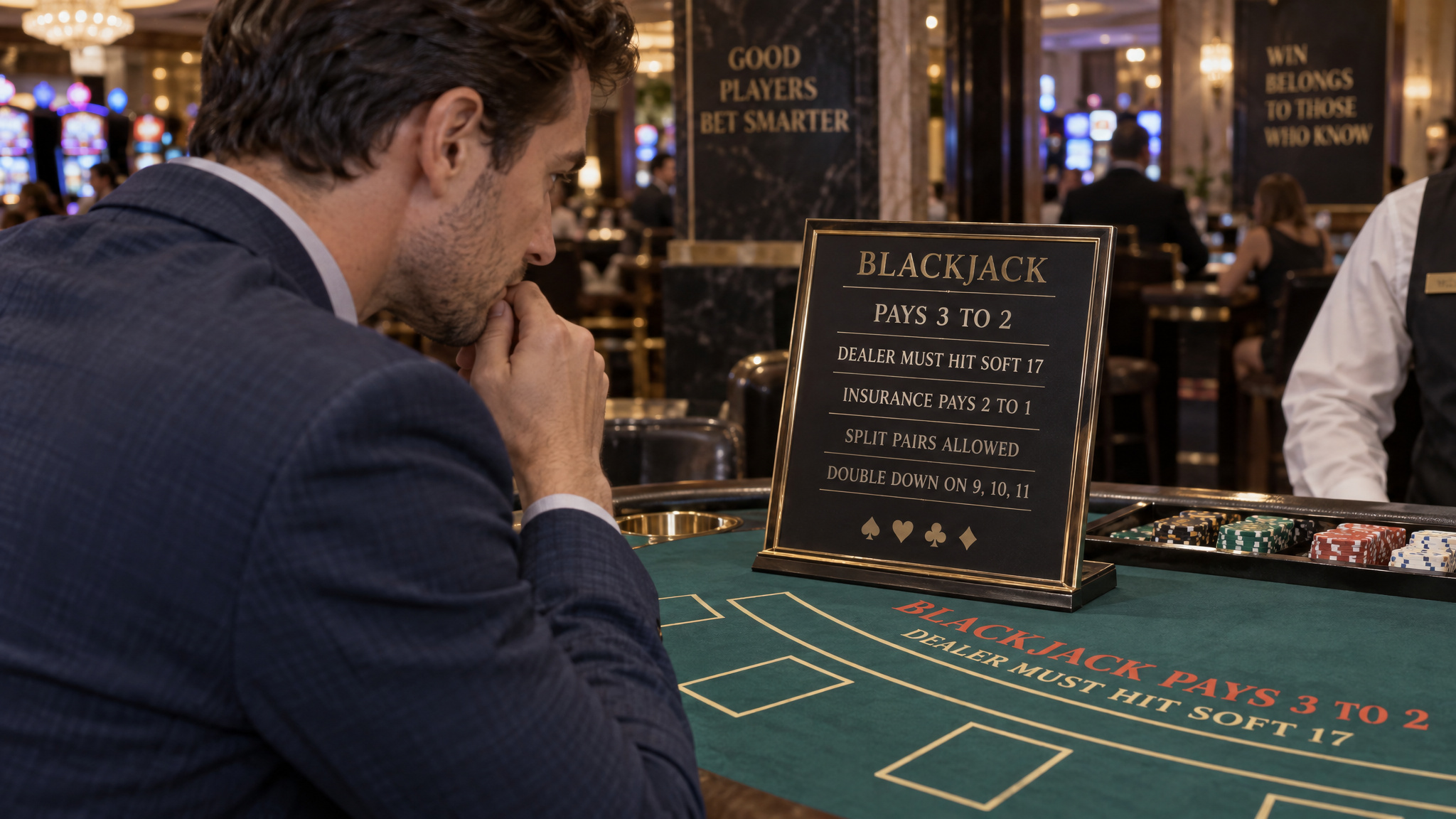
Before a single card is dealt, insist on a table that pays 3:2 on blackjack, never 6:5. Also look for a game where the dealer stands on soft 17, which saves you about 0.22% in house edge compared to a table where the dealer hits soft 17. Playing a flawless chart at a bad table is like buying high-end tires and running them flat: table selection and playing strategy are two separate levers on your bankroll.
Standard dealer rules
At any standard table, house rules force the dealer to draw on totals of 16 and below and stand on 18 or higher. Tables differ on how the house handles the 17 rule when a 6 and an Ace make a soft 17. A rule requiring the dealer to stand on soft 17 shaves roughly 0.22% off the house edge; when the dealer hits soft 17, the house adds about 0.22% back onto its tab.
The rules checklist before you sit down
Plenty of guys grab the first open seat, buy in, and only notice three hands into the shoe that the felt says 6:5 on blackjack. Walk right past any 6:5 game and find a 3:2 table. Beyond 3:2 payouts and the dealer standing on soft 17, scan the placard for four player-friendly rules: early surrender (especially against a dealer 10 or Ace), double down after split, re-splitting aces, and single- or double-deck shoes.
Using the sheet at the table: three ways it fails
To use a printable blackjack cheat sheet PDF at the table, bring a chart that maps the best mathematical decision for every hand against the dealer’s up card and matches your exact game variation and table rules, even when you find the best blackjack you can play online, a 6-deck chart and a single-deck chart aren’t interchangeable because the correct plays shift with the deck count, blackjack variation, and table rules in front of you. Even with a downloadable basic strategy PDF in hand, SiGMA Play Reviews points out three ways players still blow their edge: bringing a chart built for the wrong game variation, failing to adjust when the table blocks moves like doubling after a split (or lacking early surrender when your chart calls for it), and ditching the chart for gut feeling after losing two hands in a row.
Printing a one-page blackjack cheat sheet matched to your table’s rules lets you walk up to any live casino game and play at a 0.50% house edge immediately, and if you want to play without looking down at a card, you can drill the hard, soft, and pair decisions at home the exact same way dealers memorize the book in training. You don’t need a special memory system to do it. Start by locking in the big swings: hitting 12 through 16 against a 7 or higher, splitting Aces and 8s, and doubling 10 and 11.
Around Unfinished Man, we look at a night at the casino the same way we look at tools or everyday gear: don’t pay extra for zero return. Bringing a free printed card to the felt and taking ten seconds to verify the table pays 3:2 saves you roughly 5% on every hand compared to guessing. Keep the card next to your chips, make your call without holding up the dealer, and trust the math when your gut tells you to flinch on a 16.
Frequently Asked Questions
Should you hit on 15 or 16 in blackjack?
With a hard 15 or 16, you must hit whenever the dealer shows a 7 through Ace, and stand when the dealer shows a 2 through 6. Standing against a high up card simply waits for a loss because the dealer is already positioned to build a strong total, whereas low up cards leave the dealer likely to bust. If your 16 is actually a pair of 8s, split them every time, and if it is a soft 15 or 16 (an Ace with a 4 or 5), you can hit without any risk of busting on the first draw or double down against a dealer 5 or 6.
What should you never split in blackjack?
Never split a pair of 10-value cards or a pair of 5s. Breaking up two 10s ruins a made 20 that already beats almost everything the dealer can pull. Two 5s give you a hard 10, which is a prime spot to double down (unless the dealer shows a 10 or Ace) rather than saddling yourself with two weak hands starting at 5.
How much is a queen in blackjack?
A queen is worth 10 points, matching the exact value of a 10, jack, or king. Because four different ranks all carry 10 points, 16 out of the 52 cards in a standard deck are 10-value cards. That heavy concentration of 10s is the reason basic strategy pushes you to double down on 11 and stand on stiff totals when the dealer shows a weak card like a 6.
What are the blackjack card values?
Number cards from 2 through 9 count at their exact face value, while 10s, jacks, queens, and kings each count as 10 points. Aces are flexible and count as either 11 or 1 depending on what keeps your total from going over 21. Holding an Ace counted as 11 gives you a soft hand that cannot bust on a single hit, because drawing a high card simply forces the Ace down to 1.
When should you double down in blackjack and when should you not?
Double down on a hard 10 or 11 against any dealer card from 2 through 9, and double down on soft 13 through soft 18 when the dealer shows a vulnerable 5 or 6. Do not double a hard 10 or 11 when the dealer shows a 10 or an Ace; just take a regular hit so you don’t put twice the money against a likely 20 or blackjack. You also cannot double on a three-card total or when table rules block doubling after a split, in which case the chart’s double command defaults to a normal hit.
Is insurance a good bet in blackjack?
No, insurance is a losing side bet with a steep house edge that steadily drains your bankroll. Offered whenever the dealer flips an Ace up, its payout fails to cover the actual odds of the dealer holding a 10-value card in the hole. You should also turn down even money when holding a natural blackjack against a dealer’s Ace, because keeping your hand collects the full 3:2 payout most of the time instead of settling for 1:1.
How does a blackjack strategy chart work?
A strategy chart is a table-legal probability grid that lists your hand down the left column—grouped into hard totals, soft hands, and pairs—and the dealer’s visible up card across the top row. You cross-reference your cards with the dealer’s card to find a single-letter command: H to hit, S to stand, D to double down (or hit if restricted), and P to split. Casinos let you keep a printed card right on the felt as long as you read it quickly and don’t stall the deal.