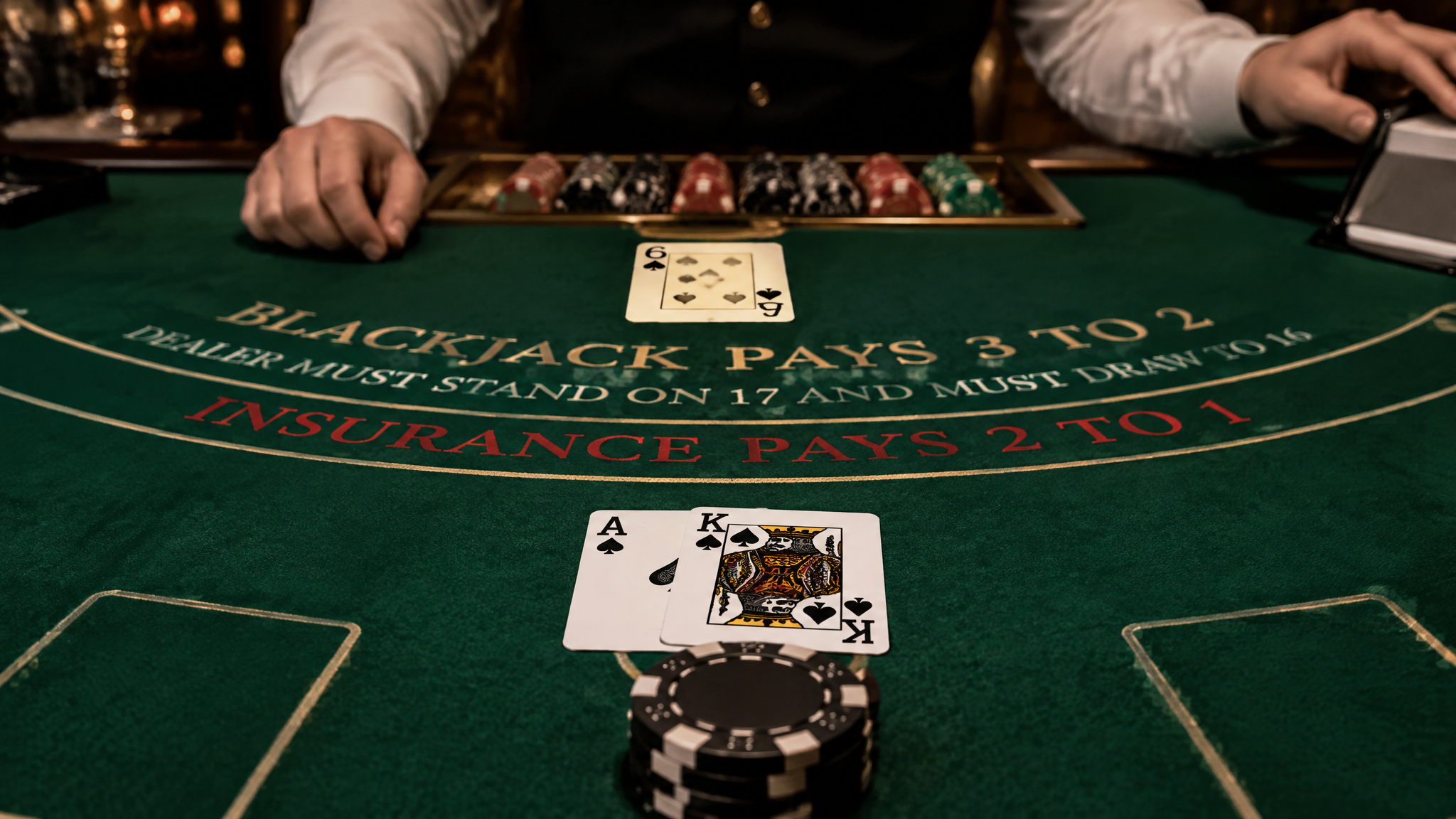
You get dealt two cards at a live table, the dealer stares at you waiting for a hand signal, and suddenly the free, printable chart you glanced at on your phone is useless. A color-coded grid is only layer one of a five-layer system, not the finish line, which is why a real blackjack strategy guide has to teach the expected value behind each cell before moving up to rule variations, table-speed memorization, bankroll management, and card-counting deviations.
Basic strategy gives you the mathematically right move for every hand, yet perfect play still concedes about 0.5% to the house. You don’t win every hand. You just lose less money over time. Don’t drown in dozens of rule-specific PDFs or online calculators. Blackjack Apprenticeship (whose presenter ran card-counting teams and now runs training tools and a community for counters) recommends that 99% of players master one generic downloadable chart first. Save the rule-specific chart tweaks for when you learn count deviations.
Key Takeaways
Perfect basic strategy cuts the casino house edge to about 0.5%, down from the 1% to 2% disadvantage of an average player. That drops your expected hourly losses from roughly $80 per hour to $20 per hour.
Every cell on the chart reflects expected value and bust math: standing on 20 carries an expected value of +0.70 versus +0.20 to +0.25 when splitting 10s, hitting hard 16 carries roughly a 60% bust risk, and a dealer showing a 5 or 6 busts 42% of the time.
Basic strategy is a mandatory floor rather than a winning system; turning the mathematical edge in your favor requires card counting and count-based deviations, such as standing on 16 against a dealer 10 when the running count is positive.
Table of Contents
What is blackjack basic strategy
Basic strategy specifies the single mathematically correct decision (hit, stand, double, split, or surrender) for every possible hand you can be dealt. It’s 1966 mainframe math, not a casino hunch.
Mathematics professor Edward Thorp created basic strategy in 1966 by programming an IBM 704 mainframe in Fortran and using the Kelly Criterion to simulate millions of hands, publishing the results in Beat the Dealer. After reading Beat the Dealer, IBM programmer Julian Braun contacted Thorp, refined the simulation program for Thorp’s revised edition, and later published his own work in How to Play Winning Blackjack (1980).
Dealers and players still call basic strategy “the book” because every cell comes from simulated mathematics rather than table folklore. As casinos altered their table rules over the decades, computer simulations continuously revised the chart to match.
What perfect strategy is worth: the house edge in dollars
Perfect basic strategy is an expected-value decision floor that cuts the casino house edge to about 0.5%. The average player sits at a 1% to 2% disadvantage because they play by gut feel or table superstition. At typical stakes, that expected value (EV) gap translates to roughly $20 per hour in expected loss for a perfect basic strategy player versus roughly $80 per hour for an average player.
A 0.5% house edge still favors the casino, meaning the chart is a mandatory floor rather than a menu of suggestions. The biggest beginner mistakes that forfeit expected value are verifiable departures from the chart: taking insurance or even money, standing on soft 18 against a dealer 2 through 6, hitting a pair of 8s (hard 16) into a roughly 60% bust risk, and misplaying hard 16 against a dealer 10.
Table payout rules shift the math before a card is even dealt. A 3:2 natural blackjack payout rewards $150 on a $100 stake, whereas 6:5 tables exist to accommodate more bet types and offer worse odds to players fooled by the larger-looking numbers.
The blackjack basic strategy chart: hard and soft totals
The blackjack basic strategy chart is the complete decision grid for hard, soft, and pair hands, built for the 80% of US casinos where the dealer hits soft 17 (H17). Across vegas.com, CEG Dealer School, and Vegas Aces chart rules, once you take a hit on any hand, you treat the resulting total as a hard hand from that point forward. Stiff totals (13 through 16) stand against dealer bust cards 2 through 6 and hit against 7 through Ace. Soft hands use the flexible Ace to double against weak upcards. That includes the three-way soft 18 row, where players who say “I usually stand” immediately fail Blackjack Apprenticeship’s test question for knowing basic strategy.
Hard totals
The blackjack basic strategy chart divides hard totals (hands without an Ace counted as 11) into five clear rows:
- Hard 8 or less: always hit.
- Hard 9, 10, or 11: double down per the chart against weak dealer upcards (doubling requires an equal additional bet for exactly one more card); otherwise hit.
- Hard 12: stand against dealer 4 through 6; hit against 2, 3, and 7 through Ace.
- Hard 13 through 16: stand against dealer 2 through 6; hit against 7 through Ace.
- Hard 17 through 21: always stand.
Soft totals and the soft 18 row
Soft hands count an Ace as 11, meaning you can’t bust on a single hit:
- Soft 13 through 17 (A-2 through A-3, A-4 through A-5, A-6): hit normally, or double down against weak dealer bust cards depending on the upcard.
- Soft 18 (A-7): double against dealer 2 through 6 (or 3 through 6 with a stand on 2 under S17 charts), stand against 7 and 8, and hit against 9, 10, or Ace.
- Soft 19 through 21 (A-8 through A-10): always stand.
Soft 18 is the most notorious row on the chart because players who think they know basic strategy almost always stand on it instinctively, treating 18 as a lock. Doubling a soft hand against a weak upcard bets on the dealer busting rather than your own hand making 20. In one played example doubling soft 15 against a dealer 6, even the worst draw (a 7 for hard 12) is acceptable, and the dealer drew a 7 on 16 to bust and pay $200.
Surrender
Surrender is an optional first-decision forfeit of half your bet to exit a losing hand, used in basic strategy only on hard 16 (excluding a pair of 8s) against a dealer 9, 10, or Ace, and on hard 15 against a dealer 10. When surrender is unavailable on hard 16 against a dealer Ace, you hit. You’re likely to lose the hand either way, but hitting loses less money over the long haul than standing.
Never take insurance or even money
Never take insurance. Never take even money. Standard basic strategy, per Vegas Aces, rejects both wagers unless you possess elite card-counting skills.
Insurance is a side bet that the dealer holds a 10 underneath an Ace upcard. When you hold a natural blackjack against a dealer Ace and the dealer offers “even money,” they’re offering the exact same losing insurance side bet in disguise.
Every card drawn shifts bust and blackjack probabilities across the shoe. While one CEG Dealer School play-session presenter stated an anecdotal preference for taking insurance when holding a 20, that’s one player’s table habit rather than chart math. Stick to the standard chart rule and decline the bet every time.
How splitting works in blackjack at the table
Knowing the pair chart won’t keep the game moving if you mishandle your chips or touch the cards on the felt. At a live table, you signal a split with two fingers and match your original bet, though exact house rules vary from pit to pit.

What a split is and how to signal it
A split, per ReadWrite, takes two initial cards of the same numerical value (such as two 8s or two 10-value cards) and divides them into two separate hands, requiring an additional wager equal to your original stake. At a live table, you signal a split without touching the cards by raising two fingers in a V-shape and placing an equal chip stack next to your original bet. You then play the hand on your right first until you stand, hit 21, or bust, before moving to the second hand.
Split rules that vary by table
Double After Split (DAS) is a table rule variation that lets you double your bet for one card on a newly split hand. It’s common across casinos, including online casinos that offer 0 wagering requirement bonuses, though it isn’t universal. Whether a table offers DAS determines if splitting small pairs like 4s is profitable. Most tables also allow re-splitting up to three times for a maximum of four total hands (except on Aces), though some tables limit you to a single split. Always ask the dealer for the table’s specific split rules before betting.
Always split aces in blackjack
Always split Aces. Even when the dealer shows an Ace upcard, splitting a pair of Aces is an automatic basic strategy rule with no exceptions.
Ten-value cards (10, J, Q, K) outnumber every other rank in the shoe. Splitting Aces gives you two separate shots at catching a 10 to make 21, and even when a split Ace draws a lower card, the hand can still win whenever the dealer busts.
Live tables attach a specific restriction that catches players off guard. Split Aces typically receive only one card each, and drawing a 10-value card on a split Ace counts as an ordinary 21 with a 1:1 payout (even money) rather than a 3:2 natural blackjack payout.
Always split 8s in blackjack
Always split 8s, regardless of the dealer’s upcard, and re-split them up to the table limit whenever you draw another 8. Two 8s form hard 16, the worst total in blackjack, and hitting a hard 16 carries roughly a 60% bust risk.
Splitting a pair of 8s escapes that 60% bust risk on a single bad hand and converts it into two playable hands starting at 8. Because 10-value cards are the most common rank in the deck, drawing a 10 on either half turns a near-doomed 16 into a competitive 18.
Never split 10s in blackjack
You should never split 10-value cards in blackjack because standing on a hard 20 carries an expected value (EV) of +0.70, whereas splitting 10s drops your expected value on the split decision to between +0.20 and +0.25.
A total of 20 is the second-best hand in blackjack behind 21. Breaking up a made 20 to chase two uncertain hands forfeits roughly half a bet of expected value every single time you do it. Keep the 20 and let the dealer try to beat it.
Never split 5s in blackjack
Never split a pair of 5s because together they form a hard 10, one of the strongest doubling hands at the table. Once you reject the split on the pair row, follow the hard-10 chart row: double down against a dealer 2 through 9, and hit against a dealer 10 or Ace.
When to split 2s, 3s, 4s, 6s, 7s, and 9s
Splitting pairs in blackjack is governed by a two-camp decision rule: you split either to improve a weak starting total or to get more money on the felt when the dealer is likely to bust. Aside from always splitting Aces and 8s and never splitting 10s and 5s, conditional pair splits depend on the dealer’s upcard and are anchored by a 42% dealer bust probability whenever the dealer shows a 5 or 6 (card counters may deviate based on the count):
- Split 2s, 3s, and 7s against dealer 2 through 7.
- Split 6s against dealer 2 through 6.
- Split 9s against dealer 2 through 6 and 8 through 9 (stand against 7, 10, or Ace).
- Split 4s only against dealer 5 or 6 when Double After Split (DAS) is allowed.
Split 2s, 3s, and 7s vs dealer 2-7
Weak dealer upcards improve the odds of winning both hands, but you never split 7s against a dealer 8 or higher. In an A1 Blackjack played example holding 7s against a dealer 8, standing on 14 or hoping for 17 won’t beat 18, so the player hit to 19 against the dealer’s 18 and won $100.
Split 6s vs dealer 2-6
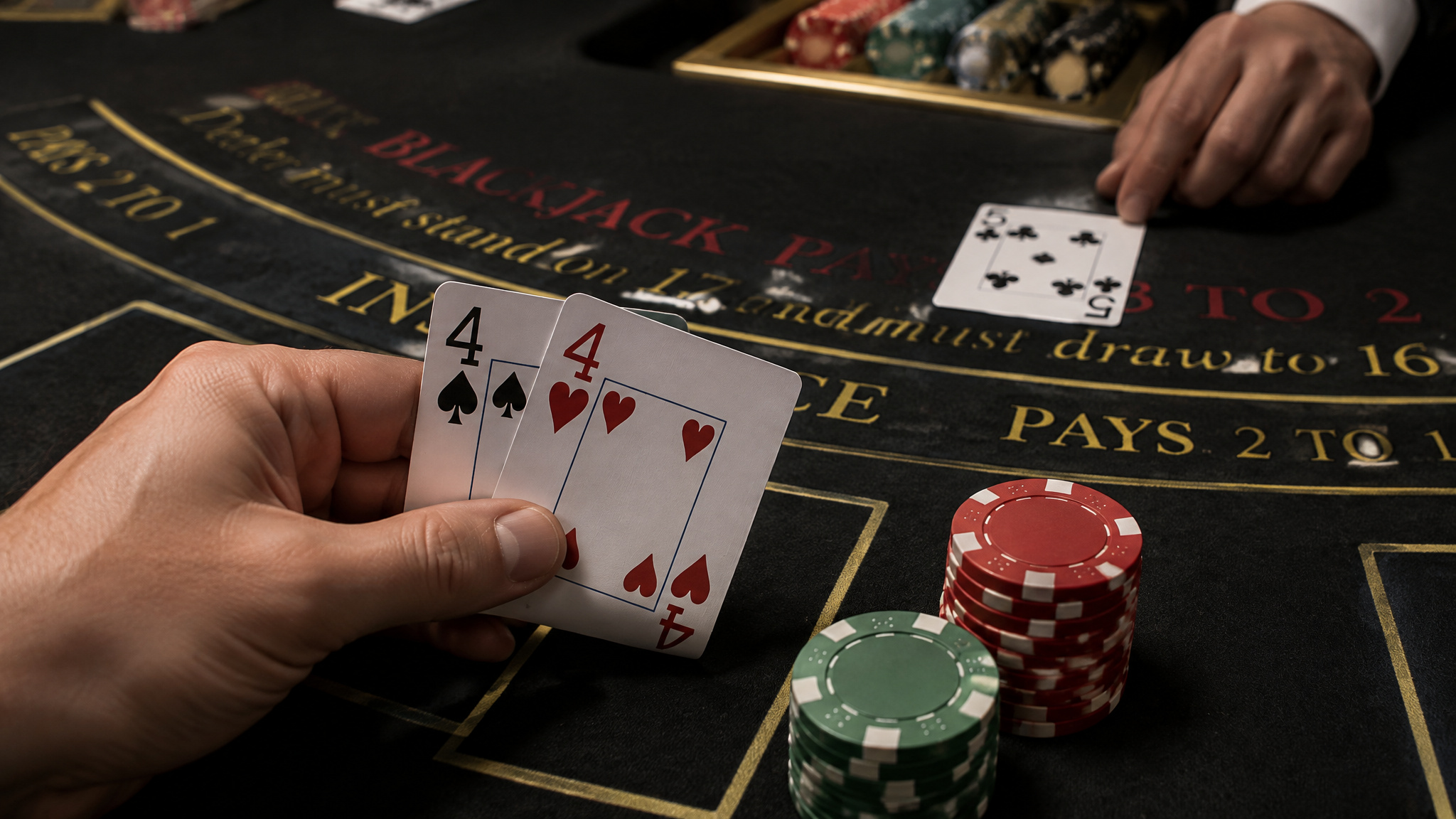
Splitting 6s against a dealer 2 through 6 escapes a stiff 12 against a bust-prone dealer upcard. In a played example against a dealer 4, the player split 6s, drew a 9 to double down, and won when the dealer flipped a 5 under the 4 for 15 and busted (even drawing a 7 for 12 is fine because the play targets the dealer busting).
Split 9s vs 2-6 and 8-9
Split 9s against dealer 2 through 6 and 8 through 9, but keep them together against a 7, 10, or Ace. Standard chart rules stand on 18 against a 7, 10, and Ace because 18 already beats a dealer 7 upcard and splitting risks two weaker hands.
Split 4s only vs 5-6
If the dealer has a 2, 3, 4, 7, 8, 9, 10, or Ace, then with a pair of 4s you should hit instead of splitting; split 4s only against dealer 5 or 6. That split only works when Double After Split (DAS) is allowed, letting you capitalize on the dealer’s 42% bust probability on a 5 or 6 upcard.
Which blackjack chart matches your table’s rules
Yes, the blackjack strategy chart changes when the dealer hits soft 17 (H17) versus stands on soft 17 (S17), whereas the number of decks barely moves the math. Roughly 80% of US casinos deal H17 games, so the generic Blackjack Apprenticeship chart assumes H17, which flips specific cells like doubling 11 against a dealer Ace and doubling soft 19 (A-8) against a 6, while deck-count differences between single-deck, double-deck, and 6-to-8-deck shoes shift the house edge by only about 0.001%.
S17 vs H17: the rule that actually changes cells
A plastic blackjack basic strategy card bought in a casino gift shop (per Vegas Aces) is completely legal to consult at the live table, but it’s built for a 4-to-8-deck shoe under S17 rules where the dealer stands on soft 17. First-time visitors routinely buy that S17 gift-shop card and sit down at an H17 table without noticing the felt says the dealer hits soft 17, leaving a few edge-case cells (such as standing on soft 18 against a 2 under S17/H17 rules instead of doubling) slightly mismatched unless they grab a rule-specific basic strategy PDF.
Deck counts: why per-deck charts are a waste
Hunting for separate per-deck charts is a waste of study time for 99% of players because that 0.001% edge difference is a rounding error, despite minor cell tweaks like hitting A-7 against an Ace in single-deck H17 or splitting 7s against an 8 and 6s against a 7 in double-deck S17. European no-hole-card blackjack is the one genuine exception where the dealer takes no second card until players finish acting, which requires a different chart entirely.
Blackjack variant split rules compared
Blackjack variants alter pair strategy by expanding or stripping away re-split and Double After Split (DAS) permissions, with Spanish 21 offering the most permissive rules and Double Exposure and European Blackjack enforcing the strictest bans. Per ReadWrite, always verify the house rules with the dealer before sitting down, as Premium or VIP tables permit re-splitting Aces while dealing only one card per split Ace:
| Blackjack Variant | Re-split Aces | Double After Split (DAS) |
|---|---|---|
| Spanish 21 | Yes | Yes |
| Double Exposure Blackjack | No | No |
| Blackjack Switch | No | Yes (permitted after splitting Aces) |
| European Blackjack (no hole card) | No | No |
How to memorize the basic strategy chart: 21 phrases
The 21-phrase method is Blackjack Apprenticeship‘s verbal compression system that turns the entire basic strategy chart into 21 recited sentences for table-speed play. A printable PDF or plastic card is only a study reference, and you have to master the chart row by row before adding casino pressure. Instead of memorizing hundreds of isolated grid squares, the splits portion of the 21-phrase method (“always split aces and eights, never split tens and fives…”) compresses the entire pair-splitting grid into a handful of lines.
The 21-phrase recitation method
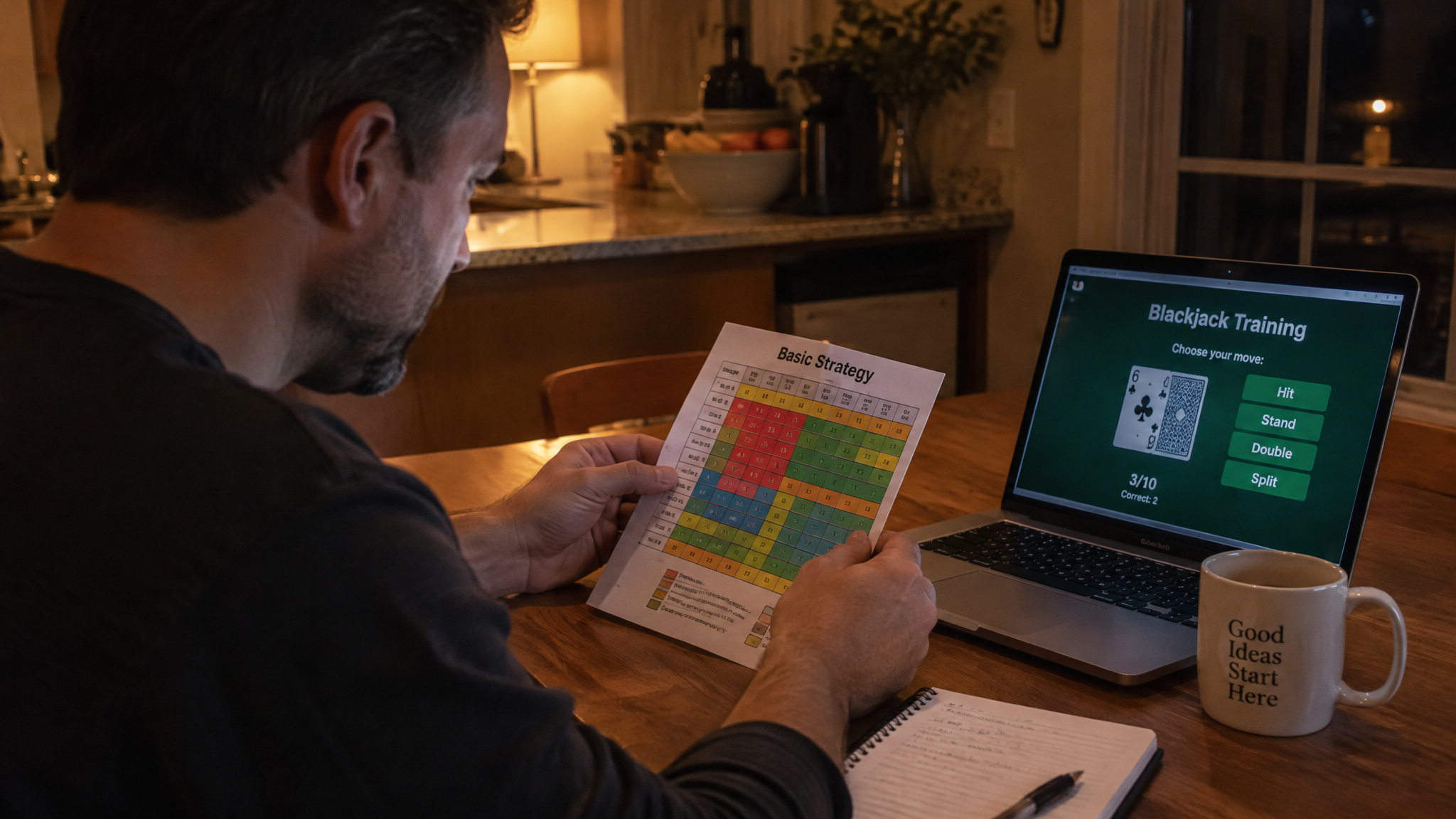
Memorize the basic strategy chart by reciting one chart row at a time until it’s automatic, starting with “always split aces” on the pair chart before moving into hard and soft totals. Take one section of the chart, drill the exact phrasing out loud, and make sure you nail the three-way soft 18 row (double against 2 through 6, stand against 7 and 8, hit against 9, 10, or Ace) before advancing to the next block.
Reciting the 21 phrases in order builds a mental script you can run in two seconds when the dealer points at your cards.
Practice with tools that flag mistakes
Being able to recite the 21 phrases in your living room is only half the job; you next have to drill hands using blackjack basic strategy trainers that actively flag your mistakes. Playing casual online hands where nobody corrects a bad stand on soft 18 or a missed double on hard 9 only reinforces bad habits.
Use a free web basic strategy drill, an iOS trainer app, or paid drills that test 2-, 3-, and 4-card hand totals so every chart departure triggers an immediate alert. A shaky basic strategy foundation undermines every advanced skill stacked on top of it. When you can’t recall a chart row instantly, your running count, bet sizing, and playing deviations fall apart under live casino pressure.
The 2-1-2 betting strategy and bankroll basics
The 2-1-2 progression is a system of positive progression units that reshapes session swings without changing the 0.5% house edge: start at 2 units, drop to 1 unit after a win, add 1 unit on each subsequent win, reset to 2 units on a loss, and hold your bet level on a push. In a CEG Dealer School test session ($500 combined buy-in at $250 each using $5 red, $25 green, and $100 black chips, $5 to $10 base bets peaking at $30 to $45 system bets, including a hand where presenter Raquel split 3-3 against a dealer 6 and doubled after the split), roughly 20 minutes of play ended the first shoe up just $10 combined, showing that unit sizing and knowing when to walk protect your bankroll.
Where basic strategy ends and card counting begins
No, basic strategy alone isn’t enough to win at blackjack, except as the mandatory foundation before card counting for players who want a mathematical edge over the house. Perfect basic strategy is a fixed floor that cuts the casino’s advantage to 0.5%, whereas card counting tracks the ratio of high to low cards to tell you when to raise your bets and when to use a count-based deviation, such as standing on 16 vs dealer 10 at a positive count instead of following the chart’s rule to hit at a running count of zero or lower.
In one played hand at a low count, hitting 16 against a dealer 10 drew a 4 for 20 to push the dealer’s 20. Serious counters size their bets using the same Kelly Criterion mathematics that Edward Thorp used in 1966 to compute the original chart, and the Blackjack Apprenticeship presenter’s card-counting teams reportedly won roughly $4 million across his 15 years of playing and teaching. Because counters beat the game by deviating from “the book,” Vegas Aces notes that casino floor managers and dealers also study basic strategy so they can spot advantage players and protect their tables.
Frequently Asked Questions
When should you split in blackjack?
You always split Aces and 8s regardless of what the dealer shows, and you never split 10s or 5s. For the remaining pairs, your move depends on the dealer’s upcard: split 2s, 3s, and 7s against a dealer 2 through 7; split 6s against a 2 through 6; and split 9s against a 2 through 6 or an 8 through 9 (standing against a 7, 10, or Ace). As for a pair of 4s, you only split them against a dealer 5 or 6, and only if the table permits Double After Split (DAS).
What is surrender in blackjack?
Surrender is an optional rule on your initial two-card decision that lets you forfeit the hand immediately and recover half of your wager. Basic strategy calls for surrendering in only two spots: when you hold a hard 16 (other than a pair of 8s, which you split) against a dealer 9, 10, or Ace, and when you hold a hard 15 against a dealer 10. If your table doesn’t offer surrender on a hard 16 against an Ace, you should hit instead of standing to lose less money over the long run.
What is DAS in blackjack and when does it matter?
DAS stands for Double After Split, a table rule that lets you double your wager for a single draw card on a hand you just created by splitting a pair. It matters most when you are dealt small pairs against bust-prone dealer upcards—specifically a pair of 4s against a dealer 5 or 6, where the dealer has a 42% probability of busting. You only split 4s against a 5 or 6 when DAS is permitted; without it, you simply hit the hard 8.