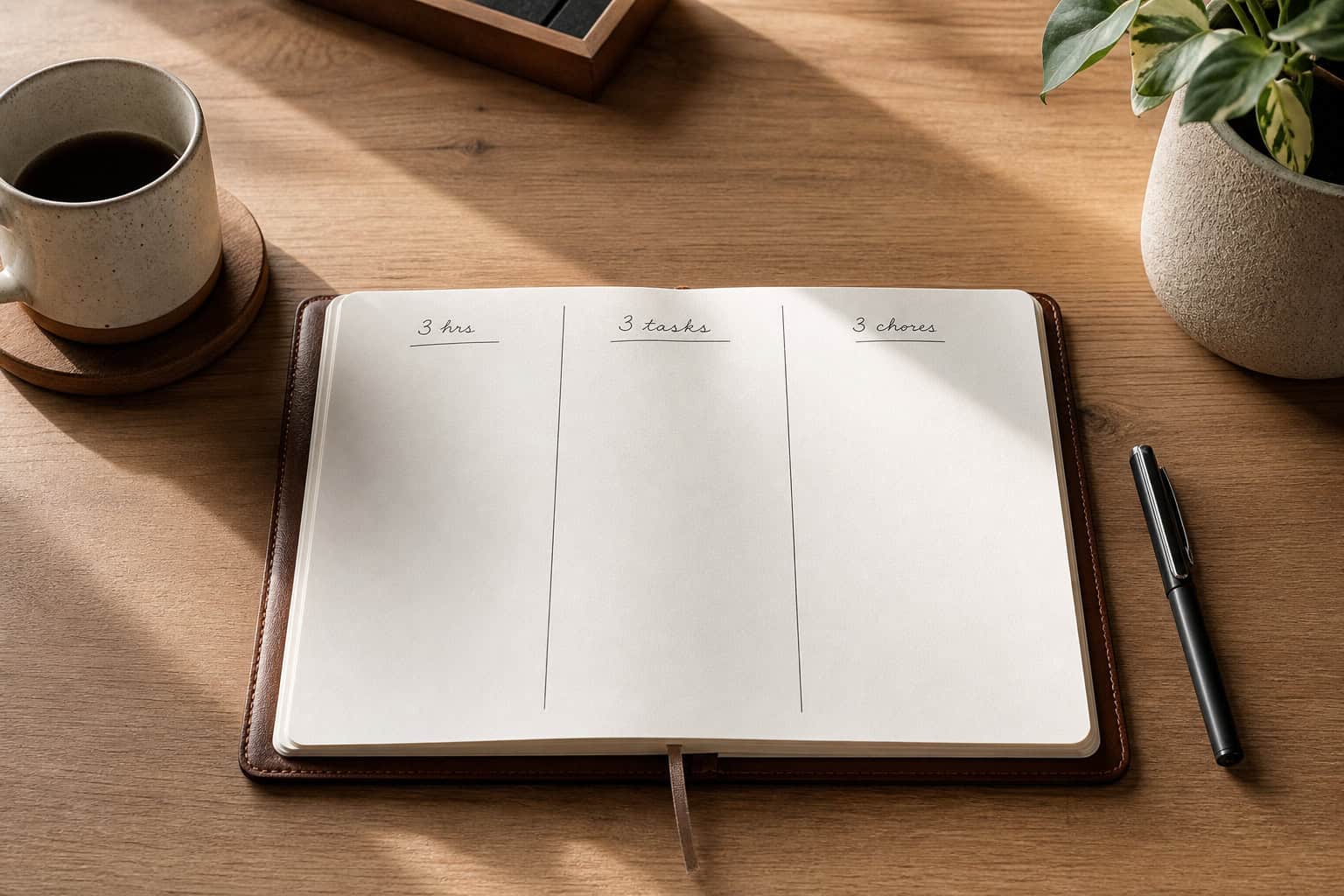
You know that feeling. It’s 5 pm and you’ve been busy all day — firefighting emails, hopping between meetings, ticking off little tasks, yet the one thing that actually matters is still sitting there, untouched. You feel like you worked hard but accomplished nothing. The list never gets shorter. The guilt builds.
I’ve been there. I’ve tried every productivity system that promised to fix it, and most of them just gave me a longer list of things to do differently. But then I came across something that actually stuck: the 3-3-3 method. Oliver Burkeman popularized it in his book Four Thousand Weeks: Time Management for Mortals, and the whole thing is disarmingly simple.
You spend three hours on your most important task, complete three shorter tasks you’ve been avoiding, and do three maintenance activities. That’s it. Nine purposeful actions per day. A clear finish line.
It sounds almost too easy. But the power isn’t in cramming more in — it’s in giving yourself permission to stop after nine things. No guilt. No “I could have done more.” Let me show you what it looks like and why it actually works.
Key Takeaways
The 3-3-3 method limits your day to 3 hours of deep work, 3 shorter tasks, and 3 maintenance activities — nine total actions, then you’re done.
Research and historical examples (Charles Darwin, Henri Poincaré, monks at the Monastery of Christ in the Desert) show that humans can sustain high-quality mental focus for only 3–4 hours daily.
The method eliminates “never enough” thinking by providing a concrete stopping point; the key mindset shift is Fr Simeon’s response when the work bell rings: “You get over it.”
Table of Contents
What Exactly Does the 3-3-3 Method Look Like?
Let’s break it into the three buckets, because the devil’s in how you fill them. For example, Charles Darwin’s three-hour deep-work block consisted of two 90-minute sessions on the theory of evolution, followed by walks and naps.
The three-hour deep-work block
This is the heavy lift. Three uninterrupted hours on the one thing that actually moves the needle — developing a strategy, writing a report, analyzing data, prepping for a key meeting. No notifications, no open browser tabs, no meetings. Silence your phone, close the door, protect this time like it’s the only thing that matters.
Because in this system, it kind of is. Most people have their highest energy in the morning, so that’s where this block goes. Don’t waste your peak mental power on email.
Three shorter tasks you’ve been dodging
These are the tasks that don’t require deep focus but you’ve been putting off. The email you need to send, the follow-up you’ve been avoiding, the decision you need to make, the awkward call you keep rescheduling. Three of them. That’s it.
Limit yourself. You could probably find twenty things, but the point is to clear the mental clutter without overwhelming yourself. Knock them out in the midday slot when your focus naturally dips.
Three maintenance activities
The boring stuff that keeps your life from falling apart. Responding to emails, updating your task list, tidying your desk, throwing in a load of laundry, planning tomorrow. These aren’t glamorous, but they close mental loops. Do them in the afternoon or evening.
When all three are crossed off, your day is complete. That’s nine things total. Not a 50-item to-do list that makes you want to crawl back into bed.

Why Three Hours? The Science of Focus Limits
Three hours sounds arbitrary until you look at the evidence. Research shows that humans can only sustain serious mental focus for about three to four hours a day. After that, you’re just spinning your wheels — making errors, re-reading paragraphs, feeling busy without making progress.

Alex Pang’s book Rest documents this pattern across history. Charles Darwin worked on the theory of evolution in two 90-minute sessions plus one hour per day at Down House. That’s three hours. He changed the world, and the rest of his day was walks, naps, and letters.
Henri Poincaré, the mathematician, worked two hours in the morning and two in the afternoon — four hours total, the upper limit. Thomas Jefferson, Charles Dickens, Virginia Woolf, Ingmar Bergman, same pattern. A few hours of deep work, then they did other things.
If that feels like a cop-out, consider the monks at the Monastery of Christ in the Desert in New Mexico. Their daily work period is exactly three hours, ending at 12:40 pm. No exceptions. When Jonathan Malesic asked Fr Simeon, a former defense attorney turned monk, what to do if work is unfinished when the bell rings, he said: “You get over it.”
That’s not laziness. That’s wisdom.
Bottom line: Your brain can only sustain serious focus for 3–4 hours daily. After that, you’re making errors, not progress.
The Real Benefit — Permission to Stop
Here’s the part most productivity methods miss, including best times for deep work. The 3-3-3 method isn’t about squeezing more out of your day. It’s about removing the “never enough” feeling. You do your nine things, and you’re done. No guilt.

Burnout doesn’t come just from external pressure. It comes from the internal demand for constant productivity — the voice that says you should have done more, even after a full day. The valuable skill isn’t pushing harder. It’s knowing when to stop and recuperate, even when work remains unfinished. Fr Simeon’s “you get over it” is the mindset you’re training.
You don’t need to eliminate all interruptions from your day. That’s impossible. You just need to protect your three to four hours of deep work. If the rest of the day is scattered chaos, that’s fine.

You got your important stuff done. Focus on that, and let the rest slide.
How to Apply the 3-3-3 Method — A Step-by-Step Day
Here’s how it breaks down hour by hour.
Plan the night before. Before you close your laptop, write down your 3-3-3 for tomorrow. Marc Andreessen uses a simple 3×5 notecard. Low-tech, effective.
Decide your three-hour deep-work task, the three shorter tasks, and the three maintenance activities. It takes five minutes and saves you an hour of decision-making in the morning.
Morning — protect the block. First thing, put your phone on airplane mode, close your browser tabs, and dive into your priority project. Three hours. Developing strategy, writing a report, analyzing data — whatever moves the needle most.
Whatever your most important work is, do that. No meetings, no email, no Slack.
Midday — clear the clutter. Shift into your three shorter tasks. The emails you’ve been avoiding, the approval you need to give, the appointment you need to book. Knock them out. It feels good to clear that mental weight.

Afternoon/evening — maintenance mode. Finish with your three maintenance activities. Inbox zero, tidy your desk, plan tomorrow, pay that bill. These close out the day cleanly.
If you’re on a 9 9 6 rule work schedule, these pockets of order are vital for reclaiming rest. Cross each item off as you go. When all nine are done, you’re done. Close the laptop. Go home.
The method is flexible by design. Ideally the three hours are consecutive, but if your schedule forces a split (two hours morning, one hour afternoon), that’s fine. Adjust the timing to fit your life. The goal is steady progress, not perfection.
How to Choose Your 3-3-3 Tasks (Using the Eisenhower Matrix)
The hardest part isn’t structuring the day — it’s deciding what goes where. You’ve got nine slots. What deserves them?
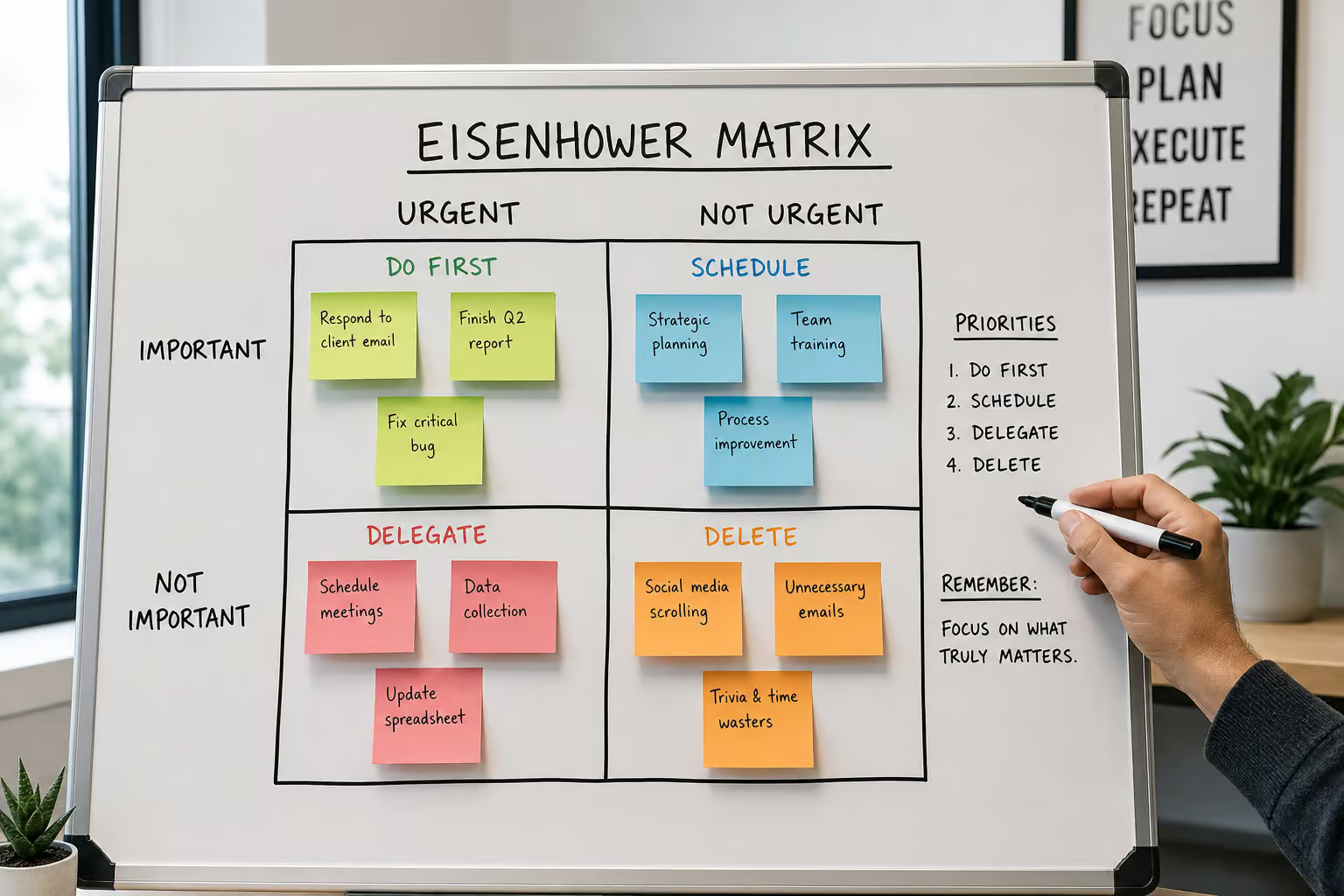
The Eisenhower Matrix is a great companion here. It sorts tasks by urgency and importance. Important, high-impact work belongs in your three-hour deep block. Urgent but lower-effort tasks — the things that need to get done today but don’t require deep thinking, go into your three shorter tasks. Routine, administrative stuff fits into maintenance.
This prevents busywork from crowding out meaningful progress. Don’t let the urgent kill the important. Setting priorities helps reduce stress by focusing on important tasks first, avoiding last-minute rushes. Use the matrix to triage, then plug the results into your 3-3-3 buckets. Limit each category to three items. That forces real prioritization.
Adapting the Method — Flexibility, Mistakes, and Who It’s (and Isn’t) For
This method isn’t a religion. It’s a tool. If your job is mostly reactive — customer support, urgent client demands, three consecutive hours might be impossible. Do what you can.
For a salesperson with back-to-back client calls, the three-hour block might be two hours in the morning and one in the afternoon. The three shorter tasks could be follow-up emails, and maintenance could be CRM updates.

Two hours in the morning, one in the afternoon. Or just protect one hour. Something is better than nothing.
Common mistakes: overloading any category with more than three items, treating the method as rigid (if it doesn’t work one day, adjust, don’t abandon it), and letting meetings steal your deep-work block by default. Block that time on your calendar and defend it. Meetings can wait.
Who is this for? Leaders, knowledge workers, remote or hybrid teams. People who feel weighed down by endless lists and need structure without micromanagement. People who want to reduce stress and reclaim focus. It works well within the first week — most people notice improved clarity and less overwhelm.
Who is it not for? Perfectionists chasing the next hack. If you need to do everything perfectly, this will drive you crazy. It’s about good enough.
Also worth noting from The Passion Paradox: it’s okay to let work be work. Your career doesn’t have to be your purpose. If your job is a means to an outside end, focus on that end outside of work.
Complementary Systems — What Bezos, Andreessen, and Others Do
The 3-3-3 method isn’t an island. It aligns with patterns used by some of the most productive people around.

Jeff Bezos limits himself to three big decisions per day. Each one takes real energy. Beyond that, decision quality degrades. Sound familiar? It’s the same principle as the three-hour deep block — your mental bandwidth is finite, so choose carefully.
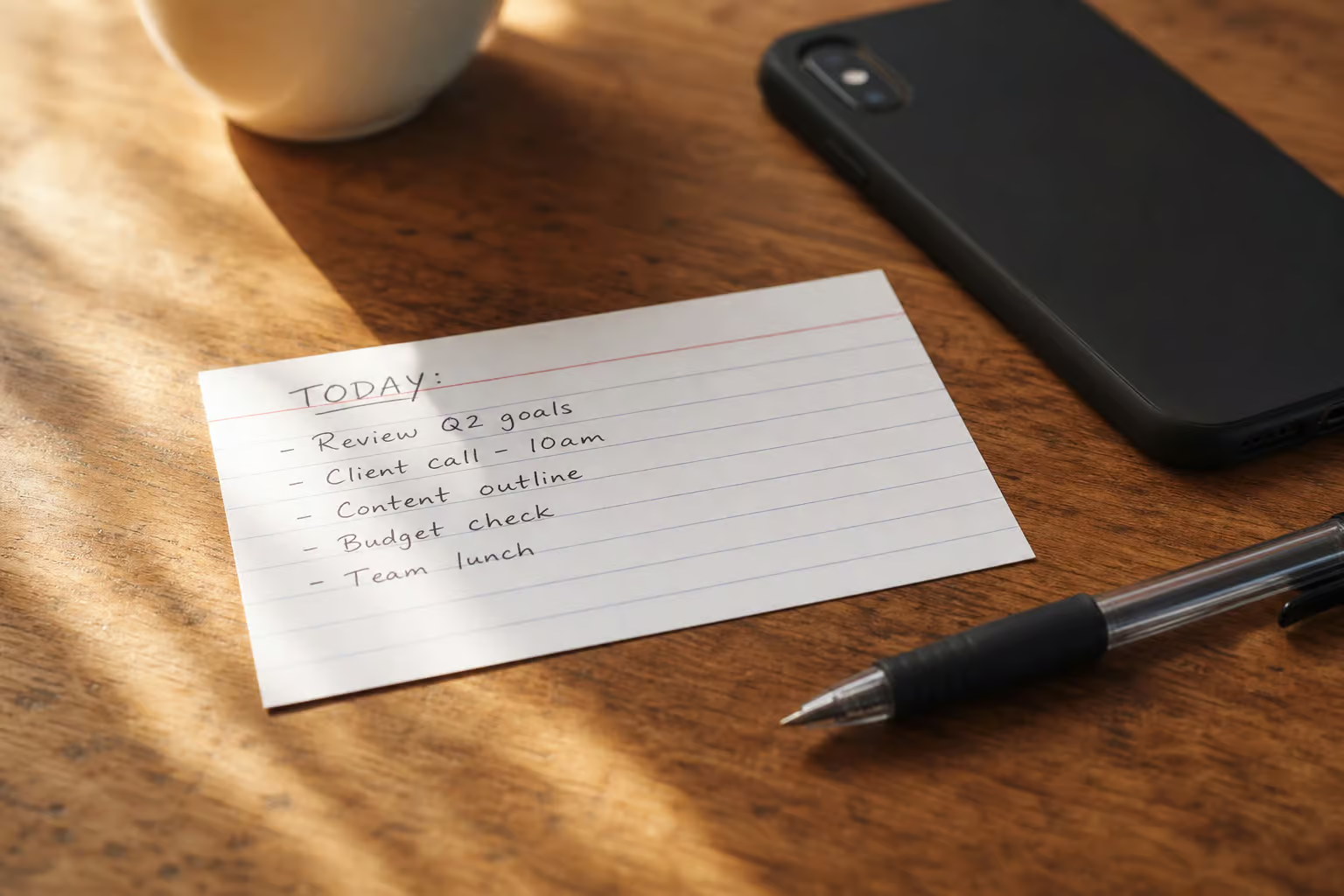
Marc Andreessen keeps three lists: to-do, watch, later. He uses a 3×5 notecard to plan the next day. He also suggests strategic procrastination — if you’re avoiding the big thing, do something else productive instead of scrolling your phone.
The perfect workday exercise: Take a piece of paper and split it in half. On the left, sketch your current workday hour by hour. On the right, sketch your ideal workday. Then look at the gap.
Identify one or two small steps that would move you closer to the right side. You don’t need to overhaul your life — just make incremental changes.
For non-linear challenges (big potential rewards): avoid distractions, ask foundational questions (Socratic questioning), and pick the most leveraged approach. That’s the kind of thinking that produces asymmetric outcomes. Apply it to your three-hour deep-work block.
A Quick Clarification — The 3-3-3 Method vs. the Grounding Technique
Before you head off to search for “3-3-3 method anxiety,” let me clear something up. There’s a separate grounding technique used for anxiety relief that goes like this: name three things you see, three sounds you hear, and move three body parts. It’s a useful tool for acute panic, but it’s completely different from the productivity method.
This article covers the productivity version: three hours deep work, three shorter tasks, three maintenance activities. Both are valid, just different purposes. If you came here looking for the anxiety technique, now you know. If you came here for structuring your workday, keep reading.
The Permission Slip — Your Day After 9 Actions Is Complete
The three-hour focus limit isn’t a weakness. It’s a sustainable pattern that geniuses and monks have respected for centuries. The 3-3-3 method gives you a clear finish line. Cross off nine things, and you’re done. No guilt. No “I should have done more.”
Fr Simeon’s four words capture the entire philosophy: “You get over it.” The work will be there tomorrow. The world won’t end because you stopped at 12:40 pm — or at the end of your ninth action.
Most people notice improved clarity and reduced stress within the first week. It works fast because it’s simple. No apps, no complicated frameworks, no guru bullshit. Just three hours, three tasks, three chores, and a clear conscience.
The only way to find out is to try it. Tonight, write down your 3-3-3 for tomorrow. Tomorrow morning, protect that three-hour block. See how it feels to stop after nine actions. You might find that less is, in fact, enough.
People Also Ask
What is the 3-3-3 rule for working?
It’s a framework for structuring your workday: three hours of uninterrupted focus on a high-impact project, three medium-effort tasks that clear mental clutter, and three routine maintenance activities like email or planning. The method is designed to protect your limited deep-focus capacity and prevent burnout from endless to-do lists.

