
Infidelity is the most common reason couples break up, according to Grøntvedt et al. That holds across 160 cultures, backed by Grøntvedt et al. The same team noted something honest: long-term relationships rarely remain entirely free of transgressions. Researchers such as Ami Rokhal and Sybil H. Chan of York University and Western University have explored these dynamics under a Creative Commons Attribution (CC BY) license.
And when you’re on the receiving end of it, the first question is almost always why.
Between 15% and 25% of marriages will deal with infidelity at some point, per Grøntvedt et al. That is a lot of people asking the same question.
Key Takeaways
Emotional neglect is the most common driver: Thompson’s deficit model frames infidelity as a symptom of low satisfaction, high conflict, and poor communication. Affairs grow in pre-existing cracks.
Different emotional deficits produce different affairs: a Selterman et al. study of 495 participants found that lack-of-love motivation leads to longer, more intimate affairs, while neglect drives shorter, more desperate ones.
The pain of discovery mirrors an infant’s separation from its mother: Johnson et al. showed that betrayal activates the same neural pathways as attachment trauma. It is not “just getting over it.”
Emotional Invisibility: The Most Dangerous Infidelity Driver
When a wife feels emotionally invisible in her marriage, the risk of infidelity rises sharply. This section explores how unmet emotional needs create the conditions for betrayal.
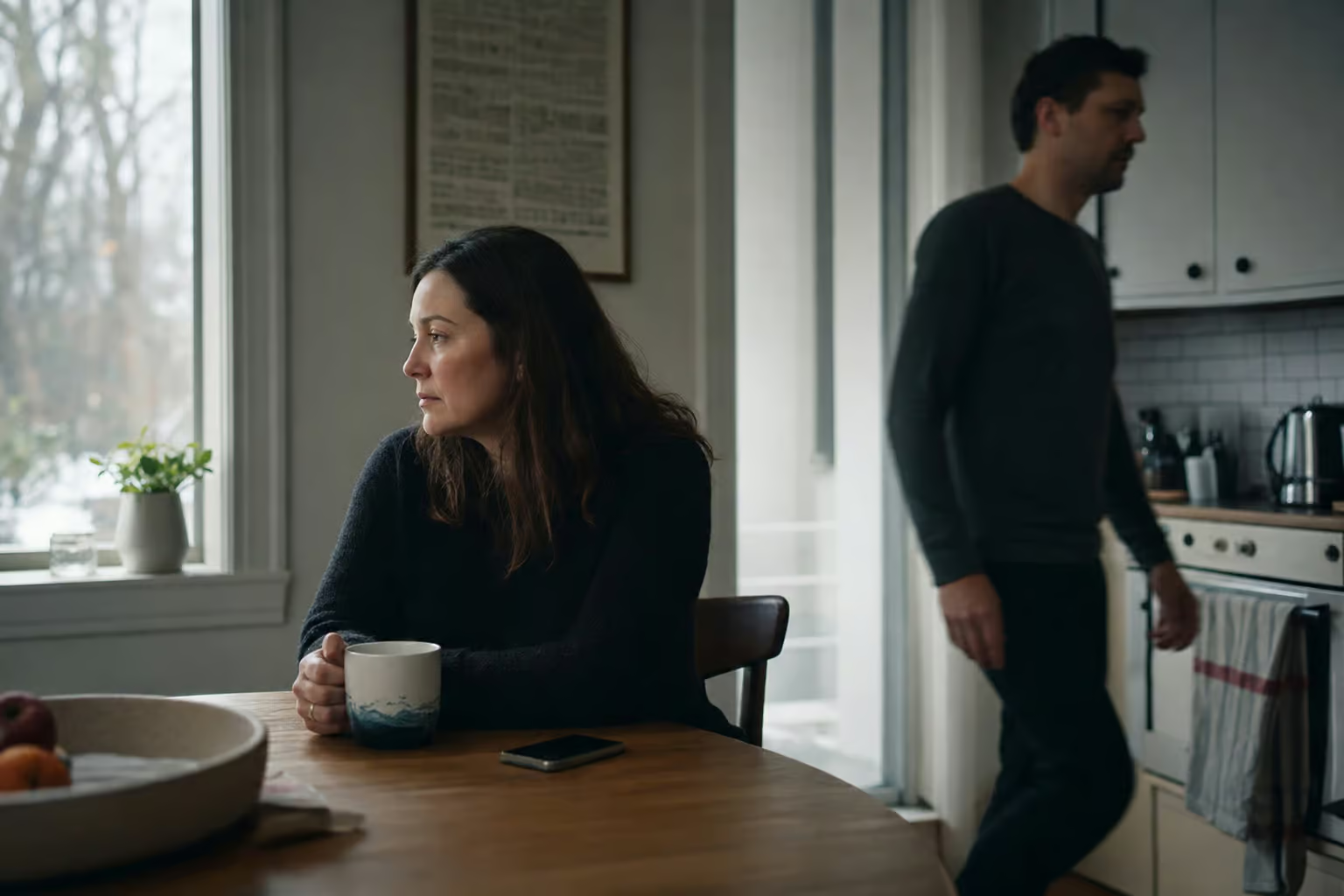
The deficit model: When relationship dissatisfaction predicts betrayal
Thompson’s deficit model is straightforward: infidelity is a symptom, not the disease. The primary relationship was already struggling — low satisfaction, high conflict, poor communication. Affairs don’t pop out of nowhere.
A wife tries repeatedly to communicate her emotional needs. Direct requests. Hints. Tears.
She’s met with dismissal, defensiveness, or silence. Over months or years, she stops trying. Then a colleague or an old friend offers a listening ear. The emotional intimacy that follows feels like a lifeline — at first.
Marital discord and sexual unhappiness are the most frequently cited variables in infidelity research, per Thompson’s deficit model.
How different emotional deficits create different affairs
A Selterman et al. study with 495 participants tracked relationship lengths from one month to 28 years. The motivation behind the affair predicted its shape.
When infidelity was driven by lack of love, the affairs were longer-term. More “I love you” statements. More public displays of affection. Greater emotional satisfaction. These were parallel relationships.
When it was driven by neglect, the affairs were shorter and more desperate. Less emotional satisfaction, but still a powerful pull. The wife was trying to fill a hole that her husband wasn’t seeing.
Affairs motivated by sexual desire or opportunity? Short-lived and emotionally hollow. Research by Symons and Buss (1994, Volume 56, page 1052) further contextualizes these patterns.

Clinical examples from the literature illustrate this, such as Gerald and Samantha. Gerald and Samantha: she was anxious, seeking attention; he was avoidant, shutting down. She eventually found attention elsewhere. They went to therapy and slowly rebuilt trust. Jerry: conflict-avoidant, brushes issues under the rug, feels distant from his wife. Leonna: feels hopeless after her husband’s retirement and depression, confides in a coworker.
The Childhood Roots of Betrayal: Attachment Styles at Work
Attachment theory, from John Bowlby and later Hazan and Shaver, says our early bonds with caregivers shape how we connect as adults. Your wife’s attachment style — how she learned to relate to people when she was a kid, can create specific pathways to infidelity. These attachment styles are built from internal working models formed in childhood, mental templates that shape how a wife expects to be loved or rejected in her marriage.
Anxious-ambivalent attachment: The reassurance-seeking pathway
A woman with anxious attachment constantly seeks reassurance. She craves closeness but fears abandonment. When her partner withdraws — especially if he’s an avoidant type, her anxiety spikes.
She feels invisible, so she finds herself drawn to a more attentive man. Gerald and Samantha are a textbook case: Samantha’s attachment anxiety pushed her to seek attention elsewhere because Gerald couldn’t give her the reassurance she needed.
Avoidant attachment: The distance-creating pathway
The avoidant wife values independence above almost everything. She may feel suffocated by emotional demands. An affair becomes a way to have connection on her own terms — distant, controlled, safe. She is looking for an escape valve.
Disorganized attachment: Acting out unresolved trauma
Disorganized attachment is the most complex — a mix of anxious and avoidant behaviors, often rooted in childhood abuse or neglect. For some women with this style, infidelity can be an unconscious re-enactment of early relational trauma. The chaos and betrayal feel familiar.
The attachment injury parallel: Why discovery feels like infant separation
Johnson et al. compared the emotional pain from infidelity to an infant’s separation from its mother. Same neural pathways. Infidelity is an attachment injury. The betrayed partner’s brain processes it like a child separated from its mother.
Attachment injuries are traumatic interpersonal experiences that violate an individual’s expectation of a trustworthy base for support, as defined in reference [29]. This concept appears in Volume 27, pages 145-155 (Johnson et al., 2001).

Nature vs. Nurture: Who Is Genetically or Personality-Wired to Cheat?
Both biology and environment play a role in infidelity.
The heritability factor: What twin studies reveal
Twin studies suggest 40% of infidelity behavior is heritable, a figure supported by twin studies from PubMed.
Neuroticism and the Dark Triad: Three personality profiles
Neuroticism is the most consistent personality predictor across studies, according to a 2019 systematic review in the Journal of Sexual Medicine. High neuroticism means emotional instability — prone to anxiety, insecurity, and seeking validation. That combination can make someone more vulnerable to an affair.
Dark Triad traits each have their own signature:
- Machiavellianism: strategic, calculated affairs. She’s managing the situation, not falling into it.
- Narcissism: entitlement-driven. She believes she deserves whatever she wants, consequences be damned.
- Psychopathy: low empathy. The harm she causes doesn’t register the same way.
Biology is not destiny: The role of values and choice
When Betrayal Begets Betrayal: The Revenge Affair
Women are over three times more likely than men to cite revenge as a motive for infidelity, per a study in Evolution and Human Behavior. That finding comes from a study published in Evolution and Human Behavior.

The revenge affair is less about the other man and more about restoring a sense of agency and fairness. A wife discovers her husband’s infidelity, or feels deeply wronged by his emotional distance. Rather than confronting the pain directly, she initiates an affair of her own — sometimes with a man she knows will hurt her husband.
These affairs are typically short-lived and emotionally hollow. The confession comes quickly, because the point was never the affair. It was the message.
The Evolutionary Lens: Dual-Mating and Mate-Switching
Two evolutionary hypotheses explain female infidelity as a strategic reproductive choice.
The Dual-Mating Strategy suggests a woman might seek “good genes” from an affair partner while relying on her primary partner for resources and stability. The Mate-Switching Hypothesis proposes that infidelity can be a way to facilitate exit from an unsatisfactory relationship — test the waters before leaving.
These theories also explain the gender difference in jealousy. About 80% of women rate emotional infidelity as worse than sexual infidelity in forced-choice scenarios, per Buss et al. Evolutionary psychologists like Buss and Symons argue this makes sense: women carry the fetus and depend on the partner for provision, so the threat of him leaving (emotional involvement with someone else) is more dangerous than a one-night stand. But should I cheat on my girlfriend? Men, by contrast, are more threatened by sexual infidelity because of paternity uncertainty.

The Trauma of Discovery: Why It’s Not Just ‘Getting Over It’
Discovering infidelity can cause profound psychological pain that mimics trauma. This section explains why standard PTSD criteria often fail to capture this experience.
Why PTSD doesn’t fit betrayal trauma
Steffens and Rennie and Laaser et al. found that infidelity victims met all DSM-5 criteria for PTSD except one: Criterion A, which requires exposure to death, serious injury, or sexual violence — either actual or threatened. Infidelity doesn’t qualify.
But the symptoms are identical: intrusive thoughts, hypervigilance, emotional numbness, nightmares.
Adjustment disorder as a better framework
Maercker and Lorenz proposed that Adjustment Disorder (AD) may be a more accurate diagnosis. AD is triggered by “everyday” stressors like divorce or betrayal — not just death or violence. This framework takes the trauma seriously without over-pathologizing. It matters because it changes how you get treated. A therapist who understands Adjustment Disorder can help without labeling you with a diagnosis that technically doesn’t fit.
Lonergan et al. documented that infidelity victims experience intrusive images, hyperarousal, emotional dissociation, and rumination — the same laundry list as PTSD.
The Lethal Consequences: Infidelity as a Public Health Issue
Infidelity is not just a personal crisis; it has serious public health implications. This section details the mental and physical health risks associated with betrayal.
Depression and anxiety: The 6x risk finding
Cano and O’Leary found that women who experienced threats of marital dissolution or husband’s infidelity were six times more likely to be diagnosed with a major depressive episode.
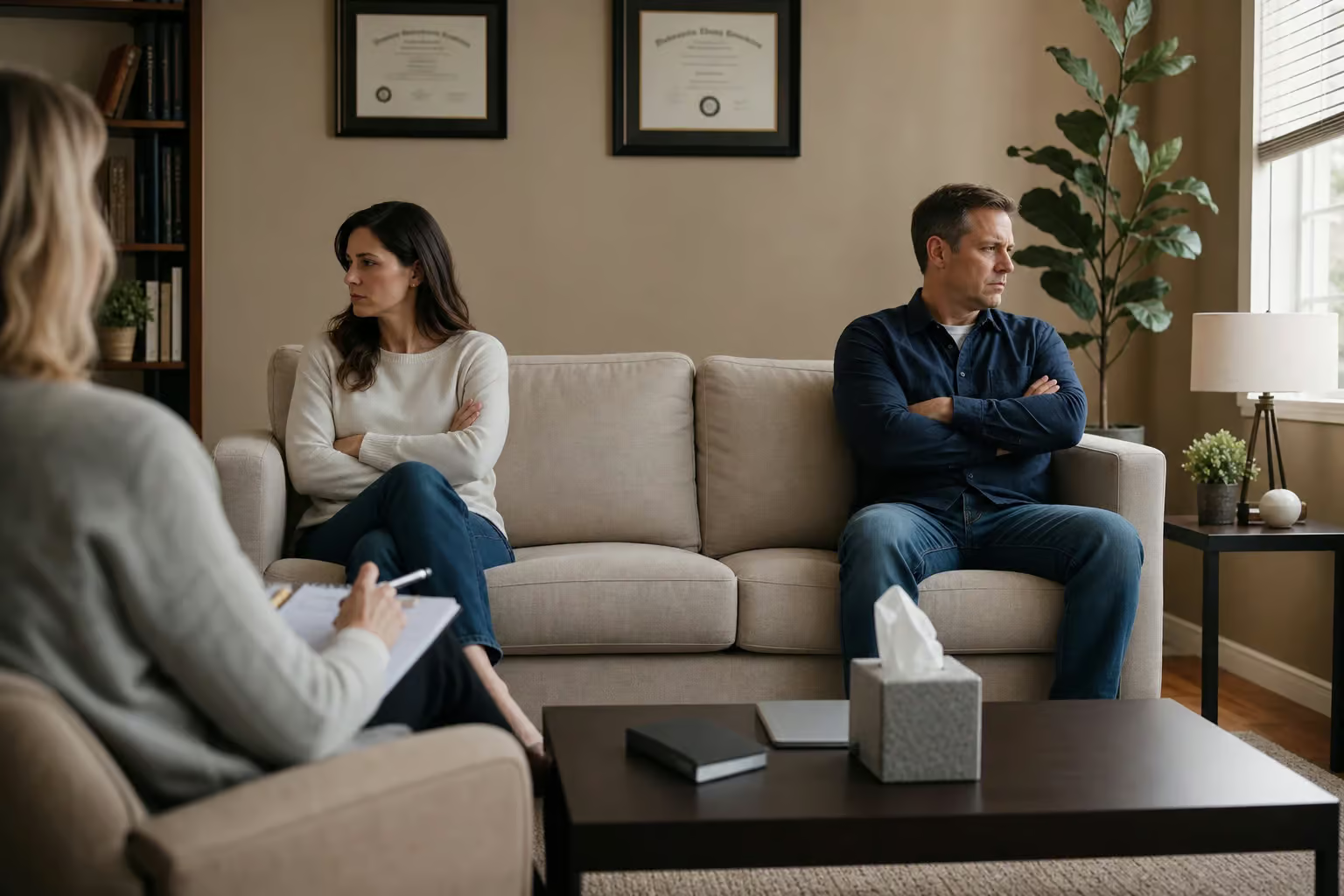
Suicide and homicide: The lethal edge
Martin et al. studied 100 U.S. Air Force suicide decedents. Nine percent had experienced spouse infidelity within 24 hours of their death. Twenty-four hours.
Infidelity-related jealousy is the leading cause of spousal homicide in the United States, according to Leeker and Carlozzi. The numbers are brutal.
The symptom profile: PTSD-like without PTSD
Technology and the Pandemic: New Facilitators of Infidelity
Modern technology and recent global events have created new pathways for infidelity. This section explores how digital tools and pandemic stress have changed the landscape.

How social media lowers the barrier
What once required a secret meeting and careful logistics can now happen through a late-night text. You don’t need a motel. You need to send a DM when your partner is asleep.
Facebook alone has 2.45 billion active monthly users. Roughly 30% of internet users go online for sexual purposes. Reconnecting with an old flame, sharing a late-night conversation, testing boundaries — it’s all frictionless.
Pandemic stress as a risk amplifier
Gordon and Mitchell documented that COVID-19 increased infidelity risk through stress, financial loss, and forced proximity. The paradox: more risk, less ability to heal. Lockdowns meant couples were stuck together under immense pressure. Emotional needs went unmet. The usual safety valves — space, therapy, friends, were unavailable.
When Therapy Fails: The Hidden Therapist Bias in Infidelity Treatment
Therapy can be a crucial resource for couples after infidelity, but not all therapists are equipped to handle it. This section examines the gaps in training and biases that can undermine treatment.
The training gap: Most therapists are not prepared
Irvine and Peluso found that most therapists have never received formal training on infidelity. They’re figuring it out as they go. Perceived competence is low.
The bias problem: Garza’s discovery
Garza found that therapists with negative personal views toward infidelity focused on surface-level fixes — “limit his internet access,” “check her phone”, rather than addressing the deeper relational dynamics. Countertransference led them to over-identify with one partner.
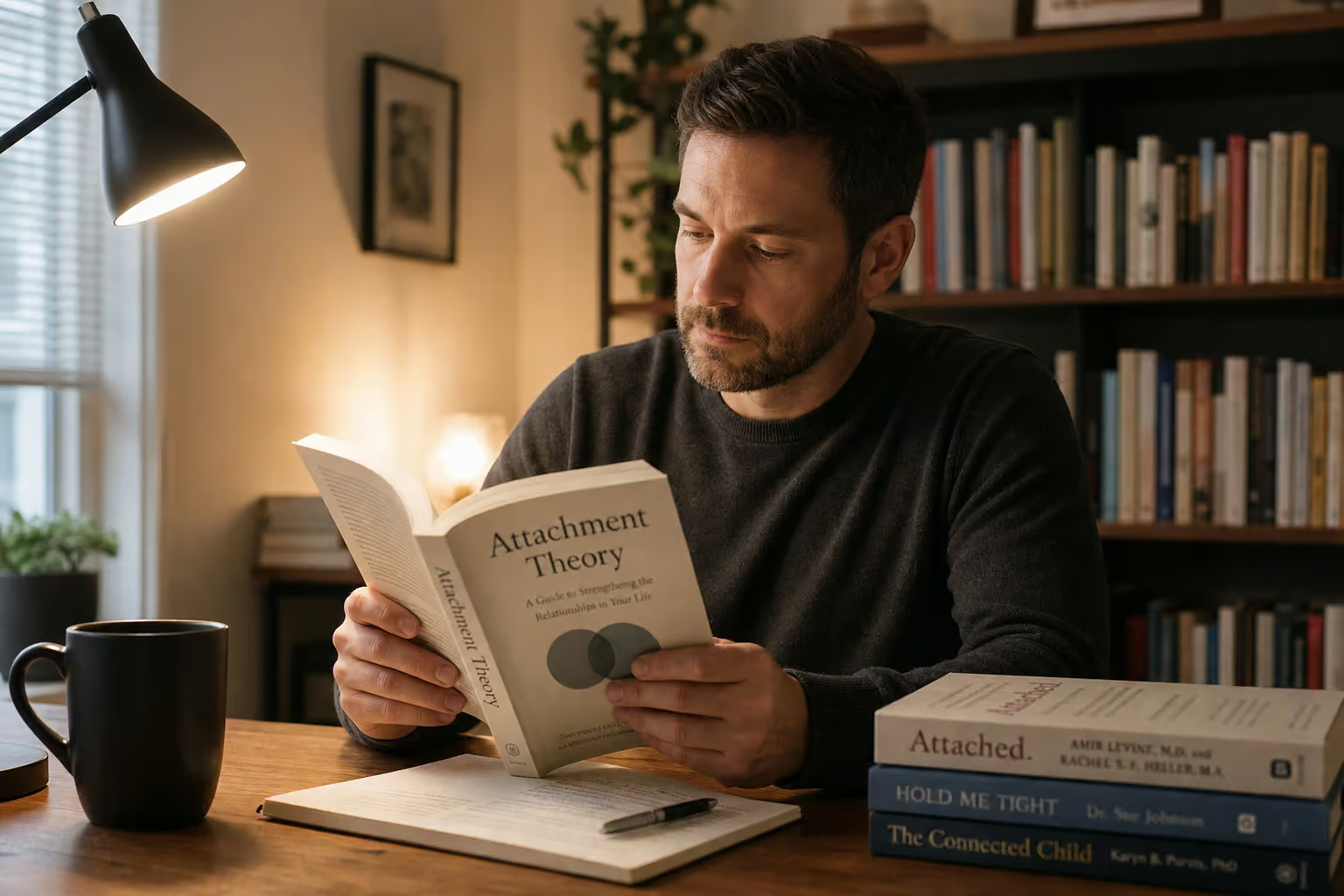
Irvine and Peluso identified four negative factors that can derail therapy: a therapist’s own history of infidelity, personal condemnation of cheating, lack of training, and discomfort with the topic.
What to look for in a competent therapist
Clinicians with more than 16 years of experience and MFT or PhD credentials report the highest competence in treating infidelity, per Scuka. Scuka suggests normalizing the experience as a first step — making it okay to talk about without judgment.
If you’re looking for help, look for someone who’s been doing this for a long time, has specific training in marriage and family therapy, and doesn’t flinch when you say “infidelity.” They should normalize the experience, not judge it.
Is Recovery Possible? The Optimistic Data on Healing After Infidelity
Despite the pain, many couples find a path forward after infidelity. This section presents encouraging statistics and therapeutic outcomes that suggest healing is possible.

The numbers: 60-75% of couples stay together
Research from the Relationship Counseling Group shows that 60-75% of couples stay together after infidelity is revealed. Two-thirds to three-quarters.
What therapy can achieve: Indistinguishable relationship satisfaction
A study tracked couples who completed therapy for infidelity. At the start, they were significantly more distressed and depressed than other couples. At the six-month follow-up, their relationship satisfaction was statistically identical to couples who had never experienced infidelity.
The researchers called it “generally optimistic results.”
Post-traumatic growth: When relationships emerge stronger
Esther Perel has reframed infidelity as a potential catalyst for deeper connection. Some couples report a stronger relationship after infidelity than before.
Understanding Without Excusing: What This Means for Your Relationship
Grøntvedt et al. opened with the observation that transgressions are largely inevitable in long-term relationships.
For more on navigating the aftermath, check out our guides on what to do if your wife cheated but won’t admit it, how to get over your wife’s infidelity, and a comprehensive overview of dealing with a cheating wife.
People Also Ask
What is the psychology of a cheating wife?
The psychology often centers on unmet emotional needs, attachment patterns from childhood, or a quest for identity. Emotional neglect is the most common driver, where a wife feels invisible and seeks validation elsewhere. Attachment styles like anxious-ambivalent or avoidant can create specific pathways to infidelity, and in some cases, personality traits like high neuroticism or Dark Triad characteristics play a role.
What is the most common reason why wife cheated?
Emotional neglect is the most common reason cited in research. When a wife feels emotionally invisible and her repeated attempts to communicate her needs are met with dismissal or silence, she becomes vulnerable to someone who offers a listening ear. Marital discord and sexual unhappiness are the most frequently cited variables in infidelity studies.
How does emotional neglect lead to infidelity?
Emotional neglect creates a deficit that makes a wife more vulnerable to attention from others. When she feels invisible and her partner is dismissive or defensive, a colleague or friend offering a listening ear can feel like a lifeline. The emotional intimacy that follows often feels like a solution, but it’s typically a short-term fix for a long-term relational problem.