
A guy named Devon (name changed) sat in a Zoom session with relationship coach Tara Blair Ball and said he was done with dating. Around the same time, a Reddit thread about men giving up on dating grew so large it had to be closed after more than 6,000 comments. Both stories ran in the Good Men Project in June 2022. That’s part of why “why men don’t want relationships anymore” keeps getting searched.
But the phrase assumes rejection, and the numbers tell a different story. The rest of this piece asks whether the retreat is sensible self-protection or an overcorrection that’s hardened into avoidance.
Key Takeaways
Pew’s 2022 survey found 63% of US men under 30 were single, up from 51% in 2019. The share actively looking for dates fell from 61% to 50%, men are disengaging and losing hope rather than rejecting commitment.
The State of UK Men report, published November 14, 2025, found 1 in 4 UK men believe no one will ever fall in love with them, and 36% of men aged 18 to 24 agreed that no one can fall in love with them.
Ofcom’s Online Nation 2025 data shows UK dating apps became a male-majority space68% of about 5.3 million users are men, with male users growing from 3.2 to 3.6 million while female users fell to 1.7 million, which mechanically raises the effort every man spends per match.
Table of Contents
Men are retreating from relationships, not rejecting them
Most men who’ve opted out haven’t rejected commitment. They’ve retreated from it, or quietly lost hope that it’s possible for them. That distinction is the whole answer, and the data backs it.
Pew Research Center’s 2022 survey found 63% of American men under 30 were single, up from 51% in 2019. The share of those men actively seeking dates fell from 61% to 50%. If men had simply decided they prefer being alone, both numbers would move together. They didn’t. The gap between being single and wanting to change it is where the real story lives, disengagement and lost hope, not preference.
The State of UK Men report, published November 14, 2025 by the equality charities Equimundo and Beyond Equality (surveying more than 2,100 UK men and women aged 18 to 45), puts its own reading plainly: plenty of men aren’t saying no to relationships; they’re backing away from them, or have given up believing one could happen. The report blames financial pressures and gendered digital subcultures that make intimacy feel “risky, confusing, and often unattainable.”
The hopelessness numbers are the heaviest in the piece, so here they are without commentary. One in four UK men believe no one will ever fall in love with them. Among men aged 18 to 24, 36% agreed that no one can fall in love with them, and 33% agreed they’d end up without a life partner for good. Suicide rates among men under 30 have risen 40% since 2010 and run four times young women’s. Gen Z men are 29% more likely than Gen Z women to be single right now.
How charged has the topic become? When Cosmopolitan took a sign reading “Single men! What do you really think of the dating scene?” onto the University of Leeds campus, one man in his twenties literally ran away.
It’s a lot of work: why dating apps feel like a part-time job
Yes, dating apps feed men’s disengagement, but mostly through a structural effort imbalance rather than any loss of desire. The apps widen your access to single women and charge you more for it, more time, more energy, more money, with far more misses than hits. Men on Reddit compare dating to a “part time job,” and one wrote he’d “rather stay a bit lonelier than put up with all the hassle of dating.” Nobody in the thread argued with either quote.
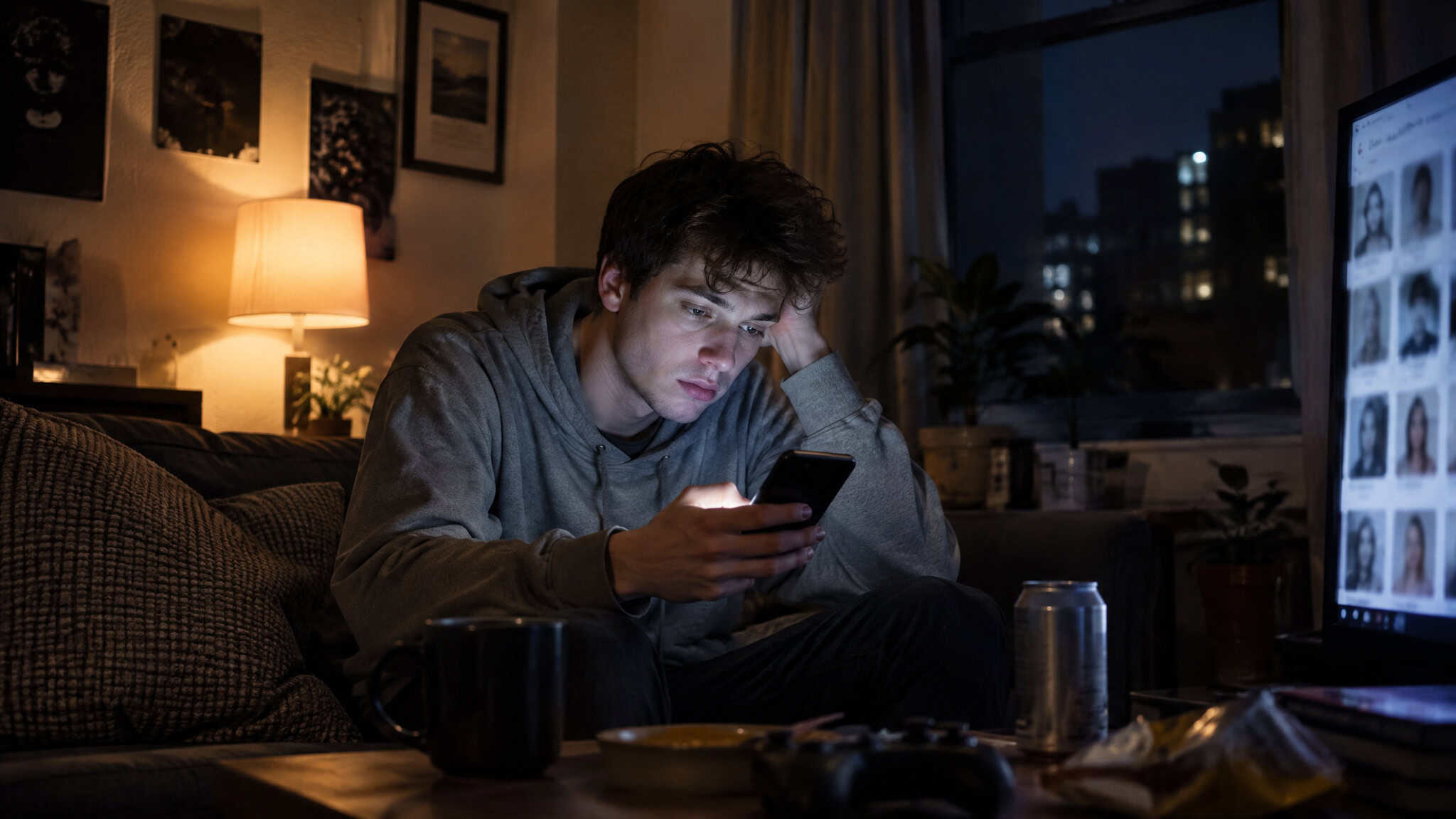
The structure behind the complaint is measurable. Ofcom’s Online Nation 2025 report found about 5.3 million UK adults use dating apps and 68% of them are men. Overall use is falling. Tinder and Bumble lost hundreds of thousands of users between May 2023 and 2025, yet male users rose between May 2024 and May 2025, from 3.2 million to 3.6 million, while female users dropped to 1.7 million. The apps are becoming a male-majority space, which means effort-per-match rises mechanically for every man on them, even if nothing about him changes.
Luke Brunning, co-founder of the University of Leeds’ Centre for Love, Sex, and Relationships, adds the mechanism that makes a match worthless: people swipe indiscriminately, half-watching TV, drunk, bored, or handing their phone to a friend. A match stops meaning much, so the attention you paid gets nothing back. Filters, editing tools, and what Brunning calls the “Love Island-ification” of attractiveness warp the whole picture, young men calling Margot Robbie “mid” is the shorthand for the gap between what people actually like and what they’ve been trained to like. And there’s a spiral: long-term male users feel worse about themselves, which makes the app feel like the only place anyone shows interest, which keeps them on it. Meanwhile 54% of UK men say most men don’t stand a chance on apps.
This is where the Cosmopolitan 250-men project earns its keep, two months, 250 men, online and in person, led by Brit Dawson with reporting from Catriona Innes (with the project’s own caveat that Leeds and online interviews can’t speak for all UK men). Mark, 28, from London, describes himself as a “firmly average man.” He went on nine first dates in eight months, none of which stuck. In his view, there is no smoke without fire, but it can’t be that half the population are truly awful.
What actually helps: cap your app time. Be pickier about who you message. Say what you want in the profile. Message like you mean it, move toward actually asking, and take breaks without treating them as failure.
Field note: If the app feels like a second job, cut the hours before you cut the whole thing — cap time, message with intent, take breaks.
One honest counterweight before the pile-on continues: apps still genuinely earn their keep for LGBTQ+ people, night-shift workers, single parents, and disabled people, anyone whose daily life doesn’t hand them introductions. The critique is about the odds, not the tool’s existence.
There’s always someone better available: the self-sabotage loop
Expecting abandonment produces the abandonment it fears. When the next swipe is always right there, investing in the person in front of you feels risky, why put effort in when something shinier might be one match away? Reddit users describe dates breaking things off abruptly for “something more exciting,” and living with the “is today the day?” feeling. The mechanism runs like this: if you’re telling yourself she’ll leave no matter what you do, you start ignoring her small reach-outs, replying clipped, putting in low effort.
That behavior produces the breakup, which reinforces the original “why bother.” The Gottman Institute’s research gives the counter-move a number: successful couples respond to each other’s bids for connection, small things like asking for a hug or sharing their day, about 87% of the time. The fix is conversational, not therapeutic. Respond to the bids. Ask what you can learn from the relationship you’re actually in instead of pre-abandoning it.
Women’s standards are too high, grievance, economics, and 1974
The grievance, stated as what men say rather than fact: women want a high earner or a celebrity while bringing less to the table themselves, a claim the internet labels hypergamy. The State of UK Men report quantifies the feeling, 65% of men believe women have too many expectations, 57% believe women only seek money or status, 48% say a serious relationship would demand too much change from them, and 44% of men aged 18 to 34 call a relationship too big a financial commitment. The texture is familiar from the reporting: a worst-date story where a woman arrived late, was rude, and wordlessly slid the bill across, his objection was the assumption he’d pay, not paying itself. A street-interview clip on who pays sums it up: Dating for men is like paying for a job interview.
The complication is that women couldn’t open bank accounts in every US state until the Equal Credit Opportunity Act passed in 1974. Within living memory, a husband was the financial plan. Now that women earn their own money, they’re selecting for how a partner shows up emotionally and around the house.
And the economics: men outnumber women on nearly every app (68% male per Ofcom), so high demand and low supply raises the price, the standards, without anyone being villainous. Hence 56% of women versus 35% of men saying it’s hard to find someone who meets their expectations.
The manosphere’s answer is the 80/20 rule, the claim that 80% of women want the top 20% of men. It’s a belief, not a fact, held by 28% of Gen Z men and 33% of millennial men per a 2025 YouGov survey. Related, as perception data: 57% of Gen Z men believe society has gone so far promoting women’s equality that men now face discrimination (2025 Ipsos UK / King’s College London). The practical close: hold your own standards and ask whether someone fits what you actually want long-term, rather than taking whatever you can get.
Protection or overcorrection: when avoiding volatile partners becomes avoiding relationships
Here’s the argument we’d make at Unfinished Man, and it’s ours, not a paraphrase of some expert. The pattern shows up constantly in forum threads and coaching conversations: one or two volatile or abruptly-ended relationships get generalised into all dating, and the protective rule to avoid volatile partners quietly becomes a blanket rule of avoiding relationships altogether. A simple self-test on your own I’m done moment is to list what the boundary actually filters.
Boundaries on specific behaviors, which apps, how often, which red flags, preserve optionality. Rules that eliminate the entire category convert temporary recovery into permanent exit. (Our guide on how to avoid crazy women covers the filtering version properly: spotting instability early so volatile relationships never start, rather than exiting dating altogether.)
The cost side is real, and the Reddit guy choosing to be “a little lonelier” is making an honest trade. But 48% of men won’t chat someone up in person for fear of looking “creepy,” and avoidance compounds into lost skill and lost confidence. Facebook groups where women post men’s profile pictures to check how he’s treated others add another layer of perceived risk to approaching, stated as fact, no outrage either direction. Tie it back to the self-sabotage loop and the circle closes: overcorrection manufactures the very outcomes that justify it.
The hopelessness pipeline: manosphere, isolation, and AI substitutes
Isolated men go looking for answers, and the manosphere is waiting with them. Manosphere and incel ideology gain traction among extremely online men lacking positive male role models, drawing them toward figures like Andrew Tate and Jordan Peterson. Red pill culture, the term comes from The Matrix, holds that society lied to men about women and relationships, sorting men into “high-value men” and everyone else. Some of it is confidence advice.

Some curdles into anger and us-versus-them resentment. It raises real grievances, loneliness, rejection, feeling unseen, and answers them with hostility instead of healing.
Where men’s heads are at, as data rather than verdict: 50% of UK men endorse red pill rhetoric, 67% agree the media portrays men negatively, 59% agree feminism favours women, 1 in 6 boys aged 6 to 15 have a positive impression of Andrew Tate, and 55% of young men who watch masculinity influencers on YouTube and TikTok believe women don’t care about men. Movember’s data connects the media diet to the frustration: 63% of influencer-following men believe women should fill traditional roles, the tradwife ideal, versus 37% of non-followers, and for the 60% of men who engage with this content, friendship shifts toward ambition, wealth, and popularity over trust, a lone-wolf version of masculinity. The divergence is political too. Gen Z men are 30% more conservative than Gen Z women across 30 countries, and the British Election Study (analysed by the Financial Times) puts women 25 percentage points more liberal than their male counterparts.
The moment this went mainstream was Netflix’s Adolescence, four episodes about 13-year-old Jamie Miller, more than 70 million viewers, an audience larger than the population of France. Christopher Pepper, co-author of Talk To Your Boys, points out that Gen Z is the first generation to communicate mostly by phone: There’s no responsibility for what’s on the receiving end. And the newest substitute: 15% of men and 14% of women report interacting with a virtual girlfriend or boyfriend, digital intimacy without rejection risk. Read that as a symptom of the isolation, not a cause of the retreat.
The other side: mankeeping and women’s quiet-quitting
Stanford researchers call it “mankeeping“: the emotional support work women experience as labor while men treat it as just how relationships work. Men reserve vulnerability for women because opening up to male friends feels “weird or like a waste of time”, and two-thirds of younger men report “no one really knows them.” Sit with that one for a second.

Women are withdrawing too, and it’s quantified. Women are 23% less likely than men to want to date. 62% of single women report not looking at all, versus 37% of men. 60% of men feel they’re expected to do too much, while women feel men aren’t doing enough for equality. Part of the withdrawal has a justification that gets stated flat: women are twice as likely as men to point to physical and emotional risk, and 2020 Pew found 57% of women on apps received unsolicited explicit content, 44% were called offensive names, and 19% were threatened with physical harm. Add the costs of caring, suppressing their own needs, always-on availability, “playing house” during COVID lockdowns.
The women tell it themselves: Ava, 27, realized mid-conversation she had no idea how Max felt about her or their future, and stopped asking: “We have enough to think about.” Sara, 21, whose cheating boyfriend wanted comfort for his shame rather than remorse said that had to help him find the words for his feelings, not his actions. Becca, 31: It’s a feminism thing… But also a way of processing the outsized support we gave them.
The Gen Z version: Unless you’re really in love, then it’s not your problem if they’re not emotionally available. Then there’s heterofatalism: Emily Ratajkowski told Elle in June 2025 she refuses to “centre men” and says she has no straight men in her life apart from romantic interests.
Then the spiral: the more women withdraw from the emotional burden, the more boys feel rejected, and lonely boys are easy marks for voices reframing that abandonment as design. It’s the school disco, years later, everyone still on opposite sides of the hall, older, jaded, judging each other. Neither exit is independent.
The relationship recession: fewer couples, not smaller families
Zoom out once and the individual “I’m done” stories sit inside a demographic shift. Derek Thompson, writing in The Atlantic, notes the US marriage rate is near its all-time low, the share of women under 65 not living with a partner has grown steadily since the 1980s, and the past decade is the only period since at least the 1970s when women under 35 were more likely to live with parents than a spouse. John Burn-Murdoch in the Financial Times makes the clean causal point: births per US woman halved from almost 4 to 2 between 1960 and 1980 while the share of women in married couples barely moved, so today’s fertility decline stems mostly from fewer couples forming, not couples choosing smaller families. Lyman Stone of the Institute for Family Studies adds the economics: men’s relationship odds still track income closely, fewer men graduate college while record numbers of women do, and less-educated men’s incomes stagnated while women’s rose.
The counter-framing deserves a fair hearing: some argue financial independence raises the bar rather than removing it. Scott Galloway’s point that great single women can’t find dates that are “economically and emotionally viable.” And it’s global, not just Western: Alice Evans ties the spread to wider exposure to Western media expanding women’s expectations. Which leaves you with: this is a couple-formation problem, not a personal quirk. The hard numbers back that up, the US marriage rate is sitting near its all-time low, and Burn-Murdoch’s fertility math shows the decline comes from fewer couples forming, not couples choosing smaller families. No precise figure exists for the percentage of men who don’t want to marry, the singlehood and seeking numbers above are the honest answer.
Why “just meet people IRL” is advice without a runway
The standard advice fails because the offline infrastructure is degraded. Luke Brunning’s point is that the 2020 to 2022 lockdowns landed right when guys would have been learning to talk to people, costing them both practice and self-belief. Gen Z men are more than twice as likely as Boomers to say they had no teenage relationship. Then there’s Toby, 28, who tried speed dating once and won’t go back: cancellations left fewer women than men, the crowd skewed a decade older than him, and he hit it off better with the guys. “If the aim of the event was to meet new bros, then it did very well.”
What actually helps: boundaries, de-escalation, and an honest cost-benefit ledger
You leave this piece with remedies at two levels, not a pep talk. Individually: taking a break from dating is fine, and if that’s where you are, own it. But if you actually want a lasting partner, “I’m done” can’t be the final word. The documented pattern among men who stayed in the game: the ones who shared burdens, practiced self-awareness, and developed emotional fluency became more attractive to the women they dated and better partners. Plain observation, nothing more.
Structurally, Brunning has proposed dialing down the pressure, app designs with an in-between “maybe, once we know each other better” option, and separating real dating from reality-TV portrayals. Interesting ideas from one researcher, not a plan of action.
Then the honest ledger. In a 2023 analysis of General Social Survey data, University of Chicago economist Sam Peltzman found marriage correlated with happiness more strongly than any other variable studied, including income. Weigh that against the documented costs of dating already laid out here, the effort imbalance, the standards gap, the risk of overcorrection, with the caveat that single life can be happy enough. Both sides of the ledger are on the table. Which side weighs more is your call, not ours.
Frequently Asked Questions
Why do some men never want a relationship?
Most men who’ve opted out haven’t rejected commitment — they’ve retreated from it or quietly lost hope it’s possible for them. Pew’s 2022 survey found 63% of US men under 30 were single, up from 51% in 2019, but the share actively looking for dates fell from 61% to 50%. That gap points to disengagement and lost hope, not a genuine preference for being alone.
Why do men not want relationships anymore?
The retreat is driven by a stack of measurable pressures rather than a rejection of commitment: dating apps have become a male-majority space (68% of UK dating app users are men per Ofcom’s 2025 data), which mechanically raises effort per match; financial pressure weighs heavily, with 44% of men aged 18 to 34 calling a relationship too big a financial commitment; and hopelessness is widespread, with 36% of UK men aged 18 to 24 agreeing no one can fall in love with them.
Do dating apps make men less interested in relationships?
The apps feed disengagement mostly through a structural effort imbalance, not a loss of desire. Male users on UK dating apps grew from 3.2 to 3.6 million between May 2024 and May 2025 while female users fell to 1.7 million, so effort-per-match rises for every man even if nothing about him changes. Long-term male users end up feeling worse about themselves, which keeps them on the app in a self-reinforcing spiral.