Every few weeks some creator torches what’s left of their reputation and the internet eats it up. Meltdowns, escalating stunts, public feuds, sudden pivots into whatever the feed wants this month. It looks like a parade of unstable people. It isn’t.
The honest answer to why do influencers go wild is boring and a little worse: ordinary status motives running on a scoreboard that counts every like, with the metrics themselves picked to make platforms money. The wildness is the output, not the input.
Key Takeaways
A 2023 paper in Perspectives on Psychological Science (Metzler and Garcia) argues influencers go wild because ancient “get along, get ahead” motives now run on quantified feedback loops, not because creators are uniquely unstable.
Facebook’s own metric history shows outrage was an engineered choice: the angry emoji counted five times a like in 2018, then got weighted to zero by 2020.
The evidence on algorithms as direct villains is thin: the famous emotional-contagion study found a 0.1% effect, and the well-being research supports at most a small mood effect, with social comparison doing most of the documented damage.
Table of Contents
Why influencers go wild: status on a quantified scoreboard
Influencers go wild because the oldest human motives, getting along and getting ahead, now run on a scoreboard that counts every like, and the chase escalates from there. The easy story is that these people are attention-seekers with a personality flaw. The better read comes from a 2023 paper in Perspectives on Psychological Science by Metzler and Garcia, which argues social media works precisely because it plugs into wiring we already had. Connection makes people open up and keep ties alive. Status makes them broadcast, curate how they look, and chase feedback.
The “get along, get ahead” engine
Neither motive is new. What’s new is the scale. A bigger network means a bigger gap between winners and everyone else, and likes and comments make feedback instant and countable. A number you can watch is more motivating than a vague vibe.
What likes measurably do to posting behavior
Likes aren’t just vanity. Research from 2018 through 2021 found they influence how fast someone posts again, whether they judge a post a win, and how good they feel about themselves afterward. In creator communities this shows up as a common pattern: a post that underperforms quietly disappears within hours, and the next week of content gets re-planned around whatever overperformed. The metrics end up deciding what gets made. That’s the loop: people copy whatever the algorithm rewards to gain status, and the metrics get chosen to maximize corporate profit.
How engagement algorithms reward outrageous content
Engagement algorithms reward outrageous content because they optimize for metrics picked to maximize profit, and those metrics favor whatever triggers an immediate emotional reaction over what’s actually good. Stripped of the mystique, that’s how social media algorithms work: a ranking system is a set of weights on behaviors, the platform decides which actions signal value, and the feed shows you more of whatever scores.
Facebook’s metric history: a dated causal chain
Facebook ran this experiment in public, and each fix created a new problem. Early on, the algorithm optimized for clicks, likes, and comments, and got clickbait. In 2015 it switched to time spent reading and watching, and got more passive scrolling. Then came the “meaningful social interactions” era, which boosted heavily commented posts, which often meant the anger-inducing ones.
The numbers tell the story best: in 2018 an angry emoji counted five times a like, and by 2020 Facebook had weighted it to zero. Engineers priced anger, then walked it back. That pair of numbers is the proof the outrage incentive was an engineered choice, not some emergent mystery. One dry aside: the scoreboard itself can be gamed. Bots, trolls, and fake accounts inflate popularity numbers too.
Red flag: When a platform changes what it counts, creators change what they make. Watch the metric, not the mission statement.
What each platform pays for today
Every major platform runs its own payment schedule. The current ranking signals:
- Instagram weights DM shares 3 to 5 times more than likes, per Adam Mosseri. Sends beat likes.
- TikTok prioritizes watch time and completion rate, with a 30%-plus completion rate treated as the gold standard for videos under 20 seconds (industry figures).
- Twitter added view counts in early 2023.
- YouTube heavily rewards roughly 70% audience retention, hit that mark and the recommendation engine pushes your video significantly harder (also an industry figure).
Keep the tiers straight: the Facebook timeline and the motives research are peer-reviewed territory, while the completion rates and retention benchmarks come from practitioners and platform insiders. Either way the pattern holds. Every signal on the board rewards an immediate reaction. Nothing on it rewards being good.
Why each stunt has to be wilder than the last
Controversy spreads faster because high-arousal emotions drive sharing, and virality doesn’t track quality. Once a creator competes on the same metrics as everyone else, the only direction left is up in intensity.
The best evidence for that comes from a strange experiment. In 2006, Salganik, Dodds, and Watts built artificial music markets where thousands of listeners downloaded the same set of songs. Some participants saw only the songs. Others saw download counts.
Same songs, wildly different outcomes: popularity rose and fell with social contagion, not merit. Hits were partly luck. The uncomfortable follow-up is that popularity and quality genuinely diverge, and chasing popularity appears to actively lower content quality.
The sharing mechanics back this up, though from practitioner research rather than peer review: awe, anger, humor, and surprise get shared, while sadness mostly doesn’t So what makes a video viral, in practice, is arousal, not craft. If your income depends on being shared, you’re not posting the quiet, thoughtful thing. You’re posting whatever spikes someone’s pulse in the first two seconds.
No study has directly tracked influencer stunts escalating over time. The escalation logic is a synthesis of the findings above, and admitting that is what makes it trustworthy instead of a hot take. The ingredients are documented. High-arousal emotion spreads.
Popularity diverges from quality. Metrics reward reactions. Put a creator in that system and intensity is the rational direction of travel.
Backlash doesn’t stop the cycle either, which is the part most people get wrong. Outrage and negative comments still count as engagement. The same Facebook era that weighted anger at five times a like also boosted heavily commented posts, so a furious comment section counts as fuel rather than punishment. Two concepts explain why creators keep misjudging how a stunt lands: context collapse, where all your audiences show up in one comment section at once, and the imagined audience, the crowd a creator thinks they’re performing for. Both fall apart at scale.
And the audience plays its part. A typical dynamic in creator communities: followers reward drama with disproportionate engagement, then express disappointment when the creator “changes.” They funded the change.
The money squeeze behind plateaued creator growth
Wildness is the rational economic move for an influencer. Income depends on reach, reach depends on engagement, and engagement falls as audiences habituate. The safe content that built the audience stops paying. Hence the stunts: one Instagram account ordered an anvil a day from Amazon and returned them (the latest order was 21 anvils), and another creator dug a hole with a spoon, one spoonful per follower, until it became backyard tunnels. Virality without brand positioning delivers attention without income, because views only matter when they map to awareness, consideration, or conversion.
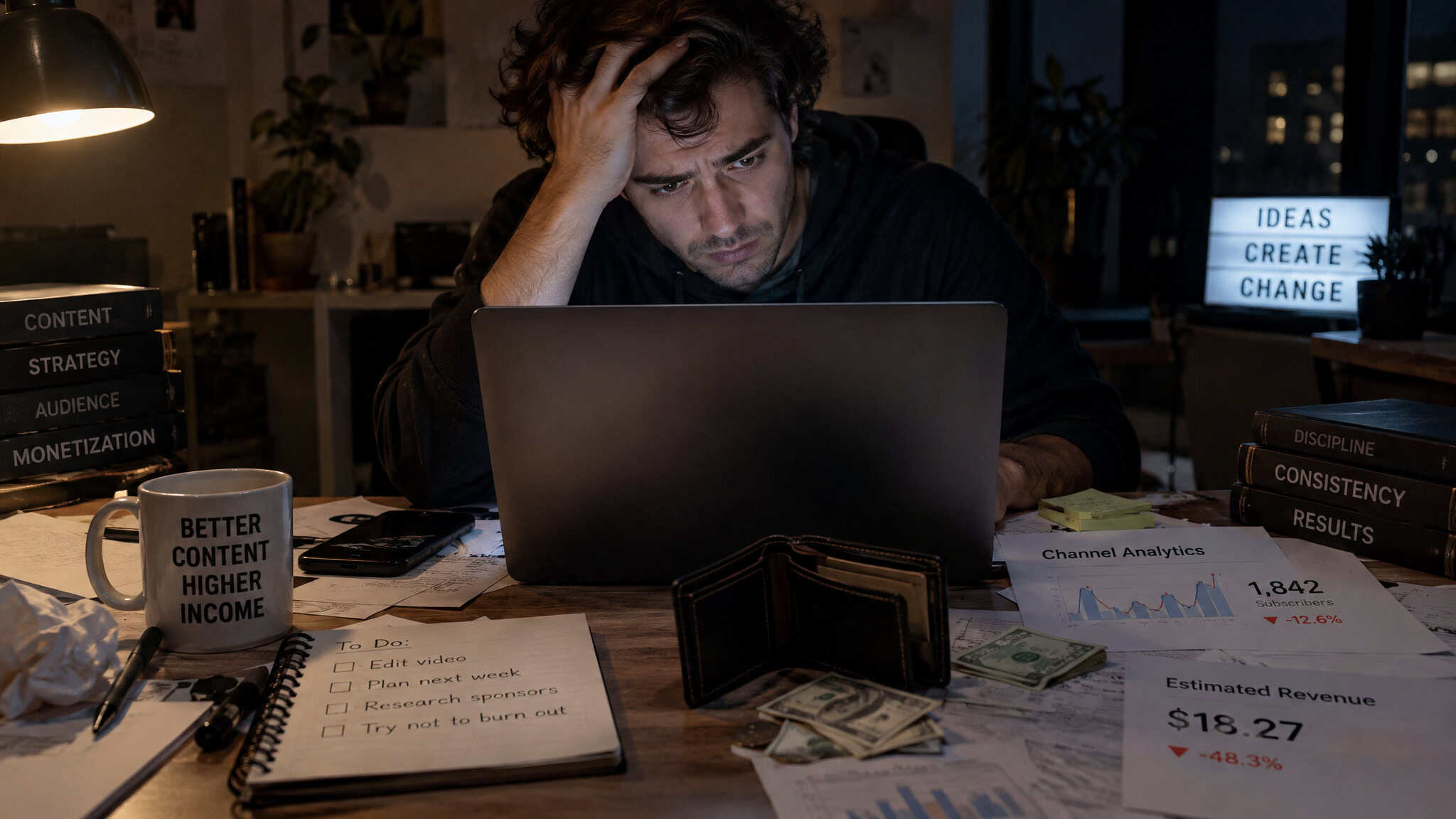
Practitioner data adds a twist: watch-time retention matters more than follower count, which is why small accounts can blow up fast, and why everyone fights for the same attention signals. The content plan follows the metrics, same pattern as before: underperformers deleted, overperformers replicated.
The stunts make more sense in this light. One Instagram account ordered an anvil a day from Amazon and returned them; the latest order ran 21 anvils. Another creator dug a hole deeper for every follower who asked, until the hole became tunnels. Dry amusement is the right response, but note the contrast: being watched and being good at something are different things.
The creator playbook behind engineered virality
Clout chasing works in the short term because virality follows rules that can be gamed, and it backfires because it trades long-term trust for reach. Fair warning: this entire section is practitioner-sourced, medium-to-low confidence. It explains the levers. It isn’t peer-reviewed fact.
The persuasion triggers creators pull
Anchoring comes first: people average 1.7 seconds per post, so the opening frame decides the read. Then come the classics: loss aversion and FOMO, social proof, reciprocity, serial positioning, the verbatim effect, priming. You’ve seen the brand versions: Netflix‘s “leaving soon,” Amazon‘s “only X left in stock,” Booking.com‘s “only 1 room left.” These work, and they erode trust when abused.
Story hooks and the validate-and-teach formula
Virality gets treated as an engineerable system: psychology explains why people share, the algorithm decides what gets amplified, and the creative earns the attention. Hook in 1 to 3 seconds, quick payoff, emotionally satisfying ending. Story hooks beat tutorials, and content that confirms what the viewer already believes while teaching something goes viral.
The feed as a mirror, and its limits
Lucero’s work claims platforms build psychological profiles from watch time, likes, comments, and shares, and that even content arriving via DM is a signal. His four-bucket feed audit, sorting your feed into personal interest, belief-based, validation, and problem content, is a quick honest look at what it says about you. One honesty beat: his claim that feeds only reinforce existing beliefs goes further than the academic evidence supports. The research picture is that echo chambers are smaller than assumed, and that engagement metrics favor content matching your immediate mood and beliefs over quality or long-term value, which gets fuller treatment below. Flag the tension rather than asserting either side.
Is the algorithm really to blame? What evidence shows
No, the algorithm alone doesn’t make influencers act out; the evidence points to social drivers with algorithms as amplifiers, and on mental health the honest answer is “depends”: constant online validation looks like a small, real mood effect at most, not a machine that breaks people.
The studies that pin down algorithmic effects
The famous Facebook emotional-contagion study, the one everyone freaked out about, is still basically the only study isolating an algorithm’s effect on emotion. Hiding positive posts changed positive posting by 0.1%. The Facebook college rollout from 2004 to 2006 happened before recommender algorithms existed. Adoption still showed moderate effects on depression and small effects on anxiety, apparently through unhealthy social comparison, with people measuring themselves against other people.
What the well-being evidence actually supports
Deactivation trials, where people were randomly assigned to quit Facebook, showed small-to-moderate drops in anxiety, depression, and loneliness. Life satisfaction didn’t move after one week but rose after four. Real, but modest. The caveats, stated plainly: the well-being evidence is thin and supports at most a small mood effect; effects depend on who’s using the thing and how; teenage girls and disadvantaged users look more vulnerable; and people systematically overestimate their own usage and “addiction” in self-reports. That’s not a verdict of innocence. It’s a verdict of multiplier, not root cause.
Who profits from the ‘algorithm made them do it’ story
Platforms profit from the omnipotent-algorithm story. Advertisers believe it, and Cambridge Analytica literally marketed it. Blaming the tech without examining what drives it sends both conversation and policy in the wrong direction. The sharpest rebuttal of the popular fix: a chronological feed is itself an algorithm, and a flawed one, favoring frequent posters and doing nothing about overload.
The “just kill the algorithm” proposals from Frances Haugen and Elon Musk don’t hold up. Echo chambers turn out smaller than assumed, and the YouTube rabbit-hole evidence is weak: about 1 in 100,000 moderate viewers moved toward far-right content, mostly arriving from outside the platform.
Why wildness looks different on every platform
Influencers are popular because platforms industrialize two ancient motives, connection and status, and the same creator behaves differently on each app because each platform’s incentive physics select for a different flavor of wild. Twitter runs on inter-group political combat; that’s the local sport. YouTube’s toxicity gets attributed to a huge mixed audience plus upvotes and downvotes counting equally. Facebook and Instagram are microcelebrity machines built around self-presentation, which is why influencer culture lives there. TikTok gives everyone a few views and unpredictable virality: low barrier to start, with a doomscroll cost on the viewer side.
The distribution split matters more than the vibes. Twitter, Facebook, and Instagram distribute through your social graph. YouTube and TikTok distribute through recommendations, which hands those platforms far more power over who rises. Facebook and Instagram copying TikTok’s recommendation-based video feeds shows everyone converging on the same model.
As for what replaces influencers if audiences tire of outrage content: audience fatigue and authenticity demands could shift attention toward niche creators and ordinary user-generated content. That’s forward-looking commentary, not a finding. The core research doesn’t directly support predictions here.
The demand side: how audiences fund influencer wildness
Gen Z’s trust in influencers over traditional celebrities comes from parasocial closeness and the microcelebrity authenticity dynamics that Instagram and Facebook are built around. Say it plainly: the core research doesn’t directly study this, so treat it as a reasoned extension, not a finding. Audiences aren’t victims of wild content; they’re the ones paying for it with attention. An NYT study puts a number on it: 68% of people share content as a way of telling others who they are.
Sharing is identity performance, not just distribution, which is why drama outperforms polish. There’s a pull-side reason for that: roughly 90% of consumers use social media to keep up with cultural moments and trends, so showing up in the feed means showing up in the conversation. Followers reward outrage with disproportionate engagement, then lament that the creator “changed.” The same audience demanding authenticity supplies the outrage metrics. Context collapse and the imagined-audience problem explain why creators keep misjudging how wildness lands.
Outrage engagement is the currency that makes escalation profitable, and you supply it every time you rage-comment. When the escalation goes far enough, the fallout gets documented in its own right: lost sponsorships, apologies, and the occasional comeback.
Bottom line: The audience isn’t trapped here. Every share and angry reply is a vote for more of the same.
What would actually change the wildness incentives
Platforms probably can’t fix engagement-driven algorithms without losing users, and there’s a documented case proving it. Facebook tried an algorithm that emphasized posts “good for the world.” It cut low-quality content, and it also cut how often people opened the app, so it shipped in weakened form. Incentives beat intentions.
Design levers with evidence behind them do exist: hiding engagement counts, labeling extreme voices, adding sharing friction, empathy prompts. A few positive results stand out. Empathy-based counterspeech reduced racist hate speech, and small bespoke experiments, concealing political affiliation or running anonymous cross-party conversations, reduced polarization. One trade-off stays visible: “civility” is a value judgment, and letting users define their own algorithm sounds nice until you remember partisan-only feeds are dangerous.
The honest ending: meaningful change likely requires regulation, the European Digital Services Act being the live example, and transparency, like Twitter releasing its algorithm code, since platforms are private companies run for profit. Beyond that sits an open possibility worth taking seriously: algorithms could be built to support well-being rather than short-term profit. I’d take that bet over another decade of anvils. This site doesn’t chase engagement bait itself, for what it’s worth, and I’d like to keep it that way.
Frequently Asked Questions
Why does Gen Z trust influencers?
Trust comes from parasocial closeness and the authenticity dynamics that microcelebrity platforms are built around — influencers feel like peers rather than distant celebrities. Worth noting: the core academic research doesn’t directly study this, so it’s a reasoned extension rather than a documented finding. The audience side matters too, since sharing content is largely identity performance.
Why do influencers go wild and post increasingly extreme content?
Ordinary status motives running on a quantified scoreboard. A 2023 paper in Perspectives on Psychological Science argues the ‘get along, get ahead’ motives now run on instant, countable feedback loops, and metrics get chosen to maximize platform profit. The wildness is the output of the system, not evidence that creators are uniquely unstable.
What makes a video go viral and why does controversy spread faster?
Arousal, not craft. Practitioner research finds awe, anger, humor, and surprise get shared while sadness mostly doesn’t, so content that spikes someone’s pulse in the first two seconds wins. Virality doesn’t track quality — the 2006 Salganik, Dodds, and Watts music-market experiment showed popularity rose and fell with social contagion, not merit.