A guy wanders into the Twitch esports directory on some random Tuesday night and sees a wall of streams with double-digit viewer counts. His conclusion: esports is dead. It isn’t, he just showed up between events. The majors run mostly on weekends, and there’s a twist to where people actually watch that almost nobody mentions.
So, the direct answer: people watch esports primarily on live-streaming platforms, chiefly Twitch and YouTube Gaming, and plenty of them follow the action through e-Sports betting as well. In 2025, the global audience hit 640.8 million viewers, and they watched 2.7 billion hours of esports, per Stream Hatchet’s Esports Trends Report 2025. That hours figure directionally exceeds total live NBA coverage, though measurement methods differ, so don’t quote me on a clean win. Here’s the map.
Key Takeaways
Twitch (1.2B hours, 43.6%) and YouTube Gaming (1.1B, 40.5%) took 84.1% of all esports hours in 2025, with TikTok a distant third at 116.3 million (4.2%). Korea’s own platforms, Chzzk and SOOP, combined for 117.8 million hours, enough to edge out TikTok.
Over half of esports watch time now happens on creator co-streams: 1.4 billion hours (51.2%) versus 1.3 billion on official broadcasts. And while most events stream online, TV is creeping in too. BBC, Sky, and ESPN have all experimented with esports coverage.
The most-watched event ever is still LoL Worlds 2024 at 6.86 million peak viewers, and published peak figures understate reality because Esports Charts excludes Chinese platforms.
Table of Contents
Where people watch esports: the streaming platforms
Yes, you can watch esports live streams free, no subscription required. Twitch is the home base: it led 2025 with 1.2 billion esports hours watched, a 43.6% share, and it carries the big leagues like Overwatch League, the ESL Counter-Strike Pro Championships, and Call of Duty League. Streams for major events are free to watch; you don’t need a subscription, just an account if you want to chat.
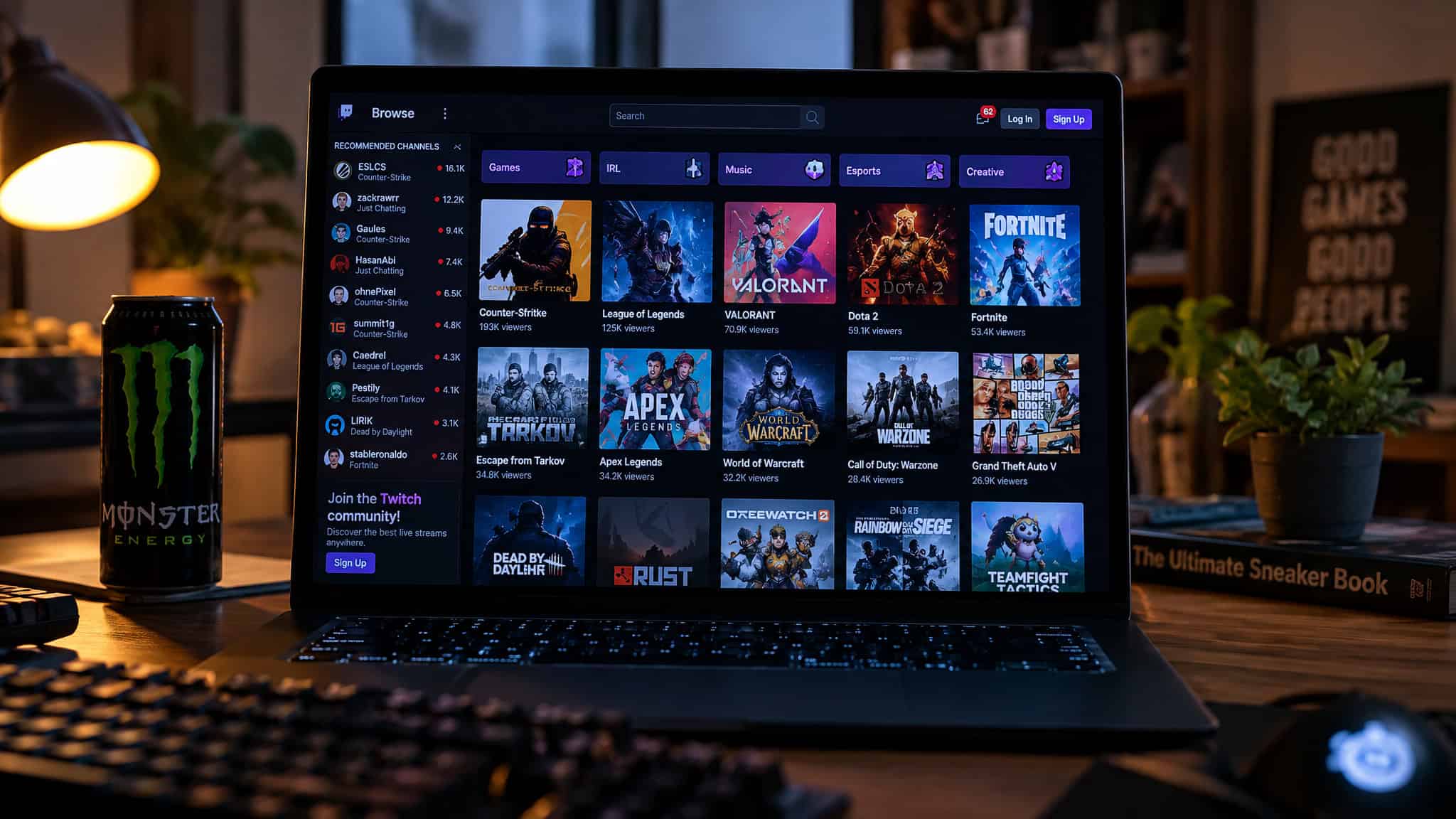
YouTube Gaming is right behind it, with 1.1 billion hours and 40.5% share. The gap between first and second place? 83.8 million hours. That’s a rounding error at this scale, so the race is close. The practical upside is that you already have a YouTube account.
Majors are free there too. And all gaming content on the platform hit a record 8.8 billion hours in 2025, up 12% year over year, so esports is riding on top of a healthy host.
| Platform | 2025 esports hours | Share | Best use |
|---|---|---|---|
| Twitch | 1.2B | 43.6% | Live finals, game-directory discovery |
| YouTube Gaming | 1.1B | 40.5% | Live plus catch-up on demand |
| Chzzk + SOOP | 117.8M | ~4.3% | Korean coverage, LCK |
| TikTok | 116.3M | 4.2% | Clips and highlights |
| Facebook Gaming | Not disclosed | Not disclosed | Same big tournaments, smaller scale |
Facebook Gaming is also in the room, carrying Call of Duty League, Overwatch League, and ESL’s Counter-Strike Pro Championships. Same big tournaments, different app. Nobody should pretend it rivals Twitch, but it exists and it’s free.
Then the weird stuff. TikTok was a distant third at 116.3 million hours, 4.2% share. But engagement there runs 108% above YouTube, so it’s the clips-and-highlights option, not where you watch a final live. The actual surprise: Chzzk and SOOP in Korea together drew 117.8 million hours, which edges out TikTok entirely.
Think of them as Korea’s local answer to Twitch. If you ever want to watch LCK the way Korean fans do, that’s where it lives.
Two honest caveats. First, who holds the broadcast rights shifts from event to event and country to country, so there’s no universal answer; you check where your event is streaming. Second, if the directory looks dead when you first open it, that’s normal. Off-peak hours are quiet.
The majors run weekends, and that’s when the numbers show up. And yes, some viewing happens in arenas in person, but for virtually everyone reading this, the screen is the venue.
Watching esports on TV: BBC, Sky, and ESPN
Mostly no. Esports is overwhelmingly an online product, and that’s where you should plan to watch. But TV coverage exists: the BBC, Sky, and ESPN have all experimented in the space, and there’s been increased TV coverage in recent years. Treat it as supplementary.
Co-streams: where over half of esports viewing happens
Here’s the fact that changes the answer: in 2025, creator co-streams carried 1.4 billion hours of esports viewing, 51.2% of the total, versus 1.3 billion hours (48.8%) on official broadcasts. Most people now watch esports through someone reacting to it, not through the polished feed, a shift that has changed where people watch esports. The old default advice, “watch the official channel,” stopped being the majority experience by 2025, when co-streams took 51.2% of all esports hours.
The scale underneath that stat is real. 22,200 unique co-streamers ran events last year. At the top, Caedrel and Gaules alone moved a combined 145 million hours, roughly a tenth of all co-stream time. Just two guys accounting for more than 10% of the category. The co-streamers in that top 10 reach audiences in English, Portuguese, Korean, French, and Ukrainian.
For much of the world, co-streaming isn’t an alternative to watching esports. It is how esports gets watched, and it’s part of the case for esports being considered a sport. One deep cut for the curious: set1awanade stacked up 20.8 million hours, every one of them on YouTube, as the lone Mobile Legends co-streamer in that top 10.
In practice, here’s how a newcomer experiences this. Search a tournament name and you’ll get the official channel plus a personality co-streaming it. Plenty of people land on the creator’s commentary and stay, because a good co-streamer explains what’s happening while the official cast assumes you know, and those creators, unlike the esports teams bankrolling the scene through winnings, sponsorships, and merchandise, don’t depend on organisers at all. The awkward implication for organisers: when a creator reshuffles their schedule, an event’s reach can swing more than from any broadcast-production decision. That’s how the numbers fall now.
My take: if you know the game, the official feed is great. If you’re learning, pick the co-stream with commentary in your language. Both cost nothing, so pick one.
Twitch or YouTube Gaming for first-time viewers?
Twitch is better for live first-timers. The game-directory discovery is the whole pitch: you search a game, everything happening right now is in one place, you click. YouTube Gaming is better for catch-up, because completed tournaments live there as video-on-demand and you can watch a final on your own schedule.
The honest condition: 2025 was nearly a coin flip, with 83.8 million hours separating the two, and broadcast rights vary by tournament. So the real answer is “check where your event broadcasts.” Major streams are free on both, so trying each costs you nothing, and the real money in this space flows to the players themselves, through esports player earnings from sponsorships and content creation that can reach $5 million.
Quick test: Know the game? Watch the official feed. Learning it? Pick a co-streamer commentating in your language. Either way, it’s free.
The tournaments people actually watch, and what the numbers mean
League of Legends owns the viewership ceiling. Worlds 2025 peaked at 6,752,585 concurrent viewers in the T1 vs KT Rolster final, the largest live esports audience of 2025, though it fell short of Worlds 2024’s all-time record of 6.86 million. Worth remembering: those figures exclude Chinese livestreaming platforms, so the real audience ceiling is higher than the published tables show. One more wrinkle: by raw hours watched, the LCK 2025 season topped everything at 161.8 million hours. Long seasons pile up hours that three-week events can’t.
Premier tournaments and leagues worth following
Premier tournaments are the easiest way in. They take the spotlight across streaming platforms and run year-round, following the seasons of their respective leagues. Here’s my shortlist.
LEC. The League of Legends European Championship, with spring and summer splits across Europe and North American league play alongside. In season, that’s four-plus series four days a week. A lot of LoL, in a good way. The World Championship is the game’s biggest single event.
Call of Duty League. Activision-run, generally 12 teams, points-based playoff qualification. If you play CoD, this is the obvious pick.
Overwatch League. The game’s flagship annual event, and the broadcast switches between first- and third-person perspectives, which is a neat watch. One flag: I’m citing it as the reference example here, and its current operational status isn’t something these sources document.
The International. Dota 2’s world championship and the biggest payday in esports, with a peak prize pool over $30 million back in 2019. You can watch from inside the game client, including a pro player’s perspective, and there’s a VR spectating hub. Huh, neat.
ESL One. CS:GO and Dota 2 events, and the annual Cologne tournament holds some of the best viewing figures in esports history. UK readers: ESL, Gfinity, FaceIt, and Blast TV are the big names, with UKEL, UKLC, ESL Premiership, and grassroots events like epic. LAN below them.
Esports World Cup. The 2025 edition in Riyadh carried a $70M+ prize pool across 25 tournaments, and the 2026 edition has shifted to Paris, now carrying a record $75 million. Where it streams, the sources don’t say, so I can’t point you to a platform; check the event’s own channels when it runs.
Where in the world people watch: the regional reality check
North America holds just 12% of the world’s esports audience. Asia Pacific holds 57%, with China and the Philippines alone accounting for 40%. So a US Twitch feed looks nothing like where the world actually watches. US viewership is growing, from about 45 million in 2023 toward a projected 65 million by 2028, but that’s from a small base, and over 80% of US respondents in the underlying survey said they’re not interested.
The games themselves are regional sports wearing a global label. Honor of Kings and MLBB each draw 99% of their hours from Asia. Counter-Strike flips it: 89% of hours from Europe, mostly Russia. Free Fire is run from Singapore, yet 49% of its audience is Brazilian. And the growth edges: Hindi broadcast hours jumped 247.8% year over year, Turkish-language peak viewers 249.1%.
One measurement caveat worth knowing before you trust any “most watched” table: Esports Charts excludes Chinese livestreaming platforms. Honor of Kings’ China crowd never shows up in those concurrent-viewer numbers. Published figures understate the true ceiling.
How to start watching esports: the beginner path
Start with games you already play: check if they have a competitive scene, open Twitch and search by game, then follow the major tournaments like LEC, CDL, The International, and ESL One, and follow teams and organisers on social media so you know when things run. Major streams are free, so the entry cost is zero. Smaller scenes are less polished but still genuinely fun, and even big titles run smaller tournaments worth your time.
The five-minute League of Legends primer. It’s a 5v5 MOBA: each squad picks champions with set roles, all trying to destroy the enemy Nexus. Objectives matter: the Dragon (a soul at four dragon kills), the Rift Herald (until about the 20-minute mark), Baron Nashor (a three-minute buff). Once you know that, you can read the pro screen: watching Faker damage the first mid turret while DRX’s Zeka sat with six seconds left on his death timer is the kind of thing that becomes obvious.
Basic knowledge enhances the fun. It doesn’t gate it.
Is esports growing, and the honest fine print
Yes. Viewers grew from 435.7 million in 2020 to 640.8 million in 2025, projected to reach 924.9 million by 2030. The market was worth $2.89 billion in 2025, heading toward a projected $10.9 billion by 2032. Majors and Premier events accounted for 86.4% of all hours watched, which tells you the viewing hierarchy is stable.
And the legitimization keeps coming: the first Olympic Esports Games are set for Riyadh in 2027, decided at the 142nd IOC Session in July 2024, with the Esports World Cup Foundation brought on as a Founding Partner. Which games get played is still open.
The fine print, stated plainly. A study of 50,441 players found peak prize earnings come at age 21.2, meaning competitive careers are short. And esports betting was a $12.67 billion market in 2024, expected to pass $20 billion by 2027, with NBC News documenting real gambling harms among young men. That part isn’t a game.
Still, the scene itself is durable, and walking in costs nothing. The first move is opening Twitch and searching a game you already play.
Frequently Asked Questions
Why does a 6.86 million viewer record understate esports’ real audience?
Because Esports Charts excludes Chinese livestreaming platforms, huge audiences like Honor of Kings’ China crowd never show up in published concurrent-viewer numbers. That’s why the most-watched figures are a floor, not a ceiling. It also matters geographically: Asia Pacific holds 57% of the global esports audience versus North America’s 12%.