
Five beers over a football game doesn’t feel like a bender. It feels like a Sunday. But run that afternoon through the CDC’s math and it clears the binge drinking threshold somewhere in the third quarter, if you’re a guy. No stumbling, no stories the next morning, nothing that would make anyone at the bar look twice.
That’s the problem with the term: “binge drinking” sounds like a college stunt, while “heavy drinking” sounds like a guy with a problem, and most people assume they’re the same thing. They aren’t, and the numbers that separate them are worth knowing exactly.
What is considered heavy binge drinking comes down to two different measurements. Binge drinking is counted per occasion: 5 or more drinks in one sitting for men, 4 or more for women. Heavy drinking is counted by volume over a day or a week. Both fall under the CDC’s “excessive drinking” umbrella. This piece covers what a standard drink actually is, why the thresholds sit where they do, and a quick way to check your own last month against the official line.
Key Takeaways
Binge drinking is 5 or more drinks on one occasion for men or 4 or more for women, per the CDC. Heavy drinking is measured by volume over a day or week, not per sitting, and the two counts are different instruments, not one scale.
The drink counts aren’t arbitrary: they approximate the .08% blood-alcohol level that’s the DUI cutoff in all 50 states. A 750ml bottle of wine is about 5 standard drinks, which crosses the women’s threshold in one sitting.
Over 80% of binge drinkers aren’t alcohol-dependent, and 25.1% of U.S. adults had at least one heavy drinking day in the past year (2018 NHIS). Crossing the line is common, not a diagnosis, and not harmless.
Table of Contents
What counts as binge drinking: the 5/4 drink threshold
Binge drinking is 5 or more drinks on an occasion for men, or 4 or more for women, according to the CDC. That’s the whole definition. No time window beyond “an occasion,” no frequency requirement, no judgment about what you were drinking. One night a year qualifies. So does every Friday.
The CDC’s count isn’t the only way to define a binge, though, and the second definition explains where the numbers come from. The National Institute on Alcohol Abuse and Alcoholism defines binge drinking as consumption that raises your blood-alcohol content to .08%. That’s not a random lab value. .08% is the impaired-driving cutoff in all 50 states. So the 5/4 drink counts exist because they roughly approximate how much alcohol it takes an average man or woman to hit the legal driving limit.
One binge can put you at the limit behind the wheel. That’s the plain function of the threshold.
Which means the counts are a safety line, not a round number somebody picked for a brochure. Drink past them and you’re not just “drinking a lot.” You’re in the territory where judgment, reaction time, and memory start degrading in ways the law already recognizes as dangerous.
A few things the definition does and doesn’t account for:
- It’s per occasion, not per day. Two drinks at dinner plus three at the bar is five drinks on one occasion if they’re part of the same sitting.
- It’s sex-specific. The 4-drink line for women reflects that women generally reach a given BAC on fewer drinks than men do.
- It’s an approximation, not a guarantee. BAC varies with body weight, sex, what you’ve eaten, and how fast the drinks went down. A 130-pound woman on an empty stomach hits .08% faster than the count suggests; a 250-pound guy who ate a steak might stay under it. The CDC’s numbers are built for populations, not for predicting any individual’s blood on any individual night.
Dr. Brewer restates the same 4-or-5-drink definition in a CDC video, so the number is consistent across CDC materials. The threshold is the threshold. What changes is how people count their own drinks, which is where most of the self-deception happens.
What counts as heavy drinking: a day count, a week count, and why they differ
Heavy drinking is measured by volume over a day or a week, not per occasion, and the thresholds depend on which body is doing the counting. The CDC’s “heavy drinking day” is 5 or more drinks for men or 4 or more for women in a single day, per the CDC FastStats page last reviewed February 18, 2026. A different analysis, the CDC’s MMWR pregnancy study, uses the Dietary Guidelines definition: 8 or more drinks in a one-week period. STAT cites a clinical variant of 4 or more drinks on any given day.
For women versus men, the day counts are 4 versus 5: the CDC’s FastStats page defines a heavy drinking day as five or more drinks for men and four or more for women. On a weekly basis, 8 or more drinks in a one-week period counts as heavy under the Dietary Guidelines for Americans definition used in the CDC’s MMWR pregnancy study, not some universal medical standard. Before you compare any two drinking statistics, check which definition and which time window each one uses. Otherwise you’re comparing inches to centimeters.
The difference between binge and heavy drinking: peak vs. volume
Binge drinking measures how high consumption goes in a single sitting. Heavy drinking measures how much accumulates over a day or week. That’s the entire difference, and it matters more than it sounds.
The confusing part is that the CDC’s thresholds look numerically identical, 5-or-more and 4-or-more in both definitions. But one counts per occasion and one counts per day or week. Most people see “4 to 5 drinks” in both places and assume it’s one scale. It’s two instruments measuring different patterns.
Worked case: a nightly two-drink habit adds up to 14 drinks a week. That can meet a heavy weekly threshold without a single occasion ever reaching the binge line. Flip it around: a guy who drinks nothing for three weeks and then has a 7-drink bachelor party has binged without carrying heavy weekly volume. Neither pattern clears the other’s bar, and both fall under the CDC’s “excessive drinking” umbrella, which covers binge drinking, heavy drinking, and any alcohol use by pregnant women or anyone under 21.
What a standard drink actually is (and why your count is probably low)
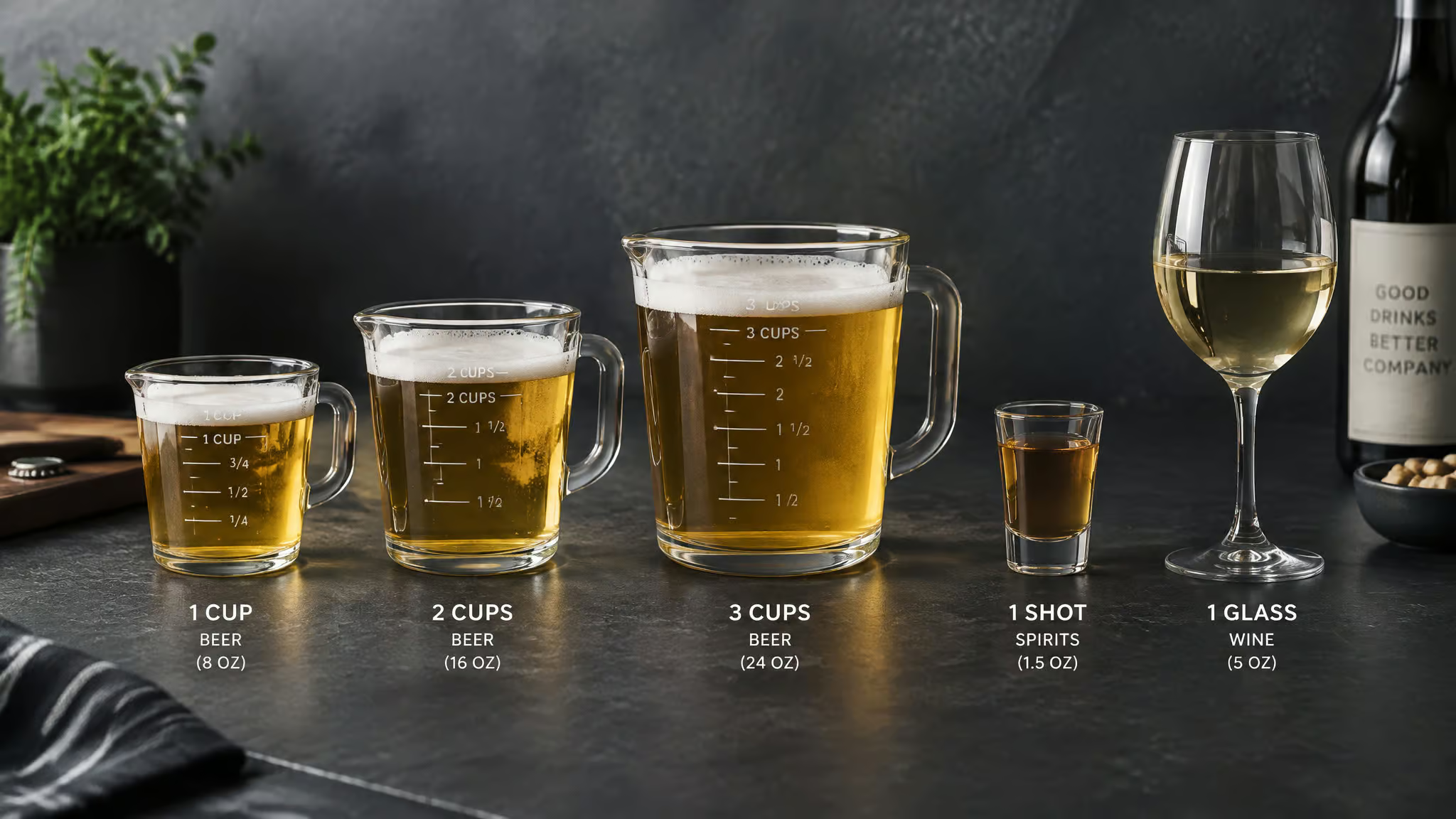
A standard drink is roughly 12 ounces of beer at about 5% alcohol, 5 ounces of wine at about 12%, or 1.5 ounces of spirits at 40%, per the NIH “Rethinking Drinking” framework. Every drink count in every definition above assumes that unit. Real pours run larger.
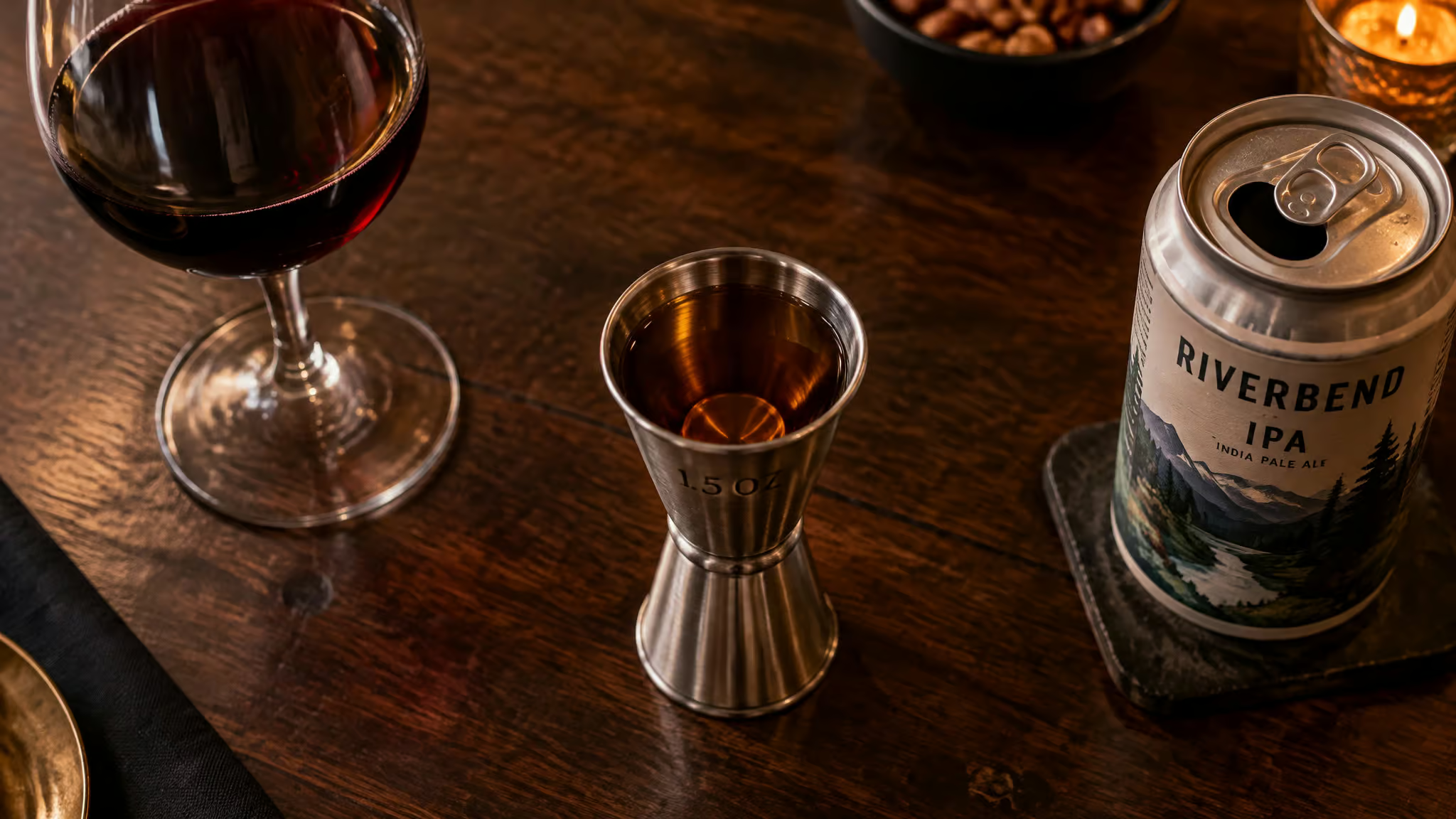
The common counting pattern looks like this: restaurant wine pours run closer to 6 ounces, so a glass of wine is quietly 1.2 standard drinks. Home mixed drinks often use 2 ounces of spirits, which is 2 standard drinks in one glass. Craft beers at 8 to 9% ABV, and those are approximations since it varies by beer, count as more than one standard drink each. None of this requires dishonesty. It just requires pouring like a normal person instead of like a government chart.
The conversion that changes answers: a 750ml bottle of wine is about 5 standard drinks. That crosses the women’s binge threshold in one sitting. A double-shot mixed drink counts as 2. The tell is the guy who says “I only had three drinks” after a night that actually totaled five-plus standard drinks once you weigh the pours.
He’s not lying. He’s counting glasses instead of drinks.
Quick test: Weigh every pour against the standard sizes before trusting any drink count. Glasses lie; ounces don’t.
Is 5 drinks in 5 hours binge drinking?
Yes. Five drinks in five hours counts as binge drinking under the CDC’s per-occasion definition, because “occasion” is not time-boxed to two hours. Spreading drinks across a long afternoon or a long game doesn’t take the occasion off the books.
The two-hour framing you may have seen belongs to a separate clinical variant. STAT cites a definition of four or more drinks in a span of two hours as a binge for women, which is a stricter, time-based way of counting the same behavior. It’s not the CDC’s count-based definition, so don’t graft a two-hour box onto the 5/4 numbers.
That said, speed isn’t irrelevant. NIAAA’s BAC framing implies it: the same five drinks spread over five hours produce a lower peak blood-alcohol level than the same five drinks in two. But how much lower depends on your body and how fast the drinks went down, so nobody can give you a precise number for your particular night. The count still stands. The peak just moves.
A quick self-check: where do your habits fall
Two steps, no lecture. First, map your real pours to standard drinks using the conversions above, because undercounted pours produce false reassurance. The 6-ounce wine glass, the 2-ounce home pour, the 9% craft beer. Count those honestly before you check anything.

Second, run two separate questions against your last month:
- Did any single occasion reach 5 or more drinks (men) or 4 or more (women)? That’s the binge scale. One time in the month counts.
- Does your weekly volume cross a heavy threshold? That’s the volume scale. Fourteen drinks a week from a nightly two-drink habit qualifies without ever being a binge.
The bottle-of-wine case answers itself once you run the math: about 5 standard drinks, which crosses the women’s binge threshold in one sitting, and stacks up heavy weekly volume fast if it’s a nightly bottle. So yes, a bottle of wine a day is over both lines.
Treat the result as a screening line, not a diagnosis. 25.1% of U.S. adults had at least one heavy drinking day in the past year, per the 2018 National Health Interview Survey, and most people who cross the line aren’t dependent on alcohol. That’s exactly why honest counting matters now, before patterns harden. If the check turns something up, how to stop binge drinking covers what to do about it.
What one binge episode can do: the acute risks of crossing the line
One binge episode can compromise immune function, and in someone with underlying pancreatic damage it can trigger acute pancreatitis. That pancreatitis risk only applies to people who already have pancreatic damage, not every healthy guy who overdoes it once. But the broader point holds. The damage isn’t only a long-term story. One bad night does something.
The acute cluster around a single crossing is well documented. Crossing the binge threshold raises the risk of blackouts and overdoses, plus unsafe sexual behavior, STIs, and unintentional pregnancy, the judgment-impaired-decisions package. And the risks scale with peak consumption: the more you drink in one sitting, the worse the odds get. That dose-response relationship is the reason the line is a safety line rather than a long-term-health guideline. It matters on the very first crossing, not after years of it.
Then there’s the injury list, stated without decoration: falls, burns, drownings, car crashes. Impairment is the mechanism in all of them. Nobody plans to fall down stairs. Nobody plans to misjudge a left turn. The planning happens before the fourth or fifth drink, and the plan doesn’t survive it.
The driving numbers are the ones that should stick. Binge drinkers are 14 times more likely to report driving drunk than non-binge drinkers, and 88% of impaired-driving events are caused by binge drinkers, per Dr. Jernigan of the CDC. Read those two numbers together. The population that crosses the per-occasion threshold isn’t a contributor to drunk driving. It’s essentially the whole story.
None of this needs dramatizing, so it won’t get any. These are documented risks of crossing the threshold, the same way a spec sheet lists failure modes. If a heavy night has already happened and you’re wondering what it does to your body afterward, how long it takes to recover from binge drinking walks through the timeline.
Heavy drinking over time: chronic disease and the death toll
Nightly drinking versus weekend binges: which is worse? The honest answer is that the evidence supports two different harm patterns and no head-to-head verdict. High peak consumption drives the acute risks above. Sustained volume drives the chronic ones.
Repeated binge drinking contributes to liver disease and other chronic conditions over time, and raises the risk of head and neck, esophageal, liver, breast, and colorectal cancers. Those are the named cancers, not a vague “cancer risk” hand-wave.
The mortality numbers, with their vintages: 2024 NVSS data via CDC WONDER counts 27,754 deaths from alcoholic liver disease (8.2 per 100,000) and 46,714 alcohol-induced deaths excluding accidents and homicides (13.7 per 100,000). The CDC’s 2016 Alcohol Use at a Glance fact sheet, dated December 31, 2015, put excessive alcohol use at 88,000 deaths per year, a figure a CDC video cites as roughly 79,000, an earlier vintage of the same estimate. Excessive drinking accounted for 1 in 10 deaths among working-age adults, with an average of 30 years of life lost. The economic tab: $249 billion in 2010, about $2.05 per drink, with $2 of every $5 paid by the public rather than the drinker.
One more number ties it together: binge drinking drives over half of those deaths and three-quarters of the costs. Binge episodes are the dominant engine of alcohol’s total burden, which makes the “occasional” binge the main event rather than a footnote.
Who actually crosses the threshold: the data vs. the stereotype
You can binge drink and not be an alcoholic. Over 80% of binge drinkers are not alcohol-dependent, per Dr. Brewer. That’s the fact most people have backwards, and it’s the reason the threshold goes unrecognized: guys assume the label only applies to dependency, so a pattern that isn’t dependency doesn’t register as anything.
The stereotype doesn’t survive the data either. 52.8% of U.S. adults regularly consumed alcohol and 25.1% had at least one heavy drinking day in the past year, per the 2018 NHIS. Roughly 1.5 billion binge episodes happen per year in the US, and 70% involve people 26 and older. More than half of all the alcohol American adults drink gets consumed during binges, and 90% of adults who are excessive drinkers binge drink. The college-kid image is wrong on the age math alone.
Income runs the wrong direction from the stereotype too. Binge drinkers most commonly make more than $50,000 a year, per Dr. Jernigan. Risk rises with income, not with unemployment. The typical person crossing the threshold is a functioning, employed adult with a career and a group chat, who doesn’t think the label applies to him.
And per Dr. Jernigan, most alcohol problems are caused by people who don’t consider themselves problem drinkers. Sit with that one for a second. If you can’t tell whether your pattern is dependency or just a heavy-episode habit, binge drinking vs alcoholism breaks down the difference.
Bottom line: Crossing the threshold measures episodes, not dependency. Most guys who cross it are employed, social, and nowhere near alcoholic.
The definitions in use: drinking during pregnancy
The same thresholds do real epidemiological work in the CDC’s MMWR analysis of 2021-2024 BRFSS data, released June 11, 2026 by Nicholas Deputy, PhD, and colleagues. It found 15.2% of pregnant women reported current drinking, meaning 1 or more drinks in the past 30 days, up from 13.5% in 2018-2020. 4.9% reported binge drinking, defined as 4 or more drinks on an occasion, and 2.2% reported heavy drinking, defined as 8 or more drinks in a week under the study’s definitions. Among pregnant women who were current drinkers, 33.2% also binge drank. Geographically, current drinking ran highest in New England at 19.9%, versus 10.4% to 12.4% across the mid-South and Mountain West regions.
The zero-threshold edge case: no amount of alcohol is proved safe in pregnancy. Ethanol is a known cause of birth defects and fetal alcohol spectrum disorders, and the CDC and ACOG recommend complete abstinence. Federal estimates suggest FASD may be more common than autism, though that’s an estimate, not a settled count.
The candid caveats: the numbers are self-reported, the 30-day recall window may capture drinking that predated the pregnancy, no trimester data was collected, and people generally underestimate their drinking. STAT‘s own analysis, reported by Isabella Cueto, found a preliminary single-year downtick in 2024, unconfirmed. Separately, STAT reported that officials impeded alcohol-use tracking, the most recent PRAMS data (2023) from the Department of Health and Human Services remains unreleased, and CDC staff cuts left the system in limbo. Alcohol use spiked during the Covid pandemic and has by some measures declined recently, but alcohol-related harms mostly have not returned to pre-pandemic levels. The findings also drew coverage from MedPage Today’s Rachael Robertson, with Nikki Zite, MD, MPH, of the University of Tennessee Graduate School of Medicine among the clinicians weighing in.
Why the numbers matter at scale
Binge drinking grows out of community environments that support it, per Dr. Jernigan, and most Americans see it as socially acceptable. Since most binge drinkers aren’t dependent, the fixes that work are environmental: increasing alcohol taxes is described as the single most effective measure, along with reducing purchase locations, limiting sale days and hours, enforcing the age-21 minimum, and de-normalizing binge drinking. The MMWR pregnancy report’s parallel recommendations, screening, brief counseling, referral, and community measures, point the same direction.
Where to check your own numbers
Start with NIH’s “Rethinking Drinking,” the tool for drink sizes, amounts, and the binge definition, and for converting your own pours into standard drinks before checking either threshold. The CDC’s Binge Drinking Fact Sheet backs the threshold figures; WebMD’s binge drinking overview gives the same facts in general-public framing; SAMHSA’s “Bringing Down Binge Drinking” infographic covers under-21 prevalence; NIAAA’s “Understanding Binge Drinking Fact Sheet” tracks rates across the lifespan; and “The Burden of Binge Drinking in Wisconsin” documents county-level impact if you want a state-level example.
Frequently Asked Questions
What qualifies you as a binge drinker?
Per the CDC, hitting 5 or more drinks on one occasion if you’re a man, or 4 or more if you’re a woman. There’s no frequency requirement — one night a year qualifies, so does every Friday. The counts exist because they roughly approximate how much alcohol it takes an average man or woman to reach the .08% blood-alcohol level that’s the DUI cutoff in all 50 states.
Is a bottle of wine a day too much to drink?
Yes — it’s over both lines. A 750ml bottle of wine is about 5 standard drinks, which crosses the women’s binge threshold in a single sitting, and a nightly bottle stacks up heavy weekly volume fast. The catch most people miss: restaurant pours run closer to 6 ounces and home pours are often bigger than the 5-ounce standard, so the real count can be even higher than the math suggests.
What are the health risks of binge drinking even once?
A single episode raises the risk of blackouts, overdoses, unsafe sexual behavior, and injuries like falls, burns, drownings, and car crashes — impairment is the mechanism in all of them. The risks scale with peak consumption, which is why the threshold is a safety line rather than a long-term-health guideline. In someone with underlying pancreatic damage, one binge can even trigger acute pancreatitis.
How many Americans binge drink each year?
Roughly 1.5 billion binge episodes happen per year in the US, and 70% involve people 26 and older — not college kids. Per the 2018 National Health Interview Survey, 25.1% of US adults had at least one heavy drinking day in the past year, and more than half of all alcohol American adults drink gets consumed during binges. Binge drinkers most commonly make more than $50,000 a year, so risk rises with income, not with unemployment.