The Smellmaxxing Game: When Your Nose Becomes the Controller
Gaming has cracked just about every sensory channel you can think of. Graphics, audio, haptics, motion controls, even the rumble in your controller that mimics a heartbeat. But smell? Nobody’s figured out smell yet. It’s the last untapped sensory frontier, the one thing that can’t be streamed through a headset or rendered on a screen.
Meanwhile, a completely separate group of guys on TikTok has been quietly treating their own scent as a game they can win. They call it smellmaxxing, and it’s not about buying expensive cologne. It’s about small, consistent choices, tracked like a score, improved like a skill tree. These two worlds seem totally unrelated. But pull back far enough and they’re both playing the same game: making your nose the most important sense in the room.
This article is about both versions of that game. The literal one, where developers build scent-emitting hardware and software that respond to what you’re doing in a virtual world. And the personal one, where you use fragrance as a self-improvement tool with streaks, feedback, and rewards. By the end, you’ll know how the tech works, why it’s been so hard to crack, and how to run your own scent routine like a game you can actually win.
Key Takeaways
Smellmaxxing (also called scentmaxxing) is the intentional use of fragrance for self-improvement, and TikTok creators have popularized it by describing cologne in vibe terms like “fresh out of the shower” or “date-night menace.”
Scent devices like Olorama use atomized fragrance cartridges triggered by APIs that connect to game engines, so entering a virtual forest releases earthy moss scents while exploring a marketplace triggers spices.
Soma Games is building a scent-driven system for The Scout, their Redwall-based game, using an Animal-Vegetable-Mineral-Organic classification with wind vector fields and scent prints that fade based on surface type.
Table of Contents
What Is Smellmaxxing? The TikTok Trend Behind the Term
Smellmaxxing and scentmaxxing are the same thing: the intentional use of fragrance as a form of self-improvement, and it’s the exact same mindset as looksmaxxing or gymmaxxing. The “maxxing” suffix comes from internet culture that treats self-improvement as an optimization problem. Small, consistent choices beat big, expensive ones. That’s the whole philosophy.
TikTok made this trend stick. Creators there don’t review cologne like a fragrance catalog. They describe it in vibe terms that translate instantly: “fresh out of the shower,” “date-night menace,” “library in autumn.” You can’t smell the thing through your phone, but you get exactly what they’re selling. The trend has been building for years, with notable articles on the topic appearing as early as October 2022 and continuing through March 2024.
That’s the trick of the whole trend. It’s about the identity a scent projects, not the ingredients.
The social flex is real, too. Smelling good is an invisible identity. It shapes how people perceive you before you speak. Somewhere between the handshake and the conversation, you’ve already told the other person something about how you operate.
And the self-improvement angle isn’t about luxury. It’s about intentionality. You don’t need a $300 bottle. You need to show up consistently with a routine that works for you.
Bottom line: Smellmaxxing isn’t about price tags. It’s about showing up daily with a routine that projects who you want to be.
How Video Game Scent Technology Works
Scent devices use cartridges filled with fragrance compounds, which get atomized and released into the air in controlled bursts. The words that matter there are “controlled bursts.” Advanced microfluidic systems handle precise modulation of intensity, duration, and timing. That’s what separates a real scent system from a guy spraying air freshener at his desk.
The software side is what makes it responsive. APIs connect the device to the game engine, so the system dynamically triggers the right scent based on where the player is and what they’re doing. Enter a virtual forest and you get earthy, mossy fragrances. Walk through a marketplace and suddenly it’s spices and baked goods.
The scent isn’t just ambient noise. It’s tied to your movement and choices.
Olorama is the current leader here. They build scent boxes and generation software designed specifically for game developers, and the whole thing works across VR headsets, consoles, and PC. There are three core benefits that make this more than a gimmick. Enhanced sensory immersion means smells transport you into the world. Emotional and narrative depth means scents can evoke nostalgia, danger, or calm in ways visuals can’t.
And interactive engagement means scents can act as clues or signals that help you play better. The tech isn’t perfect, but the direction is right.
What Games Have Tried Scent Mechanics?
Scent mechanics aren’t new. Games like Dog’s Life and Batman: Arkham Asylum tinkered with the idea, but it was mostly hidden tracks or gimmicky screen filters. Red Dead Redemption II has a scent mechanic too, but it’s simpler and more scripted. Nobody had built a real system where smell was the point.
That matters because scent has a unique tie to emotion and memory. A familiar smell can transport you somewhere faster than any screenshot or soundtrack. That’s why it works as a game mechanic. It’s not just another input method. It’s a direct line to how you feel about a moment.
The Scout, Soma Games’ upcoming title based on the Redwall book series, is positioning itself as the first real attempt. It goes back to 2014 in development. The core idea is that animals rely on their sense of smell much more than humans, so the entire game should let the player experience the world through smell. That’s the difference in kind, not degree.
Other games use scent as a bonus feature. The Scout uses it as the foundation.
The Subjectivity Problem: Scent Has No Rules
Here’s the fundamental problem Soma Games had to solve: the science of smell is underdeveloped and lacks definitive answers. Many scent classification systems exist, but each is tied to a specific industry and subjective. There’s no universal standard for what smells like what.
The Army spent millions of dollars searching for an odor to use as a non-lethal deterrent. They wanted one scent that everyone would find unpleasant. It doesn’t exist. Millions of dollars, and they found nothing. That’s the reality of smell. What one person finds evocative, another finds faint or cloying.
Quick test: Ask three friends to describe the same cologne. If you get three different answers, you’ve just proven why scent systems are hard to build—and why the more advanced art of layering cologne is the real key to a signature smell that sets you apart.
Case Study: Soma Games’ Scent System in The Scout
So how do you build a game mechanic on top of that chaos? Soma Games started with a classification system that’s almost childishly simple: Animal, Vegetable, Mineral, plus a fourth category they call Organic. Each scent is made up of a base note that lingers, a mid-note that clarifies, and a high note that evaporates quickly. Garlic, for example, is Pungent, Vegetable, and Spicy. Simple to understand, flexible enough to cover everything.

Passive Scent and the Wind Vector Field
The world itself carries scent. Every level has a vector field describing wind speed and direction, and scents travel downwind until they diffuse and disappear with time. This is a living system. You can pick up a scent from downwind and follow it back to where it started.
Enemies can smell you when you’re upwind. The wind is both your tool and your vulnerability.
Visualizing this was the biggest UI challenge Soma Games has ever faced. They settled on tinting wind wafts to reflect the three scent notes, making them look vaporous and oily, distinct from clean air. The inspiration came from how Sea of Thieves and Breath of the Wild depicted wind. It has to be readable at a glance but subtle enough not to feel like a HUD overlay.
Active Sense, Scent Prints, and Scent Marks
Players also have an active ability called Active Sense. It lets you see more distinction between colors, recognize specific known scents among competing unknowns, and find static scent clues. It’s the difference between walking through a forest and actually reading it.
Scent Prints reveal who passed through a room minutes earlier, and they fade with time. The fade rate depends on the surface. Bare earth holds a print longer than cold stone. Stream beds hold nothing at all, which makes them useful for avoiding pursuit.
Scent Marks are more deliberate. They reveal an object’s owner, a recent battle, or territorial marks left by enemies. The whole system makes the world feel alive in a way that visual-only games can’t touch.
The Technical Cost of a Scent-Driven World
Building this was not cheap. The first implementation used a Unity plug-in called Megaflow, but it consumed too many CPU cycles. They replaced it with Unity particle forcefields, which brought a whole new set of problems. Particle optimization became the major roadblock. The solution was pooling particles into fewer systems that update locally to the player, rather than trying to simulate everything globally.
A typical level might include 50 unique emitters, both moving and stationary. The passive scent system requires tens of thousands of particles with exceptionally long decay rates. That’s the hidden cost of building a world that smells. It isn’t just the fragrance. It’s the entire simulation running underneath.
The Challenges and Limitations of Scent Technology
The honest truth is that scent gaming hasn’t gone mainstream, and there are three reasons why.
First, fragrance is deeply subjective. Devices need adjustable intensity because individual preferences vary wildly. What smells perfect to one person is cloying to another. That’s not a bug you can patch. It’s a fundamental constraint.
Second, scent dispersion must be precise. You can’t have one smell bleeding into another, or you get a muddle that breaks immersion entirely. Getting the timing and spatial distribution right is genuinely hard engineering. Third, the machines have to stay small, silent, and work with different gaming setups, such as VR headsets and consoles. Nobody wants a device that sounds like a fan running under their desk.
In practice, the most common failure mode is a device that overwhelms the experience. A single scent that’s too strong or lingers too long can ruin a session. Adjustable intensity is the workaround, but it’s not a solved problem.
The Smellmaxxing Starter Routine
Scent layering means using multiple complementary scented products, not competing ones. The balanced routine is straightforward: scented body wash or bar soap, then deodorant, then a light mist of cologne. Add lotion before the cologne, and it helps the scent last longer.
If you want to take this further, the principles behind smellmaxxing build on this exact routine. Moisturized skin holds fragrance longer because dry skin absorbs aromatic oils faster and the scent fades sooner.
Application technique matters. Target your pulse points: wrists, neck, chest. Body heat helps diffuse the scent oils into the air. And here’s the dosage rule: one or two sprays is sufficient, a lesson that’s been amplified all over the smellmaxxing tiktok trend, where fragrance influencers preach subtlety over saturation. You want people to notice when they’re near you, not from across the room. Nobody is impressed by the guy who smells like a department store explosion.
There’s a vocabulary for all this that’s worth knowing. Projection is how far an aroma travels. Longevity is how long it lingers. Sillage is the subtle trail left behind you as you move. You don’t need to be a fragrance snob to use these words, but they help you think about what you’re doing.
Fresh scents work for daytime. Woodsier scents fit evening. And here’s the cost-conscious truth: you don’t need 37 bottles or rare cologne. Consistency and intentional layering matter more than price. The goal is a signature that’s yours, not a collection that’s expensive.
Dr. Squatch Scents for Your Rotation
Dr. Squatch makes natural soaps, deodorants, and colognes for guys who want to ditch drugstore junk. Their bar soap is handmade cold process, and essential oils drive the quality. You don’t need the whole lineup, but a few options give you a rotation that covers most situations.
Coastal Mist is ocean spray and sea moss, breezy and fresh off the coast. This is your daytime, warm-weather, no-effort-needed scent. Rainforest Rapids brings eucalyptus, sage, and cedarwood, making it lush and grounded. It’s a step up in character without being heavy.
Wood Barrel Bourbon hits sweet, woodsy tones, and Fireside Bourbon takes a woodsier route for cooler moods. These are your evening options. If you want something icy and sharp instead, Glacial Falls changes the vibe completely. For casual daytime, Fresh Falls is clean and reliable.
And Summer Citrus feels vibrant and energizing, which makes it a good workout or hot-day pick. When you need something more sophisticated for an evening out, Maverick Musk or Woodland Pine will get you there.
The key insight here is that essential oils make the difference. They smell like the thing they claim to smell like. Synthetic fragrances can be sharp or flat by comparison. Natural oils wear differently, and they tell a more accurate story. Match the scent to the occasion and you’ve got a rotation that covers you from the office to date night.
Buyer rule: Pick three scents — one fresh for daytime, one woodsy for evening, one wildcard for variety. That’s a complete rotation.
Turning Smellmaxxing into a Game: Streaks, Feedback, and Scoring
Here’s the thing I’ve noticed watching both worlds develop: treating scent improvement like a game is what makes it last. The guys who last at this aren’t the ones with the most bottles. They’re the ones who built a system with rules, streaks, feedback, and rewards. So I built myself a simple scoring framework.
It’s not an app. There’s nothing to download. Just a notebook or a notes app.
Streaks. Track consecutive days of completing the four-step routine. That’s the foundation. Missing a day resets the streak, and that’s the motivation.
You don’t want to break the chain. It sounds silly until you have a 14-day streak and you’re standing at the sink at 11 PM deciding whether to do the whole routine or just skip it. The streak wins. That’s the point.
Feedback. Once a week, do a self-assessment. How long did the projection last? Did the sillage hold?
Ask one trusted friend for honest input. Track compliments as a metric, but don’t train yourself to fish for them. There’s a difference between noticing positive feedback and demanding it.
Scoring. This keeps it concrete. Award points for consistency, technique, and outcomes. One point per day of routine completion.
Two points for a technically clean application: correct pulse points, one-to-two spray discipline. Three points for a verified compliment, plus a weekly streak bonus. It’s not science. It’s just a way to keep yourself honest and engaged.
Levels and rewards. Master a new scent before rotating in another. Reward yourself for hitting week or month milestones. The framework is self-administered, so you’re playing against your previous week’s score, not against other people.
This works because games give you structure. You know what winning looks like. You know when you’re falling behind. Applied to something as subjective as scent, that structure is what turns a casual interest into a habit.
The Honest Counterargument: Is Smellmaxxing Just a Marketing Ploy?
Let’s steelman the case against all this. The Army spent millions searching for a universally unpleasant scent and found none. If no scent is universally disliked, how can any system promise a “win”? The subjectivity problem applies in gaming, where one player’s evocative forest scent is another player’s faint, confusing whiff.
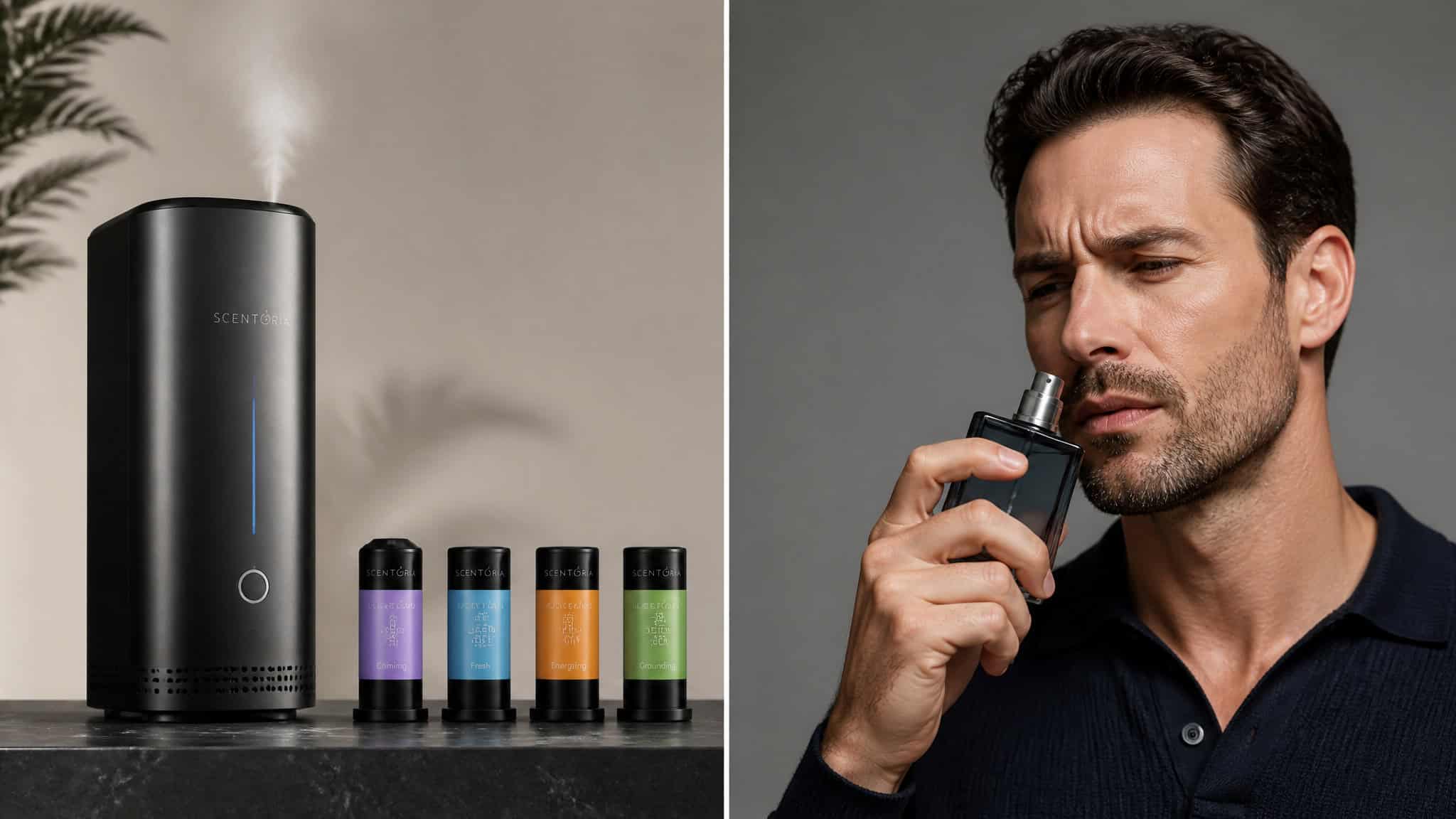
And it applies in personal care, where the trend conveniently aligns with product catalogs. Dr. Squatch sells soap. The internet tells you to buy it.
But subjectivity doesn’t invalidate the practice. It argues for adjustable intensity in devices and for finding your own scent identity in personal care. The problem isn’t that scent is subjective. It’s that we expected a universal answer.
There isn’t one. There was never going to be one.
What survives the critique is the habit-building structure. The streaks, the routine, the self-improvement mindset.
Even if the “game” framing is partly a marketing lens, the underlying practice is defensible. You shower anyway. You put on deodorant anyway. Adding a two-spray cologne step and tracking your consistency costs almost nothing. The ROI is entirely in your corner.
The Future of Scent: Beyond Gaming and Into Everyday Life
Here’s where the convergence happens. The same tech that makes gaming smell real is going to make personal fragrance more precise and data-driven. Olorama is already working on AI-driven scent control, miniaturization, and more accessible home setups. The trajectory is clear.
Soma Games is thinking beyond gaming too. White water rafting. Black hole surfing. Any simulation benefits from scent, not just the ones with forests and marketplaces. The principle is universal: scent adds depth to experience, whether you’re fighting a boss or just answering emails.
The smellmaxxing game, in both senses, is early. The tech is getting better. The culture is getting more sophisticated. And they’re converging on the same insight.
Smell matters more than we gave it credit for, and we’re getting better at controlling it. That’s a game worth playing.
People Also Ask
What does “scentmaxxing” mean?
Scentmaxxing, also known as smellmaxxing, is the intentional use of fragrance as a form of self-improvement, similar to looksmaxxing or gymmaxxing. It’s about consistent, small choices in your scent routine rather than expensive products, and it’s popularized on TikTok where creators describe colognes in vibe terms like ‘fresh out of the shower’ or ‘date-night menace.’
What are that smell game rules?
The smell game rules refer to the framework for treating your scent routine like a game. This includes tracking streaks of daily routine completion, giving yourself feedback through weekly self-assessments and trusted friend input, scoring points for consistency and technique, and rewarding yourself for milestones. The goal is to build a habit through structure, not to compete with others.
How does scent technology in video games work?
Scent technology in games uses devices like Olorama that atomize fragrance cartridges, releasing controlled bursts of scent triggered by APIs connected to the game engine. This allows scents to change based on in-game location and actions, such as entering a forest and smelling moss or walking through a marketplace and smelling spices. The system aims to enhance immersion and provide gameplay cues.