
The English language has hundreds of ways to call a woman attractive. I dug through a compiled source of 473 slang terms for “hot girl.” Found everything from the obvious to the borderline offensive. There’s even a dedicated category of “Slang terms for women” that runs 59 pages across four subcategories, which led me to a guide on 12 English slang terms you need to know in 2022. And a separate guide called “75 Ways to Say Beautiful” that tries to cover every possible adjective.
But here’s the thing: knowing a bunch of words isn’t the same as knowing which one to use. Call her “foxy” and you sound like you just stepped out of a 70s disco. Drop “hottie” in a serious conversation and you might come off like a teenager. Say the wrong thing in Spanish and you could get slapped (more on that later).
This article isn’t a dictionary dump. It’s a cheat sheet — context included. After reading it, you’ll know which terms actually work, which ones will age you, and which ones are better left in a time capsule. The goal isn’t to impress anyone with your vocabulary. It’s to pick the right word for the situation without sounding like a creep, a time traveler, or someone who just discovered Urban Dictionary.
Key Takeaways
The source material lists 473 slang terms for “hot girl,” but the majority are either outdated, overly sexual, or carry cultural traps — knowing when to use a term matters more than knowing how many exist.
Terms like “cute” and “pretty” are considered innocent; “hot” and “sexy” are explicitly noted as slightly objectifying — choose accordingly based on your relationship and setting.
A direct translation of “fox” into Spanish gives you “zorra” — which means prostitute, a real-world failure case from the source that proves why context and cultural awareness beat a thesaurus.
Table of Contents
The 25 Most Common Synonyms for “Hot Girl” – Quick Reference
These are the terms you’ll hear most often. Each comes with a quick note on where it fits so you don’t accidentally use something that’s dated, too juvenile, or too formal.
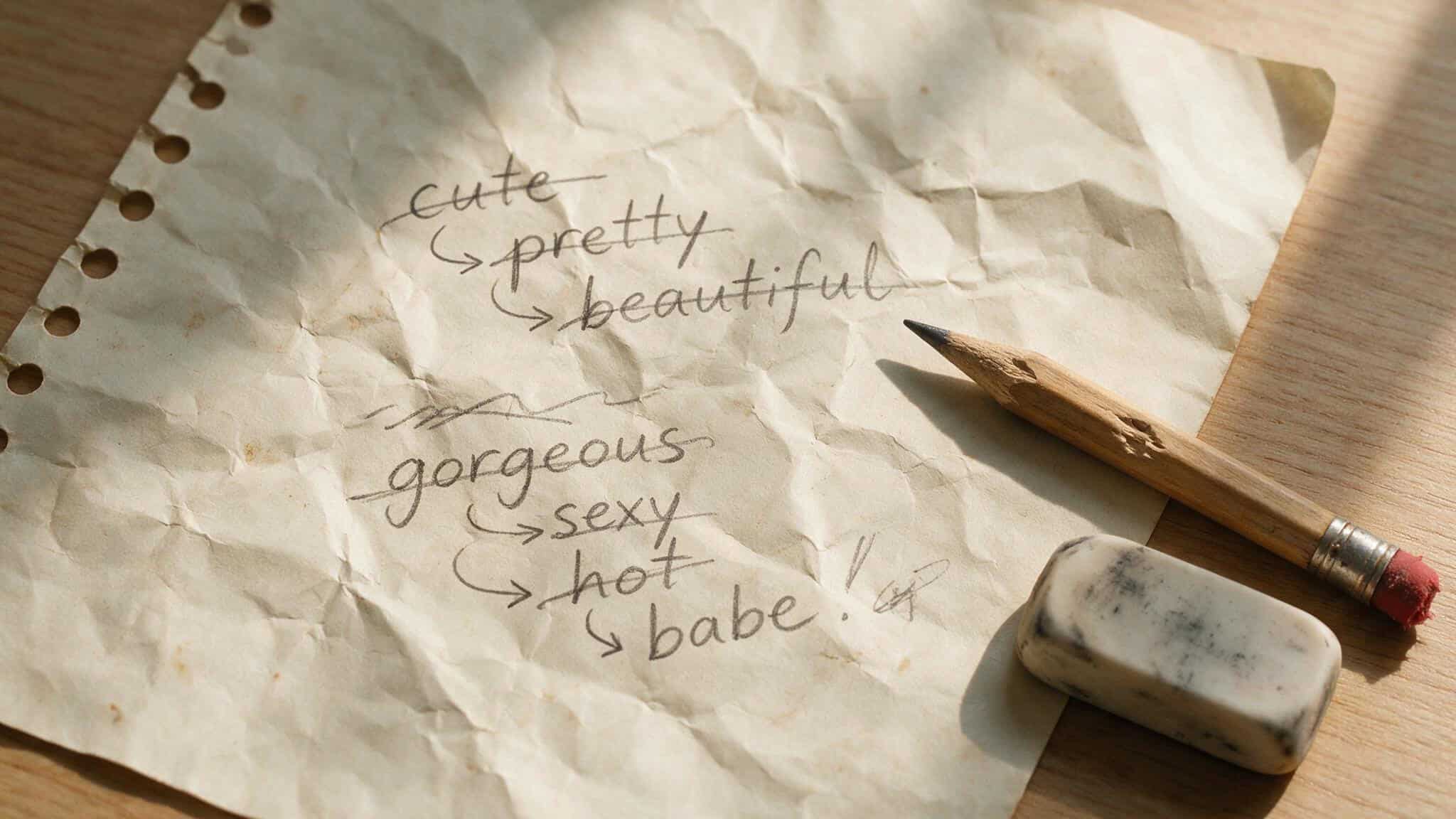
Hot chick
Direct, straightforward, and a little blunt. Works when you’re describing someone to a buddy, but probably not the best move in a romantic context.
Pretty girl
One of the most common descriptors you’ll hear. Safe, neutral, and works in almost any casual setting.
Sexy girl
Very direct and sexual. No ambiguity about what you mean. The source explicitly notes that “sexy” (and “hot”) are slightly objectifying — keep that in mind.
Lovely girl
Classic and warm. Feels more like a genuine compliment than slang. A bit old-school but still effective.
Beautiful girl
The foundation term. Carries weight. Implies depth, inner beauty — not just looks. Not a casual throwaway.
Pretty lady
Slightly more formal than “pretty girl.” Sounds respectful, maybe a little old-fashioned.
Cute girl
Versatile. Can describe a dog, a baby, or a romantic interest. Often the first phase of attraction, but can also be purely platonic. Context is everything.
Fine girl
90s slang. “She’s fine” means she’s attractive without getting too graphic. Still around, but it pegs you to a certain era.
Good-looking girl
One of the most common ways to describe an attractive person. Hints at romantic interest more than “attractive,” but not a guarantee. Comes from “to look good.”
Hottie
Urban Dictionary defines a “hottie” as someone physically attractive who doesn’t know it yet. Often used by teenagers or young people. If you’re over 25, you might sound a little young.
Hot woman
Direct and adult. Less juvenile than “hot girl.” Straightforward.
Sweet girl
Emphasizes personality more than appearance. Not really a synonym for “hot” — it’s a different compliment entirely.
Gorgeous girl
Strong, purely physical attraction. Works for both men and women. The source notes that “gorgeous” is surface-level compared to “beautiful,” which includes inner qualities.
Attractive girl
The most generic, objective term. If you want to say someone looks good without any romantic subtext, this is it. Safe for professional settings.
Hot babe
Combines “hot” and “babe.” Feels like something from a 90s movie. Not current, but you’ll still hear it. (For a deeper breakdown, check out what does hot babe mean.)
Beautiful lady
More formal variant of “beautiful girl.” Polite and respectful. Not slang, but a genuine compliment.
Sexy woman
Adult version of “sexy.” Very direct, sexual, no ambiguity. Use with awareness.
Babe
Noun for a very beautiful woman (rarely a man). As strong as “gorgeous,” but its frequency has declined. You’ll see it in old movies and songs. (For more on whether it’s flirty, see Is babe a flirty word.)
Prettiest girl
Superlative of “pretty girl.” A bit romantic, but still innocent.
Lovely lady
Elegant term. Describes graceful, radiant beauty. Very British.
Hot lady
Equivalent to “hot woman.” Direct, a little blunt.
Beautiful woman
Classic, deep compliment. The gold standard when you want to say something meaningful.
Hot women
Plural form. Same as above, for groups.
The short version: stick with “pretty,” “beautiful,” “cute,” or “gorgeous” in most situations. Save “hot” and “sexy” for when you’re sure the context is right.
From Innocent to Suggestive — The 16 Core Compliments (Ranked by Intensity)
Not all compliments are equal. The source ranks 16 common beauty synonyms from most innocent to most sexually suggestive. Knowing where a term lands on this scale is the key to not misreading the room.
Cute
Can describe a dog, a baby, or a romantic interest. Often the first phase of attraction, but easily confused with platonic affection. The Swiss Army knife of compliments.
Adorable
Stronger than cute. Implies deep affection. Works for people, pets, and babies. Can be romantic, but not necessarily.
Attractive
The most neutral, objective term. No hidden meaning. Use it to describe someone as good-looking without implying romantic interest.
Good-looking
Hints at romantic interest more than “attractive,” but still safe. Comes from “to look good.” One of the most common ways to say someone is attractive.
Beautiful
Classic and weighty. Expresses outer and inner beauty. Calling someone “beautiful” is a statement — it’s not casual. Generally reserved for women, but can describe a delicate type of man.
Handsome
Traditionally used for men. In the US, it’s old-fashioned and rarely used by people under 40. In Australia, all ages use it regularly. If you’re in the US and under 40, “good-looking” or “cute” sounds more natural.
Pretty
Similar to “beautiful” but more innocent and focused on physical appearance. “Pretty” is based on what can be enhanced with cosmetics. “Beautiful” goes deeper. A woman would never call a man “pretty.”
Gorgeous
Denotes very powerful physical attraction. Purely physical, unlike “beautiful.” Works for both men and women. Women use “gorgeous” for men more often than men use it for women.
Lovely
Describes elegant, radiant feminine beauty. Also used for things and events (“a lovely dinner”). Very common in posh British English.
Exquisite
Beautiful in a very delicate, refined way. Extreme feminine beauty. Also describes food, wine, or art. Not a casual word.
Stunning
Surprising, shocking beauty — the kind that stops you in your tracks. Works for both men and women.
Foxy
70s slang. “She’s foxy” or “she is a fox.” Not used much nowadays. If you call someone “foxy,” you’ll sound like you’re wearing bell-bottoms.
Radiant
Bright, shining beauty. Implies energy, health, and luminosity. Often a temporary, in-the-moment thing. Mostly used for women.
Sexy
Attractive in a very sexual, sensual way. Also used colloquially for exciting things (“a sexy new guitar”). The source flags it as slightly objectifying.
Hot
Similar to “sexy” — provokes sexual interest. Very common, but also slightly objectifying. Works for both men and women.
Babe
Noun for a very beautiful woman. As strong as “gorgeous,” but its usage has decreased. Seen in old movies and songs. (For how to interpret the phrase “you’re such a babe,” see You’re such a babe meaning.)
The gradient is clear: innocent terms like “cute,” “pretty,” and “beautiful” are safe in almost any setting. As you move toward “sexy” and “hot,” you’re signaling sexual interest. Use that shift intentionally.
More Ways to Say Beautiful — The Exhaustive List
The source’s alphabetical appendix includes every adjective for beauty it could find. Many are rare, outdated, or carry specific connotations. This section is for reference — not for daily use.

Aesthetically Pleasing
Objective, common for design and art. Sounds strange applied to a person in a romantic context.
Appealing
Attractive or interesting. More common for things and ideas than people. Doesn’t imply romantic interest.
Alluring
Mysterious, seductive. Implies a pull that’s hard to resist. Works for people and things.
Amazing
Impressive. When used for a person, it’s about more than just looks — their whole being.
Angelic / an Angel
Religious connotation. Sacred, almost otherworldly beauty. Very strong word.
Banging (bangin’)
Slang for sexy or hot. Mainly for women. Also means awesome (“that party was bangin’”). Comes from the verb “bang.”
A Beauty / A Beaut
Perfect example of something. “She’s a beaut” — old-school, mainly used by men.
Becoming
Brings out beauty. “That dress is becoming on you.” Also means appropriate.
Beguiling
Charming in a clever or deceptive way. Implies a bit of trickery.
Bewitching / Bewitched
Casts a spell, makes you lose control. Very intense.
Bootylicious
Portmanteau of “booty” and “delicious.” Curvaceous, sexy. Made famous by Destiny’s Child. Very 2000s.
Breathtaking
Takes your breath away. Common for natural beauty, but works for people too.
Buxom
Voluptuous, big‑breasted figure. Old‑fashioned and specific.
Captivating
Surprises and holds you captive. Strong word.
Charming
About personality and presence. More common for men (“Prince Charming”).
Comely
Attractive combination. Old‑fashioned, literary.
Dainty
Delicate, exquisite feminine beauty. Old‑fashioned. You’ll find it in books, not conversation.
Dazzling
Blinds with bright light. Works for smiles, diamonds, performances.
Delightful
Pleases the senses deeply. Warm and positive.
Divine
Heavenly, sacred. Not a casual compliment.
Doll
Outdated. “She’s a doll” sounds like a 1950s movie line.
Dreamy
Invokes daydreaming. Old‑fashioned, teenage crush language.
Drop‑Dead Gorgeous
So attractive your heart stops. Common collocation, works for both genders.
Eye‑Catching
Grabs attention visually. Works for people and things.
Easy on the Eyes
Understatement. Casual, slightly old‑fashioned. Mild compliment.
Eye‑Candy
Visually appealing but lacking depth. Direct and sexual. Can be objectifying.
Enchanting
Casts a spell. Strong, romantic.
Fabulous
Inspires wonder. More common in fashion and entertainment contexts.
Fair
Delicate Old English. Also means just or light‑skinned. “My fair lady.”
Fine
90s slang for sexy/attractive. “She’s fine.”
Fly
90s ghetto slang for cool/beautiful. Very dated.
Fetching
Old English for attractive. Rarely used today.
A Goddess
Female deity. Divine, superhuman beauty.
Glamorous
Magical, exciting charm.
Glorious
Splendor and admiration.
Graceful
Elegant beauty.
A Head Turner
Causes people to turn their heads.
Heart‑stopping
Extreme beauty that stops the heart.
Hottie
Already covered in the 25 list. Duplicate.
Hypnotic
So attractive you lose control.
Irresistible
Cannot be resisted.
A Looker
Good‑looking, typically a young woman. Slightly old‑fashioned.
Luscious
Sensually attractive. From good taste.
Magnetic
Pulls you in.
Magnificent
Impressive, extravagant beauty.
Marvelous
Inspires wonder.
Nice
Colloquial synonym for beautiful. In Australian English, it implies sexual attraction.
A Perfect 10
Perfect score on a 1‑10 scale. Objectifying.
Ravishing
Extreme beauty that hypnotizes.
Riveting
Captures attention completely.
Seductive
Seduces and tempts.
Sensuous
Purely physical beauty.
Smoking (smokin’ hot)
Beyond really hot. Urban Dictionary level.
Spectacular
Dramatic, impressive.
Striking Beauty
Hits you hard.
Sublime
Almost spiritual beauty.
Taking
Captivating. Not commonly used now.
A Traffic Stopper
So attractive they stop traffic.
Winsome
Attractive in appearance or character. Not common.
Wonderful
Inspires wonder.
Slang Terms to Use with Caution (or Avoid Altogether)
Some terms seem harmless until you learn the cultural or generational trap. Here are the biggest offenders from the source.
Red flag: A direct translation of “fox” into Spanish is “zorra” — which means prostitute. One guy learned this the hard way and got slapped. Skip “fox” entirely around Spanish speakers.
The Spanish “fox” disaster. The source includes a real‑world anecdote: a guy calls a woman a “fox” in front of a Spanish‑speaking friend. The literal translation is “zorra” — which means prostitute. He got slapped.
The British origin word “foxismonitism” (meaning young and attractive) won’t save you. If you’re around Spanish speakers, skip “fox” entirely.
Generational time bombs. “Foxy” is 70s slang. “Fine” and “fly” are 90s slang. “Doll” and “dreamy” are ancient.
“Dainty” is literary. Unless you’re intentionally going for a retro vibe, these terms date you badly.
“Handsome” in the US vs. Australia. In the US, “handsome” is old‑fashioned. Most American guys under 40 say “good‑looking” or “cute.” In Australia, “handsome” is still common across all ages. Know your audience.
“Babe” and “hottie” are fading. Both are still in use, but they’ve lost currency. “Babe” used to be as strong as “gorgeous,” but now it feels like something from your dad’s playlist. “Hottie” is fine for teenagers, awkward for adults.
Objectifying shortcuts. “Eye‑candy,” “a perfect 10,” and “a traffic stopper” reduce a person to a rating or a visual snack. Use them only when you’re being deliberately crude among friends.
Respectful Compliments vs. Objectifying Slang
The source explicitly flags “hot” and “sexy” as slightly objectifying. That doesn’t mean you can never use them — it means you need to be aware of the difference between admiring someone and reducing them.
Respectful terms (convey genuine appreciation):
– Beautiful, stunning, radiant, captivating, lovely, exquisite, graceful, charming.
Objectifying terms (focus on physical appeal, often in a surface‑only way):
– Hot, sexy, eye‑candy, a perfect 10, a looker, banging, smoking.
The rule of thumb: in professional settings or early romantic encounters, stick with the respectful list. Save “hot” and “sexy” for when you’re already in a mutual space where both parties are comfortable with direct sexual language. No one ever complained about being called “beautiful.” Plenty of people have bristled at being called “a piece of eye‑candy.”
Gen Z Slang — What’s Hot Right Now
Slang evolves fast. The source doesn’t cover everything, but a few newer terms have become common enough to mention.
- Snack – Someone attractive enough to eat (food metaphor). Casual, flirty, very Gen Z.
- Baddie – A confident, attractive woman. Often used on social media to describe a woman who owns her look.
- Dime piece – A perfect 10 on the rating scale. Comes from the idea of a dime being the highest‑value coin. (The source includes this from Urban Thesaurus.)
- Smokeshow (or smoke show) – Extremely attractive. Derived from “smokin’ hot.”
- Chica caliente – Spanish‑infused slang, literally “hot girl.” Use with caution if you’re not a Spanish speaker.
These terms are casual and best used among younger crowds or in laid‑back social media comments. They won’t work in a professional email or a first date.
How to Choose the Right Term for the Situation
Here’s the practical decision guide you actually need.
1. When you’re just getting to know someone – Stick to the innocent end of the spectrum. “Cute,” “pretty,” “beautiful,” or “stunning” are safe. They convey attraction without pressure.
2. When you’re already in a romantic or sexual relationship – “Hot,” “sexy,” “gorgeous” are fine. You know each other’s boundaries. Just be mindful that even within a relationship, “hot” can feel reductive if it’s the only thing you ever say.
3. When you’re describing someone to a friend – Use whatever fits the vibe. “She’s a babe,” “she’s fine,” “she’s a dime piece” — your buddy will get it. But if you’re in mixed company or a public setting, keep it clean.
4. When you’re in a professional or formal setting – Avoid slang entirely. “Attractive” or “good‑looking” are fine for objective statements. Better yet, focus on her accomplishments or personality.
5. When you’re talking to someone from a different generation – Match their age group. Under 25? You might get away with “snack” or “baddie.”
Over 40? “Beautiful” or “lovely” won’t fail.
6. When you’re in a multilingual environment – Avoid direct translations. “Fox” does not translate well into Spanish. “Hot” might not either. Stick to universal positives like “beautiful” or “stunning.”
The golden rule: when in doubt, choose a term from the innocent end of the spectrum. “You look beautiful” or “you’re stunning” will never backfire. Save slang for when you know exactly what you’re doing.
The Bottom Line
The best slang term for a hot girl is often no slang at all. A genuine “you look beautiful” or “you’re stunning” carries more weight than any thesaurus word. English gives you hundreds of options, but context beats vocabulary every time.
Remember the “zorra” lesson: the word you think is harmless might be a disaster in another language or era. Know your audience, match your tone to the situation, and when you’re not sure, keep it simple. That’s the real cheat sheet.