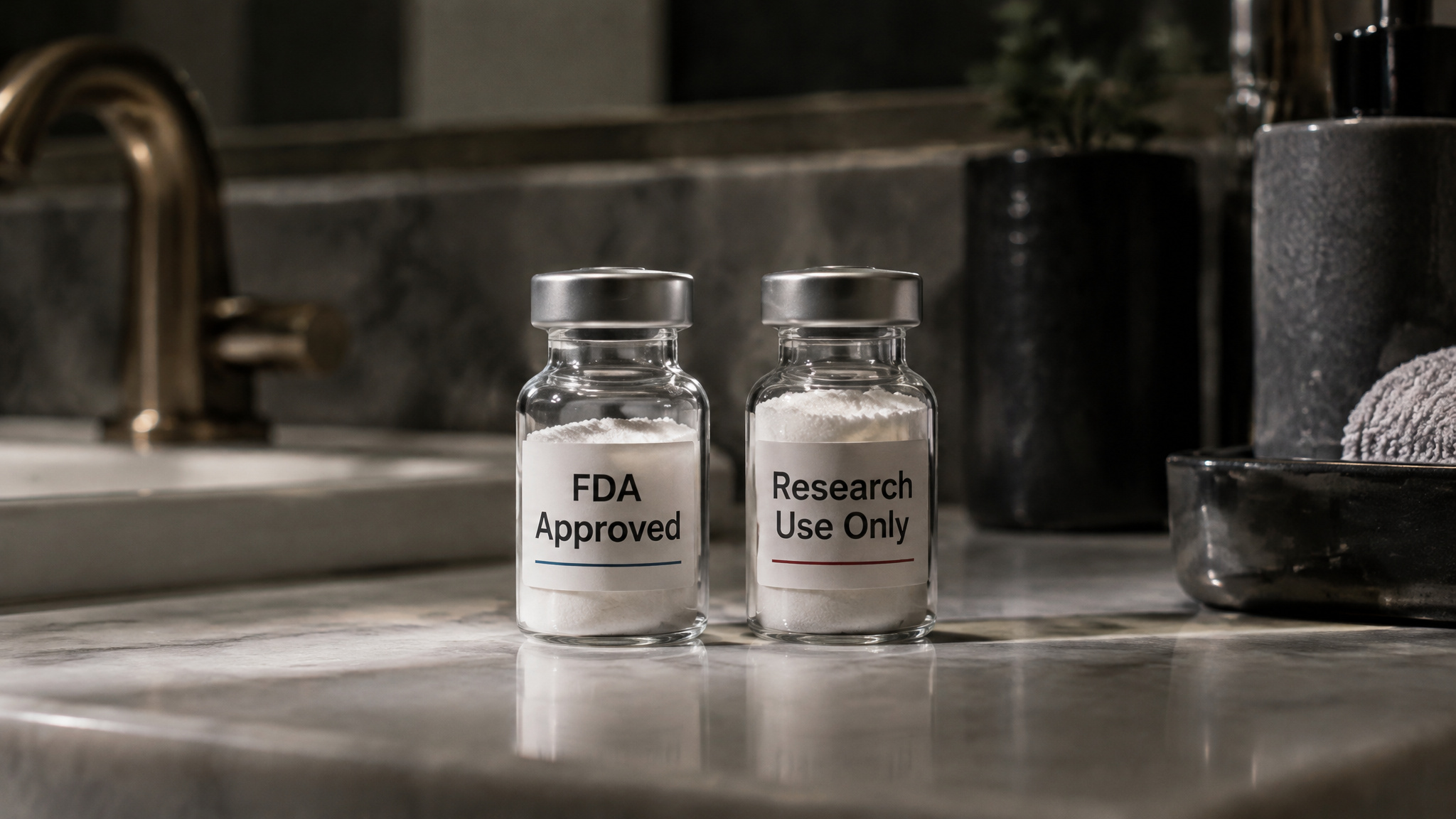
Two vials can sit next to each other on a bathroom counter, both mixed with sterile water and drawn into an insulin syringe, and one of them is a billion-dollar pharmaceutical drug while the other is powder from an unaudited warehouse with a legal disclaimer on the sticker. If you’ve spent ten minutes talking to gym buddies or scrolling TikTok lately, you’ve heard the pitch for popular peptides for men: BPC-157 for a bum shoulder, CJC-1295 for leans and sleep, or the Wolverine Stack to heal like you’re twenty-two again.
Chemically, peptides are just short chains of amino acids your body already uses as cellular messengers to regulate cell function. Scientists copy or tweak those chains into mostly injectable medicines, a legitimate track record that started when insulin was discovered in 1921 and transformed diabetes care, and continues with FDA-approved peptide drugs like semaglutide (Ozempic). Before you reconstitute a vial at home, the sorting rule is simple: stop asking whether something is a peptide, and ask whether it’s an FDA-approved prescription drug or an unregulated research chemical.
Key Takeaways
The men’s peptide market splits cleanly between FDA-approved prescription drugs like insulin, tirzepatide, and tesamorelin (approved only for HIV-associated lipodystrophy) and gray-market research chemicals like BPC-157, TB-500, CJC-1295, and Ipamorelin that the FDA restricted from pharmacy compounding in 2023.
An audit by musculoskeletal researcher Flynn McGuire found only three human studies on BPC-157 (with the lone musculoskeletal study lacking a control group) and zero human studies on TB-500 itself, while actual recombinant growth hormone outranks every growth hormone secretagogue at a lower cost.
Unregulated vials carry real-world harms beyond wasted money, including a 52-year-old Texas fitness coach who suffered an 11-month autoimmune joint reaction after nine days on 60 micrograms of BPC-157, and two women hospitalized at a 2025 Las Vegas anti-aging conference after peptide injections.
Table of Contents
What peptides are, and the line that matters
A century of prescription pharmaceuticals sits on one side of the peptide counter, and unverified social-media vials sit on the other.
What peptides actually are
When formulated for peptide therapy, these short amino-acid chains mimic your body’s natural cellular signaling processes. That pharmaceutical history started with insulin in 1921, expanded into FDA-approved prescriptions for osteoporosis, irritable bowel syndrome (IBS), cancer, and HIV, and recently rewired diabetes and obesity care through GLP-1 drugs like Ozempic and Wegovy. Bodybuilders started experimenting with injectable peptide derivatives back in the 1980s and 1990s. Wellness clinics like Ageless MN now pitch peptide therapy as nudging your body’s own endogenous production rather than introducing outside hormones, positioning it as a lower-risk, more sustainable alternative to hormone replacement therapy (HRT).
That HRT comparison is a clinic marketing claim, though legitimate clinics at least pair it with a medical history, lifestyle analysis, blood work, and patient education before writing a prescription. Meanwhile, non-prescription compounds sold online by Kovagen research peptides are strictly supplied for laboratory research and are not intended for human consumption.
Approved peptide drugs vs. research chemicals
As AARP and University of California, Davis stem cell biologist Paul Knoepfler point out, “People hear the word peptide and presume all peptides are safe and effective,” even though online darlings like BPC-157 and TB-500 have little to no human research and rely on rat studies, cell models, and anecdotes.
GH secretagogues: the growth hormone imitators
Ipamorelin, CJC-1295, Tesamorelin, BPC-157, TB-500, and GLP-1 receptor agonists are the core compounds in men’s peptide protocols, grouped into growth hormone secretagogues for body composition, recovery peptides for tissue repair, and prescription GLP-1 drugs for fat loss. For men chasing the best peptide stack for muscle growth and fat loss, clinics routinely recommend pairing CJC-1295 with Ipamorelin for synergistic growth hormone output, targeting guys who want leaner body composition and faster recovery without jumping straight to exogenous hormones. Across the market, men’s protocols sort into growth hormone secretagogues, including Sermorelin, the CJC-1295 and Ipamorelin combo, Tesamorelin, and the oral non-peptide secretagogue MK-677, alongside recovery injectables BPC-157 and TB-500 and approved GLP-1 weight-loss drugs. Yet in an evidence tier list by urologist Dr. Alex Tatem, actual recombinant growth hormone sits alone as the unopposed S-tier gold standard, now cheaper and more accessible than the secretagogues sold to mimic it, while Ipamorelin grades out at D tier.

| Compound | Pathway / Category | FDA-Approved Drug | Urologist Tier Grade | Primary Evidence Reality |
|---|---|---|---|---|
| Growth hormone | Somatotropic hormone | Yes (specific diseases) | S tier | Proven for muscle, fat loss, collagen, and tissue repair |
| Tesamorelin | GHRH analog | Yes (HIV lipodystrophy) | B tier | Cuts visceral fat in HIV patients; zero trials in healthy men |
| IGF-1 LR3 | Long-release IGF-1 | No | B tier | Drops blood sugar acutely; real GH is cheaper and better |
| Ipamorelin | Ghrelin mimic (GHRP) | No (2023 FDA restriction) | D tier | Failed post-surgery gut trials; abandoned as a market drug |
| CJC-1295 | Long-acting GHRH analog | No (2023 FDA restriction) | No standalone grade | Claimed benefits only; carries GH-manipulation risks |
| GHRP-6 | Pituitary GH stimulator | No | No standalone grade | Spikes appetite hard, hurting fat-loss cuts |
Ipamorelin: the ghrelin mimic that failed its trials
Ipamorelin and CJC-1295 get mixed reviews for growth hormone results because they’re indirect workarounds with abandoned clinical trial histories, real metabolic side effects, and weaker results than actual growth hormone. Marketed by clinics like Ageless MN as a growth hormone-releasing peptide (GHRP) that mimics ghrelin at the pituitary without spiking appetite or cortisol, with claimed indirect support for testosterone, lean muscle, fat loss, sleep, and skin elasticity. Ipamorelin was actually studied for gut healing after abdominal surgery, produced equivocal results, and got dropped as a commercial drug. It appears mostly safe aside from injection-site reactions, but Tatem gave it a D tier because better options exist, and the FDA restricted it from compounding in 2023.
CJC-1295: the long-acting GHRH analog behind the classic stack
CJC-1295 draws mixed real-world reviews because its claimed benefits, lean muscle, less fat, sleep, cognition, and immune support via a growth hormone-releasing hormone (GHRH) analog with a prolonged half-life, rest on marketing rather than controlled trials, while manipulating GH carries real downsides. As Men’s Health notes in The Peptide Playbook, CJC-1295 and Ipamorelin carry risks of insulin resistance, swelling, and theoretical cancer concerns, compounded by frequent mislabeling in gray-market vials. It was also named in the 2023 FDA reclassification.
Tesamorelin: approved for HIV lipodystrophy, marketed for belly fat
Tesamorelin is a GHRH analog that genuinely reduces visceral fat via lipolysis and energy expenditure, earning a B tier and real FDA approval for HIV-associated lipodystrophy. For healthy guys using it for cosmetic belly fat loss, zero clinical trials exist.
GHRP-6: the appetite-driving outlier
GHRP-6 stimulates pituitary GH release and is promoted for protein synthesis, strength, recovery, fat metabolism, and sleep quality, alongside cousins like Sermorelin (often compared when men look up how sermorelin and gonadorelin differ on hormone pathways) and oral MK-677. Its catch is a massive appetite spike: useful for a bulk, counterproductive when cutting.
IGF-1 LR3: the direct hypertrophy claim
IGF-1 LR3 is a long-release version of IGF-1, the hormone that does growth hormone’s work in tissue, and the only new-generation compound claimed to directly drive muscle hypertrophy. Because it acts like insulin, it can drop blood sugar acutely and trigger hypoglycemia sweats, landing at B tier because real GH is cheaper and better.
Growth hormone itself: the S-tier benchmark
While Tatem disclaims injecting anything without a prescription, actual growth hormone is the unopposed S-tier benchmark for fat loss, muscle, recovery, collagen, and tissue repair. Early GH was pulled from cadaver pituitaries until Creutzfeldt-Jakob prion contamination shut it down and forced the switch to lab-made recombinant GH. A 1993 Food, Drug, and Cosmetic Act amendment then banned GH for non-disease uses, closing longevity clinics and creating the legal workaround market for secretagogues like Ipamorelin.
Recovery peptides: BPC-157, TB-500 and the Wolverine Stack
BPC-157 and TB-500 don’t have solid human clinical evidence, aside from three small human studies on BPC-157 where the lone musculoskeletal trial lacked a control group. Both compounds are heavily promoted across social media and strongman gyms as injectable peptides to speed up recovery from training injuries, based on cell and rodent models showing tissue and wound repair. However, an evidence audit led by musculoskeletal medicine researcher Flynn McGuire and reported in Men’s Health found that nearly all BPC-157 data comes from rodents, and because no pharmaceutical company owns the patent on BPC-157, no company has a financial incentive to fund human clinical trials or manufacture a pharmaceutical-grade supply, while TB-500 has zero human studies on the synthetic peptide itself.
BPC-157: three human studies, one without a control group
BPC-157 is the slightly better-documented option compared to TB-500 for muscle strains, though neither peptide has controlled human evidence proving it heals tendon injuries. Derived from a protein in human stomach juice, BPC-157 for injury recovery and gut healing is a stable 15-amino-acid gastric pentadecapeptide that, in cell and rat studies, organizes fibroblasts toward wound repair, drives collagen synthesis, calms inflammation, and triggers angiogenesis (new blood vessel growth), showing preclinical promise for sprains, tendonitis, and inflammatory bowel disease. Men also search whether BPC-157 has any direct effect on testosterone, though its studied pathways are strictly local tissue repair, antioxidant, and anti-inflammatory signaling. It earned a C tier with no serious side effects reported in vitro, but McGuire and strength coach Shane Reece warn that angiogenesis carries an unstudied theoretical risk of feeding undiagnosed tumors. Both the World Anti-Doping Agency (WADA) and the 2023 FDA reclassification restrict it.
TB-500: no human data for the peptide itself
Judged by the same standard, TB-500 is a synthetic copy of thymosin beta-4 that regulates actin and cell cytoskeletons to speed cell migration and wound repair, also landing at C tier and under the 2023 FDA restriction. Its clean safety reputation is borrowed from topical thymosin beta-4 eye-injury studies, while user reports split evenly between miracles and “wasted money sent to China.”
The Wolverine Stack: popular despite weak data
Combining BPC-157 and TB-500 creates the Wolverine Stack (or the glow stack when adding GHK-Cu), which grades at C tier. Across roughly 20 BPC-157 self-experiments over 10 years of coaching athletes like 18-time World’s Strongest Man competitor Mark Felix and two-time Britain’s Strongest Woman Lucy Underdown, Reece saw fast relief on muscle-belly strains, zero benefit on tendons, and admits he can’t separate the peptide from his rehab work.
Instead of injecting unapproved peptides, men recovering from injuries should use structured physical therapy, gradual tissue loading, sleep, nutrition, and a real doctor’s diagnosis because peptides like BPC-157 mask pain without remodeling damaged tissue. As Reece and physician Spencer Nadolsky warn, the typical trap is reconstituting a gray-market vial at home, feeling less pain a few days later, skipping rehab to load a torn tendon early, and delaying real care.
Fat-loss peptides: from approved medicine to marketing claims
FDA-approved GLP-1 receptor agonists like semaglutide and tirzepatide are vastly better for body-composition fat loss than gray-market peptides because they’re backed by massive human clinical trials rather than unverified clinic marketing claims.
Tirzepatide: the trial-tested benchmark
Alongside prescription GLP-1s like liraglutide and semaglutide (Ozempic and Wegovy), dual GIP and GLP-1 receptor agonist tirzepatide (Mounjaro) beat semaglutide head-to-head in clinical trials for lowering blood glucose, triglycerides, and body weight. Its GIP receptor activity gets credit for targeting fat loss while keeping appetite down.
Retatrutide: top-rated in the pipeline, already gray-market
Retatrutide adds glucagon receptor activity to GLP-1 and GIP, driving dramatic body-composition changes and earning the first-ever S tier in Tatem’s urologist review. Though reported as expected on the market within a year of that review, unapproved vials were already being bought and injected off gray-market Chinese websites.
AOD-9604: a growth hormone fragment on claims alone
Marketed by clinics like Ageless MN as a modified human growth hormone fragment that triggers lipolysis and blocks fat storage without hurting insulin sensitivity, AOD-9604 rests on thin independent human data.
MOTS-c: the mitochondrial peptide with thin evidence
Similarly, MOTS-c is a mitochondria-derived peptide pitched for regulating energy metabolism and insulin sensitivity, backed mostly by marketing claims rather than independent human trials.
Skin, longevity, and the route-of-administration blind spot
Topical safety never guarantees injectable safety, a rule urologist Dr. Alex Tatem illustrates with ketoconazole: completely safe as an anti-dandruff shampoo, but causes liver failure if swallowed.
GHK-Cu: A-tier on skin, unproven in a syringe
Named for glycine, histidine, lysine, and copper, GHK-Cu earns an A tier for topical skin tone, glow, hydration, and repair despite lacking high-quality clinical trials, while injectable “glow stack” use has minimal evidence and hair-loss peptide claims have no support.
Epithalon: telomere claims from cell lines only
Pitched for anti-aging and longevity via telomerase stimulation, Epithalon gets an F tier: its data is cell-line only, unmeasurable in humans, and likely counterfeit.
Thymosin Alpha-1: clinical drug, unregulated vials
A pharmaceutical-grade version exists for specific clinical immune conditions, but online vials are unregulated with no general-wellness evidence, even if Texas coach Judd anecdotally credited it with calming his mitochondrial inflammation.
Methylene blue isn’t a peptide
Grouped with peptides, methylene blue is actually a surgical dye rated S tier for treating methemoglobinemia and turning urine dark blue within seconds to locate ureters, but F tier for longevity with zero evidence and overdose toxicity.
Legality, sourcing, and the research-chemical loophole
BPC-157, TB-500, CJC-1295, and Ipamorelin are illegal to sell as dietary supplements or human performance enhancers in the United States, meaning legitimate access requires a physician prescribing FDA-approved medications for recognized conditions rather than buying gray-market vials online. To bypass federal drug laws, unregulated webshops sell these compounds in unverified vials stamped “for research use only” or “not for human consumption.” In 2023, the U.S. Food and Drug Administration reclassified BPC-157, TB-500, CJC-1295, and Ipamorelin over safety risks and missing human data, effectively barring compounding pharmacies from making them, though federal officials later weighed reversing that restriction. As AARP notes, even if compounding resumes, compounded drugs never undergo FDA safety or effectiveness review, leaving dosing, impurities, side effects, and label accuracy unverified.
The 2023 FDA reclassification
When guys check whether peptides require a doctor’s prescription, that 2023 FDA crackdown is the dividing line. Overseas and in sports, the UK MHRA (Medicines and Healthcare products Regulatory Agency) hasn’t approved BPC-157 for human use, and WADA bans it in competition.
Why the gray market exists
When compounding got restricted, online sellers filled the gap. First-time buyers routinely treat the “not for human consumption” sticker as a wink-and-nod legal formality, missing that it means zero federal oversight on sterility or whether the powder matches the label.
How peptide demand went mainstream
What started as 1980s bodybuilder experimentation is now mainstream social-media commerce: coach Shane Reece watched online peptide vendors multiply from a single company to dozens, some sponsoring athletes and increasing legality confusion and supply-chain quality risks. Strongman coach Will Clarke says injury-driven clients now order vials off TikTok claims of “tendons healing overnight” with zero clue about dosing, sterility, or sourcing, copying strangers online to chase a quick fix instead of doing proper rehab, loading, and rest.
What actually goes wrong: the documented harms
Peptides are safe for men when prescribed as FDA-approved medications under a doctor’s supervision, whereas unapproved research-grade peptides bought online carry unmeasured risks of bacterial infection, label adulteration, autoimmune reactions, and long-term organ damage. Because unapproved peptides skip clinical trials, University of California, Davis stem cell biologist Paul Knoepfler and Johns Hopkins School of Medicine anesthesiologist and former FDA adviser Dr. Anita Gupta warn that “These are unapproved drugs that have not gone through clinical trials,” leaving no established safe human dose and no medical screening before patients inject them. Those risks showed up in real life when 52-year-old Texas fitness coach Judd injected 60 micrograms of BPC-157 for about nine days and triggered an autoimmune reaction attacking his joints for 11 months, and at a 2025 Las Vegas anti-aging conference where ProPublica reported two women were hospitalized, and one placed on a ventilator, after receiving peptide injections.

Infection, dosing, and the vial you can’t verify
Injecting peptides at home without a doctor is an uncontrolled self-experiment: mixing unregulated research vials in a non-sterile bathroom risks localized abscesses, systemic blood infections, and erratic dosing from adulterated powders. As Gupta, Nadolsky, and McGuire point out, rising demand has worsened label mismatches, and Gupta stresses that peptides are a therapeutic tool rather than a cure.
Judd’s 11-month reaction and the Las Vegas hospitalizations
Living on a sailboat with 30 years of fitness experience, Judd trusted BPC-157 after an earlier run with Thymosin Alpha-1 helped his chronic inflammation. Instead, nine days of BPC-157 left him with joint pain, cramps, anxiety-like symptoms, and anhedonia for nearly a year. The two women hospitalized in Las Vegas in 2025 developed swollen tongues, trouble breathing, and spiking heart rates right after their shots.
Long-term risks nobody has measured
Knoepfler notes that because unapproved peptides have no recommended safe dose, commonly used doses could cause cancer or kidney, liver, and organ damage that only surfaces years later, adding, “Peptides are hawked claiming all kinds of benefits, including for aging-related conditions, but it is largely profit-driven hype.”
Peptides for men over 50
For men over 50, avoiding unapproved peptides in favor of FDA-approved treatments under a physician’s care is the safest path for managing energy, recovery, and body composition. While clinics pitch secretagogues for aging vitality, Northwestern Medicine physician Dr. Rachel Amdur noted that peptides became a hot topic in 2026, “I’ve had people asking me [about them] during visits, sending me messages via the electronic medical record, and calling me asking me for input”, and AARP warns that chronic conditions and multiple prescriptions heighten interaction risks for older adults, with Amdur refusing to let patients be guinea pigs in an uncontrolled experiment.
How to read peptide evidence and online anecdotes
Online peptide forums look overwhelmingly positive because moderators ban skeptics. Judd was kicked off a forum just for questioning safety while glowing posts pulled dozens of replies, and because stacking multiple compounds makes it impossible to know which vial did anything.
The evidence hierarchy, using BPC-157 as the worked example
McGuire notes that rat doses, injection methods, and metabolism never map cleanly to humans, leaving barely any short-term human data.
Why peptide forums skew positive
Anecdotes split between cured my spinal stenosis and I avoided back surgery and “sugar water that did nothing,” and as Tatem’s tier list notes, a drug with zero side effects probably isn’t doing anything at all.
Choosing: a three-question filter and what to do instead
Recombinant growth hormone, tirzepatide, retatrutide, tesamorelin, and topical GHK-Cu are the top five compounds in the men’s peptide space when ranked by clinical evidence rather than social-media hype, fitting men who want proven muscle, fat-loss, or skin results under medical supervision. Before buying anything, every option should pass a three-question filter: whether it’s an FDA-approved prescription drug for your condition, whether a licensed physician is supervising your blood work, and whether controlled human trials back the outcome. When urologist Dr. Alex Tatem graded the landscape by actual evidence, the rankings separated compounds with literature-backed human benefits from those resting on rodent studies, cell-line research, and split anecdotes.
- S tier: Recombinant growth hormone (the unopposed gold standard for muscle and tissue repair) and retatrutide (the first-ever S-tier weight-loss peptide, though still in clinical trials and unapproved).
- A tier: Topical GHK-Cu for skin hydration and repair.
- B tier: Tesamorelin (FDA-approved for HIV lipodystrophy, unproven in healthy men) and IGF-1 LR3.
- C tier: BPC-157, TB-500, the Wolverine Stack, and the glow stack.
- D and F tiers: Ipamorelin (D tier), Epithalon (F tier), and methylene blue for longevity (F tier, though S tier in surgery).
Approved, compounded, or research chemical?
A legitimate peptide clinic requires a full medical history, lifestyle analysis, blood work, and a licensed physician prescribing FDA-screened medicine, non-negotiables you won’t get from an online research-chemical shop. That separates regulated care from unscreened vials.
Matching a peptide to your goal
Stick to approved GLP-1s like tirzepatide for fat loss, medically indicated GH pathways for muscle, and topical GHK-Cu for skin. Men also search for peptides pitched as Viagra alternatives like PT-141 (bremelanotide), Kisspeptin-10, and Gonadorelin, but the clinical evidence reviewed here doesn’t back up those sexual-health claims.
The rehab path experts recommend for injury recovery
For injuries, skip C-tier injectables that mask pain and put your money into structured physical therapy, gradual loading, sleep, nutrition, and a real medical diagnosis.
Frequently Asked Questions
Are peptides safe for men to take, and what are the real risks?
Prescription peptides taken under a physician’s supervision are tested and regulated, whereas gray-market research vials sold online are an unmonitored gamble. Injecting unapproved powders mixed at home carries documented risks of bacterial abscesses, systemic blood infections, erratic dosing, and adulterated ingredients, along with unmeasured long-term threats of cancer or liver and kidney damage. Real-world fallout includes a 52-year-old Texas fitness coach who suffered an 11-month autoimmune joint reaction after nine days on BPC-157, and two women hospitalized at a 2025 Las Vegas anti-aging conference immediately after peptide shots.
What is the best peptide stack for muscle growth and fat loss?
Wellness clinics routinely pair CJC-1295 with Ipamorelin as their go-to stack for lean mass and fat loss, pitching the combination as a way to boost natural growth hormone output without taking exogenous hormones. In reality, Ipamorelin earned a D tier in urologist Dr. Alex Tatem’s evidence review after failing post-surgery gut trials, and CJC-1295 relies on marketing claims while carrying risks of insulin resistance and swelling. Actual recombinant growth hormone is the unopposed S-tier benchmark for muscle and tissue repair at a lower cost, while FDA-approved GLP-1 drugs like tirzepatide are far superior for cutting fat.
Do BPC-157 and TB-500 actually have human evidence, or is it all rat studies?
An evidence audit by musculoskeletal researcher Flynn McGuire found that TB-500 has zero human clinical studies on the synthetic peptide itself, while BPC-157 has only three small human studies—and its lone musculoskeletal trial didn’t even use a control group. Almost all the hype around BPC-157 organizing fibroblasts, driving collagen synthesis, and growing new blood vessels comes from cell dishes and rodent models, which don’t map cleanly to human metabolism. Because no pharmaceutical company holds an active patent on BPC-157, nobody has a financial incentive to fund big human trials.
What peptides help men over 50 with energy, recovery, and body composition?
Men over 50 are much safer sticking to FDA-approved prescription treatments under a doctor’s supervision rather than experimenting with clinic secretagogues or online vials. Older adults often manage chronic conditions and multiple prescriptions, which raises the risk of dangerous drug interactions when adding unstudied compounds. Legitimate care requires a full medical history, blood work, and a licensed physician prescribing proven medications rather than turning patients into test subjects.