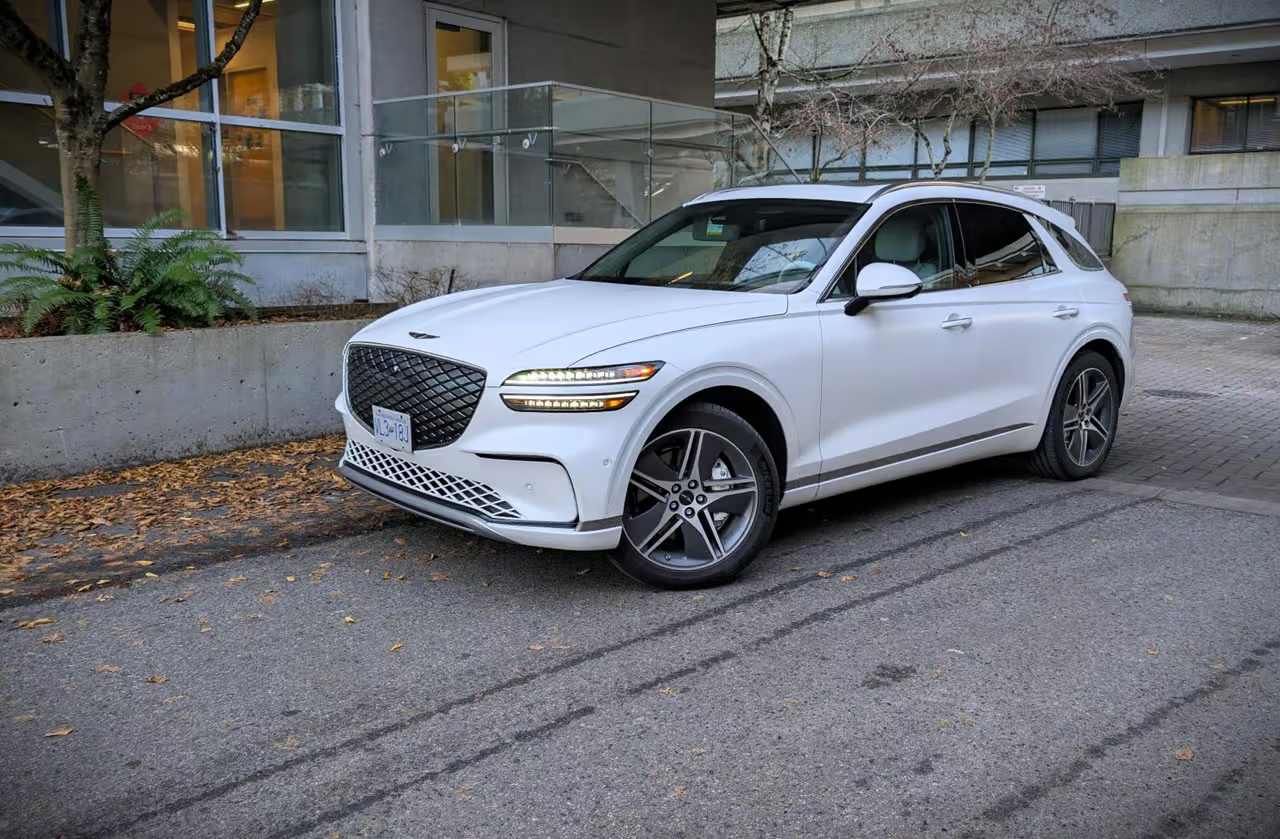
A lease hands you every responsibility of owning a car you don’t own. Insurance, registration, liability if something goes wrong. The bank holds the title. So is leasing a car a good idea for seniors?
Yes, if you drive low miles, want to preserve cash, and never want to meet a surprise $2,000 repair bill. No, as an automatic wealth move, because leasing is the most expensive way to put a car in the driveway. This one’s for retirees and their adult kids working from a pension or Social Security budget, not commuters. And the stakes are bigger than a budget line: a recurring car payment quietly raises the amount you need invested to retire.
The math arrives later. First, the four conditions that decide which side of the answer you land on.
Key Takeaways
Leasing fits retirees who drive 5,000 to 7,000 miles a year, well under the 10,000 to 15,000-mile caps sized for commuters; blow the cap and it costs 25, 35, or even 40 cents per mile depending on the model.
AARP’s worked example: a 2018 Honda CR-V ran $287/month to lease versus $749/month on a three-year loan at 5%, but a down payment on a lease builds no equity and vanishes if the car is totaled.
The typical 36-month, 36,000-mile lease matches most car warranties, so the retiree covers only tire rotations and oil changes instead of a $2,000 repair bill.
Table of Contents
Is leasing a car a good idea for seniors?
Yes, when four conditions line up: you want a new car every few years, you drive low annual miles, you’d rather preserve cash, and you don’t want to deal with maintenance.No, as a default money move, because over the long run leasing costs more than buying.
That framework comes from Jeff, the CPA-turned-banker behind the Holy Schmidt! retirement channel. He started it in 2020, it’s past 335,000 subscribers, and his four-condition test is the cleanest way to score yourself. Run the list:
- You want a new car every few years and can afford it.
If you’re only driving for three more years anyway, fresh safety tech and reliability buy real peace of mind. - You drive low annual miles. Under roughly 7,000 miles a year and the lease structure works in your favor. The mileage math gets its own section below.
- You want to preserve cash. Less money upfront and lower monthly payments keep dollars free for hobbies, travel, and medical bills.
- You don’t want to deal with maintenance.
The warranty covers the lease term, so your exposure is oil changes and tire rotations.
Score three or four and leasing is genuinely rational for you. Score one or two and it isn’t.
AARP frames the trade-off honestly: the bank or leasing company owns the car while you carry the insurance, registration, inspections, and legal liability. You’re holding the responsibilities of ownership without the ownership.That arrangement doesn’t appeal to everyone, and it shouldn’t, but it isn’t a scam either.
One thing worth knowing early: retirement income counts. Social Security, pensions, 401(k) distributions, all of it qualifies under standard credit criteria. The paperwork detail comes later.
Jeff spent 25-plus years in financial services and isn’t a leasing fan when every dollar counts, but he puts it fairly: leasing is
“undoubtedly not the cheapest option,”
yet it buys
peace of mind, convenience, and liquidity.Judge it by whether it fits your driving habits and budget, not by whether you own the car at the end.
Why low annual mileage makes leasing work for retirees
Low annual mileage is the strongest reason the lease structure fits retirees, and it’s the one most lease articles wave past.
Lease mileage caps are sized for commuters. The standard 10,000 to 15,000 miles a year exists because the default customer drives to work five days a week.Retire that commute and the cap stops being a constraint. Someone averaging 5,000 to 7,000 miles a year, the typical retired pattern of grocery runs, visits to friends, and the occasional road trip, stays comfortably in the clear. The cap becomes surplus instead of a trap.
The penalty is what makes the surplus matter.Go over and it runs 25, 35, or even 40 cents per mile depending on the model. Do that math on your own driving before you sign, not after. At 40 cents, every 1,000 miles over the cap is $400.
There’s a quieter benefit too.Low miles mean the car comes back in excellent shape, which is how you dodge the wear-and-tear charges that sting high-mileage lessees at turn-in.
Ask the dealer whether a lower mileage cap, something like 7,500 or 10,000 miles, is available. Not every manufacturer offers reduced-cap leases and pricing varies, so treat it as a question rather than an expectation. If it’s on the table, a cap matched to your actual driving is the cleanest version of this deal.
The pattern lease advisors see with new retirees is worth naming. A guy carries his commuting-era assumptions into a standard 12,000-mile lease, then figures out a year in that he’s driving a fraction of what he’s paying for. Nothing shady about it, just money spent on miles that never happened. An honest estimate of annual driving before signing is the fix, if you’re realistically in the 5,000 to 7,000-mile range, you’re in the clear, while blowing past the cap can run 25, 35, even 40 cents a mile depending on the model.
The case for leasing on a fixed income
A lease’s lower, predictable payment pairs with pension or Social Security deposits in a way an unpredictable repair bill never can. That’s the whole case, and it breaks into three parts.
The payment gap
AARP’s worked example: a 2018 Honda CR-V at $33,500 ($35,000 out the door, $10,000 trade-in, nothing due upfront) ran $287/month to lease against $749/month on a three-year loan at 5%, about the average rate per Bankrate. You’d need an eight-year loan to approach the lease payment, but the loan buyer keeps the car.Say both halves out loud. And this isn’t exotic: leases were 31.3% of new-car transactions in the first half of 2018, up from 25.7% in 2013, per Edmunds.com.
Warranty alignment
The typical 36 months or 36,000 miles matches most manufacturer warranties, so a lessee’s cost exposure is oil changes and tire rotations, not a $2,000 transmission surprise. On a fixed income, that’s the entire argument.
Safety tech each cycle
Backup cameras, blind spot alerts, and lane assist arrive fresh every three years. AARP and Holy Schmidt! both flag this as particularly relevant for older drivers.
Why a senior shouldn’t put money down on a lease
No. A down payment on a lease is the wrong move on a fixed income, and the decisive reason is what happens if the car gets totaled.
Down payments build no equity.They shrink the lease balance, reduce the leasing company’s risk, and add risk to yours. Total the car two years in and the insurance check goes to the leasing company; the money you handed over at signing doesn’t come back. Leasing companies love the arrangement because they get cash upfront and carry less risk. You get less cash and carry more.
The substitute is simple: ask for a zero drive-off lease with taxes and fees rolled into the monthly payment, then park the would-be down payment in a high-yield savings account. Withdraw monthly, mortgage-style, and the cash is still yours if the worst happens.
Holy Schmidt!’s comparison makes the upfront difference concrete: buying a $40,000 car takes $5,000-plus down. Leasing the same car takes $0.The cash stays available, though you own nothing at the end. On a fixed income, the cash staying available is the half that matters.
What the low lease payment hides: the depreciation trap
Financially, buying beats leasing over the long run, especially a reliable used car bought outright, with one exception: the low-mileage driver. The lease payment is literally depreciation.You pay for the steepest part of the value curve, then hand the car back. Cars lose most of their value over 10 to 15 years and bottom out around year 10, and a car is the most expensive thing most people buy besides a house.
The Money with Katie writer documented the counterfactual with her own purchase. She bought a three-year-old Audi A3 in 2020 for $19,500.MSRP new was $36,000. The prior lessee likely paid about $1,000 down plus $500 a month for three years, roughly $19,000, and walked away with nothing.
Nearly half the retail value, gone in three years. Her own caveat: the math depends on the agreed-upon residual.
Unlike rent-versus-buy for housing, cars aren’t cheaper leased long-term, because owning a car carries no year-over-year costs the lessee escapes. The overspending gap between the leased car and the affordable one can hit $20,000. To her credit, the same writer had a pro-leasing guest on her show in 2022 to argue when leasing makes sense.
When buying a modest used car outright still wins
A modest used car bought outright beats any payment structure when the goal is the cheapest reliable transportation, and the ranking proves it.The Money with Katie writer ordered car strategies best to worst: no car or one family car (most cars sit parked 90% of the time); a used Toyota or Honda bought outright, since they’ll do 200,000 miles with few, cheap repairs, or a three-year-old Certified Pre-Owned, the category CarMax built its business on; a used other-brand on a big loan; buying new; and leasing new at the bottom.
Then the retirement math, offered as a planning heuristic rather than a rule: a $500/month payment plus $150/month insurance is $7,800 a year, and sustaining that in retirement takes roughly $195,000 more invested ($7,800 × 25). Her compounding counterfactual: investing that $500/month for ten years instead nets about $750,000 by 55. Her math, not a promise.The spending audit behind it all: nearly $6,000 in one year on a car that mostly sat unused.
The closing question is the “last car” question. Perpetual payments versus a paid-off asset that outlives you, including whether a surviving spouse could carry any debt. That’s a tradeoff to weigh with the people who’d inherit it, not an age to calculate.
Choosing a car that leases well
Because lease payments are based on depreciation, the car you pick decides your payment. High-resale vehicles lease cheaper. The residual value in the payment formula is the same number as the resale value, so retention directly shrinks the payment.
The documented examples come from Kelley Blue Book’s 2018 best-resale-value awards, so mind the vintage.The Toyota Tacoma, Tundra, and 4Runner held the top three slots, holding roughly 65 to 70% of new value after three years. The Jeep Wrangler and five pickups trailed, and the first actual car, the Subaru WRX, sat at No. 10. Ronald Montoya’s guidance holds up better than any single year’s rankings: popular vehicles with good resale, SUVs and Toyotas, are the best financial bet on a lease. The durable move is checking KBB’s current segment leaders, since the top performers differ by body style.
Deal-shopper reality check: advertised sub-$200 leases are teaser terms on low-residual structures. The same depreciation mechanic explains why the cheapest advertised lease is usually the worst-residual car. Local inventory and pricing vary by region, and lease pricing swings with rate cycles, which is its own question. The criteria travel; the listings don’t.
How to negotiate a car lease without getting ripped off
The lease price is negotiable, and the defense is a line-item breakdown: the agreed price plus fees like sales tax and the dealer’s documentation fee, minus the projected end-of-lease value, equals the capitalized cost, the basic amount you’re actually repaying. Dealers act like the payment is fixed. It isn’t. Montoya’s own caveat that leases “have a lot of variables” is why the checklist below earns its keep.
Negotiate the price, not the payment
Chase a $525/month target and you’ll likely land at $550 to $575, because the dealer can stretch the term, inflate the money factor, or tweak the residual to hit any number. Negotiate the selling price to the leasing company as if you were buying outright. Check comparables on Truecar.com, KBB, and Edmunds, and get a purchase quote from the dealership’s internet department before you set foot in the showroom.
The money factor and the acquisition fee
The money factor is the lease’s interest rate, and dealers can legally mark it up.Ask what it is, whether it’s marked up, and what the leasing company’s base rate is. The acquisition fee itself is non-negotiable, but the dealer’s markup isn’t required: the documented example is $7.95 becoming $9.95, with about $200 to the dealer. Ask them to waive it even if they refuse.
The extended warranty that starts after your lease ends
$2,000 to $4,000, roughly $60 to $100 a month extra, for coverage that kicks in around 36,000 miles or three years, when the lease is already over.Structurally worthless on a standard lease.
One definition, since every fee flows through it: capitalized cost is the agreed price plus fees (sales tax, dealer documentation fee) minus the projected end-of-lease value, the amount the lease actually repays. A padded quote shows up as a payment without a breakdown. Ask for cap cost, money factor, and acquisition fee separately and the markups show themselves.
The full cost stack: senior car insurance economics
The lease payment is only half the fixed-income cost stack, and the insurance curve moves against the mileage advantage after 70. Average premiums run $1,934 a year at 60, below the $2,168 national average, but rise to $2,089 around 70, per The Zebra. The Centers for Disease Control points to age-related changes in vision, hearing, and cognition, and National Highway Traffic Safety Administration data shows fatal crashes rising among drivers 70 to 74 and peaking at 85. Pay-per-mile programs flip the same low-mileage profile into savings: Nationwide SmartMiles users driving about 500 miles a month average 28% less, in 46 states plus DC, and telematics programs like TrueLane apply the same idea, pricing the policy on how you actually drive.
CNBC Select reviewed more than 25 providers using a sample 70-year-old driver with a clean record and a 2020 Camry, and a few stood out for this reader:
- The Hartford’s AARP program: RecoverCare covers up to $2,500 in post-accident help, like rides and housekeeping.
- Geico: below-average rates for older drivers and 16 discounts total, including a defensive-driving discount for 50-plus.
- Travelers: up to 3% off a car under three model years old, 2% for a hybrid or EV, IntelliDrive telematics worth up to 30%.
- Progressive: claims under $500 don’t raise your rate, and five accident-free years earn forgiveness on bigger ones.
- Allstate: up to 25% a year for bundling home and auto online, one of the better bundling deals around.
- Auto-Owners: 15 potential discounts, but only 26 states and everything runs through an agent.
- USAA: some of the lowest full-coverage rates in all 50 states, if you’re military or a veteran.
Raising a deductible from $200 to $500 can cut collision and comprehensive costs up to 30%, and $1,000 can save 40% or more, per the Insurance Information Institute, though a higher deductible means more out of pocket after a crash.It’s also worth a glance at J.D. Power’s claims-satisfaction scores and an A.M. Best financial-strength rating before committing, because a cheap policy that fights claims isn’t cheap. All figures are sample-profile averages, not personal quotes. And gap coverage matters here, since the leasing company owns the car.
End-of-lease realities and qualifying on retirement income
The last few months of a lease carry their own decisions and costs, from turn-in choices to damage questions. The good news on the income side: retirement income counts when you qualify. This section covers both, starting with what actually happens when the lease runs out.
What happens at the end of a car lease
Three paths: return the car, buy it out, or roll into the next lease.The lifecycle has a ratchet. The first lease is artificially cheap because a used trade-in cut the payment, and that advantage never recurs; the second lease resets higher with nothing to trade. The return appointment doubles as a sales event.
The Money with Katie writer nearly leased a new Acura RDX at turn-in after a showroom invitation, a pattern the personal-finance literature documents repeatedly.On damage charges, low-mileage drivers usually return cars in good shape, but the inspection-and-charge process isn’t something the available material documents in detail, so raise it as a question before signing rather than planning around a fee schedule.
Can you qualify on Social Security or a pension
Yes. Retirement income counts under standard credit criteria. Social Security, pensions, and 401(k)/IRA distributions are documented with award letters, benefit statements, and tax returns; investment income needs two years of tax returns to count toward qualification, and lenders will likely want bank statements to prove the deposits and steady income.Fixed incomes can inflate debt-to-income ratios, the share of monthly income going to debt payments, and most lenders prefer under 45%, though some allow 50%.
Lenders judge older borrowers on the same criteria as anyone: credit, DTI, income. You can pull your credit reports for free at AnnualCreditReport.com before applying, so there are no surprises at the dealership. The Equal Credit Opportunity Act bars age discrimination in credit, though a 2023 Federal Reserve Bank of Philadelphia paper found rejection rates rising steadily with age. Bankrate’s Mark Hamrick notes retirement incomes are stable but largely fixed, so keep a clear budget.
And the human question: could a surviving spouse carry the payment? Worth answering together before either of you signs.
Lease, buy used, or keep driving: the decision framework
Three situations, three answers.
| Your situation | The move |
|---|---|
| Drives under ~7,000 miles a year and values liquidity | Leasing can be rational (zero drive-off, nothing down) |
| Wants the cheapest reliable transportation | A modest used car bought outright |
| Already has a paid-off reliable car | Keep driving it |
If you lease, the golden rules and the zero drive-off structure from above apply. The final judgment is fit with your current driving habits, budget, and lifestyle, not ownership goals and not total-cost math alone.For the broader framework at any life stage, the full lease-versus-buy decision guide picks up where this one leaves off. And that’s the call this publication takes seriously: most men’s blogs skip the retirement-stage car decision entirely, and it deserves better than a shrug.
Frequently Asked Questions
What are the advantages of leasing a car?
Leasing gets you a lower, predictable monthly payment, less cash tied up upfront, and a warranty that typically covers the whole lease term, so your exposure is limited to oil changes and tire rotations. You also get fresh safety tech like backup cameras and blind spot alerts every few years. The trade-off is that you never build equity and leasing costs more than buying over the long run.
Why does low annual mileage make leasing a better deal for retirees?
Lease mileage caps of 10,000 to 15,000 miles a year are sized for commuters, so a retiree driving 5,000 to 7,000 miles stays comfortably under the cap and turns it into surplus instead of a trap. Low miles also mean the car comes back in excellent shape, dodging wear-and-tear charges at turn-in. Ask whether a reduced cap like 7,500 or 10,000 miles is available to match the lease to your actual driving.
Can you lease a car if you are retired?
Yes. Retirement income counts under standard credit criteria — Social Security, pensions, and 401(k)/IRA distributions all qualify, documented with award letters, benefit statements, and tax returns. Lenders judge older borrowers on the same criteria as anyone: credit, debt-to-income ratio, and income, and the Equal Credit Opportunity Act bars age discrimination in credit.
Should a senior on Social Security put money down on a lease?
No. A down payment builds no equity and vanishes if the car gets totaled — the insurance check goes to the leasing company, and the money you handed over at signing doesn’t come back. Instead, ask for a zero drive-off lease with taxes and fees rolled into the monthly payment, and park the would-be down payment in a high-yield savings account where it stays yours.
When does buying a modest used car outright still beat leasing in retirement?
When the goal is the cheapest reliable transportation, a modest used Toyota or Honda bought outright wins over any payment structure — they’ll do 200,000 miles with few, cheap repairs. There’s also the retirement math: a $500/month payment plus $150/month insurance is $7,800 a year, which takes roughly $195,000 more invested to sustain. And if you already have a paid-off reliable car, keep driving it.