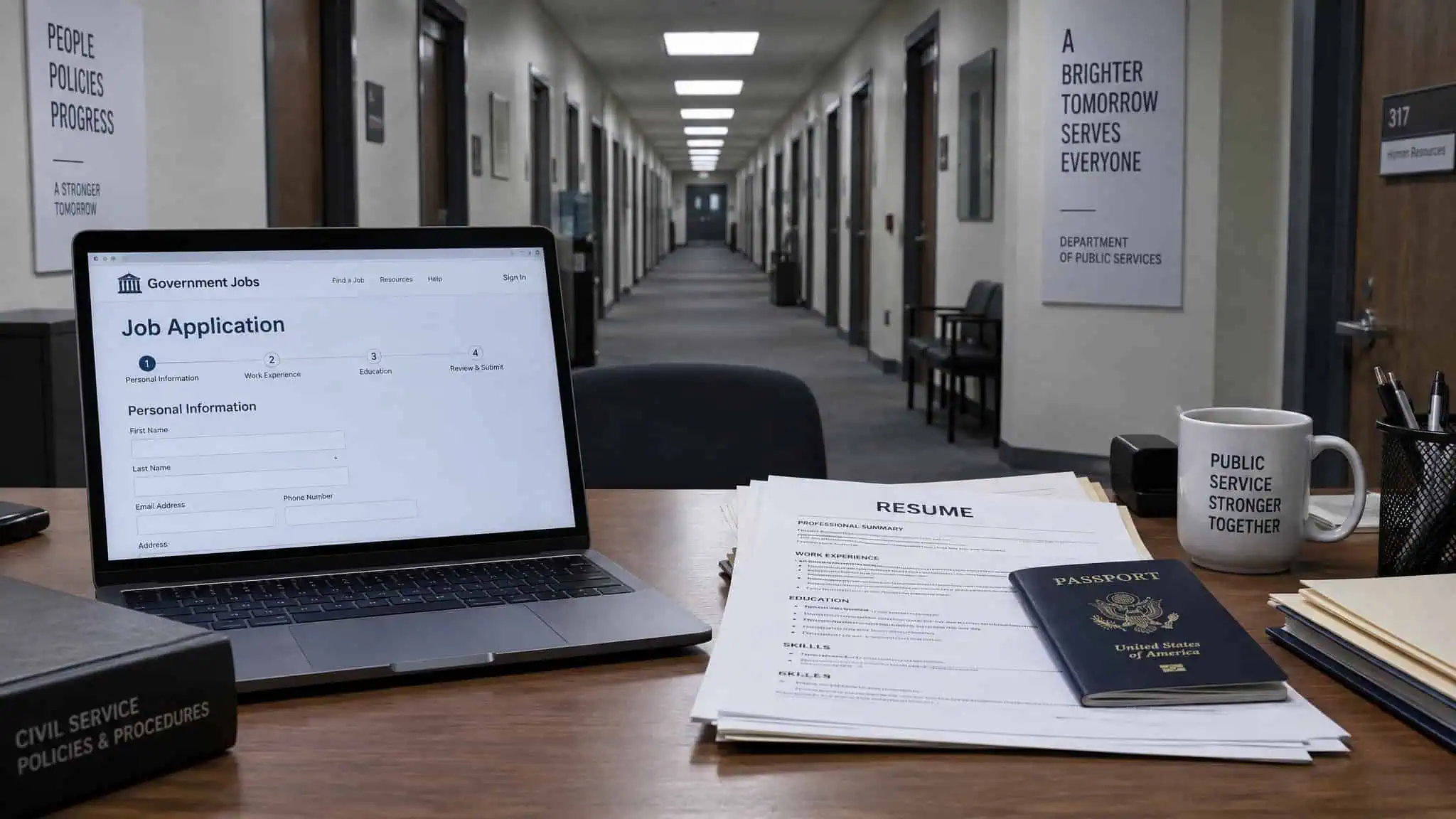
The Bourne version of CIA recruitment involves a park bench and a man who already knows your name. The actual version involves a job portal called MyLINK, a resume with your citizenship printed on it, and a lot of waiting. That’s the gap worth understanding before you go any further, because the real funnel rewards patience and honesty, not parkour.
The CIA’s own recruitment head, Ron Patrick, has said the process is “not so secret.” And per interview sources, roughly 90% of its roughly 10,000 staff (that figure is a single interview-source estimate, not an official headcount) are not undercover. Most of them are analysts, logisticians, and engineers whose LinkedIn accounts work like yours. Here’s the whole road in order: whether you’re eligible, the exact steps, what actually disqualifies you, and which track fits your background.
Key Takeaways
Eligibility is a five-box check: US citizen (dual counts), 18+, physically in the US when you apply through MyLINK, willing to relocate to the DC area, and able to pass security and medical checks.
Drug lookback windows apply at application time, not forever: 90 days for marijuana (including medical, regardless of state law), 12 months for other drugs, and a 12-month minimum wait between applications.
Prior military service with an active TS/SCI clearance is the fastest route, reportedly cutting about 11 months off a civilian clearance that can run around 9.
Table of Contents
What the CIA actually is (and isn’t)
Before you commit to anything, know what the job is. The CIA does three things: collects foreign intelligence (mostly human intelligence, or HUMINT, meaning people, not satellites), produces analysis, and runs covert action when the president directs it. It’s the only US agency legally authorized for that last one. Its intel goes up to the president, the National Security Council, and the wider circle of policymakers who act on it. The stated mission boils down to using information to keep the country safe, which reads like a corporate mission statement, but the customer list tells you the stakes.
There are over 140 occupation types there, including doctors and logisticians. Nobody pictures that.
After 9/11, the agency expanded into covert paramilitary work, and the Information Operations Center, one of its biggest divisions, shifted from counterterrorism to offensive cyber. That’s why cyber and data roles exist in the building now.
Who can apply: eligibility requirements
Run the checklist before you get excited:
- You’re a US citizen. Dual citizenship counts. It’s a hard box, not a preference.
- You’re 18 or older.
- You need to be physically present in the US, territories included, when your resume goes through MyLINK. Don’t apply from your Bali trip.
- You’re willing to relocate to the DC area. That’s a real life decision, rent and commute and family included.
- You can pass security and medical checks. Everyone does; it’s expected, not ominous.
Selective Service registration may come into play for some guys. One line, done.
Is there an age limit?
Minimum is 18, and there’s no stated maximum. The “CIA cuts you off at 35” thing is a rumor. 30 is not too old, and the agency actually values life experience. If you’re mid-career and wondering, we’ve got a full piece on whether 30 is too old to join the CIA.
Can a non-citizen join?
No. Citizenship is a gate, not a nice-to-have. There’s no clever workaround, only the path to citizenship first, which we cover in how to join CIA as a foreigner.
The application process, step by step
The CIA’s official application sequence has seven steps: you submit a resume via MyLINK, they invite you to apply for a specific position, you go through screening, testing, and interviews, you get a Conditional Offer of Employment (COE), you complete the COE paperwork including the SF-86, you go through security and medical evaluations, and you get the official offer and onboarding. That’s the spine. Patrick’s internal version matches: resume review, phone interview, online tests covering writing, problem-solving, and interpersonal fit, background investigation, polygraph. In that order.

One thing to know going in: you don’t pick your job. They assign it after standardized tests measuring IQ, personality, stress tolerance, and ambiguity tolerance. Interviews are fit-based, typically two or three visits, though some candidates have gone back five or six times. They’re figuring out where you fit, not just whether you pass.
MyLINK and the resume that gets noticed
MyLINK is the portal. A spookier name than LinkedIn, same basic idea: you express interest, upload a resume, and a recruiter might actually call you. Don’t assume it’s spam.
The resume is the one thing you fully control here. Match it to what the announcement actually asks for, and include the details a civilian resume never has: job announcement number, title, grade, your country of citizenship, and any existing clearance. They apparently read closely.
Screening, testing, and interviews
It’s the same gauntlet as any serious job, just longer. Prep real stories: collaboration, communication, analysis, multitasking, pressure. Expect questions on why you want in, what you know of the mission, and how a current world issue relates to US interests. Stories beat adjectives every time.
The Conditional Offer of Employment
“Conditional” means what it says: they want you, but the clearance still stands between this and a paycheck. There’s paperwork, medicals, and background steps left. Don’t quit your job yet.
Security clearance and polygraph: the real bottleneck
The clearance is where the process actually slows down. This is the bottleneck, not a checkbox, and knowing why helps you survive it.

Background investigation and polygraph
The background investigation is exactly what it sounds like: they dig. They’ll talk to people close to you, friends, family, maybe exes, so be ready for the “wait, who called you?” conversation. Per Patrick, it boils down to whether you’ve lived honestly and openly. Boring honesty wins.
Then comes the Full-Scope Polygraph, which nearly every CIA job requires. Frame it as their honesty filter, not a trap, and know it comes after the background investigation, not before. And no, nobody’s drilling your spine to detect LSD. The spinal tap thing is a myth; even the Navy debunked the claim that it’s the only way to detect past LSD use.
Physical and psychological exams
Routine step. They check whether your health fits the specific job, not whether you’re a perfect human.
Here’s the practical part: a civilian clearance can take around 9 months, and the SF-86, which asks for addresses, contacts, and travel history, is where first-timers stall, a pattern familiar to anyone who’s prepared for how to apply for the CIA. Hitting the conditional-offer stage, then stalling for weeks reconstructing your own past, is common. Start assembling that paperwork before you apply, not after.
Field note: A civilian clearance can run about 9 months, and the SF-86’s demand for addresses, contacts, and travel is where most first-timers stall. Build that paperwork early.
What disqualifies you (and what doesn’t)
No single mistake permanently disqualifies you from the CIA: the drug lookback windows (90 days for marijuana, one year for other drugs) apply at application time, and the agency’s own record includes an applicant told to wait a year and reapply rather than barred for life. The hard tripwires are different animals, criminal conduct regardless of conviction, dishonesty of any kind (including omitting or underreporting), evidence of disloyalty, and excessive alcohol use. That’s the whole headline. The rules measure where you are when you apply, not who you were at 22.
The drug windows first. Marijuana within 90 days of applying is a problem, including medical marijuana, regardless of your state’s laws. This is the trap that catches a recurring type of guy: he lives somewhere weed is legal, assumes legalization protects him, and it doesn’t. Federal rules don’t care what your state said. Illegal drug use or prescription misuse within the past year is another tripwire.
And heavy drinking can sink you too. Not “you had beers at a wedding” heavy drinking. The kind your friends have mentioned.
Everything else: dishonesty kills applications. Omitting stuff, lowballing answers, changing your story between forms and interviews. Criminal conduct matters even without a conviction, which surprises people. And disloyalty is the obvious dealbreaker; apparently even friending or following the CIA on social media gets flagged as a problem, which feels almost unfair, but it’s their fence.
Now the reapplication reality, which is where most readers exhale. The minimum wait between applications is 12 months. The Colorado applicant who admitted pot use was told to wait a year and reapply, not banned forever. A slip costs you time, not forever. When you come back, bring an updated resume that shows you’ve built up your skills in the meantime.
A few conduct rules that are small but add up. Keep the application quiet: no group chat, no posting, nothing. Answer their outreach fast; dragging your feet on a clearance-track application is a costly way to lose it. Don’t contact the CIA while you’re overseas, which sounds weird but is easy if you know it ahead of time. And before you even start, make sure your timing is actually clean, no overlapping obligations or loose ends, and that you’ve sorted the basics like whether foreigners can join the CIA, since that alone trips up plenty of applicants.
The one-line version: the drug windows are short and specific, the dishonesty bar is absolute, and most disqualifications are a wait, not a wall.
Red flag: Dishonesty is the absolute disqualifier — omissions, lowballed answers, or a changed story between forms and interviews end applications faster than any drug window.
Find your fit: the five directorates
The CIA’s directorates number five. Analysis, Operations, Support, Science and Technology, and Digital Innovation, and it’s Support, not Operations, that turns out to be the largest. Before the breakdown, the number that reframes everything: over 140 occupation types. Think of the directorates like departments at a large company, which is essentially what they are.

Here’s the composite pattern worth noticing: aspiring applicants fixate on Operations after years of movies, then learn that roughly 90% of roles involve no undercover work, and that their actual background, logistics, engineering, language, maps better somewhere else. That discovery usually improves their odds, and working through the five directorates is how you find out where your resume actually fits.
Directorate of Analysis
The brainy side. Analysts anticipate and assess what’s happening around the world, brief people out loud, and feed the president’s daily brief. You specialize by region or topic, and some analysts teach or take corporate stints along the way. If you like reading the board before anyone else, this is your department.
Directorate of Operations
The movie job, and the frontline for human intelligence. Officers build intelligence networks, work overseas, and are often undercover. The real trade-off: it’s an exciting job with a complicated personal life. Even family can’t know everything. You do get specialized foundational training, so you’re not thrown in cold.
Directorate of Science and Technology
Go ahead and think Q-branch. Then get concrete: this shop builds surveillance tools, secure comms, and one-of-a-kind gear for specific missions. Custom, not off-the-shelf. Engineers, this is your lane.
Directorate of Digital Innovation
Software development, open-source collection, big data, cybersecurity, IT infrastructure. Basically every tech job title you know, inside the CIA. DDI owns the modernization push into AI and analytics, and keeps agency teams connected while keeping secrets. The current director talking points, per the agency’s own recruitment side, are that threats today sit in cyberspace, AI, and data analytics, and that’s what this directorate specializes in.
Directorate of Support
The backbone, and the biggest. Supply chain, HR, facilities, logistics, security, finance, medical. Every normal job exists here somewhere, and it’s the reason everything else works. It goes all the way down to cooks and cleaners, and even they typically need a Top Secret clearance.
The four entry-level operations roles
The ops side has four official entry-level positions, from analyst roles to support careers that can lead there. See which one your background matches.
Core Collectors and Operations Officers
The closest thing to the movie job: work abroad finding, recruiting, and protecting foreign sources. If that’s the job you’ve been picturing since you were fourteen, this is it, with all the personal-life complications from the last section included.
Collection Management Officers
Desk-side but mission-critical. CMOs evaluate, validate, and route intelligence up the chain. Less glamorous, still essential.
Staff Operations Officers
The link between headquarters and the field, with covert travel to back up agents. You’re not the face, but the operation doesn’t run without you.
Specialized Skills Officers
Deployed where language, technical, media, or combat skills matter most. If you’re a linguist with rare skills, you’re this, not a Core Collector.
The contractor pipeline: the second door
Yes, contractor jobs can lead to a direct CIA hire. Here’s who it fits: elite military backgrounds. Third-party defense contractors with active CIA contracts hire from that pool, and strong performers have received direct CIA offers after an assignment. The side door leads to the same room.
It’s not a guarantee, and contractors still pass extra training and assessment before operational work, so it’s not a shortcut around standards either. If the contractor route sounds closer to your situation, we break down CIA contractor jobs in detail.
There’s also a rare “unique access” route: occasionally the CIA approaches people directly, when you have access it can’t get otherwise, after extensive vetting. Extremely rare. Don’t wait by the phone.
The TS/SCI shortcut: why military service is the fastest on-ramp
Yes, prior military service is the fastest route, and the decisive condition is an existing TS/SCI clearance.
The TS/SCI advantage
Active TS/SCI is the minimum for a field officer. One military speaker reported his clearance saved about 11 months versus a civilian clearance, which can take around 9 months. That’s the difference between starting at mile zero and mile nine. If you have one, you’re already ahead and don’t know it.
How the CIA finds candidates
Military-to-CIA transfer is reportedly a handshake with no break in service. Almost insultingly smooth compared to the civilian grind. Lots of officers are former military; veterans are the norm, not the exception. Other channels exist too: college fairs where strong or bilingual students get pulled aside, and odd direct approaches, like one interviewee whose Peace Corps application got flagged and drew a call from the CIA. The takeaway from all of it: the CIA often finds you, so build a visible, clean, skilled profile.
How to stand out: credentials, languages, and disposition
The practical levers, in order of what actually moves your resume up the pile.
Degrees, GPA, and the no-degree question
A bachelor’s is typical, with a 3.0+ GPA, in fields like criminal justice, economics, engineering, international affairs, law, law enforcement, digital innovation, or a foreign language. A master’s can open doors and pay better; simple cost-benefit. Military or law enforcement background helps without being required.
On the no-degree question: a degree is not always required depending on the job, but the sources don’t name which roles waive it, so I won’t pretend otherwise. The practical answer is that Support and skills-adjacent paths are where non-degreed readers realistically fit.
Skills and languages that move the needle
Per Mike, the recruiter on The Langley Files, communication is the first skill that jumps out. Then stress tolerance, problem-solving, teamwork, and cross-cultural ability. Translated: be clear and keep your cool when it’s messy.
Here’s the reframe I’d sit with: the CIA recruits for the world 5-10 years out, which is why fluency in Japanese, Russian, Korean, or Arabic beats another generic credential. Time living abroad signals you can handle unfamiliar situations. If you speak a high-demand language, lead with it on the resume. For more on pay and progression once you’re in, see our piece on CIA agent salary.
Alternative on-ramps: internships and student programs
If you’re younger, or you’ve got a college kid, this is the earliest door. The CIA runs paid internships year-round for undergrads. Actual pay, not credit-only. Fields include finance, economics, foreign language, engineering, IT, and analysis, a list that looks weirdly like any normal company’s. One honest caveat: unlike the contractor route, where a solid performance record can turn into a direct-hire offer, I’ve got no sourced detail on whether internships speed up clearance timelines at all.
Fellowships and scholarships add real experience and real connections. It’s the earliest on-ramp there is, and we’ve mapped the entry level CIA jobs landscape separately if you want the full picture.
What the job actually is: expectation reset before you apply
How hard is it? The funnel itself is ordinary, but the vetting is deep: 2-6 fit interviews, a full-scope polygraph, a clearance that can run around 9 months for civilians, and timelines the agency itself admits are long enough to scare off good applicants. It’s working on that without cutting security, but patience is still required, apparently around its 75th anniversary, the agency tied hiring reforms to the milestone, though the wait hasn’t shortened much. Pay varies by role and grade, since no reliable pay-scale figures appear in the sourcing.
You’ll work in the DC area or overseas; the couch is not an option. And the scale is smaller than you’d think: roughly 10,000 people total, of whom only about 1,000, around 10%, work undercover. One former officer, Lindsey Moran, described the work as psychology-based, like being a clinical psychologist for assets. Knowing exactly which question to ask matters, an officer might need precision as absurd as confirming a specific warhead’s yield, say, the third warhead carried on the second missile of the fifth squadron based in Cheyenne, Wyoming. Benefits exist: flexible schedules, solid time off, health care, retirement, gyms, education money.
Closing: your roadmap, honestly framed
Check the five eligibility gates. Apply via MyLINK with a resume tailored to a specific announcement. Survive screening, the COE, the SF-86, and the polygraph. Wait out the timeline, and if it stalls, reapply after 12 months with a better resume.
The real differentiators aren’t polish. Prior clearance and a findable, skilled, clean profile beat a shiny resume chasing the Bourne fantasy. The job that exists is mostly patience, honesty, and 140 ways to do useful work. Decide if that’s the one you want.
Frequently Asked Questions
How hard is it to get a job with the CIA?
The application funnel itself is ordinary, but the vetting is deep: expect 2-6 fit interviews, a full-scope polygraph, and a security clearance that can run around 9 months for civilians. The agency admits its timelines are long enough to scare off good applicants. Patience and honesty are the real differentiators, not polish.
How long does the CIA hiring process take from application to onboarding?
The security clearance is the bottleneck: a civilian clearance can take around 9 months, while prior military service with an active TS/SCI clearance reportedly saves about 11 months. Add screening, testing, 2-6 fit interviews, a conditional offer, and the polygraph on top. A common pattern among first-timers is stalling for weeks at the conditional-offer stage reconstructing their SF-86 details, so build that paperwork before you apply.
Can you join the CIA without a degree?
Sometimes — a degree is not always required depending on the job, though the agency doesn’t specify which roles waive it. The realistic paths for non-degreed applicants are the Directorate of Support (the largest directorate, spanning logistics, security, finance, and facilities) and skills-adjacent roles. Military or law enforcement background can substitute in many cases.
Do I have to pick my job when applying to the CIA, or do they assign it?
They assign it. After standardized tests measuring IQ, personality, stress tolerance, and ambiguity tolerance, the agency figures out where you fit across its five directorates and 140+ occupation types. Interviews are fit-based rather than pass/fail, and discovering your background maps better outside the Directorate of Operations usually improves your odds.