
Applying to the CIA is nothing like applying anywhere else, and that’s the part that quietly wrecks good candidates. The job listing on USAJOBS is labeled “for viewing purposes only,” so there’s no apply button where you’d expect one. You can only express interest in four jobs total. Leave a field blank and you can get rated ineligible, and the first thing standing between you and an offer is a polygraph that nearly every federal agency treats as optional and the CIA doesn’t. Well-qualified people fail on rules they never knew existed, months after submitting.
So here’s the whole journey, step by step, anchored to one real federal announcement: a Polygraph Examiner posting, USAJOBS Announcement 24-12186857-7098. Every requirement below is checkable against that document, with the process mechanics coming from CIA’s own how-we-hire page at cia.gov/careers/how-we-hire/. One posting, worked end to end. It’s a worked example, not a template for every CIA role, and none of this is official agency direction.
Key Takeaways
You must be a U.S. citizen, at least 18, located inside the United States or one of its territories when you submit via MyLINK, and free of illegal drug use within the last 12 months; dual nationals are eligible, foreign nationals and green card holders are not.
You can express interest in up to four jobs on cia.gov/careers, and the USAJOBS listing itself is viewing only; incomplete MyLINK information can earn an ineligible rating.
The worked-example posting pays $68,974 to $128,956 (GS-7 to GS-12), and hiring runs 6 to 18+ months for that role, 12 to 24 months agency-wide.
Table of Contents
CIA eligibility requirements: the gates before you apply
CIA eligibility comes down to five things: U.S. citizenship, at least 18 years old, registered with Selective Service if you’re a man born after December 31, 1959, and ready to move to the Washington, DC area, and no illegal drug use within the last 12 months. That’s the whole list for the baseline. Most of it you either clear or you don’t.
The boundary cases are where guys get it wrong. Dual-national U.S. citizens are eligible, and that surprises people who assume dual citizenship kills the application. It doesn’t. Foreign nationals and permanent residents are a different story: if you’re not a citizen, this door is closed.
Age has no documented upper limit in any official source, so if you’re 30 or 35 and wondering whether the window shut, it didn’t. The forum myth about a cutoff at 35 has no basis in anything CIA has published.
Two gotchas deserve their own lines. First, your location when you submit through MyLINK has to be inside the United States or a U.S. territory. That requirement applies at submission time and is separate from citizenship, so if you’re working overseas, plan the logistics before you click anything. Second, dual citizenship and foreign ties will get scrutinized during the background check, but they’re not automatic disqualifiers.
Family abroad isn’t a dealbreaker. Expect questions, have answers.
Quick test: Before anything else, confirm you’re a citizen, 18 or older, physically in the U.S. when you submit, and clean for the past 12 months.
And pair the 12-month drug window with the honesty principle, because they’re the same theme: a spotless record matters less than being straight when the polygraph and background check come around. Concealment is the bigger sin, not the past.
Choosing a role: CIA’s five career paths and decoding a real posting
CIA organizes everything into five career paths: Operations, Analysis, Science & Technology, Digital Innovation, and Support, and those lanes line up with the real entry points for new grads and career changers. That’s the orientation for the case-officer-versus-analyst question, or any of it: pick a lane, then find the postings inside that lane. The Polygraph Examiner role we’re using as the worked example sits in Support, inside the Office of Security.
Now the reusable skill: reading a federal posting, because every requirement is in there if you know how to look. This one runs GS-7 to GS-12 and pays $68,974 to $128,956. The initial tour is four years in the DC area. Worth noting: older postings and the training pathway referenced five years, so if you see that number elsewhere, that’s where it came from.
The schedule is a 5/4-9 alternate, which means 80 hours per two-week period (45 plus 35) and every other Friday off. A three-day weekend twice a month, guaranteed, in a federal job.
The day itself is two polygraph sessions, each 2 to 3 hours, so roughly four to six hours of intense focused work daily. The posting calls the job “fast paced, demanding, and, at times, unrelenting.” It also notes that domestic and foreign travel becomes available after you’ve proven yourself. Nothing in that posting is decoration. It’s all checkable.
Education and qualifications: degrees, GPA, and what strengthens a candidacy
This posting requires a bachelor’s degree from an accredited institution, and it doesn’t matter what the major is. Philosophy, business, kinesiology, whatever. Applicants who are within one year of finishing a four-year degree can apply too, so college seniors shouldn’t wait for the diploma. So no, you can’t skip the degree for this role, the closest workaround is applying while you’re still a year out from finishing one.
A few edges to that rule. A foreign degree works if you get a credential evaluation confirming U.S. equivalence, and you pay for that evaluation yourself. It’s a hoop, not a wall. The posting prefers a 3.0 GPA on a 4-point scale, but “preferred” means preferred, not required, and exceptions exist for extenuating circumstances. If you’re sitting on a 2.8, don’t self-reject.
Two honest limitations. The degree requirement is specific to this posting; some CIA support roles differ, so check each announcement on its own terms. And if you’re already spending money on a degree, know going in that it’s a hard requirement here, so treat it as part of the investment.
The most underrated part of any posting is the desired-qualifications list, which is basically a resume roadmap. For this one: interviewing, investigation, or elicitation experience, a current federal polygraph certification, and familiarity with SEAD 4. That list tells you exactly which experiences to surface on your resume. No guessing.
How to submit your application via cia.gov/careers and MyLINK
Submitting a resume to the CIA means expressing interest on cia.gov/careers, for up to four jobs, after which MyLINK takes your resume, your job rankings, and your basic personal information. The USAJOBS listing you found is viewing only. Two steps, in this order: browse the postings on USAJOBS, then express interest on cia.gov/careers, at which point you’re redirected to MyLINK for the actual submission. That’s it. There is no apply button on the USAJOBS post, and guys who wait for one wait forever.

Three failure conditions live in this stage, and they’re all silent:
- The four-job cap. You can express interest in up to four jobs. Once you’ve used them, you’ve used them. Pick deliberately instead of firing off four half-hearted selections.
- The physical-presence rule. You must be on U.S. soil or in a U.S. territory at the moment you hit submit through MyLINK, not when you start filling things out. Easy to miss if you’re overseas, easy to fix if you know about it.
- Incomplete information. The posting’s own language warns that failure to provide all required information may result in an ineligible rating. Not a rejection you can appeal. A rating that ends the run.
Here’s the part that catches private-sector people: the instinct to write a polished one-page narrative works against you in a federal application. A common pattern in federal hiring generally is a slick resume that omits dates, citizenship status, or degree details, followed by silence the applicant reads as rejection when it was actually a screening failure. Checkboxes matter more than narrative here. Dates, citizenship status, degree details, every field complete. Fill it out right the first time.

After that, the only thing that happens is this: if your qualifications match agency needs, a recruiter may contact you for further discussion. Before that contact, silence is normal. It is not a signal. Don’t read tea leaves; the process is slow by design, and we’ll get to how slow.
Screening: occupational testing, medical, and psychological exams
Once a recruiter contacts you, the sequence runs in a fixed order: occupational testing first, then medical and psychological exams, then the polygraph, then a comprehensive background investigation. The occupational testing stage is four named components, not vague “assessments”, together they measure your intellectual capability, communication skills, and psychological profile for the role:
- An aptitude test
- A writing test
- A personality inventory
- A personal interview
The medical and psychological exams are formal gates, not courtesy checkups, they’re part of the hard requirements for becoming a CIA agent, several of which are non-negotiable, and you have to successfully complete them to move forward. The practical prep move is boring and effective: assemble verified dates, education records, and an honest account of your own history now, before any of this starts. The same facts recur at every later stage, and having them consistent from day one is half the battle.
The CIA polygraph: scope, failure modes, and honest preparation
What actually sinks people is inconsistency, not a hidden past. That’s the takeaway to hold onto through the whole exam.
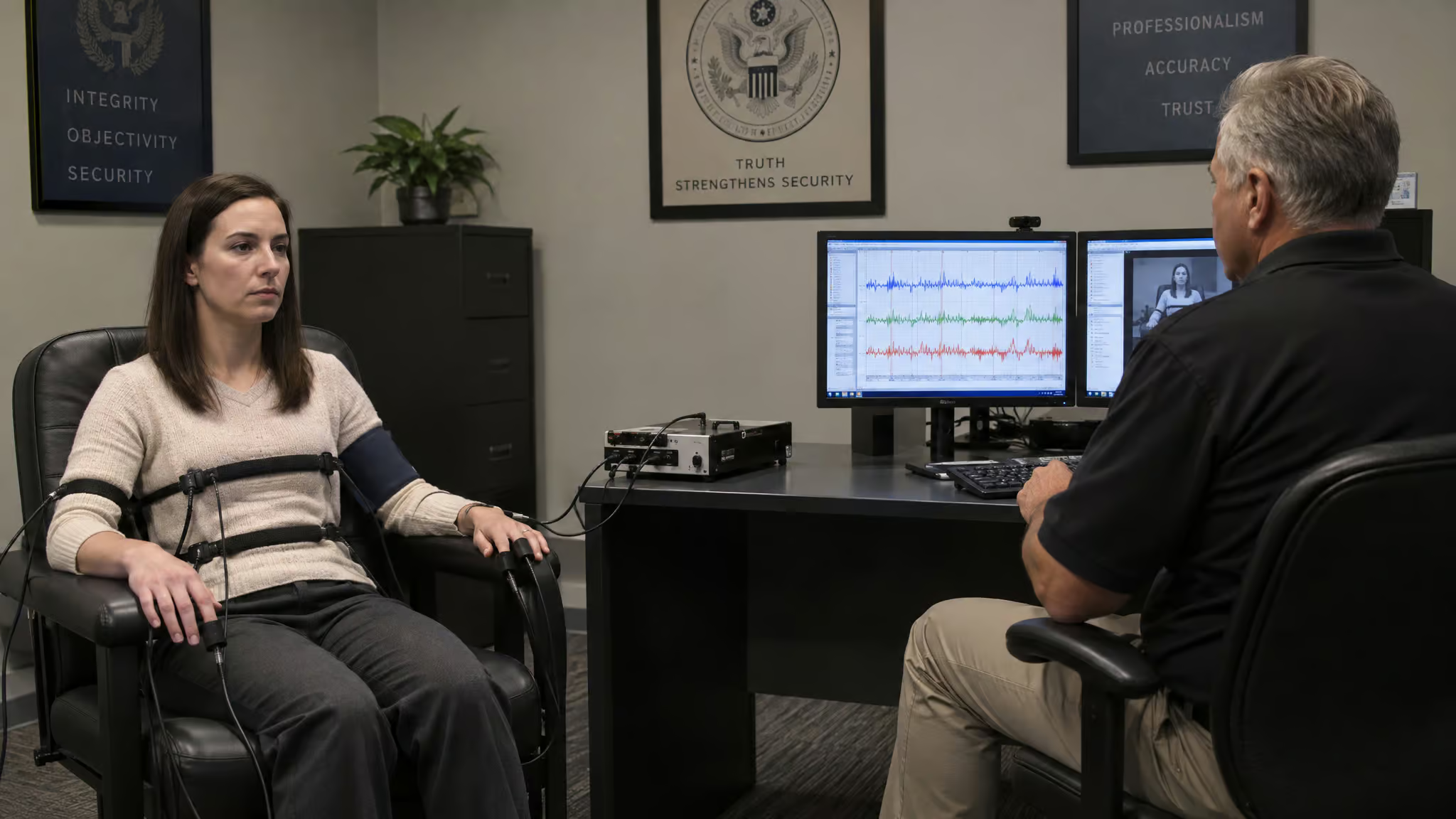
CIA mandates a Full Scope polygraph for every employee, the strictest policy among federal agencies, and there’s no talking your way around it. The exam covers counterintelligence and lifestyle components, governed by ICD 704 and SEAD 4, and that’s all the directive-name context you need. The lifestyle questions get personal, and that’s by design, not sadism.
On validity, modestly: research exists. The Bersh study found 92% agreement between polygraph outcomes and verdicts reached by separate review panels, and work by Horvath and Reid showed high inter-rater reliability. So treat the exam as a structured process with research behind it, not a mind-reading machine and not a coin flip.
Red flag: Telling your history two different ways — once on paper, once in the pre-test interview — is the classic failure pattern. Reconcile your records first.
The real preparation isn’t a technique. It’s reconciling your own history on paper before anyone asks, because the recurring failure pattern in security-clearance processing broadly is inconsistent answers between the background questionnaire and the pre-test interview. Same facts, told two ways. That’s what gets flagged.
And drop the “beat the polygraph” framing entirely: there’s nothing to beat. There’s only your own consistency with yourself.
The TS/SCI background investigation and SEAD 4 adjudication
Illegal drug use within the last 12 months generally disqualifies you. That’s the hard window. Dual citizenship and foreign ties do not automatically disqualify, though they get scrutinized. Those two facts are the whole disqualifier picture, and they’re worth rereading twice.
The machine behind it: TS/SCI clearance means top secret with access to sensitive compartmented information, and earning it means an investigation that covers your personal, professional, financial, and social history. Investigators interview your family, friends, neighbors, former employers, and academic contacts. Your people get calls. The answers you put on the National Background Investigation questionnaire become the script those people get checked against, so assemble residences, employment, finances, and foreign contacts before you apply, not after.
SEAD 4 then adjudicates the whole person: loyalty, honesty, reliability, trustworthiness. Translated: they’re deciding whether you’re the kind of guy who can keep secrets. And the guideline’s actual logic points one direction: concealment, not past conduct, is the greater risk. The guy who discloses an imperfect history is safer to them than the guy who omits it.
Salary and benefits: what CIA jobs actually pay
The worked-example posting pays $68,974 to $128,956, GS-7 to GS-12, per Announcement 24-12186857-7098. That range reflects the 33.94% DC locality pay added to base GS rates plus the 1.7% across-the-board GS increase that took effect in 2025. And it moves: the previous cycle, which closed September 2023, listed $65,495 to $122,459. Federal pay creeps up reliably; that’s the trend, not a forecast.
Polygraph Premium Pay is the part people miss. It arrives only after you complete federal certification, and it’s described as a significant addition. Not automatic, not day one.
The benefits stack in plain English: FERS, which is a pension plus Social Security plus the Thrift Savings Plan (TSP), a 401(k)-style account with up to a 5% government match (money you don’t contribute yourself), FEHB health insurance, FEGLI life insurance, and 13 days of annual leave to start. Honest caveats: eligibility depends on position type, and 13 days is not unlimited PTO. Boring benefits that add up.
For context, clearly non-official: federal examiners average around $80,000 with the top 10% over $100,000, and CyberSecJobs puts full-scope clearance holders at $148,314 on average. Worth knowing, not gospel.
Training and regulation: how CIA examiners are certified
Two doors: show up with federal certification in hand, or go through CIA’s Polygraph Examiner Program, where they train and certify you. Training happens at the CIA Polygraph School, where Alan Trabue spent six years as director and taught 13 classes of examiners. The office itself has grown roughly 4x since the early 1970s, and the work is governed by standards like the DoD PDD Examiner Handbook alongside oversight from bodies such as the American Polygraph Association (APA) and DCSA. The credential is portable across the intelligence community, including NSA, DIA, FBI, CBP, and NRO, and if CIA screening stalls, CBP runs a parallel examiner path starting at GS-12 with NCCA training through Careers. CBP.gov/S/Poly.
Timeline, the silent stretch, and self-screening before you submit
The polygraph examiner role takes 6 to 18+ months depending on how complex your background investigation turns out to be. Agency-wide CIA hiring runs 12 to 24 months. Those are two different scopes, not a contradiction: one is role-specific, one is the general figure CIA hiring sources cite. Don’t merge them into one confident number, and don’t quit your job to wait by the phone.
The hardest part is the silent stretch. Weeks without recruiter contact are normal, not rejection. CIA itself says the process may be lengthy, which is the understatement of the year. Candidates commonly report misreading that silence as a soft rejection and doing the worst possible thing: submitting a duplicate application through a parallel portal.
Conflicting records slow everything down. One MyLINK pathway, one submission.
Before you submit, pass or fail yourself:
- Drug use: anything illegal within the last 12 months generally disqualifies. Hard window.
- Citizenship: citizen or not. No middle ground.
- Physical presence: will you be in the U.S. or a territory the moment you submit?
- Honesty: under SEAD 4, being straight outweighs a spotless record. If you’re planning to shade anything, stop now.
If you clear those, the sequence runs: recruiter contact, testing, conditional offer before final clearance adjudication, then the DC relocation, the four-year tour, and travel once you’ve proven yourself. That DC move deserves real thought. Four years in one of the country’s most expensive metro areas is a life decision, not a line item.
And the polygraph isn’t going anywhere. FBI Director Patel’s recent polygraph waiver decisions made news, but the test remains central to intelligence-community security either way. Plan around it.
On difficulty, the honest answer is: it depends on whether you clear the gauntlet, not whether you’re extraordinary. Four screening gates, a Full Scope polygraph everyone takes, a 12-month lookback, and a long timeline. Pass yourself against each one honestly and you’ll know where you stand before the agency does.
The process rewards exactly what the posting demands: completeness over narrative, honesty over a perfect record, patience over anxiety. So do one thing: confirm you’re eligible, then express interest in up to four jobs on cia.gov/careers, and let the real timeline, not forum myths, set your expectations.
Frequently Asked Questions
How much do CIA agents get paid?
For the worked-example Polygraph Examiner posting, the range is $68,974 to $128,956 (GS-7 to GS-12), reflecting the 33.94% DC locality pay plus the 1.7% across-the-board GS increase that took effect in 2025. Benefits include FERS retirement, a TSP account with up to a 5% government match, FEHB health insurance, FEGLI life insurance, and 13 days of annual leave to start. Polygraph Premium Pay is a significant addition, but only after you complete federal certification.
How do you submit a resume to the CIA through MyLINK?
Browse postings on USAJOBS first, then express interest on cia.gov/careers — the USAJOBS listing itself is viewing only, with no apply button. Expressing interest redirects you to MyLINK, where you submit your resume, job rankings, and basic personal information. You can express interest in up to four jobs total, and incomplete MyLINK information can earn an ineligible rating that ends the run.
What disqualifies you from joining the CIA?
Illegal drug use within the last 12 months generally disqualifies you — that’s the hard window. Not being a U.S. citizen is the other absolute gate: foreign nationals and green card holders are out, though dual-national U.S. citizens are eligible. Dual citizenship and foreign ties get scrutinized during the background check but are not automatic disqualifiers, and under SEAD 4, concealment is the bigger sin than an imperfect past.
Why does the CIA hiring process take so long?
The polygraph examiner role takes 6 to 18+ months depending on how complex your background investigation turns out to be, and agency-wide CIA hiring runs 12 to 24 months. The TS/SCI investigation covers your personal, professional, financial, and social history, with investigators interviewing family, friends, neighbors, and former employers. Weeks of silence between stages are normal, not rejection — and submitting a duplicate application through a parallel portal only slows things down further.
What happens if you fail the CIA polygraph?
The polygraph is a mandatory gate for every CIA employee — the strictest policy among federal agencies — so failing it stops your candidacy. What actually sinks people is inconsistency, not a hidden past: telling your history two different ways, once on paper and once in the pre-test interview, is the classic failure pattern. Reconciling your own records before anyone asks is the real preparation.