
Aging well physically after 40 comes down to rebuilding muscle mass, strength, power, and VO2 max rather than chasing a lighter number on the bathroom scale. Regular exercise protects mobility, heart health, and independence as you get older, and a man who has let his fitness slide can reverse the stall by running a four-pillar weekly plan: one 45 to 75 minute zone 2 cardio session, one high-intensity interval training (HIIT) workout, heavy time-under-tension lifting, and explosive jumping with controlled landings.
A Theory of Man breakdown based on published research and conversations featuring Dr. Andy Galpin frames those four pillars around brain health and performance first. Better cerebral blood flow, active upper-to-lower motor neuron pathways, muscle-derived bloodborne factors, osteocalcin, and brain-derived neurotrophic factor (BDNF) are the primary payoff, while a leaner, more capable body comes along as the side effect. The baseline rule is non-negotiable: lift weights and do cardio every week, splitting the aerobic work between at least one HIIT session and one long slow distance session, and pick formats you can carry out consistently without getting injured, because staying pain-free and capable over the next 20-plus years is the whole point.
Key Takeaways
After roughly age 40, muscle size drops about 1% per year, strength drops 2% to 4% per year, and muscle power drops 8% to 10% per year, making explosive power and heavy overload resistance training the top priorities for preventing falls and neuromuscular decline.
A complete weekly template requires 45 to 75 minutes of continuous zone 2 cardio, one HIIT session (such as 4x4x4 intervals or 1-minute assault bike rounds), three to four days of joint-safe resistance training with one-third devoted to slow time-under-tension reps, and low-box explosive jumps.
The 40-year-old protein RDA of 0.8 g/kg is roughly 50% too low for aging adults; aim for about 0.8 grams of protein per pound of ideal body weight split across three meals starting two hours after waking, and track your progress using a DEXA or InBody scan instead of the number on the bathroom scale.
Table of Contents
What actually declines after 40: muscle size, strength, and power
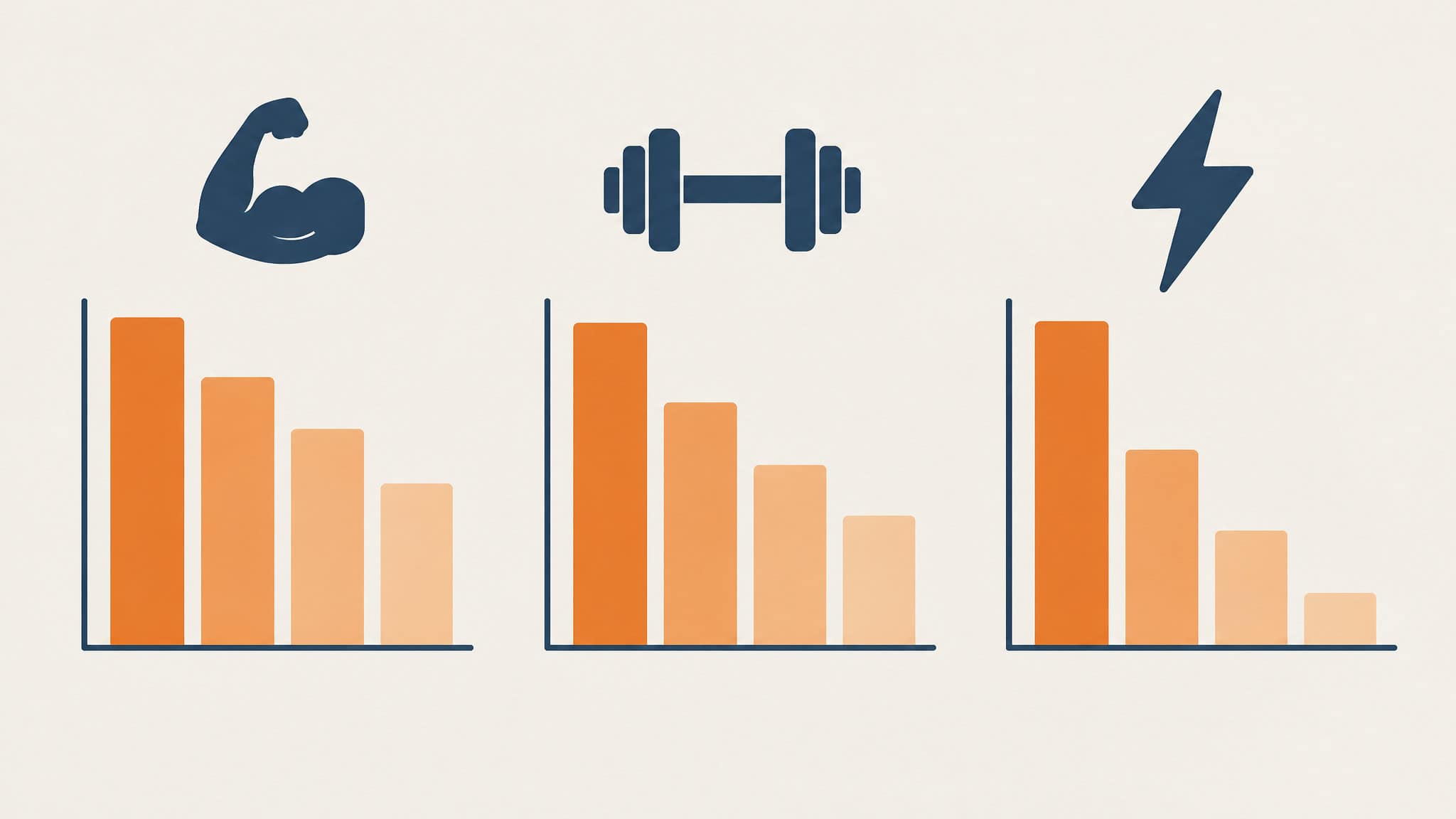
Muscle power drops faster than strength after 40 because power is the speed-dependent ability of your nervous system to generate force quickly, and as Dr. Andy Galpin and Andrew Huberman discussed, power declines at roughly 8% to 10% per year compared to 2% to 4% for strength and about 1% for muscle size. Strength is force production, which is a nervous-system job, whereas hypertrophy simply means bigger muscle fibers without any guaranteed gain in function. A muscle can get bigger without getting stronger.
For beginners and intermediate lifters, strength and size training overlap almost completely, and most early strength gains come from the nervous system learning to recruit muscle you already have. Past that stage, heavier lower-rep work drives strength while higher total set volume drives size.
Galpin points out that treating lifting as an athlete’s tool and cardio as a fat-loss tool is backwards. Lifting heavy with progressive overload is your primary defense against neuromuscular aging, while research repeatedly ranks cardiorespiratory capacity among the most reliable indicators of how long you will live. Strength supports movement quality, power keeps you quick and steady enough to climb stairs or catch yourself mid-fall, and muscle mass backs up both. Build your base on strength, then train power using quick step-ups, low jumps where you land softly, and moderate weights lifted as fast as good form allows.
Pillar 1: Zone 2 cardio, 45 to 75 minutes, and no, you don’t have to run
Sustained aerobic work requires at least one continuous 45 to 75 minute session of zone 2, or long slow distance, cardio every week, occasionally drifting into zone 3. That steady output feeds the brain by boosting blood flow to the head, supporting the lining of your blood vessels, and improving how your body delivers fuel.
You don’t have to pound pavement to get it. If running beats up your knees or bores you to death, use a rower, stationary bike, road bike, swimming pool, or a trail. The Theory of Man presenter gets his zone 2 work in by jogging or hiking with a weight vest. The machine or trail doesn’t matter; picking an option you actually enjoy enough to repeat every week without getting hurt is the entire game.
Pillar 2: HIIT once a week, a protocol menu, not one correct answer
Zone 2 cardio and high-intensity interval training serve different physiological demands after 40 because continuous zone 2 builds aerobic endurance and cerebral blood flow, while HIIT delivers an all-out intensity and heart-rate stimulus that steady movement can’t replicate. Longevity requires both formats every week, pairing one 45 to 75 minute zone 2 session with at least one injury-free interval session such as Dr. Andy Galpin’s 4x4x4 protocol. Pick the interval structure that fits your joints and schedule, or pair one weekly sprint workout with one assault-bike session.
The 4x4x4 protocol
Credited to Dr. Andy Galpin, this classic setup runs 4 minutes all-out with no pacing games, followed by 4 minutes of rest, repeated 4 times.
3x3x4 and 6x6x6 variants
Galpin notes that 3 minutes hard with 3 minutes rest for 4 rounds (3x3x4) or a 6x6x6 structure also deliver strong HIIT results, though 6x6x6 is too brutal for most people to touch.
The 2-on / 3-4-off format
The Theory of Man presenter runs 2 minutes hard followed by 3 to 4 minutes of rest for 4 to 5 rounds.
The time-crunched assault bike option
On an Airdyne or assault bike, where the fan exists to fight you with resistance rather than cool you off, warm up for 1 to 2 minutes and then alternate 1 minute all-out with 30 seconds of rest by feel rather than staring at a heart-rate monitor. If you’ve been away from intervals, rounds one through four feel manageable, rounds seven and eight are where you hit the wall, and your heart rate drops back to baseline about five minutes after you climb off.
Pillar 3: Time under tension, the tempo prescription for muscle and brain
Slowing your lifting tempo down to heavy sets of 4 to 8 reps, taking at least double the time to lower the weight as you do to lift it, turns standard resistance work into a brain-and-hypertrophy stimulus. Instead of just heaving iron from point A to point B, time under tension (TUT) forces you to squeeze the working muscle hard through the whole range of motion. That deliberate effort recruits the neural pathways connecting your upper and lower motor neurons and pushes muscle-derived signaling factors into the bloodstream that support brain function both short-term and especially long-term.
TUT builds strength and particularly muscle size, and the presenter devotes roughly one-third of his weekly lifting volume to it. In a two-exercise TUT block, run your first movement as a heavy compound lift like squats, deadlifts, dips, or overhead presses after warming up: drive the weight up fast, lower it at least twice as slowly, and pause at the bottom without racking the bar. Follow that with a second exercise performed under continuous tension, where the muscle never relaxes until the set is finished.
Pillar 4: Explosive jumping and eccentric landings, the bone-and-brain pillar
Jumping explosively and absorbing the landing under control is a bone-and-brain requirement, not a gym stunt, though new eccentric work carries a steep soreness and injury risk if you start too high. When you jump as high as you can and control the eccentric descent on the way down, you load the skeleton, sharpen coordination and fall prevention, release the bone-derived hormone osteocalcin, and boost BDNF for brain performance.
The catch is that eccentric loading wrecks unconditioned tendons and muscles. Guys coming back after a layoff who jump off tall boxes or land stiff-legged on hard floors get hit with brutal soreness and quit by week two. Start on low boxes, progress slowly, and always land on mats, grass, or dirt rather than concrete. Getting injured is the single biggest threat to both brain and body health because injury stops exercise cold, and the brain-health benefits of training start fading fast once you’re sidelined.
Why muscle is survivability insurance, not a vanity goal
Avoiding serious falls and hip fractures in later decades requires keeping your muscle power, balance, and bone density intact through weight-bearing lifting and jump-and-land training, because bone density erodes without mechanical load and a woman who breaks a hip in a fall has a 50% chance of never walking again. After 45, when you can no longer coast on the training you did in your 20s, building a physical and mental health span as a man means treating fitness as job number one. Plenty of guys spend ages 25 to 50 torching their health to build a business and would later hand over every dollar to buy it back; just like in the sword-and-shield era, the best-conditioned guy is the one who survives.

The organ-by-organ case
A geriatrician guest on Shawn Stevenson’s show describes skeletal muscle as body armor and an amino-acid reservoir that supplies your brain, liver, and kidneys through ongoing tissue breakdown and repair whenever you’re fasted or sick, while Stevenson notes that muscle acts as an endocrine organ releasing myokines that help the immune system recover from illnesses like pneumonia. Muscle is the body’s metabolic engine, and backing that tissue with strength and power forces the heart, lungs, and liver to run more efficiently.
What people call dying of old age is actually organ failure: an untrained person facing pneumonia or congestive heart failure has often been limping along at roughly 10% of vital capacity for their last 15 years. That decline starts early, which is why the metabolic and cardiovascular diseases that shorten men’s lives are directly tied to muscle tissue: insulin resistance shows up in the skeletal muscle of healthy sedentary 20-year-olds a full decade before liver, triglyceride, glucose, or insulin blood markers budge. Carrying more muscle also improves cancer survivability because cancer is fiercely catabolic, chewing through muscle in a process called cachexia (which is why sudden unexplained weight loss triggers clinical suspicion), and exercise boosts natural killer cells and counters inflammatory pathways against certain cancers, even if the clinician stops short of calling exercise broadly anti-cancer.
The nighttime trip scenario
When a strong older guy catches a toe in the dark at 2 a.m., he stumbles, catches his balance, and laughs it off. A guy without muscle, power, or bone density hits the floor, snaps a hip, develops pneumonia in the hospital, lacks the muscular strength to cough up sputum, and dies of organ failure.
Protein after 40: why the RDA is roughly 50% too low
Daily protein intake after 40 requires roughly 0.8 grams of protein per pound of ideal body weight (around 1.6 to 1.8 g/kg), which is double the official 0.8 g/kg Recommended Dietary Allowance (RDA). Aging adults need heavy protein support to protect bone and muscle from sarcopenia, yet the official 0.8 g/kg RDA has sat unchanged for 40 years after being extrapolated from animal data and nitrogen studies on 18-year-old men, leaving it roughly 50% too low for older-adult survivability.
The geriatrician warns that trendy longevity advice telling older adults to restrict protein is dangerous because society faces a widespread shortage of muscle alongside rising obesity rates: movement is medicine and muscle is medicine. Split that 0.8 g/lb target (ideally based on lean muscle mass) across three circadian-aligned meals, eating your first meal about two hours after waking. Leading with protein steadies blood sugar and kills hunger; after putting away a large Steak Florentine, the speaker stayed full through a three-hour walk.
Cramming that much protein into two meals makes intermittent fasting tough to pull off, and while muscle doesn’t care whether amino acids come from plants or animals, hitting the number on plants takes more work. By your 60s and 70s, protein needs climb to support survivability while reduced insulin sensitivity caps how many carbs you can handle, and pushing dietary fat up near 200 grams a day is discouraged.
Measure body composition, not scale weight, and reframe the goal as gaining muscle
Bathroom scale weight is as useless in isolation as a standalone total cholesterol number, so you need a DEXA scan or InBody test to see whether “normal” weight is hiding sarcopenic obesity. Assuming normal thyroid function, muscle is the main metabolic lever you control, and the clinician treats your 30s, 40s, and 50s as prime muscle-building decades, the ideal window to tell a patient who is 30 pounds overweight and 5 pounds under-muscled to gain 5 pounds of muscle instead of losing 30 pounds. One gym client, Vicki, lost 5 pounds of fat and gained 5 pounds of muscle, dropping two clothing sizes without the scale moving an ounce.
The joint-safe exercise toolkit: what to lift for the rest of your life
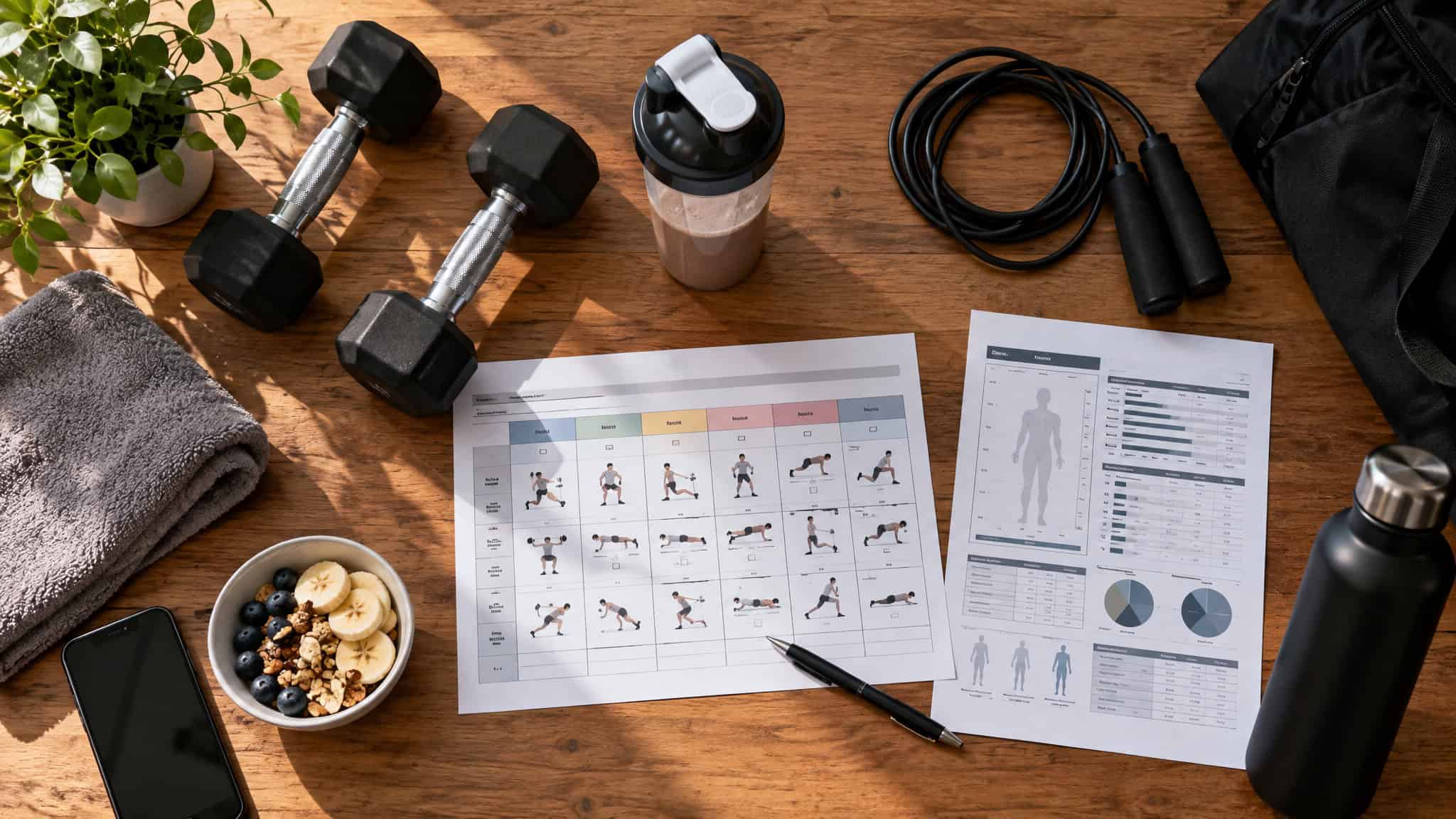
The best exercises for men over 40 are joint-safe, full-body movements you can load for the rest of your life without wrecking your shoulders, knees, or low back. Jeff Cavaliere (ATHLEAN-X) laid out a 10-exercise lifetime list that he wishes he had run in his 20s, which pairs cleanly with Paul Czech’s observation that humans are built to move on their feet rather than sit locked into machines, needing heavy, well-executed standing movements with free weights, cables, and bodyweight over isolation vanity work.
Box squat
Cavaliere’s number-one lifetime pick uses a box set just below parallel alongside safety pins to teach a clean hip hinge, fix back-wrecking mechanics, and remove any fear of getting pinned under the bar.
Reverse lunge
Stepping backward instead of forward slashes knee pain while firing the glute medius for side-to-side stability, especially if you widen your stance slightly and lean your torso over the front knee.
30° incline dumbbell bench press
Pressing dumbbells from a 30-degree bench spares your shoulder joints compared to a flat barbell while letting you pull your shoulder blades down, load the chest heavy, and keep the pushing strength needed to get yourself off the floor.
High pull
Holding dumbbells close and pulling with your wrists above your elbows puts the shoulders into safe external rotation rather than the impingement-heavy internal rotation of an upright row, hammering the middle and rear delts.
Pull-up / assisted pull-up
Gravity and posture work against you with age, making the pull-up the ultimate upper-body measuring stick (the classic cliff-hang survival test), and you can loop in a heavy assist band to unweight 60% to 70% of your body weight at the start.
Seated cable row
Brace your feet and let the cable stack take your low back out of the equation: tuck your elbows with a narrow grip to hit the lats, or flare them out to load the rear delts heavy.
Barbell curl
Cavaliere admits this is his one vanity pick, and if your wrists hurt on a straight bar, tight lats from sitting all day are usually locking your shoulders into internal rotation; use an EZ-curl bar as a workaround, or skip arm isolation altogether like another presenter who relies strictly on pull-ups, push-ups, and bent-over rows.
Lying tricep extension
Letting the weights travel back overhead stretches the lats progressively deeper on every rep while loading the long head of the triceps.
Cable pull-through
Unlike a Romanian deadlift (RDL), which lets you go heavy but won’t stop your lumbar spine from rounding, the low cable pulls your hips back and makes a pain-free hip hinge automatic.
Face pull
Adding an extra overhead raise at the end of a cable face pull lights up the lower traps, middle traps, rear delts, and rhomboids, replacing the light “pink dumbbell” T/Y/I/W raises guys skip out of embarrassment.
Programming: the 3×10 diagnostic audible
Run these on a classic Joe Weider 3 sets of 10 scheme (light, medium, heavy, with an option to work up to 5 sets, where 40-pound dumbbells might be the heavy set for an older lifter) stopping at technical failure where rep 10 looks identical to rep one, using the light first set as a diagnostic “audible” to drop weight or swap a barbell for dumbbells if a wrist barks, and scaling push-ups from feet-elevated down to knees-off-floor or a Slingshot band.
How often to train: muscles don’t care about calendar weeks
Your muscles respond to stimulus, recovery, and adaptation rather than a 7-day calendar, making 3 to 4 lifting days per week on a flexible 9- to 12-day cycle the practical sweet spot after 40. Newer lifters do best hitting each body part 2 to 3 times a week, whereas advanced lifters generating high intensity can only hammer a muscle directly once a week ( echoing a split the speaker learned in a paid consult with Mike Mentzer of shoulders/arms, two rest days, legs, two rest days, chest/back, minus Mentzer’s joyless one-set-to-failure rule) and can split workouts across days when travel or falling asleep reading to the kids pushes training to 10 p.m. As researcher Brad Schoenfeld pointed out to the presenter, indirect volume counts even when studies only tally direct sets: running posterior-chain legs, then chest, then back alternates push and pull for a neurological break while hitting the biceps indirectly 48 to 72 hours after arm day via chin-ups and underhand rows.
The real signs you’re aging well: sprint, jump, and get off the floor
The clearest signs you are aging well physically are functional capacities: sprinting flat-out, jumping and sticking the landing, getting up off the floor without using your hands, and holding onto cardiorespiratory fitness and clean strength benchmarks. Aesthetic mirror checks miss how your nervous system and skeleton are actually holding up in your 60s, 70s, and 80s, whereas impact-loading movements like jumping trigger the release of bone-derived hormones such as osteonectin that travel to the brain and help neurons survive.

When the presenter’s mother, in her mid-70s, asked him what she should do to keep her brain sharp, his first question back was whether she could still jump up and land. Load-bearing impact connects bone longevity directly to brain longevity. He ranks sprinting even higher as the single most transferable exercise a human can do. It carries over to fighting, escaping danger, jumping, and even distance running (he jokes that Usain Bolt would probably run a decent distance race untrained, and notes a former employee built 19-inch arms from sprinting alone). Holding onto a strength benchmark like benching one plate (135 pounds) for reps where the last rep looks as crisp as the first sends the same youthfulness signal to your tissues.
Watch how a guy gets down to the living room rug. Popping straight down and standing right back up is a clean health signal; circling around like a cat to find a painless way onto the floor means joints and stabilizers are hurting.
Most men don’t lose the ability to sprint or jump because of an injury. They lose those gears because they voluntarily stop using them decades before anything breaks.
Think about how kids move: the presenter’s 12-year-old son climbs walls just to jump off them, his daughter jumps nonstop, his wife grew up in Kenya doing fast-twitch double-Dutch jump rope with neighborhood girls, and every guy remembers jumping off the back bumper of a school bus as a kid, a drop that would wreck most untrained adults now. Compare that self-imposed caution to 57-year-old Joel Green breaking into a spontaneous sprint down the street in dress shoes like a little kid in the middle of a podcast taping.
If you’re around 45 and haven’t moved fast in years, don’t start with all-out track repeats. Micro-dose explosiveness into your day and build up gradually so you don’t pull a hamstring:
- Get out of your car seat quickly instead of hauling yourself up by the door frame.
- Stand up from the floor or a chair without bracing your hands on your knees.
- Do short bouts of rope-less jump rope to wake up your calves, tendons, and timing.
Starting late: the data on building muscle at 50, 60, and beyond
No, building muscle at 50, 60, or beyond is not too late when you run progressive resistance training scaled to avoid injury. Sedentary adults lose roughly 0.5% of their total lean mass per year starting at 40, a rate that doubles at 50 and doubles again past 60 as clinical sarcopenia sets in, yet deconditioned trainees in their mid-80s regrow muscle like college kids when given modified lifting programs, and a study cited by Dr. Andy Galpin showed adults over 90 gaining 30% to 170% in muscle size in about 12 weeks.
If you’re starting from scratch after years at a desk, keep the entry bar low enough that you actually show up, while still giving the muscle enough stimulus to adapt (giving a hypothetical client named Sean a 10-minute walk builds a habit, not leg mass). The presenter, who started lifting on his Richmond, California high school football team because there were no local gyms, gives beginners a simple minimal dose: 2 to 3 exercises, 2 to 3 sets per exercise, hitting 2 to 3 body parts per week. On slammed workdays, micro workouts spread across the afternoon kill the “no time” excuse: 50 air squats, 20 push-ups, a 2-minute plank, or pacing during business calls all count.
Training when you don’t feel like it builds what David Goggins calls a forward center of mass, and the reward has to stay internal. After a hard session or a cold shower, taking one minute to tell yourself, “This is good for me. This is benefiting me,” trains your brain not to rely on outside pats on the back, while sensible training volume lowers inflammation and deepens sleep. And if you love lifting heavy, enjoy it: bodybuilder Michael Hearn stayed at 253 pounds around age 55 and above 240 into his late 50s doing what he loved, though for pure longevity, prioritizing muscle quality, strength, and power beats carrying maximal bodybuilder mass.
The weekly plan: putting the pillars, protein, and measurement together
Staying strong and capable past 40 comes down to a consistent weekly routine that pairs the four brain-and-body training pillars with high-protein nutrition and body-composition tracking. Combining weekly aerobic work, heavy resistance training, and adequate recovery (anchored by 7 to 9 hours of sleep per night) gives men over 40 a complete system where every habit is governed by one rule: never let ego or impatience cause an injury that forces you to stop training. If you want a broader look at daily routines beyond the gym, our evidence-backed daily checklist for healthy aging covers the lifestyle side of the equation.
- One continuous zone 2 session (45-75 minutes): Row, cycle, swim, jog, or hike with a weight vest at a steady aerobic pace to drive cerebral blood flow and endothelial health.
- One weekly HIIT or sprint session: Run Dr. Andy Galpin’s 4x4x4 (4 minutes all-out, 4 minutes rest, 4 rounds), a 3x3x4 variant, the presenter’s 2-minutes-on / 3-to-4-minutes-off for 4 to 5 rounds, or time-capped Airdyne intervals (1 minute all-out / 30 seconds rest).
- Joint-safe resistance training 3-4 days per week: Beginners start with 2 to 3 exercises for 2 to 3 sets across 2 to 3 body parts weekly; experienced lifters can run 3 sets of 10 (light, medium, heavy) on lifetime movements like box squats, reverse lunges, 30-degree incline dumbbell presses, pull-ups, seated cable rows, cable pull-throughs, and face pulls.
- Heavy eccentric time under tension: Devote roughly one-third of your lifting to 4 to 8 reps where you drive the weight up fast, take at least double the time on the descent, and hold the bottom pause without resting the bar on the pins, keeping in mind that eccentric work increases soreness.
- Flexible 7- to 12-day training cycles: Stretch your split beyond a rigid 7-day calendar week, similar to the Mike Mentzer philosophy, so your recovery schedule adapts as life demands.
- Explosive jumps with controlled landings: Jump as high as you can and absorb the landing softly on mats, grass, or dirt to load bone and trigger osteocalcin and BDNF release.
- Daily explosive movement habits: Get out of the car fast, stand up from the floor without using your hands, and do rope-less jump rope, building up gradually around age 45 to avoid injury.
- No-excuse micro workouts and walking calls: Knock out micro sets of 50 air squats, 20 push-ups, or a 2-minute plank throughout the day and take business calls while walking so a busy schedule never stops your training.
- Daily protein at ~0.8 g per pound of ideal body weight: Double the outdated 0.8 g/kg RDA by hitting roughly 1.6 to 1.8 g/kg split across three meals, starting about two hours after waking, while tracking lean mass via DEXA or InBody scans instead of scale weight to reframe a “lose 30 pounds” goal into “add 5 pounds of muscle.”
- Consistent 7-9 hour sleep window: Let reasonable training volume improve your sleep quality while giving your nervous system and blood vessels the overnight window they need to adapt.
Treat the first light set of every lifting movement as a diagnostic audible: if a joint feels off with joke weight on the bar, drop the load or switch to dumbbells, and build up box-jump height and sprint speed over months so detraining never sends you back to zero.
Frequently Asked Questions
How do you age well physically?
Physical longevity past 40 hinges on four weekly training pillars rather than chasing a lower number on the scale: one 45-to-75-minute zone 2 cardio session, one all-out HIIT workout, three to four days of heavy joint-safe lifting (with a third of that work done using slow time-under-tension reps), and explosive jumping with soft, controlled landings. Back that training up with roughly 0.8 grams of protein per pound of ideal body weight per day and 7 to 9 hours of sleep. Above all, choose exercise variations that don’t beat up your joints, because avoiding injuries that bench you is the whole game.
What are the signs you are aging well?
Mirror checks don’t tell you much about how your nervous system and skeleton are holding up in your 60s, 70s, and 80s. The real benchmarks are functional: being able to sprint flat-out, jump up and stick a soft landing, and drop to the living room floor and stand right back up without bracing your hands on your knees. Holding onto crisp strength standards—like benching 135 pounds where your final rep looks as clean as your first—and maintaining strong cardiorespiratory output are what actually signal a young body and brain.
Is it too late to build muscle at 50 or 60?
Not even close. Untrained adults in their mid-80s can rebuild muscle tissue at rates similar to college students when put on modified lifting plans, and research cited by Dr. Andy Galpin showed people over 90 increasing their muscle size by 30% to 170% in just 12 weeks. If you’re starting from scratch after decades at a desk, begin with a simple baseline of 2 to 3 exercises for 2 to 3 sets across 2 to 3 body parts per week, and scale the movements so you don’t get hurt.
Why does muscle power drop faster than muscle size after 40?
After age 40, muscle size shrinks by about 1% per year and strength falls by 2% to 4%, while muscle power—your ability to generate force quickly—plunges by 8% to 10% annually. Hypertrophy is just larger muscle fibers, whereas strength and speed-dependent power rely heavily on your nervous system recruiting motor units on command. Most men lose that fast-twitch gear because they voluntarily stop sprinting, jumping, and moving weights quickly decades before anything actually breaks.