
I entered the job market around 2008, just in time to watch hiring freeze over and watch friends scramble for whatever work was left. Reading today’s headlines about an AI-driven market correction and hearing people toss around “Great Depression 2.0” brings back that same knot in the stomach.
When you’ve lived through one ugly downturn, every steep market drop starts looking like the edge of a cliff. The only way to tell real danger from media noise is to test those claims against what actually happened in the 1930s: which failure mechanisms could repeat today, which modern safeguards block them, and what one person can realistically do without buying into the hype.
Key Takeaways
Three of the five economic and historical analyses I checked say a second Great Depression could happen today because no system has immunity, while five of the eight forum posters who reported their own approach are preparing by buying land, solar gear, or supplies.
The 1929 stock market crash did not cause the Great Depression on its own; a 35% collapse in the money supply, 9,000 bank failures, and the 1931 collapse of Creditanstalt in Vienna turned a recession into a decade-long global crisis.
The New Deal stabilized the banking system and shifted expectations in 1933, but World War II mobilization is what finally ended the Depression as government-financed capital spending jumped from 10% to 67% between 1940 and 1943.
Table of contents
Table of Contents
What the ‘Great Depression 2.0’ label means
“Great Depression 2.0” is an informal label used in economic commentary, online debates, and media to describe fears of a downturn rivaling the 1930s, not an official economic classification. Unless unemployment, total economic output, and international trade are collapsing at 1930s rates, the word “depression” is being used rhetorically rather than literally. Commentators and analysts have reached for the phrase across different shocks:
- COVID-era employment drops in spring 2020
- Tariff and market turmoil in 2025
- Household debt and affordability squeezes
- Fears of widespread AI-driven job disruption
The clearest modern attempt to apply the label literally came from economist Lee Ohanian on April 21, 2020, when he argued that California was experiencing a depression-level decline. Over four weeks from mid-March to mid-April 2020, unemployment claims in California topped 3.1 million, pushing the state’s unemployment rate to at least 17% and possibly over 20%. That sudden freeze wiped out a decade of job gains, knocking employment back to 2010 trough levels while the state committed its $20 billion reserve, added at least $7 billion in new coronavirus spending amid falling tax revenue, and left Los Angeles facing a $600 million budget shortfall. Ohanian described those drops as declines not seen since the 1930s.
What separated 2020 from a true repeat of the 1930s was duration and follow-through. A sharp shock that rebounds within months is painful, especially if you’re the one losing a paycheck, but a real depression grinds on for years across banking, credit, and trade all at once. Without that multi-year lockup, the 2.0 tag stays a headline hook rather than a diagnosis.
How bad was the Great Depression?
To measure whether modern scares come close, you need the actual 1930s baseline.
The severity benchmarks: unemployment, output, trade
The Great Depression became a worldwide economic collapse that started with the 1929 Wall Street crash and lasted from 1929 to 1939 by most accounts, though Gary Richardson, who wrote the page at federalreservehistory.org, extends the span to 1941 during World War II. It remains the longest and deepest downturn in U.S. and modern industrial history, defined by four brutal benchmarks: U.S. unemployment peaked at 25% in 1933, U.S. GDP contracted 30%, U.S. industrial production dropped 46% between 1929 and 1932, and international trade fell by more than 50% over the same three years.
The damage wasn’t confined to America. Worldwide GDP fell roughly 15% between 1929 and 1932, with the United States, Germany, and the United Kingdom taking the worst hits. Unemployment reached 33% in some countries, and Germany, heavily dependent on U.S. loans, neared 30%.
In the United States, families wiped out by the 1929 stock losses cut household spending by 10%. By May 1930, car sales had fallen below 1928 levels, crop prices plunged as much as 60%, and construction stopped in many countries. Looking back at 2008 from my own experience entering the workforce then, jobs were scarce and people were terrified, yet the grocery stores stayed full, banks didn’t lock their doors for good, and a quarter of the country wasn’t out of work. The 1930s operated on a different scale of breakdown.
Breadlines, Hoovervilles, and the Bonus Army
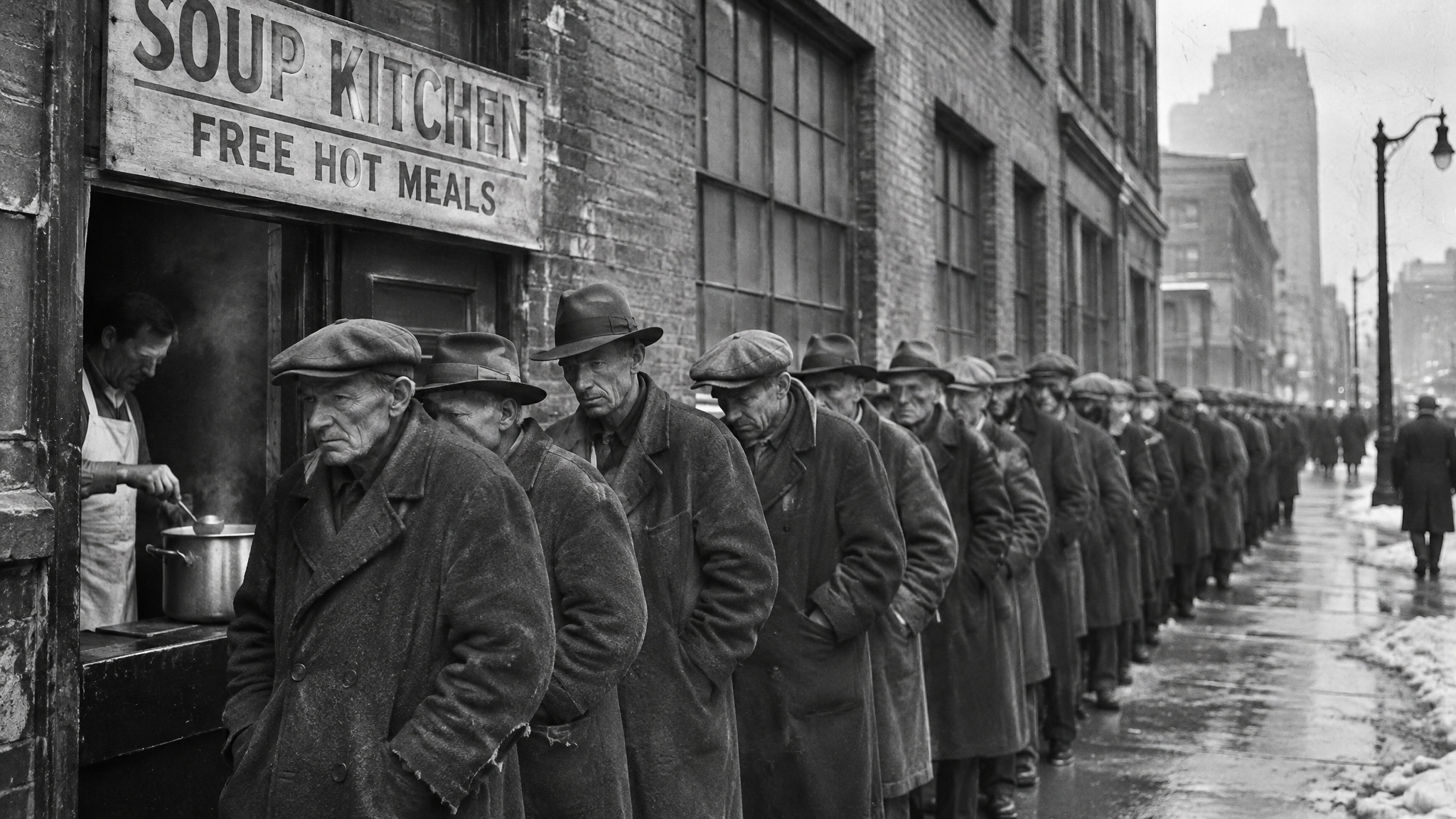
Statistics flatten out what that collapse looked like on a Tuesday afternoon. By February 1931, unemployed men in Chicago were lining up outside a soup kitchen opened by Al Capone. Across cities, shantytowns sprang up out of scrap wood and tin, mockingly named Hoovervilles after President Herbert Hoover.
In 1932, military forces drove the Bonus Army, a group of World War I veterans demanding promised bonuses, out of Washington’s Anacostia flats on Hoover’s order. Out in the country, roughly one in three American farmers lost their land. When severe drought hit the farm belt in the mid-1930s, Dust Bowl storms buried farm machinery in South Dakota, and even with federal help, nearly 10% of all Great Plains farms changed hands at the peak.
Families fractured under the pressure. At the worst of the crisis, about 250,000 teenagers were living on the roads alone, alongside tens of thousands more traveling with evicted parents after fathers lost their jobs and thousands of local schools went broke and shut down.
What caused the Great Depression?
The Great Depression was caused by a chain of failures, not the 1929 crash alone. A speculative boom built on loose lending and growing inequality set the stage, a stock market crash broke financial confidence, regional bank runs escalated into a national banking collapse, the Federal Reserve failed to supply emergency cash as lender of last resort, the gold standard locked nations into a rigid trap, and steep tariffs choked off global trade.
The 1929 crash and the speculation behind it
During the Roaring Twenties, real industrial growth generated large profits, and a huge share of that money poured straight into stock market speculation. Wealth inequality widened while barely regulated banks handed out loose loans, leaving debt piled up across the economy. By mid-1929, falling consumer spending had already trimmed manufacturing output and pushed unemployment higher before a single panic trade hit Wall Street.
When the 1929 crash hit, the Dow Jones Industrial Average fell from 381 to 198 in two months. It bounced back to 294 by April 1930, then ground down to a low of 41 by July 1932, erasing roughly 85% to 87% of the market’s value from September 1929 to mid-1932. Some historians treat the crash as the main cause, while others view it as a symptom of a slowdown already underway, but everyone agrees it shattered confidence in the financial system.
An AI stock bubble could spark a sharp selloff, in my view, but it wouldn’t mirror the 1929 crash without the broader financial cracks behind it, like growing wealth inequality and minimally regulated banks fueling loose lending and widespread debt. That’s my own read on today’s market, not a forecast: the heavy concentration of money chasing AI stocks reminds me of how 1920s boom profits poured into stock speculation, yet an AI stock correction is still a far cry from the systemic banking collapse that followed 1929.
Bank runs turned recession into crisis
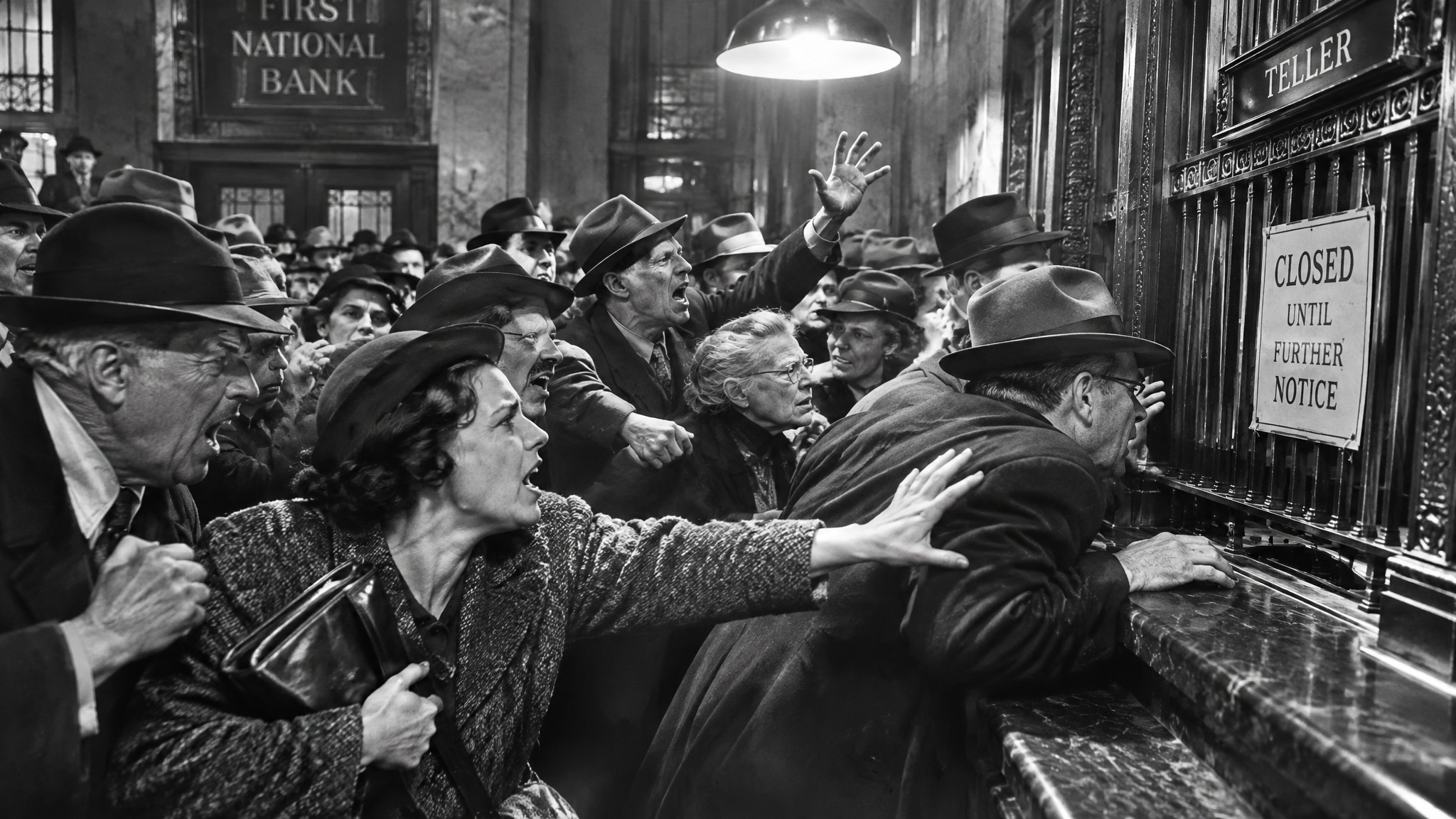
The turning point from a standard recession to an outright crisis happened at bank teller windows, not on the stock exchange floor. Bank failures started in the South and Midwest before reaching New York, where customers panicked and ran on the Bank of United States at 79 Delancey Street in December 1930. Some economists point to that run as the Depression’s starting point.
Regional banking panics in 1930 and 1931 snowballed into national and international crises through 1933. The commercial banking system finally hit bottom in March 1933, forcing newly inaugurated Franklin D. Roosevelt to declare a national bank holiday. By that year, 9,000 of the 25,000 banks in the United States had failed.
Creditanstalt and the global deflationary spiral
If domestic bank runs lit the fuse, Europe blew up the powder keg. In May 1931, the collapse of Creditanstalt in Vienna triggered a global deflationary spiral, turning a severe American downturn into an international catastrophe.
Prices began falling across the board in 1931. Even when interest rates sat low by mid-1930, businesses and households refused to borrow or spend because they expected prices to keep dropping. Economists Irving Fisher and Ben Bernanke later framed this as a debt-deflation trap: when prices fall, fixed debts become heavier in real terms, which forces people to cut spending even further and locks the economy in a downward spin.
Why the Fed’s failure made the Depression ‘Great’
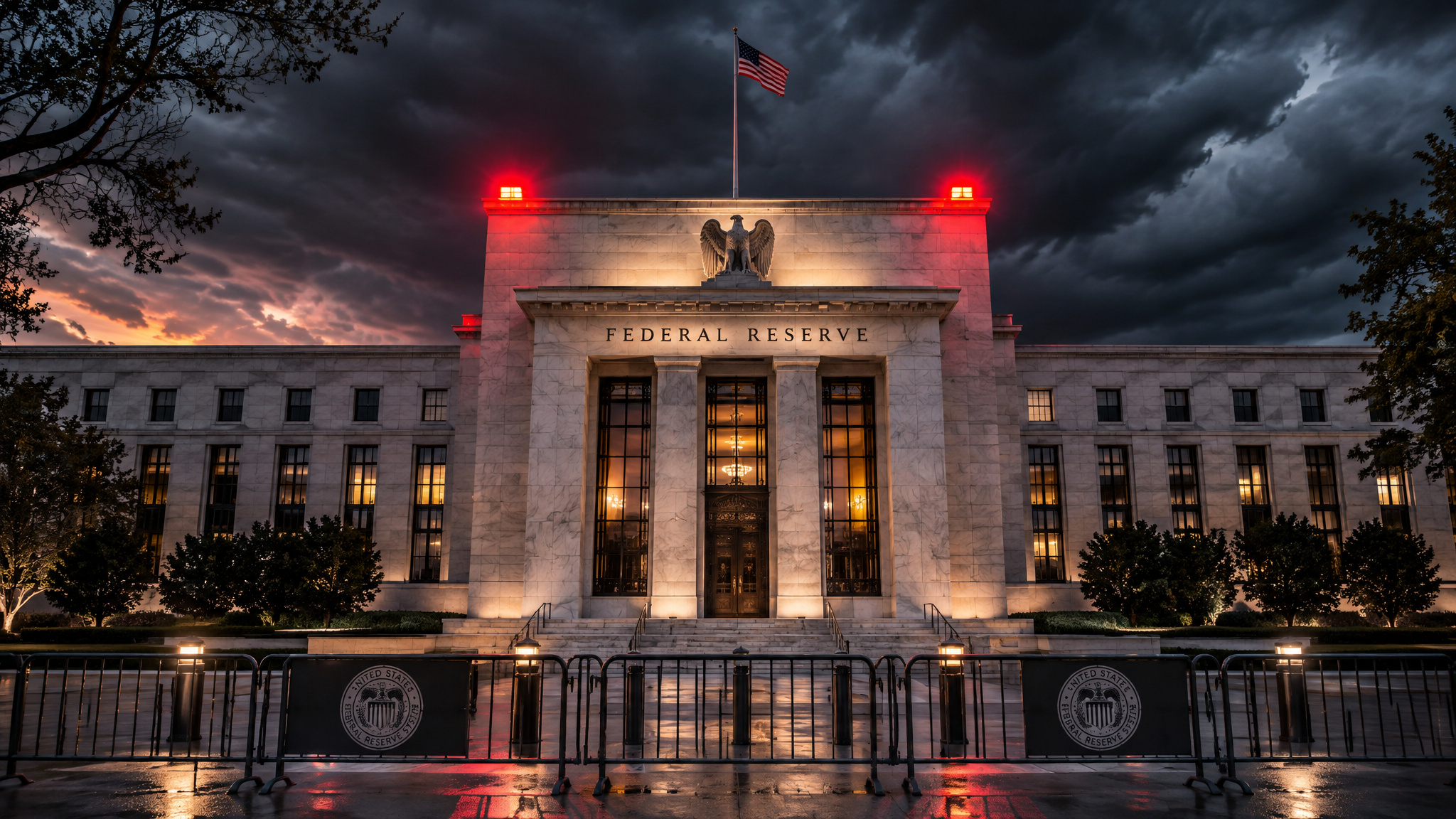
Popular history blames Wall Street greed for the 1930s, but the crash didn’t create a decade of misery on its own. The Federal Reserve’s failure to act as lender of last resort is what turned a bad downturn into the Great Depression.
The Great Contraction: money supply fell 35%
Between 1929 and 1933, the U.S. money supply shrank by roughly 35% overall, with Richardson noting a drop of nearly 30% from fall 1930 through winter 1933 alone. That “Great Contraction” starved the economy of cash, drove deflation, made every existing loan harder to pay back, warped business decisions, and forced wave after wave of bankruptcies. As David Wheelock at the St. Louis Fed has pointed out, recovery didn’t begin until the money supply finally started growing again.
Instead of flooding panicked banks with liquidity, the Fed made things worse. It had raised interest rates in 1928 and 1929 to cool stock speculation, slowing growth and exporting recession abroad, and it repeated that rate-hiking mistake during the fall 1931 international crisis.
Most of the banks that went under weren’t reckless casinos; they were sound, well-run institutions caught in a sudden cash crunch. Internal doctrinal fights, pitting Bagehot’s rule of lending freely in a panic against the real bills doctrine and Treasury Secretary Andrew Mellon’s liquidationist view, paralyzed the Fed alongside a decentralized structure that left its board without clear authority. Fed Governor Randy Kroszner later noted that the central bank didn’t respond to what was happening in the economy in the early 1930s, focusing on the narrow monetary base it controlled directly instead of the broader money supply, even though it could have stepped in at any point.
Four schools, one shared lesson
Economists have argued over the primary spark for nearly a century, splitting into four main camps:
- Monetarist economists, led by Milton Friedman, blame the Fed’s inaction and the 35% monetary contraction.
- Keynesian economists, following John Maynard Keynes, point to insufficient aggregate demand and argue that active fiscal policy, aggressive government spending, was needed to drive recovery.
- Debt-deflation theorists like Irving Fisher point to the vicious cycle of falling prices crushing borrowers under fixed debts.
- Heterodox thinkers offer competing angles, with the Austrian School blaming unsustainable credit booms, Marxists blaming capitalism’s built-in instability, underconsumption theorists citing productivity shocks alongside weak demand, and analysts like Lionel Robbins weighing the policy missteps.
Even though those schools disagree on what lit the match, they converge on one practical lesson. Central banks had to step in, expand the money supply, and act as lender of last resort to keep a downturn from dragging on for years.
Gold standard, tariffs, and the global collapse
Domestic mistakes didn’t stay inside U.S. borders. Rigid currency rules and self-inflicted trade walls exported the crash around the world and decided which countries crawled out first.
Gold-standard rigidity and recovery timing
The gold standard tied countries together like mountain climbers roped to a falling partner, locking interest rates and monetary policy in step across borders. Countries that ditched gold early and devalued their currencies, including Britain, Argentina, and Brazil, started recovering much sooner than nations that clung to gold.
Recoveries split sharply along those lines. The United States, Germany, and Japan were recovering by the mid-1930s, while France didn’t get back to pre-shock growth until late in the decade. The United Kingdom, already stuck in a late-1920s slump, absorbed the U.S. shock less severely, while Germany’s industrial output fell roughly as hard as America’s. Countries also tried different playbooks, from Japanese deficit spending to France’s state-directed consumption programs like the Code de la Famille, while the 1934 U.S. Silver Purchase Act even forced China off the silver standard and into a 1935 fiat currency reform.
Looking at that pattern today, the real warning isn’t gold itself. It’s any modern policy rule or political constraint that ties a central bank’s hands right when the financial system needs emergency cash.
Smoot-Hawley and the trade collapse
While currency rules squeezed credit, trade policy hammered exports. Hoover was reluctant to intervene heavily in the domestic economy, but in 1930 he signed the Smoot-Hawley Tariff Act, which raised import duties and inadvertently worsened the Depression as global trade fell by more than half.
The fallout reached far beyond factory floors and shipping docks. Economic desperation fueled the rise of fascism in Europe and Asia, paving the way for Hitler’s Nazi Party in Germany in 1933 and ultranationalist statism in Japan. Out of that wreckage came postwar social democracy, modern central-bank doctrine, John Steinbeck’s social realism, and the quiet grit of women stretching scraps to keep households running. Today’s tariff debates still rattle markets, though modern trade institutions and floating currencies give the global economy shock absorbers that didn’t exist in 1930.
Did the New Deal end the Great Depression, or did WWII?
The New Deal stabilized the financial system and started the recovery, while World War II mobilization is what finally ended the Great Depression.
After defeating Hoover in 1932, Roosevelt rolled out New Deal relief, job-creation programs, and sweeping financial reforms starting in 1933. That policy shift broke the deflationary panic and changed public expectations, though economists still debate whether New Deal spending alone was ever big enough to restore full employment. As John Maynard Keynes observed about the political limits of peacetime stimulus:
Peacetime capitalist democracies appear politically unable to approve spending on the scale needed to test his case, only war conditions make that possible.
World War II, starting in 1939, proved that point on an industrial scale. Factories ramped up around the clock, the military absorbed huge numbers of unemployed young men, women stepped into factory jobs, and millions shifted out of the civilian labor force. Between 1940 and 1943, government-financed capital spending surged from 10% to 67% of the total, pulling the economy back to full output and employment.
The 1937 to 1938 recession: when recovery reversed
Just as the economy looked like it was healing, policymakers triggered a self-inflicted double-dip recession in 1937 and 1938. Federal spending cuts, tax increases, and higher bank reserve requirements knocked the fragile post-New Deal recovery backward.
That reversal shifts how you have to think about modern policy risk. The danger isn’t only failing to act when a crisis hits; it’s pulling support away too early while the recovery is still finding its feet.
Could another Great Depression happen in the United States?
No, a 1930s-scale Great Depression is unlikely in the United States today because modern safeguards block the second-act banking and monetary failures, though there’s no immunity. Looking at the 1930s mechanisms next to today’s setup shows where the real guardrails sit:
- Market speculation: 1929 margin buying and unregulated leverage wiped out households, whereas today’s leverage and AI-concentrated equity exposure sit inside stricter margin rules and broader market oversight.
- Bank runs: 9,000 banks failed in the 1930s without a safety net, whereas deposit insurance and modern capital rules prevent ordinary depositors from stampeding every local branch.
- The Fed let the money supply shrink by 35% in the Great Contraction. Today’s Fed carries an aggressive lender-of-last-resort toolkit built to flood crises with liquidity.
- Trade walls: The Smoot-Hawley Tariff Act helped cut world trade in half during a rigid era, whereas today’s tariff environment operates inside modern trade frameworks and flexible exchange rates.
- Currency rules: Gold-standard rigidity locked countries into deflation, whereas today’s fiat currency system lets central banks expand money without waiting on gold reserves.
The 1930s mechanisms vs. today’s safeguards
The biggest reason a 2008-style crash didn’t turn into a 1930s collapse is that the Federal Reserve learned its lesson. David Wheelock emphasized that price stability is paramount, meaning central banks have to prevent both 1930s deflation and 1970s-style inflation. When financial panic hits, they have to flood the system with liquidity to restore confidence and keep the payment system running. During the 2007 to 2009 financial crisis, the Fed’s aggressive liquidity response avoided a 1930s deflationary spiral and prevented a second Great Depression.
The verdict: unlikely, with no immunity
Even with those guardrails in place, Wheelock warned plainly that it could certainly happen again and that there’s no immunity to a depression. As for viral claims predicting a Great Depression in 2030, there’s no evidence supporting any specific-year cycle forecast; those timelines are pure speculation.
Across the broader debate, opinions split depending on whether you look at institutional safeguards or personal vulnerability. Three of the five economic and historical analyses I checked say a second Great Depression could happen today, while two say no. At the same time, among eight forum posters who reported their own experience when asked their main way of preparing for a possible second Great Depression, five say buying land, solar gear, or supplies, two say securing fellowships or fallback jobs, and one says cutting spending and saving money.
As one poster planning for worst-case disruptions put it, they’re “going solar as much as possible.” Those two groups aren’t necessarily contradicting each other: the analytical view rests on whether central banks and banking safeguards hold, while everyday people hedge against the possibility that those safeguards fail when it counts.
What entering the job market in 2008 taught me
Entering the job market around 2008 and watching that downturn’s economic carnage firsthand permanently changed how I read market headlines. When you start your career watching businesses fold and qualified people beg for entry-level work, every sharp drop in tech stocks feels like the opening scene of a sequel.
That generational scar is useful for keeping you humble, but it’s a lens, not evidence. Plenty of people who graduated into a bad recession become chronically risk-averse and miss years of normal growth because they’re always bracing for the worst. Checking the 1930s record against modern safeguards is how I keep my gut reaction from making my financial decisions for me.
How I prepare for a possible Great Depression
Preparing for a possible Great Depression comes down to eliminating debt, sizing cash reserves to the deflation-inflation tradeoff, and using a market-navigation method you trust. My own approach is built around carrying zero debt of any kind and keeping plenty of cash on hand whenever recession fears spike. That posture traces straight back to the 1930s debt-deflation trap: when prices and incomes fall, fixed debt turns into an anchor that sinks you, while unencumbered cash gives you breathing room when everyone else is forced to sell.
Zero debt, high cash: one person’s posture
I don’t carry a mortgage, car note, or credit card balance, and I keep a deep cash cushion sitting ready. I’m sharing that as one person’s risk tolerance after living through 2008, not as universal advice you have to copy. For someone with steady, recession-proof work or high-growth goals, holding that much cash might feel overly cautious, while for me, knowing nobody can call a loan on my life lets me sleep through ugly market weeks.
Cash vs. investing: the deflation-inflation tradeoff
The harder call today is deciding how much cash to hold versus keeping money invested in the market. In the 1930s, cash was king because widespread deflation meant every dollar bought more goods as prices fell. Today’s economy carries real inflation risk, which quietly eats away at an all-cash pile over time, alongside the opportunity cost of sitting out market rebounds. Your own expectation of inflation versus deflation, not a generic prepper checklist, should decide how heavy your cash reserve gets.
For the money I do keep in the market, I like using the Kelly Letter “9Sig” newsletter to navigate the swings without guessing off daily headlines. That’s strictly my personal preference, with no performance claims attached. Whether you use a structured system or simple index funds, the goal is the same: clear your debt first, keep enough cash to survive a bad year without panicking, and let the Fed’s modern toolkit worry about the systemic plumbing.
Frequently Asked Questions
What was the Great Depression and when did it begin?
The Great Depression was the longest and most severe economic collapse in modern industrial history, triggered by the Wall Street crash of 1929—though some economists point to the December 1930 run on the Bank of United States in New York as the true breaking point. Unemployment in the U.S. eventually hit 25%, industrial output tumbled 46%, and global trade shrank by more than half. What began as an American downturn quickly turned global after bank failures and falling prices locked economies into a multi-year spiral.
What years did the Great Depression span and when did it end?
Most historians date the Great Depression from 1929 to 1939, though Federal Reserve historian Gary Richardson extends the timeline to 1941. While Franklin D. Roosevelt’s New Deal stopped the banking panic and shifted expectations starting in 1933, peacetime spending wasn’t enough to restore full employment on its own, and premature tightening even caused a 1937 to 1938 double-dip recession. What finally ended the slump was World War II mobilization, which pushed government-financed capital spending from 10% to 67% between 1940 and 1943 and put factories at full capacity.
What caused the Great Depression and could those causes happen again?
It took a chain reaction rather than just the 1929 stock crash: loose lending and speculative excess met bank runs, a 35% drop in the money supply due to Federal Reserve inaction, the 1931 collapse of Vienna’s Creditanstalt, rigid gold-standard rules, and the Smoot-Hawley tariffs. Today, deposit insurance, stricter margin rules, floating fiat currencies, and a central bank willing to flood crises with liquidity block most of those second-act failures from repeating in the same way. Even so, modern policy constraints or pulling support away too early remain real risks.
Why did the Federal Reserve’s inaction make the Great Depression worse?
Instead of acting as a lender of last resort when panicked depositors rushed banks, the Fed stood back and let the U.S. money supply contract by roughly 35% between 1929 and 1933. Internal fights over the real bills doctrine and liquidationist thinking, combined with a decentralized board structure and poorly timed rate hikes in 1928–1929 and fall 1931, left sound banks to fail in a cash crunch. That severe monetary contraction fueled deflation, made fixed debts heavier in real terms, and turned a recession into a decade-long catastrophe.
How bad was the Great Depression compared to the 2008 financial crisis?
Having entered the job market around 2008, I remember how terrifying the hiring freeze was, yet grocery stores stayed stocked, banks didn’t permanently lock their doors, and a quarter of the workforce wasn’t unemployed. In the 1930s, U.S. GDP fell 30%, 9,000 of 25,000 banks collapsed, and roughly one in three farmers lost their land. The crucial difference in 2008 was that the Federal Reserve aggressively pumped liquidity into the system, stopping a 1930s-style deflationary spiral before it could start.
Could another Great Depression happen in the United States?
A 1930s-scale collapse is unlikely because modern safeguards—like deposit insurance, fiat currency flexibility, and the Fed’s emergency liquidity toolkit—stop bank runs and monetary contractions before they snowball. Still, there is no total immunity, a point St. Louis Fed economist David Wheelock has warned about plainly. Out of five economic and historical analyses I checked, three argue a second Great Depression could happen today while two say it won’t, showing that institutional guardrails are only as strong as the policymakers running them.
Is a Great Depression coming in 2030?
No—viral claims pinning a Great Depression to 2030 are pure speculation with zero evidence behind them. Specific-year cycle forecasts make for dramatic headlines, especially when people are already anxious about AI stock valuations or tariffs, but economic collapses don’t run on a calendar schedule. A genuine depression requires a multi-year breakdown across banking, credit, and global trade, not a date on a chart.
What would a Great Depression 2.0 look like if it started today?
To earn the label literally rather than as media hype, a “Great Depression 2.0” would need a multi-year lockup across jobs, total output, banking, credit, and international trade all at once. Even the brutal spring 2020 shock—when California’s unemployment rate spiked past 17% and possibly over 20% in a matter of weeks—didn’t qualify because the economy rebounded within months instead of grinding down for years. Without sustained deflation, widespread bank failures, and a prolonged collapse in trade, sharp market drops or AI-driven job fears don’t add up to a real depression.
How do you prepare for a Great Depression?
Practically speaking, preparing means clearing high-risk fixed debt, building a cash buffer, and avoiding panic-driven decisions based on daily headlines. Among eight forum posters who reported their own experience when asked how they prepare for a second Great Depression, five focus on buying land, solar gear, or supplies, two line up fellowships or fallback jobs, and one concentrates on cutting spending and saving. Whether you lean toward physical self-reliance or financial liquidity, the goal is giving yourself room to maneuver if credit freezes up.
How do you prepare financially for a possible Great Depression?
My own financial posture—shaped by watching the 2008 downturn firsthand—is to carry zero debt, including no mortgage, car note, or credit card balance, and keep a deep cash reserve ready. Eliminating fixed debt keeps you out of the classic debt-deflation trap where falling prices and incomes make loan payments impossible to service. That’s my personal risk tolerance rather than a universal rule, and for the money I do keep invested, I rely on the Kelly Letter “9Sig” newsletter to navigate market swings systematically.
Is keeping cash better than investing during a depression-level crash?
It depends on whether you’re facing 1930s-style deflation or modern inflation. Cash was king during the Great Depression because falling prices meant every dollar gained purchasing power, whereas today an all-cash pile quietly loses value to inflation and misses out on market rebounds. The smartest move is sizing your cash reserve to survive a bad year without forced selling, rather than abandoning the market completely out of fear.