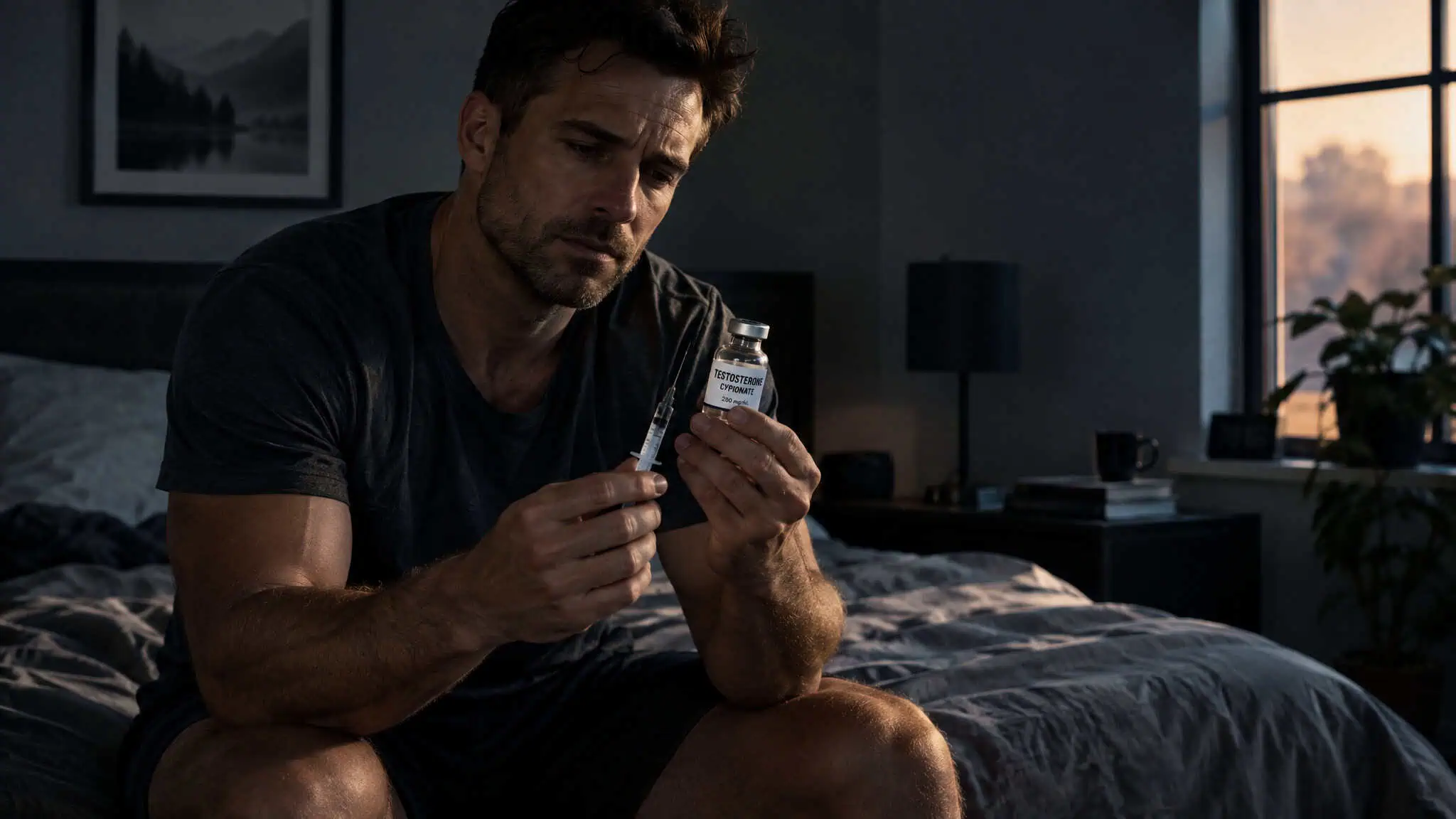
The ads make it sound like a vitamin. Tired, foggy, like you’ve lost your edge at 42?
One prescription and you’re back. What the commercial doesn’t mention, in the fine print or anywhere else, is what happens the day you want to stop. Guys start testosterone, feel genuinely better, then discover quitting isn’t a decision anymore. It’s a negotiation with their own body. That gap between the pitch and the permanence is the whole story here.
Key Takeaways
For men with confirmed hypogonadism, TRT is generally an indefinite commitment, because treatment shuts down the body’s own testosterone production.
Stopping means a withdrawal valley while natural production restarts: hormone recovery takes months to years and fertility recovery is slower and less certain.
For clearly deficient men, recent trials show no apparent excess heart attack, stroke, or new prostate cancer risk, but staying on means bloodwork for as long as you’re on therapy.
Table of Contents
Do men stay on TRT forever? The direct answer
For men with confirmed hypogonadism, testosterone replacement therapy is generally an indefinite commitment. Harvard Health‘s reviewed guidance calls it the testosterone trap: men get started, feel better, then find it hard to come off. Not because the drug is addictive. Because while you’re on treatment, your body stops making its own testosterone. The shots handle everything, so your natural production shuts down, and that’s what manufactures the permanence.
So the honest answer is yes, usually forever, and the reason is physiological rather than arbitrary. What matters more is separating the two groups of men who end up on therapy: the ones who genuinely need lifelong replacement, and the ones who got started on a weak indication and never should have signed. That distinction, plus what to settle before the first shot, is the real job of this article.
What happens when you stop TRT: the withdrawal valley and the two recoveries
When you stop, symptoms revert toward your pre-treatment baseline, because your body’s own production hasn’t restarted yet. Men often feel a big difference coming off, and that felt crash is the recovery gap, not proof the drug was doing something magic. Libido and sexual function drop first. Muscle goes, fat creeps back. How rough the crash gets depends on how long you were on and how well your body restarts.

The withdrawal valley
Clinicians commonly describe a stretch of weeks to months where natural production simply hasn’t come back online. You’re running on empty between the exogenous supply ending and your own system waking up. The longer you were on therapy, the more suppressed your production likely is, which is exactly why “forever” is the default answer.
Testosterone recovery
Months to years, and not guaranteed. That’s the honest timeline, and it varies man to man. No source gives per-man dates, and anyone who tells you your levels bounce back in six weeks is selling something.
Fertility and testicular recovery
This is the recovery nobody mentions. Exogenous testosterone blunts the brain signals (GnRH, LH, FSH) that drive sperm production, so fertility recovery is slower and more uncertain than hormone recovery. If you still want kids, that changes the quitting math considerably. As for the other question: yes, testicles shrink while production is shut down.
Whether everything bounces back afterward isn’t something anyone can promise. Once you start testosterone therapy, stopping is its own project, and it’s worth reading before the first injection rather than after.
Permanent or temporary: who can actually come off TRT
TRT is permanent for men with true hypogonadism, meaning primary testicular failure, Klinefelter syndrome, or pituitary disorders. It’s potentially temporary for men who started on weak indications. Worth stating against the marketing: clinical hypogonadism affects under 2% of men. Compare that to how many are actually on therapy and you can do the arithmetic yourself.

Who needs lifelong therapy
The confirmed-deficiency cohort, men diagnosed with a rigorous entry process: actual symptoms plus actual low levels, verified properly. For them, replacement is what it sounds like. The body can’t do the job, the medication does it, indefinitely.
The discontinuation-feasible group
Men who got started on fatigue plus a normal-ish reading, or a low reading that was never repeated. This is a diagnostic-process pattern, not a diagnosis: a guy whose entry workup was thin is the guy most likely to come off successfully. No success rates exist for quitting, and anyone quoting one is making it up.
Structured exit checkpoints
The evidence defines two concrete exit ramps, and only two. A day-30 recheck after starting, to see how you’re actually responding. And a 3 to 6 month sunset clause: if there’s no symptomatic improvement within the realistic timeline of changes, that argues for stopping. If TRT isn’t doing anything for you, there’s no reason to pay for it.
Before the first injection: the pre-commitment contract
Because the commitment is effectively irreversible, the entry decision is the real control point, and the cheapest safeguard is a properly timed repeat test. A guy I know tested high on the day of his restart, figured he was cured, and was right back to low-T a day later. Single readings lie.
Quick test: Any low reading gets confirmed with a second test on a different day, drawn between 7 and 10 am. One weird number is not a diagnosis.
Confirming the diagnosis
Measure between 7 and 10 am, when testosterone peaks. Confirm a low reading with a second test on a different day. Look at free or bioavailable testosterone, not just the total number. And if anything’s ambiguous, an endocrinologist second opinion is cheap insurance.
You don’t replace the alternator off one weird dashboard light. Bad or misread results cut both ways: they can scare a healthy man into treatment or miss a real deficiency.
Rule out reversible causes first
Are you actually sleeping? Are you actually exercising? Fatigue has a hundred causes, and most men who get tested after generic symptoms turn out normal, despite what the ads imply. Sexual complaints can come from relationship or psychological stuff rather than hormones, which is worth ruling out honestly before you start injecting. Fatigue alone is not an indication.
Who shouldn’t start
The caution list: high prostate cancer risk, severe urinary symptoms from prostate enlargement, diagnosed heart disease, prior heart attack, clustered cardiometabolic risk. Then the one-way decisions. If fertility matters to you, settle it first; sperm banking shows up in the evidence as one documented individual’s precaution, not standard care for everyone. Formulation matters too, since injections, gels, and patches are different commitments.
The counseling is blunt and worth internalizing: accept low testosterone, or commit to lifelong medication. Our fuller guide to whether men should take TRT covers the candidate question in depth.
Alternatives to indefinite full-dose TRT: middle paths and their real tradeoffs
The honest alternative isn’t a miracle protocol. It’s exhausting the reversible options first, and knowing that even the middle path carries a cost.
Lifestyle-first is the only option that avoids the trap entirely: sleep, fitness, and sorting out relationship or psychological factors before hormones enter the picture. Unglamorous, free, and skipped by most guys.
The ED redirect matters more than it sounds. Erectile dysfunction can signal cardiovascular disease rather than low T. Treat the wrong cause and you commit to the wrong therapy, possibly for life.
Dose-reduction titration is the middle path, and one documented public figure self-halved his prescribed dose, after banking cryopreserved sperm in hopes of spontaneous conception, and reported markedly diminished energy at the reduced dose. That’s one guy’s self-titration, not a medically endorsed protocol. The tradeoff being real is the point: less dose, less effect. There’s no free version of this.
Living on TRT: the monitoring obligations of an indefinite therapy
Staying on means periodic bloodwork, testosterone checks, blood counts, and prostate monitoring, for as long as you’re on therapy. Testosterone raises hemoglobin 5 to 7%, pushing polycythemia into over 20% of treated men, so you get a baseline complete blood count before starting plus interval checks, with a hematocrit of 54% triggering a dose pause. Thick blood is a theoretical clot and stroke concern, though it hasn’t been demonstrated in TRT populations. The PSA rule is the sharpest one: any rise over 1 ng/mL in the first 3 to 6 months may reflect cancer that was already there, and that means stopping therapy until it’s checked out. One of the few defined scenarios where treatment actually ends.
Red flag: A PSA jump over 1 ng/mL in the first 3 to 6 months means pausing therapy until a doctor rules out what’s driving it.
The rest of the watch list, compressed: sleep apnea is associated with TRT (cause unclear, no proven link), gynecomastia and breast tenderness show up in 10 to 25% of men because some testosterone converts to estrogen, and one-sided changes get worked up. Acne from extra skin oil, some edema, and closer follow-up if you’ve got a heart failure history. Liver and kidney function deserve periodic awareness too, especially on long-term therapy, caution is advised with chronic renal insufficiency because of water retention, and hepatic findings are mixed enough that clinicians stay alert. Think of it as ownership cost, like oil changes on a car you actually drive. Not surveillance. Maintenance.
Is TRT safe long term? The reconciled cardiovascular and prostate evidence
- Is TRT safe long term? For men with clearly confirmed deficiency, yes, recent evidence shows no apparent increased risk of heart attack, stroke, or new prostate cancer.
- Earlier warnings raised possible cardiovascular risk, but later research is more reassuring. The catch: decades-long outcome data remain limited.
- That’s genuinely good news, and it deserves to be stated plainly. But it’s not a flat verdict, and men and their doctors should still weigh these issues before committing to long-term therapy.
The cardiovascular chronology
The history matters here. In 2015, the FDA flagged cardiovascular risk based on observational studies, and that warning spooked a generation of men away from therapy. Later randomized trials, including a large 2024 testosterone-gel trial, found no apparent excess of heart attack, stroke, or de novo prostate cancer in clearly deficient men. The honest exception: one small trial in high-comorbidity patients showed increased cardiovascular events, which is why “clearly deficient” is doing real work in that sentence.
And nobody has decades-long outcome data yet. So the story runs from alarm to reassurance, and the decades-long data that would settle it still doesn’t exist.
The prostate paradigm shift
The old assumption was that feeding testosterone to the prostate was like pouring gas on a fire. The saturation model says otherwise: androgen-driven prostate growth plateaus at normal levels. More gas pedal doesn’t add top speed. The evidence backs it up: prostate cancer incidence looks similar on and off TRT across a 3-year prospective trial and a meta-analysis of 18 prospective studies.
The counterintuitive part: an enlarged prostate isn’t a dealbreaker, and TRT isn’t contraindicated in benign enlargement. Urinary symptoms don’t worsen on therapy, some series show improvement after a year, and prostate growth in older men on TRT, around 12%, mirrors normal age-related growth. The hard limits stay hard, though. TRT is contraindicated in untreated prostate and breast cancer, and it may accelerate an existing cancer.
Attitudes are shifting even post-prostate-removal: in a retrospective review of 103 men after radical prostatectomy, twice as many recurrences appeared in the group not on TRT at 36 months. But active or metastatic prostate cancer remains an absolute no, since blocking testosterone is literally the treatment for advanced disease.
Realistic expectations: TRT is not a fountain of youth
Testosterone therapy is not a fountain of youth. There’s no proof it restores youthful fitness or sexual function, extends life, prevents heart disease or prostate cancer, or improves memory. On longevity: no demonstrated lifespan shortening in clearly deficient men per recent trials, and no proof of extension either. Decades-long data are limited, and there’s no safety data for the very old.
The real gains for appropriately selected, monitored men: libido, energy, bone density, muscle mass, possibly cognition. One caveat worth knowing upfront: TRT may raise sex drive without fixing erections. You might want sex more without being able to perform. An annoying mismatch, and the ads never mention it.
Why the forever question is suddenly urgent: marketing and the T-maxxing economy
FDA-approved testosterone therapy is for confirmed hypogonadism, a medical condition affecting under 2% of men, not age-related decline. The gap between that indication and what’s being marketed is where the urgency lives.
The pharmaceutical pitch hasn’t changed much: the “do you feel tired?” ads promising alertness, energy, mental sharpness, and sexual function. Read that symptom list honestly and it qualifies most of the male population over 40. That’s the point of a symptom list that broad.
The cultural funnel is newer and faster. Search volume for “low testosterone” is up roughly 60% year-over-year globally. “T-maxxing” influencer content pushes testosterone well beyond its approved indication, and the influencers frequently monetize the clinics and supplements they steer men toward. The funnel sells the start, loudly and constantly. Nobody’s pricing the decades of monitoring after, because the monitoring isn’t the product.
Then there’s the mainstreaming signal: an announced directive from Hegseth for annual testosterone screening of US service members aged 30 and up. Announced, not implemented policy. The point isn’t the policy itself. It’s that testing is entering channels that never mention the lifelong commitment attached to a positive result.
Here’s the consumer-protection frame, stated plainly. Millions of American men use prescription testosterone injections or gels. The benefits are real when levels are genuinely low, which is exactly why use has surged even though long-term data is thin. The therapy works.
The marketing works better. And that combination is precisely why “is this forever” deserves an answer before the first injection, not after.
Frequently Asked Questions
How long do most men stay on TRT?
For men with confirmed hypogonadism, testosterone replacement therapy is generally an indefinite commitment — usually forever. The reason is physiological, not arbitrary: while you’re on treatment, your body stops making its own testosterone, so the shots handle everything. The exception is men who started on weak indications with a thin diagnostic workup; they’re the group most likely to come off successfully.