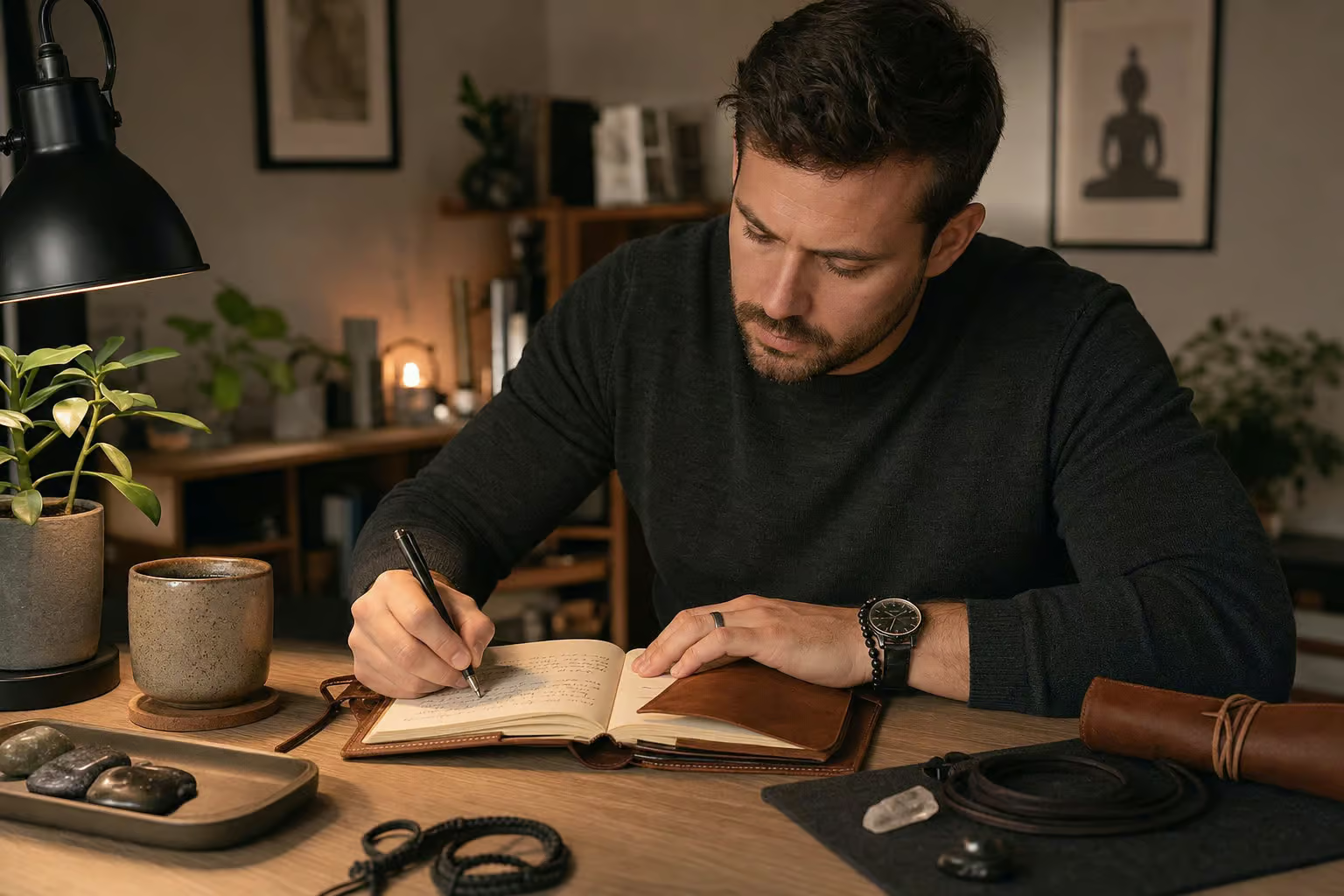
Someone asks what you do for fun, and the honest answer is a shrug. You watch things. You scroll things. Somewhere in a closet is a guitar, a telescope, or a set of nice watercolors you paid real money for, used twice, and now avoid looking at.
That purchase is the most common failure pattern in hobbies: buying the gear felt like starting the hobby, and it quietly replaced actually doing it. If you’ve been circling creative hobbies for men and telling yourself you’re “just not the creative type,” the problem probably isn’t talent. It’s the setup. So here’s the shape of this piece: first the actual barrier, which has a name; then a menu of things you can make, where every entry starts with a step that costs nothing or nearly nothing; then a realistic plan for still doing it in week four.
One permission up front, because it’s the whole stance here: hobbies don’t have to be done perfectly. The point is fun. There’s no scoreboard.
Key Takeaways
Many men skip creative hobbies because of “achievement perfection,” a fear of being visibly bad at something new named by Andrew Rainer, a senior lecturer in men’s studies at Towson University, and the gear you bought and never used is the pattern’s calling card.
Every hobby in this piece has a no-buy or near-no-buy first step: a pencil you already own, your phone’s camera, a found branch for whittling, a rented instrument instead of a purchased one.
Quitting in week three is usually a dose problem, not a character problem: 10 to 20 minute sessions a few times a week beat the marathon sessions beginners assume they need.
Table of Contents
Achievement perfection: why men avoid creative hobbies
Most men don’t skip creative hobbies because they lack interest. They skip them because of an ingrained fear of failure or embarrassment, a pattern Andrew Rainer, a senior lecturer in men’s studies at Towson University cited via Forbes Advisor, calls “achievement perfection.” The mechanism is simple: being visibly bad at something new feels bad, and creative hobbies put your badness on display. A drawing looks like a bad drawing. A first attempt at the guitar sounds like a first attempt.
So the brain finds a workaround that feels like progress. You buy the gear. The purchase delivers the hit of starting something, the supplies arrive, and then they sit. Eventually the kit stops being equipment and becomes a guilt object you move around the house.
This is a common pattern with a known shape. The way out isn’t willpower. It’s picking hobbies where being bad costs nothing and grades nothing, and creative hobbies are the rare category that carries no scoreboard at all. More on that later.
What counts as a creative hobby for men
A creative hobby is any hobby where you make something: an object, an image, a sound, a dish, or a page of text. That’s the dividing line. The scored, competitive hobbies that dominate most men’s lists, chess and running and lifting, measure you against a number. Creative hobbies measure nothing. You either made a thing or you didn’t.
The stable consensus on the category is broad, and it’s worth seeing the whole map before picking a spot. Creative hobbies for men span:
- Hands-on craftsmanship: woodworking and whittling, plus car restoration and 3D printing if you’ve got the space and budget
- Visual art: drawing, painting, photography, calligraphy
- Music: piano, guitar, electronic music production
- Words: creative writing, journaling, blogging
- Food craft: cooking, mixology, home brewing, pickling, wine tasting
- Textile and at-home crafts: knitting, sewing, candle making, soap making, gardening
- Digital creation: coding, videography, LEGO-scale builds
- Performance: acting, improv, tabletop roleplay, dance
The wedge this article adds is the on-ramp. Every hobby above starts with a first step that costs nothing or nearly nothing: a pencil you own, a phone camera, a found branch, a free app. No entry requires a shopping trip before you’re allowed to begin.
For contrast, look at how the genre usually handles this. Forbes Advisor publishes a ranked table of the best hobbies for men, twelve of them, organized by persona and price tier: best for intellectual types, best for introverts, best for stress, each with a cost rating attached. It’s a useful document and this article reports it rather than copies it. But notice the framing: hobbies as purchases, sorted by who you’re supposed to be.
The test you can run on any hobby after reading this piece is simpler. Does it make something? Then it’s creative. Does it score you, or does it just consume something? Then it’s competitive or consumptive, and it lives on other lists.
Pick your first creative hobby: the three-list exercise
The fastest way to pick a first hobby is Andrew Rainer’s three-list exercise, and it takes about ten minutes. Write three lists: hobbies that are familiar or easy, hobbies blocked by insecurity, and hobbies you abandoned in childhood. Pick one from each list. Then start one of the three. Rainer’s corollary is worth keeping: no “right time” exists, which means the waiting you’re doing isn’t a plan.
When the choice comes down to low-cost expressive options like drawing, photography, and writing, use three tiebreakers: cost, time dose, and space. Drawing wins on cost and space. Writing wins on cost. Photography wins if you’d rather look than make marks. Pick the one whose worst day fits your actual apartment and schedule.
On life stage: the sources here support cost tiers and practice doses, but they offer no creative-specific guidance for older beginners, so the honest answer is to match by the three lists rather than by age. That’s an inference from the exercise itself, not a sourced rule. If you want the broader life-stage picture anyway, we’ve covered it in our guide to hobbies for older men. Either way, you should walk away with three candidate hobbies and one to start this week.
Manly creative hobbies: what the framing actually says
The “manly hobby” framing is marketing data, and it says more about who’s selling the list than about the hobbies themselves. wikiHow‘s hobbies-for-men article, written by Eric McClure and reviewed by certified life coach Seth T. Hall, has racked up 7,514 views and cites 8 references, and it calls woodworking the most traditionally masculine hobby, and it makes the case with a Ron Swanson reference, which is about as subtle as you’d expect. The same article frames candlemaking as unconventional for men but appealing, and frames gardening largely around attractiveness. Its hands-on list also includes lockpicking and metalworking.
Then the same sources turn around and recommend “stereotype-defying” picks like calligraphy, which tells you the gender filter isn’t really doing any work. If a list needs an exception category, the category was never the point. The honest move is to drop the filter and pick by interest. One caveat on all of this: the attractiveness claims are framings from the sources, not facts, and they get treated that way throughout this piece.
Drawing and sketching without the art-school gatekeeping
This is the cheapest creative hobby with the longest skill curve, and you can start tonight with a pencil and paper you already own. That’s the entire equipment list. The inspiration problem solves itself too: build a Pinterest board of stuff you’d want to draw and draw from it. It’s a free reference file that gets better every time you use it.
If the blank page is the intimidating part, there’s a legitimate ladder, and it starts with guardrails: adult coloring first, then paint-by-numbers, then sketching, then painting. Watercolor or acrylic at the top, and yes, the sparkly watercolor kind exists. Nobody’s grading a paint-by-numbers, and that’s the point. For guys convinced they can’t draw, working inside the lines is the starting mode. The structured-to-freehand progression is real, and the only rule is that you keep going down it at whatever pace doesn’t make you quit.
Calligraphy: a stereotype-defying pen craft
Fancy handwriting is an unexpected hobby for a guy, cheap to try, and weirdly satisfying, and there’s no irony in that sentence. wikiHow explicitly frames calligraphy as a stereotype-defying hobby for men, and The Everygirl recommends it as an at-home hobby, which makes it one of the few entries with two independent sources pointing at it. The equipment barrier is about as low as hobbies get: a pen and practice sheets. That’s it. The stereotype angle gets its one line here, and the rest is just a pen craft that costs a few dollars to sample and looks genuinely good on the stuff you already write anyway.
Pottery: start with air-dry clay at home
Nobody can promise you a date for getting decent at pottery. The sources give practice doses but no mastery timelines, so the honest answer to “how long until I’m good” is that progress tracks the small-session habit, not a promised number of weeks. Anyone selling you “decent in 30 days” is inventing a number.
What’s certain is the output: clay becomes functional or decorative pieces, and both count. Mugs or weird sculptures, that part’s your call. There are two entry points, and they’re a clean low-commitment-versus-proper-class decision. Air-dry clay trays you paint at home cost almost nothing and require zero equipment.
An actual pottery class costs more and gets you a wheel, instruction, and fired pieces. Start with the first if you’re not sure; the clay doesn’t care.
Photography: learn the exposure triangle before buying gear
The best budget camera for photography is the phone already in your pocket, because the real bottleneck isn’t gear. Here’s the friction point that keeps recurring among beginners: they can’t explain why their phone beats their actual camera on a given shot. The fix is vocabulary, not hardware. Learn aperture, shutter speed, and ISO on one manual mode before buying anything. Those three parameters are the exposure triangle, and they matter more than the camera body you attach them to.
When you do want a dedicated camera, the no-buy and low-buy paths come before any DSLR: thrifted vintage point-and-shoots, film cameras, disposable Polaroids. Forbes ranks photography at medium cost, which tracks; the cheap entries are cheap and the rabbit hole isn’t. Stock photos can be sold, so the hobby can eventually pay for itself. No income math attached to that, and no improvement timelines either.
The camera doesn’t improve. You do.
Learning an instrument without the sticker shock
Piano and guitar are the two most-cited first instruments, and the honest comparison comes down to cost tier, rental availability, and practice dose, because the sources run no direct head-to-head between them. What the sources do establish is the money math: private lessons run roughly $50 to $200 an hour, which is exactly why you rent the instrument instead of buying a Steinway or a Gibson. The rental-first path makes month one cost roughly nothing, and it survives the most likely outcome, which is that you try it and move on.
The practice dose is 10 to 15 minutes daily, which sounds insultingly small and is exactly the right size. YouTube is the free teaching alternative, and it works well enough that learning “Baby” by Justin Bieber on piano as a party trick is a documented outcome. Play it straight-faced at the party and the joke lands itself. On the health side: studies link piano learning to higher IQ scores, with “linked” doing real work in that sentence.
Instruments also improve information processing and mood, per the same sources. One claim, one sentence, no stack.
Creative writing and journaling protocols
Writing failure is a process bug, not a talent problem. The pattern looks like this: open a blank document, edit the first sentence five times, quit. The fix is almost embarrassingly simple. Write 10 to 15 minutes daily with editing banned.
That’s the whole method. The no-editing rule is what makes it doable: re-reading your bad sentences is what kills the writing habit.
Journaling is the lower-pressure on-ramp if short stories and poetry feel like too much. Not a hierarchy, just less pressure. The dead-simple prompt: what you did, how you feel, and what you’re looking forward to. Three lines, not an essay, and no special notebook implied.
Five minutes a day is the whole recommendation. If you want a reason to believe it works, the gratitude element has research behind it per Greater Good Magazine at UC Berkeley. I read enough of that coverage to stop rolling my eyes at gratitude journals, which is about as far as I’ll go.
Cooking as craft: mixology, brewing, and fermentation
Cooking gets sold to men on practicality, which undersells it: you’re making a thing, the thing is dinner, and you eat the result the same night. Technique mastery is the creative payoff on top of that. No other hobby on this list has a daily payoff that obvious. And if your current range is microwave-forward, no judgment. Every entry below starts smaller than you think.
Mixology
Home mixology saves money versus bar cocktails, and that’s the hook. Two drinks at a bar cost more than the ingredients for four at home, and the drinks get better as your technique does. If you want structure, MasterClass has a mixology course. No cocktail-snob tone required; the goal is drinks you like, made by you, for less.
Home brewing
Set the expectation before someone finds out the hard way: fermentation takes a few months, not days. You brew, you wait, and the waiting is most of the process. The patience is the price of admission, and it’s better to know that before you’re staring at a carboy in month two wondering if you broke it. You didn’t. It’s fermenting.
Pickling, canning, and hot sauce making
These are the entry-level food crafts, and hot sauce in particular is having its moment for good reason: vinegar, peppers, a jar, done. One real warning, stated like a guy who’s heard what happens: canning needs sterilization or it can go bad on you. That’s not a food-safety manual, just the one step you don’t skip.
Wine tasting as sensory training
Wine tasting is training your nose and mouth to name what they’re already detecting. The sourced example is someone identifying rosemary, sage, and daffodil notes in a ’98 chardonnay, and yes, the raised eyebrow is intact: does anyone actually taste daffodil? Apparently somebody does, or at least claims to. Either way, it’s a cheap skill to practice and it makes cheap wine more interesting.
How to start woodworking with basic tools
Woodworking starts with a basic toolkit and online tutorials, or with whittling, which costs nothing if you can find a branch. That’s the whole on-ramp, and it’s worth sitting with: the most traditionally masculine hobby on any list, the one wikiHow leans on a Ron Swanson reference to sell, has a zero-dollar entry that involves a stick and a knife. The character got the fame; the sawdust is the actual hobby.
The sourced beginner advice is exactly what you’d expect and exactly what works: start with a basic toolkit and online tutorials. You need a starter kit and YouTube, not a workshop or a table saw. Whittling is the near-zero-equipment entry if you want to test whether you like making things out of wood before owning anything that plugs in.
The project ladder, small to ambitious:
- Birdhouses: the classic first build, forgiving wood, forgiving mistakes
- Cutting boards: sanding and finishing practice with a usable result
- Wooden toys: small parts, real joinery, kids or nieces and nephews as clients
- Tables: where you stop buying lumber by the scrap piece
- Sculptures: the ambitious end, where the wood starts dictating terms
Cost honesty earns trust here, so: Forbes ranks full woodworking high-cost, and tools are where the money goes. Enter at the bottom of the ladder and let the hobby earn each purchase. The whittling-to-workbench progression exists precisely so you don’t buy a contractor-grade saw before you’ve finished a birdhouse.
The benefits framing from the DIY sources: creativity, meditation-like stress reduction, and confidence, in one plain sentence. That’s the pitch. No lumberjack cosplay required.
Car restoration and the high-cost build tier
Forbes ranks car restoration high-cost, and it’s worth saying plainly: this is the most expensive hobby in the piece, and pretending otherwise would read like a lie. A non-running project car plus tools plus parts plus space adds up faster than any other entry here, and the bill arrives in installments across years, not weeks.
The sourced lower-stakes entry is a motorbike. Smaller project, smaller bill, same satisfaction, and it’s the sensible on-ramp rather than the consolation prize. You learn the same skills, fabrication and systems and patience, on something that fits in half a garage. The sources cover cost tiers but don’t map hobbies to living situations, so the garage-level space this hobby implies comes from the hobby type, not from any sourced guidance. If you’ve got the space and the budget, there’s nothing else on this list that turns into a running machine you built.
Beekeeping: join a group before buying gear
It’s good for the environment, and you get honey. That’s the whole pitch, and it’s a genuinely interesting one, which is why this entry gets curiosity instead of irony. Bees are doing important work, and the hobbyist version of that work comes with a jar of the best honey you’ll ever eat.
The rule worth underlining: join a local beekeeping group before buying gear like Langstroth hives and smokers. This is the try-before-you-buy pattern built into the hobby itself. Experienced keepers will tell you what actually matters in your climate, what’s optional, and what’s a dumb first purchase, which is exactly the conversation you want before spending. Forbes ranks beekeeping at medium cost: real money, not car money. Pair the group-first rule with that cost tier and the spend stays sane.
LEGO and building sets for adult builders
This is a legitimately adult hobby, the kind you do with a beer nearby, and it deserves to be described that way instead of as a nostalgia bit. The named sets do the selling: the LEGO Botanicals Orchid, which is a display-piece flower build that doesn’t look like a toy on a shelf, and the Nooktales book nook, which is a tiny diorama that slots between books and makes a bookcase look finished.
Where these sit on the build-craft ladder is between whittling and the workbench: a finished build with zero tool acquisition. No glue gun, no saw, no shop. You follow the instructions or you don’t, and either way you end up with an object. No set-price talk here and no collector framing either. It’s building, scaled to a weeknight.
3D printing and tech tinkering
This is the hobby where you design the thing and the machine makes it, and the output splits cleanly: useful parts or desk toys, reader’s choice. The useful-parts angle is what hooks practical readers, because a printed bracket that fixes a broken appliance latch pays for the hobby’s existence in one afternoon.
The tinkerer’s buffet around it is deep, so treat it as pick-your-rabbit-hole: Arduino gadgets, Raspberry Pi experiments, drones, custom PCs, home automation. Every one of those is a hobby-shaped hole that can eat a decade, and that’s a feature. Electronic music production is the audio-side sibling, same instinct, different output. The frame worth keeping is that screen-adjacent making is production rather than consumption. The screen is a tool here, not the product.
The ‘grandma hobbies’ revival: needle crafts
The “grandma hobbies” label is a wink, so take it as one and then look at the actual case. The anti-consumerist framing that ran through the 2025 New Year’s reset crowd put it plainly: the death of the handmade hobby tracks the rise of shopping and scrolling, and needlework is the counter-movement, “value-based entertainment” against brain rot. The phrase is the hook that makes an old idea feel current, and it’s more right than wrong. That holds for needlework and for the other creative hobbies that pull you out of a rut. We’ve written before about hobbies that replace screen time, and this is the craft-side version of that argument.
The genuine insight, stated plainly: once you’ve made something by hand, you get why handmade goods cost what they cost. That perspective shift is worth the price of a skein of yarn by itself.
Knitting and crocheting
The output is blankets and scarves: tangible, usable, and it keeps your hands busy during TV, which is the actual selling point. Embroidery, punch needling, and cross stitch are in the same family, smaller formats, same instinct. The punch-needle projects show how far the small formats go: a punch-needled pumpkin for a letter board, punch-needled earrings, even a watermelon wallet remade into a shirt.
Sewing, quilting, and macramé
Sell sewing as the fix-your-stuff hobby first: hemming pants and repairing a seam is the on-ramp, and the creative side comes after. If you feel stuck in the same routine and want hobbies that require skill, sewing fits: patterns are purchasable online and YouTube tutorials are free, so the barrier is low. Macramé is knots, not needles: wall hangings, plant holders, yoga mat carriers. Quilting is the long game. Slow, but the result is the kind of thing that sticks around.
Jewelry making from secondhand pieces
The starter version is embarrassingly simple: elastic string, beads, a knot. That’s bracelets, anklets, necklaces. Secondhand broken-down pieces are fair game for parts, which is the cheap-and-clever angle: a dead necklace from a thrift store is a bag of components for a couple of dollars.
Fashion design and clothing upcycling
The concrete list: old jeans into a purse, thrift flipping, ribbons, rhinestones, and sequins if that’s the look. Your closet is the raw material and the projects are specific, not conceptual. The real payoff is saying “I made it!” when someone asks about the jacket. The sustainability angle is the bonus, not the pitch.
At-home crafts: gardening, candles, soap, and plants
At-home creative hobbies for guys include gardening, houseplant care, candle making, soap making, and home improvement DIY, roughly sequenced by confidence: low-maintenance plants first, wax and fermentation work later. Feeling bored or stuck in your free time is a common issue for young men, and picking up one of these hobbies can help, everything on this list happens inside or immediately outside your own walls, and every entry produces something you use. For more ideas, see best hobbies for men in their 20s.
Gardening
The believable part first: you eat healthier because you grew the food. That’s the pitch that survives contact with reality, and it’s the one to lead with. The “attractive” framing from the sources gets a light touch at most, attributed and moved past. The offshoots are where this gets deep: composting, rainwater harvesting, terrariums, herb gardens, raised beds. Pick your depth: a windowsill pot costs nothing, rain barrels are the deep end.
Houseplant care
Start with pothos or snake plants. Both survive neglect, which is exactly how beginners build confidence: the plant lives through your learning curve instead of dying in week two and ending the hobby.
Candle making
It’s unconventional for men, per wikiHow, and that gets a shrug rather than a thesis. The payoff is control: custom scents, shapes, and sizes you picked, which is a better outcome than anything on a store shelf for the same effort.
Soap making
Homemade soap with natural ingredients and essential oils, and that’s the whole description, said like a guy describing what’s in his shower. You end up with soap you’d actually use, which is the test most craft projects fail.
Home improvement DIY
This is the hobby that pays rent, because the output is a better place to live. Paint, upholstery, or alterations to revive old furniture instead of replacing it. Shelving plans you can download. Light fixtures built from repurposed materials. No electrical-work advice here; that’s where the DIY tier ends and the licensed-professional tier begins.
DIY crafts: origami, scrapbooking, and small makes
These are the lowest-supply craft entries, each one brief because each one is small.
Origami and paper crafts. Paper and patience. Bookmarks and scrapbook picture frames that end up as room decor, which is the quiet win: small stuff, real output.
Scrapbooking. This one preserves memories, so it needs different supplies than origami and aims at something different. Photos, ticket stubs, a book that holds them.
Vision boards. A collage of where you want to be. It’s a craft project with a point, and the craft part stays primary; the goal part is secondary, and there’s no manifestation talk attached.
Nail art. DIY nails skip the salon bill, and the money argument does the selling. Handle it with a straight face: it’s a precision hobby that happens to be nails.
Digital creative outlets: coding, video, blogging
Yes, creative hobbies can make money, but only once the passion is established. That’s the supported framing: the sources mention stock photos, Etsy, and Upwork as outlets, and none of them promise income. The hobby earns the money question by existing first. The screen paradox is worth naming too: these are screen-based outlets that produce rather than consume attention, a distinction the anti-scroll framing usually flattens.
Coding
The free resources have names: Code.org, the same one public schools use; Free Code Camp, which is 100% free; Codecademy‘s free tutorials. Start with HTML, CSS, or Python, and it’s a pick-one decision, not a ranking. The career upside gets mentioned once, quietly, and that’s it.
Videography
Photography’s louder cousin. The phone works, the formats are cinematic nature and trip videos and vlogging, and the editing skills compound, meaning month six you is meaningfully faster than month one you. No creator-economy career framing attached.
Blogging
Writing with a public shelf. WordPress or Squarespace, just pick one; the platform decision matters way less than starting. The rule is consistency over perfection: publish before it’s ready, because nobody’s first post is good.
Performing and connecting: acting, D&D, dance
The absence of a scoreboard is the mechanism. Rainer’s thesis is that competition walls people off from each other, so noncompetitive hobbies encourage deeper engagement and reduce loneliness, which is the opposite of what the chess, running, and lifting entries that dominate men’s lists deliver. The three entries here: acting, improv, and stand-up, same family, different risk levels. Dungeons and Dragons and tabletop roleplay, with LARPing as the live-action variant, both mentioned without snickering. And ballroom dancing, framed by sources as attractive and impressive, reported as framing and left there.
Try before you buy: equipping a hobby without overspending
Drawing and journaling start at $0 with supplies you already own, coding is free, thrifted puzzles and cameras cost pocket change, and instruments rent instead of buy. That’s the cheap tier of this whole article in one sentence, and it’s most of the menu.
The philosophy inverts the shopping list: borrow, rent, or share equipment. Libraries are sharing infrastructure, and so are secondhand craft stores. Buy local where you can. The rule that matters is to delay purchases until the hobby proves long-term, which in practice means a month of sustained practice before spending.
This is the callback to the gear-guilt pattern from the opening: the purchase is the failure mode, not the solution. Prices may vary on anything mentioned here, and none of it was price-checked for this piece. The sources cover cost tiers but don’t map hobbies to apartments versus garages, so measure your own space before the hobby measures it for you.
Buyer rule: Give any hobby a month of real practice before spending money on it. If you’re still showing up in week four, the gear is earned.
What the research says about hobbies and well-being
Yes, the research supports this: hobby engagement is linked to reduced depression, stress, and anxiety, and increased quality of life, per the Forbes Advisor research summary. One sentence, four outcomes, hedges intact. DIY crafts in particular get described as meditation-like stress reduction that builds confidence, which tracks with anyone who’s sanded a cutting board for an hour.
Then the attribution discipline that separates this article from the genre. The attractiveness framings, like reading being the most attractive habit in a man, are source framings, not fact. The instrument and reading health claims are source assertions, not independently verified. The depression and quality-of-life findings are research. Being able to tell those three apart is most of the skill of reading any hobby list, including this one.
Sticking with a creative hobby past week three
Quitting after a few weeks is usually a dose problem, not a character problem. Small sessions beat the marathon sessions beginners assume they need, because the marathon session is what makes Tuesday feel impossible. The sustainable numbers: 10 to 20 minute sessions a few times weekly build routines that hold. The dose family runs 15 to 20 minutes daily for reading, five minutes daily for journaling or meditation, and 10 to 15 minutes for instruments and writing. Smaller than you think, every time, and that’s the recurring reassurance.
The maintenance tool is the hobby menu, or dopamine menu, the TikTok trend of organizing free time into mood-based activity categories, so a tired evening has a list instead of a decision. The warning from the language-learning sources applies everywhere: don’t quit after a week or two, because that’s exactly when the dose problem shows up. For scale, one creator adopted hobbies after self-reporting 2.5 hours a day on TikTok, which is the trade most guys are actually making without naming it. Close on the permission from the top: hobbies don’t have to be done perfectly. The point is fun.
Beyond creative: adjacent hobbies for men
These are the non-creative hobbies that fill out the men’s-hobby genre, named with one sourced fact each so you can pivot if a making-focused hobby isn’t the fit. The Forbes Advisor 12-hobby ranking with its price tiers is the genre’s scored-hobby contrast case.
Puzzles and games
- Jigsaw puzzles: thrifted, like Michael Storrings’ Cats In The City at 1,000 pieces
- Chess: easy rules, deep strategy, and “supposedly” makes players smarter
- Sudoku: difficulty dials to whatever you want
- Wordle: free daily New York Times puzzle, six guesses at a five-letter word, one per day, doubles as small talk
- Rubik’s cube: fidget-like fun plus a lifetime solving skill
- Billiards: easy to learn, hard to master, and the bar is the venue
- Magic: The Gathering: dates to the early 1990s, combines poker, chess, and Pokémon elements
- Tarot: beginners start with one-card pulls
- Gaming: flexes to your mood, needs boundaries against screen burnout
Learning hobbies
- Reading: low cost and best for continuous learning per Forbes, libraries make it free, don’t finish books you aren’t enjoying, and the “most attractive habit” framing stays attributed as framing
- Language learning: Duolingo, with the real warning being don’t bail after a week or two; the Census Bureau’s most popular U.S. languages are English, Spanish, Chinese, Tagalog, Vietnamese, and ASL, and nonprofits want interpreters
- Free college courses: MIT’s free directory, Harvard’s YouTube including Paul Bloom’s Psychology 110, Coursera
- Studying a subject: a history period, philosophy like existentialism or stoicism, astronomy, linguistics, gender studies
- Sporcle: one in-depth quiz daily
Outdoors and physical
- Hiking: almost zero equipment, almost always free
- Martial arts: low cost per Forbes with injury risk named in the same breath; HEMA via the HEMA Alliance club finder, and the Mortal Kombat childhood bridge already exists
- Running: low cost, but bad footwear costs plantar fasciitis, shin splints, and blisters; Couch to 5K to start, Strava and Nike Run Club to keep going
- Weightlifting: memberships from about $10 a month, and half an hour of heavy strength training may aid longevity against heart disease, diabetes, and lung cancer
- Fishing: medium cost, best for introverts, reduces stress
- Rock climbing: the head of the adventure-sport cluster
- Ultimate frisbee: team or individual disc sports, pick based on whether you want teammates
- Yoga: Move with Nicole and Boho Beautiful at home, 10 to 20 minutes a few times weekly
- Pickleball: racket sports are linked to living longest
- Geocaching: GPS to find caches, sign the logbook, leave the cache; Pokémon Go in the same bucket
- Birding: identification by sight, location, and sound; the “cool old lady” aspiration and the kids-recognize-logos-not-plants observation are both true; foraging carries a toxicity risk
- Master naturalist certification: 40 volunteer hours a year, up front
If the outdoors cluster is where you landed, our outdoor adventure hobbies guide goes deeper on that world, and the broader screen-free hobbies hub maps everything that doesn’t need a monitor.
Community and calm
- Volunteering and civic groups: you can start your own, like the Walk Talk and Tidy model, two hours a month of walking and trash pickup
- Animal fostering: volunteering that happens at home
- Meditation: five minutes daily, Headspace or Insight Timer
The three-list exercise is still the move. Pick the familiar thing, the insecure thing, and the childhood thing, start one this week, and let the first 15 minutes cost you nothing.
Frequently Asked Questions
What do you do for fun as a man?
If your honest answer is a shrug, the fix is picking something where you make something — an object, an image, a sound, or a dish. Creative hobbies carry no scoreboard, which is exactly why they work for guys who dread being visibly bad at something new. Start with a first step that costs nothing: a pencil you own, your phone’s camera, or a found branch for whittling.
What are some good hands-on hobbies?
Woodworking and whittling top the list, with whittling costing nothing if you can find a branch and a knife. Other hands-on options include pottery with air-dry clay, LEGO building sets, candle and soap making, and car restoration if you have the space and budget. The on-ramp for each is a near-zero-equipment first step before any shopping trip.
What are the five good hobbies?
A solid five that each make something: drawing (pencil and paper, $0 to start), photography (your phone plus the exposure triangle), learning piano or guitar (rent the instrument first), cooking or mixology (you eat the result the same night), and woodworking or whittling (a birdhouse is the classic first build). Every one has a no-buy or near-no-buy entry point.
What are some manly activities for men?
Woodworking is the most traditionally masculine hobby on most lists, and it has a zero-dollar entry — whittling a found branch. Car restoration, home brewing, mixology, and gardening also show up on men’s-hobby lists. But the ‘manly’ filter isn’t doing much real work: the same sources that rank woodworking also recommend stereotype-defying picks like calligraphy, so picking by interest beats picking by image.
is learning guitar or piano a better first instrument for an adult beginner
There’s no direct head-to-head verdict, so the honest comparison comes down to cost tier, rental availability, and practice dose. Either way, rent instead of buying — private lessons run roughly $50 to $200 an hour, so the rental-first path keeps month one near zero and survives the most likely outcome of trying it and moving on. The practice dose is 10 to 15 minutes daily, and YouTube is a free teaching alternative.
can creative hobbies like photography or woodworking actually make money
Yes, but only once the passion is established. Stock photos can be sold, and outlets like Etsy and Upwork exist for handmade and creative work — though none of them promise income. The hobby earns the money question by existing first; a printed bracket fixing a broken appliance latch is the kind of practical payoff that shows up early.