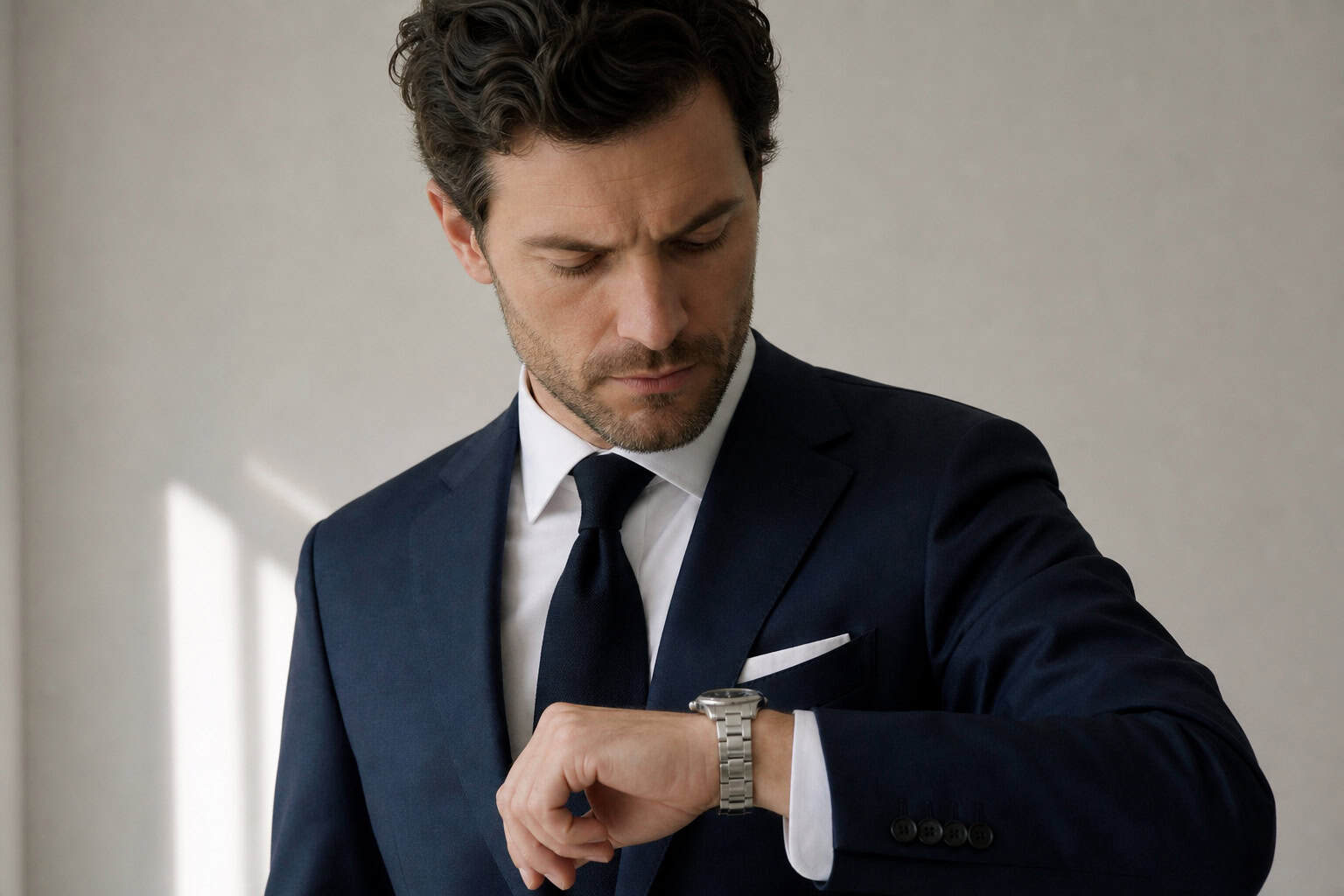
You pull out your phone to check the time, and suddenly you’re three apps deep, lost in notifications. You weren’t looking for any of it. You wanted to know if you were late for a meeting.
That’s the quiet case for wearing a watch. It’s not about telling time—your phone does that better, faster, and always has the right time zone. It’s about making a deliberate choice. Men have limited options for personal adornment (‘bling’), and a watch is one of the few acceptable forms. We don’t get a lot of bling to play with. A man who wears a watch makes an effort to be on time and to look good, signaling that you made an effort without saying a word.
But walking into a watch store—or worse, diving into the online rabbit hole—is overwhelming. Movements, materials, water resistance ratings, lug-to-lug measurements, in-house vs. third-party calibres. It’s a mess of jargon designed to sell you more watch than you need.
At Unfinished Man, we’ve spent years fielding questions from friends and readers who just want a straight answer. Here’s the guide I wish I’d had when I started. No fluff, no brand worship. The real trade-offs so you can buy the right watch for you.
Key Takeaways
A $20 quartz watch keeps more accurate time than a $20,000 mechanical Patek Philippe—quartz loses 1–2 seconds per month while a COSC-certified mechanical runs within -4 to +6 seconds per day. You’re choosing between precision and craftsmanship, not between right and wrong.
The most expensive mistake buyers make is misreading water resistance: a 50-meter watch cannot safely go 50 meters deep. Static pressure tests don’t account for arm movement. For swimming, you need at least 100 meters; for scuba, 200 meters or more.
Servicing a mechanical watch every 3–5 years can cost $300 to $800+, while a quartz watch needs a battery change every year or so—unless you own something like a Breitling Aerospace, where the battery change itself can cost $800 (I learned that one the hard way).
Table of Contents
Watch Movements: Mechanical, Automatic, and Quartz
The movement—the engine inside the case—is the most important technical decision you’ll make. There are three main types, and none is best. They’re built for different priorities.
Mechanical Watch
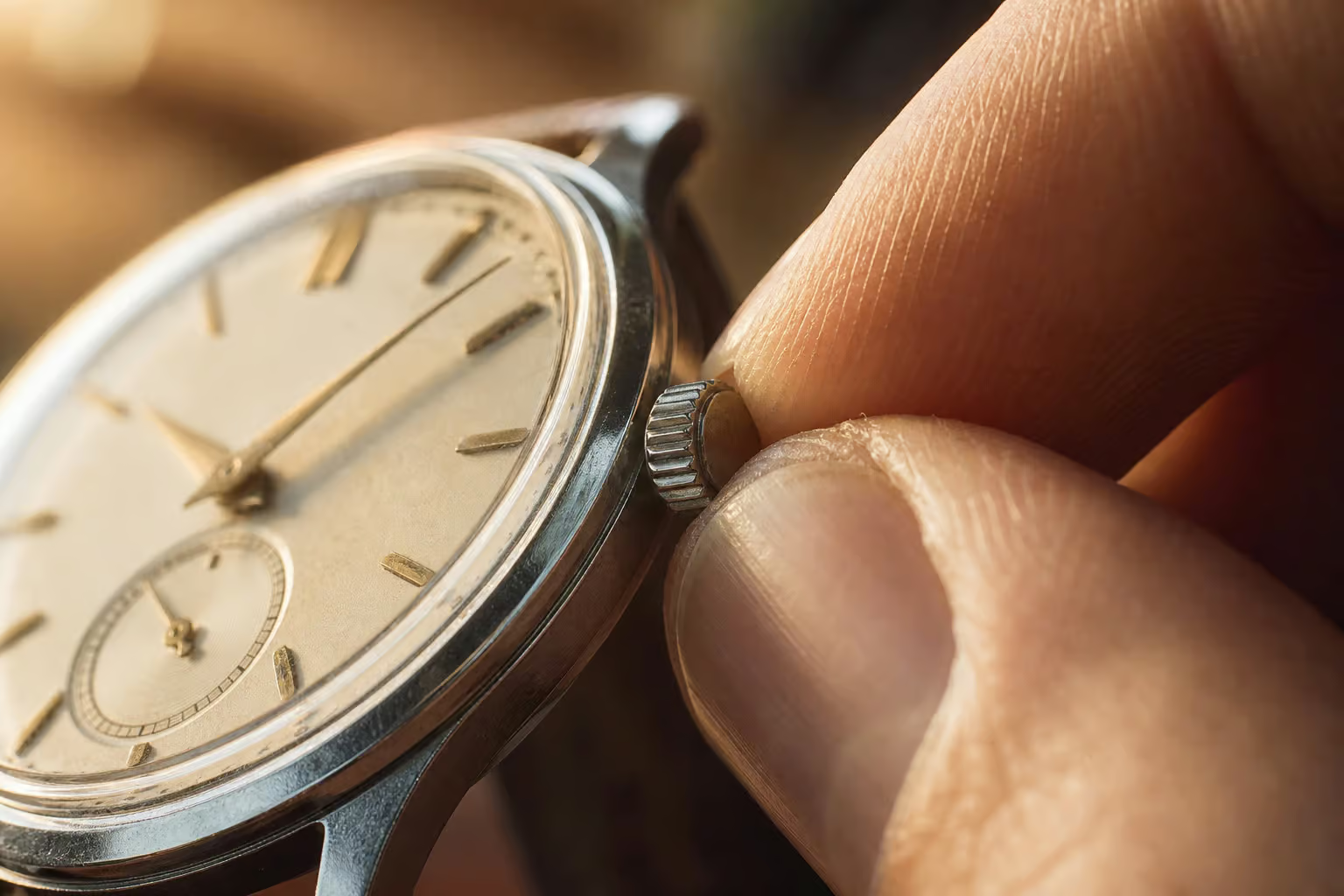
A mechanical watch is hand-wound. You turn the crown, which tightens a mainspring (about 9 to 13 inches of coiled steel ribbon). That spring slowly unwinds, releasing energy through a gear train controlled by an escapement and a balance wheel that oscillates at a constant rate. It contains roughly 200 moving parts working together, all powered by your morning ritual.
Most mechanical watches have “hacking seconds”—the second hand stops when you pull out the crown, letting you set the time precisely to the second. That’s a small but satisfying detail.
Pros of Mechanical Watches
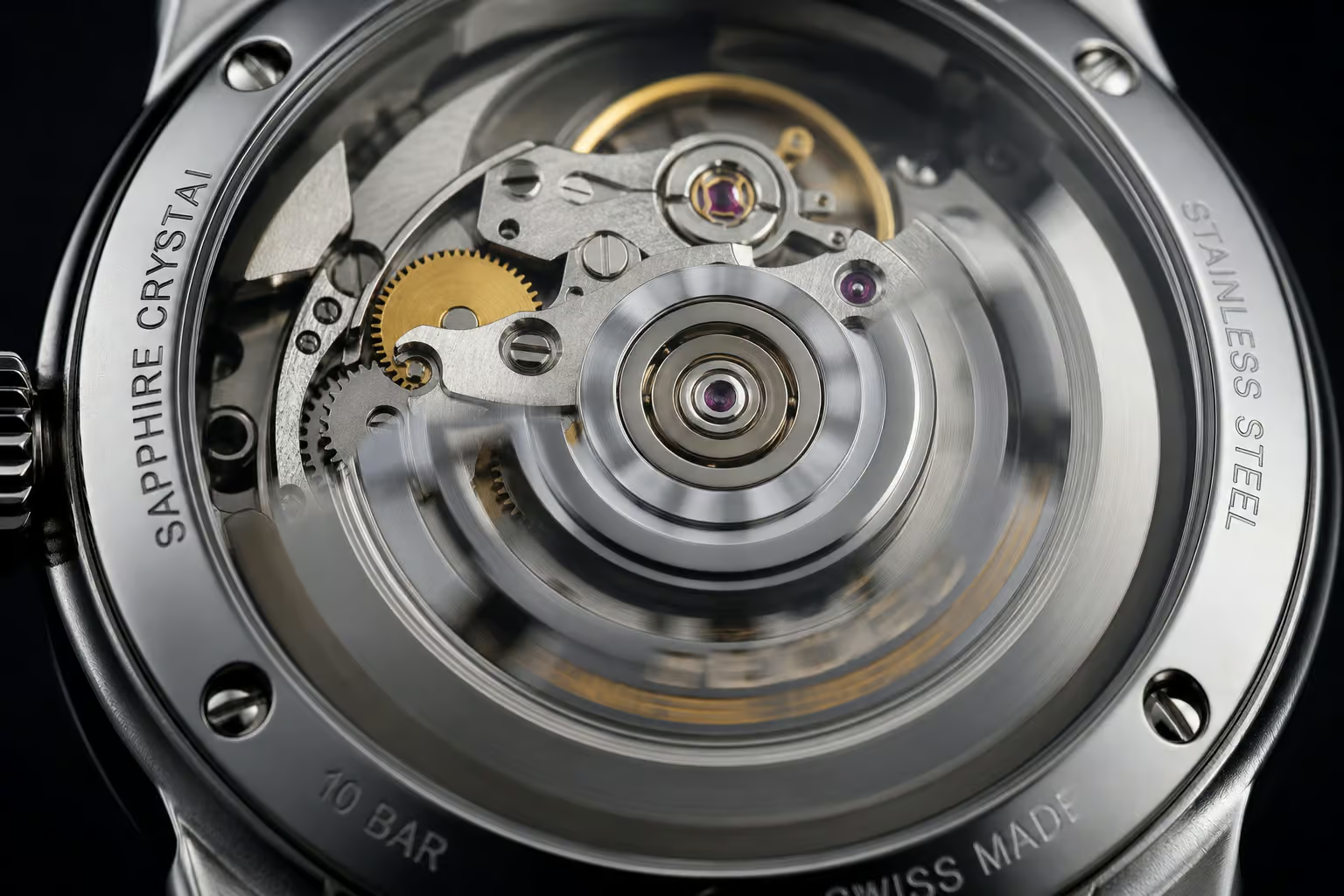
- Craftsmanship: There’s an artistry to the tiny gears, polished wheels, and hand-applied finishes. Some movements are beautiful to look at through a display case back.
- No battery: It’s powered by energy you supply. That feels meaningful to some people.
- Collectibility: Mechanical watches hold historical and emotional value. They’re heirlooms.
- Sweeping seconds hand: The second hand glides instead of ticking. It’s a small visual pleasure.
- Ritual: Winding your watch each morning becomes a quiet moment of connection to the machine on your wrist.
Cons of Mechanical Watches
- Daily winding: If you skip a day, it stops. You’ll need to reset the time.
- The Four Horsemen: Moisture, dust, shocks, and magnets. Mechanical movements are sensitive to all four. A strong magnet can magnetize the balance spring and throw accuracy off by minutes per day.
- Servicing cost and frequency: Every 3–5 years, expect to pay $300 to $800+ for a full service.
- Accuracy: Even a well-regulated mechanical watch will drift. COSC chronometer certification: movement must operate within -4 to +6 seconds per day. That’s about 99.99% accurate—but a quartz watch is 99.9999% accurate.
Automatic Watch
An automatic watch movement is self-winding via a rotor that uses kinetic energy from the wearer’s wrist motion. Inside, a weighted rotor spins with the motion of your wrist, winding the mainspring through a series of gears. No crown winding needed—as long as you wear it regularly.
Most automatics have a power reserve of approximately 48 hours when not worn. If you take the watch off on Friday evening, it’ll still be running Monday morning. Just barely.
An important technical detail: automatics have a ‘slipping clutch’ device to prevent over-winding once the mainspring is fully tensioned. Manual mechanical watches don’t have that—you can feel when they’re fully wound and stop turning.
Some owners use a watch winder—a small box that rotates the watch to keep it running when not worn. They’re not expensive, but it’s one more thing to buy.
Pros of Automatic Watches
- Best of both worlds: You get the intricate mechanical movement without having to wind it daily.
- No battery needed: Same as manual mechanical.
- Low maintenance if worn daily: The rotor keeps it running, and the movement stays lubricated.
Cons of Automatic Watches
- Stops if not worn: If you rotate between watches, you’ll need to wind and set the time each time you put it on.
- Servicing requirements: Same as manual mechanical—every 3–5 years, similar cost.
- Thicker case: The rotor adds height, which can make it harder to slide under a shirt cuff.
Quartz Watch
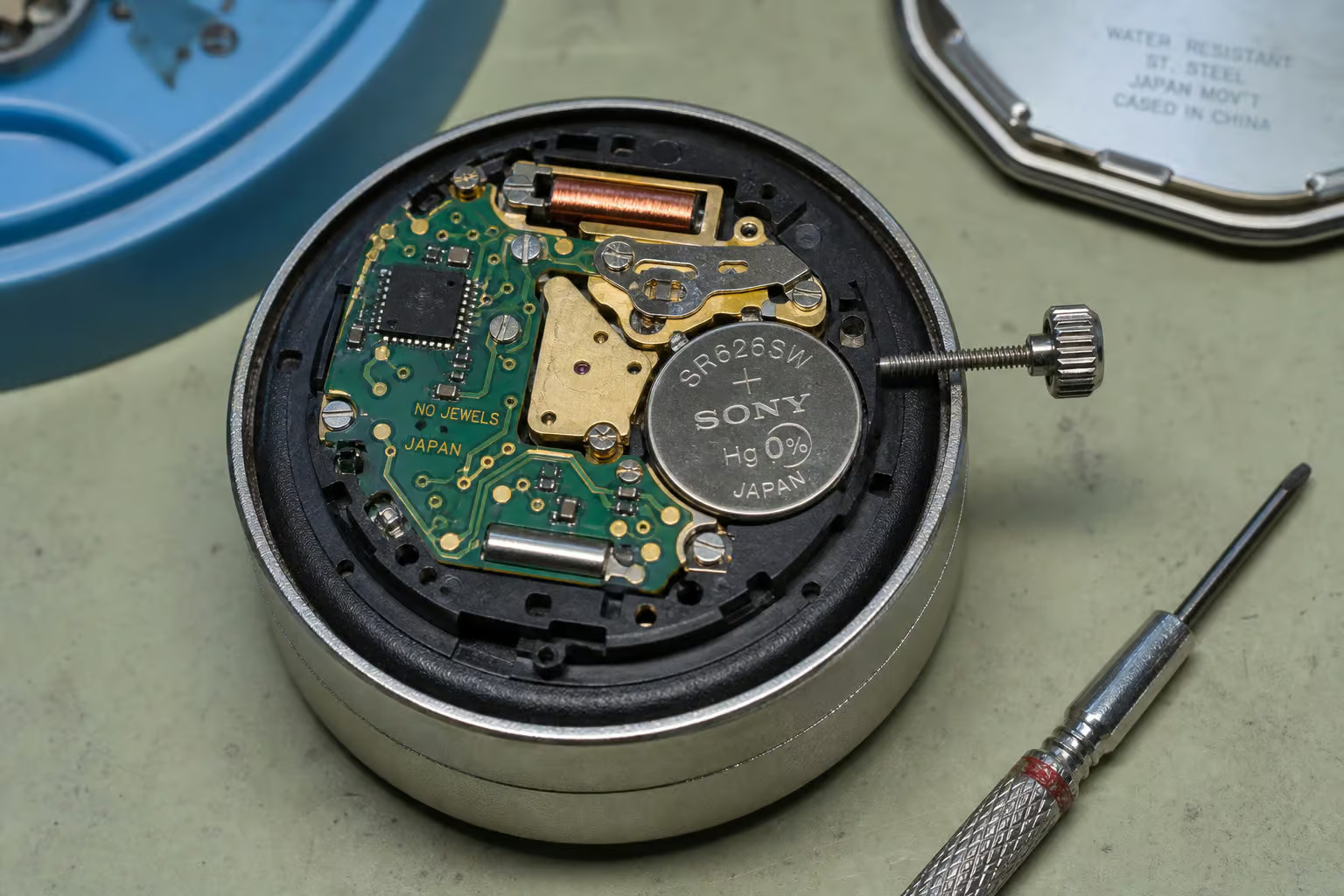
Quartz watch movement is battery-powered; uses a quartz crystal to regulate electric pulses at 32,768 vibrations per second. A battery sends electricity through a quartz crystal, which oscillates at exactly 32,768 vibrations per second. A microchip counts those vibrations and drives a tiny motor to move the hands. The second hand moves in distinct ‘ticks’—the “tick tick tick” you hear.
Quartz debuted in the 1960s in Japan; eclipsed mechanical watches by the 1980s. It’s why Swiss watchmaking nearly collapsed.
Pros of Quartz Watches
- Affordable: A reliable quartz watch can cost $20 and keep better time than a $20,000 Patek.
- Highly accurate: Most high-quality quartz watches lose only 1-2 seconds per month.
- Durable: Fewer moving parts mean less to break. Quartz movements handle shocks and magnets better than mechanicals.
- Low maintenance: A battery change every year or so, costing a few dollars. No regular servicing needed.
Cons of Quartz Watches
- Lacks craftsmanship: There’s no tiny art gallery inside. It’s a circuit board and a motor.
- Battery changes: It’s a minor hassle, and some watches require a trip to a jeweler.
- The tick: Some people prefer the smooth sweep of a mechanical hand. That’s personal.
The Comparison: There Is No “Best”
Quartz wins on accuracy, durability, and cost. Mechanical wins on artistry, tradition, and emotional connection. Automatic splits the difference—mechanical soul with self-winding convenience.
What matters is what you value. Do you want a precision tool you can wear every day with zero fuss? Quartz. Do you want a piece of functional art that requires a relationship? Mechanical or automatic.
A few hybrids exist: Grand Seiko‘s Spring Drive uses a quartz regulator with a mechanical mainspring, giving a smooth sweep and quartz accuracy. And meca-quartz combines a quartz chronograph with a mechanical module for that satisfying chronograph reset—seen in watches like the Dan Henry Maverick. But for most buyers, the three categories above are where you’ll live.
Bottom line: Choose quartz for accuracy and value; choose mechanical for artistry and ritual; choose automatic if you want the middle path without daily winding.
Case Materials: What the Watch Is Made Of
The case material determines weight, durability, scratch resistance, and price. It’s the first thing people see, and it dictates where you can wear the watch.
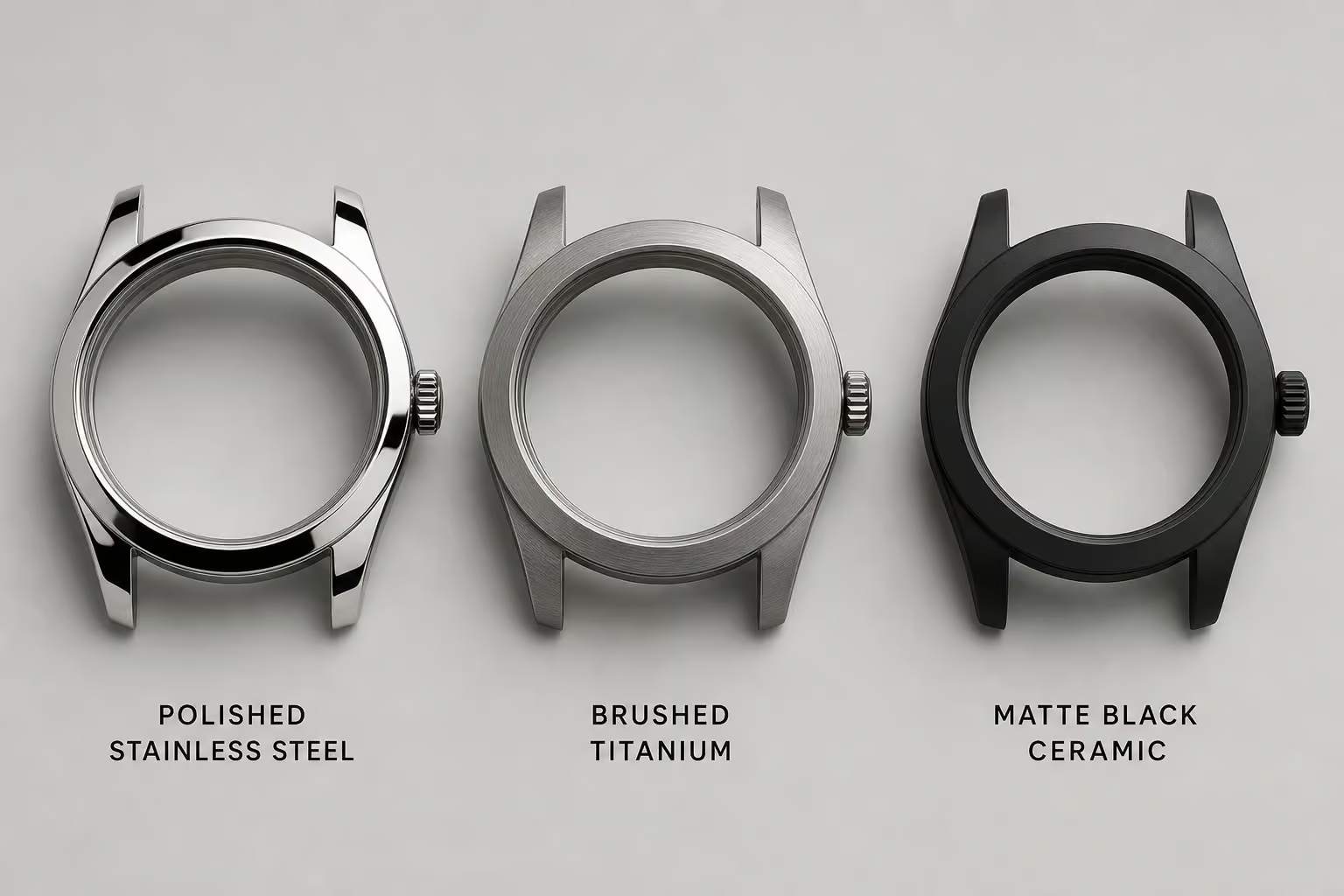
- Stainless steel: The workhorse. Lightweight, corrosion-resistant, durable, and affordable. Used from $50 to $50,000. It’s the baseline.
- Titanium: About half the weight of steel but twice as durable. It feels lighter on the wrist. Main drawback is price. Some watches—like the Tudor Pelagos—lean into titanium as part of their identity. Ideal if you want a lighter feel but don’t want to sacrifice strength.
- Ceramic (zirconium oxide): Hypoallergenic, incredibly scratch-resistant, and won’t fade in sunlight. The downside: it can shatter under a hard impact. It’s a high-performance choice, not an everyday beater.
- Precious metals: Gold, white gold, rose gold, and alloys. Beautiful and traditional, but soft. They scratch and tarnish more easily. Not suitable for active wear. Silver: rare, tarnishes easily, scratches/dents easily; silver-plated stainless steel is more common and more practical.
- Tungsten: Dense and very durable, but less common. Heavy on the wrist.
- Bronze: Increasingly popular for tool watches. It develops a patina over time, which some people love and others hate.
For everyday wear, stainless steel is the most balanced all-rounder. Titanium is lighter and stronger but pricier. Ceramic is scratch-proof but brittle. Pick based on your lifestyle and how much you care about a few scuffs.
Watch Glass (Crystal): Protecting the Dial
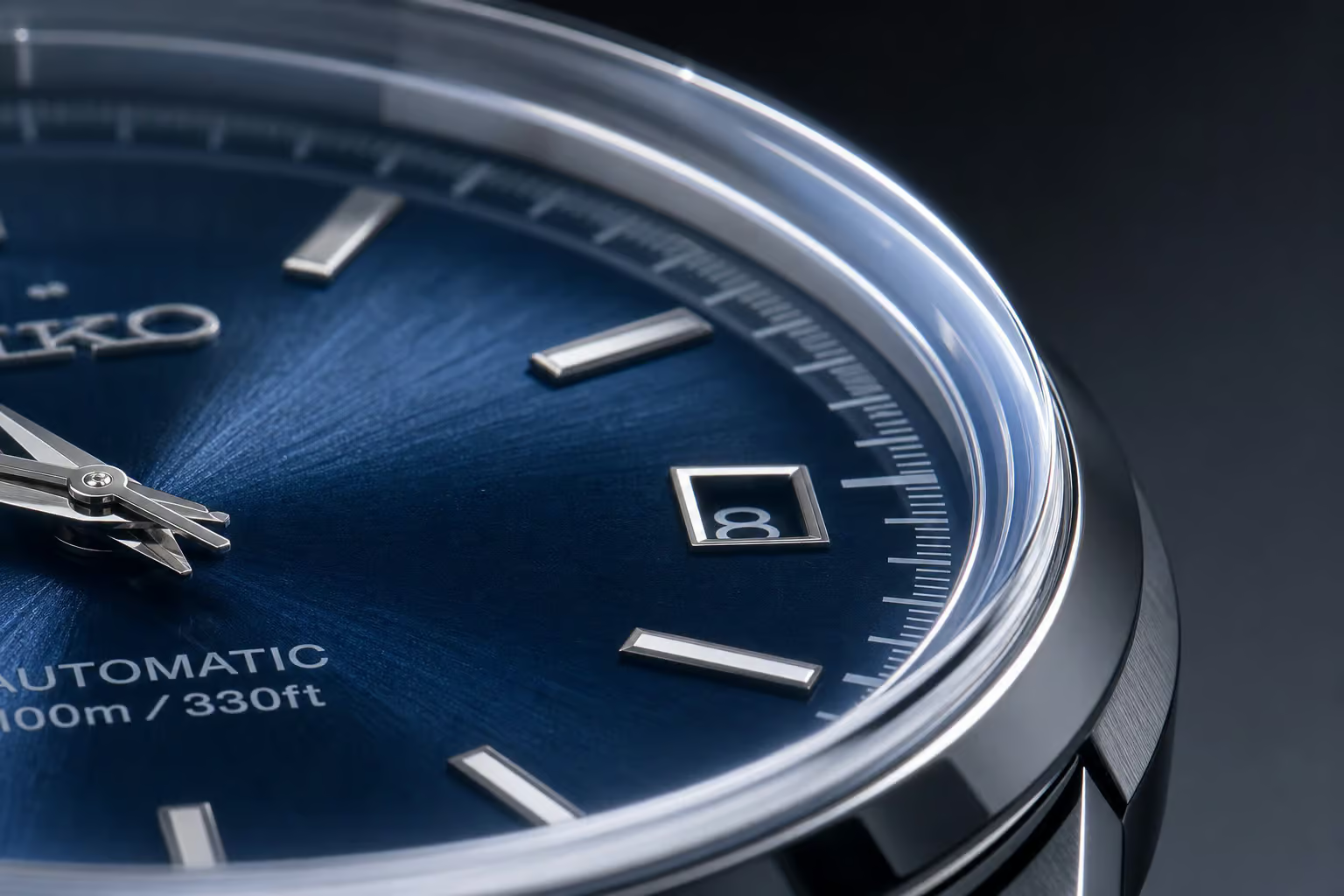
The crystal is your watch’s face. A scratch or crack ruins the look and costs money to fix. Three main types, each with a trade-off.
- Mineral glass: The most common. More scratch-resistant than acrylic, more affordable than sapphire. Difficult to polish and can chip or break under impact. Difficult to polish out scratches.
- Acrylic (plexiglass): Very cheap, flexible, and won’t shatter. Susceptible to scratches—but those scratches can be polished out easily. Used in vintage and field watches. Omega’s Hesalite (used in the Moonwatch) is a famous acrylic. Seiko also uses a proprietary mineral glass called Hardlex on some models.
- Sapphire crystal: One of the hardest materials on Earth—second only to diamonds and tungsten carbide. Ultra scratch-resistant. It’s become the industry standard for quality watches. The catch: it can shatter under extreme impact.
Sapphire is better at scratches but worse at drops. Some crystals are double-domed to minimize distortion for a clearer view.
Here’s the paradox: scratch resistance vs. impact resistance. If you bash your watch on doorframes, sapphire might not be the safest choice. Acrylic is forgiving but looks beaten up quickly. Mineral is the middle ground. Rado’s plasma high-tech ceramic offers a unique alternative—scratch resistance almost on par with sapphire, but with greater toughness than standard ceramic.
Straps and Bands: How the Watch Meets Your Wrist
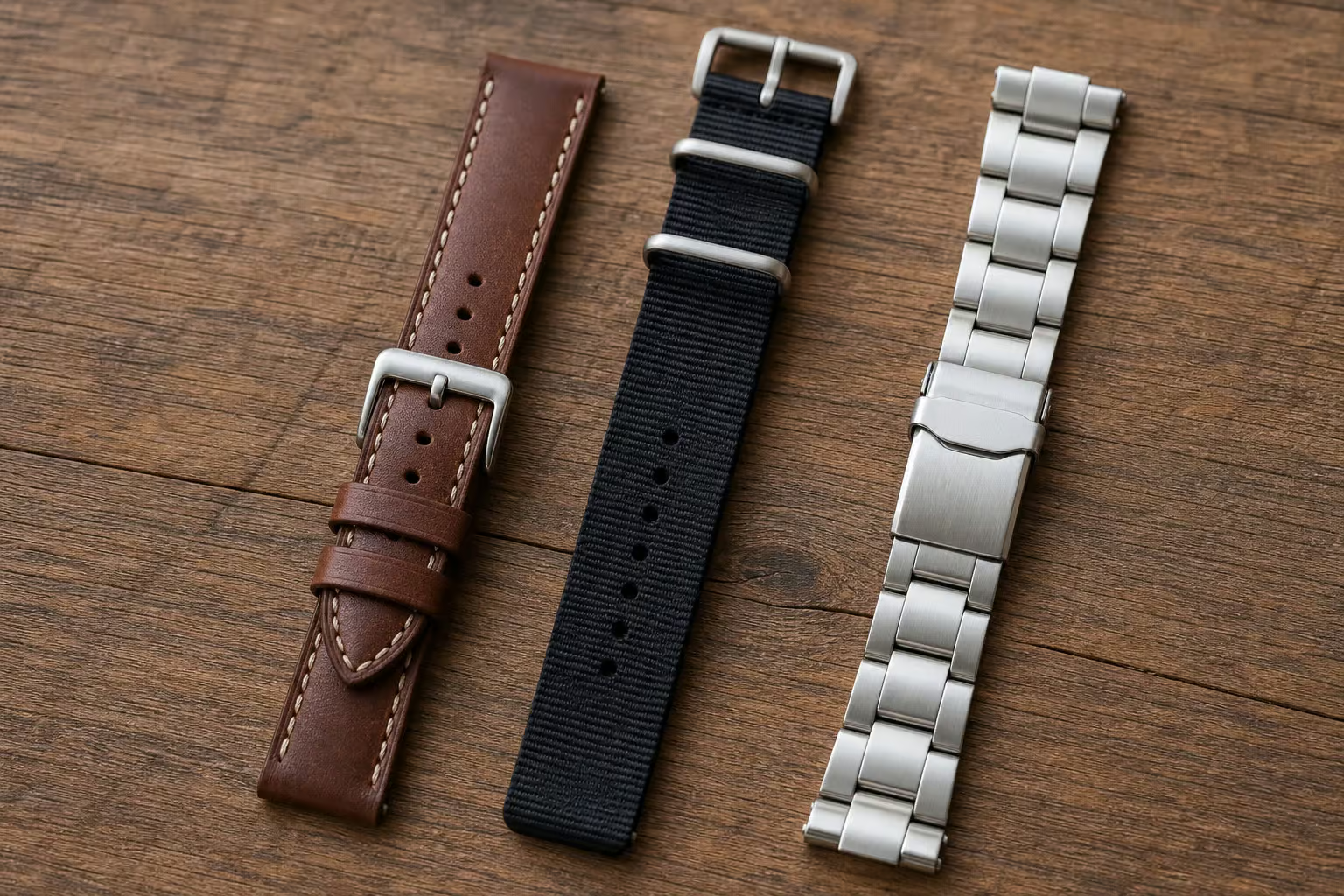
The strap is the cheapest way to transform a watch. A single watch can feel different on leather vs. metal vs. fabric. And you’re not locked in forever—quick-release pins make swapping straps easy.
- Metal bands (bracelets): Durable, dressy, made from various metals. Can weigh down a small wrist. Expensive to replace.
- Leather straps: Classic and comfortable. Hypoallergenic. Not suitable for water or sweat—moisture degrades leather quickly. Adds vintage character.
- Fabric straps (NATO, nylon, canvas): Affordable, durable, water-resistant. The NATO strap was introduced in the 1970s for military use—it’s a single-piece design that slides under the watch and can be swapped in seconds. Great for beach days or casual wear.
- Perlon: Tightly woven nylon, thick but breathable. A less common but comfortable option.
- Rubber: The go-to for sports and dive watches. Durable, waterproof, easy to clean.
Strap sizing: The width is the distance between the lugs in millimeters (e.g., 20mm). Length is expressed as two numbers (e.g., 120/70 mm). Quick reference for wrist sizes:
- 6.0–6.5 inches: 120/70 mm
- 6.6–7.0 inches: 125/75 mm
- 7.1–7.5 inches: 130/80 mm
- 7.6–8.0 inches: 135/80 mm
- 8.1–8.5 inches: 140/85 mm
- 8.6–9.0 inches: 145/90 mm
Should you buy leather or metal? Leather is classic and comfortable but not for sweaty or wet conditions. Metal is durable and dressy but heavy. Consider your climate, your typical dress code, and whether you want quick swaps. The good news is you can buy multiple straps for the same watch and change them in seconds.
Water Resistance: What the Numbers Actually Mean
The most expensive mistake most buyers make isn’t picking the wrong movement—it’s misreading the numbers. Water resistance ratings are static pressure tests. They measure how much pressure a watch can withstand from a stationary column of water. Real-world movement—swimming, diving, or even washing dishes—adds dynamic pressure that can exceed the rating, which is why studying how to buy a men’s watch before committing can save you from costly errors.
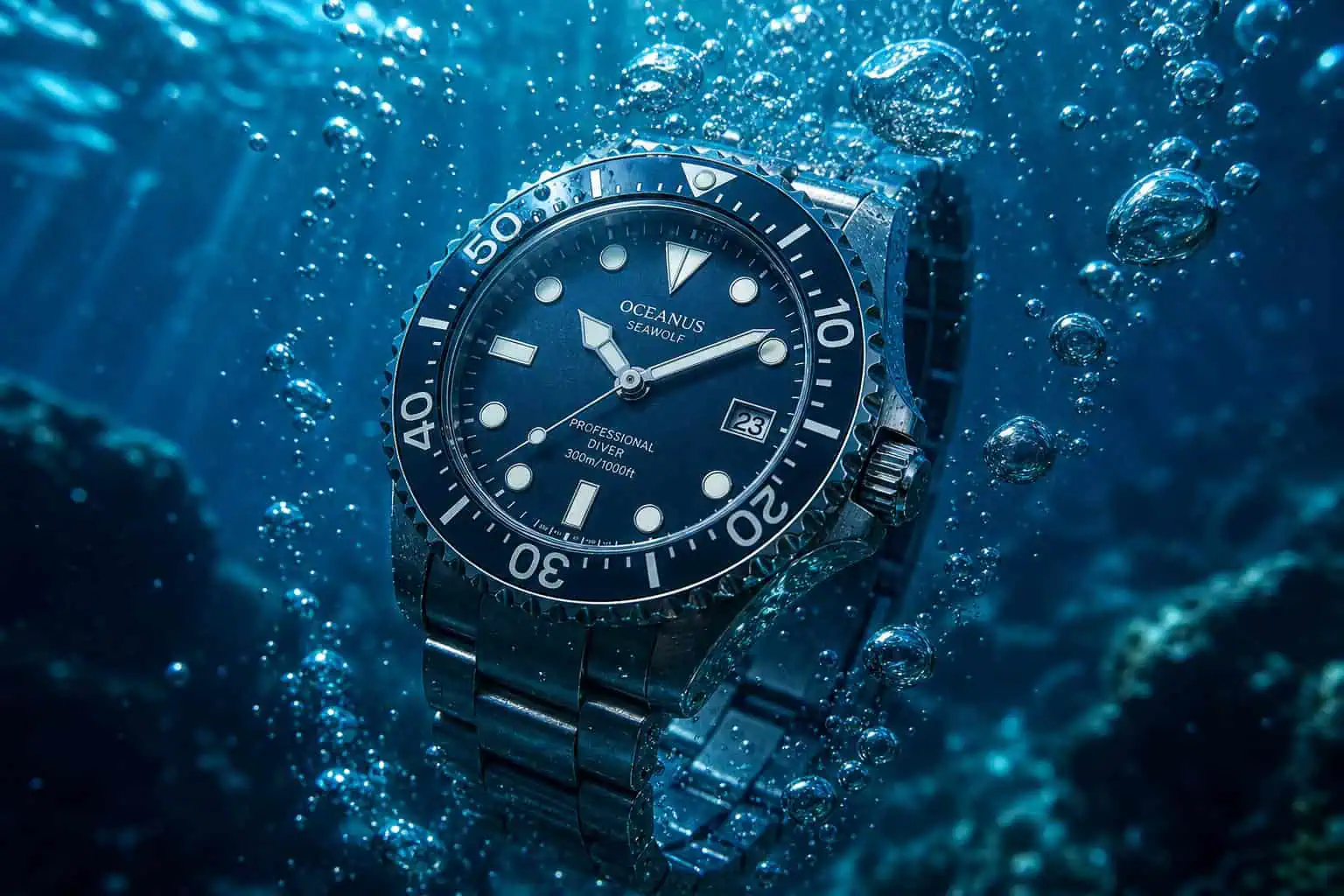
Water resistance does not mean waterproof.
Here’s what the numbers mean:
- 3 ATM / 30 meters: Rain, splashes, handwashing only. Do not swim with it.
- 5 ATM / 50 meters: Suitable for swimming and showering (though hot water can degrade seals). Not for diving or water sports.
- 10 ATM / 100 meters: Suitable for swimming, surfing, snorkeling. Not for scuba diving.
- 20 ATM / 200 meters and above: Suitable for scuba diving and high-impact water sports.
A 50-meter watch can’t go to 50 meters deep. That rating is a static test. If you swim with it, the pressure from arm movement can exceed that. As a rule of thumb, treat any rating below 10 ATM (100 meters) as splash-proof only—not safe for swimming. General rule: 30m for everyday; 100m for swimming; 200m+ for diving. And even then, don’t press buttons underwater unless the watch is designed for it.
Cost check: A watch killed by pool water because you trusted a “50m” rating for swimming will cost more to repair than it’s worth. Use the rating table literally.
Sizing and Fit: The Right Watch for Your Wrist
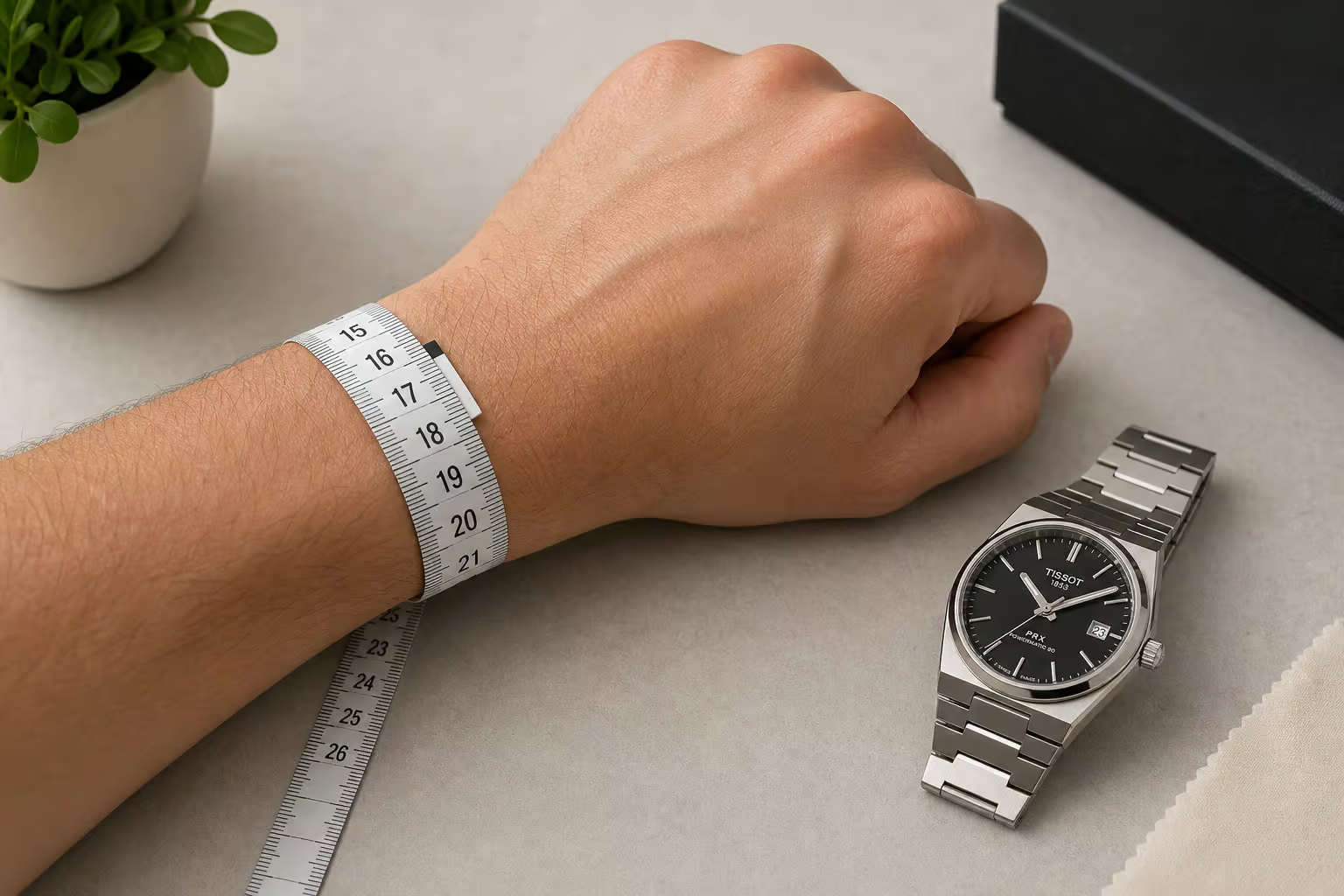
A watch that doesn’t fit is unwearable, regardless of specs. Case diameter is the number everyone quotes, but lug-to-lug distance and thickness affect fit more.
Case diameter: Men’s watches range from 34mm to 50mm. Under 40mm for thin wrists; over 50mm is a statement. But two watches with the same diameter can wear differently depending on lug length and case shape.
Lug-to-lug: The distance from the top lug tip to the bottom lug tip. A 40mm watch with long lugs can overhang a small wrist and look clownish. Always check lug-to-lug, not just diameter. Wrist shape also matters: flat wrists make lug overhang more likely, while round wrists tend to cradle the watch more naturally.
Thickness: Mechanical and automatic watches are thicker because of the movement. More complications add more height. A dress watch should slide under a shirt cuff. If you wear suits, thickness matters more than diameter.
Sizing by wrist circumference:
- Small wrist (less than 6.5 inches): Choose case under 40mm, slim strap, minimal bulk.
- Average wrist (6–7 inches): 38–42mm case.
- Large wrist (7+ inches): 44–46mm case.
The “lug overhang” problem is real. A watch that looks perfect in photos can hang off the wrist if you don’t check the dimensions. Measure your wrist, then look up lug-to-lug for the watch you’re considering.
Complications: Beyond the Basics
Any function beyond telling time is a complication. Some are useful; others exist to impress.
- Date complications: The most common. Date window at 3 o’clock, big date, date wheel, annual calendar. Practical for everyday.
- Chronograph: A built-in stopwatch. Usually one or two pushers on the side of the crown. A flyback chronograph resets without stopping; a split-second chronograph measures two intervals simultaneously. Most chronographs also include a tachymeter bezel to calculate speed or distance.
But ask yourself: how often do you time things? Most people don’t need a chronograph. A three-hand watch with date is more reliable and cheaper to service.
- Travel complications:
- Dual time: Two time zones displayed via main dial and subdial.
- GMT: A fourth hand and a 24-hour bezel let you track three time zones by rotating the bezel.
- Other complications: Moon phase, power reserve indicator, alarm, minute repeater, tourbillon. These are high-end, expensive, and rarely essential for daily use.
A chronograph adds complexity, cost, and servicing requirements compared to a three-hand watch. If you travel between time zones, get a GMT. If you time things regularly, get a chronograph. If you just want the time, keep it simple.
Watch Styles for Every Occasion
Match the watch to your lifestyle and dress code. A dive watch can work with a suit (James Bond proved that), but a pilot watch cannot.
- Dress watches: Sleek, minimalist, thin case to fit under a shirt cuff. For formal events and suits. Many dress watches use Roman numerals to enhance the refined look. Examples: Patek Philippe Calatrava, Rolex Cellini.
- Field watches: Rugged, military-inspired—descended from WWI trench watches. Legible, often with bold Arabic numerals, and no complications or only a date. Versatile for casual and business casual. Examples: Hamilton Khaki Field, Seiko 5 Sports.
- Dive watches: High water resistance (100m+), unidirectional rotating bezel (safety feature that only turns counter-clockwise to prevent accidental extension of dive time). Robust. Can be worn with a suit. Examples: Rolex Submariner (introduced in the 1950s), Omega Seamaster 300M (James Bond’s watch), Tudor Pelagos, Seiko Prospex.
- Pilot/Aviator watches: Oversized dial, clean legible numbers, luminous hands. Casual only—not for formal wear. Examples: Laco Kiel, Hamilton Khaki Aviation Pilot.
- Racing chronographs: Feature chronograph and tachymeter. Flashy and sporty. More casual. Examples: TAG Heuer Carrera, Monaco.
- Smartwatches: Digital alternative (Apple Watch, Samsung Galaxy). Prioritize connectivity over traditional craftsmanship. They’re tools, not heirlooms.
For a professional office, an analog display dress watch or a slim dive watch on a bracelet works best. A pilot watch is too casual. A field watch fits business casual but not suits. The dive watch is the most versatile—it can go from office to pool without missing a beat.
Value, Sourcing, and Buying Decisions
This is where the rubber meets the road. You’ve decided on a style and movement. Now you need to spend wisely.
Third-Party vs. In-House Movements
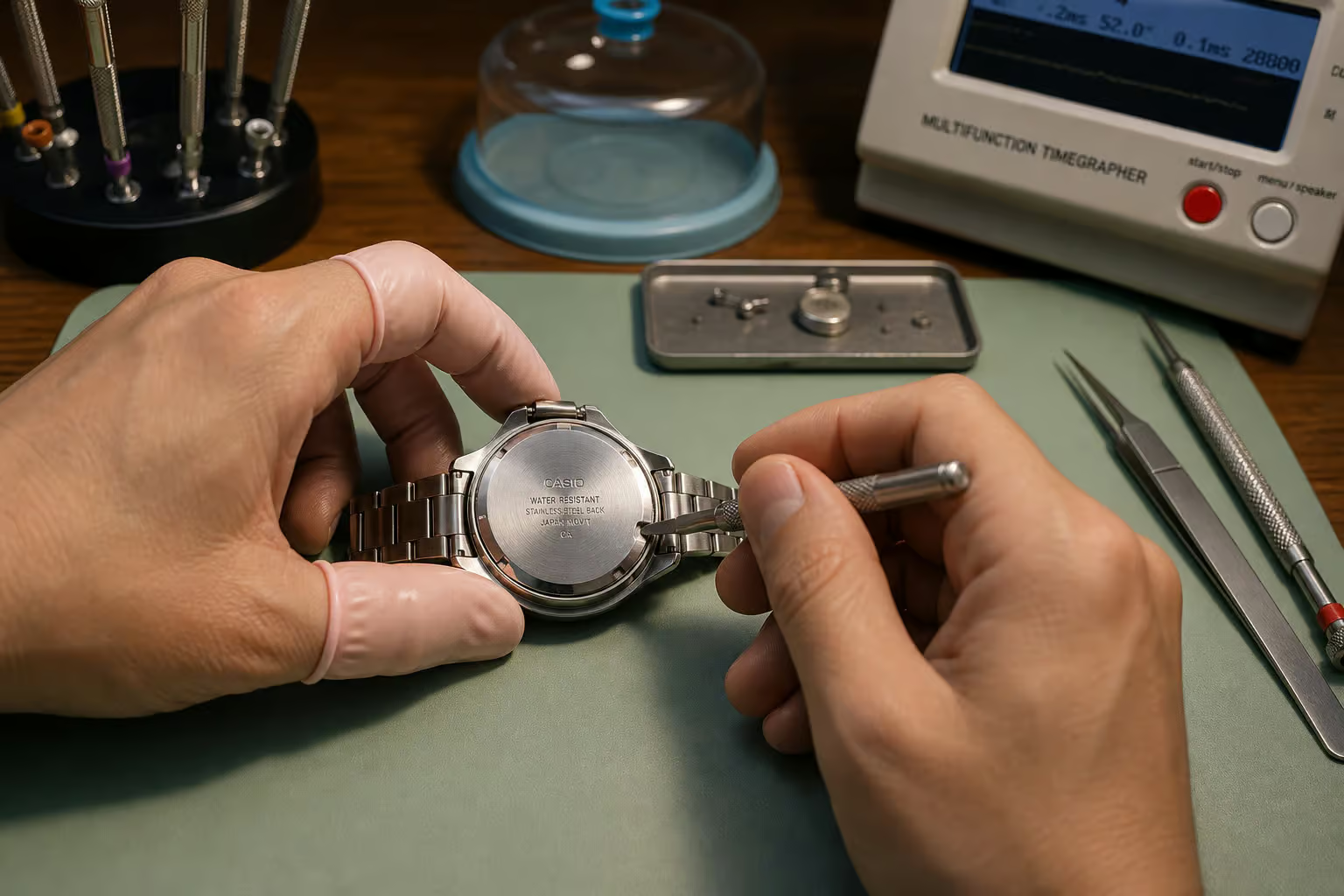
Third-party movements—like Sellita SW200/SW300, ETA, Miyota 9000 series, and Seiko NH series—are used by many independent brands. They’re predictable, parts are available, watchmakers are familiar with them, and servicing costs are lower.
In-house movements are made by the watch brand itself. The selling point is vertical integration and brand differentiation. But in-house does not guarantee superior quality. A well-finished Sellita is often a smarter choice than a first-generation in-house movement from a brand that’s new to making them.
Hybrid strategies exist: Tudor uses Kenissi (a dedicated movement manufacturer that they partly own), and Longines uses exclusive ETA calibres. The line is blurring. Don’t assume “in-house” means better. It often means more expensive to service.
Mass-Market Luxury vs. Ultra-Luxury
Mass-market luxury brands like Rolex and TAG Heuer produce hundreds of thousands of watches per year. Prices are driven partly by marketing and brand power. Ultra-luxury brands like Audemars Piguet, Blancpain, and IWC make only a few hundred or thousand of a model. Prices reflect scarcity and hand-finishing.
Understand what you’re paying for. Mass-market luxury is not scarce. Ultra-luxury is.
Budget Segments
- Under $1,000: Strong value from independent brands that use well-established third-party movements. Focus on case design, dial, and wearability. You can get excellent quality here.
- $1,000–$3,000: Greater refinement, superior finishing, and more assured design. This is a competitive sweet spot where established maisons and independents fight for your dollar.
New vs. Pre-Owned
- New: Warranty, known provenance, the experience of first ownership. You pay a premium.
- Pre-owned: Access to discontinued models, stable value retention, and character. You need to verify service history. Some brands—like RZE—offer trade-in policies that make upgrading easier.
Common Buying Mistakes
- Buying into hype: A hyped watch won’t fit better or last longer.
- Ignoring comfort: Specs don’t matter if the watch doesn’t feel right on your wrist.
- Chasing specifications: More features often mean more servicing costs.
- Overlooking servicing realities: I learned this lesson the expensive way when a battery change on a Breitling Aerospace cost me $800. Always check what servicing will cost before you buy, especially for quartz watches with proprietary movements.
- Settling for available watches: If the watch you want isn’t available, wait. Don’t buy a compromise you’ll regret.
Maintenance Overview
- Mechanical/automatic: Service every 3–5 years. Cost: $300 to $800+ depending on the movement.
- Quartz: Low maintenance. Battery change every year or so, usually cheap. But some quartz watches are expensive to service if the movement is integrated or proprietary.
How can you tell if a used watch is worth buying? Start with the movement type—third-party movements are easier and cheaper to service. Verify the service history. Inspect case and crystal condition. Buy from a reputable seller or one with a trade-in policy.
Red flag: If a quartz watch uses a proprietary or integrated movement, a simple battery change can turn into an expensive repair. Always check service cost before buying.
Building Your Collection and Final Thoughts
Most people don’t need twelve watches. The recommended minimum is three: a dress watch for formal occasions, an everyday watch that’s versatile, and a sports/casual watch for activities.
But for most guys, the right move is to start with one versatile everyday watch that matches their lifestyle. Wear it for a year. Learn what you love and what you don’t. Add from there.
Trust your instincts. Choose a watch that reflects your personality and style—not just specs or hype. A watch is a personal statement. It should make you feel good when you glance at it.
Quick recap of what to look for when buying a men’s watch: Decide on movement type (mechanical, automatic, or quartz). Choose case material that fits your lifestyle. Pick a crystal that balances scratch resistance with impact tolerance. Select a strap that works for your climate and dress code.
Understand water resistance ratings so you don’t kill your watch in the pool. Check sizing—lug-to-lug matters more than diameter. Decide which complications you’ll use. Match the watch style to your daily environment. And always factor in servicing costs.
You don’t need to be an expert to buy a great watch. You need to know what you’re looking for. Now go find yours.
Frequently Asked Questions
How much does it cost to service a mechanical watch?
Expect to pay $300 to $800+ every 3 to 5 years for a full service. The cost depends on the movement complexity and the brand. That’s a recurring expense you should factor into your purchase decision — unlike quartz, which only needs a cheap battery change every year or so.
What’s the difference between a mechanical and an automatic watch?
Both are mechanical movements, but an automatic watch winds itself using a rotor that spins with your wrist motion. A manual mechanical requires you to wind the crown daily. Automatics are more convenient if you wear the watch daily, but they’re thicker and still need servicing every 3–5 years.
What size watch should I get for a 6.5-inch wrist?
For a wrist under 6.5 inches, look for a case diameter under 40mm and pay close attention to lug-to-lug distance — that’s what determines whether the watch overhangs your wrist. A 40mm watch with long lugs can look clownish on a small wrist, so always check both measurements.
Is sapphire crystal better than mineral glass?
Sapphire is much more scratch-resistant — it’s second only to diamonds in hardness — but it can shatter under a hard impact. Mineral glass scratches more easily but is less likely to shatter. Acrylic is the most impact-resistant but scratches easily and can be polished out. Choose based on whether you bash your watch into doorframes.
Why is a chronograph watch more expensive to service?
A chronograph adds complexity with extra gears, pushers, and a stopwatch mechanism. That means more parts to disassemble, clean, and reassemble during servicing. A simple three-hand watch with a date is more reliable and cheaper to maintain — most people don’t actually time things regularly enough to justify the extra cost.