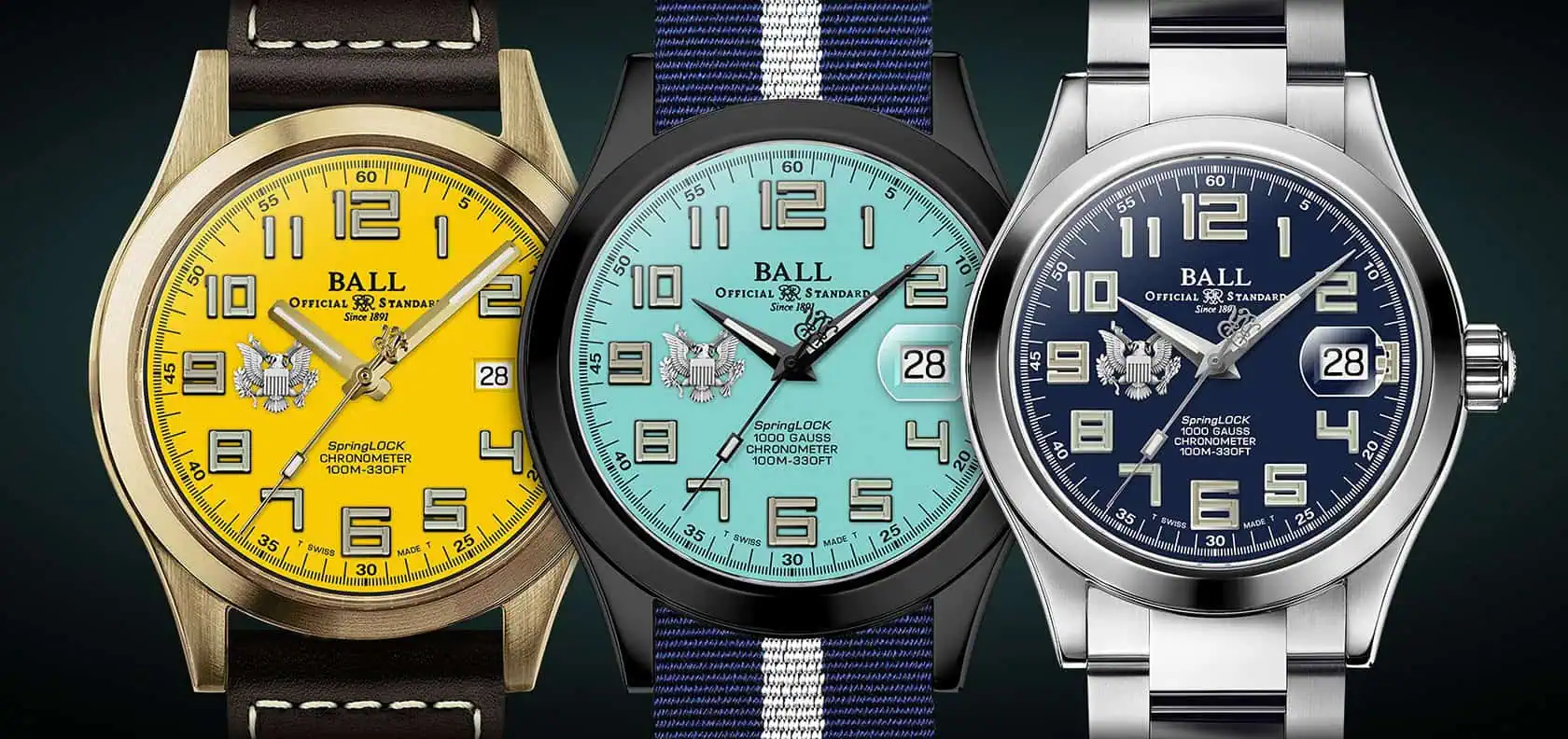
On paper, the BALL Watch Engineer III Army is one watch: an official U.S. Army-licensed limited edition, four dial colors, arriving December 2026, priced somewhere between $2,899 and $4,249. That last number is where it gets interesting. That’s a $1,350 spread across watches the marketing pages make look nearly identical, and they are not. Case heights differ by more than a millimeter.
The anti-magnetic protection differs by an order of magnitude. One version doesn’t even magnify the date. BALL has done unit-partnership editions before, like its collaboration with the Navy Explosive Ordnance Disposal team, which we covered in our Engineer Hydrocarbon EOD review, but this Army release shows the same lesson: if you’re shopping by color alone, you’re about to learn the expensive way that “pick a color” is the wrong way to do it.
Key Takeaways
Four executions share one COSC-certified movement, but they split on price ($2,899 to $4,249), case height (12.35mm to 13.6mm), anti-magnetic rating (1,000 Gauss on steel/DLC vs 4,800A/m on bronze), and date magnification.
The licensed branding is a trademark deal with the U.S. Army, not an endorsement, and each of the four dial colors is capped at 1,775 pieces.
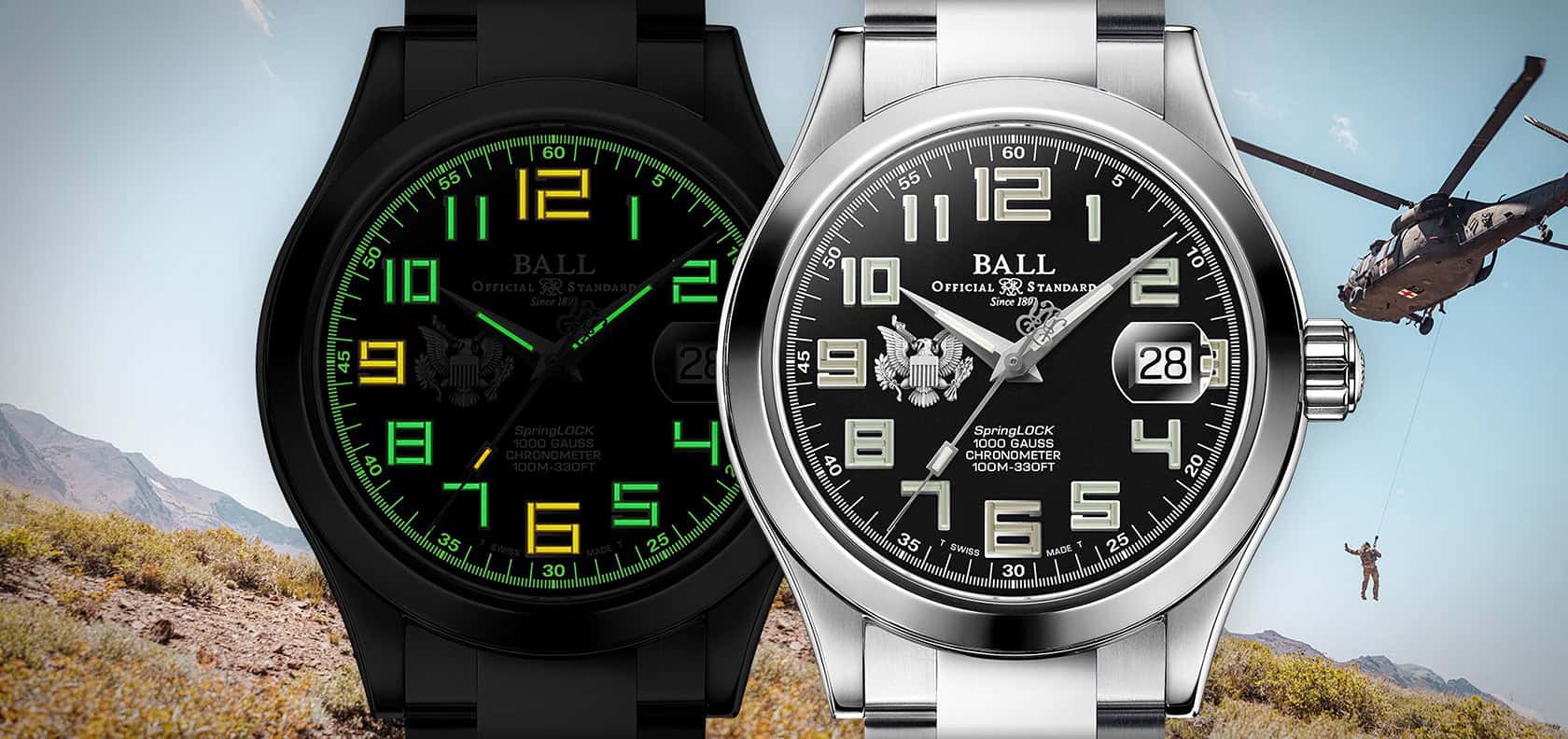
The 51 self-powered micro gas tubes glow constantly with no light charging, and all three hands carry tubes, so one glance reads the full time in the dark.
Table of Contents
What the official U.S. Army license actually means
Yes, this watch is officially licensed by the United States Army, and the caveat that matters is right behind it: that’s a trademark licensing arrangement, not military issue, government approval, or an endorsement of the watch by anyone in uniform. You’re buying a licensed civilian commemorative, full stop.
The license does show up on the watch itself, not just the box. There’s a silver eagle insignia on the dial and a modern five-point star logo on the caseback, so you can verify the Army connection in any product photo. The Army’s licensing program frames its merchandise as products that need to meet a standard of quality people can trust and be proud to use, which is fair, though every licensor says something like that. For quick context: the Army is the land service branch of the U.S. Armed Forces, one of six branches under the Department of Defense. The usual fine print applies too: the watch carries the U.S. Army name, wordmark, logo, and insignia under license.
Limited edition: why 1,775 pieces
Each dial color is limited to 1,775 pieces, and the number isn’t random: it nods to 1775, when the Continental Army was formed. The modern U.S. Army dates to 1784, when it succeeded the Continental Army, but it’s the earlier year that made it onto the caseback math.
Here’s the part worth doing the math on. Four case executions times four dial colors (black, blue, turquoise, yellow) means 16 separate limited pools of 1,775 pieces each. The dial you pick at launch decides which pool you’re in, which matters more than it sounds, because the editions aren’t interchangeable under the skin. There’s a pattern with multi-execution releases like this: collectors fixate on dial color first and only notice the execution-level differences later. That’s exactly the mistake worth avoiding here, and it’s why the next few sections exist.
Micro gas tubes: how the night reading actually works
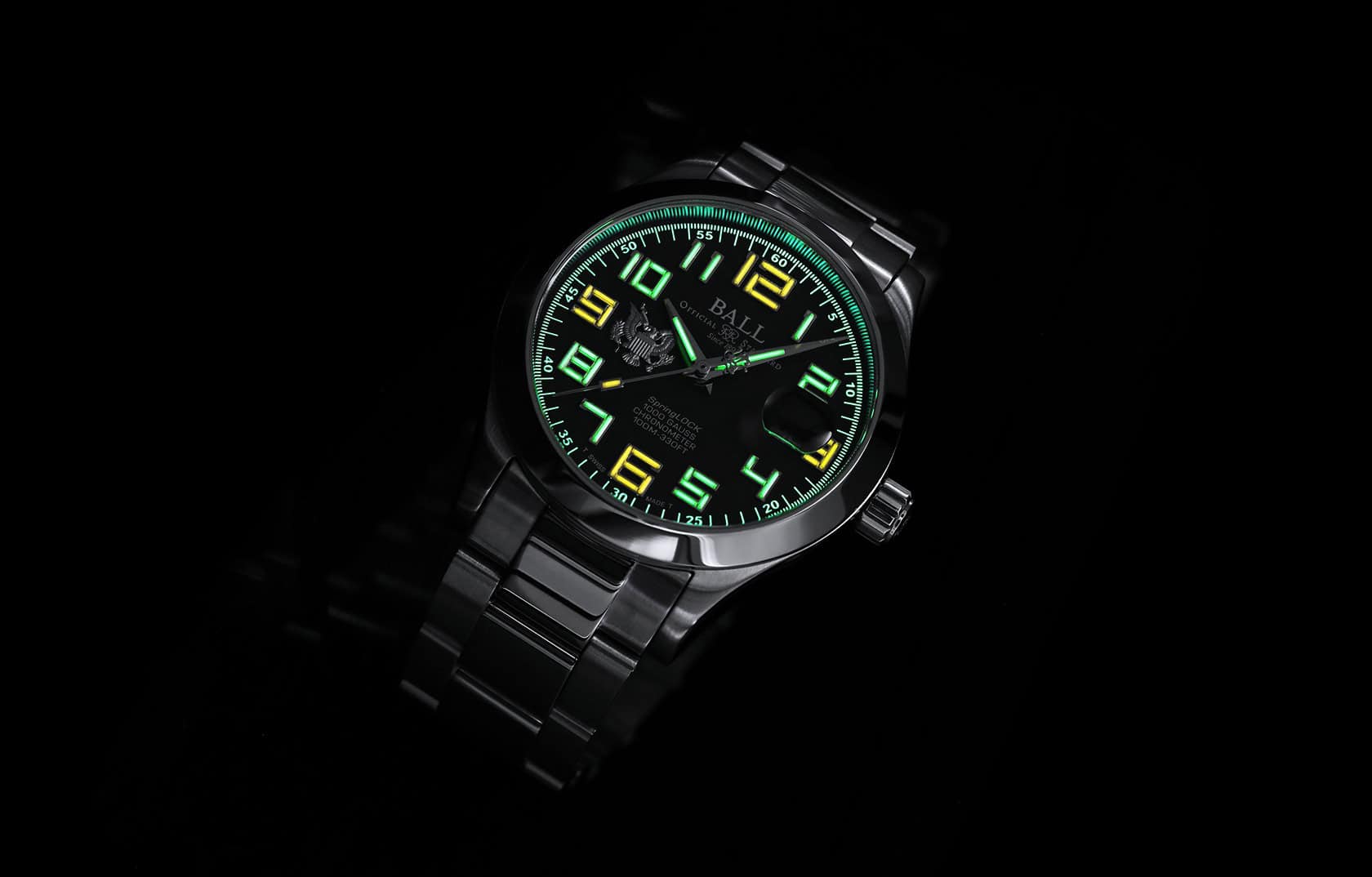
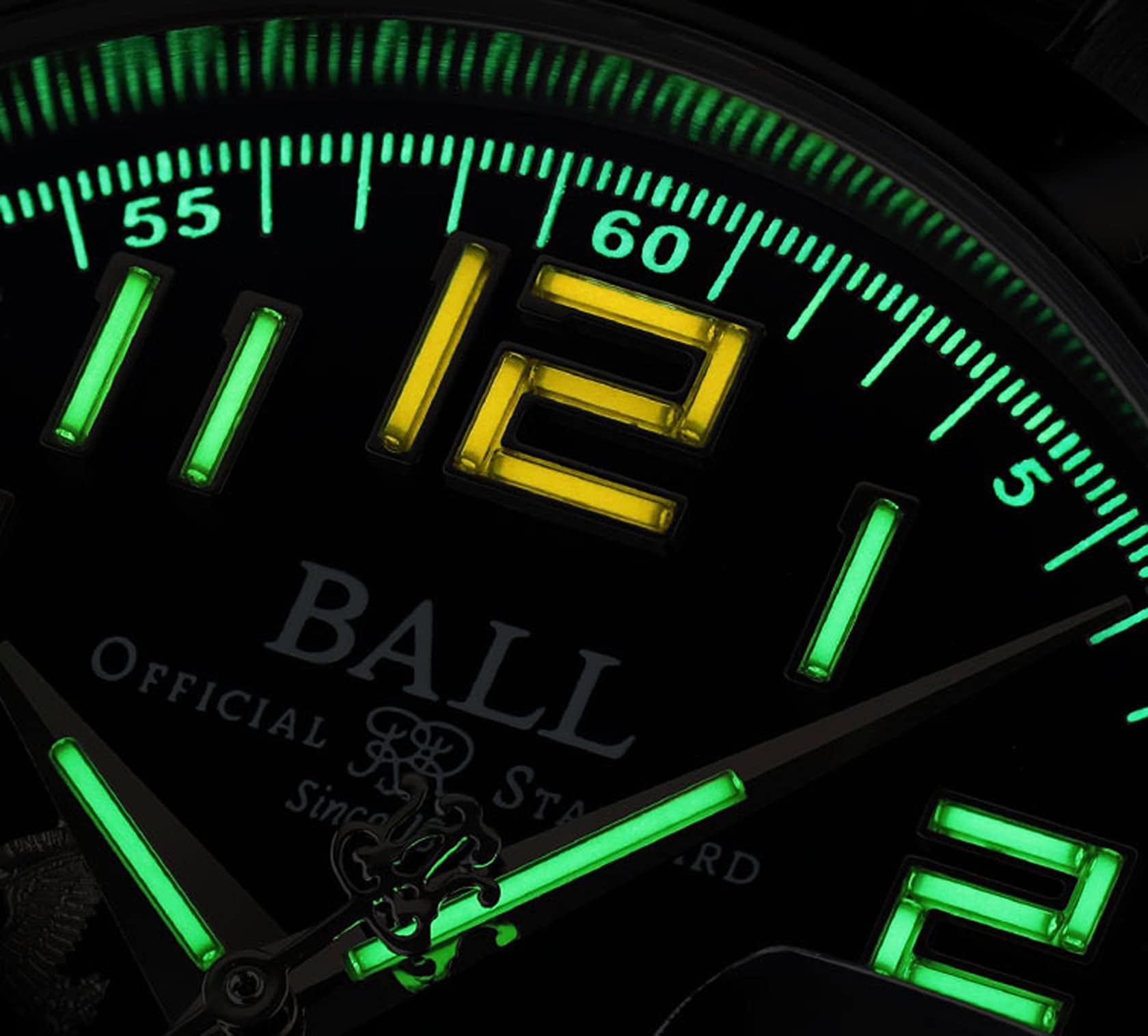
The headline difference from every lume you’ve used before: these tubes glow constantly on their own, with no light charging. Conventional lume soaks up light and fades through the evening unless you hit it with a lamp first. These don’t play that game. When the day fades, they’re already on.
There are 51 micro gas tubes total, sitting on the numerals and on all three hands: hour, minute, and second. That last placement is the practical payoff. Watches that glow on the markers only leave you squinting to figure out where the hands actually point. Here, one glance reads the full time at night. If you’re used to the flashlight ritual before bed, the lack of a charging step takes some getting used to, in the best way.
Protection: the anti-magnetic shield and shock system
Protection is where the four versions quietly split, and it’s the split most buyers miss. Two systems do the work here: a magnetic shield around the movement and a shock-absorbing setup for the balance spring. Here’s how each one functions.
The mu-metal shield
On the steel and DLC models, a mu-metal shield protects the chronometer-rated movement to 1,000 Gauss, which is the same spec as 80,000A/m, just expressed in different units. Mu-metal is a magnetic-shielding alloy, and the mechanism is the part almost nobody explains: it doesn’t block magnetism so much as pull field lines around the movement, thanks to its high magnetic permeability. That approach outperforms the soft iron most anti-magnetic watches rely on. In plain terms: magnets won’t wreck this movement.
SpringLOCK
The number to know is 66%: BALL’s patented SpringLOCK system cuts balance-spring shock impact by 66% versus Swiss certification standards. Why that matters is the fragility. The balance spring, or hairspring, is one of the most delicate parts of any mechanical movement, and a hard knock can make its coils unfurl, deform, or snap. SpringLOCK limits exactly that failure mode. Add series-wide shock resistance of 5,000Gs across all four models, the same durability philosophy behind BALL’s BMW watch line, and the translation is simple: magnets and drops won’t kill it, and the numbers back that up.
The four versions, and the one nobody compares properly
All four executions look like siblings in the press photos. The spec sheet says otherwise, so let’s do this properly.

40mm stainless steel (NM3000C)
The entry point at $2,999, and the wearability pick. At 40mm across and 13.6mm thick, this is the size that fits most wrists without drama. The full reference is NM3000C-S11C-BK/-BE/-TQ/-YE, with the trailing suffixes covering the four dial colors: black, blue, turquoise, and yellow. It comes on a steel bracelet with a folding buckle, and the date is magnified.
43mm 904L steel (NM9028C)
Also $2,999, also on a steel bracelet, also with a magnified date. The difference is the metal: 904L is the fancier steel in watchmaking, usually found on pricier watches, which matters if you’re staring at two watches on a screen that look nearly identical, black dial, stainless steel, and you’re trying to spot the best value men’s watch brands tested side by side. The fun detail: at 13.15mm thick, this 43mm case is actually a hair thinner than the 40mm one. Bigger watch, slightly slimmer profile.
43mm DLC (NM2028C)
Here’s the contrarian pick, and the cheapest of the four at $2,899. It’s steel underneath a diamond-like carbon (DLC) coating applied via physical vapor deposition (PVD), which is a way of bonding a microscopic carbon layer to the case. The result is a scratch-resistant, deep matte black finish, and yes, BALL’s “covert watchmaking that deserves to be noticed” line is doing some work there, a different take on the chronograph watch from the American watchmaker. Usually the all-black stealth version carries a premium.
Here it doesn’t. It runs thinnest of the 43s at 12.35mm, on a rubber strap with a standard buckle.
43mm bronze (ND2186C)
The personality pick, at $4,249, carrying reference ND2186C-L4C-BK/-BE/-TQ/-YE across the same four dial suffixes. The case is a copper-aluminum bronze chosen for impact strength and corrosion resistance, and it patinas uniquely per wearer, so after a year yours won’t look like anyone else’s. You get a titanium caseback with a sapphire window to see the movement, and a calf leather strap. Now the honest caveats, stated plainly: the bronze is anti-magnetic only to 4,800A/m, versus 1,000 Gauss (80,000A/m) on the steel and DLC models, and the date is not magnified.
The premium buys material and patina. It does not buy protection.
Buyer rule: Match the execution to your wrist and priorities first — the dial color only decides which limited pool you’re locked into.
| Model | Case | Height | Strap | Anti-magnetic | RRP |
|---|---|---|---|---|---|
| NM3000C | 40mm stainless steel | 13.6mm | Steel bracelet, folding buckle | 1,000 Gauss / 80,000A/m | $2,999 |
| NM9028C | 43mm 904L steel | 13.15mm | Steel bracelet, folding buckle | 1,000 Gauss / 80,000A/m | $2,999 |
| NM2028C | 43mm DLC-coated steel | 12.35mm | Rubber strap | 1,000 Gauss / 80,000A/m | $2,899 |
| ND2186C | 43mm bronze | 12.35mm | Calf leather | 4,800A/m | $4,249 |
Sizing first, everything else second: 40 versus 43mm is the decision that determines whether this watch works on your wrist. All four arrive in December 2026.
One movement under all four: the RR1103-CSL
Every version runs the same automatic, the BALL RR1103-CSL, and it’s COSC chronometer certified, meaning an independent Swiss body tested it for accuracy. That’s the whole performance story: one good engine, four bodies. You’re choosing case material and looks, not performance tiers, because there are none.
The shared kit across all four:
- BALL RR1103-CSL automatic, COSC chronometer certified
- 100m / 330ft water resistance
- Anti-reflective sapphire crystal
- Screwed-in crown
- 5,000Gs shock resistance
- Hours, minutes, sweep seconds, date
The steel construction is meant for bumps, knocks, and daily wear.
And the heritage connects to that chronometer badge. In 1891, a head-on train collision in Kipton, Ohio prompted the railroads to appoint Webster Clay Ball as Chief Time Inspector, with the job of getting every railroad watch synchronized. Standardized “railroad time” inspired what eventually became COSC, and it’s also where the proverb “Be on the Ball” comes from. So a COSC-certified BALL in 2026 is a reasonably tidy full circle. The company didn’t found COSC and isn’t out there timing trains today, but the certification on this dial descends from a lineage BALL helped shape.
The dog tag caseback: engraving for everyone
Yes, dog tag engraving is available on the caseback, and it’s open to all buyers, not just service members. The feature borrows from standard-issue dog tags: you can put your name, birthdate, blood type, and more on the caseback.
There’s one exception worth knowing up front, since a lot of buyers assume the whole engraving program is military-only. It isn’t. The one restricted field is the military identification number line, which is reserved for active and retired service members. Everyone else gets the standard fields. Few watches at $2,899 to $4,249 offer caseback engraving at all, and it’s the detail that makes the Army connection feel personal rather than decorative.
Which one, and is it worth it?
So which of the four should you buy, and does the Army license change the math? The honest answer depends on your wrist, your budget, and whether the bronze trade-offs sting. Two questions come up most, so let’s take them in order.
The military-buyer question
A lot of service members researching this watch end up on uniform-regulation questions, the AR 670-1 and basic-training-watch-rules territory. Fair question, straight answer: this is a licensed civilian commemorative. It’s not issued equipment and it’s not regulation-approved gear. The Army branding is a trademark arrangement, nothing more. BALL’s own positioning calls it a commemorative tool watch honoring the Army, officially licensed by the United States Army. Whether it fits your unit’s uniform standards is a question for your regulations, not for BALL’s marketing, and we can’t verify compliance here, check the current regulation text yourself.
The verdict
My read: at $2,899 to $2,999, the steel and DLC executions are where the value lives. You get COSC certification, 51 gas tubes, mu-metal shielding to 1,000 Gauss, and SpringLOCK, and the DLC is the sleeper, since the stealth finish somehow costs the least of the four.
The bronze is a different purchase entirely. At $4,249, you’re paying $1,250 or more over the others for material and character: a case that patinas into something no one else will own, and a sapphire-window caseback to watch the movement. What you give up is real, though: weaker anti-magnetic protection and no magnified date. If those trade-offs sting, buy the DLC and don’t look back.
If you want a watch that ages differently than anyone else’s, the bronze is the one. Everything ships December 2026, and each dial color is capped at 1,775 pieces, so the color you pick now is the pool you’re locked into. Choose accordingly.