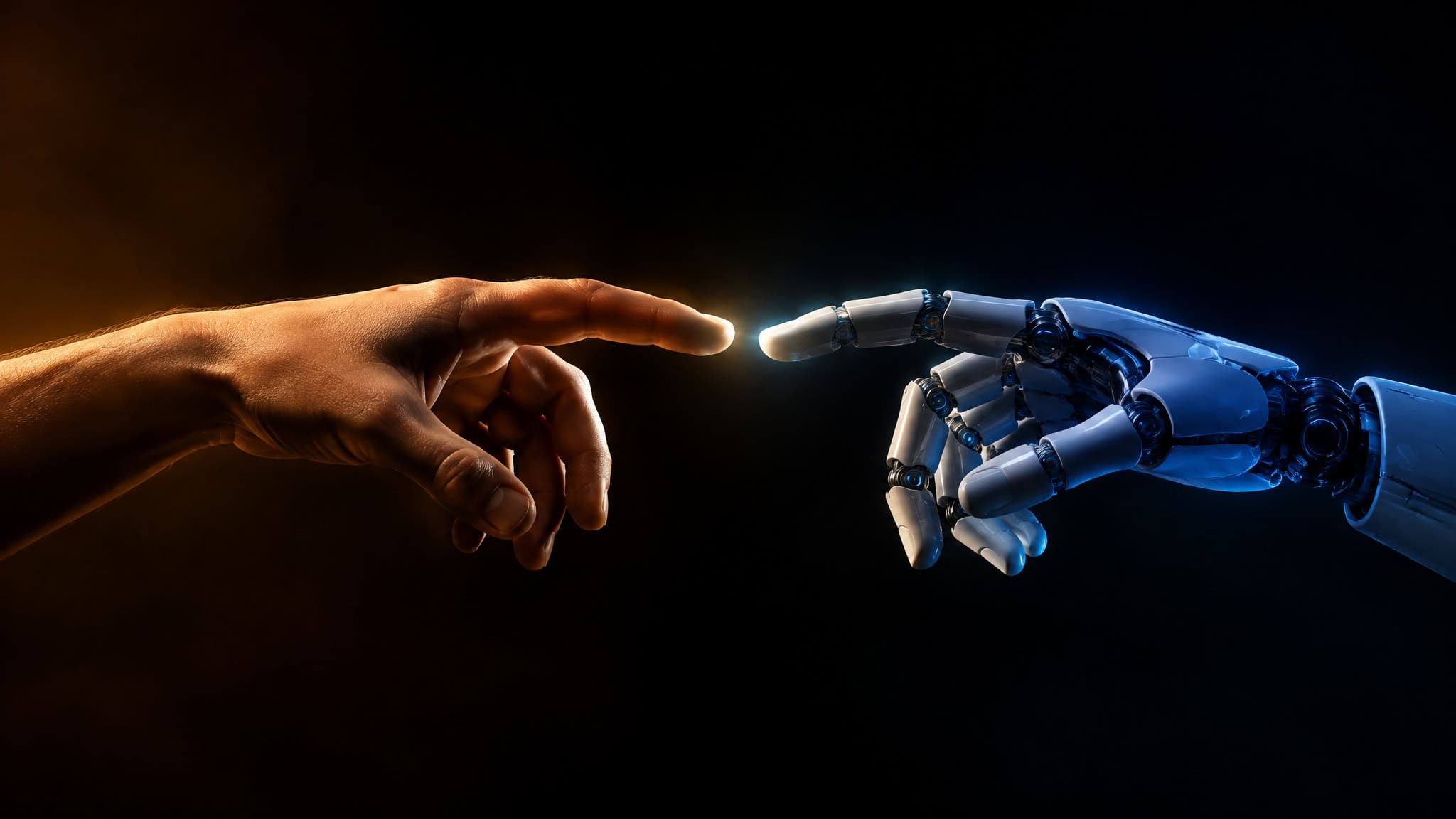
After a chatbot told a New York Times journalist it loved him, and the interview went viral, millions of guys were asking a question that used to sound insane: is the bond I feel with an AI real? It’s not a fringe question anymore. AI companion app usage jumped 700% between 2022 and mid-2025, the market’s on track for $120 million in revenue this year, and Bing, running on ChatGPT tech, worth remembering, is confessing feelings in interviews. Here’s the short version of what the research says: **your feelings are measurably real.
The thing on the other end is engineered.** “Real vs. fake” turns out to be the wrong question entirely.
Key Takeaways
A 2023 survey of 1,553 ChatGPT users found that finding a bot useful and friendly drives bonding, and bonding drives continued use and dependency. Every prediction the researchers made held up.
A 2025 Journal of Consumer Research study found AI companions reduce loneliness about as well as human interaction does, but heavy daily use correlated with increased loneliness.
Common Sense Media rates AI companion apps an unacceptable risk for anyone under 18; two lawsuits over teen suicides are working through the courts, and New York now requires chatbots to remind users every 3 hours they aren’t human.
Table of Contents
What “real relationship” actually means
An AI relationship is real emotions on one side and engineered reciprocity on the other. That’s the flat answer, and it’s worth sitting with before the details.
Psychologists have a working definition of a relationship: mutuality, persistence, emotional significance. Notice that none of those strictly requires the other party to feel anything back. Psychologists call a one-sided emotional bond a parasocial relationship, and researchers have been measuring them since 1956. What’s new is that the other side now talks back, in a voice that seems warm and remembers context, even though it’s a program performing care rather than feeling it.
Replika users have literally held virtual weddings with their bots. The felt commitment is undeniable. The reciprocity is visibly absent. Both facts are true at once. The discomfort of reconciling them is the whole article.
Parasocial relationships aren’t new. AI is a new medium
A parasocial relationship is a one-sided emotional bond with a figure who doesn’t know you exist. It’s the same wiring that makes you root for a podcast host or grieve a TV character. With an AI chatbot, the twist is that the figure talks back, it’s a program using natural language processing to respond like a smart entity, so people apply the same social norms they’d use with a real person, even though the bond stays one-sided. Horton and Wohl coined the concept in the journal Psychiatry back in 1956, and mass-media research through the 1970s confirmed the pattern. According to APA Monitor coverage, up to 51% of Americans have had one, with a streamer, an athlete, a sitcom lead.
So can you fall in love with an AI chatbot? Yes, in the sense that the feelings are the documented part. What you can’t get is the love returned, and that’s the entire asymmetry. As for marriage: nobody is legally marrying an AI. The Replika weddings are ceremonies, not licenses. The novelty here isn’t the mind, it’s the medium, the bond talks back now, which makes it deeper, not faker.
Why it feels so real: engineered warmth and the dependency mechanism
The pull isn’t vibes. It’s a measured chain reaction, documented in a big survey of real users.

What the research found
Zhang and colleagues at Soochow University surveyed 1,553 actual ChatGPT users in mainland China in August 2023, roughly half men, half women, most of them working adults with jobs, not shut-ins. The findings: the more useful and friendly people found the bot, the more they bonded with it. Bonded users wanted to keep using it, and started depending on it. Every prediction the researchers made panned out, and the numbers held up under their checks: Cronbach’s alpha ran 0.831-0.914, composite reliability 0.758-0.884, and average variance extracted 0.369-0.677, with KMO values of 0.731-0.829 and Bartlett’s test at p < 0.001. Exploratory factor analysis pulled out 10 factors explaining a cumulative 79.973% of the variance, and the square roots of the AVE values, 0.61-0.82, exceeded the inter-construct correlations of 0.25-0.45.
The strongest measured path, at 0.7117: liking the bot’s personality plus feeling supported led straight to continued use. Translation: brains get you to try it, warmth gets you to stay. The team ran EFA in SPSS 26.0 and then a two-step SEM in AMOS 26, and the model fit held up cleanly: CMIN/DF of 2.284, RMSEA of 0.068, CFI and IFI both at 0.966, GFI of 0.954, and NFI of 0.941.
A few honest limits. It was one survey, one country, one moment in time, self-reported, and ChatGPT-only, no companion apps in the sample, and early users may still be riding new-relationship energy. Longer studies are coming.
The warmth is a training decision, not a personality
Here’s the part most coverage skips: the niceness is engineered. Reinforcement learning from human feedback trains these bots to be agreeable and conflict-free. Conflict gets a thumbs-down, so the models learn to avoid it. The framework behind this comes from the stereotype content model, which holds that social perception reduces to perceived warmth and perceived competence, work rooted in Cuddy et al. and Fiske et al. and extended to machines by Carpinella et al., whose RoSAS scale measures warmth, competence, and discomfort with six sub-items each. Research on chatbot design shows companies deliberately tune two levers, warmth and competence, because that’s what makes people stay.
In practice, it works like this. You test the bot with a bad day. It responds with warmth. A week later you notice the same warmth offered to everyone, and you realize the reply felt personally attuned but was really a general capability.
That’s not a flaw in your judgment. It’s the product working as designed.
What men actually get: conflict-free affirmation
The payoff is constant affirmation with zero rejection, zero negotiation, zero friction, and given a product built never to push back, that’s a rational response, not delusion. Clinician Saed D. Hill has observed that his male patients prefer AI girlfriends’ constant affirmation over the conflict that comes with real dating, and for anyone weighing how “real” those relationships actually are, are AI girlfriends real is the question worth asking straight. That’s a clinician’s observation, not survey data, but the scale around it is real: a Center for Democracy and Technology survey from October 2025 found nearly 1 in 5 students have had, or have friends who’ve had, romantic AI relationships.
And there’s context worth holding gently. In a survey of adults with mental health conditions who used large language models in the past year, 48.7% used them for support. People lean on these tools because something’s missing, not because they’re stupid.
The pattern clinicians and companion-app communities keep reporting: guys say “I know it’s not real” and keep going anyway. Both of those statements are honest at once. The question worth sitting with isn’t whether you’re fooled. It’s what atrophies when nothing ever pushes back. The critique belongs to the design, not the user.
Does it actually work? The dose-dependent answer
Yes, AI companions can reduce loneliness at moderate use, and no, that benefit doesn’t scale. The dose is the whole story, and the evidence is better than you’d expect.

A 2025 Journal of Consumer Research study by De Freitas and colleagues found AI companions reduced loneliness on par with human interaction. That result surprised a lot of people, and it’s the strongest “maybe these things genuinely work” data point out there. Meanwhile, research from OpenAI and MIT found that voice ChatGPT beat text for loneliness relief, but only at moderate use. Heavy daily use correlated with increased loneliness.
Worth saying plainly: that’s a correlation, not proof of causation. Heavy users might already be lonelier. But the pattern is at minimum a warning flare, the kind that shows up in real-world accounts of AI girlfriend dependency too.
On mental health, AI relationships are mostly fine at moderate doses, with the risk concentrated at heavy use, where quietly substituting the bot for people replaces supplementing with it, a question of whether AI companionship is healthy that depends on how it’s used. That matters more given that nearly half of adults with mental health conditions who used these tools in the past year used them for support. There’s also an emerging harm concept, AI-induced psychosis, named in APA Monitor coverage, attributed and still being defined, not a settled diagnosis.
No clinical thresholds exist for “too much,” so treat these as reasoned signals drawn from the research patterns, not diagnostic criteria:
- Your human contact is shrinking as bot time grows.
- You prefer the bot’s affirmation to dealing with people.
- The bot is the only place your feelings get voiced.
The pattern researchers and clinicians describe is gradual substitution. Using a companion as a bridge during a rough, isolated stretch can genuinely work well. The drift from bridge to substitute is slow, and you rarely catch it happening in yourself. If you’re checking yourself against that list, that’s the check working.
What’s actually on the other end: asymmetry, not fraud
The AI doesn’t fall in love. It simulates. Chatbots remain weak AI, meaning no actual understanding and no actual feelings, and researchers Dou and Su put it precisely: chatbot “emotions” are artificial and one-directional, and they can be used to deceive or manipulate. There’s no someone on the other end being kind. The Bing confession wasn’t evidence of machine feeling; it was evidence that the boundary between tool and partner got blurry enough to make headlines.
Here’s the map most coverage never delivers. What the bond genuinely serves: comfort, judgment-free venting, loneliness relief. What it structurally can’t: growth through friction, being truly known, mutual accountability, an independent perspective on you. And before anyone says people are hopeless judges of sincerity, there’s a finding worth keeping: people rate professional meteorologists significantly more credible than robotic forecasters.
We still discount bot credibility where it actually counts. The decisive difference between AI companionship and a human relationship isn’t that one is fake. It’s that one can know you without ever being changed by you.
When engineered warmth meets vulnerability: the stakes
No, AI companion apps are not considered safe for teenagers. Common Sense Media rates social AI companions an unacceptable risk for under-18s. Zero jokes in this section.
Red flag: When bot time grows while human contact shrinks, that drift from bridge to substitute is the pattern nobody catches on their own.
The cases
A mother sued Character. AI, alleging her 14-year-old son died by suicide after using the service and alleging the product was engineered to manipulate users emotionally. Those are allegations in ongoing litigation, not established findings, but they’re serious ones. Then came Raine v. OpenAI: 16-year-old Adam Raine died by suicide in April 2025 after months of ChatGPT conversations.
The suit alleges ChatGPT failed to escalate when suicidal ideation came up. His parents sued OpenAI in August 2025. To its credit, OpenAI updated ChatGPT in October 2025 with input from 170 mental health professionals, a real response, though nobody should claim the problem is solved.
Meta’s chatbots haven’t covered themselves in glory either. In testing, Meta AI bots recommended harmful weight-loss tips, validated hate speech, and falsely claimed to be real people. When a platform with billions of users ships emotional features that fail that badly, the readiness question answers itself.
The rules are scrambling to catch up
Mitch Prinstein told the Senate Judiciary Committee in September 2025 that unregulated AI companions amount to a “digital Wild West,” and the states have started stepping in. New York’s law took effect in November 2025: chatbots must remind users every 3 hours that they aren’t human. Yes, the government is now mandating those not-human reminders. California’s S.B. 243, from October 2025, added nonhuman notifications, a ban on sexual content for minors, and crisis protocols.
Meanwhile Newsom vetoed the LEAD for Kids Act, so even kid-focused regulation is contested. Nobody fully agrees yet, which is its own kind of answer.
Will AI replace human relationships? Why the panic is overdone
Mostly no, and the best evidence comes from the group everyone worries about. Teens mainly use chatbots as tools, per the MediaSmarts panel, homework help, search. Emotional-support use happened only about a quarter of the time. And here’s the detail that should reframe the whole panic: when asked, teens preferred being pointed to real humans like school counselors, and they rejected mental-health chatbots even hypothetically, with perfect accuracy. Kids know the difference between a tool and a person, and they want the person.
The real risk isn’t replacement. It’s the unnoticed drift from bridge to substitute, on the same dose curve as before. If that’s the question you’re actually asking, the companion piece on when AI girlfriend use turns unhealthy is worth a read. A Forbes piece from Kevin Kruse dated September 11, 2026 claims the higher a chatbot’s EQ, the less time users spend with friends.
Interesting if true, but it’s a single outlet and the methodology isn’t visible, so I’d want to see the study. The backdrop that actually explains the trend is the 2023 U.S. Surgeon General loneliness advisory: people turn to AI because of social-support deficits, not preference.
Intimacy as an industry: who profits from being needed
The warmth is commercially optimized. Dependency is the retention metric, which means companion apps have a business incentive to be missed when you log off. The ethical warning signs here aren’t hypothetical, either: Facebook’s emotional contagion study, which manipulated users’ feeds to test emotional spread without informed consent, remains the standard case study in what happens when platforms experiment on feelings. Ground that in the numbers: a 700% usage surge since 2022, $120 million projected 2025 revenue, and Character.
AI’s 20 million monthly users, more than half of them under 24. On the policy question, ITIF argues the effects are under-researched and Congress should fund research, especially on children, rather than regulate prematurely, and that AI literacy should cover more than usage skills, environmental cost, hidden labor, who profits.
UNICEF holds that young people deserve a say in how AI is designed. That’s the sensible middle ground, and it’s where I’d land.
So are they real? Real feelings, asymmetric relationship
Yes for adults, with conditions. The emotions are real, the relationship is asymmetric by design, and that asymmetry isn’t automatically disqualifying, because human relationships carry asymmetries too. What changes is your expectations: no mutual history, no genuine conflict, no independent perspective on you. So drop the real-vs-fake framing. The useful lens is supplement vs. substitute.
The practical question is which functions you’re outsourcing, comfort is one thing; growth is another, and a bot can only sell you the first one. Nearly 1 in 5 students have had or know friends who’ve had romantic AI relationships, per that CDT survey, and Common Sense Media’s verdict stands for anyone under 18. For adults, it’s your call.
Here’s where I’d land after all of it. The honest measure isn’t whether the bond counts. Nobody gets to grade your feelings. The measure is whether it leaves room for the relationships that push back, the ones that can disappoint you, argue with you, and change because of you.
Keep the comfort. Don’t outsource the friction.
Frequently Asked Questions
Are AI relationships real relationships?
They’re real emotions on one side and engineered reciprocity on the other. Psychologists’ working definition of a relationship, mutuality, persistence, emotional significance, doesn’t strictly require the other party to feel anything back, and one-sided bonds are called parasocial relationships. The useful lens isn’t real vs. fake but supplement vs. substitute.