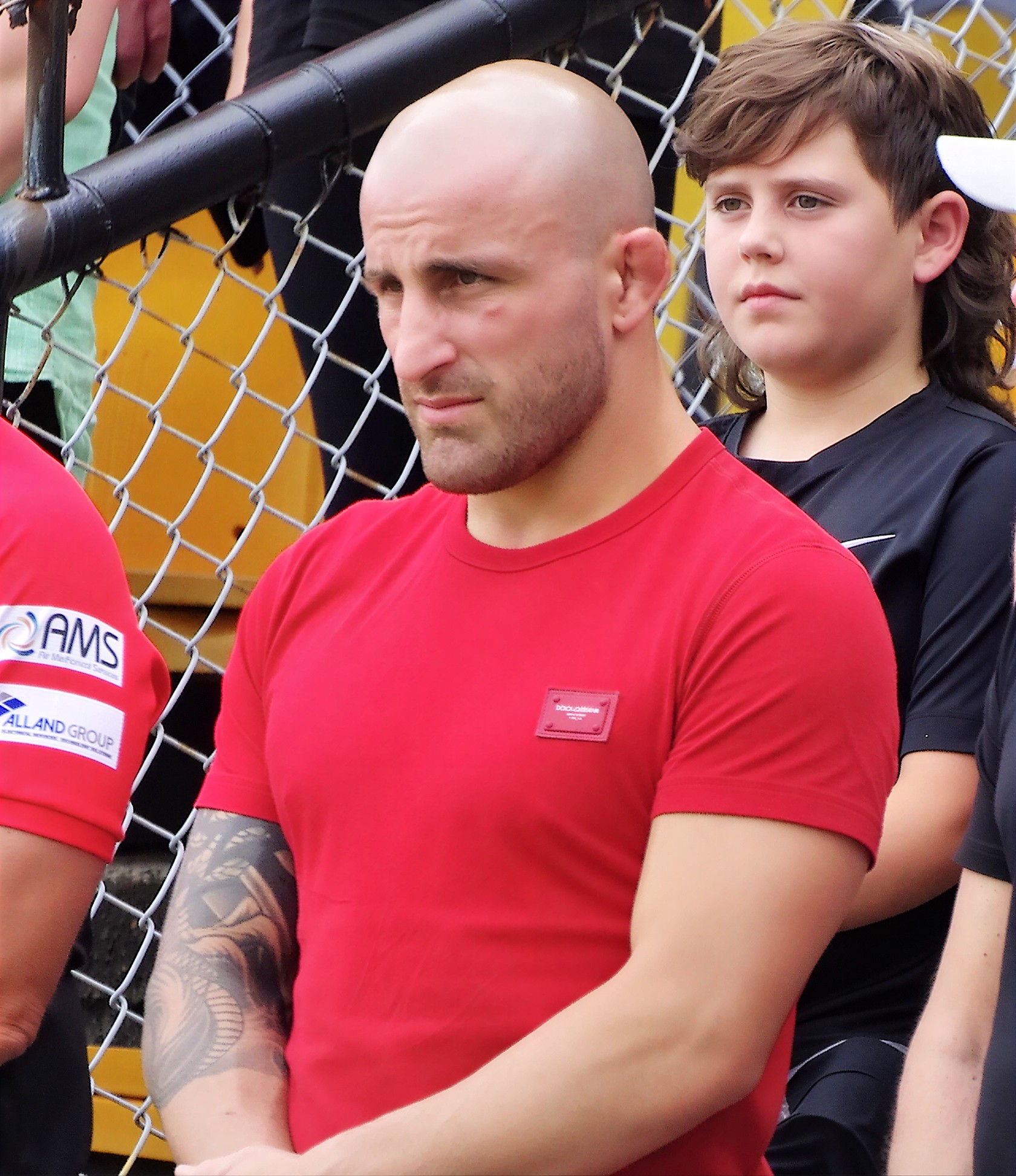
I saw Alexander Volkanovski’s social media reel announcing his Rainbet ambassadorship, where he climbs onto a rock on a mountain peak, says it’s always been about coming out on top, and launches off under a Rainbet-branded paraglider looking like a compact mountain of muscle. As Luke Benedictus noted in a November 16, 2020 Men’s Health UK profile, Volkanovski is 1.68m tall and fights at the 67kg UFC featherweight limit with a thick, stocky build rather than a wiry frame. He still carries retained rugby-prop strength after dropping roughly 30kg. He did it through a training system of specific lifts, sprint protocols, and camp phases that a normal gym-goer can selectively borrow.
Key Takeaways
Volkanovski cut out processed food to drop roughly 30kg from his 97kg semi-pro rugby prop days with the Warilla Gorillas, locking his off-camp weight into the low-70kg range so he can make the 67kg featherweight limit.
His 2018 strength and rehabilitation rebuild under Chris Jaffrey at the BaiMed Performance Centre fixed career-threatening bulging discs and sciatica by improving hip mobility and leg strength to take wrestling load off his spine.
His eight-week camp runs up to three sessions a day. He starts with heavy compound lifts before shifting to late-camp explosive power, and drops his five-round “meat grinder” circuit on fight week for low-risk technical “Spyda” rounds.
Table of Contents
From 97kg rugby prop to 67kg featherweight
Volkanovski dropped roughly 30kg from his days as a 97kg semi-pro rugby league prop for the Warilla Gorillas to reach the 67kg UFC featherweight limit by cutting out all processed food and pairing clean eating with heavy cardio until his off-camp weight stabilized in the low-70kg range.
The three weight numbers, reconciled
Those three figures, 97kg, the low 70s, and 67kg, track three separate stages of his athletic life. At up to 97kg, he was a front-row rugby prop carrying bulk to survive collisions. Once he realized the 67kg featherweight division was his best shot in MMA, he cut out all processed food and used HIIT and long sprints to lock his off-camp weight into the low-70kg range.
The back injury that nearly ended Volkanovski’s career
Alexander Volkanovski can wrestle and lift at championship volume because he resolved his career-threatening back issues in 2018 by rebuilding his hip mobility and leg strength to take the load off his spine during grappling. Before that turnaround, chronic bulging discs and sciatica that started prior to his UFC career repeatedly restricted his training, sidelined him for weeks during flare-ups, and got bad enough that he feared ending up in a wheelchair while one back specialist told him to quit MMA permanently. Ignoring that retirement verdict, he partnered in 2018 with strength coach Chris Jaffrey and the trainers at the BaiMed Performance Centre, where targeted lower-body and hip work produced immediate results and restored his ability to train consistently.
Bulging discs, sciatica, and a specialist’s quit-MMA verdict
The specialist who told him to hang up the gloves permanently wasn’t given how many weeks at a stretch Volkanovski was losing on the sidelines.
The 2018 fix: hips and legs to unload the spine
The exact rehabilitation drills Jaffrey used at BaiMed aren’t public, which is fine because the mechanical principle, rebuilding hip mobility and leg strength rather than resting the back, is what matters for a regular lifter. Avoiding lower-body work leaves the hips stiff and the legs weak, so every time you bend over to pick up a weight or tie up in a grappling exchange, your lumbar spine has to absorb the hinge and rotational stress by itself.
Building stronger legs and looser hips gave Volkanovski a working suspension system underneath his torso. Once the 2018 rebuild took the wrestling load off his spine, he went on to beat José Aldo, whom he considers the greatest featherweight of all time, and took back-to-back title fights against Max Holloway.
Where Volkanovski trains: his gyms and coaches
As Dylan Wolf detailed in a June 21, 2025 Generation Iron report, Volkanovski runs his MMA fight camps at Freestyle MMA and City Kickboxing alongside coaches and elite sparring partners, while keeping his strength conditioning and back rehabilitation separate under Chris Jaffrey at the BaiMed Performance Centre. At Freestyle MMA and City Kickboxing, he focuses on striking and grappling transitions during hard technical rounds that test his mental toughness under fatigue. At BaiMed, the focus is strictly on physical preparation and keeping his spine unloaded so his body survives the rounds he puts in on the mats.
Fight camp structure: eight weeks, three sessions a day
Alexander Volkanovski’s workout routine is a periodized system that mixes high-cardio MMA training, heavy strength and power blocks, and sport-specific conditioning drills, progressing from classic strength and hypertrophy lifts like deadlifts and explosive squat jumps into explosive power work. His fight camp runs for eight weeks with up to three training sessions per day, relying on daily discipline and consistency over raw athletic talent to move through three structural components:
- Early-camp mass and general strength: Heavy compound lifts centered on squats, deadlifts, and bench press to build muscle mass and foundational force.
- Late-camp power and explosiveness: High-velocity movements. Olympic-style lifts, box jumps, sled pushes, and medicine ball throws, as fight night gets closer.
- Mandatory metabolic finishers: Every strength session closes with high-output conditioning on battle ropes, sled drags, or high-intensity heavy bag work.
Early camp: building mass with compound lifts
A fixed Monday-to-Sunday calendar for his camp isn’t public because his team programs by camp phase rather than static weekdays. In the opening weeks of the eight-week block, the barbell moves slower and the loads are heavier. Squats, deadlifts, and bench presses build the structural armor and baseline strength he needs before the sparring and conditioning intensity peaks.
Late camp: shifting to power, plus metabolic finishers
Holding onto heavy bodybuilding-style fatigue deep into camp would leave a 67kg fighter slow on the feet and prone to upsetting favorable UFC Fight Night predictions. As the fight gets closer, he switches to explosive work using box jumps, sled pushes, medicine ball throws, and Olympic-style lifts. Even the same movement family changes purpose across the camp: heavy deadlifts lay down raw strength early, while explosive squat jumps keep fast-twitch fibers firing later. Closing every single strength session with battle ropes, sled drags, or hard bag work trains his body to keep producing force right after the muscles are already smoked.
Alexander Volkanovski’s strength workout: exercises and sets
According to his BaiMed strength coach Chris Jaffrey, Alexander Volkanovski is super-strong and nobody in the featherweight division is stronger than him, largely because he competes at the 67kg limit where pound-for-pound leverage matters more than mirror muscle. To build that edge, he runs low-to-moderate rep upper-body sets and explosive lower-body lifts built strictly for MMA transfer rather than aesthetic muscle size. His documented 8 a.m. lower-body power sessions feature trap-bar deadlifts, explosive squat jumps hugging a medicine ball to his chest, and barbell hip thrusts. An AthleTic BeasTs breakdown also notes deadlifts, box jumps, push-ups, and pull-ups, plus three exact upper-body prescriptions: Single-Arm DB Rows for 3 sets of 6 per side, landmine Power Presses for 3 sets of 8 per side, and Cable Face Pulls for 3 sets of 10.
Single-Arm DB Row: 3×6 per side
Hinge at the hips with a flat back, brace one hand on a bench, and row heavy for 6 reps per arm.
Power Press: 3×8 per side
Wedge one end of a barbell into a landmine attachment, load the other end, and press it explosively from your collarbone for 8 reps per side.
Cable Face Pull: 3×10
Set a rope attachment on a cable pulley at eye height and pull it toward your face for 3 sets of 10.
Cardio and conditioning: hill sprints, HIIT and core work
Volkanovski builds his fight-pace engine and raises his VO2 max solely through long sprints and high-intensity interval training: five one-minute hill sprints with full recovery between runs, short-burst stair sprints, 15-to-20-minute HIIT circuits, and daily timed core intervals.
Hill sprints and stair sprints: the exact protocol
Five one-minute hill sprints with full recovery between every run make up his main roadwork session. He pairs those with stair sprints, using short, all-out bursts and brief rests to mimic sudden exchanges in the cage.
HIIT circuits and daily core work
Inside the gym, his HIIT circuits last just 15 to 20 minutes, cycling through assault bike sprints, heavy bag work, plyometrics, and bodyweight exercises. Core conditioning happens every single day rather than twice a week, running timed intervals that mix sit-ups, Russian twists, planks, and hanging leg raises.
The ‘meat grinder’ circuit and fight-week Spyda rounds
Volkanovski’s “meat grinder” circuit is a five-round shark tank-style MMA conditioning drill that builds physical and mental composure under exhaustion by rotating a fresh training partner in against him every 30 seconds. The drill simulates the worst-case chaos of a live five-round fight while managing his body’s wear and tear across an eight-week camp. He has to defend and counter against rested opponents across all five rounds. Once fight week hits, his coaches swap the entire circuit out for low-risk technical “Spyda” rounds.
Inside the ‘meat grinder’: a fresh partner every 30 seconds
Every 30 seconds, someone with fresh legs and clean lungs steps in to push the pace, forcing Volkanovski to make sharp technical decisions while exhausted.
Fight week: Spyda rounds replace hard sparring
On fight week, Volkanovski’s team drops the meat grinder and hard contact entirely in favor of Spyda rounds, which use technical drills to keep his reflexes firing while cutting out sparring damage and last-minute injury risk.
MMA skill work: how much Volkanovski spars
Volkanovski spars roughly twice a week during camp to sharpen his timing, accuracy, and combinations, and cuts hard sparring out on fight week in favor of Spyda rounds so he doesn’t carry an injury into the cage. Keeping live sparring to two controlled sessions a week separates head contact from his brutal conditioning circuits, which is how a guy with a long title reign keeps his chin and joints intact. His technical base pairs foundational wrestling, which drives his takedown defense and ground control, with boxing and kickboxing. Instead of splitting those arts into isolated classes, his daily technical sessions blend striking, wrestling, and jiu-jitsu together through pad work, heavy bag drills, grappling, and controlled rounds against training partners of different body types and styles so his transitions between punching and shooting stay automatic.
Volkanovski’s diet: high protein, zero processed food
Volkanovski’s diet permanently stabilized his formerly yo-yoing weight in the low-70kg range before any fight-week cut to 67kg by enforcing one non-negotiable rule: zero processed food, backed by high-protein meals, complex carbohydrates, and heavy daily water intake. There’s no exotic biohacking supplement stack hiding behind his transformation from a 97kg rugby prop. Fuelling up to three training sessions a day without putting junk weight back on comes down to eating clean plates of protein and complex carbs so his muscles recover between morning lifting and afternoon rounds.
Can a regular gym-goer copy Volkanovski’s routine?
A regular guy with a day job can’t copy Volkanovski’s full eight-week, three-sessions-a-day fight camp because that volume requires professional recovery support, but his individual strength and conditioning pieces fit straight into a normal three- or four-day gym week. Leave the shark-tank sparring and triple sessions to paid fighters, and steal the 3×6 single-arm dumbbell rows, 3×8 landmine power presses, 3×10 face pulls, trap-bar deadlifts, barbell hip thrusts, five one-minute hill sprints with full recovery, the zero-processed-food rule, and the discipline to taper hard work before a test.
Frequently Asked Questions
How is Alexander Volkanovski’s workout routine and training schedule structured?
Instead of following a rigid Monday-to-Sunday calendar, Volkanovski’s eight-week fight camp scales up to three sessions a day across distinct training phases. He dedicates the early weeks to building baseline strength with heavy squats, deadlifts, and bench presses before transitioning into high-velocity power movements like Olympic lifts, sled pushes, and box jumps as fight night approaches. Every lifting session wraps up with a brutal metabolic finisher on the battle ropes, heavy bag, or sleds to train his muscles to keep firing under exhaustion.
What exercises does Alexander Volkanovski do in the gym with sets and reps?
His upper-body workouts focus on functional leverage rather than bodybuilding size, featuring single-arm dumbbell rows for 3 sets of 6 per arm, landmine power presses for 3 sets of 8 per side, and cable face pulls for 3 sets of 10. For lower-body power at 8 a.m., he leans on trap-bar deadlifts, barbell hip thrusts, and explosive squat jumps while hugging a medicine ball to his chest. He also mixes in classic deadlifts, box jumps, pull-ups, and push-ups alongside daily timed core intervals.
What is Volkanovski’s ‘meat grinder’ circuit and how does it work?
The ‘meat grinder’ is a grueling five-round shark-tank drill designed to test Volkanovski’s composure and decision-making under worst-case fatigue. Across all five rounds, a completely fresh training partner rotates in against him every 30 seconds to push the pace. That means he has to defend and counter against ten rested opponents per round without letting his technique break down.
How did Volkanovski drop 30kg from rugby league prop to UFC featherweight?
During his semi-pro rugby league days as a front-row prop for the Warilla Gorillas, Volkanovski carried up to 97kg on his 1.68m frame to survive heavy collisions. To make the 67kg UFC featherweight limit without his weight constantly yo-yoing, he cut out all processed food and paired high-protein, complex-carb meals with heavy cardio. That discipline locked his normal off-camp walk-around weight into the low-70kg range, turning his final fight-week cut down to 67kg into a routine drop.
How much sparring does Volkanovski do and why does he cut it before fights?
Volkanovski limits live sparring to roughly two controlled sessions a week during camp so he can sharpen his timing and combinations without destroying his chin or joints. Once fight week arrives, his coaches drop both hard sparring and the ‘meat grinder’ circuit entirely in favor of low-risk ‘Spyda’ rounds. Those technical drills keep his reflexes sharp while making sure he doesn’t carry last-minute damage or fatigue into the cage.

