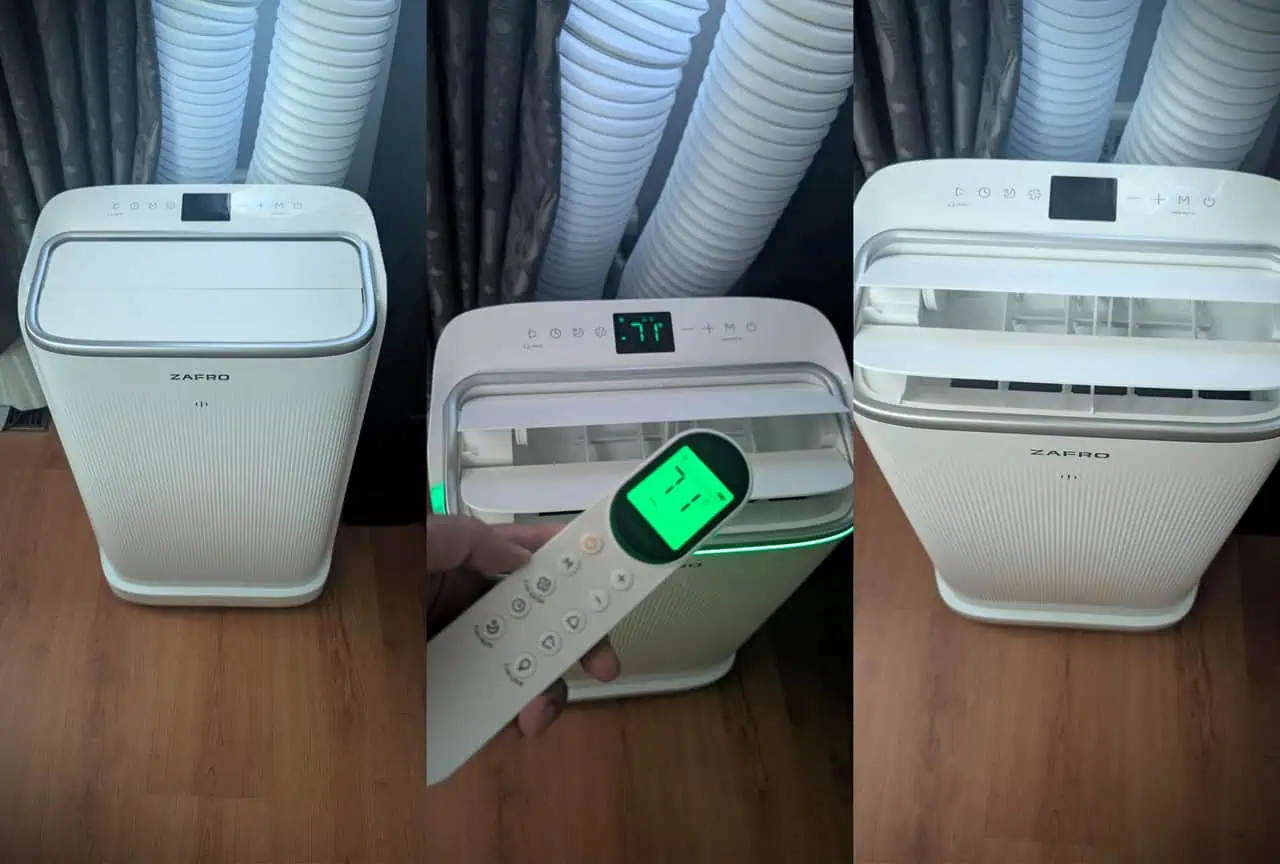
You know the drill. Three AM, you’re finally drifting off, and the portable AC compressor kicks on with a thud that rattles the nightstand. Then it runs for ten minutes, shuts off, and the room starts feeling sticky again before the next cycle. Meanwhile, your electric bill is climbing like it’s training for Everest.
That’s the portable AC experience most of us know. This Zafro unit is designed to fix those specific problems — and it might actually pull it off.
The headline specs are strong: 38dB in Sleep Mode (quiet enough that you’ll forget it’s there), a dual-hose design that doesn’t create the negative pressure mess single-hose units do, and a CEER rating up to 12.8, which is legitimately efficient for a portable. It builds on last year’s editor-recommended Zafro model, so the brand has some track record despite being a newer player (founded 2021).
Before we get into the weeds, here’s the quick verdict for guys who want the short version.
Key Takeaways
Real-world cooling is 12,000 BTU SACC (not the 16,000 BTU headline number), which handles rooms up to about 500 sq ft but works harder in direct sunlight or poor insulation.
The 38dB Sleep Mode and full DC inverter with stepless frequency adjustment mean no compressor thump — it ramps up and down smoothly instead of cycling on/off.
Self-evaporative technology means no manual drainage below 90% humidity, but if you live in a consistently humid climate (Houston, coastal areas), you’ll still need to empty the bucket occasionally.
Table of Contents
Quietness & Sleep Performance: What 38dB Actually Means
Most portable ACs that advertise quiet operation still have that compressor thump. It’s the on/off cycling that wakes you up — the sudden roar, then silence, then roar again. The Zafro solves that problem with a full DC inverter system that includes a variable-speed dual-cylinder compressor and a brushless DC motor. Instead of blasting full power then shutting off completely, it uses stepless frequency adjustment to modulate output.
It adjusts its output to match what the room actually needs. No spikes, no sudden silence, just a steady hum that settles into the background.
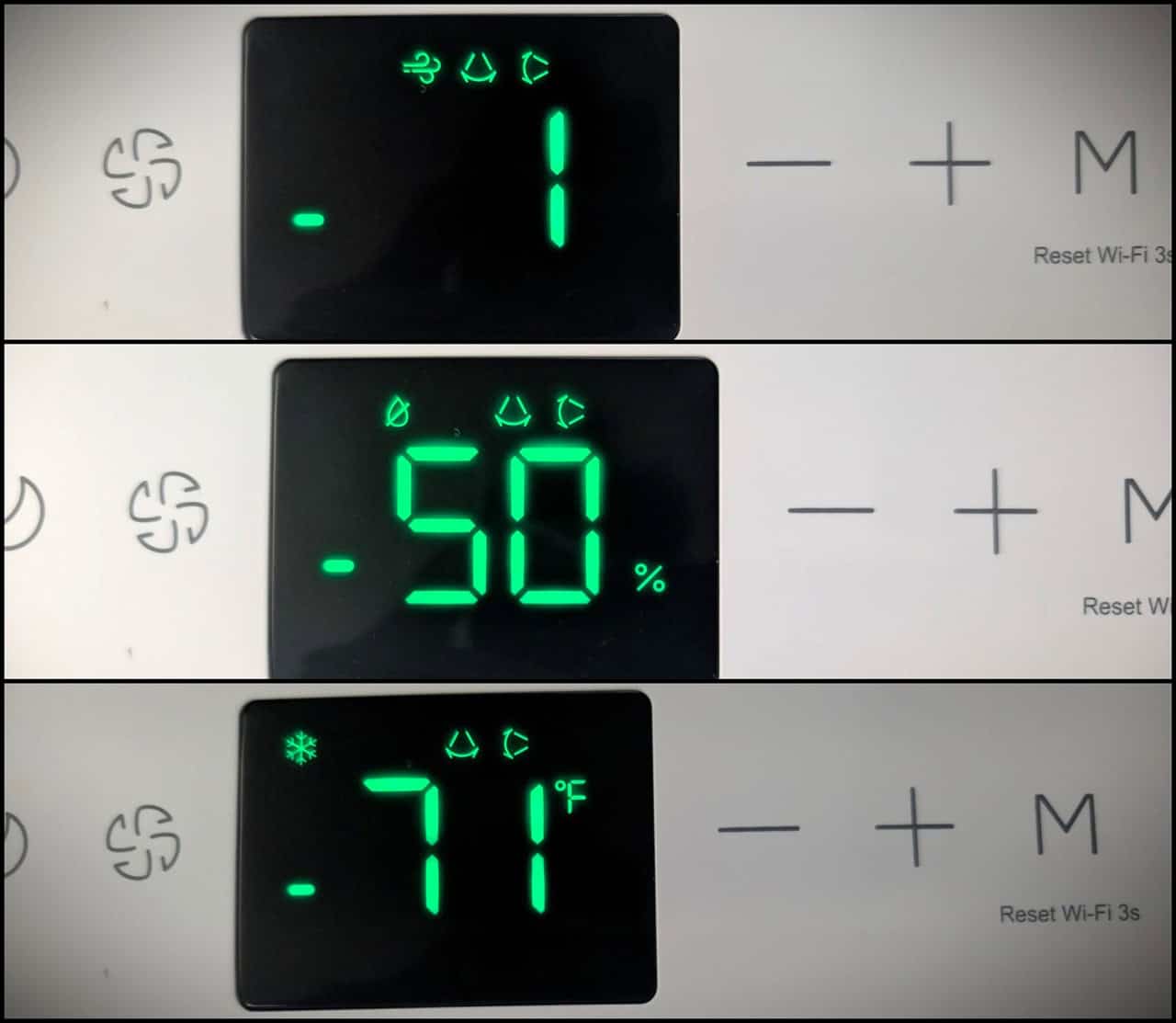
At 38dB in Sleep Mode, that’s roughly a library whisper level. It’s not silent, but it’s quiet enough that you won’t notice it unless you’re listening for it. The display-off function kills the blue light that usually glares at you from across the room. And the gentle airflow design means it won’t blow cold air directly on you all night — it moves air more evenly, which supports restful sleep.
Field note: Test the 38dB claim with a sound meter app on your phone. If your bedroom has thin walls or street noise, the difference between 38dB and 42dB disappears into ambient sound.
Energy Efficiency & Inverter Technology: What CEER 12.8 Actually Saves
CEER stands for Combined Energy Efficiency Ratio, and higher is better. Most portable ACs land between CEER 8 and 10. The Zafro’s rating of up to 12.8 puts it ahead of traditional fixed-speed portables. That CEER up to 12.8 means you’re looking at roughly 20-30% less power draw for the same cooling output compared to a non-inverter unit.
The Full DC Inverter System is the reason. That stepless frequency adjustment I mentioned — the compressor doesn’t just kick on and off. It varies its speed continuously to maintain the set temperature. That means it’s not wasting energy on full-power bursts that overshoot, then letting the room warm up, then blasting again.
Standby power is a negligible 0.5W, so you can leave it plugged in without concern about phantom drain.
Compared to a $350 single-hose unit that cycles on/off all day, this will use less electricity over a summer. It’s efficient for a portable.
Cooling Performance & Dual-Hose Advantage: Why This Design Works
Single-hose units pull air from the room to cool the condenser, then exhaust that air out the window. That creates negative pressure inside the room, which pulls hot air in from outside through door gaps, window cracks, and other leaks. So you’re cooling the room, but the unit is also actively pulling warm air back in. It’s fighting itself.
The Zafro’s Dual-Hose Cooling setup uses one hose to pull outdoor air for the condenser and another to exhaust the hot air back outside. The room air stays in the room. No negative pressure, no hot air sneaking in from the hallway.
The 16,000 BTU headline number is what you’ll see on the box, but the real-world rating is the SACC (Seasonally Adjusted Cooling Capacity): 12,000 BTU. The SACC accounts for the dual-hose configuration and gives you the number to compare against other units, like the Zafro 12,000 BTU SACC portable air conditioner. Don’t get hung up on the 16,000 — use the 12,000 for your room size math. That’ll handle a room up to roughly 500 square feet, but if your space gets direct afternoon sun or has poor insulation, expect it to work harder.
Cost check: A single-hose unit costs half as much but burns 20-30% more electricity. Over a 90-day summer running 8 hours a day, the Zafro’s efficiency premium pays back roughly $30-50 in avoided power bills.
Contrarian note: in a small, well-sealed room (say, a 150 sq ft bedroom), the dual-hose advantage is marginal. A single-hose unit might work fine there. But in a larger or leakier space, the dual-hose makes a difference.
Maintenance & Self-Evaporative System: When You Drain (and When You Don’t)
This is the part most reviews skip: how often do you have to empty the bucket? The Zafro’s Self-Evaporative Technology recycles the condensed water onto the condenser coil, which improves efficiency by cooling the condenser. The key number is 90% humidity. Below that, you don’t need to drain it manually. The unit handles it on its own.
Above 90% — which you’ll see in coastal areas, the Gulf states, or during monsoon season, the system can’t evaporate all the water fast enough, and you’ll need to drain it manually. The same goes for very humid basements. So if you live in Houston or Mumbai, check the drain pan during peak summer. For most of the rest of the country, you can set it and forget it.
The easy-to-remove washable filter — just rinse it every few weeks. No replacement filter costs.
Smart Features & Control Options: App, Voice, and Scheduling
You’ve got four ways to control this thing: the onboard panel, the remote, the mobile app, and voice via Amazon Alexa or Google Home.
The mobile app lets you schedule the AC to turn on before you get home, monitor the room temperature remotely, and adjust settings without getting off the couch. Voice control is a nice bonus if you’re already in the Alexa or Google ecosystem, but it’s more of a party trick than a daily driver. The scheduling is the real value — set it to cool the bedroom 30 minutes before bedtime, then switch to Sleep Mode automatically.
Additional Design & Convenience Features
R32 refrigerant. This matters more than most people realize. R32 is more efficient and has a lower global warming potential than the older R410A. It’s becoming the standard, and using it now future-proofs the unit against regulatory changes.
Four-way airflow. You can direct the cool air where you need it — up, down, left, right.
360° caster wheels. The unit rolls easily.
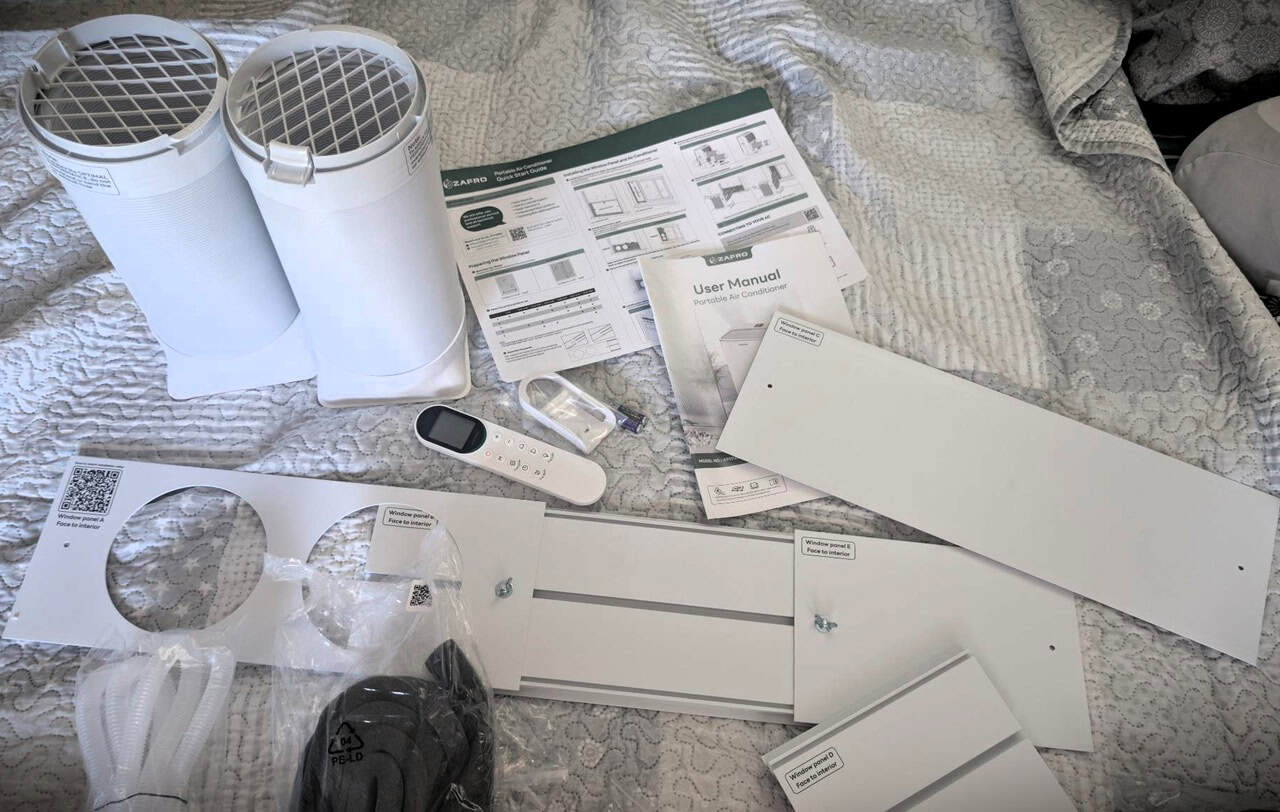
Quick-install window kit. It’s not tool-free — you’ll still need to attach the hoses and fit the kit to your window, but it’s straightforward. The exhaust hose and window kit are included.
Minimalist design.
Specifications, Pricing & Availability
- MSRP: $619.99
- Launch: Within the next month
- Review units available: Mid-April
- Cooling capacity: 16,000 BTU (12,000 BTU SACC)
- Noise level: Down to 38dB in Sleep Mode
- Refrigerant: R32
- Standby power: 0.5W
- Controls: Panel, remote, mobile app, Alexa, Google Home
- Airflow: Four-way directional
At $620, it’s priced competitively with the Midea Duo and LG’s inverter models.
About Zafro & Brand Credibility
Zafro was founded in 2021, so they’re a relatively new player. They develop portable air conditioners, air purifiers, humidifiers, and other home climate devices. Zafro’s slogan, ‘Your Comfort, Wherever You Go,’ reflects their focus on portable climate solutions. Building on last year’s editor-recommended Zafro portable AC, this one has credibility by association.
I’d recommend checking the warranty fine print before buying.
How the Zafro Compares to Competitors (and When It Isn’t the Right Choice)
The obvious comparison is the Midea Duo, the reigning champion in the dual-hose portable space. The Zafro edges it out on noise: 38dB vs Midea’s ~42dB in Sleep Mode. The Zafro also has lower standby power (0.5W vs ~1.2W), a CEER up to 12.8, and uses R32 refrigerant, which is more eco-friendly.
But Midea has a longer track record, a wider service network, and more user reviews. If brand reliability is your top concern, Midea is the safer bet.
The LG LP1419IVSM is another comparable unit — similar noise levels but higher price. The Zafro undercuts it on cost.
When a single-hose unit is a better fit: If you’re cooling a small bedroom under 200 sq ft, on a tight budget, and not bothered by noise, save money with a single-hose model. The dual-hose advantage is minimal in small, well-sealed spaces.
When a window unit makes more sense: If you have a window that can accommodate one, a window AC will always be more efficient (CEER 14+). The Zafro is a compromise for people who can’t or won’t install a window unit.
When this unit isn’t the best option: In consistently humid climates without good drainage access, the self-evaporative system will need manual intervention. Also, if you need to cool an open-plan space larger than 500 sq ft with poor insulation, this unit will struggle.
Final Verdict: Who Should Buy This
Ideal for:
- Light sleepers who can’t tolerate compressor cycling noise
- Medium to large rooms (300-500 sq ft) where a single-hose unit would create negative pressure issues
- Eco-conscious buyers who want R32 refrigerant
- Tech-savvy users who’ll use the app scheduling
- Anyone who’s been burned by a noisy, inefficient single-hose unit before
Not ideal for:
- Small rooms where you’d never notice the dual-hose advantage
- Extremely humid climates without easy drain access
- Tight budgets (this is a $620 commitment)
- Whole-home cooling (no portable AC can do that)
Bottom line: The Zafro Dual-Hose Inverter Portable Air Conditioner is a serious contender for anyone tired of the portable AC compromises. It’s quiet enough for sleep, efficient enough to save on electricity, and the dual-hose design actually works.
People Also Ask
What is the real-world cooling capacity of the Zafro dual-hose portable AC?
The unit is advertised with a 16,000 BTU headline number, but the real-world rating is 12,000 BTU SACC (Seasonally Adjusted Cooling Capacity). That’s the number you should use for room size calculations — it handles spaces up to roughly 500 square feet, though direct sunlight or poor insulation will make it work harder.
How does the dual-hose design improve cooling efficiency over a single-hose unit?
Single-hose units create negative pressure by pulling room air to cool the condenser, which sucks hot air back in from outside through gaps and cracks. The dual-hose setup uses one hose to bring in outdoor air for the condenser and another to exhaust hot air, so room air stays sealed inside. This means faster cooling and more stable temperatures without the unit fighting itself.
Do I need to manually drain the Zafro AC in humid climates?
The self-evaporative technology recycles condensed water onto the condenser coil, so below 90% humidity you never need to drain it manually. But if you live in a consistently humid area like Houston or coastal regions, or have a very humid basement, the system can’t keep up above 90% humidity and you’ll need to empty the bucket occasionally.
Is the Zafro portable AC worth $620 compared to cheaper single-hose models?
It depends on your room and priorities. For medium to large rooms (300-500 sq ft), the dual-hose design avoids the negative pressure issues that make single-hose units less efficient. The quiet inverter operation and energy savings can pay back part of the premium over time. But if you’re cooling a small, well-sealed bedroom under 200 sq ft on a tight budget, a single-hose unit might work fine for less.