A two-kilometer port transfer and a water bus ticket take you to the exact same edge of Mykonos Town, and one costs 60 euros while the other costs two. Mykonos is one of the hardest and most expensive islands in Greece to navigate, with predictable traps waiting at every turn: 40-euro short taxi rides, picking the wrong beach, a 57-euro bread basket, and 500-euro beach club tables. Paying too much by mistake is different from getting actively scammed, and every trap pairs with a simple countermove, including the party-night safety gaps standard guides skip: stacked drink pricing, riding scooters after drinks, club pickpockets, and peak-season booking fraud.
Key Takeaways
Skip the 50-to-60-euro private transfers at Mykonos New Port and the scarce 40-euro taxis by taking the 2-euro water bus into the Old Port and the 2-euro air-conditioned buses out of the Fabrika terminal to major beaches.
Protect your wallet at restaurants and beach clubs by photographing outside menus, refusing unrequested bread or oversized novelty drinks before touching them, and checking bills line by line for stacked cover charges, minimum spends, and phantom items.
Lock in your return transport before your first drink so a daytime scooter or ATV rental never becomes your ride home after dark, and book peak-season stays months ahead on verified platforms to dodge fake accommodation listings.
Table of contents
Table of Contents
Getting from Mykonos New Port to town without overpaying
Mykonos New Port (Tourlos) transfers are cheapest on the sea bus, which connects the port directly to the Old Port at the edge of Mykonos Town for about 2 euros each way. Because you should avoid walking on main roads outside Mykonos Town and cars can’t enter the pedestrian-only town center anyway, taking the sea bus or a public bus beats paying a private driver. According to Rez World Travel, travelers arriving at the New Port face taxi lines that may never move and private drivers quoting 50 to 60 euros for a two-kilometer ride, while cruise guide Traveling with Thia notes that a 2-euro water bus boards directly at the dock on a frequent schedule.
Why a car transfer stops where the alleys begin
Mykonos Town’s center is strictly pedestrian-only, and cars can’t enter many old-town areas. Paying 60 euros for a private car gets you dropped right where the narrow alleys start. Meanwhile, the wider island isn’t walkable at all, so you’ll rely on buses, taxis, or a rental car whenever you leave town.
Dock versus tender port logistics for cruise passengers
For cruise passengers, Mykonos works as either a dock or tender port depending on your cruise line. Tendered ships drop you directly at the Old Port at the edge of town: grab tender tickets early to get off fast, or wait a couple of hours for a relaxed departure after the crush clears. If your ship docks roughly a mile away at the New Port, you have three ways into town: the 2-euro water bus, the 2-euro public bus from the port, or walking along scenic but tricky roads that lack proper sidewalks.
Taxis in Mykonos: what rides cost and why you can’t get one
Mykonos taxis are scarce island-wide and cost an estimated 40 euros minimum one way regardless of distance. Because very few taxis operate on the entire island, landing one during peak season is like winning the lottery, making reliance on cabs the mistake that costs visitors the most money. On a four-day July 2023 trip documented by vlogger Mel Roselyn, no taxi ride came in under that 40-euro personal estimate (an observation from her trip rather than an official tariff, and seasonal prices may vary), whereas air-conditioned buses from the Fabrika terminal reach major beaches like Paradise Beach for about 2 euros.
The 50-euro, six-minute pedestrian-zone mistake
Booking a ride without checking a map first will burn through your budget fast. On that same July 2023 trip, booking a taxi to an old-town restaurant without checking where the pedestrian-only zones began cost about 50 euros for a six-minute ride. The driver could only go as far as cars are allowed, and the passengers still had to pay the full fare and walk the rest of the way.
Why taxi apps don’t fix the price floor
Apps make hailing a ride easier, but they don’t make it cheap. Both iMove and DriveMe work well on the island. You’ll still pay that effective 40-euro minimum one-way fare even when booking through an app.
The Fabrika bus terminal: the 2-euro fix
The unglamorous Fabrika bus terminal is the actual transport heart of the island. Buses are air-conditioned, run late into the night, and are remarkably reliable, even if they run a little late sometimes. They hit almost every major beach on the island for about 2 euros each way.
Renting a car: the 70-euro daily math
If you want your own wheels outside town, renting a car from day one beats paying for two taxi rides. Here’s how the island’s transport math breaks down:
- Fabrika public buses: About 2 euros per ride to major beaches, air-conditioned, and running late into the night.
- New Port water bus or port bus: About 2 euros each way between the New Port and the edge of Mykonos Town.
- Taxis (street hail, iMove, or DriveMe): Estimated 40-euro minimum one way in peak season, reaching 50 euros for a six-minute ride when blocked by old-town pedestrian limits.
- Daily car rental: 70 euros per day on that July 2023 trip with no cash deposit required, as the rental company held a driving license as the deposit instead (that specific shop had poor online reviews and a better-reviewed company sat right next door, though the renters had no personal problems).
- Walking outside Mykonos Town: Free, but main roads outside town are tricky and lack proper sidewalks.
Choosing the right beach: Psarou, Paradise, Super Paradise, Agios Sostis
Matching the beach’s business model and crowd to your mood before leaving town is the only way to avoid an expensive, miserable afternoon. Mykonos beaches aren’t interchangeable, and showing up at a DJ party spot expecting to read a book in peace and quiet guarantees a bad time.
Psarou Beach
Psarou is the luxury celebrity-and-yacht hub, offering crystal-clear, relatively calm water. Renting a sunbed on this sand can easily top the price of a hotel room, making it the flagship choice for upscale beach clubs for couples who want a high-end day by the water.
Paradise Beach
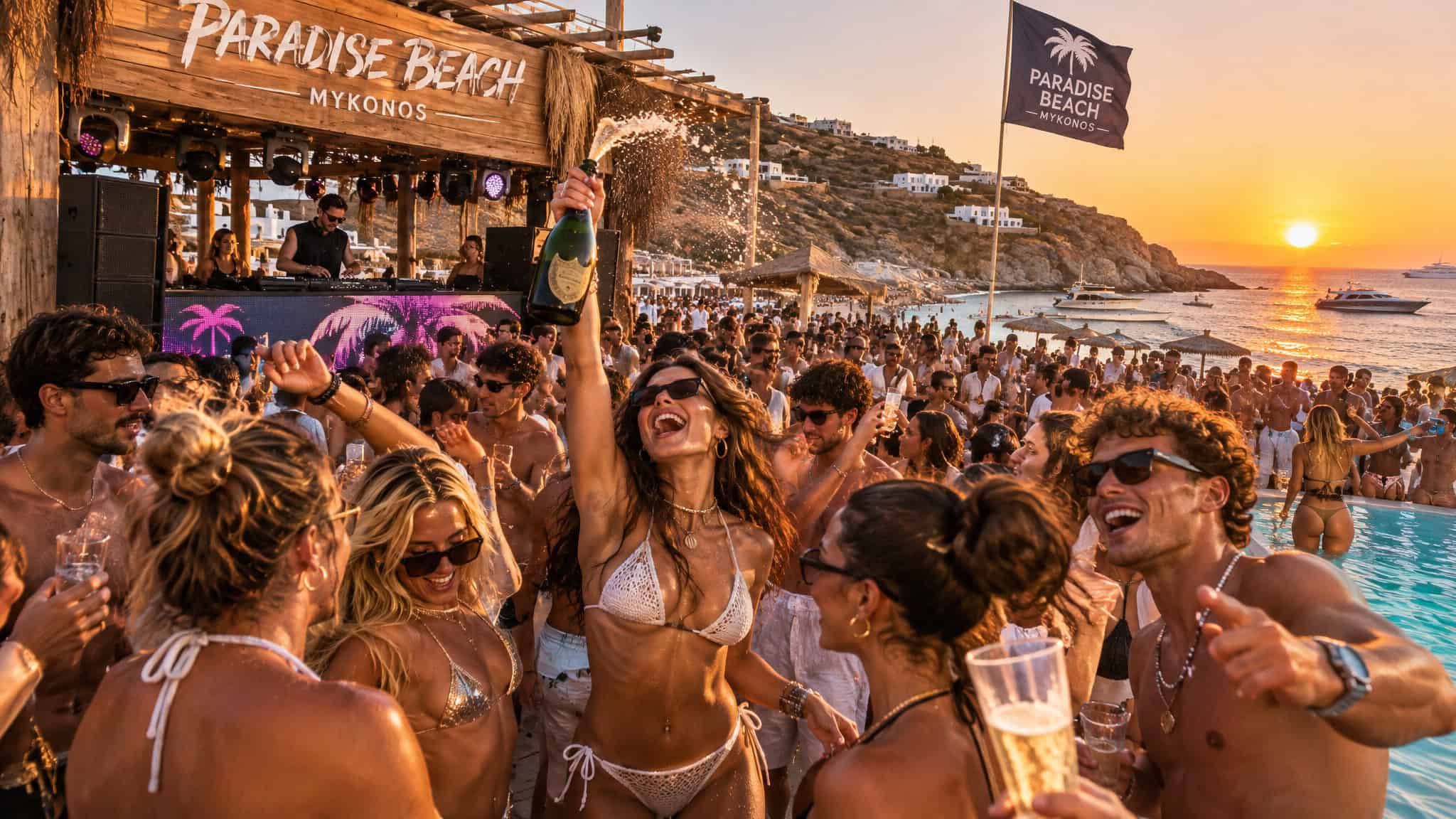
Located roughly half a mile from the New Port according to one cruise guide’s estimate, Paradise is the legendary, high-energy party beach. Expect booming DJs, table-dancing, and wall-to-wall crowds at Paradise Beach’s open-air clubs.
Super Paradise and Agios Sostis
Choosing the right Mykonos beach comes down to matching the sand to your mood: Super Paradise Beach carries a high-energy party crowd similar to Paradise Beach, while Psarou Beach draws celebrities and yachts to calm, crystal-clear water where sunbeds can cost more than a hotel room. If you want pure peace and quiet sand without the thumping bass, skip the party spots and head to Agios Sostis, Mykonos’s tranquil option.
South-side geography and the beach-club access model
The island’s best beaches sit on the south side, and almost all of them are operated by beach clubs rather than left as open public sand. Research access rules and sunbed minimums before catching the Fabrika bus out.
Mykonos nightlife costs: entry fees, minimum spends, and the bill stack
Mykonos beach clubs and town bars split into two very different price worlds: you don’t need to drop 500 euros on a VIP beach club table to have a great night out, because the real heart of the island’s nightlife is in Mykonos Town. At Unfinished Man, we see partygoers budget for a club’s cover charge and get ambushed because venue pricing stacks three separate layers on one table: the entry fee, the minimum spend, and per-item billing. On that July 2023 trip, Scorpios Beach Club charged a 25-euro entry fee per person with cocktails at 27 euros each, while SantAnna Beach Club charged 100 euros per person for a lounger, whereas town staples like Scandinavian Bar skip the VIP pretension entirely.
The three-layer pricing stack
When you map out the Mykonos party scene from beach clubs to town bars, watch how the bill compounds. You pay at the door just to walk in, you commit to a per-person minimum spend just to sit down, and then single drinks eat through that minimum in three rounds.
SantAnna Beach Club
That 100-euro per-person sunbed charge at SantAnna split into 20 euros for the lounger itself plus an 80-euro minimum spend on food and drink. While some visitors loved it and the space is huge and stunning, Mel Roselyn found it poor value: the vibe felt confused, the staff were unfriendly and rushing people, and the DJs spun standard beach-house tracks despite the venue advertising R&B and hip-hop.
The extra fries on the bill
At the beach club on that same trip, two extra portions of fries showed up on the bill when only one was ordered, and the staff were reluctant to remove them and brushed off the complaint. It’s a pattern visitors report hearing often on the island, so check your bill line by line before tapping your card.
Scandinavian Bar: the town alternative
Big beach clubs get the fame, and town nightclubs like Taboo draw a crowd, but Scandinavian Bar in Mykonos Town has been a staple for decades. It delivers a high-energy, authentic party vibe that is actually accessible for the average guy.
Over-friendly bar stewards
According to travel guide Wolters World, watch out for the super-friendly guy at the bar chatting you up and suggesting another round, especially in Santorini and Mykonos. Some bar stewards work on commission to keep you buying more drinks.
Getting home after a night out: the scooter and ATV sequencing trap
Yes, you can party safely in Mykonos nightlife, provided you lock in your return transport before ordering your first drink. The caution we emphasize here at Unfinished Man, and the one standard travel guides leave out, is the twelve-hour scheduling trap that turns daytime beach transport into a late-night hazard.
Because taxis are nearly impossible to hail and a 70-euro daily rental beats paying 40 euros per cab ride, guys rent a scooter or ATV at noon to hit the south-side beaches. You ride from the beach to a sunset bar, leave the scooter parked outside the venue all evening, and suddenly it’s 2:00 a.m. with zero taxis in sight.
Because the rental decision happened at noon and the drinking decision happened at night, that parked scooter or quad becomes your default ride back to the hotel on tricky, unlit roads lacking proper sidewalks. Fix the logistics before your first round: check the last Fabrika bus departure, pre-book a transfer, or drink in Mykonos Town where you can walk back to your room.
Pickpockets and street scams in Mykonos: what to watch and what to say
Yes, Mykonos is safe from violent crime, when you guard against the pickpockets and street scams that target crowded tourist zones. Pickpockets work wherever tourists pack together in Greece.
Plaka, Monastiraki, the Acropolis, Santorini, and Mykonos, bumping into you or asking for directions while a partner lifts your wallet. Travel creators Naick & Kim, who have visited Italy about a dozen times and broke down 9 scams in their video (including a staged clip with Belgian tourists who had been in the country two days), point out that distraction thieves around spots like the Trevi Fountain, Rome metro, and Rialto Bridge rarely look like movie villains: watch for an approachable teenager, a mother holding an infant, or a kindly older woman, and never accept anything handed to you as a “free gift.”
The free-gift rule
If anyone offers you bracelets, flowers, or toys on the street, or hands an item directly to your kids so you feel guilted into paying, it’s never free. In the friendship bracelet scam (ranked the top tourist scam in Italy and running the exact same script in Greece), a vendor opens with flattery and says, “Here, for you, it’s a gift,” then demands cash the second it touches your wrist or hand. Say “Oh, it’s okay, thank you” or “No thank you” and keep moving.
Pickpocket tactics and distraction personas
Beggars are present in parts of Greece, and the Greek government recommends not giving money because social support systems exist to help. Pickpockets work wherever tourists crowd in Greece, including Plaka, Monastiraki, the Acropolis, Santorini, and Mykonos. Keep your wallet in your front pocket or a money belt, leave valuables in the hotel safe, and watch for the bird-poop distraction play, where a stranger “helpfully” wipes your jacket while an accomplice empties your bag.
The dropped camera scam
On Mykonos specifically, watch for strangers asking you to take their photo. They fumble the hand-back so the camera hits the pavement, then demand you pay for the “broken” gear; politely decline if anything feels off.
Unposted prices at restaurants and beaches
Some Mykonos restaurants and beach spots leave prices off the menu or chalkboard, then drop an astronomical bill after you’ve eaten or used the sunbed. Get prices in writing before sitting down.
Overly aggressive vendors
Pushy street and beach vendors are common on the island. Giving a polite yet firm “no thank you” without breaking stride usually ends the interaction.
The fake police officer test
Scammers occasionally flash a badge, claim they’re investigating theft or counterfeit bills, and ask to inspect your passport and wallet before stealing your cash. Actual officers may run random ID checks, yet they will never demand to inspect your billfold or handle your cash; offer to walk to the police station together, and any impostor will back down right away.
Petition and painting setups
Give clipboard petitioners a wide berth: they ask for a signature and a small donation for a “good cause,” then either pocket the cash or use the clipboard to screen a pickpocket. Also watch your step in tight pedestrian bottlenecks, where scammers lay cheap canvases flat on the pavement (a setup spotted outside the Accademia in Florence) so you accidentally step on a painting and get pressured into buying it.
Ticket machines, taxis, and street games
Never play three-card monte on the street, and decline “helpers” at train or transit ticket machines unless they’re wearing an official staff uniform (the machines have an English button, and fake helpers just mash buttons to demand a tip). When you do get into a taxi in Greece, request the initial flag-drop rate so the meter runs properly instead of an invented flat price, a cousin to the classic Italian taxi tricks of no meter, made-up luggage surcharges, or claiming “I don’t have change for that” to force an overpayment (where the fix is sticking to licensed white metered cabs, checking fixed airport rates, or using the Freeway app in bigger cities).
Currency exchange and ATM traps
Skip currency exchange booths completely, as even the “no commission” windows post terrible rates. Avoid standalone ATMs tucked inside souvenir shops right next to major attractions (such as the ones next to the Colosseum in Italy); bank machines located in regular town squares or beside pharmacies and everyday shops are a much safer bet.
Packed venues: why club theft conditions differ
From our perspective at Unfinished Man, standard street-level anti-theft habits fall short once you step inside a packed beach club like Paradise Beach or a crowded town dance floor. Ticketed entry means fewer exits, bodies pressed shoulder-to-shoulder, phones constantly out for videos, and a dropped guard because the bouncer at the door makes the room feel secure. Leave extra cards and passports in the hotel safe, split your cash and cards, keep your wallet in a buttoned front pocket, hold zipped purses in front, and never leave your phone sitting on a club or cafe table.
Restaurant scams in Greece: seven named tactics and where to catch each
Greek restaurant billing scams are table-side pricing traps that rely on physical trigger points to lock you into overpaying before the food or bill ever arrives. When you steer clear of main-square tourist traps with aggressive hosts outside and catch the trick before accepting an item, you won’t owe an extra cent. According to Simply Greece, drawing on 20 years of experience dodging Greek restaurant traps, unrequested bread, olives, and water placed on the table can add 57 euros or more to your tab, while touching an oversized “novelty glass” drink counts as accepting a 30, 40, or 50-plus charge.
Unrequested bread, olives, and water
Waiters in tourist traps often drop bread, olives, or water on the table unasked and bill you heavily for them, or theatrically crack open a branded water bottle that was actually refilled with tap or cheaper water. If you didn’t order it, assume it isn’t free and politely but firmly ask the waiter to remove it before you touch a bite.
Two-tiered menus and the QR code defense
Some tourist traps run two menus: a cheap one for locals and an inflated one for tourists (the same double-menu game played in Italian tourist traps, where English menus cost more than the Italian-language version). Snap a photo of the menu posted outside before sitting down to compare prices, or favor spots with QR-code menus, which rarely have two versions and can’t easily be changed on the spot.
When the waiter keeps the menu
If a waiter withholds the menu and pushes vague “specials” alongside a cocktail, they’re setting you up to invent the price after you’ve eaten. Walk out immediately: no menu, no stay.
The novelty glass scam
Spotted at places like Hypocrates Square in Oldtown, Rhodes, the novelty glass trick happens when you order a standard beer or cocktail and the server brings out an oversized beer boot or a fishbowl drink, calling it their “standard size” for 30, 40, or 50-plus (currency unstated in the report). Because touching the glass or taking a sip counts as acceptance, order a specific size, point to a normal glass on a nearby table, and refuse any oversized vessel before your fingers touch it.
Fish sold by the kilo
Fresh fish priced by the kilo can leave you paying top euro for inedible crab or lobster shell, head, tail, and heavy bones, or naturally bony fish like trout that yield very little actual meat. Watch the fish being weighed on the scale and confirm the total cooked price before it goes to the grill.
Ingredient swaps and chargeable extras
Ask to swap a side or ingredient and some kitchens will bill you for both the original item and the substitute, or charge full price for an unordered half portion. And if a waiter offers a drizzle of olive oil after your Greek salad lands on the table, confirm whether it’s free first, some spots bill it as a pricey miniature bottle or premium pour.
Phantom items: check the bill line by line
Greek restaurants normally serve massive portions at great value, the kind where you order one plate and feel like it could feed a large army, and most Italian restaurants outside heavy tourist zones are honest too. Even so, tourist-trap tabs in both countries can carry phantom items like an extra beer, an unordered appetizer, extra waters, or rounded-up totals, so ask for the itemized receipt and check every line the second the bill hits the table.
Paying and booking: the defense protocol
For a peak-season Mykonos trip, book your accommodation in advance on trusted platforms like Airbnb and skip unreviewed listings or last-minute room hunting. Because you still need some physical euros for 2-euro buses and small vendors, use a credit card for every sit-down bill to get chargeback protection and lock in a listing with plenty of positive reviews months ahead of summer dates. When vlogger Mel Roselyn looked in January for her July 2023 trip, roughly 90% of stays on Mykonos were already booked, creating the exact kind of last-minute panic that pushes travelers into fake accommodation listings with non-existent addresses and realistic confirmation emails.
Pay by card, watch the machine
Paying by credit card gives you built-in chargeback protection and kills any later claim that you walked out without paying. Watch out for the “card transaction failed” trick, where a server says the machine rejected your card, frequently chatting you up about your vacation as a distraction, just to run a second swipe; keep your eyes on the terminal, check your banking app to see if the first charge posted, and pocket the printed receipt.
Book early, and verify what you booked
Although Mel Roselyn still found a lovely, reasonably priced place despite that 90% January booking crunch, we flag peak-season scarcity as a major setup for accommodation fraud. Scammers build realistic websites and send convincing confirmation emails for non-existent Mykonos addresses, counting on desperate travelers to book fast without checking; stick to trusted platforms like Airbnb and only book properties backed by a deep history of positive reviews.
What looks like a scam in Greece but isn’t
Before you go to war with a polite waiter over a two-euro charge, know how to tell normal Southern European billing rules apart from actual fraud. Legitimate local charges are disclosed, modest fees or legal tax splits that catch tourists off guard simply because the customs differ from home.
In Greece, traditional tavernas routinely bring water to the table right away in the summer heat and ask if you’d like bread; unlike the 57-euro tourist-trap ambush, this is an affordable, above-board local custom, and if you politely decline the bread you won’t be charged. Similarly, some Greek apartment rentals charge separately for air conditioning or electricity used during your stay, expect to see that written right into the lease terms rather than treating it as a shakedown.
Look closely at your itemized receipt and you may also see two different VAT rates, such as 24% on drinks versus 13% on basic food items, which is a required legal tax breakdown rather than a sneaky surcharge. If your trip pairs Greece with Italy, the same rule applies to normal Italian practices: paying 4 euros for coffee at a table versus 1 euro standing at the bar (al banco o al tavolo), a 1-to-3-euro per-person cover charge (coperto), 2-to-4-euro bottled table water, a nightly city lodging tax of a few euros per guest that hosts collect directly, and mandatory passport scans when buying a SIM card or certain tickets.
The sunset crowd trap at the Mykonos windmills
Arriving at the Mykonos windmills around 8:00 a.m. or at least an hour before sunset is the only way to beat the daily crowd crush. Show up five minutes before sunset and you’ll stand behind hundreds of people fighting for the exact same camera angle.
Built in the 16th century to mill wheat during the island’s farming past, the windmills sit right next to the path of every arriving cruise ship. Ships unload passengers at the Old Port around 10:30 a.m., turning the hills and alleys into a wall of people from late morning onward. Hit the mills at 8:00 a.m. while the lanes are empty, or claim your sunset spot an hour early. Better yet, walk down to the shoreline directly below the windmills: shooting upward from the rocks frames the white sails cleanly against the sky with zero selfie sticks in your shot.
Little Venice: the minimum-spend trap and the free workaround
Ducking into the tight back lanes tucked behind Little Venice’s waterfront buildings takes you to small public sea openings where you can watch the sunset right at the water’s edge for free. You don’t have to book a pricey waterfront table just to see the view.
Little Venice, a strip of historic shoreline homes converted into bars, cafes, and shops, commands the highest property prices on Mykonos. Grabbing a sunset cocktail at one of those waterfront bars is a great experience if you’re happy to pay a premium for the seat. The mistake is thinking a minimum-spend table is your only ticket to the coastline. Slip into the back lanes behind that front row of cafes, step out into the public gaps between the buildings, and you get the exact same wave-splashed view without opening your wallet.
The alleys were built to confuse pirates: navigating Mykonos Town
Use the whitewashed Church of Panagia Paraportiani bordering the old town as a fixed landmark instead of fighting the streets with a map: find the church, find the sea, find the port. The labyrinth of Mykonos Town alleys was literally built to confuse invading pirates, so you will get lost. Get lost on purpose, enjoy the lanes, and use Paraportiani, a globally photographed landmark built as a complex of five smaller churches inside a town of roughly 60 to 80 churches, to orient yourself back to the water.
What you can explore without a tour in Mykonos (and the one place you can’t)
Every sight in Mykonos Town and every major beach can be explored on your own for free or a 2-euro bus ticket, leaving the island of Delos as the only stop that requires a paid boat excursion. Save your tour budget for the one place that actually needs a boat and a historian.
On your own foot schedule, you can cover the 16th-century windmills, stroll under the bougainvillea along Matoyianni Street (the main drag of shops and cafes), grab a meal in Little Venice at spots like Kastro’s, or eat fresh seafood by the Old Harbor, where seaside tavernas like Apaggio sit right on the water and fellow cruise passengers praised the grilled octopus. Between meals, check out Panagia Paraportiani, browse contemporary art at Rarity Gallery and Dio Horia, inspect ancient pottery at the Archaeological Museum of Mykonos, or make the trek out to Armenistis Lighthouse for panoramic island views.
Fabrika buses handle DIY beach trips easily, though organized beach-hopping and food-tasting tours exist if you want a driver. Only nearby Delos, the mythical birthplace of Apollo and a UNESCO World Heritage site with an on-site museum, requires an organized ferry excursion, and hiring a guide there is well worth it to bring the ruins to life.
A 24-hour Mykonos itinerary that dodges every trap
Yes, you can dodge Mykonos’s worst money and safety traps when you structure your day around the 10:30 a.m. cruise-ship arrival and the 5:30 p.m. pre-sunset bus return. Because Mykonos combines tricky roads outside town, scarce 40-euro taxis, steep beach club minimums, and sudden wind shifts, your daily clock is what protects your budget. Starting at 8:00 a.m. in town, riding the 2-euro Fabrika bus to the south-side beaches at midday, and catching the 5:30 p.m. bus back to town keeps you ahead of every crowd and transport crunch on the island.
Here’s how to run a 24-hour loop without getting fleeced or stranded:
- 8:00 a.m. (Beat the cruise wave): If you’re arriving at the New Port (Tourlos), skip the 50-to-60-euro private drivers and take the 2-euro water bus to the Old Port. Walk straight to the Church of Panagia Paraportiani and the windmills (dropping down to the shoreline below for the upward photo angle) while the alleys are quiet, two and a half hours before cruise ships unload at 10:30 a.m.
- 10:30 a.m. (Stroll town and grab a quick bite): As the port fills up, wander Matoyianni Street or duck into the Archaeological Museum of Mykonos. If you stop at a cafe, photograph the outside menu first, decline unrequested bread if you don’t want it, and remember that a split VAT line on your receipt (such as 24% on drinks and 13% on food) is normal law, not a rip-off.
- 12:30 p.m. (Take the 2-euro Fabrika bus south): Walk to the Fabrika bus terminal and pay 2 euros for an air-conditioned coach heading to whichever southern beach actually fits your day: Psarou for calm water and yacht-watching, Paradise or Super Paradise for DJs and table-dancing, or Agios Sostis for quiet sand. Check beach-club sunbed minimums before you go, and if you rent a 70-euro car or a scooter instead, decide right now that it goes back to the hotel before your first evening drink.
- 5:30 p.m. (The pre-sunset bus return): Catch the Fabrika bus back to Mykonos Town at 5:30 p.m. sharp. Leaving the beach before the sunset rush saves you from scrambling for a scarce 40-to-50-euro taxi and guarantees you aren’t riding a rented scooter or ATV in the dark after drinking.
- One hour before sunset (Free views and town drinks): Claim a front-row spot at the windmills or slip through the back alleys of Little Venice to the free public sea openings behind the first row of buildings. Afterward, head to Scandinavian Bar in town for a high-energy party vibe without a 500-euro table minimum or a 100-euro lounger split, keeping your wallet in your front pocket and your phone off the bar in dense crowds.
- After dark (Pack for the meltemi wind and get lost on purpose): Keep a jumper, cardigan, or shawl in your day bag, because Mykonos’s famous meltemi winds blow at storm strength even in July and turn warm evenings surprisingly cool. When you pay your dinner tab by credit card, check the itemized receipt for phantom items, watch the card terminal yourself, and finish the night getting lost on purpose in the illuminated pirate-maze alleys, using Panagia Paraportiani as your compass back to the port.
Frequently Asked Questions
What should you be careful about in Mykonos?
Watch out for the big wallet drainers: 40-to-60-euro short cab and transfer rides, stacked minimum spends at beach clubs, and restaurant traps like 57-euro unrequested bread baskets. You also need to guard against pickpockets in packed clubs, book summer stays months early to avoid fake accommodation listings, and never rely on a daytime scooter rental as your ride home after drinking at night.
What are common restaurant scams to avoid in Greece?
The biggest traps happen before you even order: waiters dropping unrequested bread, olives, or water that add 57 euros to your bill, withholding menus to invent prices, or serving 30-to-50-plus oversized novelty drinks that you pay for the second you touch the glass. Photograph the outside menu or use QR menus to prevent two-tiered tourist pricing, watch fish priced by the kilo get weighed on the scale, and audit your itemized receipt for phantom extras before tapping your credit card.
Is it worth paying for a beach club or VIP table in Mykonos?
Rarely, unless you are fine with a three-layer pricing stack where a 25-euro entry fee, 27-euro cocktails, or a 100-euro sunbed split (20 euros for the lounger plus an 80-euro minimum spend) compound fast. You can skip the 500-euro VIP tables and rushed beach-club service by heading into Mykonos Town, where staples like Scandinavian Bar deliver a genuine, high-energy night out without the pretension.
How do I avoid the minimum spend trap at Little Venice Mykonos?
You don’t need to pay for an expensive waterfront table just to watch the sunset at the water’s edge. Duck into the narrow back lanes behind the main strip of Little Venice cafes and step through the small public gaps between the buildings for the exact same wave-splashed coastline view for free.
When should I visit the Mykonos windmills to avoid crowds?
Get to the windmills around 8:00 a.m. before cruise ships unload at the Old Port at 10:30 a.m., or claim your spot at least an hour before sunset. For a clean photo without selfie sticks in the frame, walk down to the rocky shoreline directly below the mills and shoot upward against the sky.