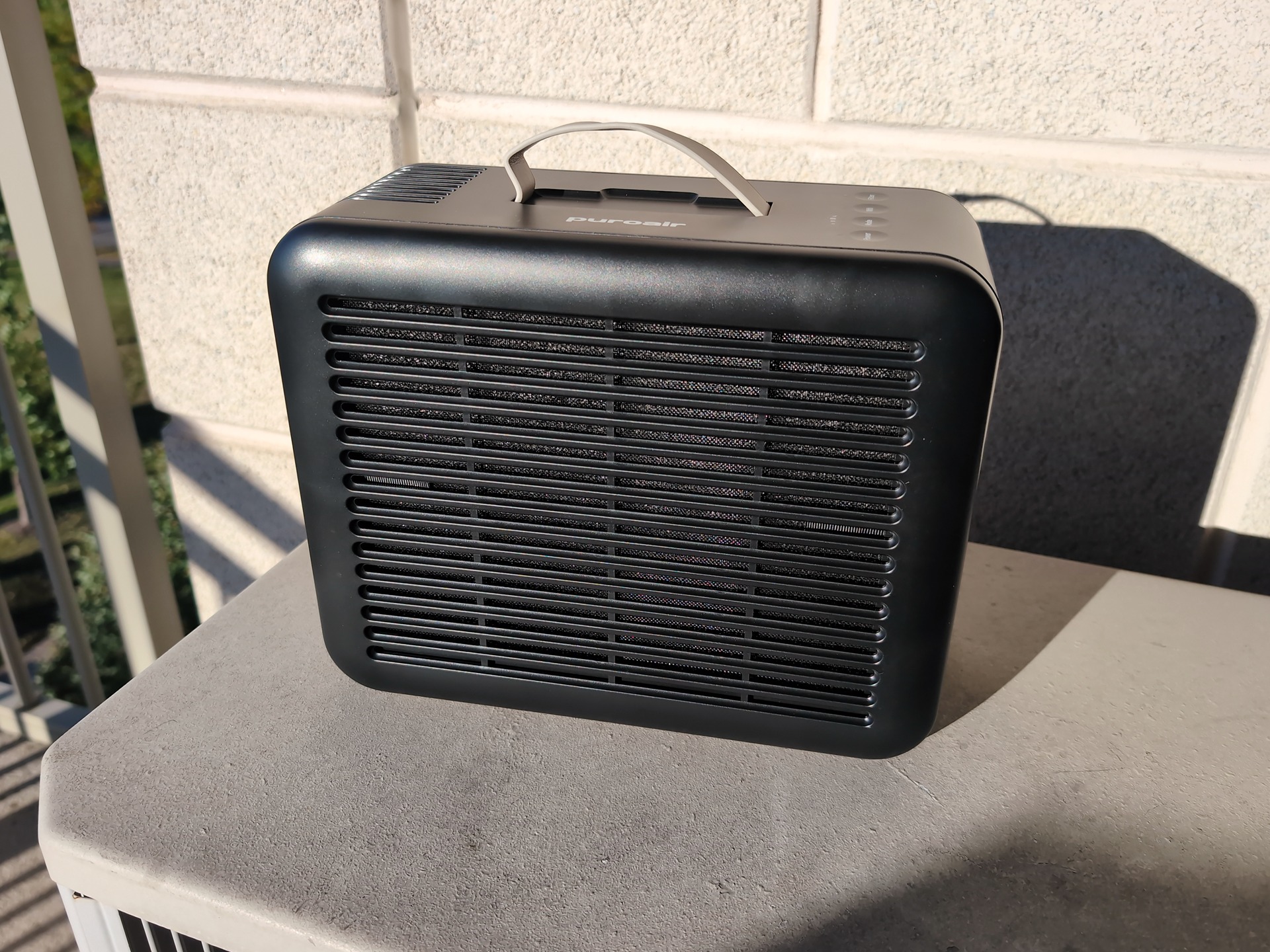
The PuroAir 100i is a compact, app-enabled HEPA purifier built for small rooms, and every performance number on its product page, the 550 square feet of coverage, the 22 dB noise floor, the 99.9% filtration figure, is a vendor claim dressed up with superscript footnotes and zero independent verification. No third-party CADR data, no independent noise measurement, no long-term testing exists for the 100i itself. The only independent lab results on any PuroAir unit belong to its bigger sibling, the 240, and those results earned one star out of five.
So here’s the method for this piece: go claim by claim through the 100i’s page, use the 240’s testing as the brand’s only calibration case, and land on a verdict with conditions attached. Those little superscript footnotes on the spec sheet are the artifact to watch for. They look like citations. They’re not.
Key Takeaways
No independent testing of the 100i exists; the only lab data on any PuroAir unit is HouseFresh‘s one-star review of the sibling 240, whose AHAM-verified coverage was 284 sq ft against 1,115 advertised.
The 100i is the only PuroAir model with app, Wi-Fi, and voice control, but the Levoit Core 300S delivers app support for roughly $20 less.
The 90-day filter cadence is the real ownership cost; the 240 ran $231.99 a year all-in, and PuroAir hasn’t published the 100i’s own filter price, so its total cost can’t be computed yet.
Table of Contents
Design, specs, and build
On paper the 100i is a small black box: 11.0 x 8.9 x 4.9 inches, 16W at 120V, Bluetooth listed on the spec sheet, four fan modes, free shipping. The suitcase-style handle and leather strap are real design choices, not decoration; this thing is meant to move. The only hands-on impression on record comes from Jay Reviews on YouTube, who flagged that it’s unusually lightweight for a unit claiming ~550 sq ft of capacity, noted a long power cable, and spotted a foam seal around the filter.
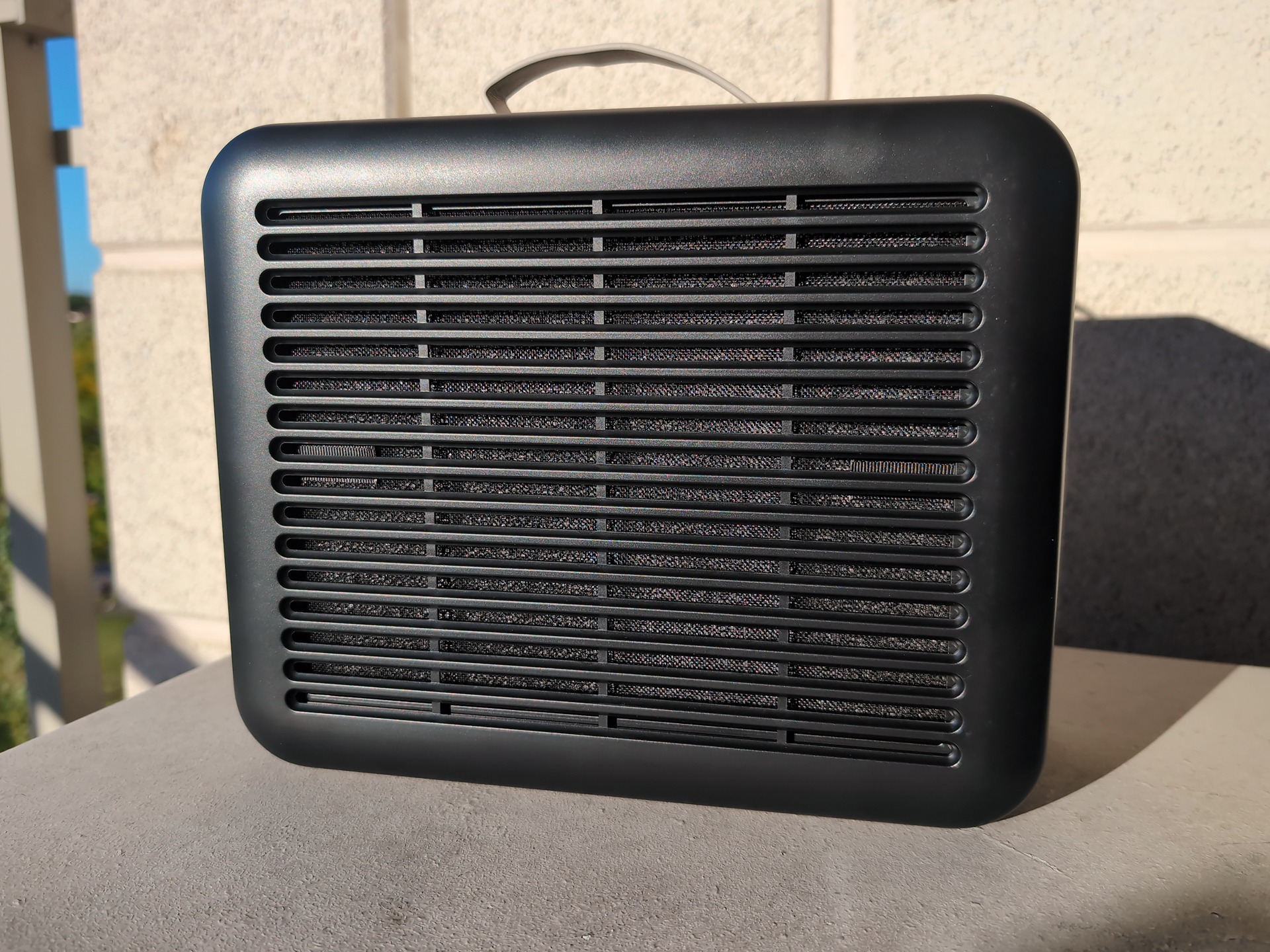
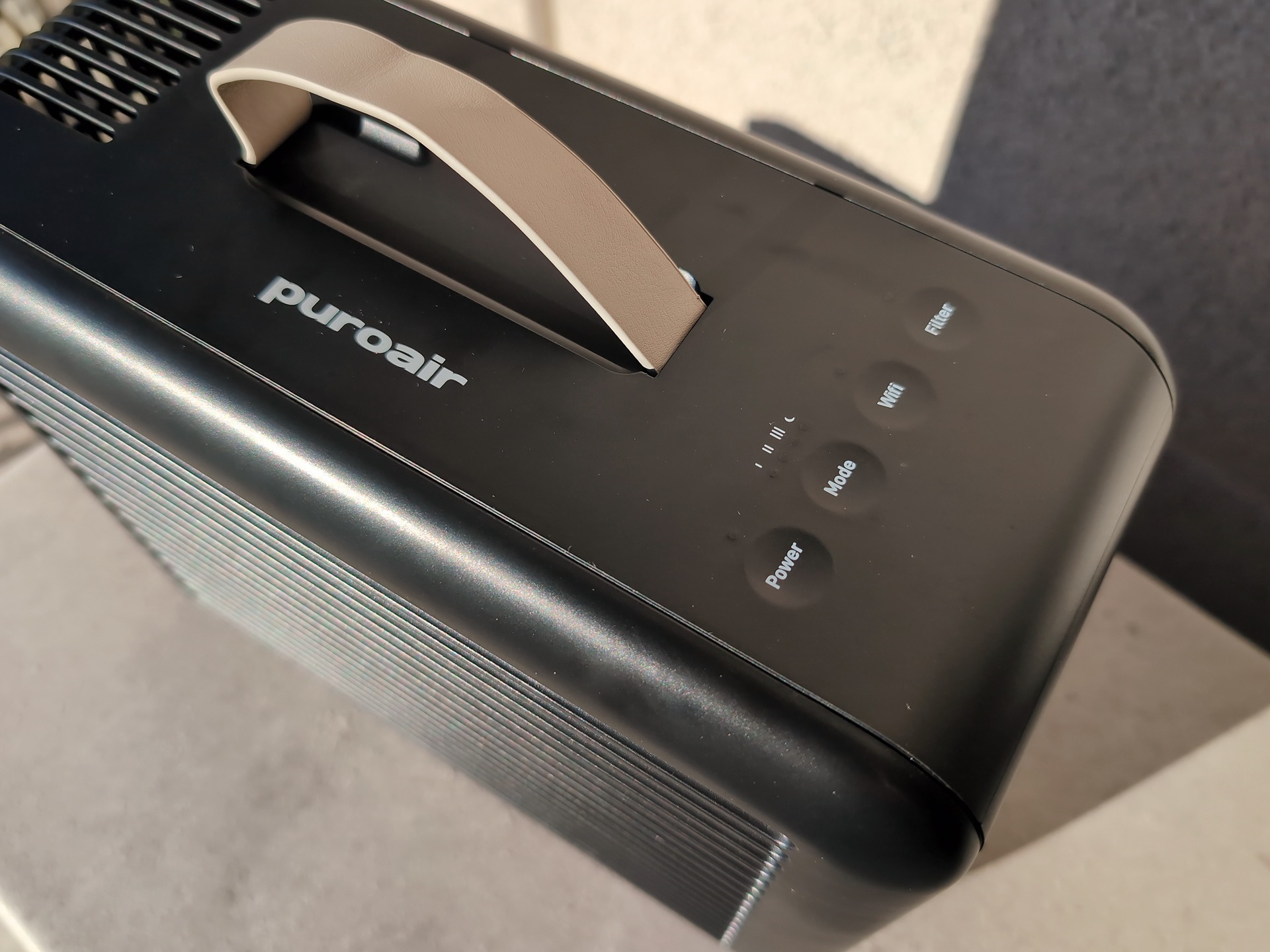
That last detail quietly raises the coverage question I’ll get to. There’s also a manual panel as the no-app fallback: power, fan levels 1 through 3, sleep/night mode, a Wi-Fi button, and a filter button that blinks red when a swap is due.
Setting up the 100i: first-run steps and pitfalls
Setup comes down to order: bag off the filter before you power it on, 8 inches of clearance from the walls, then hold the Wi-Fi button to pair with the app. That’s the whole game.
Here’s what I’d do. Unbag the filter first, because running it with the bag on chokes the airflow and you’ll misread the symptoms as a defect. Give it breathing room from the walls so air actually circulates instead of recirculating a corner. Wipe the exterior with a soft dry cloth when it needs it, no solutions, no disassembly. Then hold the Wi-Fi button to pair with the PuroAir App, which I’ll cover in the smart-features section.
Quick test: Weak airflow right after setup usually means the filter bag is still on or the indicator wasn’t reset with a 3-second hold.
The documented failure pattern is exactly what you’d guess: someone powers it on with the bag still on, sees weak airflow or a blinking red filter light, and assumes the unit is broken. One verified buyer, Ellen M., hit a blinking red light right after installing a brand-new filter, and support walked her through troubleshooting. Likely culprit is the indicator reset, which takes a 3-second button hold that’s easy to miss.
Filtration claims: what’s verified and what isn’t
If you’re shopping this for allergies or asthma, know up front: the health case rests entirely on vendor claims and buyer anecdotes. No independent allergy-performance testing exists for the 100i.
The filter itself is three layers stacked in one cartridge, and it works like a shop vac works. The pre-filter, the pre-screen layer, catches the visible junk, dust, pet hair, carpet fibers, lint, the stuff you can see on a shelf after a week. The HEPA layer behind it does the invisible work on microscopic particles, and that’s the layer that matters most. CarbonTech activated carbon is the smell layer, handling cooking, pets, cleaning products, the reason your place doesn’t smell like last night’s dinner. CarbonTech is a trademarked name for a standard material, so don’t let the ™ do extra work.
The 99.9%-down-to-0.1-micron claim covering PM1, PM2.5, and PM10 is PuroAir’s marketing, footnoted on their own page. It’s their number. Moving on.
PuroAir led with a “10x better than H13” claim for its H14 filter, and HouseFresh called it untrue: in the same unit, cheaper H13 filters cleaned the test room 3 minutes faster than the OEM H14. Higher HEPA grades restrict airflow in portable purifiers, so the headline grade is a marketing construct, not an upgrade.
Room coverage: can you trust 550 sq ft?
Maybe, and only if you size it conservatively. The 550-square-feet-in-an-hour figure is advertised with a vendor footnote, and there’s no published AHAM VERIFIDE CADR data for the 100i.
AHAM VERIFIDE CADR is the industry’s independent measurement of how much clean air a unit actually delivers, verified by the Association of Home Appliance Manufacturers and published in the ENERGY STAR directory. It’s checkable. When a brand skips it, you’re left with a coverage number only they can vouch for.
Here’s the calibration case. The 240 advertised 1,115 sq ft. Its AHAM CADR came back at 183 CFM dust, 181 smoke, 204 pollen, which supports 284 sq ft at the EPA (Environmental Protection Agency)-recommended 4.8 air changes per hour. At the advertised size, that’s roughly one air change per hour, a roughly 4x overstatement.
Convert CADR to honest room size at 4.8 ACH and you get a real number. Until independent CADR exists for the 100i, treat 550 sq ft as unverified, not false.
All vendor figures: 100i at 550, 130i at 600, 240 at 1,000 (1,115 advertised elsewhere), 400 at 2,000, Whole Home at 3,000, Whole Home+ at 4,000. The 240’s own numbers don’t even agree with each other.
Is the PuroAir 100i quiet enough for sleeping?
The PuroAir 100i’s advertised 22 dB describes its Sleep mode only. That’s the lowest-speed figure, marketed as “optimal white noise for bedrooms,” and the claim that it stays quiet even at max power is the vendor’s, not a measurement.
The brand’s documented pattern on the 240 is why that matters. PuroAir quoted only the lowest speed in its marketing while instrumented measurement found 36.9, 42.2, and 52.2 dBA at speeds 1 through 3, taken from 3 feet with a sound meter. The 100i has four fan modes, Low, Medium, High, Sleep, which means the mode doing the actual air cleaning is not the mode being advertised. No independent high-speed measurement exists for the 100i itself, so I’m not going to pretend the 240’s numbers are the 100i’s results. They’re the reason to read the spec as a floor, not a range.
What’s useful: Sleep Mode dims the lights and drops the fan, and you can trigger it by voice before bed without getting up. That’s a real 11pm feature. Fair warning for everything else: if you’re clearing cooking smoke or pet odors, you’ll hear the unit on High. Plan for it.
Smart features: app, voice control, and what they’re worth
Holding the Wi-Fi button to pair unlocks the PuroAir App: remote power and fan control from anywhere, filter-life tracking that starts at 100%, replacement ordering, in-app support, and automated notifications when the filter’s due. Alexa and Google Assistant both work. The command worth having: Sleep Mode from bed. Bluetooth is on the spec sheet without a spelled-out use, so I won’t invent one.
The 100i is the only PuroAir model with any of this, while the 240, Amazon’s best-selling air purifier of 2023, has no app support at all. The Levoit Core 300S delivers app support for roughly $20 less, so the 100i’s actual differentiator may be portability-plus-smarts together, not smarts alone.
Filter costs: 90-day replacements, generics, and running cost
The PuroAir 100i needs a new filter every 90 days, and that cadence, not electricity, is the dominant ownership cost. Filters are disposable, not washable, and washing wrecks the media, so don’t. The swap takes minutes: pull the old one, unbag the new, hold the button about 3 seconds to reset the indicator. Usage, pets, and smoke all shorten filter life. The app tracks it, and the panel’s red light blinks when it’s time. On generics: PuroAir warns knockoffs fit badly, bypass air, and clog faster, but HouseFresh’s testing on the 240 found generic HEPA 13 filters cost under $40 a year and beat the OEM H14 in the same unit, so the vendor warning deserves some skepticism.
Then the genuine-versus-generic question, with both sides attributed. PuroAir warns that knockoffs fit badly, let air bypass, use lower-grade carbon, and clog faster. Note they would say that. HouseFresh‘s testing on the 240 found generic HEPA 13 filters cut replacement costs to under $40 a year and outperformed the OEM H14 in the same unit. One claim has testing behind it.
Cost check: The 240 ran $231.99 a year all-in on OEM filters; generics cut replacement costs to under $40 a year in the same unit.
The 240 is the family’s cost benchmark: $48 per quarter in OEM filters ($192 a year), $39.99 a year in energy at max speed, $231.99 total, the highest running cost of any unit compared. The 100i’s own purchase and filter prices are missing from every source I have, so its total cost of ownership can’t be computed. At 16W, electricity is a phone-charger-level cost; running it 24/7 mainly accelerates filter replacement.
Is PuroAir a good air purifier or overhyped marketing?
No, PuroAir’s track record doesn’t yet support taking its specs at face value. Its flagship 240 scored 1/5 stars in independent testing, and that’s the only lab evidence anyone has on this brand.
The 240 was Amazon’s best-selling air purifier of 2023, with estimated sales around $56M per AMZScout, $34M from the two-device set at $349.99 plus $22M single-unit, outselling the Levoit Core 300 by roughly $23M. And in HouseFresh‘s testing, it cleaned a 728 cu ft room in 48 to 51 minutes at top speed, 11 minutes slower than the $78 Winix A230. Popularity and performance are not the same conversation.
The 240’s internals and filter near-clone the Levoit Core 300, built with thinner plastic and sharper edges. Its air sensor is a Cubic PM1006 V1.1, the same part in IKEA’s $12 VINDRIKTNING, where the sensor costs under $3. You’re paying a premium for worse execution of someone else’s design.
The marketing red flags, concretely:
- No company ownership transparency anywhere.
- Absent from the Clean Air Stars database of 680 devices.
- The “Tesla of air purifiers” line leans on quotes from Money.com, the LA Times, Popular Science, and USA Today that can’t be verified.
- No third-party lab reports verify the H14 classification.
- Harvard University and MIT logos sat on PuroAir’s site; HouseFresh‘s inquiries went unanswered, and the logos quietly disappeared during the review.
The positive coverage is promotional. The emilyreviews.com 240 review is sponsored with affiliate links and repeats the contradicted 1,115 sq ft claim. The bacon detail is fun: cooking bacon flipped the air indicator from green to yellow and the fan sped up on its own. Enjoy the anecdote; discount the coverage claim. The gift-guide placement repeats vendor specs verbatim, and that placement is a Father’s Day gift guide, not independent testing.
Testimonials get graded honestly too. Cathi D. reports her kids’ severe asthma and allergies improved within 72 hours and they stopped daily breathing treatments by day three, then bought one per room. That’s her experience, moving as it is, not a medical claim. The AI summary of 100 recent reviews pointing at quiet, compact, fresher air comes from the vendor’s own curated pool.
And the evidence vacuum is real: no Reddit threads or independent owner consensus exist in the available material. The only hands-on 100i coverage anywhere is the Jay Reviews video, which carries more weight than the product page but isn’t lab-grade testing.
100i vs 240: which model should you buy?
The PuroAir 100i is the smarter pick within PuroAir’s lineup, while the 240 is the larger option that independent testing failed. The table fills in the details.
| PuroAir 100i | PuroAir 240 | |
|---|---|---|
| App, Wi-Fi, voice control | Yes (only smart model in the lineup) | No (no app support) |
| Advertised coverage | 550 sq ft (vendor figure) | 1,000 to 1,115 sq ft (vendor figures that disagree) |
| AHAM-verified coverage | No (no CADR data published) | Yes (284 sq ft) |
| Independent test rating | No (untested) | Yes (1/5 stars, HouseFresh) |
| Annual ownership cost | No (prices not published) | Yes ($231.99/yr, highest compared) |
| Trial and warranty | Yes (100-day guarantee, 2-year warranty) | Partial (30-day trial, 1-year warranty) |
Prices may vary; the 240 currently sells for $159, down from a $229.99 launch, and the 100i’s pricing isn’t in the available material.
What the 240’s record means for the 100i: same brand, same marketing patterns, footnoted coverage claims, lowest-speed-only noise marketing. But the 100i’s own specs remain unverified, not disproven. The burden of proof sits with the vendor, and they haven’t picked it up for this model. Ladder context for upsell awareness, all vendor figures: the 130i claims 600 sq ft, the PuroAir 400 claims 2,000, and the Whole Home bundles claim 3,000 and 4,000.
If you want a smart purifier for a small room, the 100i is the only PuroAir candidate. The Core 300S comparison in the next section prices that choice.
Alternatives: tested purifiers that beat it on value
For a small bedroom, the Levoit Core 300S matches the 100i’s app support for roughly $20 less. That’s the head-to-head, and the framework behind it is cost per CADR CFM plus annual ownership cost, meaning how much clean air each dollar actually buys. On the tested numbers, the 240 runs $1.15 per CFM against the Levoit Core 300’s $0.68, the Winix A231’s $0.64, the Taotronics AP003’s $0.49, and a DIY Corsi-Rosenthal box’s $0.18. The 100i’s counter in that fight is portability, the handle, the strap, the small footprint, plus a larger claimed coverage figure with no verified CADR behind it.
The tested ladder, per HouseFresh: the Core 300 or Winix A230 under $100, and the $78 A230 beat the 240 by 11 minutes; the Vital 200S or Winix 5500-2 up to $180 for most people. A cheaper purifier wins whenever verified CADR-per-dollar matters more to you than smarts or portability. And this isn’t unprecedented: the 2023 Molekule false-advertising class action and Sharper Image’s ionizer problems came before.
Warranty and the 100 Day Cleaner Air Guarantee
The terms, in order: a 2-Year Warranty that requires registration, a Lifetime Warranty that only comes with an active filter subscription through Subscribe and Save, which also pays 5% back per refill, and a 100 Day Cleaner Air Guarantee with a full refund, no questions asked, plus free shipping. For contrast, the 240 carries a 30-day home trial and a 1-year warranty, so the 100i’s terms are better.
The strongest warranty tier is contractually tied to the recurring filter subscription, which means the “lifetime” promise and the highest-margin revenue stream are the same mechanism. Read it as what it is: the best coverage requires a standing order. The 100-day guarantee works as risk reversal for a brand with no independent performance verification, and it’s useful for exactly that. It doesn’t substitute for verified specs, and a full refund window isn’t the same thing as a unit that earns its coverage number.
Frequently Asked Questions
How many hours a day should you run an air purifier in your house?
The honest sizing math uses the EPA-recommended 4.8 air changes per hour, which is why verified CADR matters more than advertised square footage. At 16W, the 100i’s electricity cost is phone-charger-level, so running it continuously is cheap in energy terms. The real constraint is filter life: usage, pets, and smoke all shorten the 90-day replacement cadence.
Is the PuroAir 100i quiet enough for sleeping, really?
The advertised 22 dB describes Sleep mode only, the lowest-speed figure, and the claim that it stays quiet at max power is the vendor’s, not a measurement. On the sibling 240, instrumented testing found 36.9 to 52.2 dBA across speeds 1 through 3, which is why the spec should be read as a floor, not a range. Sleep Mode genuinely dims lights and drops the fan, and you can trigger it by voice from bed, but expect to hear the unit on High when clearing smoke or odors.

