The Perfume Obsessed Person, Explained
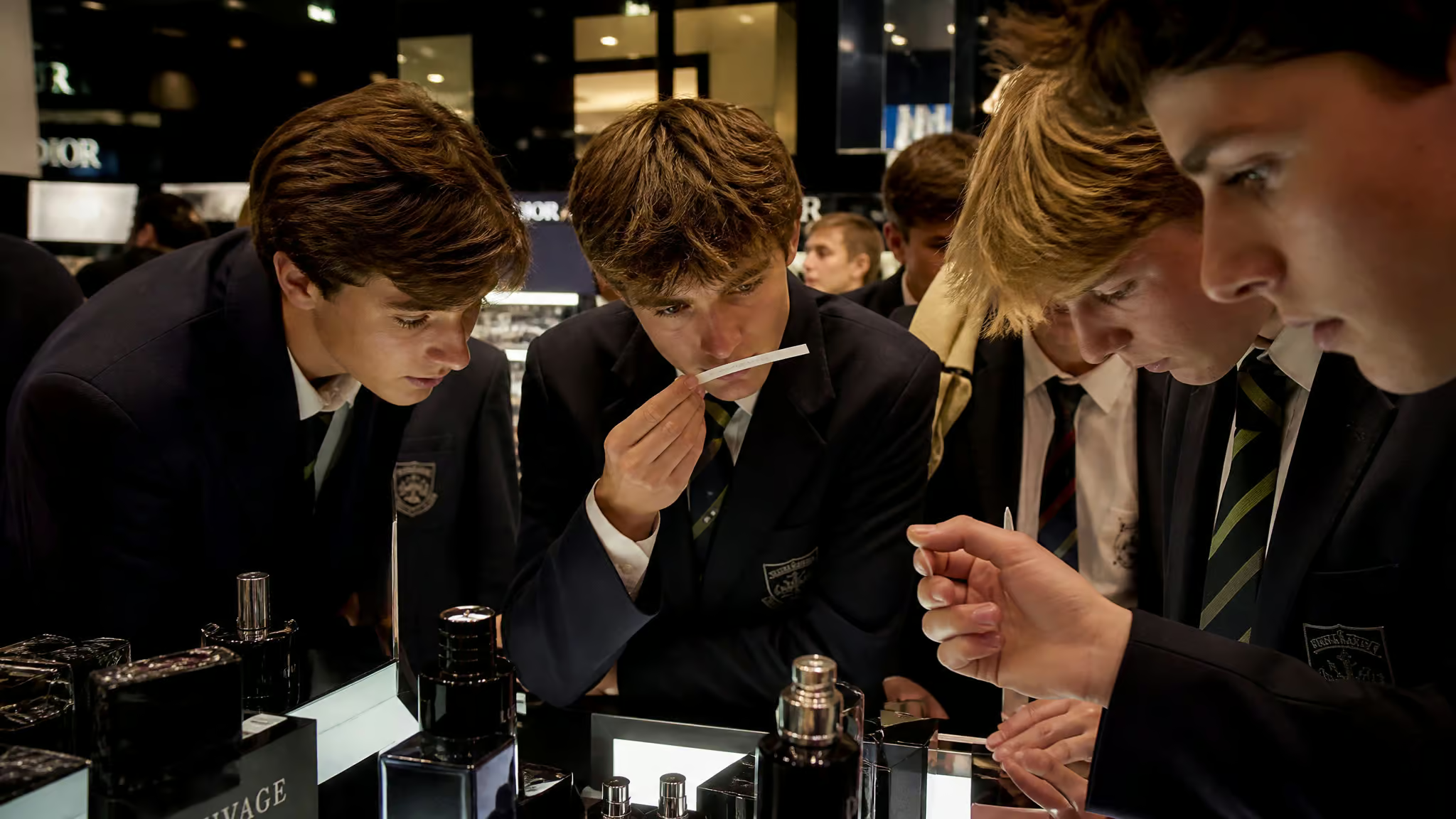
You see them at the department store. A pack of teenage boys in school uniforms, hunched over the fragrance counter like it’s a chemistry lab. They’re not browsing. They’re testing with intent. This scene is now a defining image of the fragrance boom.
They’ll spray something on a card, sniff it, pass it to the next guy, and start talking about base notes and drydowns with a fluency that would make most adults feel underqualified. This is the perfume obsessed person made flesh: not a niche collector in a tweed jacket, but a group of teenagers who’ve turned cologne into a passion, a social club, and a way of saying who they are without saying a word.
And the salespeople? They’re fascinated and exhausted. The testers are constantly empty. Some stores have resorted to locking perfumes behind glass because of what one retailer delicately called “stock shrinkage.”
It’s a concrete sign of the cultural shift that’s been building since 2020. Fragrance is no longer an afterthought in the grooming routine. It’s the fastest-growing category in beauty, a daily ritual for millions, and a full-blown cultural phenomenon.
So what’s actually going on here? Is this just hype, or is something real happening? After watching this culture develop from the inside, I can tell you: it’s a bit of both, but the substance underneath is more interesting than the noise around it.
Key Takeaways
A perfume obsessed person isn’t defined by collection size; it’s someone who uses scent as a personal and performative identity tool, the most accessible form of luxury in modern culture.
Teenage boys are driving the boom with genuine fragrance literacy, spending 26% more year-over-year and preferring premium scents, often on parents’ credit cards, turning department stores into de facto classrooms.
You can explore fragrance deeply without spending $465: dupe brands like Dossier and Fine’ry offer inspired-by alternatives, and classic scents remain affordable entry points for building a rotation.
Table of Contents
What Defines a Perfume Obsessed Person, Really
Let’s get the definition out of the way. A perfume obsessed person isn’t measured by how many bottles they own. It’s measured by what scent does for them. These are people who use fragrance as a tool for identity.
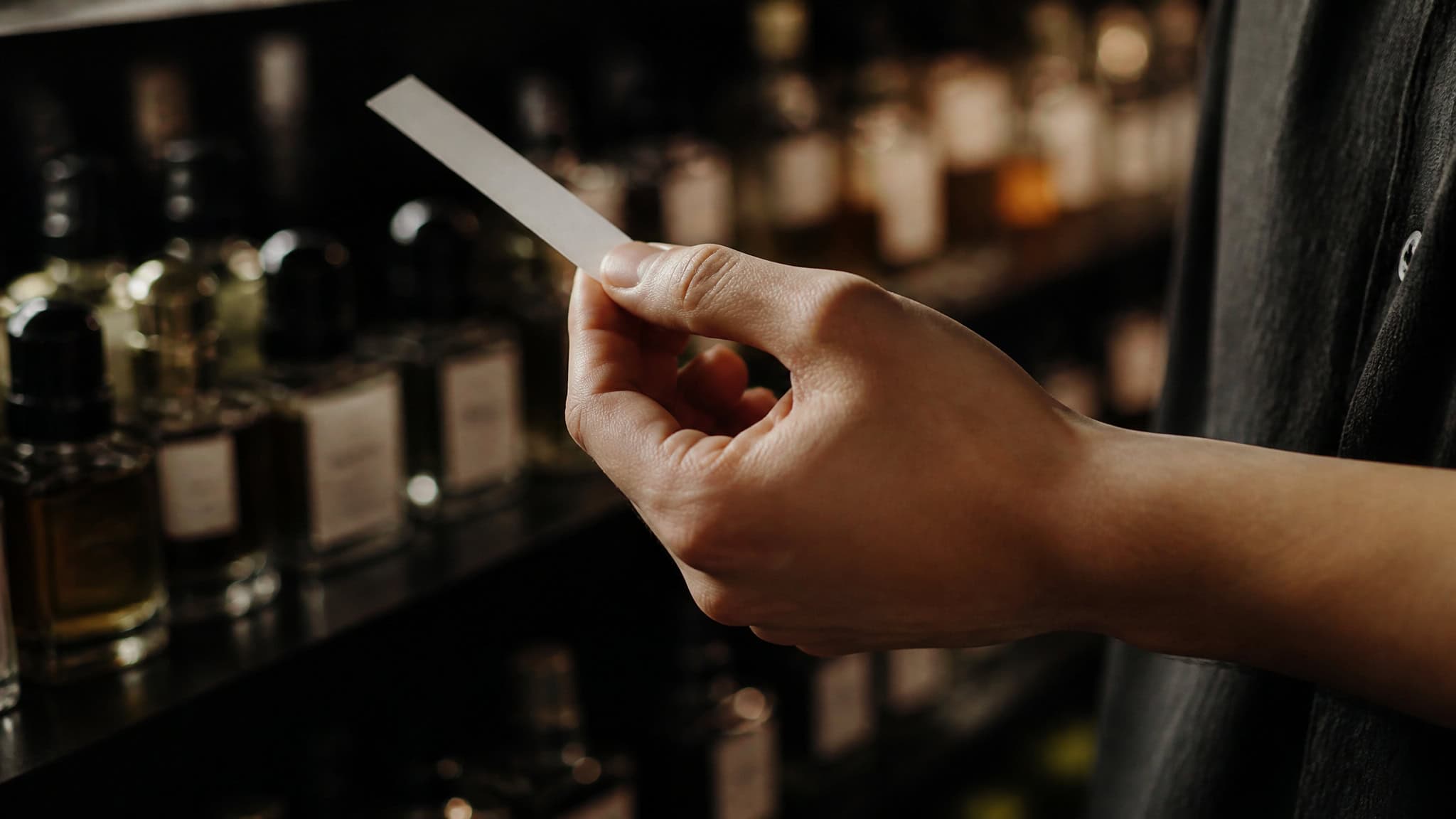
They’re not just smelling good for an occasion. They’re using scent to tell a story about who they are, to capture a mood, or to become a version of themselves that feels more aligned.
The cliché is true: scent is tied to memory. You smell something and you’re back in a specific moment. But it goes further than that. It becomes tied to identity.
People want a perfume that smells like them, “or even like me, but better,” as one observer put it. It’s a way to project intensity, to leave a marker, to have a signature that others will remember long after you’ve left the room.
This is what makes perfume so unique. It’s personal because you wear it on your skin. It’s performative because everyone else smells it. It’s external, displayed on the body like clothes or jewelry, and it’s tangled up with class, gender, and sexuality in ways that few other products are.
Since 2020, perfume’s cultural prominence has gone from background to spotlight. The church of fragrance enthusiasts expanded massively.
There’s also a practical benefit that gets overlooked. Scent training measurably boosts memory and vocabulary. This isn’t just consumerism. It’s a hobby with real cognitive payoffs.
And here’s the crucial part: you don’t need a hundred bottles or a Ph. D. to participate, the door is wide open.
The Smellmaxxing Phenomenon. Teen Boys Who Know More Than the Staff
Why are young men so obsessed with cologne? The short answer is that they’ve found a space where they can become experts, and they’re running with it. The department store has become their classroom and social club.
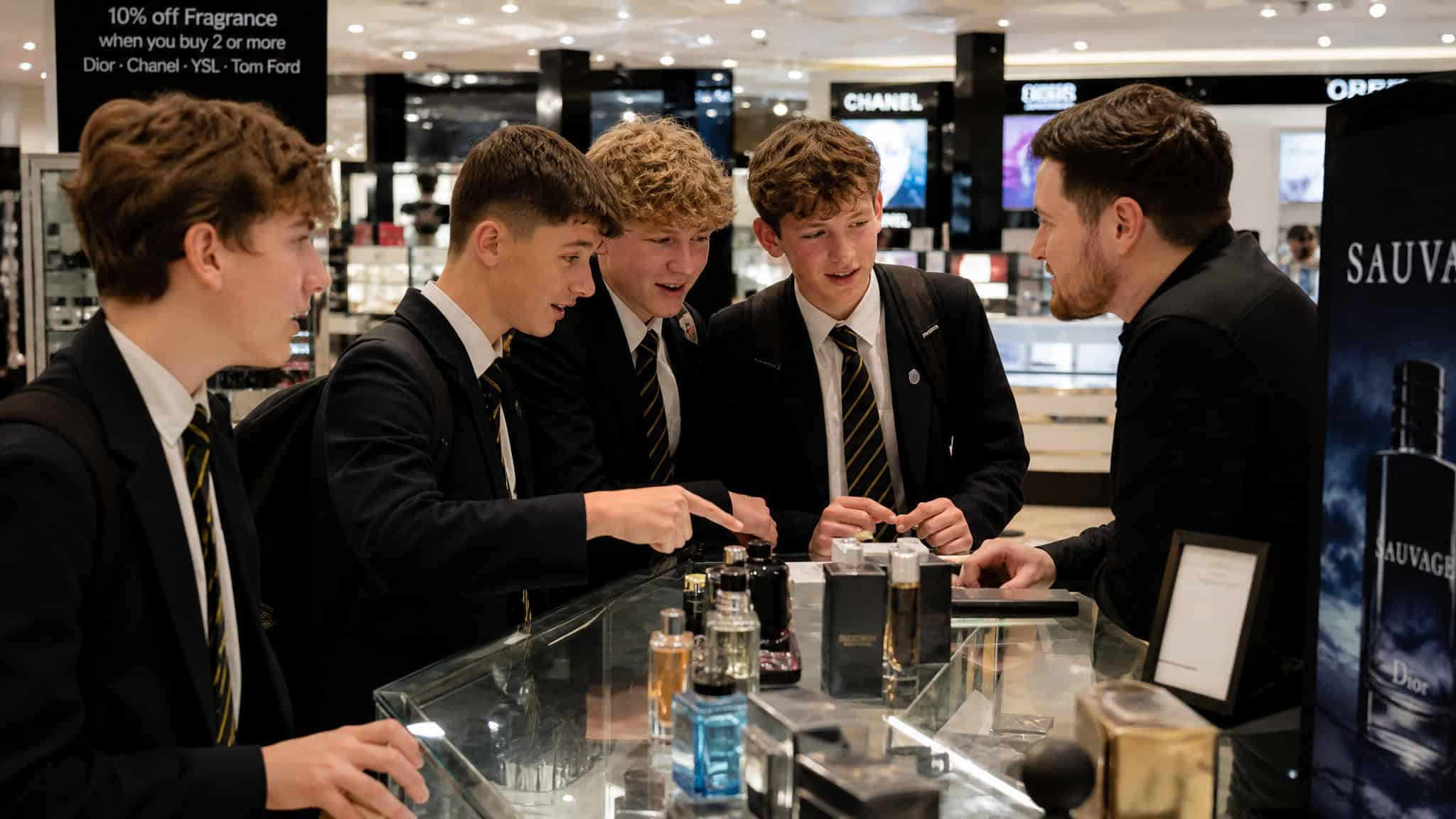
I watched a group of about seven schoolboys approach a counter. They weren’t dabbing on whatever was closest. They knew the names of perfumers. They discussed Alberto Morillas like he was a film director. One of them sprayed Gucci Guilty Absolute and laughed at its band-aid smell, but he knew why it smelled that way.
He understood the leather accord. These guys knew more about the products than the sales assistant did. It wasn’t even close.
This isn’t a fluke. Salespeople across the industry report the same pattern: boys arriving every weekday, often half an hour after the school bell rings, testing men’s fragrances with military efficiency. They come back on weekends with their parents to actually buy. The result is that men’s fragrances like Le Male, Sauvage, Versace, and Tom Ford have become bestsellers on the back of this demand.
The data backs up the anecdote. In a Piper Sandler survey of over 13,500 teens, fragrance was the fastest-growing beauty category, up 25% year-over-year. Teen boys specifically increased their spending by 26%, and they’re gravitating to premium scents, sometimes using their parents’ credit cards to make the leap. One store president noted the trend: “We noticed them arriving, sometimes with parents’ credit cards, and purchasing prestige fragrances.”
The key counterpoint here is that these aren’t passive consumers being manipulated by ads. They’re building genuine fragrance literacy that rivals or exceeds the people selling to them. Yes, they’re spending money. But at the center of it is real knowledge.
Spicebomb
A solid reference point for a guy who wants a bold, spicy scent without going niche. It’s a mainstream pick that still has character. It’s the kind of fragrance that makes a statement without requiring you to explain yourself.
Luna Rossa Black
A versatile, slightly darker scent that works for evenings without being overpowering. A safe but not boring choice. It signals that you understand the difference between a daytime freshie and a nighttime mood-setter.
Versace Eros
This is the kind of scent that gets noticed, maybe too much. It’s loud, confident, and popular for a reason. But it’s not subtle. It’s the fragrance equivalent of walking into a room and turning on all the lights. If you’re learning to build a collection, it’s a lesson in projection.
Gucci pour Homme
A classic reference point for a certain style of masculine fragrance. It’s part of the canon that these teen enthusiasts are studying.
Gucci Guilty Absolute
An intense, leathery scent that isn’t for everyone. It’s a good example of a bold choice, the kind of thing you train your nose to appreciate. The fact that a group of teen boys was debating its merits shows how deep their curiosity runs.
Sauvage by Dior
A modern powerhouse that’s everywhere. It’s a safe recommendation for a guy who wants something that works, but it’s not unique. It’s popular for a reason. It’s the baseline that a lot of these young enthusiasts start from before they go exploring.
Scent as Identity. The Death of the Signature Scent
Building a signature scent used to mean finding the one bottle that you wear until the day you die. That premise is outdated. The signature scent is all but dead. It’s been replaced by something more practical: the fragrance wardrobe.
The concrete proof is in the bottle count. Before Covid, the average beauty shopper owned 2.5 bottles of perfume. Now it’s six to ten, according to Estée Lauder insights. That’s a massive behavioral shift.
People aren’t choosing a single identity. They’re curating several, and they pick a scent based on mood, occasion, and the specific version of themselves they want to present.
Scent layering, formerly called fragrance combining, is core to this approach. It’s been part of Jo Malone London’s DNA from the start. The idea is that you don’t just wear one fragrance. You stack them.
A base, a top note, something to make it yours. This builds sales, but it also builds a more personal connection to scent. Nearly half of U.S. adults apply perfume daily, but that number jumps to 79% for people aged 18 to 34, according to Mintel. Young people aren’t treating scent as an occasional extra. It’s a daily tool.
And the motivation has shifted. Fragrance used to be about attraction. Now it’s about defining who you are and what you stand for. About 57% of consumers in the luxury category are seeking emotional enhancement as part of their experience.
They’re not asking, “Will this get me a compliment?” They’re asking, “Does this make me feel more like myself, or more like who I want to be?”
The Digital Fragrance Ecosystem. TikTok Sells What You Can’t Smell
Here’s the paradox at the heart of the fragrance boom: you can’t smell through a screen. And yet, #PerfumeTok has billions of views. TikTok is where a huge chunk of this culture is being built. People describe scents in emotional, evocative language. They promise transformation.
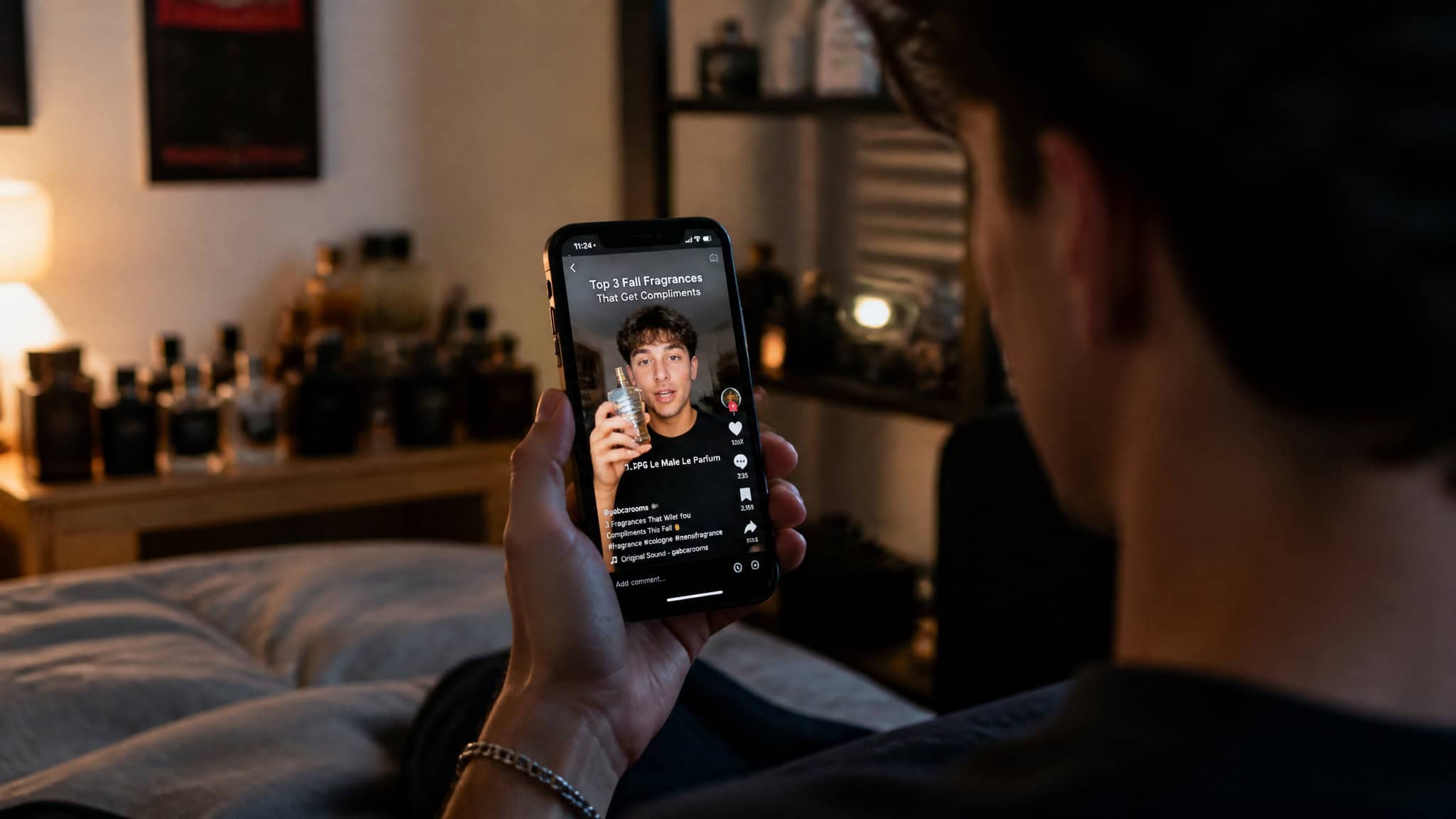
And it works. TikTok Shop has sold over $100 million in fragrances, fusing content with commerce in a way that’s rewired how people buy.
So, are fragrance influencers trustworthy? It depends. Some of them are shills who will hype anything for a check. Some of them are genuinely knowledgeable.
The tell is whether they can articulate why a scent works. Can they talk about the notes, the perfumer, the context? Or are they just saying “this is a compliment magnet”? The latter is a red flag. The former is worth your time.
The community has formed around these trusted voices. Finn Batchelor of FB Fragrances has over a million followers. Jeremy Fragrance, polarizing as he is, sits at over 13 million. Jatin Arora has 1.9 million. Beyond the big platforms, niche communities on Discord have become spaces where enthusiasts trade recommendations and dissect new releases in real time.
And Emelia O’Toole, a.k.a. Professor Perfume, has built over 400,000 followers since starting in 2020. When she started, the online community was small. Now it’s a behemoth.
As one observer noted, “There wasn’t really an established #PerfumeTok yet.” Now it’s a dominant force.
Young people often discover perfume through friends or influencers like Jeremy Fragrance. It’s a social thing, not a lecture. You’ve got to filter out the hype, but there’s real knowledge being built here. The community has created a shared vocabulary that lets people talk about scent with precision. Brands like Lattafa have become cult favorites in these circles, offering bold, affordable alternatives to Western designer scents.
d’Annam White Rice
This experimental niche scent is a tribute to Vietnam’s cultural symbol. It’s getting attention because it’s proof that buyers are going niche and unconventional, not just chasing the big designer names. It’s the kind of thing you discover through the digital ecosystem and then have to actively seek out to smell in person.
The Business of Scent. Why Fragrance Overtook Makeup
Are expensive perfumes worth the money? It depends on the bottle. But first, let’s look at the market. According to Circana, fragrance was the fastest-growing beauty category in 2024, officially usurping makeup.
Prestige scent sales jumped 12% to command 28% of total prestige beauty sales, approaching $34 billion. Mass fragrance sales clocked in at about 9% growth. To keep up with that demand, how to smell good often comes down to layering: start with a heavy base scent and add lighter notes on top, and use dry shampoo or hair perfume for quick refreshes during the day.
There’s also a strange, surprising driver: GLP-1 users are buying 23% more perfume. It makes sense when you think about it. When you lose the pleasure of food, you seek sensory pleasure elsewhere. Scent becomes a substitute.
It’s a niche stat, but it shows how deep the psychology runs. Anna Mayo, a fragrance industry analyst, has noted that this shift reflects a broader move toward scent as a primary source of daily pleasure.
So back to the money question. Some luxury fragrances are worth the price because of the ingredient quality and complexity. Some are $465 bottles where you’re paying for the name. The gap between “smells amazing” and “smells like $465” is often narrower than people think.
Luxury brands account for 12% of prestige fragrance sales, and they’re growing faster than the rest. People are buying them. But the dupe market exists for a reason, and it’s thriving. Oliver Chen of TD Cowen points out that fragrance has become a key growth driver for retailers, with premium scents outperforming other beauty segments.
Good Girl Blush Elixir
This is the top-selling fragrance launch of last year. It’s a Carolina Herrera product that sells for $175 and pulled in $39 million. It’s proof that premium pricing isn’t slowing demand. People want the experience, and they’re willing to pay for it. The question is whether you should be one of them.
Feeling the Smell. Perfume as Mood, Wellness, and Emotion
The marketing has pivoted to “fragrance as emotion management.” It’s the wellness-ification of perfume, a distinct product trend. Close to half of consumers are interested in fragrances that provide a physical wellness benefit: de-stressing, better sleep. About 57% of consumers in the luxury category are seeking emotion enhancement. They want to feel something, and for many, that pursuit now involves smellmaxxing.
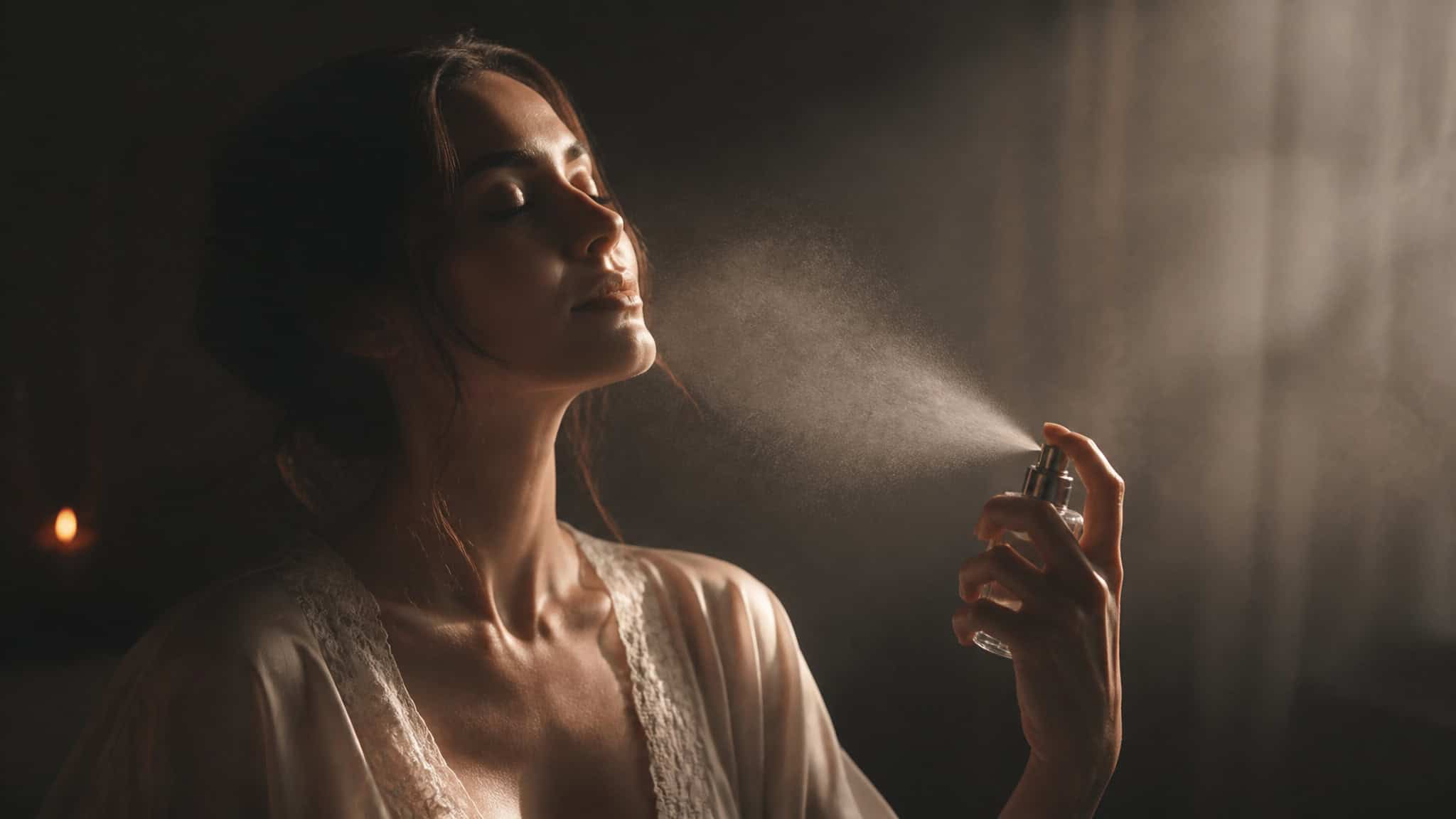
Brands are responding with neuroscience-backed ingredients. Charlotte Tilbury and the Neu Co. are incorporating these “mood molecules” into their scents. And there’s real medical proof here. Clinique Happy is a fragrance that has been shown to make people feel joyful.
As one industry insider said, “There is now real medical proof, without even asking a consumer, of an emotional response to a scent or an ingredient.” Moroccanoil has also entered this space, marketing its fragrances as mood-enhancing tools for daily self-care.
The shift is real. Fragrance isn’t just about smelling good. It’s about feeling something. That’s a powerful promise, and it’s changing what people buy.
Your Turn (Billie Eilish)
This is Billie Eilish’s fourth scent, launched at Ulta. It’s an example of celebrity fragrances still working, especially with younger buyers. It shows the power of a name, but also that the younger generation is engaging with scent as a part of their identity.
Go (Carolina Herrera)
A mood-driven launch from a mainstream house, showing that the big brands are leaning into the emotional angle, not just the niche players.
Clinique Happy
The proof point. There is real medical evidence that this scent triggers joy. It’s an accessible, affordable classic that validates the entire wellness angle.
The Dupe Economy, or Exploring Fragrance Without Going Broke
Here’s the price gap that explains the entire industry right now: Dossier’s Ambery Saffron costs under $50. It’s inspired by Baccarat Rouge 540, which costs $465. That’s the democratization of fragrance. Sales of affordable dupes of upscale perfumes have seen double-digit gains. The dupe economy is thriving.
This isn’t a new concept. Dupes have been around for decades. What changed is that they’ve achieved acceptance. Fine’ry, sold exclusively at Target, was created by Piyush Jain’s New York-based beauty incubator Maesa.
Its mission is to “democratize fragrance,” and it went viral on TikTok. Dossier got into Walmart through its Walmart Start accelerator program. Since 2019, Dossier has sold over 5 million bottles, including more than 700,000 units of Ambery Saffron alone.
There’s a cultural precedent here. Look at the success of the Wirkin, the Birkin bag-inspired dupe that took over social media. It normalized buying goods inspired by luxury items. Dupe culture has an upside.
There are two shopper types: some people buy the original, and some want value. But dupes can also be a trial. You buy the $50 version, fall in love with the scent profile, and eventually trade up. Dupes aren’t destroying luxury. They’re expanding the funnel.
And if you’re not even ready for a $50 bottle? There are accessible on-ramps: sample sets, scent swaps, decant sites, and free in-store sniffing. You don’t need a hundred bottles to love perfume. You can start smaller than that.
Birkin Bag
The luxury original. The ultimate status symbol. It’s the reference point for exclusivity and high price.
The Wirkin
The Walmart version of a Birkin. It’s a perfect example of dupe culture going mainstream. It normalized the idea that buying “inspired by” is okay.
Fine’ry
Sold exclusively at Target. Created by Maesa. Its mission is to democratize fragrance, and it went viral on TikTok.
Dossier
Discovered by Walmart through its accelerator. Has sold over 5 million bottles since 2019.
Ambery Saffron
Dossier’s best-seller, under $50, inspired by Baccarat Rouge 540.
Baccarat Rouge 540
The $465 original. The gold standard for dupes. It’s the bottle that everyone compares everything to.
The Journalism Gap. Why Mainstream Coverage Gets Fragrance Wrong
Most mainstream fragrance journalism is little more than advertising, thrown into the beauty or fashion editor’s domain without expertise. The result is coverage that misses the point. A prime example is The Cut’s piece, “Fragrance Culture is Starting To Stink.” It declares fragrance culture cynical and soulless. It claims “Commerce is the goal” of perfumery, and the target market of the perfume industry is Gen Z.
There’s a kernel of truth there, but the framing is off. The broad commentary about the changing nature of the industry is mostly accurate. But the article frames it all as negative, which feels shortsighted. Many of the issues the article raises are about the culture of capitalism, of which perfume is certainly a symptom but not a cause.
The tell is in one line. The author writes that she can’t evaluate a perfume without a Ph. D. That’s an anti-intellectualist dodge, you don’t need a Ph.
D. to appreciate a well-crafted scent; you need curiosity and a nose.
That’s what makes it accessible. What I found myself thinking at the end of reading that article was: I hope the author gives fragrance another go. The problem isn’t the hobby. It’s that mainstream media lacks the vocabulary and the expertise to analyze a legitimate art form.
Perfume appreciation doesn’t require a degree. It requires a willingness to engage.
When Obsession Crosses the Line. Health, Money, and Compulsion
Let’s be honest about the downsides. First, the health risks. The law does not require firms to list individual fragrance ingredients. You may not know if chemicals like phthalates are present.
A 2022 study found that allergic reactions are the most frequently reported risk tied to fragrance. Some colognes may contain chemicals linked to reproductive health issues, though more research is needed. It’s a fact most guys have no idea about.
Then there’s the financial pressure. There are $1,000 colognes on the market, like Jean Paul Gaultier’s. We’ve seen boys arriving at stores with their parents’ credit cards. Influencers aren’t immune either.
Jatin Arora, who runs The Real Cologne Boy, admitted to tricking his mom into buying three fragrances at Costco when he was 16. Generation Alpha influences household spending, and they’re not losing anything by asking for more.
The line between passion and compulsion gets blurry when the next bottle stops being about joy and starts being about the hit. The practical guardrails are simple: test on your skin before you commit. Buy decants. Wait before you buy full bottles.
Cap your budget. If you can’t stop, that’s a sign, not a badge of honor.
Classic Fragrances, Rediscovered. Affordable Entry Points
If you want to start a perfume collection on a budget, start with the classics. Gen Z is rediscovering old scents as affordable, timeless entry points, turning them into new status symbols. Le Male’s TikTok revival is the clearest example. Le Male has been described as the perfect gateway fragrance.
These aren’t dusty relics. They’re affordable, proven, and they work. A meaningful collection can start at £20 to £74, not $465. Nostalgia is a powerful driver here. These scents have history, and that gives them depth that a lot of new releases lack.
- Calvin Klein Obsession For Men, £37.99 for 125ml. A classic from the 90s that defined an era.
- Davidoff Cool Water, £31.99 for 125ml. A fresh, aquatic scent that has never truly gone out of style.
- Acqua di Gio by Giorgio Armani, £73 for 50ml. A massive bestseller for decades. Safe, reliable, and still relevant.
- Issey Miyake L’Eau D’Issey Pour Homme, £74 for 75ml. Another 90s classic, fresh and aquatic.
- Givenchy Gentleman Original, £91 for 100ml. A more formal, dressier scent that still holds up.
- Le Male by Jean Paul Gaultier, £63.99 for 75ml. The gateway fragrance. A bestseller for years.
- D&G Light Blue Pour Homme, £103 for 100ml. A solid warm-weather pick that’s popular for a reason.
- CK One by Calvin Klein, £55 for 100ml. The unisex fragrance that was groundbreaking in the 90s.
- Versace Blue Jeans, £20 for 75ml. A budget-friendly cult favorite.
- L’Air du Temps. A classic reference point for traditional perfumery.
- Chanel No. 5. The most famous fragrance in the world. A cultural icon.
- Floris No. 89, £90 for 50ml. Ian Fleming’s favorite. That’s a fun piece of trivia and a genuinely good scent.
The Future of Perfume Culture. From Obsession to Literacy
We’re heading toward a future where a generation discussing calone, ambroxan, and cis-hexonal 8 is building molecule-level perfume literacy. That’s the hyaluronic acid analogy. Fifteen years ago, marketing skincare with “hyaluronic acid” was unthinkable. Now it’s everywhere. Fragrance is heading the same way.
If a generation starts talking about these ingredients, it could change how perfume is marketed and sold. Brands might have to market with ingredient literacy instead of just pretty bottles and celebrity names. It’s a real possibility, not a certainty, but the foundation is being laid.
The industry is already responding. Jo Malone London has an AI scent advisor, powered by Google Gemini, that identifies neurological drivers of scent preference. Perfumers are using AI for regulatory and eco-challenges. Retail is evolving too.
Four Lauder fragrance brands, Tom Ford, Jo Malone London, Editions de Parfums Frédéric Malle, and Kilian Paris, opened on Prince Street in SoHo. The staff there have titles like “perfume curators,” “specialists,” “stylists,” and “scentertainers.” Estée Lauder’s Maison des Parfums L’Atelier in Paris is an innovation accelerator.
But there’s a caveat. There’s a risk of fragrance fatigue from market saturation with body mists and whipped vanillas. The boom could overcorrect. But the core interest is genuine.
Calone, Ambroxan, Cis-Hexonal 8
These are the molecules the next generation is learning about. Calone gives that aquatic, marine vibe. Ambroxan is that clean, slightly woody, skin-like smell that’s in a ton of modern fragrances. Cis-hexonal 8 adds a green, leafy note.
Knowing these isn’t chemistry homework. It’s understanding what you’re actually wearing.
Hyaluronic Acid
The skincare analogy. It used to be a niche ingredient. Now it’s on every label. Fragrance is heading the same way, and that’s a good thing for consumers.
Google Gemini
The AI powering Jo Malone London’s scent advisor. It’s an example of how technology is entering the space. It’s part of the story, not the point.
Conclusion. You Can Be Obsessed on Your Own Terms
Fragrance obsession, described by those deep in the culture as a lifetime commitment, connects past, present, and future. The culture has real problems. There’s overconsumption, undisclosed ingredients, and financial pressure. But the hobby itself is legitimate and enriching.
You can be a perfume obsessed person without a $1,000 bottle. Literacy, joy, and identity are the point. That’s the invitation. You don’t need to spend a fortune to participate.
You need curiosity. You need to be willing to sniff things, to make mistakes, to figure out what you like.
The hope is that this generation’s interest leads to a baseline of perfume literacy. That would be a good thing. And as the culture grows, maybe we can anticipate better, more intelligent coverage of perfume as culture, not just as a commercial product. That’s something worth smelling.
People Also Ask
What is a person obsessed with perfume called?
There isn’t one official term, but people deep in the culture often call themselves ‘fragrance enthusiasts’ or ‘perfume heads.’ The obsession itself is sometimes referred to as ‘smellmaxxing’ or simply being ‘perfume obsessed.’ It’s less about a label and more about using scent as a personal and performative identity tool.
What do you call a person who loves collecting perfume?
A person who loves collecting perfume is commonly called a ‘fragrance collector’ or ‘perfume enthusiast.’ In online communities, you’ll also hear ‘scent head’ or ‘niche head’ if they focus on niche or indie brands. The key is that the collection is driven by a passion for scent itself, not just owning bottles.
Why am I so obsessed with perfume?
Obsession with perfume often stems from its unique blend of personal and performative qualities. Scent is deeply tied to memory and identity, so finding a fragrance that feels like ‘you, but better’ can be incredibly compelling. It’s also a hobby with real cognitive payoffs—scent training measurably boosts memory and vocabulary—and it’s one of the most accessible forms of luxury.
What is a scent addict?
A scent addict is someone who compulsively buys or uses fragrance, often chasing the emotional hit of a new bottle rather than the joy of wearing it. The line between passion and compulsion blurs when the next purchase stops being about enjoyment and starts being about the rush. Practical guardrails include testing on skin, buying decants, and capping your budget.
Why are teenage boys so into cologne?
Teenage boys are driving the fragrance boom because they’ve found a space where they can become experts. They’re building genuine fragrance literacy—knowing perfumers and notes—often more than the sales staff. Data shows teen boys increased fragrance spending by 26% year-over-year, and they’re using department stores as classrooms and social clubs.