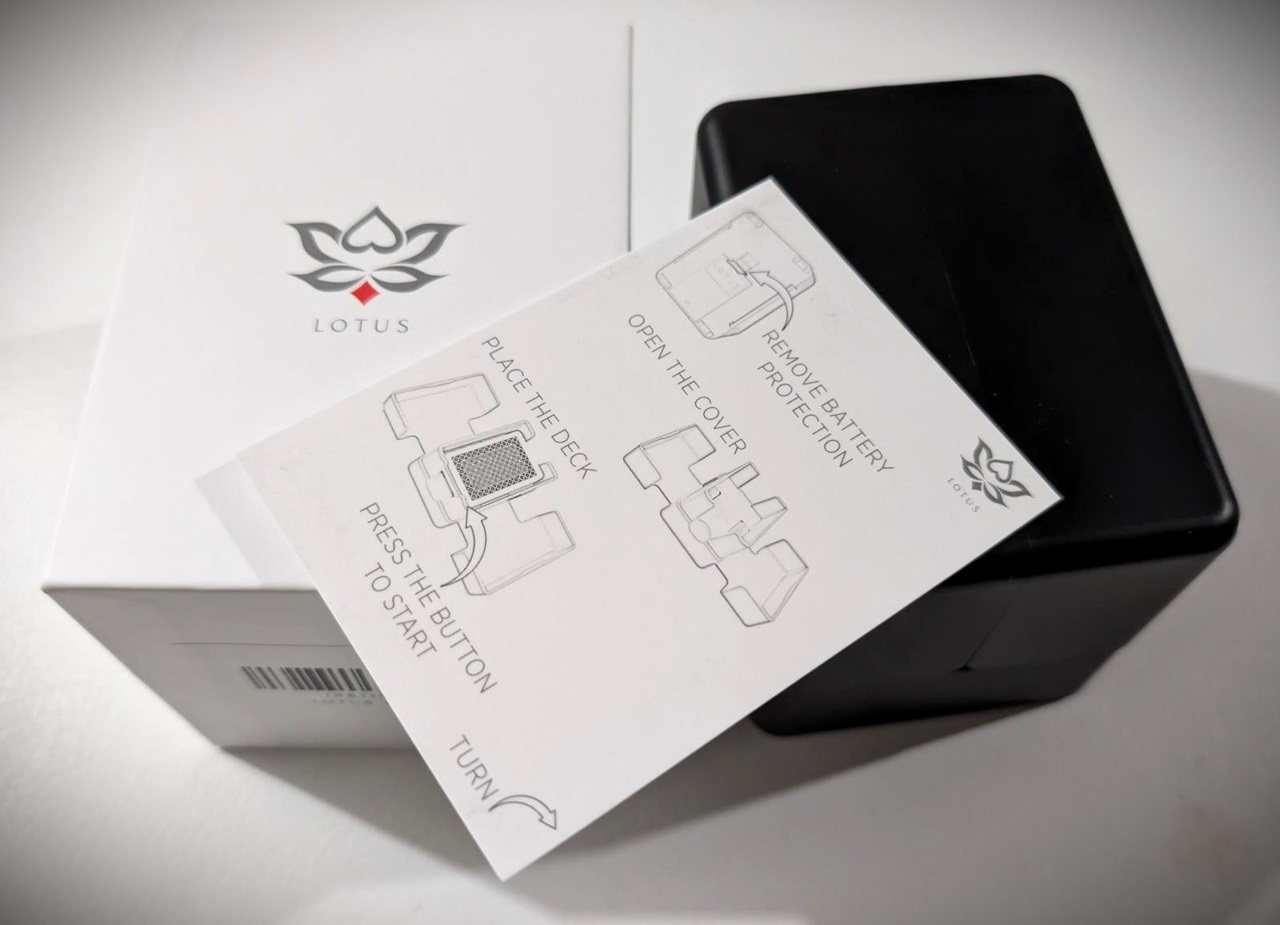
A bad hand at my kitchen table always triggers the same accusation about who shuffled the deck. Usually, the culprit is my 8-year-old, who treats a manual riffle like an audition for a riverboat casino. I avoided automatic shufflers because the cheap ones sound like garbage disposals and chew up good board game cards. The compact Lotus V2 card shuffler costs roughly $90, four to five times the price of $20 entry-level gadgets, and after five early reviewers put it through its paces, it sits on my table to keep small, dishonest hands off the riffle.
Key Takeaways
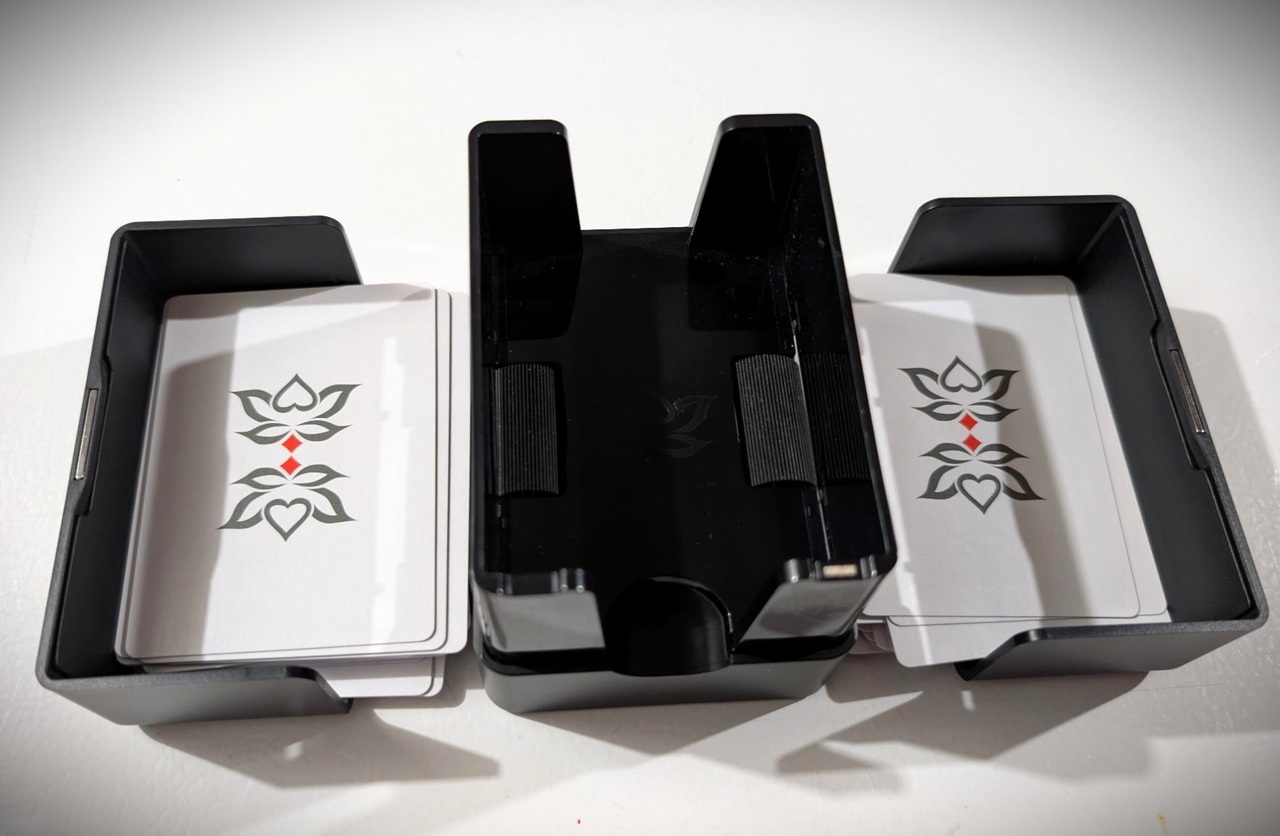
Instead of jamming two halves into a center slot, the Lotus V2 drops a full stack of up to two standard decks in the middle and splits cards outward into two side trays in 4.16 seconds per pass.
A 100-pass wear test on black-bordered cards left zero bent cards and almost no edge wear, though sleeved cards, PVC decks, and oversized tarot or giant Uno cards won’t work.
One replaceable 9-V battery powers roughly 500+ shuffles (about 160 to 170 hands at three passes per deal) with zero-force touch sensor activation.
Table of Contents
How the Lotus V2 works: splitting the deck instead of combining it
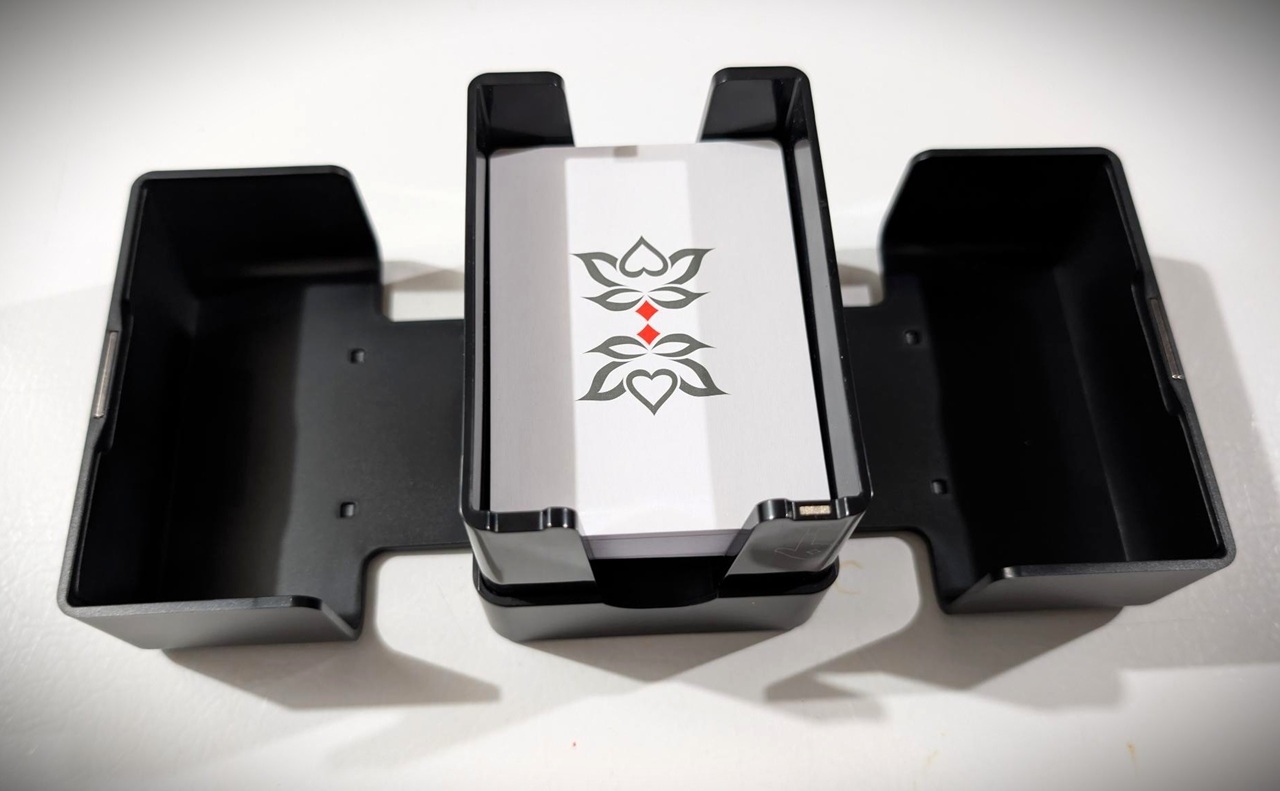
Drop the whole deck into the top center tray and the Lotus V2 splits it randomly into two side compartments, flipping the usual combine-style design on its head.
The split-to-side-trays mechanism
As Chris James at Casual Game Revolution noted on September 23, 2026, it handles up to two standard decks at once, including Canasta and Uno, without jamming if you stay below the top of the center tray. Ryan Gutowski’s teardown at One Board Family shows metal roller guides sitting above soft rubber wheels that steer cards left and right.
What the machine does and what you still do
Scott’s demo at Graying With Grace shows the machine only handles the riffle, the part that hurts your hands, while you load the deck and restack the two halves between passes.
Lotus V2 vs split-tray and hand-crank card shufflers
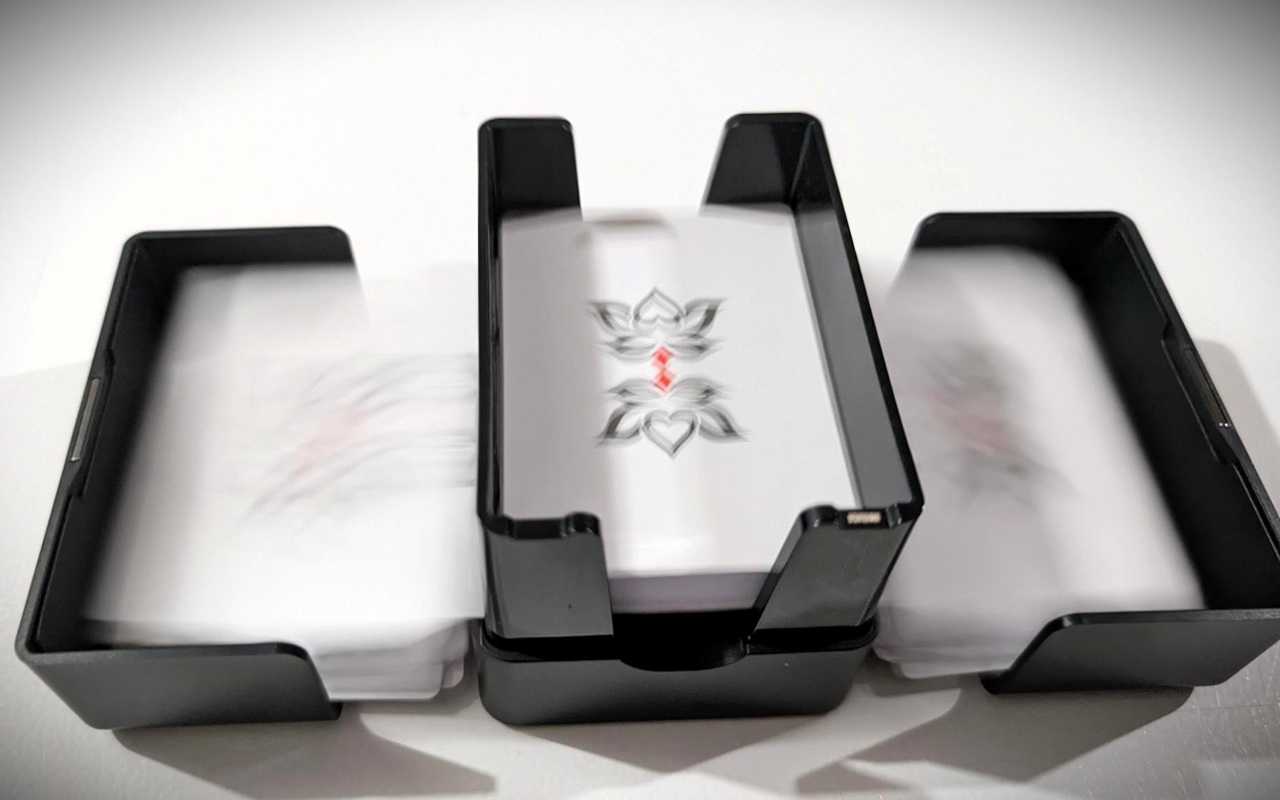
The Lotus V2 beats traditional split-tray and hand-crank shufflers by dropping a single whole deck into the center and splitting it outward, rather than forcing you to halve the deck by hand and jam both piles into a middle slot. That reversed path solves the structural flaw that made big-box shufflers infamous on game night.
When you buy a budget split-tray shuffler off the shelf at Walmart or Target, you do half the work before the motor even runs. You have to eyeball the deck into two even stacks and load both side trays before hoping the plastic gears feed cleanly into the center well.
As the comparison on Tom Reviews shows, combine-style and hand-crank shufflers bind up the moment that central receiving tray stacks too high. Cards bridge across the middle, the motor stalls or the crank locks, and you end up prying a half-shuffled deck out of the slot by hand. Because the Lotus V2 feeds from the center outward into two open side wings, there’s no central bottleneck to overload.
| Feature | Lotus V2 | Budget Split-Tray / Hand-Crank Shufflers |
|---|---|---|
| Whole-deck center loading | Yes (up to 2 standard decks) | No (requires manual halving onto side trays) |
| One-touch sensor start | Yes (zero-force touch sensor) | No (manual crank or physical switch) |
| Resists center-pile overload jams | Yes (splits outward to side trays) | No (jams when central tray stacks too high) |
| Footprint width | Compact folding square | ~3x wider |
| Power source | 1 replaceable 9-V battery | Hand crank or built-in rechargeable / AA-style setups |
Size and downtime separate them just as sharply. Casual Game Revolution and Tom Reviews each put the Lotus V2 next to an older hand-crank shuffler that sat roughly three times as wide. Taking up that much table space for a plastic trough that still jams is a bad trade. Power is simpler, too. Modern gadgets love built-in USB batteries that die mid-game and tether you to a wall outlet, while the Lotus V2 runs on a swappable 9-V battery so you never wait on a charger.
Gutowski at One Board Family already owned a card shuffler when Lotus reached out around the end of summer 2026. He took the sample anyway, ran it against his existing machine, and made the switch because the Lotus beat what he had on the shelf.
Shuffle speed and quality: timed tests and pass counts
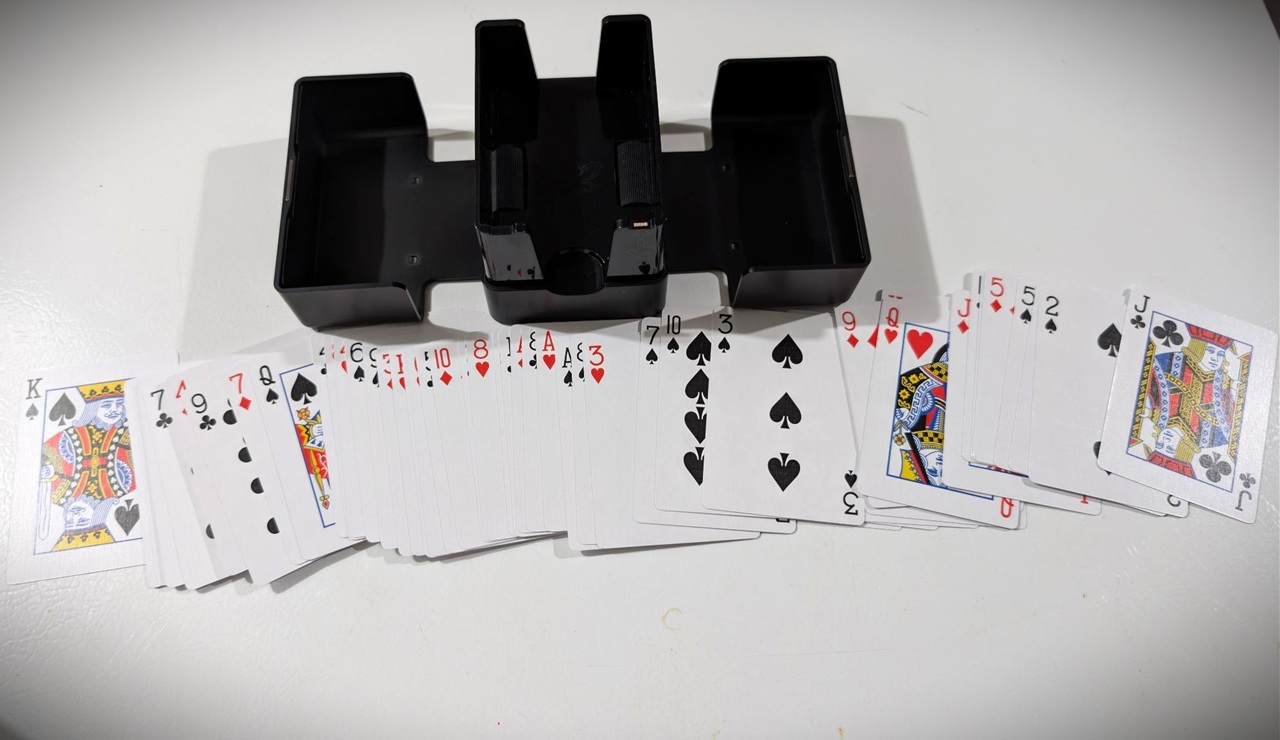
The Lotus V2 finishes a single-deck pass in 4.16 seconds and completes a three-pass casual shuffle in about 25 seconds once you factor in hand restacking between runs. The machine only splits the deck once per drop, so a mixed stack comes down to how many times you’re willing to pick the halves up and drop them back in.
Timed single-pass and three-pass speed
On Tom Reviews’ stopwatch, every single-deck pass finished in under 5 seconds. Running three consecutive passes, including pulling the two piles from the side trays and setting them back on top, took roughly 25 seconds total. Across more than 30 card and board games tested by Graying With Grace, misfeeds happened only occasionally, showing up as a single skipped card or an uneven split between the left and right trays.
How many passes for a random shuffle
Three passes is plenty for casual family play. If you care about riffle-shuffle math, One Board Family notes that seven passes achieve a near-random shuffle, while Lotus claims eight passes hit near-random and 11 passes deliver a thoroughly mixed deck. If you load a double deck, expect to run a few extra passes to get the same mix.
Does the Lotus card shuffler damage or bend your cards?
No, the Lotus V2 doesn’t bend or chew up standard cards over time because soft rubber wheels, rather than hard plastic teeth, pull the deck through. A 100-pass wear test on black-bordered cards left zero bent cards and almost no edge markings, though the rollers occasionally fail to grab the bottom card unless you press down lightly on the stack.
Gutowski at One Board Family nearly turned down the review altogether out of fear that an automatic feeder would mangle his games. To test that exact fear, Graying With Grace and Tom Reviews ran decks face-up and face-down without leaving marks on either side. Even after 100 straight passes with black-bordered stock, where any nick shows up immediately in white, the edges came out clean.
Graying With Grace also fed thick, expansion-heavy stacks from Forest Shuffle and Wingspan through the rubber wheels without chewing a corner. The only mechanical hiccup showed up during the 100-pass durability run: intermittently, the belts failed to pull the bottom cards until the reviewer pressed a finger lightly on top of the deck, pointing to a minor belt-tension quirk.
What cards the Lotus V2 can shuffle and which ones fail
Yes, the Lotus V2 shuffles when your deck sits close to a standard 2.5 x 3.5 inch poker card: bare standard-size stock and standard Uno cards run cleanly, while sleeved cards don’t fit the feed, PVC or plastic decks may jam, oversized tarot and giant Uno cards don’t fit, and small or thin cards prove unreliable. Graying With Grace mapped those boundaries by running more than 30 different card and board games through the ~2.5 x 3.5 inch feed opening.
The standard poker-size sweet spot
In Draculetta’s live demonstration, a standard Bicycle poker deck shuffled repeatedly without a hitch, even when inserted reversed. Narrower Phase 10 cards measuring 2.25 x 3.5 inches bounced slightly inside the tray during Graying With Grace’s testing, yet a worn 10-to-15-year-old Phase 10 deck ran the full stack without needing a second touch on the sensor and took zero damage over dozens of shuffles. Lotus officially recommends standard decks only, even though its website hints that other sizes might work.
Hard fails: sleeves, PVC, and oversized decks
Sleeved cards won’t fit the feed slot, which rules out sleeved collectible card games (CCGs) immediately. PVC and plastic cards can jam the internal rollers, while super-slick card finishes sometimes slip on the rubber wheels and deliver less than a true one-to-one mix. Thin, cheap card stock also feeds less reliably than premium stock like Wingspan. Oversized decks, including tarot cards and giant Uno, don’t fit the tray and have to be shuffled by hand.
The small-card split verdict
Mini cards are unreliable in practice. The wheel spacing allowed half-sized cards to shuffle in One Board Family’s test when laid sideways across the width of the tray, but Tom Vasel’s small-card test on The Dice Tower failed when every card shot out one side.
Is the Lotus card shuffler good for someone with arthritis or weak hands?
The Lotus V2 is an easy recommendation for players with arthritis, sore fingertips, or weak grip strength because it has no physical buttons to push and takes over the painful riffle motion. As long as a player can set a deck into the top tray and lift the two split halves out of the side wings, the machine requires zero downward hand force.
Graying With Grace and The Dice Tower show the two built-in sensors cutting out manual fiddling. Instead of a stiff plastic switch, you cover a small top touch sensor to start or stop the motor; it responds to a light fingertip, a pinky, or even a knuckle. A second internal sensor reads how many decks are sitting in the tray, so you never have to flip a one-deck or two-deck toggle switch.
Scott at Graying With Grace framed his whole evaluation around two-deck Canasta nights where riffle-shuffling a double stack makes hands ache. For anyone who always passes the deck to someone else at the table, it makes a thoughtful gift for an older adult.
Is the Lotus card shuffler quiet enough for game night?
Yes, the Lotus V2 is quiet enough for normal game-night conversation according to three separate microphone demonstrations, though Tom Vasel at The Dice Tower still found the motor pitch annoying at the table. Compared to a cheap plastic shuffler, it’s quiet; compared to hand-shuffling, you’ll still hear a motor.
What the audio demos show
In microphone tests run by Draculetta, Tom Reviews, and Graying With Grace, the motor hum stayed low enough that players could talk normally right over it while a deck ran through. Part of that comes down to the housing. Instead of a hollow rattle-trap, the unit is a sleek, mid-weight plastic folding cube that weighs about 279 g (just under 10 oz). When game night ends, the two side compartments fold shut with a deck stored inside, fitting back into its original retail box or slipping into a small drawer.
Tom Vasel’s dissenting noise complaint
Tom Vasel on The Dice Tower was the lone holdout on noise. He found the motor loud and irritating during repeated table use, compounded by occasionally having to press down on top of the cards to get the rollers pulling.
How long does the 9-volt battery last in the Lotus shuffler?
A single replaceable 9-V battery powers the Lotus V2 for roughly 500+ shuffles, which works out to about 160 to 170 hands of cards at three shuffle passes per deal. That battery comes pre-installed behind a compartment door, and Graying With Grace was still running on the original cell after putting more than 30 games through the machine.
Setup and real-world battery math
Pull the plastic tab from the battery door to wake the sensor up, then run a test pass with the branded sample deck Lotus includes in the box. Seeing a rectangular 9-V battery in a modern gadget gave One Board Family flashbacks to the 1980s electronic board game Stop Thief, and it does mean keeping a spare 9-V in a kitchen drawer so you aren’t caught flat-footed.
Why a swappable 9-V beats USB recharging
As Tom Reviews pointed out, a replaceable battery means zero recharge downtime. When a built-in lithium battery dies mid-game, the shuffler is dead for the night; here, you pop the door, swap in a fresh 9-V in thirty seconds, and keep dealing.
Who should buy a Lotus V2, and who shouldn’t
You only need the Lotus V2 for family game night if your group plays high-deal, multi-deck games like Canasta or six-to-seven-player Skull King, or if someone at the table flatly refuses to shuffle. If you only pull out a single deck once a month and enjoy the feel of a manual riffle, keep your money.
One Board Family opened their video with a skit about a guy named Jimmy who refuses to shuffle when handed the deck, and they plan to leave the Lotus on their game table permanently (while noting that buying four separate units so every player has their own would be nightmarish). On the flip side, Tom Vasel skipped giving the device a numeric score and questioned how many households actually need a daily shuffler, since he prefers shuffling by hand. Even so, Vasel is keeping the Lotus V2 for occasional use because it works better than any shuffler he tried before.
Keeping the shuffle honest when kids play
Here at Unfinished Man, my reason for keeping it on the table is simpler: my 8-year-old cheats when shuffling manually. Because the whole deck drops in top-down and splits mechanically, small fingers can’t stack the bottom or peek mid-riffle. It’s only a partial fix, since a kid still loads the tray, restacks the halves between passes, and deals, so I still have to watch the table.
Is the Lotus V2 worth $90 compared to a cheap automatic card shuffler?
The Lotus V2 is worth its roughly $90 price (as of the late-September 2026 reviews; prices may vary) only if you treat it as a luxury tabletop accessory that protects good board game cards, rather than a basic plastic gadget. A $20 entry-level shuffler is cheap for a reason: it demands manual deck-splitting, screams over table conversation, jams in the middle tray, and chews up card edges. The Lotus costs four to five times as much because it fixes all four of those failure points in a box the size of a softball.
Graying With Grace and Casual Game Revolution both place the Lotus V2 in the same deluxe hobbyist bracket as custom hardwood dice towers and neoprene playmats. Nobody strictly needs a $90 box to mix pasteboards. What that money buys is peace of mind when you drop an unruly, expansion-stuffed stack of Wingspan or Forest Shuffle into the feed slot.
Soft rubber wheels and overhead metal guides left black-bordered cards unbent and unmarked after 100 straight passes, whereas feeding a $60 board game plus expansions into a $20 big-box grinder is asking for creased corners. Add the zero-force touch sensor, automatic one-or-two-deck detection, and an outward split that can’t jam a center well, and the engineering gap favors the Lotus V2.
| Decision Criteria | Lotus V2 (~$90) | Entry-Level Split-Tray Shuffler (~$20) |
|---|---|---|
| Card safety (100-pass wear test) | Yes (near-zero wear on black borders, no bends) | No (known for mangling and bending game cards) |
| Center-tray overload jamming | No (splits outward to side compartments) | Yes (jams when central pile overloads) |
| Two-deck capacity (Canasta / Uno) | Yes (auto-detects 1 or 2 decks) | Partial (jams easily near tray limit) |
| Sleeved, PVC, or oversized Tarot cards | No (standard ~2.5 x 3.5 in bare stock only) | No (standard bare stock only) |
| Conversation-level motor noise | Partial (quiet in 3 mic demos; noisy per Tom Vasel) | No (loud mechanical clatter) |
Still, $90 is steep enough that its blind spots sting. If your collection is fully sleeved, if you play with waterproof PVC decks, or if you want help shuffling oversized tarot cards or tiny mini-cards, this machine can’t help you. You also have to live with an occasional skipped card and the quirk of pressing a finger on top of the stack when the belts hesitate to grab.
For fans of Eurogames and frequent card players, the tradeoff lands in the Lotus’s favor. In his September 23, 2026 review for Casual Game Revolution, Chris James weighed the high price and oversized-card limitation against its compact elegance, ease of use, and clean shuffling, then retired his old bargain shuffler for good.
Where to buy the Lotus V2, discount codes, and the sponsored-review context
You can buy the Lotus V2 directly through Lotus’s online store, where reviewers shared affiliate links and the discount code CGR for 10% off the ~$90 price during the late-September 2026 review rollout. Unlike the cheap split-tray shufflers stacked on Walmart and Target shelves, Lotus sells this version through its own website and partner network.
Before you punch in a promo code, you should know how the early consensus around this machine was built. Around the end of summer 2026, Lotus approached tabletop creators to seed the V2 for coverage, leading into Casual Game Revolution’s published review on September 23, 2026 at 13:36. Every single one of the five published evaluations across blogs, video channels, and forum discussions.
Casual Game Revolution, One Board Family, Graying With Grace, Draculetta, and The Dice Tower, came from a complimentary sample provided by Lotus, with four of the five also carrying affiliate links or the 10% CGR code. That doesn’t make their stopwatch times or 100-pass wear tests fake, and Tom Vasel still complained about the noise on his free unit, but you should know every early reviewer got the machine for free. If you want a compact shuffler that keeps its hands off your card edges and keeps your kid’s hands off the riffle, use the CGR code and keep a spare 9-V battery in the drawer.
Frequently Asked Questions
How many shuffle passes does the Lotus need for a truly random shuffle?
Because the Lotus V2 splits a deck outward rather than weaving two halves together, a single 4.16-second run only cuts and divides the stack once. Three passes take roughly 25 seconds including hand restacking and work fine for casual family games. If you want statistical randomness, One Board Family points to seven passes for a near-random mix, while Lotus recommends eight passes for near-random and 11 for a completely randomized deck, plus a few extra runs when mixing two decks at once.
How is the Lotus V2 different from split-tray or hand-crank card shufflers?
Budget split-tray and hand-crank machines make you divide the deck by hand into two side hoppers and drive the cards inward into a center well, which routinely bridges and jams when the middle pile stacks too high. The Lotus V2 reverses that geometry: you drop up to two whole decks into a single top slot, and overhead metal guides with rubber rollers shoot the cards outward into two open side wings. It also folds into a 279 g cube about one-third the width of a hand-crank trough and runs on a swappable 9-V battery instead of a manual crank or a built-in rechargeable battery.
Does the Lotus card shuffler damage or bend your cards over time?
Standard bare cards come through unharmed because soft rubber wheels move the stock instead of hard plastic gears. In a 100-pass torture test using black-bordered cards that show every tiny white nick, the machine produced zero bends and virtually no edge wear, and it handled thick expansion stacks from Wingspan and Forest Shuffle cleanly. The only minor mechanical quirk is that the belts occasionally hesitate to grab the very bottom card unless you rest a light finger on top of the stack.
What cards can the Lotus V2 shuffle and which ones fail?
The feed tray is built around standard 2.5 x 3.5 inch poker decks like Bicycle, though slightly narrower 2.25 x 3.5 inch Phase 10 cards also cycle through with just a bit of tray bounce. Sleeved collectible card game decks, oversized tarot or giant Uno cards, and plastic PVC decks are hard failures that either won’t fit the slot or will jam the rollers. Super-slick finishes and flimsy card stock can also slip on the rubber wheels, and mini cards are a gamble after failing completely in The Dice Tower’s testing.
Is the Lotus card shuffler good for someone with arthritis or weak hands?
It is one of the easiest ways to take the ache out of multi-deck game nights like Canasta because it eliminates both the manual riffle and stiff mechanical buttons. You only need enough grip to drop a deck into the top well and lift the divided piles out of the side wings. An internal sensor automatically detects whether you loaded one or two decks, and the top start sensor triggers from a zero-force brush of a fingertip, pinky, or knuckle.
Is the Lotus shuffler worth $90 compared to a cheap automatic card shuffler?
At roughly $90, it makes sense only as a premium tabletop upgrade for players who want to protect $60 board games from the loud gears, center-slot jams, and chewed corners of a $20 big-box shuffler. If you play frequent, high-deal games with bare standard cards, the compact folding design, gentle rubber rollers, and 500-plus-shuffle 9-V battery life justify the splurge. Skip it if you only shuffle once a month, prefer manual riffles, or keep your collection in card sleeves.
What did early reviewers conclude in their Lotus Card Shuffler V2 reviews?
Across five early evaluations from Casual Game Revolution, One Board Family, Graying With Grace, Draculetta, and The Dice Tower, testers agreed the V2 beat their older shufflers on card safety, jam resistance, and table footprint. Four of the five reviewers praised its conversation-friendly motor hum, while Tom Vasel at The Dice Tower dissented on the noise and occasional belt hesitation yet still kept his unit as the best automatic shuffler he had tried. Every one of those initial reviews used a free sample seeded by Lotus, and four included affiliate links or the 10% off CGR promo code.