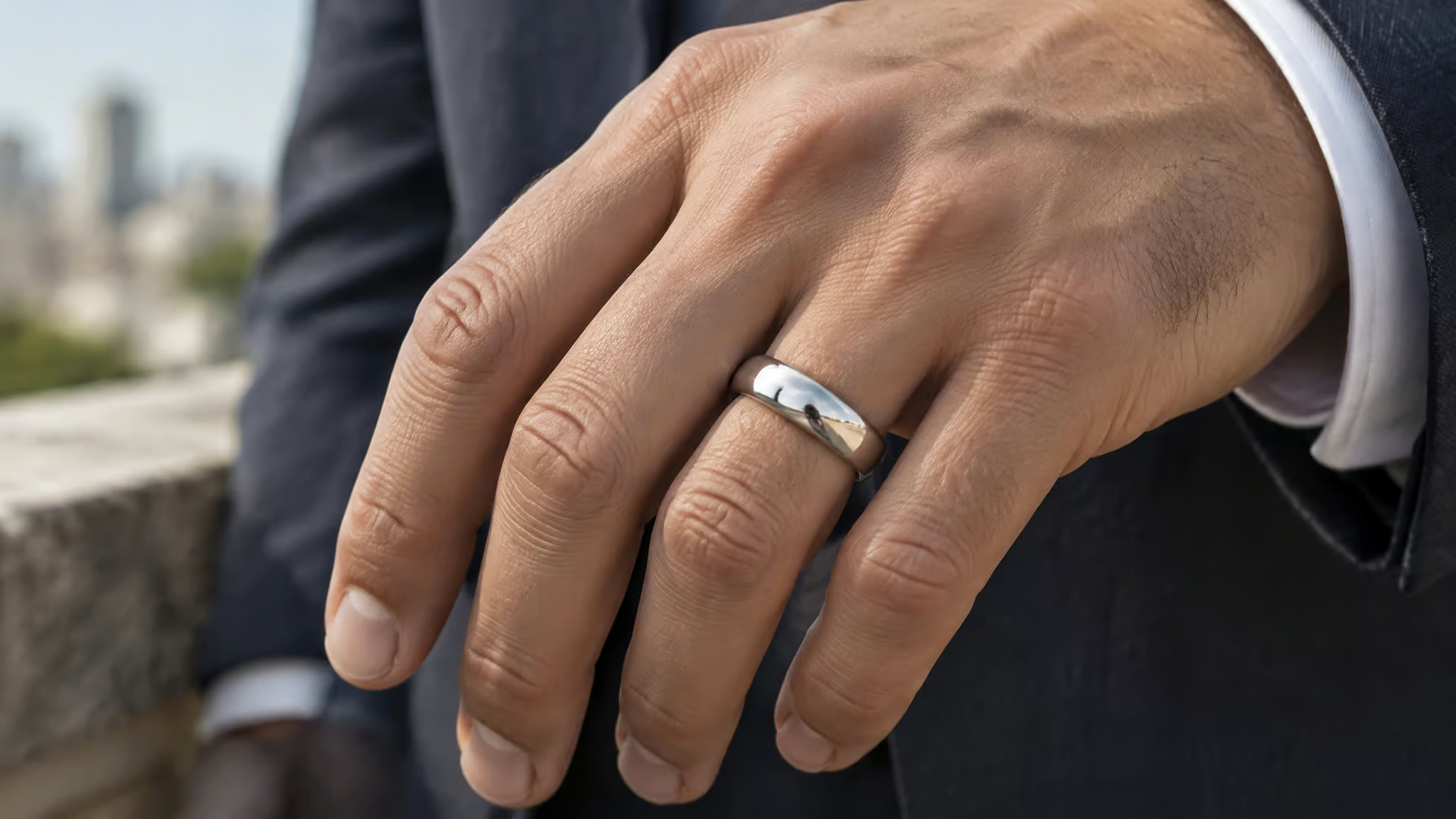
You’ll wear a men’s wedding band every day after the ceremony, which is why Modern Luxury noted on January 30, 2026 that the ring deserves the same deliberation as the venue or the guest list. Grooms in 2026 are skipping overly ornate pieces in favor of enduring, familiar designs they can see themselves wearing for decades. Getting a ring that feels right on your hand means working through the physical specs in order: width, profile, metal, finish, style, budget, engagement ring pairing, and timing.
Relying on a quick glance in a display case leaves you open to expensive mistakes, like getting measured for a wide band with a thin 3mm sizer, buying rhodium-plated white gold without realizing sweat changes its color, or ordering a diamond band encircled with stones all the way around that makes resizing impossible. Note that SheKnows may earn an affiliate commission on independently reviewed products purchased through links.
Key Takeaways
Match band width to your finger size (3mm to 5.5mm for sizes 6 to 9, and wider bands for sizes 10 to 14) and never let a jeweler measure a 6mm or 7mm ring with a 3mm sizer.
Choose tungsten, titanium, or stainless steel for hands-on outdoor work, or pick unplated yellow gold or naturally white platinum over white gold, whose rhodium plating wears off with sweat.
Order the groom’s wedding band at least two to three months before the ceremony to leave a buffer for fit checks, custom work, and engraving.
Table of Contents
What to consider when choosing a men’s wedding band
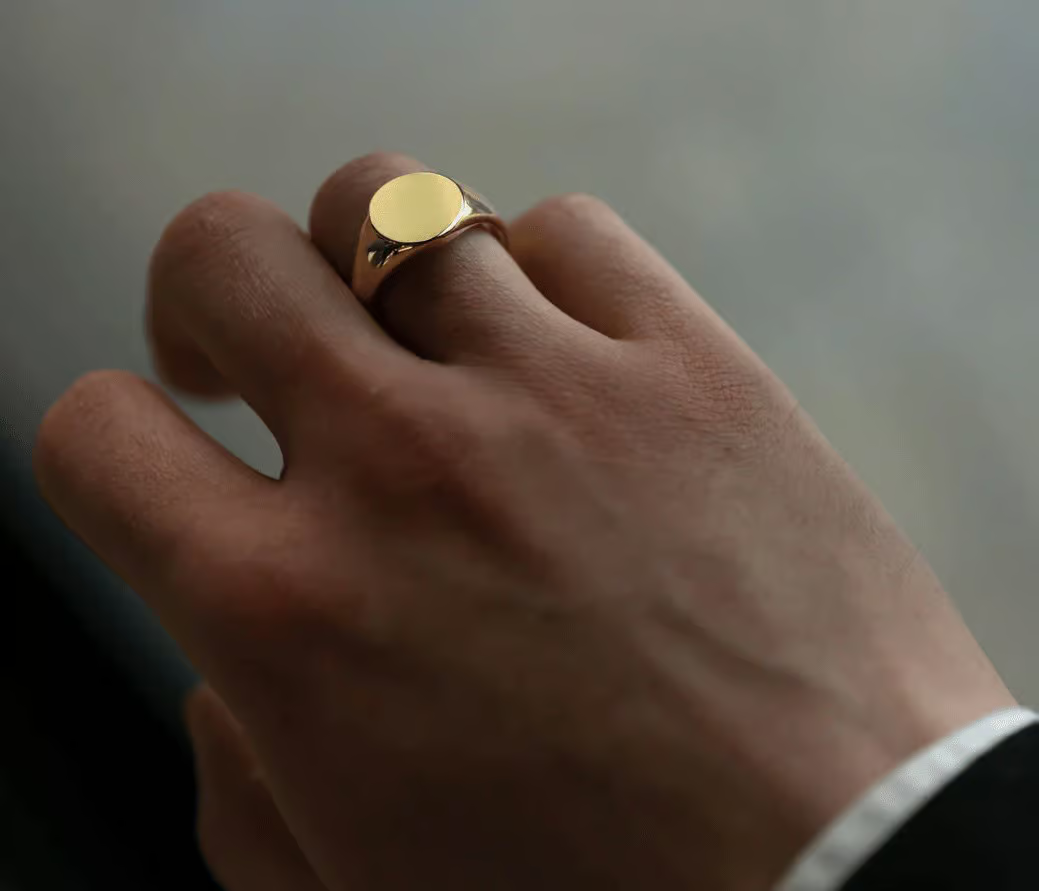
https://cullenjewellery.com/en-au/the-cut/the-rising-trend-of-mens-engagement-rings
Choosing a men’s wedding band comes down to five essential considerations outlined by Finks‘ men’s jewelry experts on June 29, 2023: width, profile, metal, durability, and style.
- Width: Governs daily comfort, finger mobility, and how the ring balances the proportions of your hand.
- Profile: Determines the outer and inner shape of the metal and how the band sits against your skin.
- Metal: Dictates how the ring holds up to physical work and how much upkeep it requires over the years.
- Durability and finish: Controls how well the surface resists or hides dings, scratches, and daily wear.
- Style: Covers personal expression, from plain solid metal to symbolic carvings or snag-free stone settings.
How wide should a men’s wedding band be?
You should pick the width of a men’s wedding band only after checking your ring size, mapping 3mm to 5.5mm widths to finger sizes 6 to 9 and wider bands to sizes 10 to 14. While Finks notes that men’s wedding rings typically run from 4mm to 8mm, picking a millimeter number from finger size rather than guesswork keeps the proportions right, and Bonnie Jewelry offers that size-to-width breakdown as a practical starting point based on hand size and comfort, provided you never measure a 6mm or 7mm band with a 3mm sizer.
Width by finger size: sizes 6-9 vs sizes 10-14
Still, after years of wide, heavy rings dominating counters, third-generation family-owned Chicago jeweler Razny Jewelers (operating for nearly 75 years and led by third-generation owner and Graduate Gemologist Christine Razny-Porter) reports that more men in 2026 are picking leaner profiles under 6mm for comfort, understated presence, and a refined European feel.
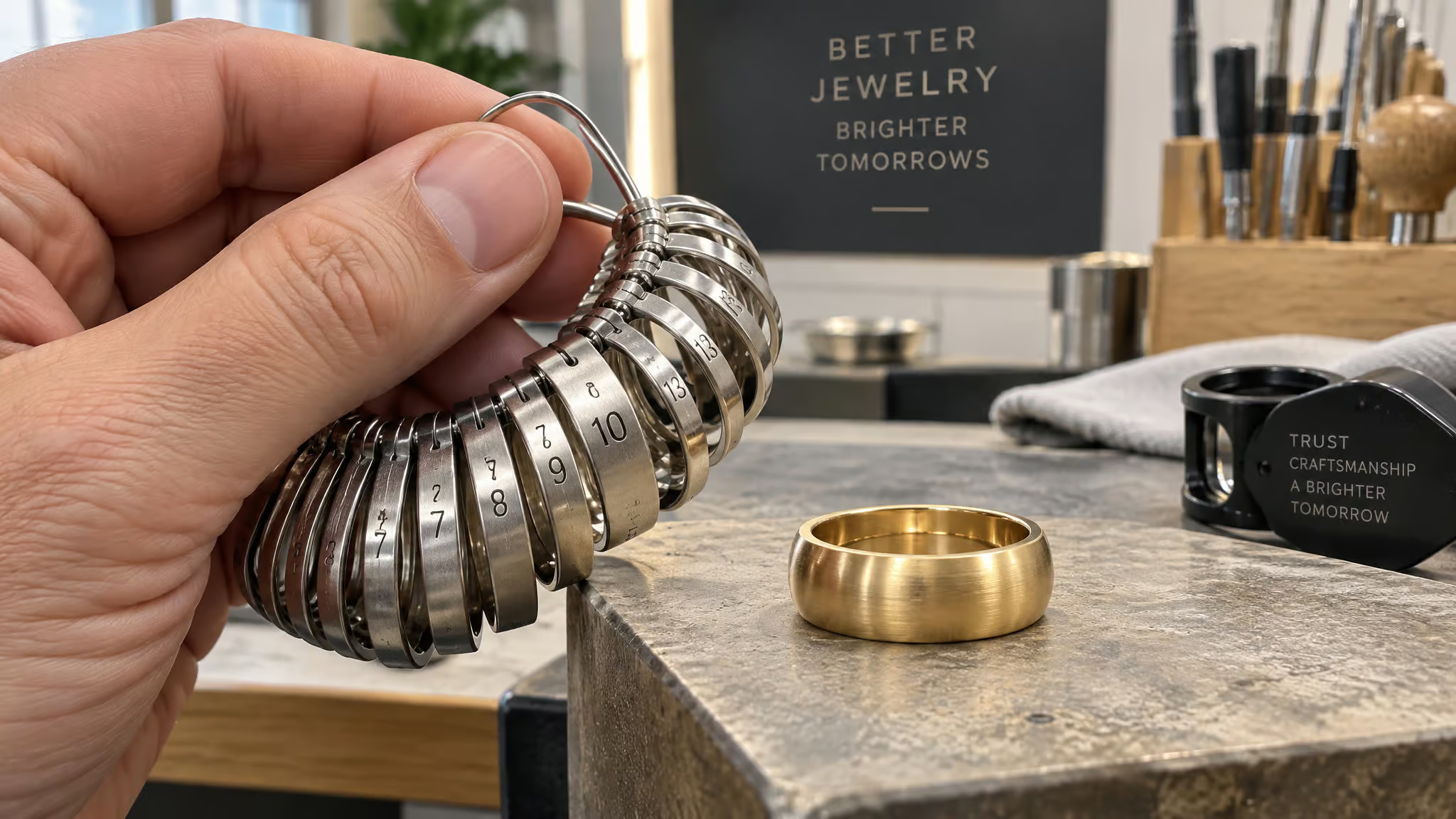
Match the sizer to the band width
Razny Jewelers warns that you should never size a 6mm or 7mm band using a 3mm sizer, because shoppers measured with a narrow ring gauge regularly find their wide band fits wrong when it arrives.
Ring profiles and fit vocabulary, decoded
A ring profile is the cross-sectional shape of the band, which Finks divides into four distinct categories based on whether the interior and exterior surfaces are rounded or flat: classic court, D-shaped, flat, and flat court.
The four ring profiles: court, D-shaped, flat, and flat court
The classic court profile is rounded on both the inside and outside, making it the most traditional option. A D-shaped profile is thin and rounded on the outside but flat on the inside. A flat profile is flat on both the inside and outside, while a flat court keeps a flat exterior paired with a rounded interior.
What comfort fit means (and European comfort fit)
Comfort fit means the inside of the ring’s shank is rounded so it slides easily over the knuckle, which matters because wider bands physically squeeze the finger more than narrower ones. Razny Jewelers defines European comfort fit as a flat comfort fit built with rounded edges on both the inside and outside. At Bonnie Jewelry, European comfort fit is the bestseller and most comfortable option among clients, whereas standard flat comfort fit feels sharper-edged and ranks as their least favorite.
Match the metal to the lifestyle
For men who work with their hands, tungsten and titanium are the top wedding band metals because they match rough daily use without demanding constant upkeep. Finks points to tungsten, stainless steel, and titanium as the ideal metals for men who are active outdoors or work with their hands because all three shrug off dings, scratches, and daily abuse.
Tungsten vs titanium for hands-on work
Both handle workshops, yard work, and heavy gear without picking up the deep gouges that softer metals collect. There’s one major safety catch with some ultra-hard alternative metals: emergency crews cannot easily remove them with a ring cutter if your finger swells.
White gold, yellow gold, and platinum
For low maintenance, yellow gold, platinum, and alternative metals beat white gold because they never need replating to keep their color. Classic precious metals like platinum, yellow gold, and white gold lead 2026 preferences at Razny Jewelers because they evoke the heritage bands worn by fathers and grandfathers, with yellow gold offering a warm traditional tone and white gold and platinum running cooler. Bonnie Jewelry warns that white gold is coated in rhodium plating that wears off when exposed to sweat and changes the ring’s color, whereas Razny notes that platinum is both highly durable and naturally white.
A bright white gold band in a showroom will gradually dull or yellow with daily wear. That shift is normal wear rather than a defect, so guys who want zero maintenance should stick to unplated gold, platinum, or alternative metals. When pairing the ring with a watch or a partner’s jewelry, 25karats notes that matching metals creates a coordinated, intentional look, while mixing metals gives you a more individual style.
10K or 14K: the karat tradeoff
Choosing between 10K and 14K gold comes down to the standard karat tradeoff between alloy hardness and gold purity. A 14K band contains more pure gold, giving it a richer color, while a 10K band uses a higher ratio of alloy metals, making the ring harder and more resistant to surface scratching during daily wear.
Finish: the five-year appearance decision
Choosing a satin finish, brushed texture, or sandpaper surface is a five-year maintenance strategy that hides dings and scratches far better than a mirror shine. Every ring knocks against desks, steering wheels, and tools, and both Bonnie Jewelry and Razny Jewelers point out that a high-polish finish shows every mark of daily wear.
Picking high polish means accepting visible scuffs or making periodic trips back to the jeweler to have the metal buffed out, while a satin finish acts as built-in wear camouflage. Brushed and sandpaper finishes create a matte texture that hides daily scuffs over time, which is why textured surfaces dominate 2026 picks and pair naturally with classic precious metals and slimmer band widths.
Men’s band styles and their meanings
The kind of wedding band a guy should get depends on whether he wants a traditional solid metal ring or a textured, stone-set, or symbolic design matched to his daily work. Finks notes that while a solid metal band remains the traditional baseline, grooms increasingly customize rings with diamonds, gemstones, engraved designs, hammered finishes, and step cuts, alongside hard-wearing tungsten, titanium, or stainless steel for active schedules.
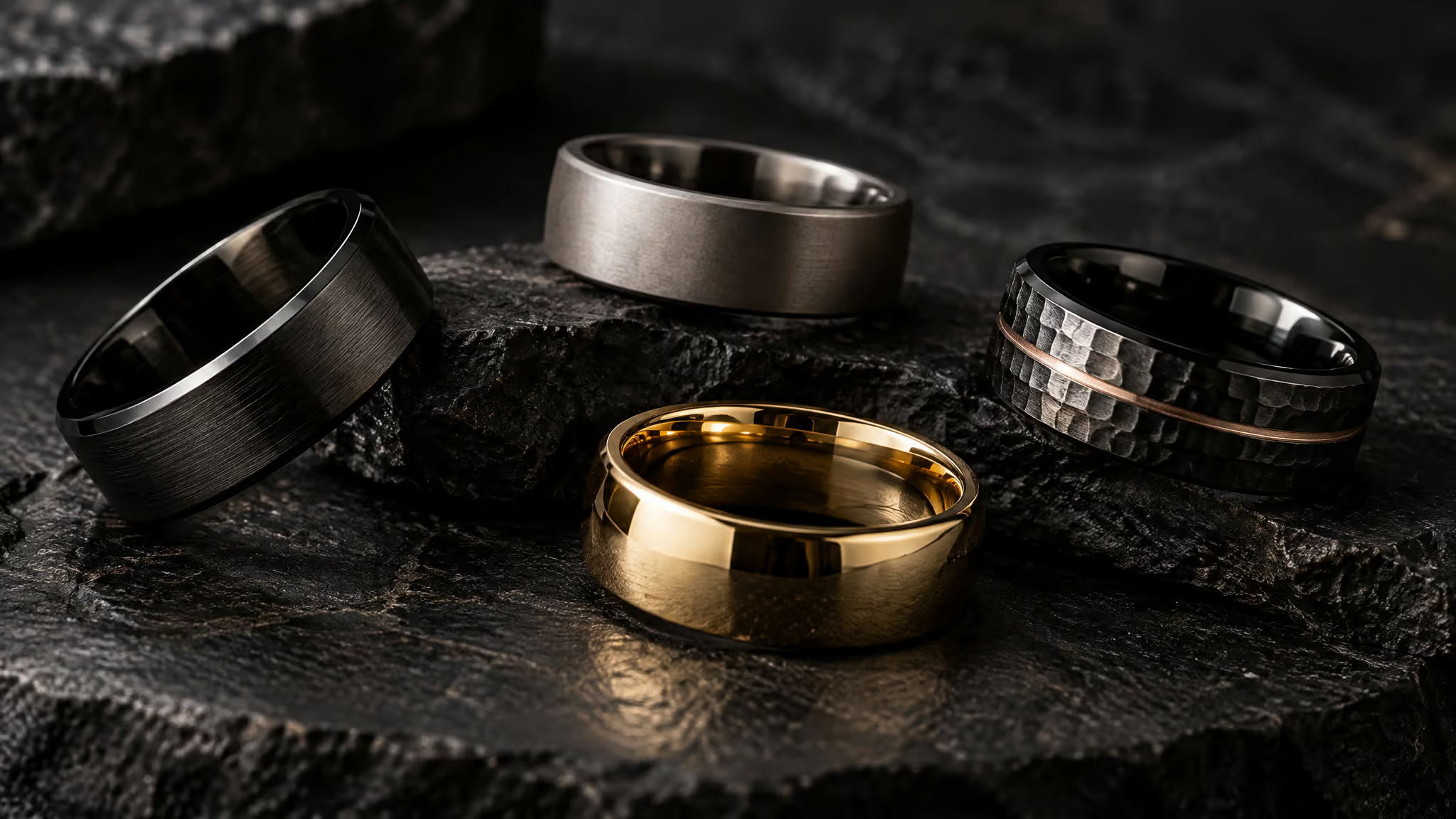
The 8mm White Tungsten Satin Center Band
Finks cites the 8mm White Tungsten Satin Center Men’s Wedding Band as the benchmark traditional solid band, while Bonnie Jewelry calls a plain comfort-fit ring the “Lord of the Rings band” and the most classic traditional style.
The 6mm Engraved Gold Band
The 6mm Engraved Gold Men’s Wedding Band is Finks’ pick for a classic traditional look elevated with polished and brushed details.
The 14K White Gold and Diamond Textured Band
Finks highlights the 14K White Gold and Diamond Textured Band for grooms who want diamonds and surface texture.
Triton tungsten black bands
For dark metals, Finks points to the Triton Textured Tungsten Men’s Black Wedding Band for a bold look and the Triton RAW 7mm Black PVD Tungsten Flat Profile Wedding Band for modern simplicity.
Claddagh bands
Built with two hands holding a crowned heart for love, loyalty, and friendship, a Claddagh band worn alone facing inward shows your heart is taken, and 25karats notes it often uses a yellow gold Claddagh on a white gold band.
Celtic trinity knot bands
The Celtic trinity knot stands for faith, love, and honor (adapted in Catholicism for the Father, the Son, and the Holy Spirit), while other Celtic bands carry unity, good luck, or eternal life emblems.
Square bands
Square bands use flat outer planes for an edgy modernist look that 25karats notes is traditionally a men’s design, sometimes dressed up with polished planes and a diamond accent.
His & Hers bands
His & Hers sets work with any ring style so long as the pair matches through interlocking patterns, mirror images, or custom designs.
Diamond bands and snag-free settings
Yes, you can wear a diamond men’s wedding band that sits smoothly without snagging or feeling bulky, provided you choose a channel setting or bezel setting rather than raised prongs and avoid a full eternity band if you ever want the option of resizing. Men’s diamond rings started with a 1940s and 1950s advertising campaign pitching diamonds as a symbol of male success, and the look shows up today on Brooklyn Beckham (who pairs a plain ring with an emerald-cut diamond band) and Justin and Hailey Bieber, who wore matching diamond wedding bands in their pregnancy announcement.
Channel-set diamond bands
Men most frequently opt for channel settings because the stones sit in a row across the front or all the way around between two walls of metal, leaving a smooth surface that won’t snag on a beard or shirt cuff or let stones fall out.
Bezel-set diamond bands
For a less flashy look, a bezel setting wraps a solitaire or accent stone inside a protective metal frame that sits flush and doesn’t catch easily.
The full-eternity resizing trap
Bonnie Jewelry warns that full eternity bands with diamonds running all the way around can’t be resized if your weight changes, so picking a half-eternity or three-quarter layout leaves plain metal for future sizing.
Men’s wedding band trends for 2026
Black wedding bands for men are in style for 2026 when paired with brushed textures, mixed precious metals, or clean flat profiles within the year’s broader return to timeless design. Rather than novelty cutouts, 2025 and 2026 demand centers on understated heritage styles updated with subtle textures, slimmer sub-6mm widths, and contrast materials like black PVD tungsten, black ceramic, and black diamonds. Razny Jewelers’ 2026 lineup proves how that contrast works on a classic frame with a 7.5mm 14k white gold and black ceramic band set with 34 round channel-set diamonds.
Classic metals and the domed shape’s return
Platinum, yellow gold, and white gold lead 2026 picks alongside the return of the traditional domed wedding band, which Razny notes is being crafted in platinum, yellow gold, or tungsten with clean polish or restrained texture, textured centers, polished edges, and softly beveled profiles.
Mixed metals and slimmer profiles
Mixed-metal bands combining platinum with yellow gold or darker tantalum and black ceramic are now mainstream, paired with braided centers, layered metals, and sub-6mm profiles that let small details stand out.
How the updates look in practice
Razny Jewelers’ 2026 roster shows these specs in metal: a 4mm 18k yellow gold high-polish dome-top band; a 6mm platinum band with a sandpaper center and polished edges; a 6.5mm 14k yellow gold low-dome band with a diamond-brush center; a 6mm 14k yellow gold and tantalum band with a sandpaper center; a 7.5mm 14k yellow and white gold band with a braided center; and a 5.5mm platinum and 14k yellow gold two-tone band with an angled groove.
What a men’s wedding band costs, and where to buy
A men’s wedding band costs under $5 to $10 for a silicone ring, $50 to $500 for an alternative metal band, several hundred to a couple thousand dollars for precious metal, and several thousand up to tens of thousands of dollars for a diamond band. Picking a ring that fits your budget with minimal upkeep, and confirming sizing, future resizing options, and care instructions before paying, keeps you from overpaying for a fragile setup. Razny Jewelers sorts bands into those three material tiers, and Bonnie Jewelry notes that within precious metals, a size 13 ring requires drastically more metal than a size 7 ring, which moves the final price.
| Tier | Typical Price Range | Where to Buy | Resizable |
|---|---|---|---|
| Level 1: Silicone & Alternative Metals | Under $5 (Razny) / under $10 (Bonnie) for silicone; $50 to $500 for alternative metals | Online (such as Amazon for silicone multipacks) | No (fixed material size) |
| Level 2: Precious Metals (14K, 18K, Platinum, Gold) | Several hundred to a couple thousand dollars (depends on ring size) | Local brick-and-mortar jeweler | Yes (with lifetime jeweler service) |
| Level 3: Diamond Bands | Several thousand up to tens of thousands of dollars | Custom-made through a jeweler | Partial (half or three-quarter eternity only; No for full eternity) |
The three tiers and their price bands
Razny Jewelers groups rings into Level 1 (no metal silicone or alternative metals), Level 2 (14K, 18K, platinum, and yellow, white, or rose gold), and Level 3 (diamond bands, which climb into the tens of thousands when built around a center stone).
Silicone loner rings
For gym-goers, active guys, or men who chronically lose rings, ultra-light silicone “loner” rings cost under $5 by Razny’s count or under $10 by Bonnie’s, making it easy to buy a multipack online and stash spares in the car, gym bag, and nightstand.
Where to buy at each tier
You should buy a tungsten or silicone band online where they are widely available, but buy a precious metal band from a brick-and-mortar jeweler so you get lifetime service, sizing, and buffing.
The emergency cut-off caveat
Bonnie Jewelry flags a major occupational hazard: standard emergency-room ring cutters cannot slice through some ultra-hard alternative metals if your finger swells after an injury, making them a bad call for firefighters and hands-on workers, while wood rings hold up poorly to frequent hand-washing unless pre-treated.
Custom vs off the rack
Going custom beats buying off the rack when you’re shopping for a diamond band, because Bonnie Jewelry warns that over-the-counter men’s diamond rings are often hollowed out to save metal weight and aren’t as sturdy. Her shop’s custom builds include a viral platinum ring featuring an East-West emerald-cut center stone (also crafted in yellow gold), a comfortable channel-set princess-cut band, and a flashy two-tone pavé band with two rows of diamonds and gold sides.
Wedding band picks at every price tier
These eleven retail picks come from SheKnows contributing commerce writer Taylor Lane (who has more than eight years of media experience), and prices may vary.
Shane Co. Channel-Set Diamond Couples Set
Best overall ($4,800): 14K yellow gold set with hand-selected channel-set diamonds in sizes 10 and 6, resizable before shipping.
Angara Half Eternity Blue Diamond Ring
Best colored diamond ($1,673, originally $1,859): 14K yellow gold half-eternity band with seven round enhanced blue diamonds in shared prongs.
Blue Nile Classic 14K Yellow Gold 2mm
Best classic gold ($280): Minimalist 2mm band in 14K yellow gold.
Kay Now + Forever Diamond Milgrain Band
Best vintage-inspired ($250, originally $500): 14K white gold with round diamonds in alternating marquise and round milgrain frames.
Blue Nile Crescendo Curved Diamond Ring
Best curved ($1,230, originally $1,640): 14K white gold curved band built to sit flush against raised engagement stones.
Rare Carat U-Prong Emerald-Cut Eternity Band
Best emerald-cut ($2,660): 14K yellow gold statement band holding 2 carats total weight of lab-grown emerald-cut diamonds in U-prongs.
Tiffany Together Double Milgrain Band
Best luxury classic ($2,300): 4mm platinum band with milgrain edges and no diamonds.
Blue Nile Brushed and Polished Comfort Fit Ring
Best black band ($385): 6mm black tungsten carbide with a brushed center and polished edges.
Rustic & Main The Olympian Titanium Band
Best titanium ($360): 6mm lightweight polished matte titanium in a classic profile.
Angara Hand Braided Twisted Rope Band
Best textured men’s band: Angara Hand Braided Twisted Rope Band ($1,781, originally $1,979), a 7mm 14K yellow gold band with a braided center and twisted rope edges.
Blue Nile J’adore Le Jardin Diamond Ring
Best floral-inspired ($2,190): Resizable 14K yellow gold ring with 5 round and 4 pear-shaped diamonds totaling roughly 5/8 carat.
Pairing the band with the engagement ring
Matching a wedding band to an engagement ring setting comes down to checking the engagement ring’s shape, setting height, metal, and resizing limits so the two bands sit together cleanly.
Why curved and notched bands exist
Curved or notched bands contour around low or raised center stones to close the gap that a straight band leaves open.
Slim vs wide relative to the center stone
A slim band enhances a delicate engagement ring while a wider band balances a large center stone, and stacked rings require planning widths and profiles together.
When to buy the groom’s wedding band
While shoppers often confuse the “3 month rule” with an engagement-ring salary formula, for the groom’s wedding band it’s a calendar rule: buy the ring at least two to three months before the wedding day. Both Finks and Razny Jewelers recommend that two to three months buffer so you can handle fit checks, custom work, delivery, and optional engraving without a last-minute panic. Waiting until inside the two-month mark squeezes the calendar if you need custom diamond work, special sizing, or a non-resizable eternity band that has to fit right on the first try.
Who pays for the groom’s band
There’s no rigid rule on who pays for the groom’s ring: couples at Bonnie Jewelry might divide the total cost, let one partner pay for both, or purchase each other’s rings and add an interior engraving to make the swap personal.
Frequently Asked Questions
What is the difference between court, D-shaped, flat, and flat court ring profiles?
Ring profiles describe the cross-sectional shape of the band’s inner and outer surfaces. A classic court profile is rounded both inside and out, whereas a flat profile is completely flat on both sides. D-shaped bands pair a rounded exterior with a flat interior, and a flat court flips that by combining a flat outer surface with a rounded interior.
Is 10K or 14K better for a men’s wedding band?
It comes down to whether you care more about scratch resistance or richer color. A 10K gold band contains a higher ratio of alloy metals, making the surface harder and tougher against daily wear. A 14K band packs in more pure gold for a deeper, warmer hue, though the softer metal will pick up scuffs more easily.
What metal is best for a men’s wedding band for low maintenance?
Unplated yellow gold, naturally white platinum, and alternative metals like titanium or tungsten are your best low-maintenance options because their color never needs upkeep. White gold is the hidden high-maintenance trap: it relies on a rhodium plating that wears off when exposed to sweat, causing the ring to dull or yellow until you pay to have it replated. Pairing a zero-maintenance metal with a satin, brushed, or sandpaper finish will also camouflage five years of desk and steering-wheel scuffs.
How much should I spend on a men’s wedding band?
Your budget depends entirely on which of the three material tiers you target, and prices may vary. Silicone rings run under $5 to $10, and hard alternative metals like tungsten or titanium cost between $50 and $500 online. Precious metals like 14K or 18K gold and platinum range from several hundred to a couple thousand dollars (climbing higher for larger finger sizes like a 13 versus a 7), while custom diamond bands start at several thousand and reach tens of thousands of dollars.
Are black wedding bands for men in style for 2026?
Yes, black bands are very much in style in 2026 when they use clean flat profiles, brushed textures, or mixed-metal contrasts rather than novelty cutouts. Grooms are gravitating toward black PVD tungsten, black ceramic, and black diamonds, often paired with traditional precious metals like 14K white gold. The look works best when it updates a classic silhouette with dark, understated contrast.
What is the 3 month rule for rings?
For a groom’s wedding band, the three-month rule has nothing to do with salary—it is a strict calendar deadline to order the ring at least two to three months before the wedding. That buffer gives you enough breathing room to handle custom design work, shipping, interior engraving, and fit checks without a last-minute scramble. It is especially critical if you are ordering a custom diamond piece or a full-eternity band that cannot be resized later.

