The real cost of a home gym depends on what you want to do in it. A pair of dumbbells and a mat won’t leave the same mark on your bank account as a rack, plates, and other full-gym equipment. The Real Cost of a Home Gym can’t be pinned to one reliable market-wide average from the available estimates, and a tiered budget guide, an itemized equipment total, and the cost of owning gear over time are three different things.
One published framework puts a basic gym at $300 to $1,000 and a commercial-grade setup at $6,000 or more. Those are examples of different equipment scopes, not a minimum entry fee or a path every buyer needs to follow. You can begin with household items or a few pieces you’ll actually use. The useful question isn’t how much a “proper” home gym costs. It’s what your training requires, what your space can handle, and whether you’ll use the gear enough to justify owning it.
Key Takeaways
One source puts basic equipment at $300, $1,000 and commercial-grade equipment at $6,000 or more; those figures aren’t market-wide price standards.
A separate $1,098 equipment estimate lists items priced at $933, so its reported total and itemized prices don’t match.
One example reaches break-even in about two years: $1,500 for a home gym versus $65 monthly dues. Another takes about four years: $1,098 versus $25 monthly dues.
Table of Contents
Home-gym cost by budget: what each tier includes
One source’s framework puts a budget gym at $300, $1,000, a mid-range gym at $1,000, $3,000, a full gym at $3,000, $6,000, and a commercial-grade setup at $6,000 or more. Those ranges reflect different equipment packages, not a universal standard or a required spending ladder.
| Budget | Example equipment scope |
|---|---|
| Budget: $300, $1,000 | Dumbbells, kettlebells, and budget cardio equipment. |
| Mid-range: $1,000, $3,000 | A power rack, barbell, dumbbells, weight plates, and bench. |
| Full gym: $3,000, $6,000 | The mid-range strength equipment plus cardio equipment, rack accessories, and flooring. |
| Commercial-grade: $6,000 or more | Commercial versions of gym equipment, with no upper limit specified. |
The budget tier is a way to picture one possible starter setup, not a bill you have to pay before you’re allowed to work out at home. If you already own dumbbells, use a mat or household items, or only need a resistance band, your new spending could be much lower. Even within the framework, gear choice changes what the same budget buys.
The mid-range package is more specific: it assumes a rack and a set of strength-training basics, rather than a few pieces for general exercise. Plates, the bench, and the rack all affect the total, and a larger rack may call for more space and add-on equipment. A buyer who doesn’t plan to lift with a barbell doesn’t need to treat that package as the definition of a decent gym.
The full-gym tier adds cardio, rack accessories, and flooring, so the higher price reflects a broader setup. It doesn’t guarantee one particular collection of machines or a complete package at a fixed price. Commercial-grade means commercial versions of gym equipment, not equipment every household needs. These categories are useful for comparing scope: the important detail isn’t just the number, but what the number is meant to include.
Why home-gym cost estimates disagree
The estimates differ because they count different things and use different methods; neither establishes what a typical buyer will spend. One source puts many home gyms at $1,500, $2,500, while a separate equipment estimate reports $1,098. Another source says accurate market data aren’t available.
The $1,098 example names an ECHANFIT treadmill ($400), two Rogue kettlebells ($89 total), LIT resistance bands ($199), a Gaiam mat ($35), a FLYBIRD adjustable bench ($162), a DEGOL jump rope ($9), and a SPRI medicine ball ($39). Those listed prices add up to $933, not $1,098. The difference is unexplained, so the reported total shouldn’t be mistaken for the sum of those items. A Niceday elliptical ($500) and YOSUDA stationary bike ($340) are alternatives, not extra purchases in that estimate. It also excludes installation and replacement costs. That makes both totals useful as examples, not definitive averages.
Strength-training equipment: what a mid-range budget buys
A mid-range strength setup can include a barbell, rack, plates, dumbbells, bench, and pull-up bar, but the right mix depends on your lifts, available space, intended loads, and safety needs. The supplied Olympic barbell examples run from $100 to $1,500 or more. The 20-kilogram REP Fitness Colorado Bar was listed at $300; a Major Fitness budget bar was $259, with a reported 750-pound limit and one-year warranty.
For a tighter footprint, the Fringe Sport Half Rack was listed at $349 with a reported 600-pound capacity. It takes less room but has fewer attachment and cable-upgrade options than the REP Fitness PR-4000, which starts around $950 and offers choices in frame, height, and attachments, including a functional-trainer option. One source calls the PR-4000 cheaper and similar in quality to Rogue Monster Lite, but supplies no Monster Lite price.
Plate choice comes down partly to how you lift: bumper plates suit planned overhead drops; cast-iron plates may work for training without them. Listed examples average $1.79 per pound for Fringe Sport bumpers and $3.22 for REP urethane-coated Equalizer plates, which aren’t for dropping. Major Fitness adjustable benches were listed at $219, compared with $635 for the Titan Fitness Titan Series. The source says adjustable benches offer more exercise options.
A low-cost setup can become inadequate when its capacity or weight range no longer fits the lifts you plan to do. Check the limits of the specific gear rather than assuming every rack or dumbbell can handle the same load.
Compact home-gym equipment for limited space
A small home gym can start with equipment matched to the movements you want to do: adjustable dumbbells or kettlebells, resistance bands, a mat, and, if your routine calls for one, a bench. You don’t need a rack or cardio machine for every routine. A pair of kettlebells, for example, may cover the exercises you have in mind without turning a spare corner into a storage problem.
Prices in the supplied examples include two Rogue kettlebells for $89 total, with the 9-pound option listed at $42 and the 18-pound option at $47. Yes4All cast-iron kettlebells were listed from $23 for a 9-pound option. LIT resistance bands were listed at $199, a Gaiam exercise mat at $35, and a SPRI medicine ball at $39. Those are individual price examples, not a complete package or a claim that these are the pieces every small gym needs.
The right starting point is the work you’ll actually do and the loads you expect to handle. Since fitness is a priority for many people, investing in home equipment can support a regular routine, but if you mainly want bodyweight training and light resistance work, household items or a few small purchases may be enough to begin. A bench adds exercise options but takes up room; a rack adds more footprint and cost. A cardio machine can be useful if it’s part of your routine, but it’s not a prerequisite for training at home.
Adjustable dumbbells can make storage simpler, but their weight limit may eventually restrict the lifts you want to do. If you need to handle more than 50 pounds, a barbell and plates may make sense as a later upgrade. That’s a possible next step, not an automatic one.
Gorilla Bow Travel, JaxJox KettlebellConnect 2.0, and Lululemon (Big) Mat also appear in supplied product roundups, but no prices are provided for them here. A compact setup doesn’t have to begin with a shopping spree. Start with the gear your routine calls for, then see whether the space and equipment are doing the job.
Cardio equipment and all-in-one machines
A full home-gym setup falls in one source’s $3,000, $6,000 tier, a range that may include cardio equipment, rack accessories, and flooring; it isn’t a guaranteed package price. Cardio examples listed include a YOSUDA stationary bike at $340, an ECHANFIT treadmill at $400, and a Niceday elliptical at $500. The separate $1,098 equipment estimate includes the treadmill, not the bike or elliptical.
An exercise bike, rowing machine, air bike, treadmill, elliptical, jump rope, or sled could provide conditioning, but one suitable option may be enough. The named roundup products Wattbike Atom, AssaultBike Classic, Peloton Tread, and Crossrope Speed Performance Set have no supplied prices. The Wattbike Atom is described as connected, with setup and performance insights; Peloton Tread offers instructor-led workouts through a connected treadmill; Crossrope’s set has different rope weights and rotating handles. An all-in-one machine can consolidate functions, while separate pieces let you choose equipment around particular exercises and the space available.
Hidden and ongoing costs of owning a home gym
Beyond the equipment checkout total, possible costs include electricity, delivery, installation, maintenance, repairs, replacements, and upgrades; the supplied estimates don’t give a comprehensive range for them. The $1,098 equipment estimate excludes installation and replacement costs. Not every owner will face every expense, but resistance bands can lose elasticity, and garage exposure may affect how equipment wears.
Subscriptions are optional recurring costs, separate from one-time purchases and contingent repairs. Listed examples include Apple Fitness+ at $10 a month, the Peloton app at $13, Peloton All-Access at $44 for owners of Peloton equipment, Strava at $12, and Sweat at $25. Nike Training Club and YouTube are listed as free alternatives. Subscription pricing and plans can change. Free trials, discounts for annual payment, and some phone-provider or card offers may lower the cost.
Reaching the limit of adjustable dumbbells may also make a barbell and plates worth considering. There’s no single total that covers the ongoing cost of every home gym.
Space, flooring, and the household tradeoff
Space needs depend on the equipment and the room, so measure usable workout area, equipment footprint, access, storage, and clearance before buying. The available information doesn’t establish one floor-area requirement for every home gym. A reported household converted part of a garage for training and found that it reduced the space available for parking and storage. That’s a real tradeoff for that household, not a given for every garage setup.
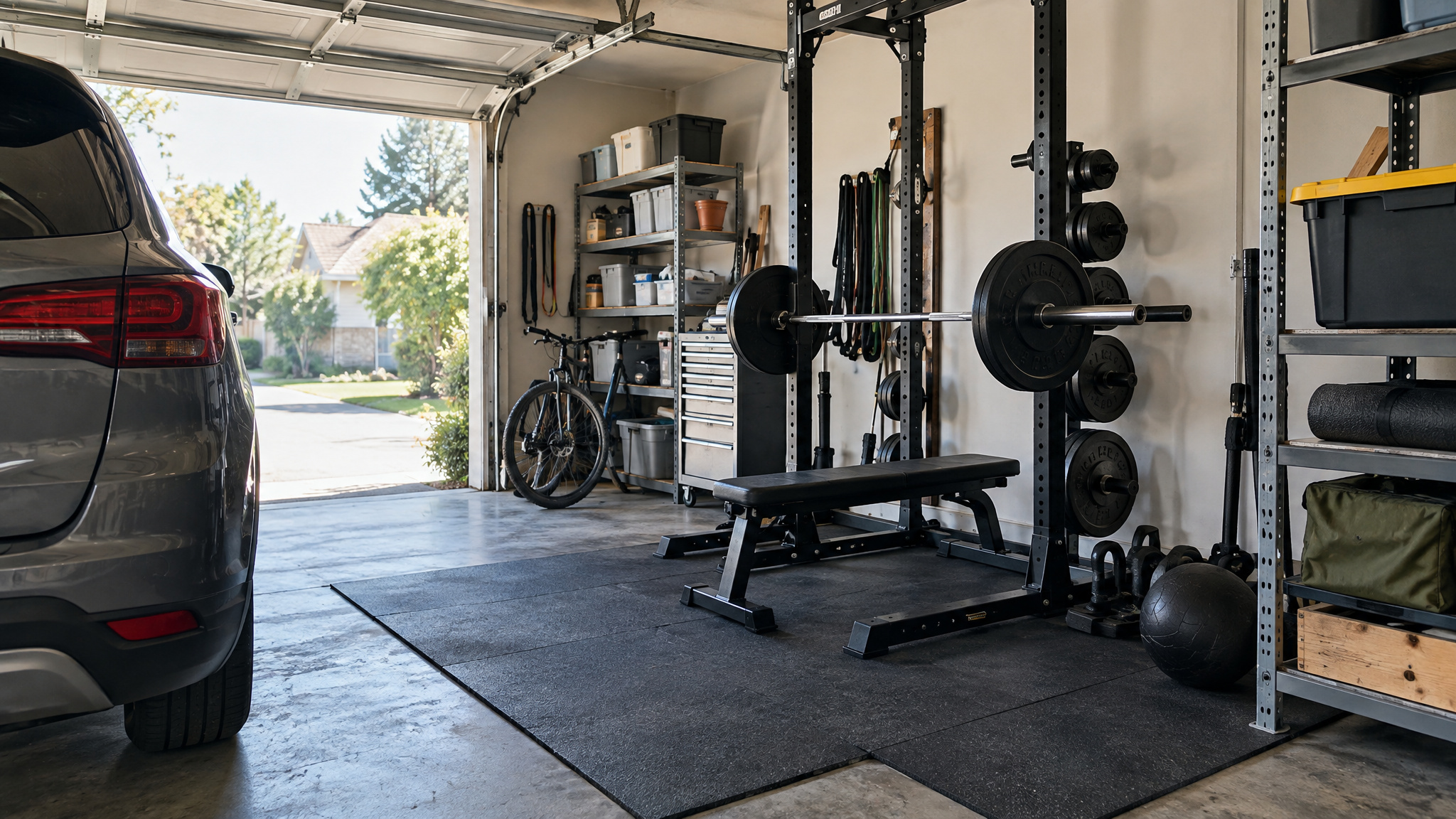
One horse stall mat example measures 4 by 6 feet, is ¾ inch thick, weighs about 50-70 pounds, and was listed at $59. How many you’d need depends on the area you want covered; that price isn’t the cost of flooring an unspecified room. Compact racks can save floor space while offering fewer attachment options, while a power rack is another rack option to consider. PRx Performance is named for fold-away racks and storage.
Delivery or installation may add to the bill, though no comprehensive price range is available. Some apartment or housing-development gyms may also mean you don’t need to buy equipment.
Build gradually, buy used, and account for resale
Start with equipment for training needs you’ve already established, then add pieces when actual use gives you a reason. That can limit upfront spending and the odds of buying gear that sits unused. Shipping several items together may be less expensive than ordering them separately, but that isn’t guaranteed, so compare the delivered total.
Facebook Marketplace, Craigslist, OfferUp, and local communities can turn up used equipment. Check its condition, test that it works, and factor in the time and cost of collection, travel, or delivery. One source author reported paying $500 for a used rower through Facebook Marketplace when comparable machines were said to cost more than $1,200 during COVID. The author had to travel to pick it up, and the story is a period-specific purchase, not a current market benchmark.
Used plates, household or DIY options, comparing prices, and seasonal promotions, including Black Friday offers, may help lower spending. Reselling or trading equipment can offset some cost later, but it doesn’t guarantee you’ll recover what you paid.
Gym membership prices, fees, and what dues include
The roughly $65 monthly commercial-gym average is an attributed 2024 Health & Fitness Association benchmark, not what every reader will pay. That works out to about $780 a year, or $7,800 over ten years in dues-only arithmetic. Lower-cost examples are well below that: Planet Fitness is listed at $15, $25 monthly in one source, while another lists Crunch Fitness at $10, Planet Fitness at $15, Gold’s Gym at $25, and LA Fitness at $30.
Those figures vary by location, plan, and time. An Equinox example is $200 a month, or $2,400 a year, before promotions or upgrades. One source reports roughly 3% annual growth in membership costs, but that isn’t a universal forecast. A gym’s monthly price may not be the full bill: one Planet Fitness example lists a separate $49 annual fee, and cancellation charges or higher post-promotion dues may apply. Introductory offers can last 30 days or up to a year. Compare the actual contract, applicable fees, and price after any promotion ends.
Home-gym break-even: compare assumptions, not promises
The estimate depends on the equipment budget and monthly dues. One simplified comparison estimates about two years for a $1,500 home gym to match a $65 monthly membership. A separate example puts the timeline at about four years for $1,098 in equipment versus $25 monthly Gold’s Gym dues.
Those estimates aren’t contradictory; they use different numbers. The Gold’s Gym example counts dues as $25 monthly, $300 annually, $1,200 over four years, and $2,100 over seven. It doesn’t make the $1,098 equipment figure a complete ownership cost. Installation, maintenance, repairs, replacement, upgrades, subscriptions, and other expenses may be left out of these comparisons. For a useful comparison, plug in what you’d actually spend on equipment, dues, and fees over the same period.
How often you use the home setup or membership matters too. Neither example promises a savings or a payback date.
Studio classes, childcare, and fitness benefits
Unlimited monthly studio examples range from $119 at 9Round to $256 at [solidcore]. CycleBar is listed at $125, Orangetheory Fitness at $159, Pure Barre at $165, and F45 at $189; these costs are separate from conventional gym dues. Listed class prices are $25 at Pure Barre and CycleBar, $35 at Orangetheory, and $34 at [solidcore]. No 9Round class price is supplied, and F45 pricing varies.
Rates depend on location and membership type. A drop-in or smaller class pack may cost less than unlimited access, but check when a pack expires; trying group classes at a gym first may also cost less. Adding a studio membership to another workout option can add about $1,000, $2,000, depending on the plan. Studio classes are an optional expense for a home-gym budget.
A YMCA example offers members up to 90 minutes of childcare; Burn Bootcamp is another cited childcare option. Employers or health insurers may offer fitness reimbursement, discounts, or direct payment under their own rules.
Home gym or commercial gym: value beyond the dues
A home setup can make it easier to choose your workout time, skip the commute, and avoid waiting for equipment. A commercial gym can offer more equipment variety, group instruction, guidance, a different setting, and a sense of community, though crowding may limit access.
One source author and spouse paid about $200 a month for two CrossFit memberships. They weighed gas, vehicle maintenance, distance, travel time, and equipment quality before moving toward a garage gym. That’s their household’s experience, not a typical membership calculation, and there’s no supported dollar value for the time or travel involved.
A hybrid approach can let someone keep gym access while adding home equipment gradually, but paying for both may cost more. Whether it’s worth owning gear or paying dues comes down to what you’ll use; either can be poor value if it sits idle.
Where to buy equipment and how to read product examples
Rogue Fitness, REP Fitness, Fringe Sport, PRx Performance, Amazon, Walmart, Target, and Five Below are among the listed places to compare equipment; they’re examples, not endorsements. One source describes Amazon as offering many budget pieces and fewer high-end options, and PRx Performance is named for fold-away racks and storage.
Named roundup items such as the Signature Fitness Plate-Loaded Lever Arm Rack Attachment, Primal Personal Series HIIT Bench, Theragun Elite, and Technogym Wellness Ball Active Sitting don’t have enough supplied price or cost detail here. Listed prices and specifications may change, and the product descriptions don’t establish an independent comparison across the field.
Is a home gym worth the cost for you?
Buying a home gym may make sense if its equipment suits your training, budget, space, and likely use. A garage setup may compete with parking or storage, while a membership can include access, classes, coaching, or community that home equipment doesn’t provide. Travel, childcare, vehicle costs, and fitness benefits can also affect the comparison, but there’s no universal dollar value for them. Starting with household items or a few established essentials lets you test the routine before expanding; resale may help later, but it won’t guarantee your money back.
Frequently Asked Questions
How much would a decent home gym cost?
There’s no single price for a decent home gym: it depends on what you train for, what you already own, and how much space you have. One budget framework puts basic equipment at $300–$1,000 and a mid-range strength setup at $1,000–$3,000, but those are examples, not required spending levels.
What does a decent home gym cost for strength training?
A rack, barbell, plates, dumbbells, and bench fit one mid-range framework of $1,000–$3,000. You may spend less if you only need a few pieces, already own equipment, or don’t plan to lift with a barbell; the right setup depends on your lifts, space, and intended loads.
What equipment do I need for a small home gym?
Start with gear that matches the movements you plan to do: adjustable dumbbells or kettlebells, resistance bands, and a mat may be enough. Add a bench, rack, or cardio machine only if your routine calls for it and you have room.
How much does a home gym cost at different budget levels?
One published framework puts a budget setup at $300–$1,000, a mid-range gym at $1,000–$3,000, a full gym at $3,000–$6,000, and commercial-grade equipment at $6,000 or more. The tiers describe different equipment scopes, not a market-wide price standard or a required progression.
What ongoing costs should I include beyond home gym equipment?
Possible extra costs include delivery, installation, electricity, maintenance, repairs, replacement parts, and upgrades. Subscriptions are optional recurring costs, and the total depends on your equipment and choices; there’s no single ownership-cost figure that applies to every setup.
How long does a home gym take to pay for itself?
It depends on the equipment cost and the gym dues you compare it with. One simplified example reaches break-even in about two years for a $1,500 setup versus $65 monthly dues; another takes about four years for $1,098 in equipment versus $25 monthly dues. Those comparisons may omit ownership costs, and neither guarantees savings.
What is the average cost of a gym membership, and how does it compare?
A roughly $65 monthly commercial-gym average is attributed to a 2024 Health & Fitness Association benchmark, while listed lower-cost examples range from $10 to $30 a month. A membership’s actual cost can also include annual fees, cancellation charges, or higher dues after a promotion, so compare the contract with your own home-gym budget and likely ongoing costs.
Is a home gym really worth it?
It can be worthwhile if the equipment suits your training, budget, space, and likely use. A home setup can save travel and waiting time, while a commercial gym may offer more equipment, classes, guidance, and community; gear that sits unused or dues you don’t make use of can be poor value either way.