
You book a “free” room at a Las Vegas casino. You feel good about it. Then you check out and there’s $90 in resort fees on your bill, plus tax, plus the $14 bottle of water you touched in the minibar. The room was never free. You didn’t know where the charges were hiding.
That’s the thing about casino comps. Casino comps are not free; they are a performance-based customer acquisition tool funded by expected gaming revenue. Casinos issue comps because they expect a profitable gaming relationship. Industry expert Andrew Cardno, who runs Quick Custom Intelligence, puts the typical reinvestment rate at about 20% of your theoretical loss.
In competitive markets, that can range from 10% to over 50%. But it’s never free money. It’s a rebate on the action you were already giving them.
This guide is the story. How the system works, how to make it work for you, and—most importantly—how to avoid the traps that turn a “comped” trip into an expensive lesson.
Key Takeaways
Casinos reinvest roughly 20% of your theoretical loss in comps, but that number varies wildly depending on market competition and how you play.
Over 30% of slot play goes uncarded—meaning those players earn nothing, even when they’re wagering enough to get comped rooms.
Downtown casinos will comp you a room with $10-$15 average bets for 3-4 hours. Luxury Strip properties like Bellagio require $75-$150 average bets for the same thing.
Table of Contents
The truth about “free” in Las Vegas
Every comp you get—room, meal, drink, show ticket—comes from a simple equation. The casino figures out how much money they expect to make from you based on your betting patterns. Then they spend a percentage of that expected profit to keep you coming back.
That’s why RFB (Room, Food, Beverage) sounds like a blank check but isn’t. You might get the room comped, but eligible meals and drinks depend on your offer, your tier, your host’s approval, and the property’s rules. The guy who plays $100 a hand at blackjack gets a different RFB package than the guy feeding $20 into a penny slot for three hours.
You don’t have to lose money to earn comps. Comps are based on theoretical loss, not actual loss. The casino tracks your action, not your results. Theoretical loss is calculated from average bet, hours played, game speed, and house edge. You don’t need to lose money to earn comps — you just need to play. Win or lose, that theoretical loss is still the same.
How casinos calculate comps
The formula, based on theoretical loss not actual loss, is straightforward:
Theoretical loss = average bet × hours played × hands per hour × house edge
Let’s run it. You’re playing $25 blackjack for four hours. Blackjack with basic strategy has a house edge around 0.5%. You’ll see roughly 60 hands per hour.
$25 × 4 hours × 60 hands × 0.5% = $120 theoretical loss.
At a 30% comp return (typical for table games), you’re looking at $30-$50 in comps.
Slots work differently because they track every spin automatically. Say you put $100 into a penny slot, play it through three times, and cash out at $80. That’s $300 wagered total. The casino doesn’t care that you only lost $20—they care about the $300 coin-in.
Slots typically return 30-40% of theoretical loss as comps, while table games run 20-30%. That’s why slot players often get better offers for the same time investment.
Table games rely on a pit boss eyeballing your play and estimating your average bet. Friendly players who bet up when the boss is watching tend to get rated higher.
Slots are automatic and accurate. No schmoozing required.
The player’s card problem
Here’s a number that should shock you: Gene Johnson, a longtime Vegas industry observer, says 30% or more of slot play is unrated. No player’s card. No tracking. Nothing.
Why? Card-reader errors, superstition (some people think the casino can “see” them), ignorance, privacy concerns, or just not having a card in the first place. Every unrated spin is a comp you earned but will never see.
Signing up takes five minutes. You need a valid ID. Most programs let you register online before you even get to Vegas. New member promotions often include $10-$25 free play, dining credits, or bonus tier points. Caesars Rewards sometimes hands out instant Gold status to new sign-ups. That’s a shortcut to resort fee waivers and priority lines.
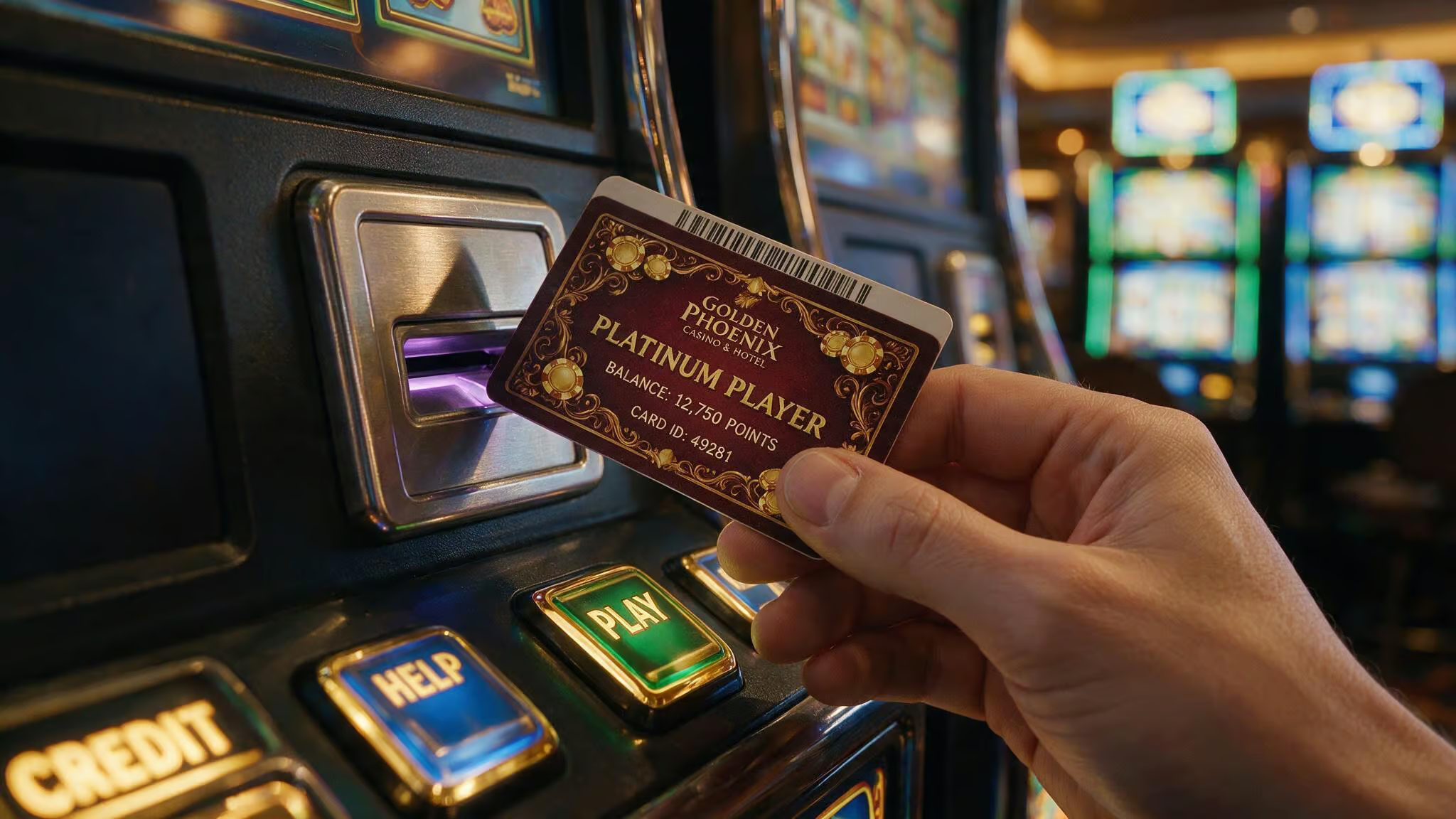
If you’re going to gamble anyway, get the card. Use it every time. Move to a different machine? Reinsert the card.
Table game? Hand it to the dealer and make sure the pit boss notes it.
Bottom line: If you gamble without a player’s card, you’re leaving 20-40% of your expected comp value on the table—every single spin or hand. That’s why it’s essential to learn how to get free stuff at casinos the smart way, preserving both your bankroll and your self-respect.
Hidden costs and fine print
That comped room you’re proud of? It’s not free until the resort fee is gone. Most properties charge $45 to $60 per night. A $45/night resort fee on a three-night stay adds $135 to your bill. Waiving the fee requires higher tier status—usually Caesars Diamond or MGM Gold.
Resort fees aren’t the only gotcha. Casino comps rarely cover tips. Tip on the full retail value of the meal, not what the casino paid for it. Beverage credits might not include top-shelf liquor, bottles at the club, or minibar items. According to a 2023 TripTips survey, 68% of comp users were surprised by the resort fee.
And don’t plan a comped stay around New Year’s Eve, Super Bowl weekend, Formula 1, or March Madness. Blackout dates are real and strictly enforced.
Backend comps—the kind a host adds to your bill after you play—aren’t guaranteed unless you confirm them in advance. And the hotel still puts a hold on your credit card for incidentals. Show up with zero available credit and you’ll have a bad time.
Where to play: property tier strategy
Your play only matters if it’s concentrated. Consolidating play at one casino group maximizes comps. Spreading $500 across five different casinos earns almost nothing. Concentrating that same $500 at one property establishes loyalty and accelerates tier progress. Put that same $500 into one property and you start building a relationship.
Here’s the breakdown by tier:
Downtown and off-Strip – El Cortez, The D, Golden Nugget, Station Casinos. You can get a comped room with $10-$15 average bets for 3-4 hours, and crowdsourced secrets on how to get free stuff at casinos reddit reveal real player hacks for free drinks, rooms, and free play without high stakes. This is the easiest path to free rooms in Vegas.
Mid-tier Strip – Flamingo, LINQ, Harrah’s. These require $25 average bets for 4-6 hours to earn a free weeknight room.
Luxury Strip – Bellagio, Wynn, Caesars Palace (sort of—it straddles mid and luxury). You’ll need $75-$150 average bets for comped rooms. The rooms are nicer, but the entry fee is steep.
The loyalty program choice matters. Caesars Rewards covers 8+ Strip properties and is generally considered the best for room comps. MGM Rewards covers 13 resorts—most of the Strip. Station Casinos’ Boarding Pass gives the best comp rates relative to play, making it ideal for budget players and locals.
Actionable strategies: how to earn comps on your trip
Free drinks are the easiest comp in Vegas. You can get them at almost any bet level as long as you’re actively playing. At slots, wager at least $0.25 to $0.50 per spin to keep the cocktail waitress coming. Tip $2-$3 on the first drink, then $1-$2 after that—it keeps the service fast. Downtown casinos are the most generous. At bar-top video poker, play $1-$5 a hand and you’ll get comped drinks while you play.
For table games, a few things help: bet bigger when the pit boss is watching, be friendly, stay at one table, and play rated for the entire session. Hopping tables breaks up your record and leaves you underrated.
Asking for comps isn’t awkward if you do it right. After two or more hours of solid play, go to the players club desk and say something like, “I’ve had a good time playing—are there any dinner options available tonight?”
If you’re betting $50+ average or visiting regularly, ask for a dedicated casino host. They can arrange room upgrades, hard-to-get reservations, show tickets, even airport transfers. To get one, ask at the players club desk or call VIP services.
Before checkout, stop by the Rewards desk and ask, “Can someone review my play to see if any qualifying room, food, or beverage charges might be comped?” It’s a common request. The worst they say is no.
After your first rated visit, the casino starts sending mailers—typically 2-4 free room nights (Sunday-Thursday), $25-$500+ free play, and $25-$100 dining credits. Check the MGM Rewards and Caesars Rewards apps weekly; offers change often. If you stay away for 6-12 months, expect inflated “win-back” offers designed to lure you back.
Timing matters. Slow seasons (January, early February, September-October) have the best deals. Tier credit multiplier days (2x-5x) accelerate your progress. And make sure your birthday is in your profile—most programs give extra points, free play, or dining credits in your birthday month.
Advanced tactics: tier matching and myVegas
Tier matching is the fastest shortcut to better comps. Present your elite status from one program at a competing casino and they’ll often match it. The classic move: Caesars Diamond to MGM Gold (and reverse). That gets you resort fee waivers and priority lines at both properties.
Another path to Diamond status is the Caesars Rewards credit card, which grants automatic Diamond status after the first purchase. That alone waives resort fees at all Caesars properties. Meanwhile, the old “$20 sandwich trick”—slipping a $20 bill between your ID and credit card at check-in and asking for an upgrade—still works occasionally at off-peak times, though it’s less reliable post-COVID.
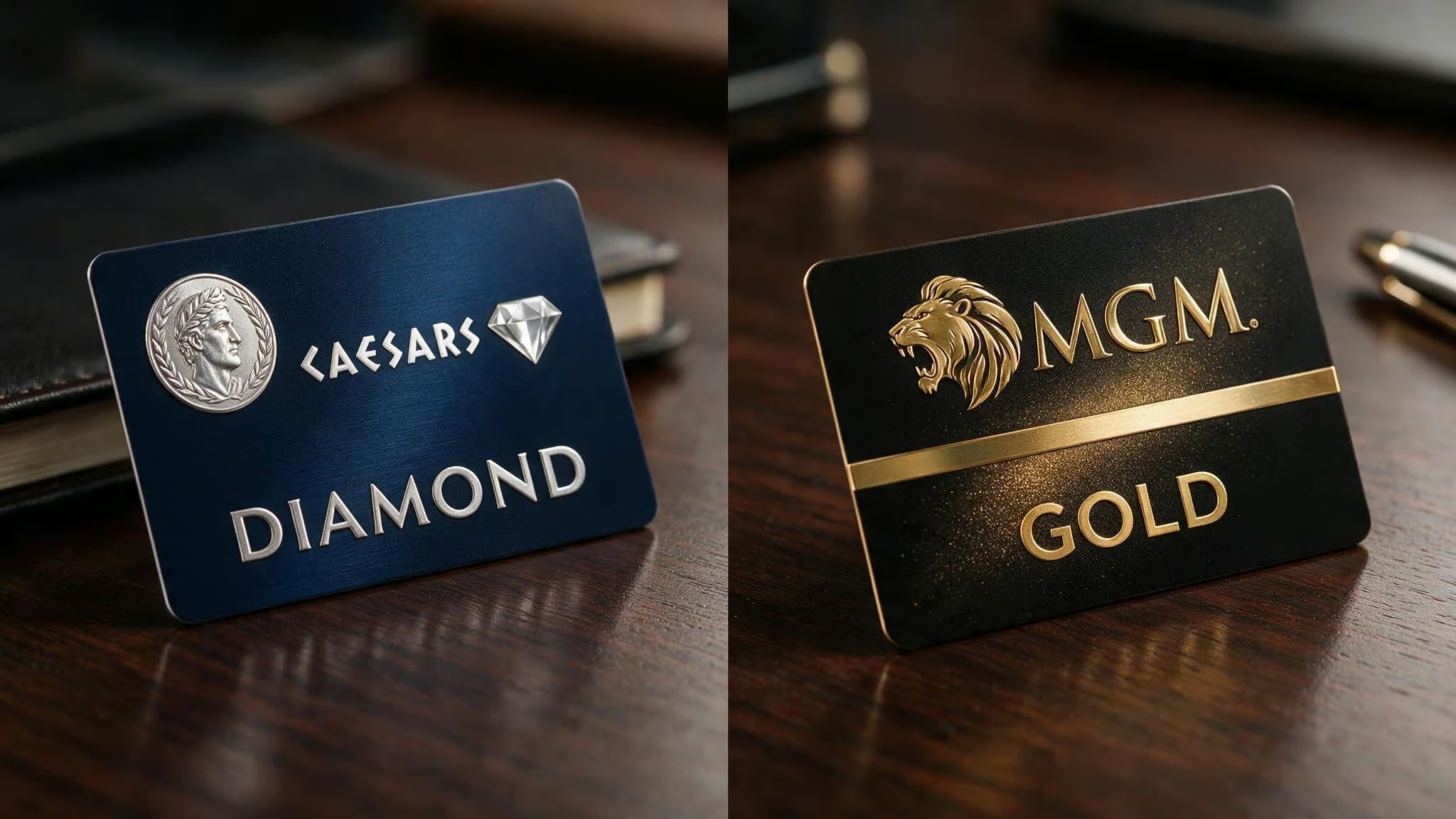
Wynn has been known to match Diamond or Gold. Station Casinos matches for first-time visitors. The catch is a play requirement within 90 days—they’re not giving it away for nothing.
The myVegas app (from PlayStudios) is a way to earn MGM comps without spending a dime. It’s a free mobile game on iOS and Android. Play consistently and you’ll unlock rewards on a rough timeline:
- After 1-2 weeks: free buffets at Bellagio, Aria, or MGM Grand
- After 1-2 months: show tickets or $25-$50 dining credits
- After 2-3 months: free weeknight rooms at Excalibur, Luxor, or Park MGM
- After 4-6 months: free rooms at Bellagio, Aria, and Vdara
Start playing at least three months before your trip to build up enough points.
Property deep dives: Caesars Palace, Bellagio, Wynn
Caesars Palace – 4.6/5 on TripTips for comps. Best for room offers, especially weeknights. Food and beverage comps are more selective—don’t expect a free steak dinner after a few hours of penny slots. Reviews are mixed: some guests report getting upgraded to fountain view rooms, others describe “bait and switch” experiences where their comped room wasn’t what they expected. It’s part of Caesars Rewards, giving you access to 8+ properties.

Bellagio – 4.4/5 TripTips. Luxury MGM property. Requires stronger play for meaningful comps. The strategy: join early, use your card every time, charge everything to your room, avoid splitting play across other MGM properties, ask for a host review before checkout, check offers after your trip, and consider building a track record at a lower-tier MGM property first.
Wynn Las Vegas – 4.3/5 TripTips. Uses COMP DOLLARS you can spend on dining, rooms, retail, spa, even golf. Because the property is expensive, a comped room or dining credit there is worth more in dollars than at a mid-tier spot. Best for high-value players and luxury travelers.
Non-gambling alternatives: the MGM all-inclusive package
MGM offers an all-inclusive package at Luxor or Excalibur priced from $330 plus tax for a two-night stay covering two people. Valid from April 6, 2026, with no blackout dates—which is rare. It includes the room, resort fees, three meals a day, two show tickets and two Big Apple Coaster rides, and self-parking.
The estimated a la carte cost for all that would be $875 to $945 plus tips, so you’re saving roughly 65%. But there are trade-offs. Dining is at casual venues with limited menus and one beer or wine per person. No fine dining at Joël Robuchon or Hakkasan. Shows are limited to Blue Man Group and Carrot Top—not Cirque du Soleil.
It’s a good deal if you use everything. Skipping meals or shows cuts into the savings. But for budget travelers who want a cost-controlled trip, it’s a legitimate alternative to comps. No gambling required.
The post-COVID comp landscape (and the most important rule)
Comps have tightened since the pandemic. Casinos track player value through multiple factors including average bet, type of game played, hours played, slot coin-in, table-game theoretical loss, frequency of visits, historical losses/wins, property loyalty, spend on rooms/dining/nightlife/entertainment. Anthony Curtis of the Las Vegas Advisor notes that pre-COVID, the Member Rewards Book had 25-30 two-for-one buffet coupons. In 2022, it had one. One.
Gene Johnson explains that the post-COVID revenue boom reduced the need for aggressive marketing. Casinos didn’t have to work as hard to fill rooms.
Curtis predicted things would start improving again going into 2023. But the golden age of comps—when you could get a free room on a Tuesday after an hour of $5 blackjack—is past. Casinos now use dynamic reinvestment tools like Quick Custom Intelligence to fine-tune offers based on individual player behavior. They know who responds and who doesn’t.
Consolidate your play. Use your card.
Check your offers. Ask politely.
Never gamble more to earn a comp. Comps are a rebate on money you were already comfortable risking. If you find yourself increasing your bet to qualify for a free buffet, the math is working against you.
Play the game you want to play. The comps will follow—or they won’t. Either way, you’re not losing more than you planned. That’s the only winning strategy in Vegas.
Frequently Asked Questions
How do I get free stuff in Vegas?
Sign up for a player’s card at every casino you play and use it every time you gamble. Casinos track your play and reinvest roughly 20% of your theoretical loss into comps like rooms, meals, and show tickets. The key is concentrating your play at one property and asking politely for comps after a few hours of rated play.
How to get free stuff at casinos?
Get a player’s card, use it every time you gamble, and concentrate your play at one casino. Free drinks are the easiest comp—tip $2-$3 on the first drink at slots or bar-top video poker to keep them coming. After two hours of rated play, ask the players club desk if any dining options are available. Never gamble more than you’re comfortable with just to earn a comp.