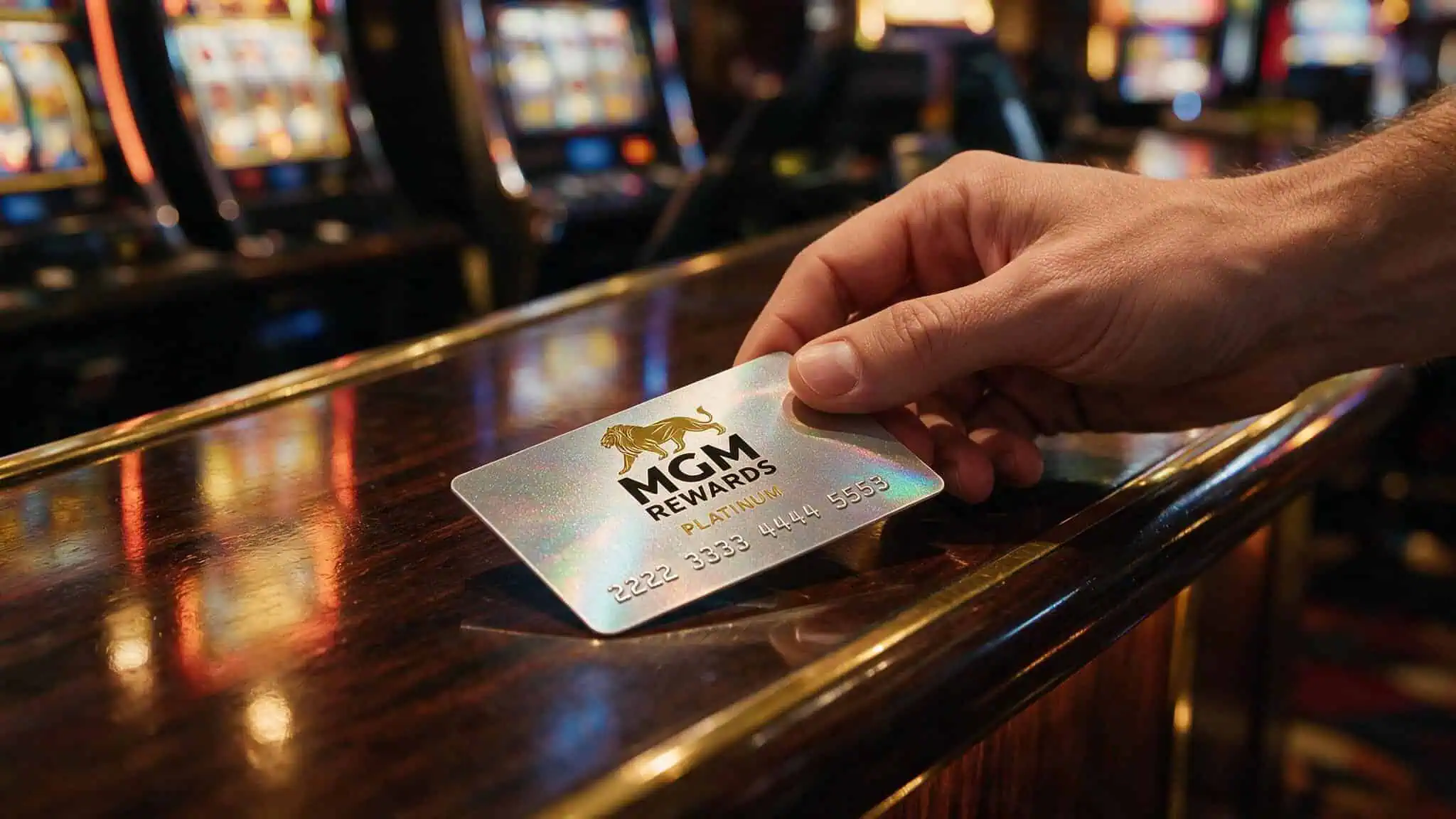
In 2011, I was in Las Vegas for a bachelor party. I wasn’t a gambler — I’d maybe played blackjack a few times, but I didn’t know a player’s card from a room key. One afternoon at Circus Circus, I dropped a $20 bill into a penny slot on a whim and walked away with $100. Feeling lucky, I moved over to MGM Grand, turned that $100 into $500 over about two hours, then slowly bled it back down to $100.
I was about to call it a night when a casino worker stopped me and insisted I sign up for the Mlife card right there. I figured why not. It’s free.
Over the next year, my inbox filled up with emails from MGM Resorts offering free nights, free slot play, sometimes both. That $20 bet turned into a discovery that’s saved me thousands on Vegas trips over the past decade-plus. And here’s the thing: I’m not a high roller. I’m a regular guy who treats $300–400 a year like a subscription fee for VIP perks. This guide is how you can do the same — without getting taken for a ride.
Key Takeaways
Two player’s cards (MGM Rewards and Caesars Rewards) cover 18 Vegas properties; signing up is free and triggers offers even with zero play.
A budget of $300–400 per year on slots, played slowly and expected to be lost, reliably generates comp offers worth far more than that spend.
Comps are based on theoretical loss (time × bet × house edge), not actual win/loss — so winners earn the same comps as losers.
Table of Contents
Step 1: Sign up for player’s cards at every casino
Most people walk right past the player’s club desk. Don’t.
Two loyalty programs cover 18 Strip and downtown casinos:
- MGM Rewards (formerly Mlife): covers MGM Grand, Bellagio, Aria, Mandalay Bay, Luxor, Excalibur, New York-New York, and others.
- Caesars Rewards: covers Caesars Palace, Paris, Planet Hollywood, Harrah’s, Flamingo, and more.
Signing up takes five minutes. You’ll get a card, sometimes a free T-shirt or a coupon book, and often a small amount of free slot play just for enrolling. Give them your email — that’s how they’ll send you offers. Even if you never gamble, the casino uses your data to send mailers. I’ve gotten free rooms for years off a single sign-up with zero play.
For table games: when you buy chips, just set your card down next to your money. The dealer handles the rest. Since 2020, non-gambling spend (meals, shows, shopping) at MGM and Caesars properties also earns comps — so hand your card over at restaurants, too. Mlife (now MGM Rewards) also ties into Hyatt status, for example, Hyatt Platinum matches to Mlife Gold, unlocking additional benefits.
Step 2: The $400/year slot subscription
You’re not gambling to win. You’re paying a deliberate annual expense — like a gym membership or a streaming service, in exchange for comped rooms, free play, and other perks.
My tested sweet spot is $300–400 per year on slots. That’s it.
I play slowly to maximize time at the machine, because comps are calculated from time × bet × house edge. The casino expects to make more from you the longer you sit there, and they comp you more for it. I fully expect to lose that entire budget.
Here’s what happened when I tested it:
- $150 play (lost it all over several hours): Offers came in, but they weren’t strong — maybe a free night here and there.
- $200 play (lost it all on the next trip): Offers got noticeably better. Free nights at multiple properties, free slot play, room upgrades.
After that, I kept repeating the cycle roughly once a year. I’ve received as many as nine comp offers in a single month (July 1 to August 1). The offers easily cover the $400 I put in — free rooms alone are worth more than that.
One important note: hand in your club card when buying food or checking into the hotel. It doesn’t help as much as gambling, but it adds to your tracked spend.
Step 3: How comp math really works
The casinos don’t care if you win or lose. They care about what they expect you to lose — called theoretical loss. Comps are based on that number, not your actual bankroll swing.

The formula: theoretical loss = time on machine × average bet × house edge.
Once you understand that, the point system makes a lot more sense — and it also reveals why points are almost worthless compared to comps.
Take a concrete example: you play $100 through a slot machine with a 90% payback rate. The casino’s expected profit is $10. In most programs, $5 of slot play earns 1 point worth $0.01. So for $100 in play, you get 20 points worth $0.20.
That’s only 2% of your expected loss coming back as points. Not great.
But actual comps (free rooms, meals, free play) are typically 5 to 20 times more valuable than your point balance suggests. The definitive guide to how to get free stuff at casinos — from the Unfinished Man perspective of smart, strategic play and authentic self-respect, shows that casinos give back roughly 10–40% of expected loss in comps. The gap is massive.
Bonus point days — 2x is common, 10x happens occasionally, can narrow that gap. A 10x multiplier turns that 2% return into 20%, much closer to the comp rate. Midweek offers (Sunday–Thursday) often have lower room rates and better comp availability, making them ideal for using bonus points.
Step 4: Slots vs. tables — the trade-off
Slots earn the most comps because they have the highest house edge. Casinos love slot players. But if you hate sitting in front of a screen pressing a button, don’t force it.
Better-odds games like craps or blackjack yield fewer comps but also lower expected losses. For a four-hour session, craps saves you roughly $50 per hour over slots. That’s $200 you keep in your pocket, which more than makes up for the smaller comp return.
My advice: choose games for entertainment, not comp maximization. If you genuinely enjoy slots, fine — you’ll get more comps and can probably figure out how to get free play in Vegas. If you’d rather play craps, do that. You’ll lose less money overall, even with fewer comp offers.
Step 5: How to actually ask for comps
Most comps aren’t automatic. You have to ask. Here are the three channels:
- Floorperson (for table games): They can authorize meal comps or small room discounts on the spot.
- Player’s Club desk (for slots and video poker): They have a set formula based on your point balance.
- Host (best option): Hosts have the most discretion. If your expected loss for a trip reaches around $100, you’re in prime territory to ask a host for something. A host can comp a meal, a room upgrade, or even waive a resort fee.
For table games, your comp credit is tracked invisibly in the computer system — you can’t see it on the machine card reader. That’s why you have to ask. Don’t be shy; it’s standard practice.

One gotcha: comp points at Strip and downtown casinos expire after a month or two. Use them or lose them. And if you get a comped meal ticket, know that you can’t use it for tips, and unused credit won’t be refunded or transferred.
Bonus: Junkets — the shortcut with strings
Junkets are another way to get a free or heavily discounted trip, but they come with real trade-offs.
There are two types:
- Casino-run junkets: Flexible play requirements, no wagering minimum. You can gamble elsewhere, but insufficient play may kill future offers.
- Third-party junkets (like those from Casinos International): You’ll give a credit card on file and must meet minimum wagering requirements. Prices run around $169–$189 per person for round-trip air and three nights.
Real example: A junket operator named Sandy Crammer ran a database of 20,000 players, sending out 7,000 letters a month. Next-tier players paid a $179 fee for better comps. That gives you a sense of the scale — the junket business is built on volume.
Junket rules are strict:
- No gambling elsewhere during the trip. Violating this can get you permanently blacklisted.
- Luggage can take 20 minutes or up to four hours to arrive. Keep meds, cash, and keys on you.
- CET (Caesars) may bait-and-switch offers based on your call history — call promptly to lock in what you were offered.
- Junket leaders sell “a planeful of gamblers,” not tourists. They want action, not small talk. If you sit at a machine and play $5 an hour, you won’t get invited back.
Casino-run junkets are simpler: no wagering minimums, but still expect you to play. Third-party junkets require a credit card on file and enforce the wagering rules. Either way, read the fine print.
Pro tips: Free drinks, partner accounts, and resort fee fine print
These small details can make a big difference in how much value you actually get from your comps and your time on the casino floor.
Free drinks
The old sit at a machine and get free drinks trick still works, but here’s how the system actually plays out. Tip $1–2 per drink. Wave a dollar bill for the first one. Waitresses care about tips, not whether you’re actively playing.
Casinos tried enforcing minimum-bet rules (Caesars and MGM experimented with it around 2016), but enforcing that policy costs more than the drink is worth, so enforcement is weak. A $1 bill works better than any computer algorithm.
Partner accounts
If you travel with a spouse or partner, you have two options:
- One shared account: Combined play reaches higher tiers faster, which can unlock better perks.
- Two separate accounts: Each of you gets separate mailers. That means two sets of offers — e.g., two three-night free stays instead of one.
Some casinos require spouses to be on one account — check their policy. If you can choose, I’d lean toward separate accounts for double the free nights, but combine if you’re chasing a specific tier that unlocks better airport lounge access or concierge service.
Resort fees
Comped rooms generally waive the resort fee — but not always. At Caesars Diamond level, the fee is waived and you get the benefits (WiFi, fitness center). Below Diamond, the fee is waived but you don’t get the benefits. When I was comped at Encore in 2019, I didn’t pay a resort fee, but I lacked Internet access. I ended up voluntarily paying the $39/night resort fee just to get online.
Moral: ask about resort fee policy when you check in. If you need the benefits, you might have to pay — but a host can often waive it.
Warnings: What “free” really costs you
Don’t play just to get comps. It’s like spending a dollar to save a quarter.
If your expected loss on a trip is $100 and the comps you earn are worth $30, you’ve still paid $70 for “free” stuff. That’s fine if you were going to gamble anyway, but if you’re only playing to chase comps, you’ll lose every time.
Some programs are stingy. The Venetian and Palazzo eliminated free rooms and meals for non-high-rollers in February 2011. They’re notoriously tight. My experience with Total Rewards (Caesars) didn’t yield the same results as MGM’s program — not even close.
Other programs are surprisingly generous long-term. I played about $30 through a machine at Wynn years ago, lost $15, and still received Wynn offers for 13 years after that trip. That’s an outlier, but it shows the range.
Junket blacklisting is permanent. If you gamble anywhere else during a junket trip, you’re done.
And CET may bait-and-switch offers depending on your caller history — call promptly to avoid getting a worse deal than the mailer promised.
The real takeaway: understand the system, don’t let it understand you.
Bringing it all together
About 12% of Las Vegas hotel stays are comped, according to the LV Visitor Study. That’s not a rare score — it’s a common outcome for people who play the game smart.
My method is a calculated risk: spend $300–400 up front, expect to lose it, and typically receive comps worth more than that. Start with player’s card sign-ups. Test with $150–200 in slot play. If the offers improve, repeat annually. If they don’t, you’re only out a weekend budget.
If you want a completely gambling-free path, Amex Fine Hotels and Resorts is a solid alternative for first-time visitors: early check-in, free breakfast, $100 resort credit, late checkout. No gambling required. But that’s a different kind of “free.”
True zero-net-loss methods like credit card churning or promotional offers are outside this guide’s scope. However, you can use the non-gambling spend comps mentioned in Step 1 — hand your card over at restaurants and shows, to earn small comps without any gambling loss.
The house always wins in the long run — but you can rig the comp game so you come out ahead on perks. Just don’t forget which side of the table you’re on.
Frequently Asked Questions
What is the $20 rule in Vegas?
The $20 rule is the idea that dropping a $20 bill into a slot machine on a whim can trigger a chain of casino comp offers worth far more than the bet. In practice, it’s less about luck and more about signing up for a player’s card immediately after any play, so the casino tracks your action and starts sending free room and free play offers.
How to get a free Vegas hotel?
Sign up for MGM Rewards and Caesars Rewards player’s cards before or during your trip — it’s free and takes five minutes. Then gamble $300–400 per year on slots, played slowly to maximize time on machine, and expect to lose that budget. Casinos track your theoretical loss and will mail you offers for free nights, often worth more than your annual spend.