Ever catch yourself staring in the mirror, wondering if that slight shift in your hairline is a dealbreaker? You might be asking, do girls notice receding hairlines?
Here’s the honest truth: most do, but probably not in the way you fear.
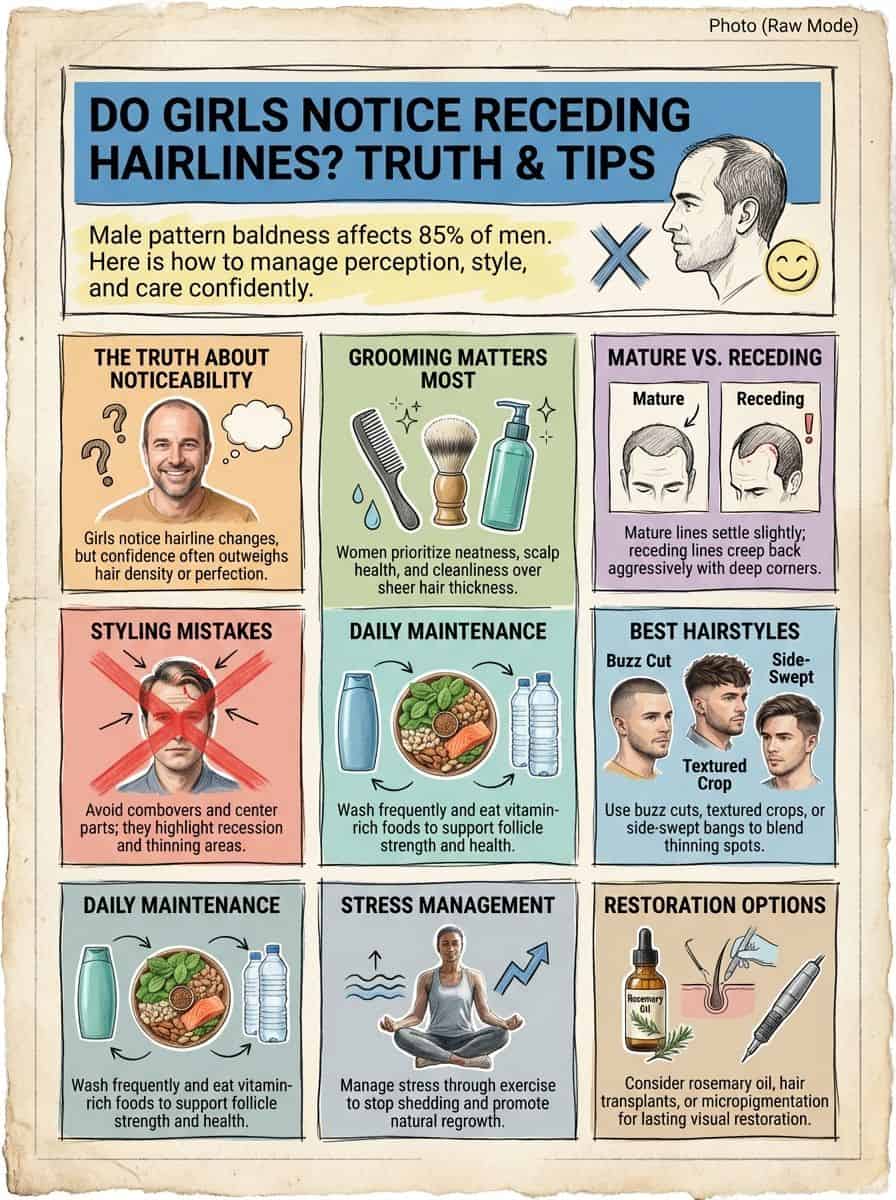
Male pattern baldness affects nearly 85% of men as they age, making it one of the most shared experiences in the barber chair. This guide cuts through the noise with real facts, expert hair care tips, and actionable advice to help you own your look.
I’m going to walk you through the exact styling tricks and solutions that have helped my clients for years. So, grab a coffee and let’s get your confidence back where it belongs.
Key Takeaways
You are not alone: About 65% of American men notice some hair loss by age 35, and that number jumps to 85% by age 50.
Hygiene wins over thickness: Hairlines with neat grooming—like washing 5-6 times per week to remove DHT-laden sebum—are consistently ranked higher by women than messy, thick hair.
Confidence is king: Celebrities like Jason Statham and Jude Law prove that self-confidence turns a receding hairline into a rugged asset rather than a flaw.
Style smarter, not harder: The “Textured Crop,” buzz cuts, and side-swept bangs are top 2026 choices for camouflaging thinning spots while adding modern flair.
Real solutions exist: Options range from natural oils (like pumpkin seed) and stress management to medical-grade fixes like FUT/FUE transplants at clinics such as Natural Transplants (with locations in Fort Lauderdale and Bethesda) or scalp micropigmentation.
Table of Contents
Do girls notice receding hairlines?
The short answer is yes, most girls spot changes in hairlines. But here is the secret I’ve learned from years behind the chair: they usually notice the attempt to hide it more than the hairline itself.
If you switch up your hairstyle abruptly or start acting self-conscious about your widow’s peak, that draws attention. However, many women prioritize the “whole package” over a perfect ponytail line.
Recent surveys suggest that while hair is a preference for some, a significant number of partners care far more about how you carry yourself than follicle density.
How aware are girls of hairline changes?
Girls tend to spot hairline recession and thinning quickly, often because they deal with similar issues. Subtle shifts, like a less rounded shape or thinning at the temples, catch their eye because they are hyper-aware of hair health.
In 2025, a study by Hers revealed that women are reporting more hair loss than ever before. Many have faced ponytail breakage, postpartum alopecia, or traction alopecia from tight braids.

This shared struggle gives them a sharp, empathetic awareness of female and male pattern hair loss. They know exactly what a higher widow’s peak or sudden bald patch looks like because they see it on TikTok and Instagram daily.
Because of this, they value early action. They respect men who take charge with scalp care routines, minoxidil foam, or strengthening shampoos. Awareness often pushes men to try new styles or consult professionals about options like Natural Transplants if things get patchy fast.
What hairline factors do girls prioritize most?
Once they notice a change, their focus shifts to maintenance. A lot of women care about neatness and cleanliness first. They tend to notice scalp health and regular washing, especially if someone shampoos 5-6 times a week.
Why does this matter? A greasy or flaky scalp signals neglect. A clean, well-kept scalp signals self-respect.
 Here is a pro-tip from the barbershop:
Many also look for a soft transition from the forehead. An abrupt, harsh line can look unnatural. A gentle curve with good density usually gets more points than sheer thickness alone.
Girls sometimes note cultural traits too; some cultures favor lower or rounder lines, while others appreciate the maturity of a higher, sharper hairline. Features like a widow’s peak can actually add character and distinctiveness.
“Poor habits make issues worse fast. In my experience cutting men’s hair since 2014, ladies often mention dry scalp flakes or itchy spots as major turn-offs before they ever comment on receding corners.”
Solid nutrition also plays a huge role. Hair that looks strong comes from foods rich in vitamins, whether you’re fighting male pattern balding or just want thicker edges. Regular trims and choosing flattering hairstyles like crew cuts work well around thinning spots too.
Girls value early action. They notice when you spot signs of alopecia areata or androgenetic alopecia and do something about it. Whether it’s balancing your diet with iron-rich foods or consulting a pro, taking control is attractive.
In short, visible self-care wins friends much faster than hiding bald spots ever could.
How do girls perceive receding hairlines?
Some girls notice a receding hairline, but many care more about how you carry yourself. Good grooming and a bit of confidence can turn thinning or receding hairlines into just another part of your signature look.
Does confidence matter more than looks?
Confidence often speaks louder than a full head of hair. Look at Hollywood icons like Jude Law, Matthew McConaughey, or Jason Statham.
They have receding hairlines or are completely bald, yet they are viewed as undeniably attractive. Why? They walk into rooms like they own the place, chin up, easy smile, not hiding behind hats or hoodies.
That kind of self-assurance draws people in faster than any thick fringe or buzz cut can. In fact, dating experiments—like those involving Tinder profiles—often show that while hair gets matches, bald men who own their look still perform well socially.
Women on forums frequently mention that confidence makes features like widow’s peaks or thinning hair fade into the background. It becomes part of your charm instead of something to hide.
How does grooming affect perception?
Looks matter, but self-assurance often steals the show. A neat haircut or a crisp beard can shift eyes away from a thinning hairline fast.
Many forum users say women rate grooming higher than actual hair density. A short, tidy hairstyle often wins extra points over a messy “cover-up” attempt.

| Strategy | Perception | Verdict |
|---|---|---|
| The Combover | Looks insecure and messy. Draws eye to the bald spot. | ❌ Avoid |
| Short & Textured | Looks intentional, clean, and confident. | ✅ Recommended |
| Hat Dependency | Implies you are hiding something. | ⚠️ Use sparingly |
Small details catch the eye. Caps, hats, headbands, even bandanas let you mix up your style, but don’t use them as a crutch. Products for scalp care and regular washing help prevent dandruff and boost overall appearance.
Stylists recommend consulting them for fresh cuts suited to your face shape—no need to go at it alone if you want sharper results. Women notice effort in maintenance more than minor changes in where your hair starts or ends.
Mature hairline vs. receding hairline
There is a big difference between growing up and going bald. A mature hairline looks like it’s settled back a tiny bit, just enough to make your forehead appear taller than when you were a teen.
A receding hairline, though, keeps creeping back, making people wonder if they should call Natural Transplants or just buy more hats.
Key differences in appearance
Notice a clear, V or M-shaped hairline? That’s likely to be the mature type that settles in during your late teens or early twenties.
It moves back slowly, about 1.5 to 2 centimeters (roughly one inch) from where you started as a kid. Crucially, it stops there. The shape may seem sharper and more angular if male sex hormones like DHT play a big part, but the hairline remains intact.
If you spot light thinning just at the temples and no signs of crown baldness, you’re probably dealing with normal maturing (Norwood Scale Stage 2).
When should you worry? Spotting temple loss plus an obvious patch developing near your crown hints at a receding hairline instead. This change is faster—months or just a few years—and often cuts back further than two centimeters.
For men facing male pattern baldness (Androgenetic Alopecia), that familiar M-pattern starts taking over as the temples thin out aggressively. Sometimes, it stretches toward the top-back of your scalp.
I saw my own shift after college. One day I had only mild recession, but by my next haircut, those spots grew fast enough for friends to notice too! Female pattern hair loss usually spreads out (diffuse), so lines stay gentle rather than getting sharp angles like males do.
How can you identify each type?
Understanding the differences in appearance is one thing, but spotting a mature hairline or a receding hairline involves paying attention to details.
A mature hairline usually forms a soft “M” or slight “V” shape and does not move much after your late teens or early twenties. Most men see this shift as natural, with the new line settling about half an inch higher than where it was at childhood—nothing wild or dramatic.
A receding hairline, on the other hand, acts differently:
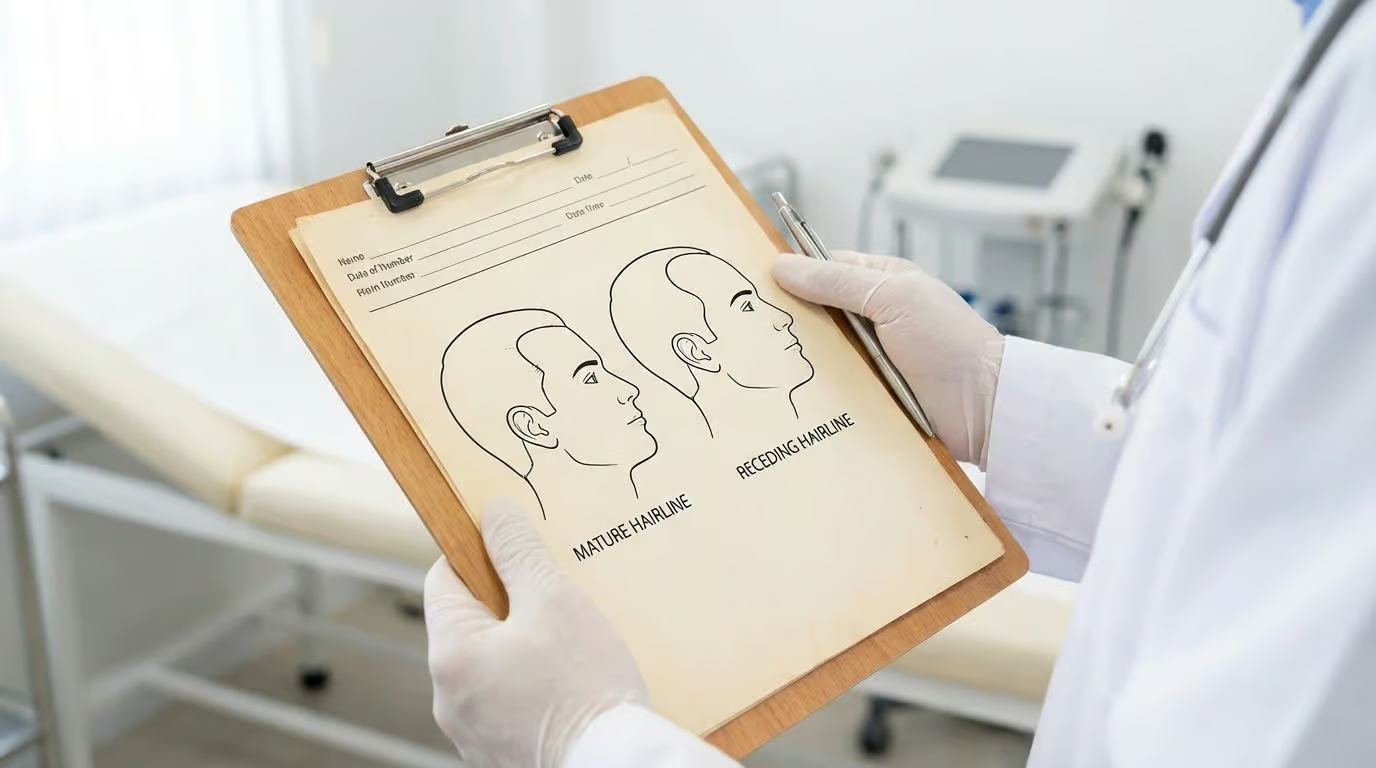
- Continual Movement: It keeps creeping back over time.
- Deep Corners: It creates deep recessed corners near your temples (Norwood Stage 3).
- Miniaturization: The hairs at the front become thinner and shorter before disappearing.
Rapid changes paired with a family history of alopecias can be warning signs. Watch for progressive thinning that exposes more scalp each year.
If you notice new bald patches popping up fast, consider seeing someone who specializes in dermatology. Genetic clues like sudden widow’s peaks showing up during adulthood also hint at androgen hormone activity and possible male pattern baldness rather than just age-related maturing.
Tracking these changes yearly using pictures helps spot patterns before things get out of hand. Stay proactive if you want to explore options such as Natural Transplants or minoxidil for men down the road.
Can a receding hairline be attractive?
A lot of people find confidence more appealing than a perfect hairline, so don’t sweat it if your forehead is getting cozy with your scalp. With the right style and care—think hair growth oils or minoxidil—your receding hairline can look sharp and even turn heads.
Why is confidence appealing?
Confidence flips the script on hair loss. Think of The Rock or Stanley Tucci.
They rock their receding hairline or bald look like it’s a deliberate style choice. That self-assurance draws people in more than a full head of hair ever could.
Women and men agree in loads of online forums: standing tall beats hiding behind hats or worrying over every strand lost to dihydrotestosterone (DHT) or male pattern baldness.
Sure, some guys spend years trying minoxidil for women or Rogaine, and even consider natural transplants or platelet-rich plasma therapy. But attitude steals the show every time.
You can turn what you see as a flaw into your badge if you back yourself up with humor and acceptance. Sensuality grows from comfort in your own skin; it doesn’t spring from any one haircut or fringe hiding the truth.
What hairstyles work well with a receding hairline?
Rocking self-assurance is great, but smart haircuts help too. The goal is to minimize the contrast between your forehead and your hair.
Try these 2026 stylist favorites:
- The Textured Crop: This is huge right now. It involves short faded sides and a textured top that is brushed forward. It naturally covers the recession without looking like a combover.
- Side-Swept Bangs: These soften edges and hide a high forehead.
- The Buzz Cut: Simple, masculine, and low maintenance. It eliminates the “thinning” look by making everything uniform.
A layered bob gives shape and bounce; shifting your part to the side helps cover sections where hair grows thin. Soft, wispy bangs blend easily into natural growth, while blunt cuts can make loss more obvious—skip those.
Volumizing sprays plump up fine strands for anyone dealing with female pattern baldness or general hair loss in men. Avoid center parts if you want less focus on receding areas.
If you’re after bigger changes later, Natural Transplants offers options like hair transplant surgery that fit right in next to topical solutions such as red light therapy or finasteride cream in daily routines for better regrowth during active anagen phases of growth.
How to manage a receding hairline
You don’t need a magic potion to care for your scalp—simple changes can help slow hair loss. Eat a well-balanced diet, keep the area clean, and talk to clinics like Natural Transplants if you want lasting results.
Can hair growth oils help?
Rosemary and pumpkin seed oil have popped up on my shelf, and I’ve been rubbing them into my scalp with hope.
Recent studies, including one from 2021, show that people saw thicker hair and fewer gray hairs after regular use of these oils. In fact, pumpkin seed oil was shown to block the action of 5-alpha reductase (the enzyme that produces DHT) in rats, showing potential for humans.
I like using natural oils because they are non-invasive, smell good, and never burn like harsh chemicals from some relaxers or treatments.
Essential oils such as these can fit right into your nightly routine, especially if you massage your scalp to boost blood flow. Consistency matters most—skipping days means no real benefit for the follicles fighting off loss of hair.
How to maintain scalp and hair hygiene?
Hair growth oils can help, but keeping your scalp and hair clean matters even more for tackling hair loss.
Wash your scalp five to six times each week, using a gentle shampoo. Scientific studies back this up; frequent washing reduces dandruff, keeps follicles open, and supports healthy regrowth by removing the DHT that accumulates in sebum (scalp oil).
Dandruff often sneaks in if oil and sweat build up, making you scratch—this leads to extra shedding. Tight hairstyles might seem stylish, yet they cause traction alopecia. This condition is reversible if caught early; just loosen up the ponytail or cap now and then.
 Feed your follicles from the inside:
- Iron & Zinc: Found in spinach and red meat, crucial for hair strength.
- Biotin (Vitamin B7): Eggs and almonds are great sources.
- Vitamin D: Low levels are linked to alopecia; get some sun or take a supplement.
Quitting smoking gives an immediate boost since nicotine shrinks blood vessels feeding hair follicles directly—it’s one less battle for new growth to fight daily.
Hair restoration experts at Natural Transplants stress that good hygiene builds a stronger base before any surgery like transplants or cold laser therapy comes into play. Keep it simple: regular washing beats expensive fixes down the line!
What role does stress management play?
High stress can hit your hair like a ton of bricks. It sends some follicles into “sleep mode,” causing telogen effluvium, which means strands start dropping faster than you lose socks in the laundry.
The good news? Once you manage stress, most guys see regrowth within six months. Workouts, meditation, and even laughing with friends all help keep those worry levels low. I found daily walks made a real difference for my mood and my hair.
Emotional pressure can also trigger habits like tugging on hair or skipping good hygiene—bad news for anyone dealing with receding or mature hairlines.
Styling tips for a receding hairline
Play around with styles that highlight your strengths—think short sides or a little length up top. Some guys even say a sharp buzz cut feels like hitting the refresh button on life.
Are buzz cuts or shaved looks recommended?
Buzz cuts turn heads for all the right reasons. They hide a receding hairline by blending shorter hair with thin patches, so your scalp shows less contrast.
Many men like buzz cuts because they are easy to maintain and work well at any stage of hair loss. Try a buzz cut fade for tapered sides or go for an even trim if you want something classic.
Face shape matters too—a strong jaw often stands out more with shaved looks. Shaved heads are bold and clean, topping lists among celebrities dealing with frontal fibrosing alopecia or male pattern baldness.
Guys who want no fuss can grab some clippers and get that smooth look in minutes; low-maintenance styles save time each morning. If you wonder about next steps with advanced thinning or “horseshoe” patterns, check out this cure for horseshoe hair article for clear advice.
Which hairstyles complement a receding hairline?
If you aren’t ready to buzz it all off, you have options that work with your hairline, not against it.
- Side-swept bangs: Soft, wispy fringe works wonders for men with thinning hairlines. These styles gently cover parts of the forehead without looking forced.
- Layered styles: Cuts with long layers and a side part create movement, hide trouble spots, and add extra volume right where it counts.
- Deep side parts: A zigzag part can distract from thinning areas more than classic center splits ever will.
Wavy and curly looks give your hair instant fullness, so grab a volumizing mousse or gel if you like that style. Avoid blunt edges or center parts; these only draw eyes straight to receded spots on your scalp.
For those aiming to find their personal best look, seek advice from skilled stylists who focus on real hair loss solutions. Looking into buzz cuts? Shaved styles might be what’s next for keeping things low-maintenance yet sharp.
Can a receding hairline be fixed?
Some men try hair transplants or scalp micropigmentation to fill in thin spots, hoping for a natural look. You can speak with clinics like Natural Transplants to learn about safe, long-lasting results.
What are the hair transplant options?
Hair transplants have come a long way from the “plugs” of the 80s. Today, they are precise and natural-looking.
Follicular Unit Transplantation (FUT): This involves taking a strip of skin with healthy hair from the back of your scalp. It’s excellent for covering large balding areas and maximizing graft yield. The “linear scar” is easily hidden by slightly longer hair.
Follicular Unit Extraction (FUE): This moves single follicles one by one. There is no strip scar, just tiny dots that fade, making it ideal if you like to wear your hair very short. However, you often need your donor area shaved for the procedure.
Cost varies by region, but in the US, these procedures typically range from $6,000 to $15,000+ depending on the number of grafts. Clinics like Natural Transplants, with locations in Fort Lauderdale and Bethesda, even offer travel incentives to help patients from across the country access their specialists.
My buddy had his receding hairline fixed at a clinic that did over 10,000 procedures since 2020. Footballer Rob Holding also went through it at the Wimpole Clinic. You can read more about options for guys considering a men’s hair transplant at Natural Transplants.
How does scalp micropigmentation work?
Scalp micropigmentation (SMP) is essentially a medical-grade tattoo for your head. It uses specialized pigment to create the look of thicker hair on your scalp.
A trained practitioner deposits tiny dots with thin needles across areas with thinning hair or bald spots. Each session can last up to five hours, and most guys need at least three sessions for a natural effect.
The process does not cause real hair growth, but it gives a convincing “stubble” appearance. Results can stick around for four years or longer since the pigments resist fading. Side effects are mild and usually include short-term redness.
Always pick someone skilled in SMP—this cuts down risks like allergic reactions or infections, which is something Natural Transplants stresses as crucial advice.
How Will Receding Hairline Trends Change in 2026?
In 2026, hair trends will shift. People want a sleeker, healthier look and less messy styles.
Many men and women are trying hair growth oils, scalp treatments, and low-level light therapy (LLLT) to care for thinning edges. You will probably see more talk about causes like genetics, stress, or changes in hormones—especially with women dealing with conditions such as polycystic ovary syndrome (PCOS).
I visit barbers often and folks share new choices they try—from buzz cuts to requesting fringe for softening the forehead. Friends mention greater comfort choosing wigs or natural transplants too; nobody blinks an eye now if you use these fixes.
Hair transplant companies like Natural Transplants expect demand spikes as people focus on restoring clean lines over covering up everything. Stylists show tricks to make receding spots blend better using updated sprays, pastes, or layering styles that boost thin hair’s volume fast.
More people now talk openly about their struggles without shame; it is clear confidence wins hearts far quicker than hiding your head ever could!
People Also Ask
Do girls actually notice a receding hairline on guys?
Many women barely notice a receding hairline, and a 2025 survey even ranked baldness as a highly attractive trait when paired with confidence. Gender expectations often exaggerate the issue, but how you carry yourself matters far more than your follicle count.
Can changing my hairstyle help hide a thinning front?
Styling tricks like a textured French crop or growing out your fringe or bangs can effectively camouflage a thinning front.
Are there medical reasons behind sudden hair loss at the forehead?
Yes, sudden loss can indicate conditions like frontal fibrosing alopecia, which inflames follicles and causes scarring. Additionally, the consumption of certain hormone-regulating medications, such as spironolactone, can sometimes trigger a temporary shedding phase as your body adjusts.
Does losing weight make my receding hairline more obvious?
Yes, shedding often occurs a few months after you lose weight rapidly due to a temporary condition called telogen effluvium. As facial fat diminishes, your hairline may also appear more defined by contrast, so maintain a balanced diet to minimize shock to your system.