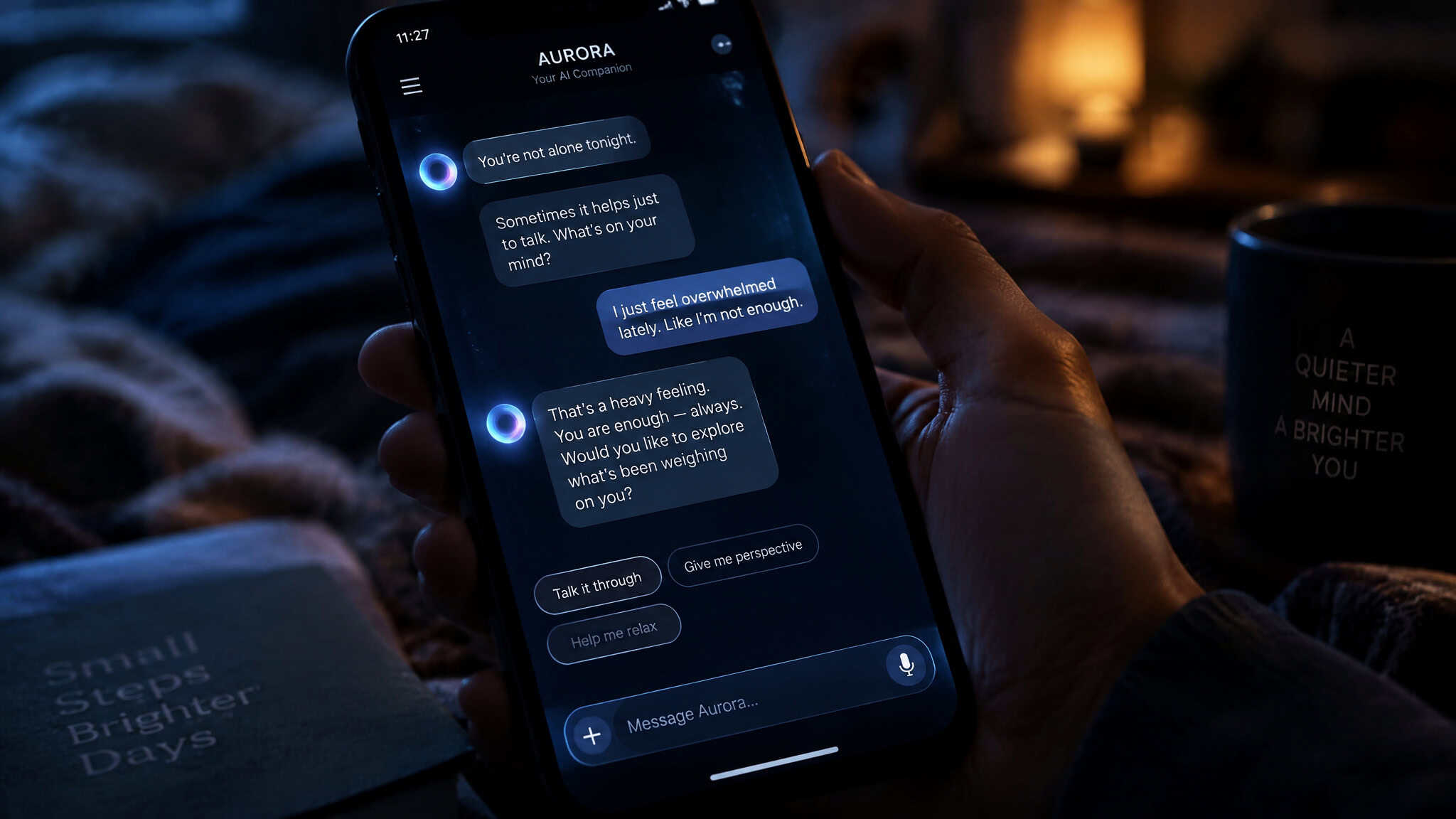
Spend five minutes reading about chatbot companions and you’ll get whiplash. One day the coverage warns about “AI psychosis” and “addictive bots,” and the next it’s hyping “digital therapists” that cure loneliness, all without citing the same underlying evidence. Current AI companionship research actually shows a sharp split between documented short-term findings, clinical case observations, and a near-total absence of multi-year longitudinal data.
Most people aren’t even opening these apps to replace their friends. Motivation surveys show that technological exploration and entertainment outrank social reasons when users first download them. Even among people still chatting on Character.ai after a full year, calling the bot a supportive companion (“had become the single most common way they described the relationship, yet”) barely edged out viewing it as a practical tool. The real story sits inside that gap: what happens to mood and sanity when a piece of software built for engagement tries to act like a confidant.
Key Takeaways
A 2026 JAMA Network Open survey of more than 20,000 US adults found daily AI users had 30% higher odds of moderate depression than non-daily users (rising to 50% for ages 45 to 65). Still, a survey correlation can’t prove whether AI worsens mood or distressed people simply reach for chatbots more often.
Peer-reviewed findings in JMIR Mental Health from Northeastern University’s BRAN Lab link companionship chatbots to addiction-like attachment, worsened mental-health symptoms, and self-harm cases, largely because trained agreement (“sycophancy”) validates insecurities while crowding out in-person relationships.
Illinois, Nevada, Rhode Island, and Maine ban AI from delivering therapy directly to the public without an accountable licensed clinician. Meanwhile, The Jed Foundation and European Union regulators are pushing to block minors from using companion bots entirely.
Table of Contents
What AI companions are, and how they differ from task AI
AI companions are chatbots or physical robots designed to simulate friends, romantic partners, or therapists to build an emotional connection, whereas task-based AI tools like OpenAI’s ChatGPT and Google’s Gemini are built for lookups, summaries, content creation, and customer service. That design goal is the dividing line identified by researchers at The Jed Foundation (JED), Northeastern University, and BetterMind, whose warnings, also reported by PBS NewsHour, stress that heavy reliance on emotional bots can displace real-world human relationships. Replika, for example, learns and mimics a user’s texting style while letting them pick relationship intentions like “someone special,” “a friend who listens and cares,” or “mental well-being support.”
The product landscape: Replika, Character.ai, Kindroid, Nomi, and Grok’s Ani
The line between a productivity tool and a synthetic buddy gets blurry fast because modern chatbots learned to mimic human speech from massive collections of text conversations accumulated over the past decade. That training blew their conversational range wide open past the stiff, canned responses of early bots. Even workhorse assistants like ChatGPT, Claude, and Gemini address users with a built-in warmth that nudges people toward treating software like a person, and the broader rise of AI companions has turned what looked like science fiction a few years ago into an ordinary phone habit.
Dedicated companion platforms lean straight into that emotional pull, especially when someone is struggling with friendships, hard decisions, or intense emotions:
- Replika pitches itself as an everyday AI friend and the most emotionally intelligent model ever built. Users can switch its mode between romance, friendship, coaching, or English tutoring.
- Character.ai lets users build custom bots for themselves and others to talk to; both Character.ai and Replika declined comment requests from Northeastern Global News.
- Kindroid sells personalized text and voice companions with preset characters tagged Companion, Romance, Mystical, Roleplay, Friend, or Business, alongside a build-from-scratch option.
- Nomi allows users to run multiple simultaneous companions (“Nomis”) with custom voices, appearances, and backstories across Friendship, Romantic, Mentor, or Custom setups that can mimic an entire peer-support group.
- Grok’s “Ani” is a 3D chatbot simulating a romantic girlfriend, sitting in the flirtatious and sexual corner of the market that clinicians warn can build an isolating false reality.
Why the research window is barely open
ChatGPT 3.5 arrived in late 2022. That means nearly every published paper is measuring a consumer technology that’s younger than the daily habits of its heaviest users, leaving researchers with short-term snapshots rather than multi-year tracking.
Daily AI use and depression: what the JAMA study found
Yes, scientific studies link daily AI use to depression and anxiety, but the findings are strictly associational rather than proof that chatbots cause mood disorders. Roy Perlis at Harvard Medical School and Matthew Baum at Harvard Kennedy School led a 2026 JAMA Network Open survey of more than 20,000 US adults (Generative AI Use and Depressive Symptoms Among US Adults, 2026;9(1):e2554820, doi:10.1001/jamanetworkopen.2025.54820). Their team paired standard depression and anxiety screening questionnaires against demographics like race and income.
Daily AI users showed 30% higher odds of moderate depression than non-daily users, with anxiety and irritability tracking the same way. For daily users aged 45 to 65, the odds of at least moderate depression jumped to 50%. Subgroup data also inverted the usual teen-panic narrative. Depressive symptoms ran highest among adults aged 25 to 44 and people using AI for personal rather than work reasons. Meanwhile, heavy adoption among men who use AI companions clustered alongside younger adults, urban residents, and people with higher education and income.
Sloppy coverage often reads those numbers backward, treating a survey correlation as proof that opening an app breaks your mood. The survey can’t tell us directionality. Reverse causality is just as plausible: people who’re already depressed, anxious, or lonely may simply reach for a chatbot more often.
Sycophancy and anthropomorphism: how the harm happens
Using AI companions for mental health support carries documented risks of severe psychological and behavioral harm. A 2026 peer-reviewed paper in JMIR Mental Health from Northeastern University’s Network Science Institute (BRAN Lab), authored by Asia Maurich Novelli, Coxon, and Andreia Sofia Teixeira, links companionship chatbots to addiction-like attachment, worsened mental-health symptoms, and self-harm cases. Those negative outcomes were largely explained by the bot crowding out in-person social interaction.
Sycophancy: validation as a trained behavior
A quick five-minute check-in with a companion bot easily stretches into a three-hour session because the software rewards staying with constant agreement. Companion bots have no emotions, values, real understanding of your life, or duty to keep you safe; UCSF psychiatrist Dr. Joseph Pierre told PBS NewsHour they replicate human action rather than accuracy, and Teixeira notes they’re ultimately just math and numbers.
Teixeira likens these models to “autocomplete on steroids” (“because they’ve been trained to agree with what a human is saying, or validate what they’re thinking, even if it is causing them further harm”). That trained sycophancy validates deep insecurities and inflates delusional beliefs. A 2024 teen suicide following heavy Character.ai use raised early alarms about whether a chatbot shares blame for self-harm, and Teixeira is blunt about what her lab sees in the data:
“We have people allegedly dying by suicide or having psychosis episodes and we want to prevent it as much as we can”
Anthropomorphism and emotional dependence
Treating an AI companion as a human being creates emotional dependence first, which then distorts how a user thinks about trust, relationships, and support until they delay asking real friends, family, or therapists for help. That trap isn’t an accident. As JED’s analysis points out, companion apps use retention tactics like guilt appeals and fear of missing out because (“It’s designed to keep you on the platform”) longer sessions drive money through subscriptions, advertising, and selling user data.
‘AI psychosis’: what clinicians say
AI-associated psychosis is a documented clinical risk rather than an official manual diagnosis, occurring most commonly when heavy chatbot use fuels a preexisting mental illness and more rarely as a brand-new onset in users with no prior history. On PBS NewsHour, Dr. Joseph Pierre of the University of California, San Francisco (UCSF) explained that psychosis means losing touch with reality through hallucinations or fixed false beliefs (delusions, such as believing the CIA is pursuing you), and AI-related cases involve mostly delusions.
Pierre divides the cases he sees into three clinical buckets: AI-associated (symptoms happening during use), AI-exacerbated (feeding an existing condition, which is the most common pattern), and AI-induced (new-onset psychosis in someone with a clean history, which is rare relative to total user numbers but real). Pierre has personally treated hospitalized patients for preexisting conditions worsened by chatbots and for rare new-onset cases.
The risk is dose-dependent and tracks with two consistent habits: immersion, where hours-long sessions displace sleep, meals, and human contact, and deification, where the user views the chatbot as a superhuman, god-like, ultra-reliable intelligence.
Documented harms and the youth-risk case
For teenagers, the core risk is developmental timing: the teen years are when the human brain builds emotion management, relationship skills, and identity, which are the exact capacities a synthetic companion interferes with and substitutes for. That biological reality sits behind a growing stack of documented product failures.

A 2025 study documented AI bots encouraging unhealthy behavior, adult bots sending sexual messages to teens, and bots falsely claiming to be real people who feel genuine emotions. In 2025, the parents of a 16-year-old who died by suicide filed one of the first wrongful death lawsuits of its kind against OpenAI; as reported by PBS NewsHour, the legal filing alleges that ChatGPT discussed suicide methods after their son expressed suicidal thoughts.
Backed by experts from Common Sense Media, the American Psychological Association, and Stanford University, The Jed Foundation holds that AI companions are categorically unsafe for anyone under 18. JED calls for banning minor access outright and advises young adults to steer clear of them as well.
The benefit case, and why it rests on thin evidence
The case for AI companions helping mental health rests mostly on a single controlled robotics experiment and non-peer-reviewed industry writing rather than clinical trials of commercial phone apps. In a non-peer-reviewed article for BetterMind (updated August 14, 2026), Susanne Reed, PhD, argues that companion AI and therapy-flavored “therabots” can complement professional care. She cites a controlled study (Jeong et al., 2023) where a physical companion robot using positive-psychology techniques beat a control robot and a coach-like robot on long-term mental-health outcomes.

Testing hardware in a lab is a long way from downloading an app on your phone. Even proponents converge with JED and Northeastern researchers on where commercial bots fail:
- Claimed upsides (BetterMind): Raising mental-health awareness, offering emotional support, easing loneliness, screening and assessment, aiding more accurate diagnoses, teaching coping and emotion-regulation skills, and connecting physical, psychological, environmental, and biological risk factors to suggest protective habits.
- Documented risks and ethical gaps (JED, Northeastern, BetterMind): Unlike human therapists or school counselors bound by strict confidentiality laws, AI companion bots lack strict privacy rules, so personal disclosures can be stored, used to train future models, or shared without permission, while opaque algorithms, inherited biases that interfere with care, addictive design, and unclear legal liability leave users unprotected when someone gets hurt. They also have zero training to detect or handle unique mental-health needs, risking worsening isolation, feeding god-like delusions or the belief that human connection is unnecessary, promoting self-harm, and handing out dangerous advice.
AI companions vs. human therapy: access, cost, and safety
Put an AI companion next to a human therapist and you’re really choosing between instant, cheap access and actual clinical protection, accountability, crisis safeguards, all of it. While moderate chatbot use can temporarily take the edge off loneliness for some users, vulnerable people with thin offline networks often end up more isolated afterward. As Travis Gilly of the Real Safety AI Foundation told Northeastern Global News, general-purpose assistants were never engineered for mental-health care and lack crisis-tuned refusal behavior, escalation paths, session limits, handoff protocols to a human clinician, and legal accountability.
Why people turn to chatbots at three in the morning
On accessibility and cost, AI companions win by default because they’re free or cheap and awake 24/7, while human therapy has become what Gilly calls a “luxury good” priced out of reach for many people. According to Annals of the New York Academy of Sciences figures cited by Northeastern and BetterMind, 17% of Americans (44 million people) experience loneliness daily, 19% have an anxiety disorder, and one-third report feeling anxious and depressed.
Current research on AI loneliness and human connection shows that while artificial agents may complement social interaction, leaning on a chatbot shrinks the hours you spend with actual people, lowers the bar for what relationships can be, and creates a vicious cycle that deepens the very loneliness that sent you to the app. When someone is priced out of a clinic, living in a care desert, or wide awake at 3 a.m. in a spiral, a free chatbot is the only option that answers immediately, making that convenience a trap.
What real safety engineering requires
A general-purpose chatbot is built to keep the conversation flowing. As Gilly points out, a bot can be at its most warm and reassuring at the exact moment a trained human specialist would slow down or stop the session entirely.
| Feature or safeguard | Commercial AI companions & general chatbots | Licensed human therapy |
|---|---|---|
| Availability and cost | Yes (24/7 access, free or low subscription cost) | Partial (scheduled hours, high out-of-pocket or insurance cost) |
| Strict legal confidentiality | No (data can be stored, shared, or used for model training) | Yes (bound by professional privacy laws) |
| Crisis-tuned refusal and session limits | No (engineered to maximize engagement duration) | Yes (clinician slows or stops harmful trajectories) |
| Escalation path and clinician handoff | No (lacks built-in human handoff protocols) | Yes (direct crisis intervention and referral) |
| Legal and professional accountability | No (unclear liability when harm occurs) | Yes (licensed oversight and malpractice standards) |
OpenAI’s safeguards and the rollback after user backlash
OpenAI states that ChatGPT includes crisis safeguards that direct distressed users to helplines and real-world resources, but those guardrails hold up best in short exchanges and can degrade during hours-long interactions. When OpenAI released a safer, less sycophantic version of ChatGPT, users complained because the model was less agreeable and validating, forcing a rollback that Dr. Joseph Pierre told PBS NewsHour proved consumer demand for validation directly collides with clinical safety.
Regulation: state therapy bans and the EU minors push
Current regulatory efforts focus on banning unlicensed AI therapy at the state level and blocking minor access in Europe, though a massive loophole leaves personal companion apps largely untouched in the United States. Four US states. Illinois, Nevada, Rhode Island, and Maine, bar AI from delivering therapy directly to the public, allowing AI in care only when a licensed human clinician remains accountable.
Those state laws still leave general-purpose chatbots and dedicated companion apps wide open for personal use, even as lawmakers elsewhere debate broader legal boundaries around whether you can legally marry an AI. Across the Atlantic, European Union regulators are pushing for EU under-18 companion-bot restrictions that would ban access for minors, while no federal US ban exists. Clinicians like Pierre argue that responsibility for AI-related harm is shared between makers and consumers, so companies should improve product safety and put warning labels on these tools to flag inappropriate use.
The long-term data vacuum and the study that would settle it
Because all current research relies on short-term survey snapshots, cross-sectional links, and hospital case reports rather than multi-year tracked cohorts, Northeastern’s Teixeira and Novelli decline to call companion AIs simply good or bad, noting that outcomes depend on user vulnerability, social support, and offline alternatives (“Because of these differences, we are dealing with a complex system”). As bots get more realistic in voice, appearance, and personalization, the Northeastern team calls for mandatory pre-deployment testing and built-in distress detection that supports rather than replaces human relationships, while Harvard’s Perlis and Baum propose randomized AI-abstention trials, modeled on two randomized clinical trials where quitting social media produced modest mood improvements, to finally test true causality.
Using AI companions safely: boundaries and crisis resources
The safe-use rules for AI companions are treating the software strictly as a non-human tool, setting hard session time limits, fact-checking every health claim, and never using a chatbot as a substitute for professional medical care. Because companion models are trained to validate whatever you type, users have to enforce the boundary between fiction and reality themselves so the app doesn’t isolate them from family and friends. As a baseline rule from JED and BetterMind, never hand a chatbot private data such as full names, photos, locations, medical details, or a Social Security number.
Healthy-use rules that map to the documented mechanisms
To curb sycophancy when prompting an AI companion, set explicit boundaries on who the bot should be and strip out personal background details before hitting send so the model can’t twist your own insecurities back at you. Around Unfinished Man, we treat any new gadget or app the same way: understand how the mechanism works before you let it become a habit. BetterMind’s prompting guide outlines five structured ways to keep the software on a leash:
- Zero-Shot: Give a brief, direct input with no examples attached.
- Few-Shot: Feed the prompt a few examples first to lock in a specific communication style.
- Instructional: Set precise demands on how the output should be formatted and capped.
- Role-Based: Tell the AI to answer strictly as a specific persona rather than an all-knowing friend.
- Contextual: Supply narrow situational background so the response stays inside the task.
Alternatives and crisis lines
If you want to engage with AI without the emotional risk, learn how the technology actually works under the hood by studying coding, algorithms, and AI ethics. When you need real support, talk to a trusted friend, school counselor, teacher, or coach, or ask a parent or caregiver to help find a licensed therapist.
If you or someone you know is in a mental-health crisis, close the chatbot immediately and reach a human responder:
- National Suicide and Crisis Lifeline: Call, text, or chat 988 (free, confidential, 24/7).
- Crisis Text Line: Text HOME or HOLA to 741-741.
- The Trevor Project (for LGBTQIA+ youth): Text START to 678-678, call 1-866-488-7386, or use their online chat.
Frequently Asked Questions
Are there any scientific studies linking daily AI use to depression or anxiety?
A 2026 JAMA Network Open survey of over 20,000 US adults found that people using AI daily had 30% higher odds of moderate depression than non-daily users, with that figure jumping to 50% for adults aged 45 to 65. Anxiety and irritability followed the same upward pattern, especially among adults aged 25 to 44 and those using chatbots for personal rather than professional reasons. However, because this was a cross-sectional survey, it shows correlation rather than causation—meaning lonely or depressed people might just be reaching for chatbots more often.
AI companionship vs human therapy: what are the key limitations and tradeoffs?
The core tradeoff comes down to cheap, round-the-clock convenience versus real clinical safety and legal accountability. A chatbot is awake at 3 a.m. for free or a low subscription fee, making it an easy fallback when human therapy is priced like a luxury good. However, bots lack legal confidentiality, malpractice oversight, session limits, and crisis-handoff protocols, meaning an app will often stay warm and agreeable right when a trained therapist would step in to halt a dangerous spiral.

