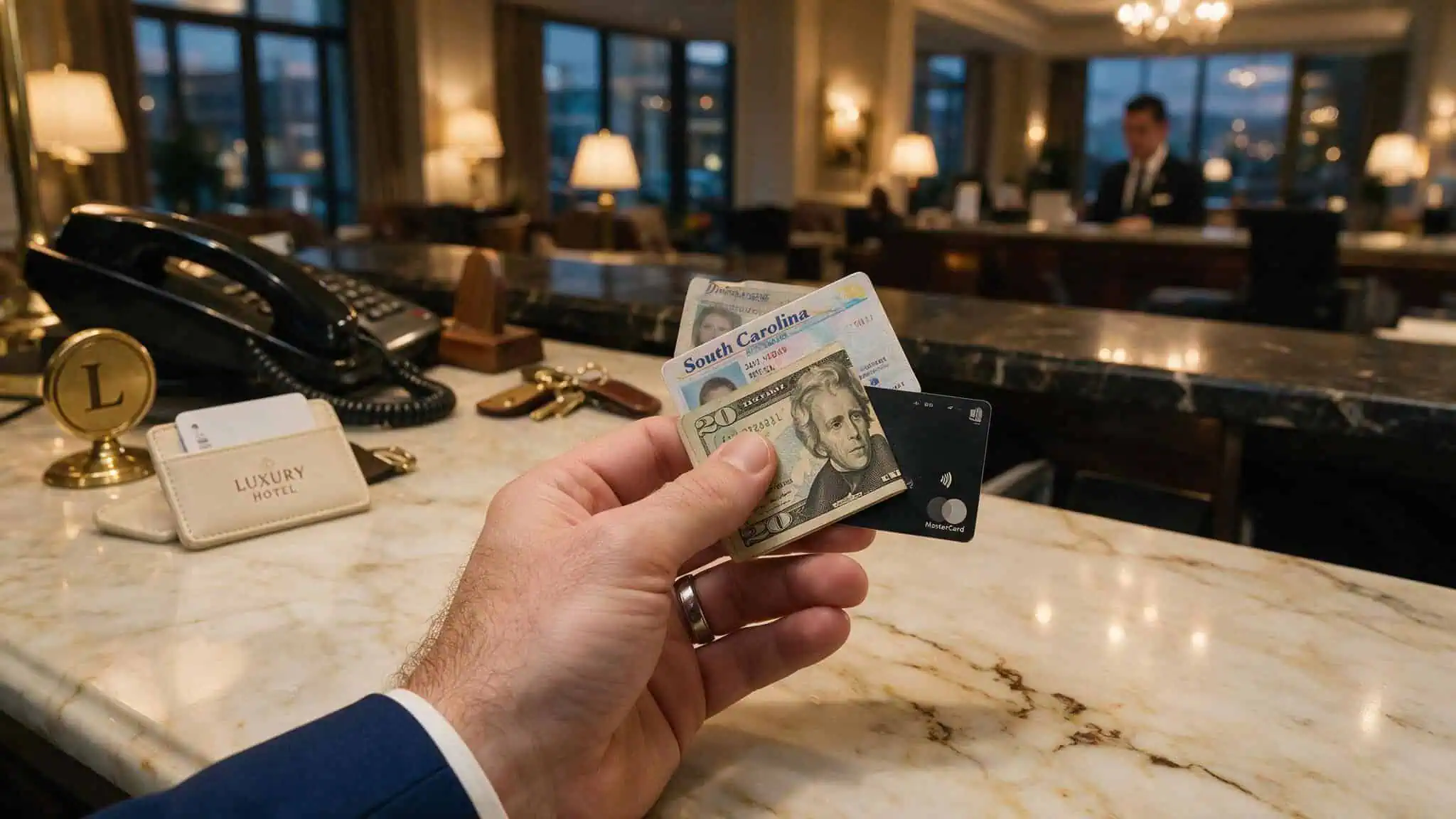
You’re standing at the check-in counter at some Vegas hotel. You’ve got a folded $20 bill tucked between your driver’s license and your credit card. The clerk takes the bundle. Sets it aside. You take a breath and say, “Hey, are there any complimentary upgrades available?”
That’s the $20 trick. The $20 method. The $20 Sandwich, if you’re a local. Whatever you call it, it’s the famous hospitality hack in Las Vegas — and probably the misunderstood.
I dug through the data, the success stories, the failure stories, and the hotel-by-hotel breakdowns to figure out whether this thing actually works. Here’s what I found.
Key Takeaways
The $20 trick works roughly three-quarters of the time in Las Vegas, according to one analysis, with radio host Rich Shertenlieb reporting success on about a dozen out of 15 attempts.
Frontdesktip.com data — collected when the site was still tracking this, showed over 90% success rates at Caesars, Palazzo, and Planet Hollywood, while MGM Grand, New York New York, and Aria came in around 50%.
The trick depends on a human clerk with discretionary rooms available, which means automated kiosks at places like Flamingo and many Caesars properties are killing it off.
Table of Contents
What Is the $20 Method?
This approach is a hotel upgrade hack. You fold a $20 bill, tuck it between your ID and credit card, and hand the whole bundle to the front desk agent at check-in. If the clerk sets the documents aside — that’s your cue, you politely ask, “Are there any complimentary upgrades available?”
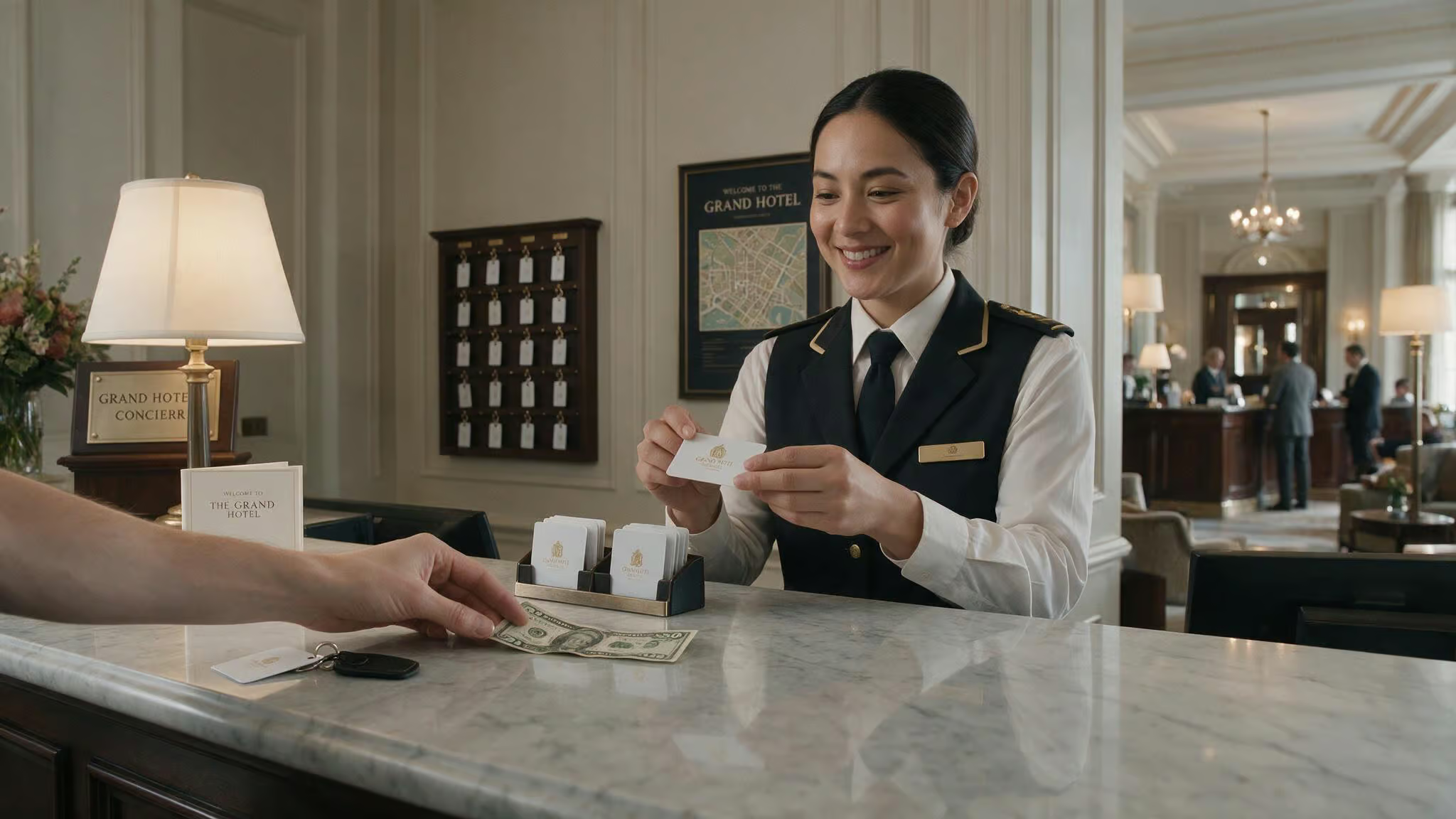
The $20 isn’t a bribe in the usual sense. It’s a thank-you tip offered before the favor. The clerk has to want to help you. The key is being cool about it.
The local Vegas nickname is “The $20 Sandwich,” named after a Vegas local named Hardy, according to Shertenlieb. The name makes sense: the bill is literally sandwiched between your ID and credit card. Simple visual.
Let me be clear about something upfront: this has nothing to do with gambling. You’re not turning $20 into $1,000 at a slot machine. You’re not finding a secret betting system. This is a hotel upgrade trick.
If you searched How to win at the casino with $20, you ended up in the wrong article. But since you’re here, the trick is real.
How to Do the $20 Trick
The $20 trick takes more than just a folded bill. The steps before you reach the counter matter just as much as the moment you hand over your documents.
The Preparation Most People Skip
Most failures of the $20 trick happen before the person ever reaches the front desk. You can’t show up blind and expect magic.
First, know what you booked. Did you book the cheapest room in the house? A standard king on a low floor? You need to know your starting point. If you ask for an upgrade without knowing what you already have, the clerk has nothing to work with.
Second, know what you want. “Strip view.” “Corner suite.” “Higher floor.”
Be specific. Vague requests get vague results — or no results at all.
Third, know what the hotel actually has. If you ask for a corner suite at a hotel that doesn’t have corner suites, the clerk can’t help you. Check the hotel’s room inventory on their website. It takes five minutes.
Fourth, check occupancy. The $20 trick works when the hotel has unsold premium rooms. Mid-week stays in low season? Your odds are high. Friday night during a convention or a big fight weekend? Your $20 is coming back to you.
The Execution Sequence
Here’s how it goes down at the counter.
Fold the $20 bill. Slip it between your ID and credit card. Hand the whole bundle to the clerk when they start check-in. Don’t hold the $20 separately.
Don’t shove it across the counter. It should look natural.
When the clerk takes the documents and sets them aside — that’s your cue. Ask politely: “Are there any complimentary upgrades available?”
Don’t demand. Don’t say “I want a suite.” The $20 is a thank-you, not a payment. The clerk has to want to help you.
Be friendly. Mention it’s your first trip to Vegas, or you’re celebrating an anniversary, or you’re just excited to be there. That human touch matters.
If an upgrade is available, the $20 is the clerk’s tip. If not, they usually hand it back. No harm, no foul.
What to Say and What Not to Say
The magic phrase is “complimentary upgrade.” If you ask for a “paid upgrade,” you’re doing it wrong. This seems obvious, but people mess it up.
One Mile at a Time tried the trick at Delano, an all-suite hotel in Vegas. The clerk offered a paid upgrade for $100 per night instead of a complimentary one. Why? The author asked for a paid upgrade, not a complimentary one. That’s the whole mistake in one sentence.
You’re asking for a free room upgrade. You’re tipping politely for the favor. Keep it simple.
Does the $20 Trick Actually Work?
The numbers say yes, but specific hotels vary.
Overall success rate in Las Vegas is around 75%, according to reporting from 8newsnow. Shertenlieb, who tried it more than a dozen times, reports success all but three times. That’s a solid track record.
The best hotel-level data comes from frontdesktip.com. That site tracked success rates before it went dormant, and the snapshot it left behind is the closest thing we have to a controlled study.
- Over 90% success: Caesars, Palazzo, Planet Hollywood
- Around 50% success: MGM Grand, New York New York, Aria
If you’re staying at a Caesars property, the $20 trick is a near-sure thing. At MGM properties, it’s a coin flip. Plan accordingly.
Reported successes include: Caesars, Bellagio, Planet Hollywood, The Mirage, Treasure Island, Encore, Sahara, El Cortez, MGM Grand, LINQ, and Palazzo.
Reported failures include: The Cosmopolitan (sold out during the attempt), MGM Grand, and The Venetian.
Factors That Determine Whether It Works
Several things affect your odds, and most of them are in your control.
- Occupancy: Lower is better. Tuesday at 2 PM beats Friday at 8 PM.
- Day of week: Mid-week stays have higher success rates. Fewer people checking in means more available rooms.
- Length of stay: One to three nights is the sweet spot. Longer stays are harder to upgrade because the hotel loses more potential revenue.
- Your demeanor: The biggest factor. Friendly, polite, excited guests get better treatment. Jerks get nothing.
- The clerk: Some clerks are more inclined to help than others. You can’t control this, but you can improve your odds by being the easiest guest they deal with all day.
- Your status: If you gamble regularly and have player rewards status, the hotel already wants to keep you happy. This helps, but even without status, the trick works.
Where the $20 Trick Works and Where It Doesn’t
Not every hotel is a good candidate for the $20 trick. Success depends heavily on location and the specific property you choose. It also works well on Fremont Street downtown, where tipping is just as expected.
Why Las Vegas Is Unique
The $20 trick works in Las Vegas because the city runs on tipping. Front desk agents in Vegas expect gratuities. It’s part of the culture.
Outside Vegas, the gesture can look like a bribe. Most hotel clerks in other cities have never been offered cash for a room upgrade. They might take it, but they might also feel awkward or report you. The 8newsnow article puts it plainly: outside Vegas, the trick of offering cash is “fairly unlikely” to work, so understanding how to get free stuff at casinos through legitimate comps is a smarter approach.
If you’re staying at a hotel in Atlantic City, Chicago, or anywhere else, don’t count on it. Vegas is the sweet spot.
The Rise of Automated Check-In
The threat to the $20 trick isn’t skeptical clerks or sold-out hotels. It’s kiosks.
The Flamingo mostly uses automated check-in kiosks. No human clerk means no one to tip. Many Caesars properties are moving in the same direction. Mobile check-in removes the interaction entirely.
The trick requires a person at a counter. If there’s no person, there’s no trick.
Hotels to Skip
- The Cosmopolitan: Often sold out. Even if it’s not, the trick fails there frequently.
- MGM Grand and The Venetian: Reported failures.
- Flamingo: Automated kiosks. Don’t bother.
- Ellis Island: It’s a regular motel with no upgrade path. The cheapest room is what you get.
- Most non-Vegas hotels: Fairly unlikely to work, per the data.
What You Can Actually Get
The upgrades range from small to ridiculous, and worth the $20.
- Strip view instead of alley view: The most common upgrade. You’re looking at the lights, not the dumpster.
- Higher floor: Less noise, better view.
- Suite: Shertenlieb’s experience at The Mirage is the ceiling of this trick. He booked the cheapest room: a low-floor single king. He got upgraded to a 1,700 square foot Hospitality Suite on the 20th floor overlooking the Strip. His parking was paid for the entire stay.
- Champagne sent to the room: A nice touch from hotels that want to keep you happy.
- Waived resort fees: One guest at Sahara got $90 in waived fees from a $20 bet.
- Drink vouchers: $30 value at Sahara, per one report.
- Free parking: Shertenlieb’s Mirage parking was comped.
The potential value of these upgrades far exceeds the $20 you’re risking. A suite upgrade alone can be worth hundreds.
Why the $20 Trick Exists
This isn’t a hack. It’s a perfectly aligned economic transaction.
Hotels prefer to fill their premium rooms rather than leave them empty. An empty suite makes zero dollars. A filled suite makes zero dollars at the room level, but a happy guest in that suite is more likely to gamble, eat at the hotel restaurants, and come back next year.
The “illusion of getting a deal” makes guests spend more. If you feel like you got something for free, you’re more willing to drop money on the casino floor, which is why savvy travelers learn how to get free play in Vegas through sign-up bonuses, match play, and promotional chips.
The $20 aligns the clerk’s personal incentive with the hotel’s corporate incentive. The clerk gets a tip. The hotel gets a happy guest who spends money. You get a better room. Three-way win.
What Happens When It Fails
The real risk isn’t losing $20. Most clerks hand the money back if no upgrade is available.
The real risk is social awkwardness. You’re standing at the counter. The clerk types at the computer. Your $20 is just sitting there. You wonder if you look like an idiot.
Here’s how it usually goes: if no upgrade is available, the clerk hands the $20 back with a polite “sorry.” Sometimes they offer drink vouchers or food credit as a consolation prize. Sometimes they keep the money without giving anything — it’s rare, but it happens. You accept that risk.
If you’re not okay with the room you originally booked, don’t try the trick. The upgrade is a bonus. The room you paid for is the room you get.
Scaling the Strategy
Twenty dollars is the minimum. You can tip more for better odds, especially at high-end properties.
- $50 works better than $20. More money, more incentive for the clerk to find something.
- $100 is the high end. One documented case: a $100 tip at Bellagio nearly secured a villa. Not a suite. A villa.
Mentioning a special occasion — anniversary, birthday, first trip, helps at any tipping level. It gives the clerk a reason to help you beyond the cash.
The $20 Method Is Not a Gambling Strategy
This is worth calling out explicitly because the search data is clear: people confuse the $20 method with a gambling strategy.
Can you win with $20 at the casino. How to turn $20 into $1,000 at the casino. What is the $20 method for slot machines.
None of that is what we’re talking about here. The $20 method has exactly zero to do with slot machines, table games, or betting. You’re not going to turn $20 into a thousand dollars at the blackjack table using this trick. You’re going to get a better hotel room.
If you’re looking for a cheap night at the tables, this isn’t that article. If you’re looking for a way to get a strip view without paying triple, you’re in the right place.
Final Verdict: Myth Confirmed, With a Technicality
The $20 trick is real. It works most of the time in Las Vegas, less so elsewhere.
The technicality is this: the trick only works at hotels with a human clerk who has discretionary rooms available. That rules out automated kiosks, sold-out hotels, and most non-Vegas properties.
But when the conditions are right — mid-week, low occupancy, a friendly clerk, a specific request, the $20 is the best investment you’ll make your entire trip. You might walk away with a strip view. You might walk away with a suite. You might walk away with a bottle of champagne and waived parking fees.
The trick isn’t about sneaking. It’s about understanding how Vegas works. The whole system is designed to take care of guests who understand the game. The $20 is just the entry fee.
Frequently Asked Questions
Does the $20 trick actually work?
Yes, it works roughly three-quarters of the time in Las Vegas overall, with some hotels seeing over 90% success rates. Success depends on factors like occupancy, day of the week, your demeanor, and whether the hotel has a human clerk with discretionary rooms available.
How to tell if a slot machine will hit?
You can’t tell if a slot machine will hit — they’re programmed with random number generators that make each spin independent. The $20 trick has nothing to do with gambling; it’s a hotel upgrade hack, not a betting strategy.
How to pick a slot machine that will win?
There’s no reliable way to pick a slot machine that will win because outcomes are random and determined by the machine’s programming. If you’re looking for the $20 method, that’s a hotel upgrade trick, not a slot strategy.
What upgrades can I get with the $20 trick?
Upgrades range from a strip view or higher floor to full suites worth hundreds of dollars. Some guests have also received waived resort fees, drink vouchers, free parking, or champagne sent to the room — all for the $20 tip.