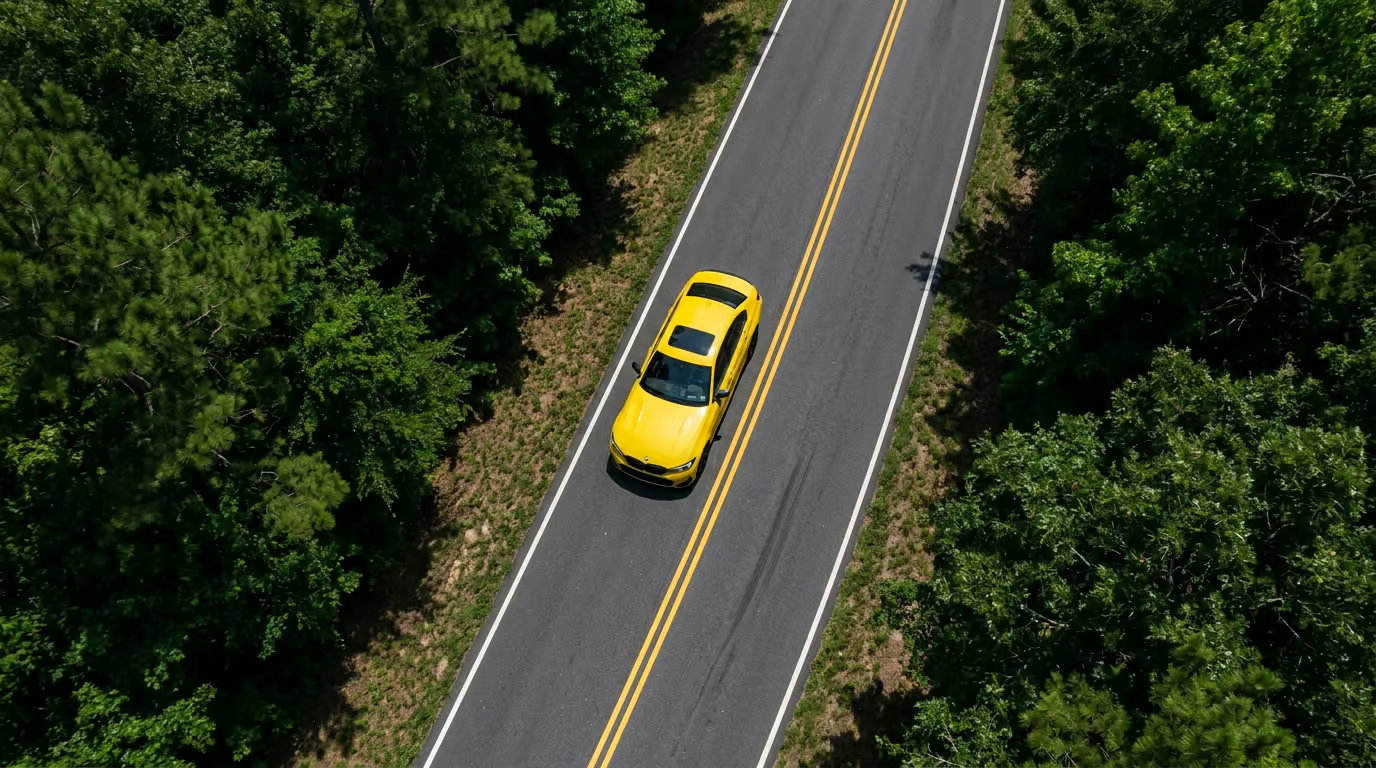
When deciding on a new vehicle for your daily driving, aesthetics usually drive the purchase, but looking at the math behind accident probability changes the equation entirely. I never thought about car colors being a factor in accident rates, but the data says otherwise. If you want the objectively safest vehicle color to protect yourself and your family on the road, the definitive answer is yellow or white.
Your car’s paint acts as a passive warning system to the traffic around you. Brightness alone does not create safety. A color’s protective power relies entirely on how violently it clashes with a constantly changing environment. Whether you are walking dealership lots or reviewing collision statistics published by a law firm, the visual contrast against the surrounding backdrop remains your primary defense against car accidents. While personal preference usually dictates a showroom purchase, collision data tells a starkly objective story about which paint jobs survive the morning commute. To understand why white and yellow cars consistently evade crashes where others fail, we have to look past the sheet metal and examine how the human eye processes moving objects on the road.
Table of Contents
The definitive data on safest car colors
White cars serve as the ultimate statistical baseline for consumer safety. According to collision data, white cars are 12 percent less likely to be involved in an accident than black cars under identical conditions at any time of day.
But yellow is actually the absolute safest color on the road. There is a deeply calculated reason commercial fleets rely on the classic “taxi strategy.” Yellow optimizes visual disruption. It stands out in almost any weather condition, making a yellow vehicle an unmistakable anomaly on an otherwise drab street. Ever since the first recorded auto collision, drivers have needed a way to spot fast-moving hazards, and yellow registers in human peripheral vision faster than any other wavelength.
Gold and orange present highly visible niche options that achieve this exact same goal. Few things in nature or roadway architecture are painted fluorescent orange or reflective gold. These colors sharply contrast against both natural and artificial environments, making them incredibly easy to spot on a busy, chaotic road. But if high visual contrast pushes you out of harm’s way, Driving a vehicle that perfectly matches the asphalt actively invites danger.
Low-contrast danger of black and grey vehicles
Nocturnal blending and darker shades
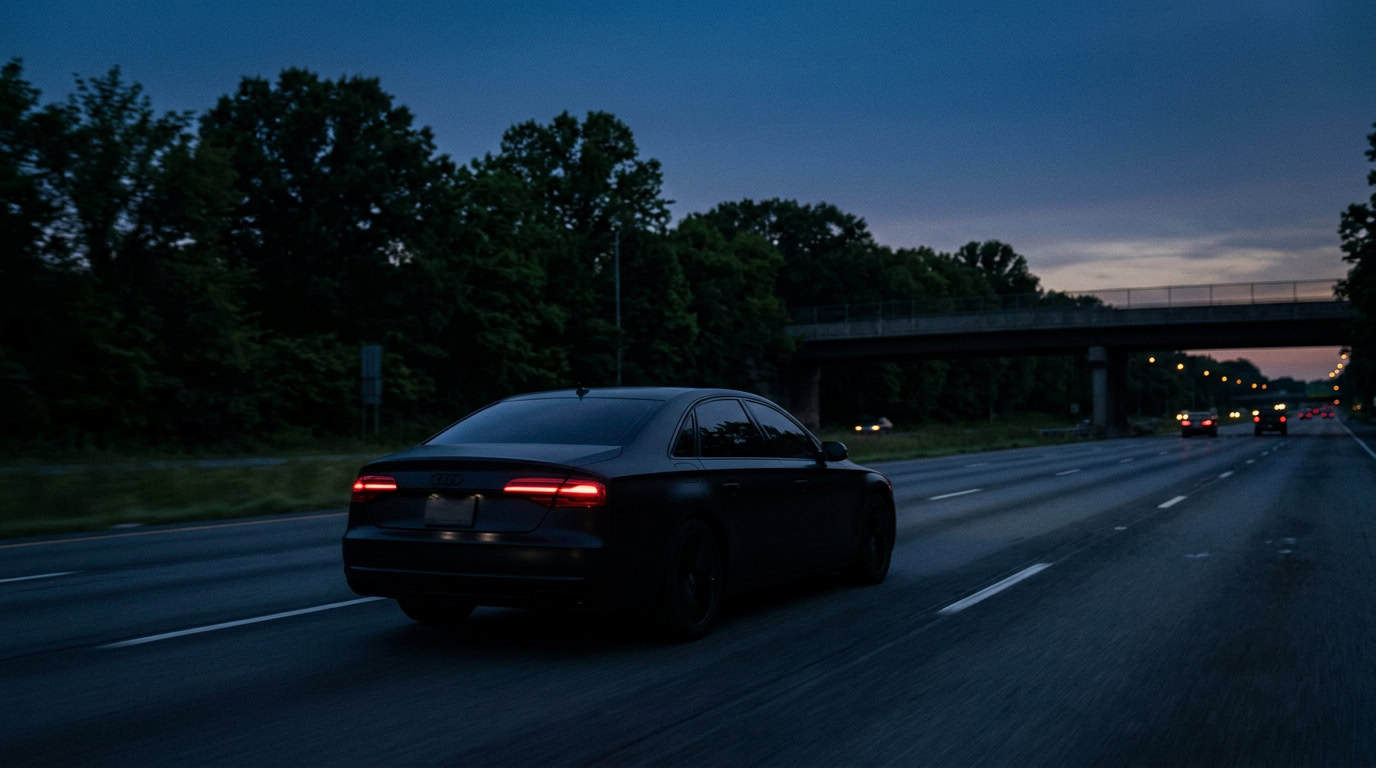
Black vehicles represent the peak of statistical danger on modern roads. At least one major study found that you are 47 percent more likely to be in a crash if you drive a black vehicle. Other, more reserved projections still show that driving a black car increases the risk of a crash by anywhere between 10 and 20 percent.
The primary culprit is nocturnal blending. Darker shades absorb light rather than reflecting it, effectively deleting the car’s silhouette from the road at night.
“Darker shades absorb light rather than reflecting it, effectively deleting the car’s silhouette from the road at night.”
Blue is one of the two most popular color choices for cars in America, but it carries a silent penalty. When compared to the safest colors, blue cars have a 7 percent higher risk of being involved in an accident. Vehicles painted in darker shades of blue tend to be involved in more crashes than those in lighter shades. A vast majority of our environment, including the daytime sky, is naturally blue. This forces blue cars to naturally camouflage against the horizon.
The silver contradiction and pavement merging
Grey and silver cars merge seamlessly with the pavement. Grey is associated with an 11 percent higher risk than the safest car, while silver rests closely behind with a 10 percent higher risk. Driving a darker car essentially forces you to depend entirely on the situational awareness of other motorists.
Yet, silver introduces a bizarre statistical quirk. While silver generally increases overall crash likelihood by blending with asphalt, at least one study noted that silver cars were 50 percent less likely to be involved in a serious accident than the safest color car on the road. This silver contradiction implies that visual blending might cause highly frequent minor fender benders but somehow correlates with drivers avoiding fatal, high-speed impacts.
The urban camouflage paradox of red and green
How vibrant red blends into traffic infrastructure
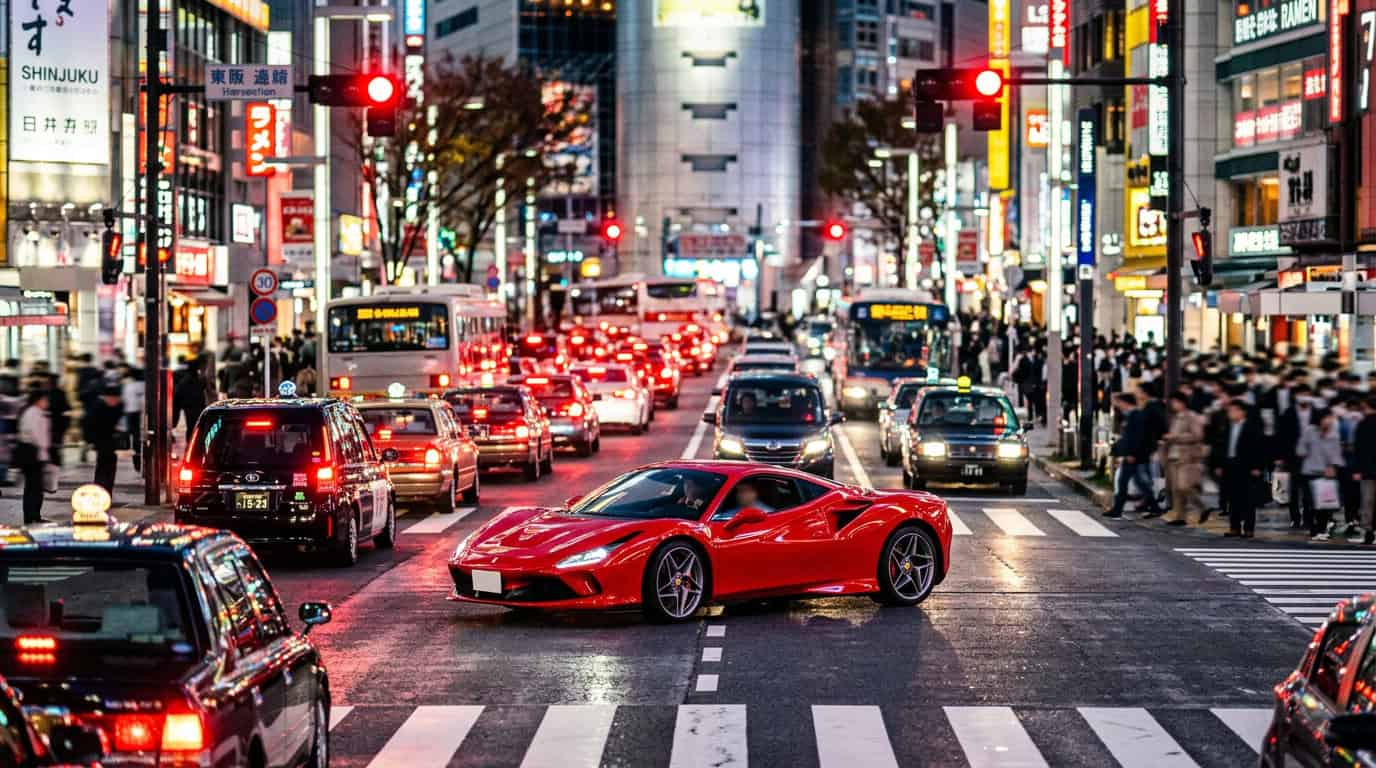
Boldness does not equal safety. We chemically associate red with alerts, emergencies, and attention, leading many buyers to assume a bright red sports car is impossible to miss. They are wrong. Red cars carry a 7 percent higher risk of an accident.
Road designers have already monopolized red for critical signals. Traffic lights, brake lights, sirens, and road signs are all red. Driving a vehicle draped in this same color creates urban camouflage. A red car does not stand out; it gets permanently lost within the highly saturated visual noise of existing traffic infrastructure.
The cognitive weight of green vehicles
Green cars risk disappearing completely into natural and suburban landscapes. The color is so prevalent in our world that green cars naturally blend in with grass, road signs, rolling hills, covered bus stops, and fences. A massive portion of residential and commercial buildings are also painted dark green.
This visual overlap drastically increases the cognitive load placed on nearby motorists. The brain is forced to unconsciously separate a moving green vehicle from a sea of static background objects. When a driver’s eyes glide over a green car parked against a green fence, the car effectively ceases to exist until the moment of impact.
Geographic limits and passive safety tech
The concept of the “safest car color” is a localized title, not a universal law. Geographic placement drastically alters the math.
White offers profound safety in a bright, sunny environment like the American Southwest. If you take that same white sedan into heavily snowy regions, inverse camouflage takes over. The car becomes virtually invisible against the snowbanks.
Fortunately, automotive engineers are fighting back against the math. Modern technologies significantly mitigate the baseline risks of driving a black or grey vehicle. High-intensity Daytime Running Lights (DRLs) and advanced reflective clearcoats act as an artificial heartbeat for low-contrast cars, projecting light where the paint absorbs it.
External nature also overrides visual advantages. When visibility degradation occurs due to severe weather conditions—like heavy fog, torrential rain, or thick cloud cover—the baseline safety margins for all paint jobs plummet indiscriminately.
Active driving habits override paint color
All of these statistical advantages are instantly nullified by severe cognitive impairments or poor choices behind the wheel. For instance, distracted driving currently results in 9 deaths and 1,000 car accident-related injuries every single day.
When forensic teams analyze the root causes of major collisions, color visibility rarely outweighs behavioral negligence. Organizations like Citywide Law Group parse these complex metrics as part of a liability investigation in volatile traffic hubs like Los Angeles. In environments where drivers are always in a hurry, aggressive driving patterns like speeding and lunging through yellow lights heavily drive intersection collisions. Driving under the influence of drugs, consuming alcohol, or ultimately getting charged with a DUI permanently eclipses whatever minor safety margin you gained by purchasing a brightly colored car.
Data sources and metric tracking
Understanding these findings requires acknowledging how automobile safety data is sourced today. Modern researchers face a growing disparity between utilizing structured scraper tools—like BeautifulSoup extracting published law firm statistics—and navigating the closed-ecosystem nature of anecdotal driver sentiment. While objective collision figures are easily gathered, capturing vital real-world driver testimonials often hits digital barricades, such as Reddit blockades or Jina Reader 403 blocks, leaving a significant gap between empirical data and human road experience.
Accidents are multi-faceted physical events, not just data points on a spreadsheet. The statistical correlation between a car’s color and its crash rate is a genuine, mathematically verified reality, but it is entirely a passive tool. A high-visibility yellow cab driven recklessly will inevitably crash long before a carefully driven black sedan ever does. Paint color buys you a fraction of a second of reaction time from the driver next to you, but the person sitting in the driver’s seat ultimately dictates who makes it home.
Frequently Asked Questions
What is the absolute safest car color to drive?
Yellow takes the literal crown. While white cars are considered the statistical baseline and are incredibly safe, yellow registers in human peripheral vision faster than any other wavelength. It creates maximum visual disruption against almost any backdrop, which is exactly why commercial taxi fleets have always relied on it.
Why do red cars actually have a higher risk of accidents if they are so bright?
Boldness doesn’t equal safety. Red suffers from ‘urban camouflage’ because traffic lights, stop signs, and brake lights already monopolize the color on our roads. Instead of standing out, a red car gets lost in the visual noise of daily traffic infrastructure, increasing its crash risk by 7 percent.
How much more dangerous is it to drive a black vehicle?
You could be up to 47 percent more likely to crash in a black car compared to lighter vehicles. The primary culprit is nocturnal blending, where dark paint absorbs light at night rather than reflecting it. Driving a dark car essentially forces you to depend entirely on the situational awareness of the other motorists around you.
What’s the difference between the crash rates of silver cars and other dark models?
Silver introduces a bizarre statistical quirk known as the ‘silver contradiction.’ Like grey or black cars, silver blends into the asphalt and carries a 10 percent higher overall accident risk compared to safe colors. However, silver cars are somehow 50 percent less likely to be involved in serious or fatal high-speed impacts, meaning you might suffer frequent fender benders but avoid catastrophe.
Does a white car keep me safe in absolutely every climate?
No, because car color safety is completely localized to your physical environment. A white sedan is a beacon of safety in the sunny American Southwest, but take it into heavily snowy areas and inverse camouflage takes over. Against a snowbank, your statistically safe white car becomes practically invisible to surrounding traffic.
Can I do anything to make a dark-colored or green car safer?
Yes, modern automotive tech acts as a great equalizer. High-intensity Daytime Running Lights (DRLs) and advanced reflective clearcoats act as an artificial heartbeat, pushing light out where dark paint normally absorbs it. Ultimately, the best fix is simply paying attention—staying off your phone completely overrides the passive safety margin of any paint job.