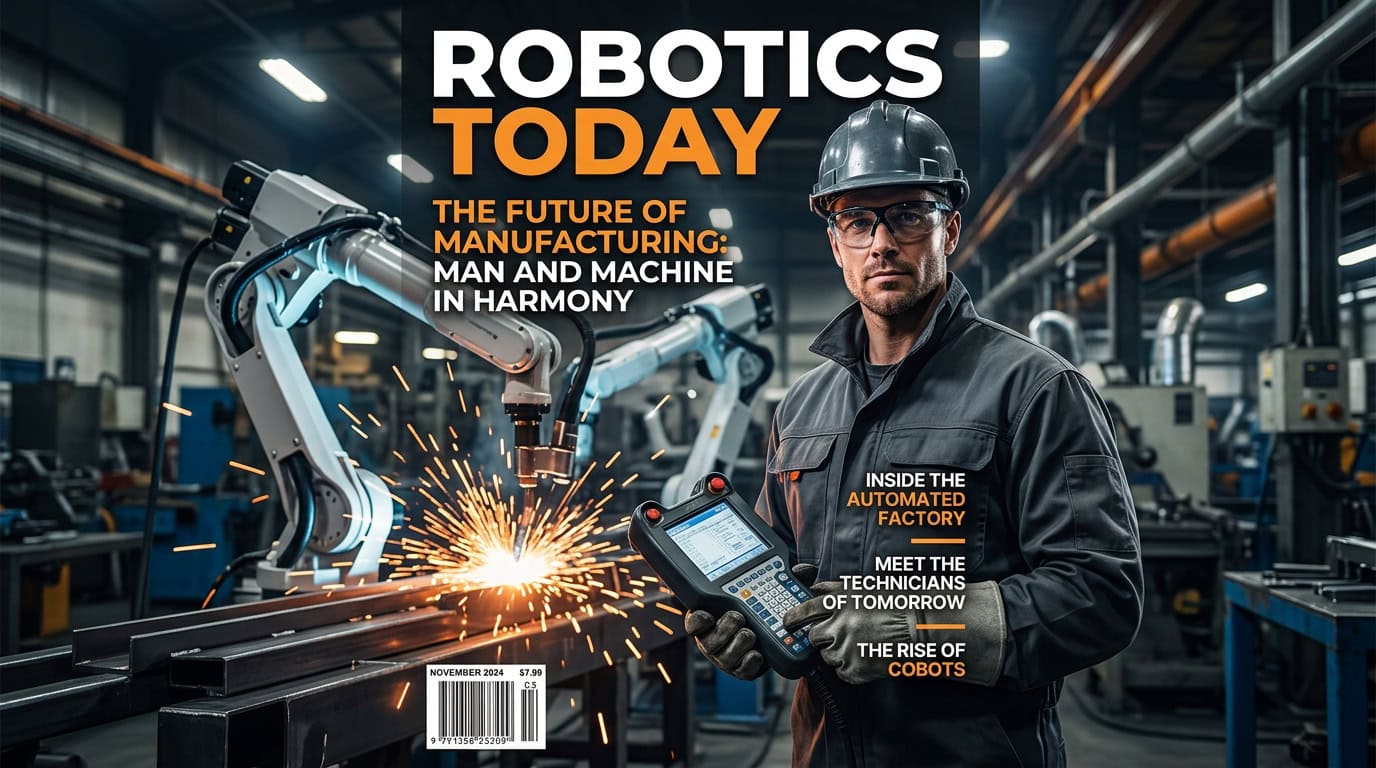
If you are evaluating a career pivot out of the white-collar grind, robotic welding is a high-paying, future-proof trade that perfectly merges hands-on mechanical skills with advanced industrial automation. The age of AI is upon us. I hear constantly from guys sitting at desks asking how to reinvent themselves when generative software seems poised to eat their livelihoods. For men quietly wondering which jobs will exist in a decade, the answer lies in bridging the digital and the physical.
We pulled raw job specs, grabbed hard salary numbers, and sifted the unvarnished reality from Reddit threads to build this guide. What you are about to read is a clear evaluation of a field where technology makes human operators irreplaceable.
Table of Contents
Escaping the AI trap: Robotic welding careers for men
Automation in the corporate sector is actively threatening purely digital desk jobs. Men who spend eight hours a day moving data around a spreadsheet or drafting emails are right to be nervous. But the dynamic changes completely once you step onto a manufacturing floor.
In heavy industry, robotics does not replace human insight. It amplifies human output.
The American Welding Society (AWS) career resources state plainly that automation will not replace welders—it will reshape how Welding is done. The guys holding these jobs are not competing against an algorithmic script. They are managing physical machines, ensuring heavy metals are fused together with perfect structural integrity. Searching for alternative career paths for men over 40 usually leads to a list of massive pay cuts or risky startups. This path is different. You pivot from being a disposable white-collar worker into a highly paid hybrid tradesman commanding a multi-million dollar robotic cell.
Why coding a robot requires callouses
A Robotic Welding Technician is a specialist who bridges manual welding mechanics with digital programming logic to set up, calibrate, and troubleshoot automated systems. You run the machines that build everything from automotive frames to aerospace turbines.
This is where the magic happens. You are taking traditional blue-collar grit and merging it with software engineering.
Programming software vs. hardware manipulation
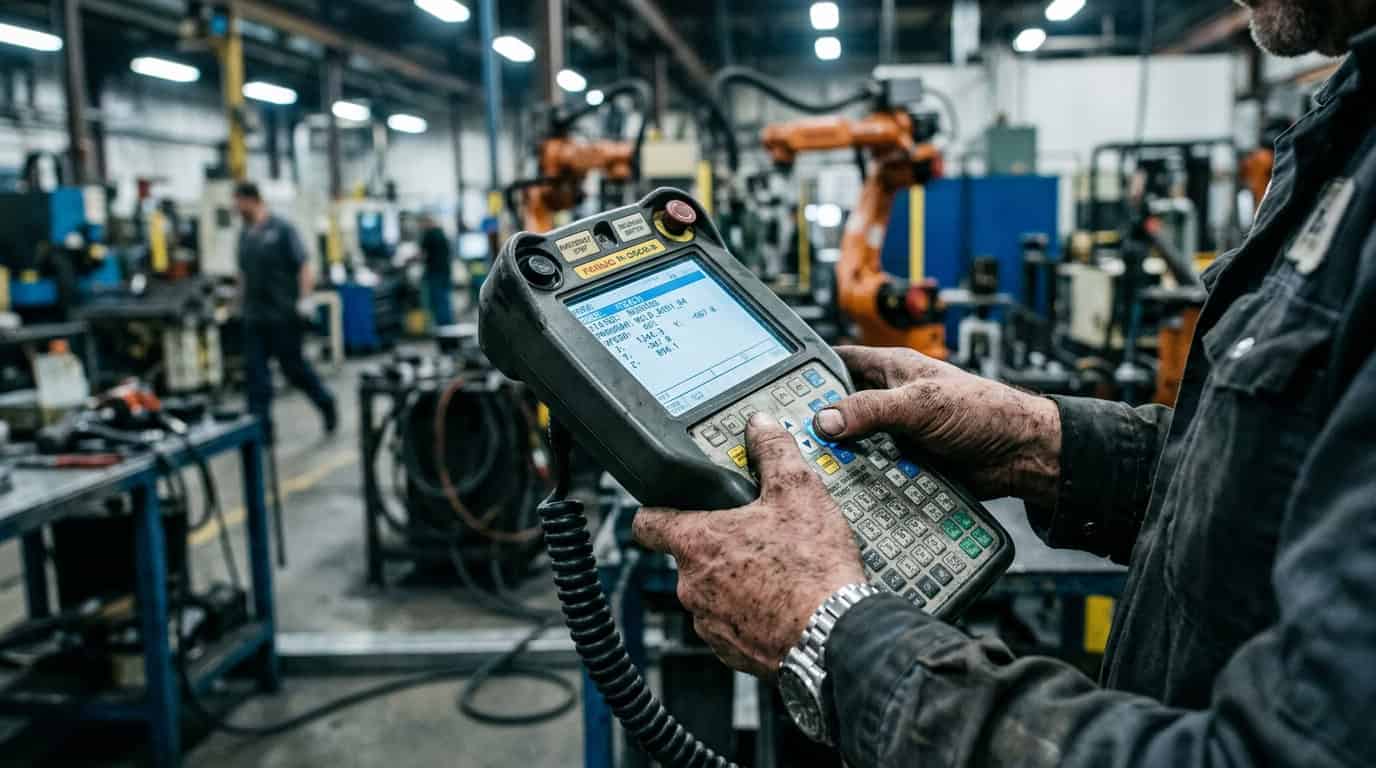
Writing code at a desk implies staring at a screen while isolated from the physical world. Programming a production cell is an entirely different beast. A technician maps the backend logic of programmable logic controllers, universally known as PLCs, directly to the moving machinery using terminal or pendant controls. You do not need to learn coding syntax like Python or C++. Instead, the programming strictly consists of creating logic loops through a proprietary hardware UI, like a FANUC teach pendant.
You are standing on a concrete floor, holding a heavy control pad, actively jogging massive robotic arms through three-dimensional space. The lines of code you enter instantly result in hundreds of pounds of steel moving with pinpoint accuracy.
Translating heat and metal into code
You can hand a guy the most advanced tools on earth, but if he does not know the raw mechanics, he is just going to build a pile of expensive trash. The same applies to the shop floor.
It does not matter if you know the software interface to run proprietary hardware from ABB, Yaskawa, or FANUC to execute robotic arc welding. If you do not have an intuitive, hands-on understanding of how extreme heat warps physical steel, your code is useless. This isn’t a delicate bench job where you dab solder onto a tiny circuit board; you have to know what a molten weld puddle looks like when it is flowing properly before you can instruct a machine on the proper speed and angle to replicate it.
“If you do not have an intuitive, hands-on understanding of how extreme heat warps physical steel, your code is useless.”
The physical reality of robotic welding careers
Just because a job involves programming logic does not mean you have escaped the demands of physical labor. Transitioning from a sedentary office chair to an active factory floor is a shock to the system for a lot of men, requiring a massive ego check and a profound cultural shift as a former email-sender enters a gritty, results-driven shop floor.
Lifting weight and spatial awareness
Despite the high-tech veneer, this remains a fundamentally active trade. Technical breakdowns from Welding Career Now highlight that the baseline physical requirements routinely include standing for eight hours, bending over, and reaching overhead inside tight work cells.
You are also regularly required to manually lift 50 lbs of raw material to load these machines. Software engineers working remotely from their couches lack the bodily resilience and spatial awareness required to maneuver dense steel components safely into a fixture. You are managing the flow of heavy materials in and out of the cell, which demands an element of physical endurance that a desk job simply cannot provide.
Bridging analog tools with digital sensors
Old-school craftsmanship directly dictates high-tech accuracy. You will spend half your day calibrating digital components, such as adjusting the precise metrics on sensors required for automated spot welding.
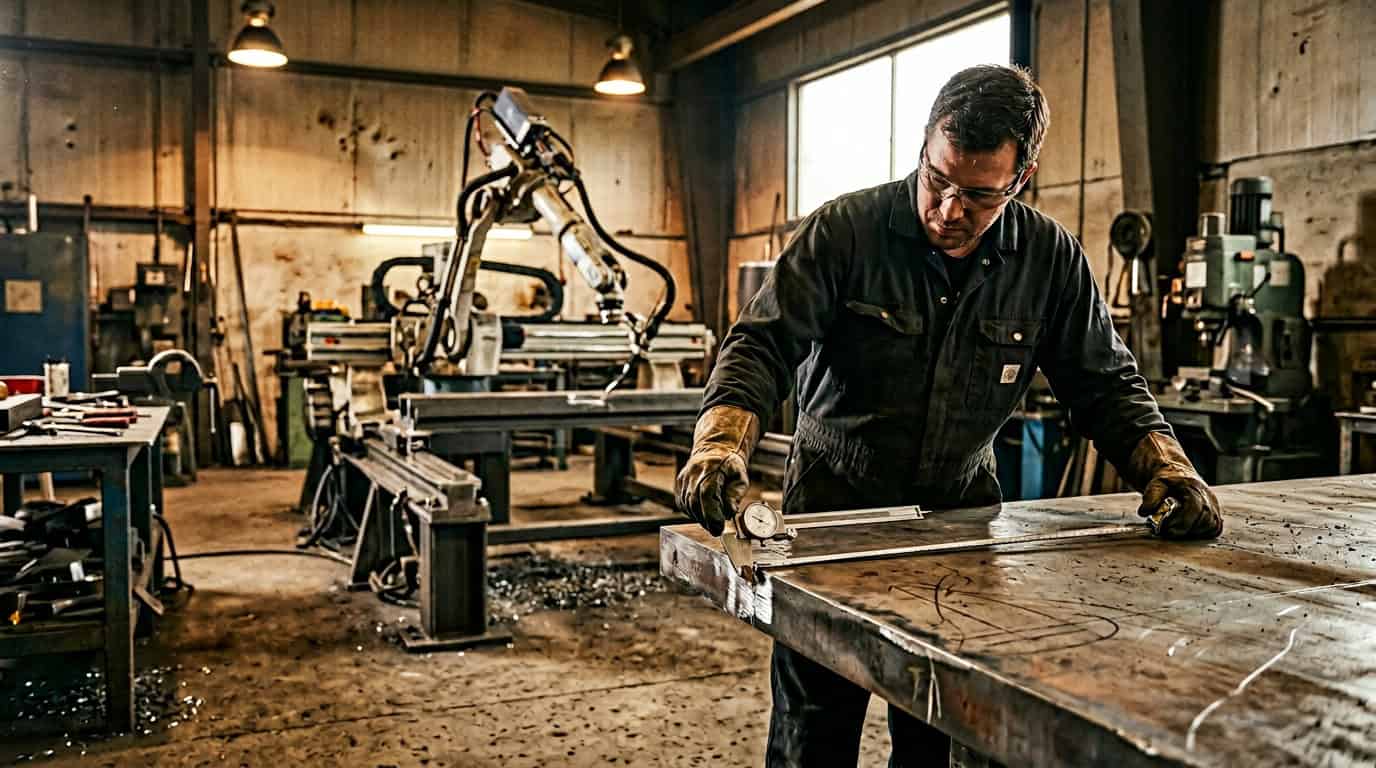
However, all that digital calibration means nothing if the underlying metal falls out of tolerance. A technician must constantly fall back on analog measuring tools like a tape measure and dial calipers to ensure the raw materials are perfectly squared. If the physical cut is off by a fraction of an inch, the robot will weld air. You have to trust your eyes, your analog gauges, and your digital readouts in equal measure.
Earning potential and the $95,000+ financial trajectory
The money in this field scales much faster than the standard corporate ladder, entirely free of the six-figure student debt usually required to land a modern tech job.
Factories are spending fortunes on manufacturing upgrades—which is a core reason heavy industry sits at the center of global conversations detailing how to reduce carbon emissions through efficiency. In order to capitalize on those massive machinery investments, they are willing to pay a premium for the men tasked with running them.
Entry-level to senior salary tiers
Because you are solving massive production bottlenecks, the compensation hits hard and fast.
According to Lightcast 2025, an entry-level technician can easily expect a baseline of $54,000 annually. The national median pay sits at a clean $60,000. But the wage growth accelerates exactly when you prove your worth. Experienced operators holding specific credentials rapidly move into the $65,000 to $80,000 bracket. For senior leads in high-demand sectors like automotive manufacturing or heavy equipment, the ceiling breaks wide open. Citing wage analytics from Lightcast 2025, aggressive go-getters in this niche are pulling $95,000+ per year.
Why automation drives wage growth
One highly dialed-in automated cell running at peak capacity can outproduce a dozen men working manually. Companies happily pay software-engineer level wages to a guy in steel-toed boots because he represents the ultimate leverage. Your ability to troubleshoot a machine and keep it running directly correlates to the company’s daily revenue.
Step-by-step roadmap to an automated welding job
You do not need a computer science background to dominate this field. You need mechanical competence and a direct sequence of skill acquisition. Here is exactly how a man transitions from zero experience into commanding automated cells.
- Establish a manual welding foundation. Before you touch robotics, you have to prove you understand extreme heat. Get your hands dirty learning traditional Stick Welding, GTAW (commonly known as TIG), and the foundational process of GMAW, which every man on a shop floor casually calls MIG.
- Gain field experience and pass formal assessments. Most manufacturers want to see an absolute minimum of 2 to 3 years of hands-on experience before letting you near a million-dollar robot. You will routinely be asked to pass a demanding welder level 3 assessment in MIG to prove your joints hold structural weight.
- Earn baseline certification. You lock in your credibility by officially getting badged up as an AWS Certified Welder. This proves to employers you are a known quantity.
- Acquire specialized robotics credentialing. With manual experience under your belt, you escalate into tech. Securing designation as a welder level B sets you apart, but the massive financial leap comes when a working technician passes the specialized CRAW-T or CRAW-S exams. That is what transforms you from a laborer into a robotics programmer.
The broader heavy industry ecosystem
Having a strong manual baseline is non-negotiable, and an Associate degree in industrial manufacturing will vastly speed up your timeline. But mastering these fundamentals does more than just prepare you for robotics.
This exact same skillset acts as the gateway to heavily respected, high-paying roles across the construction and maritime sectors. The fundamental training pipeline opens doors to the coolest jobs for men in the industrial world. With a strong grasp of metallurgy and proper certification, you have the foundational background to pivot outward into roles as a Pipefitter, Boilermaker, Pipe Welder, Structural Welder, Underwater Welder, Welding Engineer, Welding Inspector, or Sheet Metal Worker. The skills are infinitely transferable.
Future-proofing your livelihood
If you want to secure your place in the economy for the next three decades, you need to control the machines. Let the purely digital knowledge workers stress about their jobs being outsourced to an algorithm. Blue-collar trades infused with heavy automation are the ultimate shield against artificial intelligence.
Robotic welding gives you the physical satisfaction of building something structural with your own hands, combined with the extreme intellectual leverage of running advanced technology. Look into your local community college programs or step into an AWS training center. Put down the laptop, pick up a terminal controller, and secure your financial future.
Frequently Asked Questions
Do I need a computer science degree to program welding robots?
No. You do not need a computer science background to dominate this field; you need raw mechanical competence. You will use terminal or pendant controls to map the logic of PLCs (programmable logic controllers) directly to the machinery. The real requirement is an understanding of extreme heat and moving metal, not sitting isolated at a screen writing scripts.
Why do I have to know manual welding if the robot is doing the actual work?
If you do not intuitively understand how extreme heat warps physical steel, your programming code is completely useless. You have to know exactly what a molten weld puddle looks like when flowing properly before you can instruct a machine on the correct speed and angle. Old-school craftsmanship directly dictates the high-tech accuracy of the robotic cell.
How much money can a robotic welding technician expect to make?
Because a single operator running an automated cell can outproduce a dozen manual workers, the compensation scales fast. According to Lightcast 2025, entry-level technicians generally start at a baseline of $54,000 annually. Once you acquire specialized credentials and experience, aggressive operators in heavy sectors like automotive manufacturing routinely push past the $95,000 mark.
What’s the difference between writing software at a desk and programming a production cell?
A desk programmer writes logic in physical isolation, while a robotic welding tech stands on a concrete floor jogging massive robotic arms through three-dimensional space. It is a highly active job that routinely requires lifting 50 pounds of raw steel and maneuvering heavy components into tight fixtures. You also constantly rely on analog measuring tools like dial calipers to ensure physical tolerances match the digital sensors.
Which specific certifications do I need to secure an automated welding job?
You must first establish a baseline as an AWS Certified Welder with hands-on experience in Stick, TIG, and MIG processes. Employers typically want to see two to three years of manual field experience and a passing score on a Level 3 MIG assessment. The ultimate financial leap into robotics happens when you pass the specialized AWS CRAW-T or CRAW-S exams.
Can AI eventually automate the human operator out of this job?
No, because automation in heavy industry requires human insight to recalibrate and troubleshoot physical realities on the floor. A robot will weld thin air if the raw physical cut is off by a fraction of an inch and a human isn’t there to correct it. Bridging that volatile gap between digital logic and moving heavy metals makes the physical operator irreplaceable.