Ever dreamed of making money right from your couch? Learning how to make money with online trading could be your ticket. A 2025 World Economic Forum report highlights a major shift, with younger generations like Gen Z increasingly jumping into the stock market to build wealth. This guide will give you 10 savvy steps to start your trading journey on the right foot.
Ready to learn how to navigate the markets?
Key Takeaways
Online trading allows you to buy and sell financial assets like stocks and ETFs using internet-based platforms. Choosing the right platform, such as Fidelity or Charles Schwab, is a critical first step.
Successful trading requires continuous learning and understanding market fundamentals. You should get familiar with economic indicators and company financials, and practice with a demo account before risking real capital.
This article explores different trading strategies, including day trading and swing trading. It also stresses the importance of risk management tools, such as setting stop-loss orders and diversifying your portfolio.
The biggest mistakes new traders make are overtrading and letting emotions drive decisions. To succeed, you must set realistic profit goals, control emotional impulses like “revenge trading,” and learn from the strategies of successful investors.
Table of Contents
Basics of Online Trading

Think of online trading as surfing the web for profit. It’s all about buying and selling financial assets, like stocks, bonds, or ETFs, directly from your computer or phone.
What is Online Trading?
Online trading is simply the modern way to access the financial markets. You use internet-based platforms to buy and sell assets, which means no more phone calls to a broker’s office.
You can manage your investments from anywhere with an internet connection.

This digital approach has some great perks, like lower fees and instant access to real-time data. But the ease of access can be a double-edged sword. It can lead to overtrading, and without a solid plan, the market’s ups and downs can lead to big losses.
The hard truth is that very few day traders find long-term success. Some studies show that only around 4% of people who try to make a living from day trading succeed. This is why education and a disciplined strategy are so important.
Types of Online Trading Platforms
Online trading platforms are your gateway to the market, and they come in a few different flavors. Picking the right one depends on your goals, experience, and how hands-on you want to be.
| Platform Type | Best For | Examples | Key Feature |
|---|---|---|---|
| Full-Service Brokers | Investors who want research, advice, and a wide range of products. | Fidelity, Charles Schwab | Often provide access to human financial advisors and in-depth market analysis. |
| Discount Brokers | Self-directed traders who want low costs and solid tools. | E*TRADE, Ally Invest | Offer commission-free stock and ETF trades with robust mobile apps. |
| Active Trading Platforms | Day traders and frequent traders who need speed and advanced tools. | Webull, Interactive Brokers | Provide features like advanced charting, real-time data, and rapid trade execution. |
| Robo-Advisors | Hands-off investors who prefer automated portfolio management. | Betterment, Vanguard | Use algorithms to build and manage a diversified portfolio based on your risk tolerance. |
Tools Required for Online Trading

Ready to get started? You’ll need the right gear. Think of it as building a digital toolkit to help you make smart money moves.
Selecting a Suitable Trading Platform
Choosing the right trading platform is the most important first step. For beginners, platforms from brokers like E*Trade and TD Ameritrade are fantastic because they offer easy-to-use interfaces and tons of educational content. Before you decide, think about your budget, goals, and experience level.
The best investment you can make is in yourself. – Warren Buffet
Your platform should provide up-to-the-minute quotes and interactive charts. A smooth user experience is a must.5 Many traders also use third-party tools alongside their broker’s platform. For instance, TradingView is a popular choice for its powerful and highly customizable charting capabilities.

Also, pay close attention to fees. While most brokers now offer $0 commissions on stock trades, options contracts usually have a fee, typically around $0.65 per contract. These costs can add up, so factor them into your decision.
Importance of Access to Real-Time Market Data
Once you have a platform, you need to understand why real-time market data is a complete game-changer. With up-to-the-second info, you can make decisions based on what’s happening right now, not five minutes ago.
- Level 1 Data: This is what most people see. It shows the highest bid price and the lowest ask price for a stock. It’s essential but gives you a limited view.
- Level 2 Data: This gives you a much deeper look. It shows you the order book, including the full list of bid and ask prices from different market makers. Active day traders rely on Level 2 data to gauge a stock’s supply and demand in real time.
Having real-time data means you can react instantly to market shifts. In a world driven by social media and instant news, prices can change in a heartbeat. Access to live data helps you ride the trends instead of getting wiped out by them.
Getting Started with Online Trading

Ready to make your first move? Getting started is easier than you might think. Let’s break down the key steps.
How to Set Up Your Trading Account
Setting up your trading account is your first official step into the trading world. Here’s a simple guide to get you up and running.

- Pick a good broker. Look for one with low fees, a user-friendly platform, and great customer support.
- Get your documents ready. You’ll typically need a government-issued ID, proof of address, and your Social Security number for tax purposes.
- Complete the application. Most brokers have simple online forms that you can complete in about 15 minutes. Be honest with your financial information.
- Fund your account. You can connect your bank account to transfer funds electronically.
- Explore the trading platform. Get comfortable with its layout, features, and tools before you place a trade.
- Set up strong security. Always enable two-factor authentication (2FA) using an app like Google Authenticator to protect your account.
- Try a demo account first. This is a crucial, no-risk way to practice your strategy and sharpen your skills.
Remember, opening an account is just the beginning. Successful trading requires ongoing learning, discipline, and smart risk management.
Learning Market Fundamentals
Once your account is set up, it’s time to learn how the market works. Understanding the fundamentals is key to making informed decisions instead of just guessing.
- Track economic indicators: Keep an eye on reports like the Consumer Price Index (CPI) for inflation and the monthly Jobs Report, as they can heavily influence market trends.
- Analyze company financials: Learn to read a balance sheet and understand key metrics like the Price-to-Earnings (P/E) ratio to gauge a company’s health.
- Master basic chart reading: Understand what candlestick patterns and trend lines can tell you about potential future price movements.
- Learn about different asset classes: Stocks, bonds, commodities, and currencies each behave differently and have unique risks.
- Follow global events: Geopolitical news and events can create ripples across international markets.
- Use educational resources: Websites like Investopedia offer free, comprehensive courses on everything from basic terms to advanced strategies.
Effective Day Trading Strategies

Your trading strategy can make or break your success. Let’s look at a couple of popular tactics that can help you navigate the market’s daily currents.
Techniques for Scalping
Scalping is like being a hummingbird in the market. You dart in and out of trades, aiming to grab tiny profits from small price movements. A scalper isn’t looking for a home run, they’re trying to hit dozens of singles.
This high-speed technique involves making a large number of trades in a single day. For example, a scalper might aim to profit from a $0.05 move in a stock, but they’ll try to do it 100 times. Success depends on having a strategy with a high win rate, along with tight spreads and low commissions from your broker.
It’s an intense and demanding style that requires focus and discipline. One moment of hesitation can erase the profits from ten successful trades. But for those who can handle the pressure, it can be a very active way to engage with the market.
Methods for Swing Trading
If scalping is a sprint, swing trading is more like a marathon relay. You hold onto positions for a few days to several weeks, aiming to capture a “swing” or a significant chunk of a price movement.
Swing traders use technical analysis tools like moving averages and the Relative Strength Index (RSI) to identify trends and predict where the price might go next. For example, a common strategy is to buy a stock when its 50-day moving average crosses above its 200-day moving average, a pattern known as a “golden cross.”
However, swing trading isn’t a sure thing. Research suggests only about 10% of active traders find consistent success. That’s why smart swing traders always use stop-loss orders to protect their capital if a trade doesn’t go as planned.
Managing Risks in Online Trading

Online trading can feel like a rollercoaster. But with smart risk management, you can smooth out the ride. It’s all about having a plan to protect your money before you even enter a trade.
Smart traders use tools like stop-loss orders to limit potential losses and diversify their investments so that one bad trade doesn’t sink their entire portfolio.
How to Set Stop-Loss Orders
A stop-loss order is your built-in safety net. It’s an instruction you give your broker to automatically sell a stock if it drops to a specific price, limiting your potential loss.
Here’s a pro-tip: understand the difference between a standard stop-loss and a trailing stop.
- Standard Stop-Loss: You set a fixed price. If you buy a stock at $100 and set a stop-loss at $90, your broker will sell if the price hits $90, limiting your loss to 10%.
- Trailing Stop-Loss: This is more dynamic. You set a percentage, and the stop price moves up as the stock price rises. If you set a 10% trailing stop on your $100 stock and it goes up to $120, your new stop price is $108. This locks in profits while still protecting you from a downturn.
The elements of good trading are: (1) cutting losses, (2) cutting losses, and (3) cutting losses. If you can follow these three rules, you may have a chance. – Ed Seykota
Strategies for Diversifying Investments
Diversifying investments is just a fancy way of saying “don’t put all your eggs in one basket.” Spreading your money across different assets is a fundamental way to manage risk.
- Mix Asset Classes: Combine stocks, bonds, and commodities. When stocks are down, bonds might be up, helping to balance your portfolio.
- Invest Globally: Put money into companies from different countries. This protects you if one country’s economy struggles.
- Use ETFs for Instant Diversification: Exchange-Traded Funds (ETFs) are a great tool. For example, an ETF like VTI (Vanguard Total Stock Market ETF) gives you a small piece of thousands of U.S. companies in a single investment.
- Spread Across Sectors: Invest in different industries like technology, healthcare, and energy. If one sector has a bad year, the others might still perform well.
- Consider Real Estate: REITs (Real Estate Investment Trusts) let you invest in property markets without having to buy a building.
Market Analysis Techniques
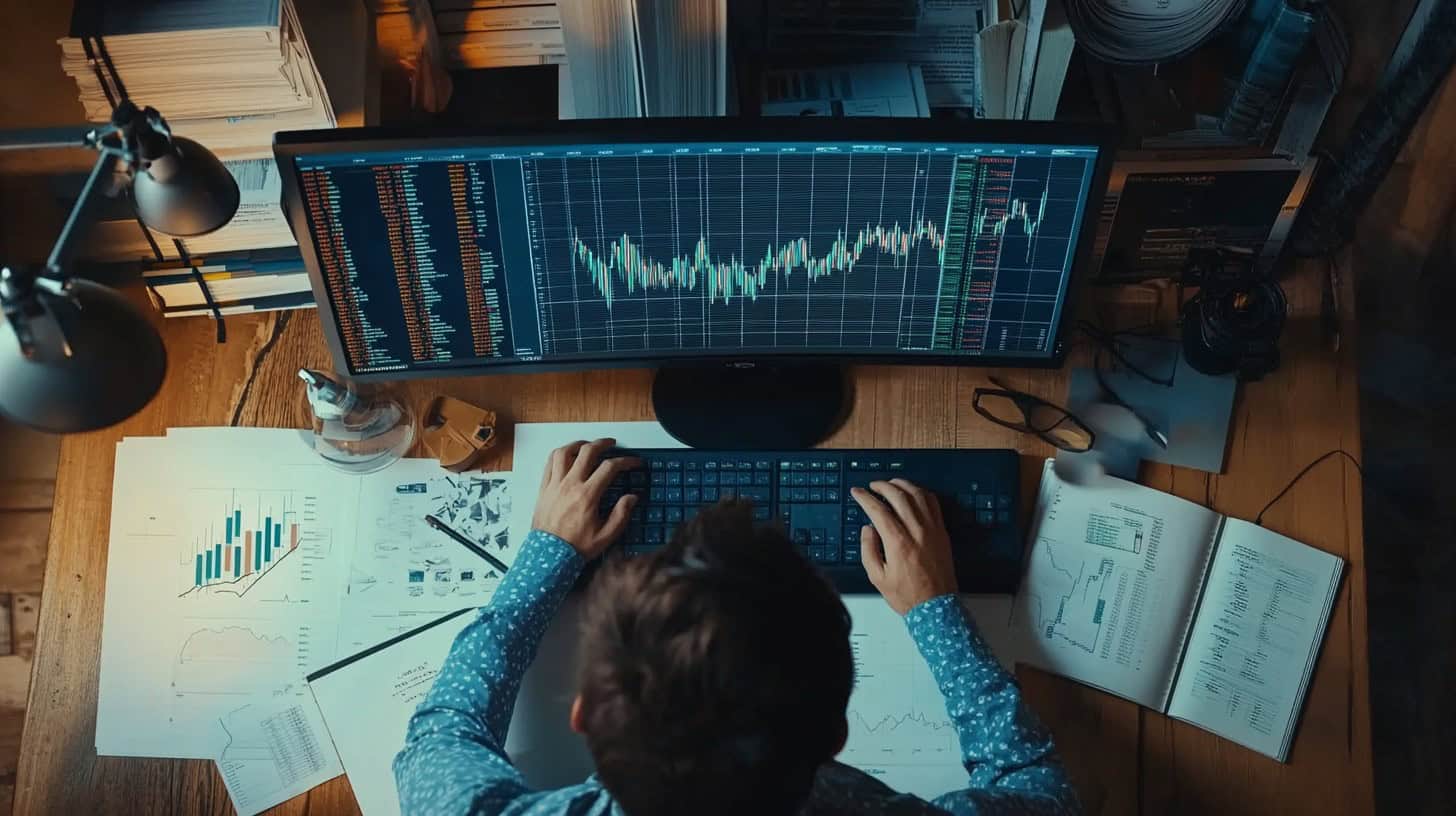
Diving into market analysis can feel like learning a new language. But you really only need to know two main approaches to start making sense of it all.
Approaches to Fundamental Analysis
Fundamental analysis is like being a detective for a company. You’re not just looking at the stock price, you’re investigating the company’s health to determine its real value.
This approach involves digging into a company’s financials, its position in the industry, and the overall economic landscape. You’ll look at income statements, balance sheets, and cash flow reports. You can easily find these for free on sites like Yahoo Finance.
It’s about answering big questions. Does the company have a competitive edge? How is the economy affecting its sales? It takes work, but it can help you find a truly great company that the market has overlooked.
Benefits of Continuous Learning and Practice
Continuous learning isn’t just a buzzword, it’s the secret sauce for trading success. Markets are constantly changing, so staying sharp is essential to keep up.
By reading and practicing regularly, you’ll start to spot trends before they become old news. Practice is where the real learning happens. Each trade, whether a win or a loss, is a lesson.
A great way to track your progress is by keeping a trading journal. Write down why you entered a trade, how it played out, and what you learned. This becomes your personal playbook for success.
Advantages of Using Demo Accounts
A demo account, or paper trading account, is a trader’s best friend. It’s a virtual playground where you can test your strategies with fake money but real market data. This is a powerful, risk-free environment to get hands-on experience.
Platforms like TD Ameritrade’s thinkorswim and E*TRADE are well-known for offering excellent, realistic demo accounts where you can practice until you feel confident. You can learn how the platform works and see how your strategy performs without risking a single dollar.
But demo accounts aren’t just for beginners. Seasoned traders often use them to test new ideas or get familiar with a new market. Since most brokers offer them for free, there’s no reason not to use one to hone your skills.
Strategies for Planning Profits
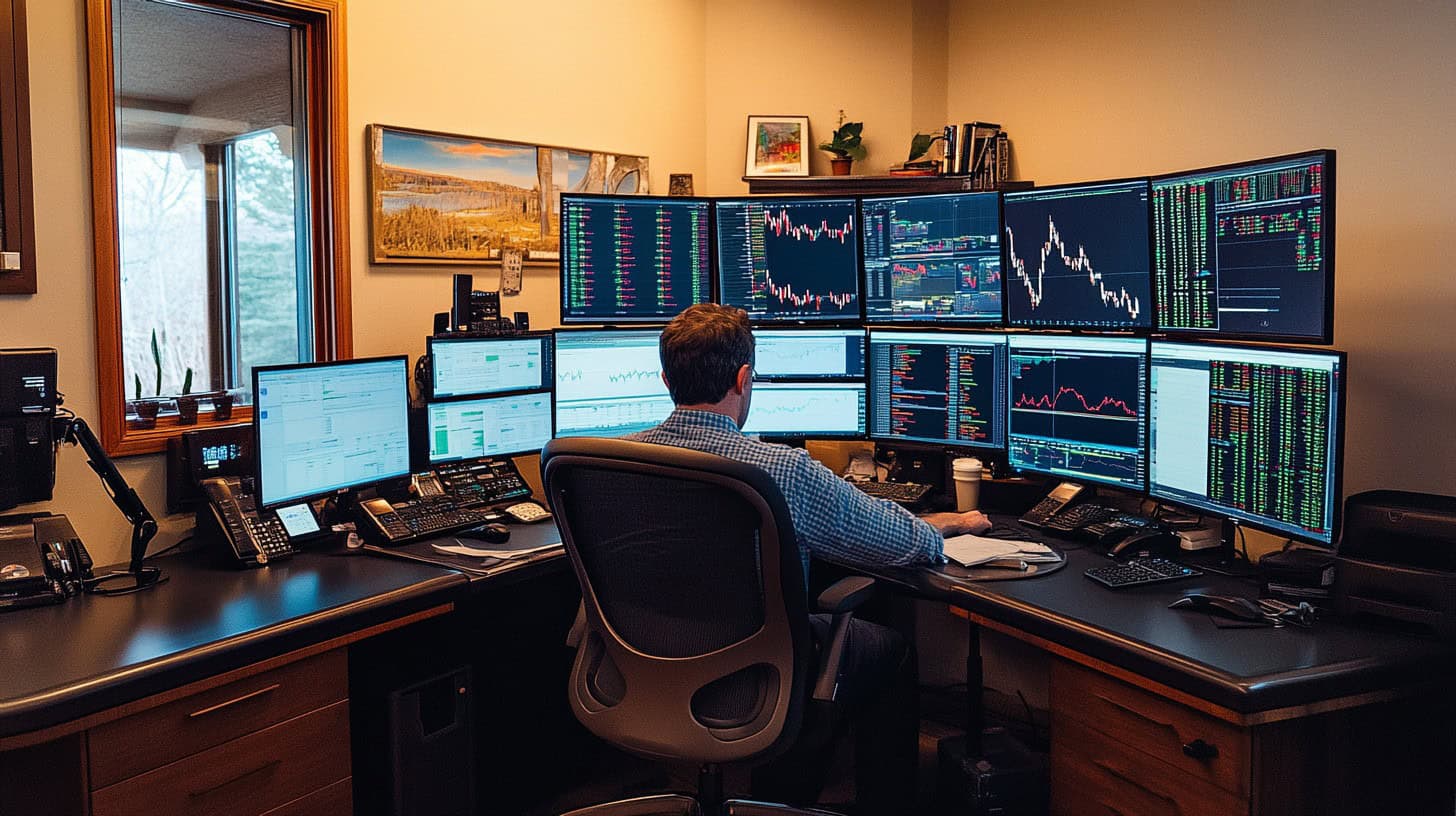
Want to make money in online trading? It all comes down to having a plan. That means setting realistic goals and knowing when to take your profits off the table.
How to Set Realistic Profit Targets
Setting realistic profit targets is about being strategic, not greedy. Your targets should be based on analysis, not just wishful thinking.
A great tool for this is the risk/reward ratio. This simply compares how much you’re risking to how much you stand to gain. Many successful traders will only enter a trade if the potential profit is at least two or three times the potential loss. For example, you might risk $1 per share to potentially make $3 per share.
This approach means you don’t have to win every trade to be profitable. With a 1:3 risk/reward ratio, you could be right only 40% of the time and still come out ahead. The market is always changing, so be flexible and ready to adjust your targets based on current conditions.
Common Mistakes in Online Trading

New traders often fall into the same traps. Let’s look at the most common mistakes so you can learn to avoid them on your trading journey.
Risks of Overtrading
Overtrading is a silent portfolio killer. It happens when you trade too frequently, often without a clear strategy, racking up commission fees and making impulsive decisions. Studies consistently show that the most active traders often end up with the worst results.
Why? Every trade has costs, and those costs eat into your profits. More importantly, frequent trading often means you’re making emotional decisions instead of analytical ones, which is a recipe for disaster. One study from 2020 revealed that 72% of day traders experienced financial losses in a single year, often due to overtrading.
Impact of Emotional Trading
Emotional trading is when feelings like fear and greed take control of your decisions. It’s the number one reason traders lose money.
You have to learn to recognize these two common emotional traps:
- FOMO (Fear Of Missing Out): This is when you see a stock soaring and jump in without a plan, afraid of missing out on profits. This often leads to buying at the peak, just before it crashes.
- Revenge Trading: This happens after you take a loss. You feel angry and frustrated, so you immediately jump into another, often riskier, trade to try and “win back” your money. This almost always leads to even bigger losses.
Trading psychology is about staying disciplined. The market doesn’t care about your feelings, so you have to learn to trade with a clear head and stick to your plan.
Success Stories from Online Traders

Ever wonder how the best traders in the world do it? Their stories aren’t just about making money, they’re packed with lessons you can use to improve your own trading.
Exploring Case Studies and Key Insights
Studying successful traders can feel like getting a masterclass in investing. Here are a few legendary investors and the key lessons they offer:
- Warren Buffett (The Value Investor): Buffett’s strategy is to buy wonderful companies at a fair price, not fair companies at a wonderful price. He focuses on a company’s long-term value and competitive advantages, what he calls its “economic moat,” rather than short-term market noise.
- George Soros (The Global Macro Trader): Soros is famous for making huge, bold bets on macroeconomic trends. His most legendary trade was “breaking the Bank of England” in 1992, where he made over $1 billion by betting against the British pound. His success teaches the importance of understanding how global events affect currency and commodity markets.
- Peter Lynch (The “Invest in What You Know” Guru): As the manager of the Fidelity Magellan Fund, Lynch achieved legendary returns by investing in companies and industries he could easily understand. His approach shows that everyday observations can lead to fantastic investment ideas.
- James Simons (The Quant King): Simons, a mathematician, founded Renaissance Technologies, a hedge fund that uses complex algorithms to find and exploit market inefficiencies. His story proves the power of a data-driven, systematic approach to trading.
Conclusion: Your Path to Successful Online Trading
Learning how to make money with online trading is a marathon, not a sprint. Success isn’t about finding a secret formula or getting lucky on a hot stock.
It’s about building a solid foundation of knowledge, creating a disciplined strategy, and managing your risks and emotions. By starting small, practicing with a demo account, and never stop learning, you can build the skills to navigate the markets confidently.
People Also Ask
What’s the first step to make money with online trading?
Start with a solid trading strategy. It’s your roadmap. Learn about stock markets, forex, and crypto assets. Pick a methodology that fits your style. Are you into swing trading or position trading? Know your stuff before diving in.
How important is emotional control in trading?
It’s crucial. The market’s a roller coaster. You need nerves of steel. Don’t let fear or greed drive your decisions. Stick to your plan. Use stop-loss orders. They’re your safety net when things go south.
What’s the deal with margin trading?
Margin trading’s like borrowing money to invest. It can boost your gains, but watch out! It’s risky. You could lose more than you put in. Know the margin requirements. Don’t bite off more than you can chew.
How do I choose between stocks, forex, and futures?
Each market’s got its quirks. Stocks offer dividend income. Forex deals with currency pairs. Futures contracts are for commodities. Pick based on your goals and risk tolerance. Remember, diversification’s key.
What tools can help me analyze the market?
Charts are your best friends. Use technical indicators like the Relative Strength Index. Keep an eye on economic forecasts. Electronic Communication Networks (ECNs) provide real-time data. Knowledge is power in this game.
How does taxes affect my trading profits?
Uncle Sam wants his cut. Different trades are taxed differently. Short-term gains face higher rates. Some losses can offset gains. Keep meticulous records. Consider chatting with a tax pro. Don’t let the taxman catch you off guard.
References
https://skilling.com/row/en/blog/trading-terms/trading-online/ (2024-05-20)
https://www.investopedia.com/articles/trading/05/011705.asp
https://money.com/best-online-stock-trading-platforms/
https://www.investopedia.com/terms/t/trading-platform.asp
https://moneywise.com/investing/10-things-to-look-for-when-choosing-a-trading-platform (2024-06-12)
https://unitedfintech.com/blog/5-benefits-of-real-time-market-data/ (2021-07-28)
https://intrinio.medium.com/what-is-real-time-market-data-how-to-use-it-701926a6ece0
https://www.bankrate.com/investing/how-to-trade-stocks/
https://www.linkedin.com/pulse/step-by-step-guide-creating-your-digital-trading-account-finveomn
https://www.investopedia.com/learn-how-to-trade-the-market-in-5-steps-4692230
https://www2.snc.edu/content/detail/HomePages/Trading_Stocks_For_Dummies.pdf
https://www.warriortrading.com/scalp-trading-strategy-for-beginners/ (2023-10-25)
https://www.investopedia.com/articles/trading/06/daytradingretail.asp
https://www.linkedin.com/pulse/swing-trading-strategies-quantifiedstrategies-dqfff
https://www.forbes.com/advisor/in/investing/swing-trading-strategies/ (2024-07-10)
https://www.linkedin.com/pulse/how-make-money-day-trading-10-best-tips-success-bhavishya-gautam
https://www.investopedia.com/terms/s/stop-lossorder.asp
https://www.investopedia.com/articles/stocks/09/use-stop-loss.asp
https://www.investopedia.com/articles/trading/09/risk-management.asp (2023-06-12)
https://www.investopedia.com/terms/f/fundamentalanalysis.asp (2024-06-21)
https://www.youtube.com/watch?v=_fsRWw0VbS4
https://www.investopedia.com/terms/t/technicalanalysis.asp
https://www.business-fundas.com/2024/the-importance-of-continuous-learning-in-trading/ (2024-06-19)
https://www.investopedia.com/articles/trading/09/demo-trading-account.asp
https://www.topbrokers360.com/trading-demo-account-tips-and-tricks-you-need-to-know/
https://fundyourfx.com/how-to-set-profit-targets-for-your-funded-trading-account-strategies-and-best-practices/ (2023-06-16)
https://www.investopedia.com/articles/trading/10/top-ten-rules-for-trading.asp
https://www.axi.com/int/blog/education/trading-exit-strategies
https://www.ncbi.nlm.nih.gov/pmc/articles/PMC3903640/
https://www.timothysykes.com/blog/dangers-of-overtrading/ (2022-04-17)
https://www.linkedin.com/pulse/emotions-trading-1-account-killer-heres-how-deal-them-heitkoetter
https://www.ncbi.nlm.nih.gov/pmc/articles/PMC4713085/
https://www.tradingwithrayner.com/how-i-become-successful-in-trading/