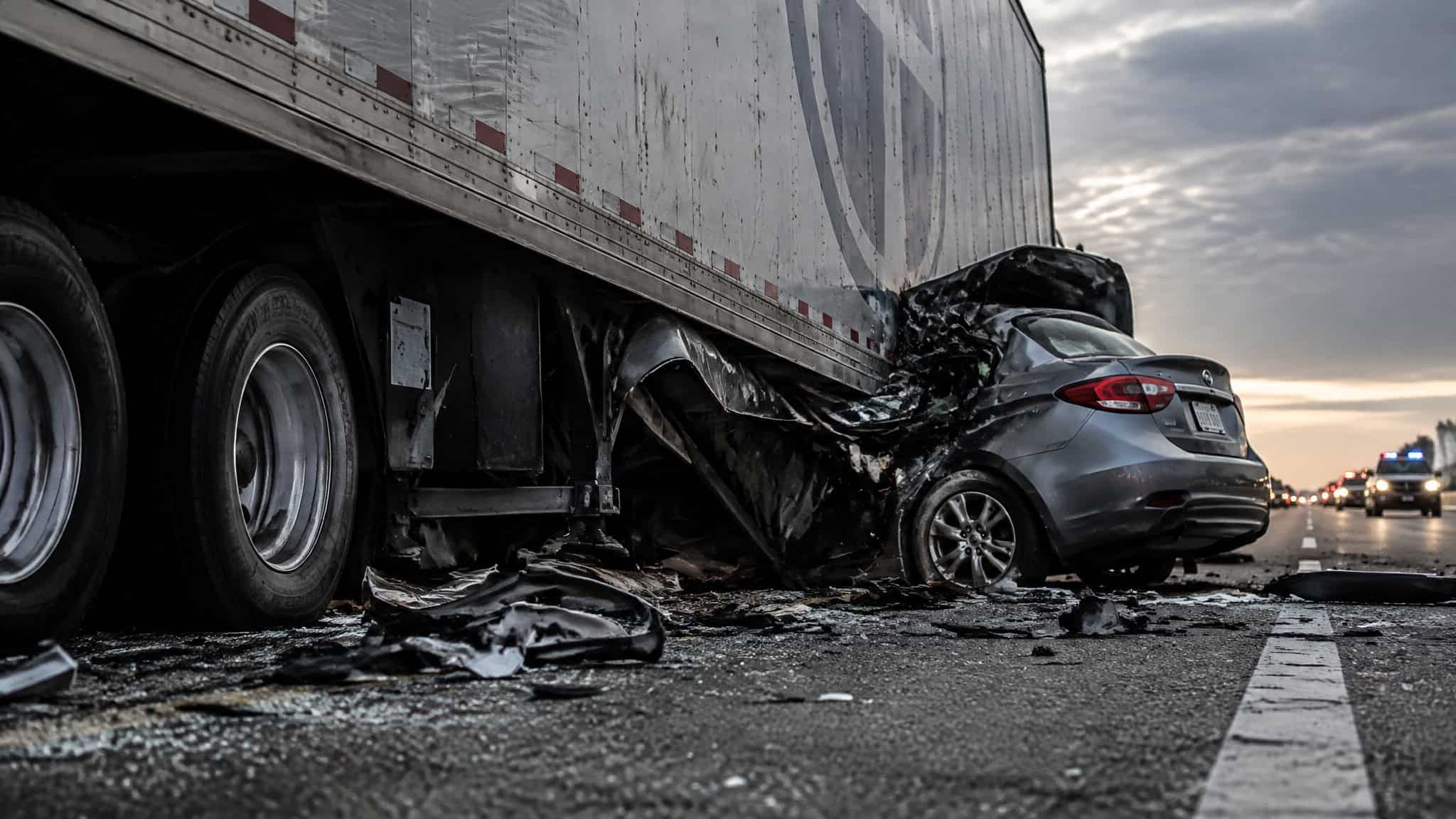
A loaded tractor-trailer weighs roughly 80,000 pounds, while the average passenger car sits around 4,000. According to the Insurance Institute for Highway Safety (IIHS) and The Hometown Lawyers, large trucks weigh 20 to 30 times as much as passenger cars and sit higher off the pavement, which lets a smaller vehicle slide underneath the trailer in a debilitating or deadly underride crash.
When you take a hit like that, adrenaline and shock flood your system and make clear thinking almost impossible. Still, what you do in the first minutes and hours shapes your recovery and your payout, notes Fitzpatrick Law. Recent Southern California crashes reported by Beverly Law show how fast serious roadway collisions turn life-altering. In September 2026, a truck crash killed a rider in a Pacific Coast Highway bike lane near Ventura, and a suspected DUI driver injured a firefighter on the 118 in Simi Valley. A month earlier in August 2026, a head-on crash with a suspected DUI driver on Grimes Canyon Road near Moorpark seriously hurt a CHP officer and his passenger.
Key Takeaways
Call 911 immediately after a semi-truck accident to generate an official police crash report and get evaluated by paramedics, because adrenaline masks delayed-onset traumatic brain injuries (TBIs) and spinal cord damage for hours or days; if you’re injured or your car isn’t drivable, stay inside with your seatbelt and hazard lights on.
Document the scene with photos of vehicle positions, damage, skid marks, and the truck’s company name, USDOT, and CA numbers, and exchange information by gathering witness contact details along with the trucker’s commercial driver’s license (CDL), insurance card, and employer name, then stick strictly to the facts with your own insurer, never apologize at the scene, and refuse recorded statements or medical releases from the trucking carrier’s adjuster.
Hire a truck accident attorney early to send a spoliation letter before dashcam video is overwritten in days and federal electronic logging device (ELD) records expire at six months.
Table of Contents
Get safe, then call 911
Call 911 after a truck accident even when no one seems hurt. That call dispatches police and paramedics to check for concussions or internal bleeding that lack immediate symptoms, and it generates the official police crash report and traffic citations that serve as objective third-party proof of fault, according to the Law Offices of James Scott Farrin.
- Check your own physical condition before trying to help anyone else.
- Move your car off the main road to prevent a secondary crash if it still drives, or stay belted inside with your hazard lights flashing if you’re hurt or the car is dead.
- Call 911 so police document the wreck and paramedics check you for concussions or internal bleeding that lack immediate symptoms.
Get to safety first
If your car won’t drive after a big truck crash on a busy corridor like I-75 or I-275 in Hamilton or Butler County, Ohio, stay inside with your seatbelt on and hazard lights flashing. Climbing out into live interstate traffic turns a survivable wreck into a fatal secondary collision.
Call 911 even if no one seems hurt
Large truck crashes routinely require on-scene life-saving care or hospital transport. In Ohio, the official police and accident reports generated by that 911 dispatch can be obtained later through the Ohio Department of Public Safety.
When the truck driver asks you not to call police
If the truck driver asks you to keep the police out of it and handle things privately, refuse and dial 911 anyway. That request is a major red flag, not a roadside favor.
Document the scene for the reconstruction expert, not the insurance file
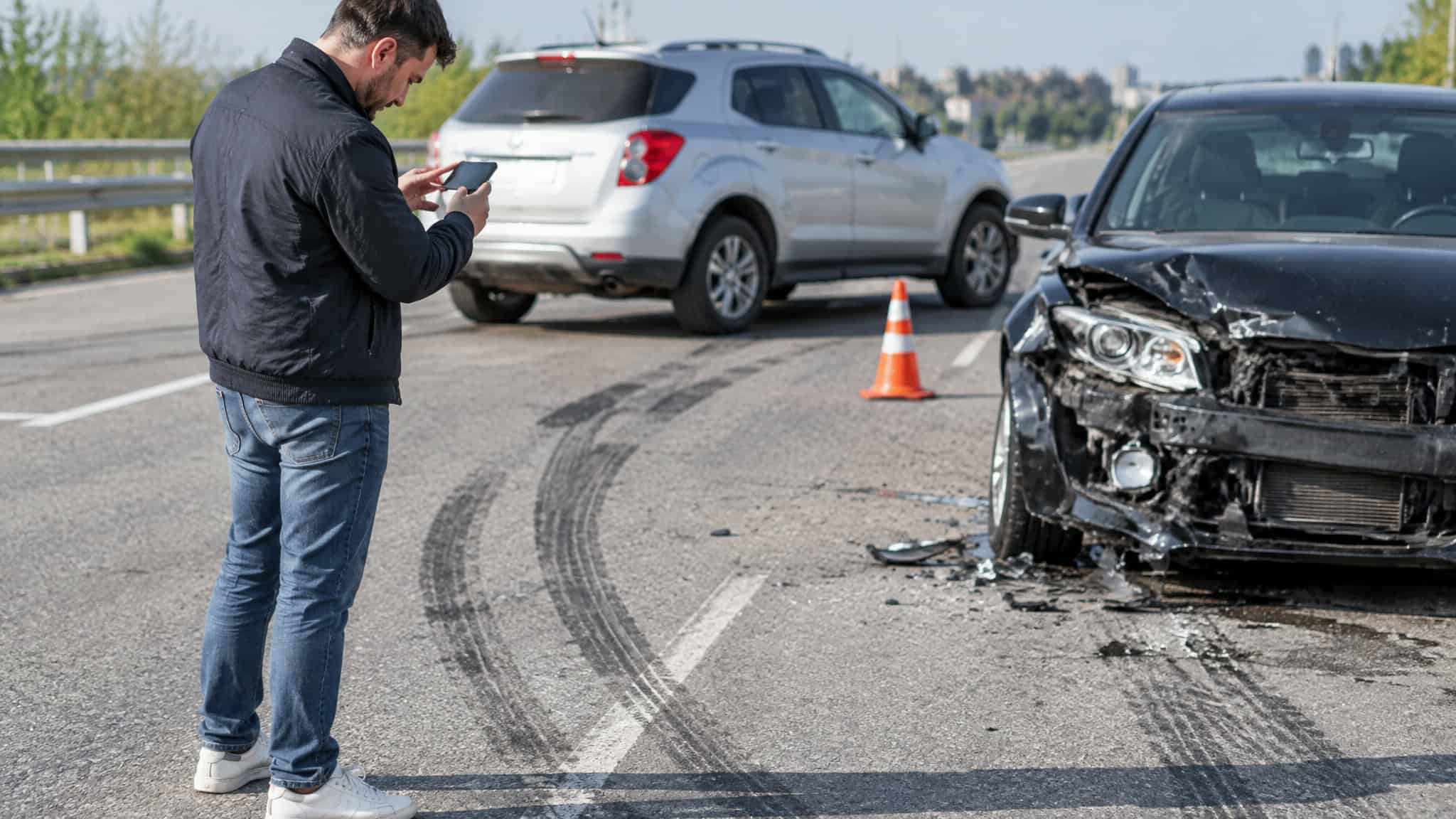
Use your phone to shoot vehicle damage, license plates, skid marks, road conditions, traffic signs, visible injuries, and the rig’s regulatory numbers before tow trucks clear the lanes. Those shots and your fresh written notes give an accident reconstruction expert the raw measurements needed to prove fault later. If you can move around safely without pain, gather these items:
- Straight-on, high-angle, and low-angle photos, combining wide shots of the whole scene with close-ups of impact points, debris fields, and roadway markings.
- Photos of the truck driver’s license, insurance card, and the company name, USDOT number, and CA number printed on the rig’s door.
- Immediate written recollections saved in a phone note, text, or email to yourself or a friend.
What to photograph, from which angles
Reconstruction specialists use skid marks, traffic signals, and final vehicle positions to calculate speed and angles of impact. If you’re injured, try to take photos of your injuries, but not if doing so is painful or uncomfortable: if severely injured, documenting may be impossible, so only do so if able and not painful.
Write down what you remember while it’s fresh
Memory degrades fast once the adrenaline wears off. Typing out what you saw, heard, and felt in the first few minutes gives your lawyer a contemporaneous record that holds up much better than a guess two weeks later.
Exchange information, and map the liability chain while you’re at it
Get the semi-truck driver’s commercial driver’s license (CDL) and the name of the trucking company or employer right away, because a commercial crash involves corporate defendants far beyond the person behind the wheel. Collect names, email addresses, phone numbers, local mailing addresses, driver’s licenses, insurance policies, vehicle descriptions, and license plate numbers (with the state) from every driver and occupant involved.
Track down independent witnesses before they drive off. Ask stopped bystanders what they saw, grab their names and phone numbers, and check nearby businesses for outdoor surveillance cameras that may have caught the impact, advises Berg Injury Lawyers.
Keep your mouth shut about fault while you trade details. Never argue with or apologize to the truck driver or anyone else at the scene, because a polite apology gets twisted into a legal admission of liability. Keep every roadside interaction brief and factual, save the accident details for law enforcement and your attorney, and write it down immediately if the truck driver apologizes to you, notes The Hometown Lawyers.
See a doctor immediately: feeling fine is a warning sign
See a doctor the same day as a truck accident. Trauma chemicals hide life-threatening internal damage, and a prompt exam creates the medical record tying your injuries directly to the crash. According to the Mayo Clinic, severe head and neck injuries may not show symptoms for hours or days after impact.
- Adrenaline and trauma-released pain-killing chemicals mask severe pain right after a wreck, making you think you walked away clean.
- Delayed-onset injuries include traumatic brain injuries (TBIs), spinal cord injuries that can lead to paralysis, internal bleeding, and organ damage.
- Waiting to see a physician hands the trucking company’s defense team an opening to argue your injuries came from somewhere else or got worse because you sat at home.
Why “I feel fine” is a symptom, not good news
Your nervous system is wired to help you survive an ambush, not win a personal injury lawsuit. When an 80,000-pound rig hits your car, your body dumps adrenaline and endorphins into your bloodstream to block pain signals so you can get out of danger. You might stand on the shoulder talking to the highway patrol feeling normal while a slow bleed or a disc herniation is already developing.
Tell the first responders at the scene about every single ache, dizzy spell, or stiff joint, even if it feels minor, advises Berg Injury Lawyers, because everything the paramedics write on their run sheet enters the official record. When you leave the emergency room or urgent care clinic, keep every discharge paper they hand you, notes Beverly Law.
How a treatment delay becomes a fault argument
If you tough it out for a week before seeing a doctor, the defense runs a two-part playbook against you. Your medical record has to prove that you were actually hurt and that the truck crash is what hurt you, and a gap gives the insurer room to dispute both. First, the insurer questions why an injured person waited days to get looked at, arguing your back or neck injury happened after the wreck. Second, the defense argues contributory fault, claiming your own delay in getting medical care made the injury worse and that they shouldn’t have to pay for the share of damage you caused by waiting.
What to say, and never say, to two insurance companies
After a truck accident, the statements and actions to avoid with the truck driver and insurance adjusters are apologies, guesses about fault, recorded statements to the trucking carrier’s insurer, and signing broad medical releases. Sticking strictly to verified facts with your own insurer while walling off the commercial carrier’s adjuster keeps the defense from building a fault exhibit out of your own words. Follow these rules on every call:
- Never say you’re sorry or speculate about your speed, lane position, or reaction time.
- Report the crash promptly to your own insurance company with basic facts on vehicle damage and injuries only.
- Refuse recorded statements to the trucking company’s adjuster, especially while you’re shaken up or on pain medication.
- Never sign medical authorizations or releases sent by the commercial carrier’s insurer.
- Do not cash an early settlement check before your medical treatment is finished.
Reporting to your own insurer: facts only
Your auto policy almost certainly has a prompt-reporting clause, so call your own insurer early enough to avoid a technical coverage denial. Give them the date, location, vehicles involved, damage, and known injuries. Stop there.
Even if you’ve paid premiums to the same company for twenty years without a ticket, your insurer is watching its own bottom line, not advocating for you. Give them zero commentary on fault.
The trucking company’s adjuster is not your friend
Expect the at-fault trucking carrier’s adjuster to call your cell phone fast, sometimes the same day as the wreck. He’ll sound warm, reasonable, and sympathetic, saying he just wants to find out what happened so he can get your bills taken care of.
He’s not your friend. His job is to get you to admit even a small sliver of responsibility so he can slash or kill your payout. You have zero legal obligation to give the other side’s insurer a recorded statement, and a recorded phone call made while you’re taking prescription painkillers becomes a centerpiece defense exhibit later. Hand all carrier calls to your lawyer.
Lowball offers, delay tactics, and the cashed check
Commercial adjusters generally work one of two plays: they either drag the investigation out for months while your surgery bills stack up, or they dangle a fast lowball check hoping you’ll bite before hiring counsel. If you cash that early check, you almost always sign away your right to ask for more money later, long before you know what your surgeries or physical therapy will actually cost.
Why you can’t wait: the evidence race and the federal rulebook
Hiring a truck accident lawyer, starting with something like a Raleigh truck accident case review, instead of handling the claim yourself is necessary immediately after a commercial crash, because trucking companies deploy rapid response defense teams the same day while key electronic evidence starts expiring within days. Waiting to see if the pain fades or hoping the insurer does the right thing is the single most common mistake after a truck wreck. While you wait, the carrier’s investigators are already on the asphalt photographing skid marks, measuring lanes, interviewing witnesses, and downloading the truck’s engine control module, notes LegalReader and Husain Law.

Rapid response teams get to the scene first
A truck accident claim is different from a regular car accident claim because of the 80,000-pound vs. 4,000-pound weight gap, the Federal Motor Carrier Safety Regulations (FMCSR, 49 CFR § 390 et seq.), perishable digital logs, and commercial policy limits. Interstate freight carriers must carry at least $750,000 in liability insurance under 49 CFR § 387.9, with $1 million or more standard and big fleets stacking layered policies far higher. That money is why their defense lawyers show up before your car is even off the flatbed.
The evidence has a countdown clock
Critical trucking evidence vanishes legally if nobody locks it down. Electronic logging device (ELD) data only has to be kept for six months, dashcam video can be overwritten in days, and the carrier can repair the rig and put it back on the highway before your side ever inspects the brakes. An attorney stops that clock by firing off a spoliation (preservation) letter on day one.
Federal regulations turn violations into proof
The FMCSR governs driver qualification, drug and alcohol testing, maintenance, cargo securement, and hours of service (HOS). Under 49 CFR Part 395, property-carrying drivers are capped at 11 hours of driving inside a 14-hour window, must take a 30-minute break after 8 hours behind the wheel, and can’t pass a 60- or 70-hour weekly cap. If a fatigued driver blew past his hours on the ELD or the carrier skipped maintenance inspections, those paper trails prove negligence, provided your lawyer demands them before they disappear.
Who can be held liable besides the driver
The parties that can be held liable in a commercial truck accident besides the driver are the trucking company or employer, the truck’s owner, the trailer’s owner, the freight broker that arranged the load, the cargo shipper or grower, maintenance or repair contractors, and component manufacturers. Not every company on that list is at fault in every crash, which is why untangling a commercial wreck takes real investigation.
Under employer-liability rules such as California Civil Code § 1714, companies answer for employees driving on the job. The motor carrier also carries direct responsibility for hiring qualified drivers, checking driving and drug-test histories, and keeping the fleet maintained under federal rules. Because the tractor, the trailer, the freight, and the maintenance contract often belong to separate companies, each potential defendant brings its own insurance policy and its own bench of defense lawyers to the fight.
Where the crash happened: fault thresholds and filing deadlines
State law dictates whether shared blame wipes out your payout and how many months you have left to file suit.
Comparative fault: the 51% bar versus pure comparative negligence
You can still recover money if you were partially at fault in a truck accident, provided your share of blame stays under your state’s legal cutoff. For a plaintiff who is less than 51% at fault: under Ohio’s comparative fault law, the plaintiff can recover, and the plaintiff’s recovery would be reduced by their portion of fault. Once a plaintiff in Ohio or Texas is found 51% or more at fault (more than 50% under Texas’s modified comparative fault rule), they recover zero. That cliff is why defense adjusters fight so hard to pin partial blame on you. California goes the other way with pure comparative negligence under Civil Code § 1714 and *Li v.
Yellow Cab Co.* (1975) 13 Cal.3d 804: if you’re 20% at fault, you still collect 80% of your damages.
Filing deadlines, including the six-month one people miss
Texas (Texas Civil Practice and Remedies Code § 16.003) and California (Code of Civil Procedure § 335.1) both give you two years from the truck accident date to file a personal injury lawsuit. Government claims shrink that window to six months, and even two years goes fast once surgeries, investigation, and settlement talks start.
In California, property damage claims get three years (CCP § 338), and you must file an SR-1 form with the DMV within 10 days of the wreck (Vehicle Code § 16000). If the crash involved a government vehicle or a dangerous road defect, you have just six months to file a formal government claim under Government Code § 911.2 (Gov. Code § 911.2). That six-month deadline is the trap people miss.
Three routes to compensation, and what damages cover
A commercial vehicle accident settlement is determined by your specific recoverable damages, past and future medical expenses, lost earnings and earning capacity, physical pain and mental anguish, physical impairment, and property damage, plus the insurance coverage behind the rig rather than a single average dollar figure. Your payout comes down to the losses you prove and the filing route you use: a third-party claim against the commercial truck insurance policy carried by the trucker or employer, a first-party claim through your own insurer, or a civil lawsuit against the responsible parties. The policy gap is huge: interstate freight carriers must carry at least $750,000 in coverage, whereas California’s minimum auto liability policy since January 1, 2025 under SB 1107 is just $30,000 per person, $60,000 per accident, and $15,000 for property damage.
Third-party claim, first-party claim, or lawsuit
Most victims start with a third-party claim against the commercial policy, which triggers an insurer investigation and an assigned adjuster. If you were hit by a small local delivery truck carrying bare-minimum coverage or a hit-and-run rig, your own uninsured/underinsured motorist (UM/UIM) policy under California Insurance Code § 11580.2 may be where your recovery money actually lives.
What your damages claim includes
Recoverable damages cover past and future medical bills (surgeries, rehab, long-term care), lost wages, lost future earning capacity, physical pain, mental anguish, physical impairment, disfigurement, property damage, and wrongful death losses (lost companionship, mental anguish, and financial support). Commercial drivers also face a strict 0.04% blood-alcohol concentration (BAC) limit, half the passenger-car standard. In California, a trucker driving under the influence (Vehicle Code § 23152) or holding a cell phone (Vehicle Code § 23123.5) commits negligence per se, and drunk driving opens the door to punitive damages under Taylor v. Superior Court (1979) 24 Cal.3d 890, which no insurance policy is allowed to cover.
Contact a truck accident attorney early, and know what to ask
Hire an experienced truck accident attorney right after the crash so they can take over adjuster calls and send an immediate spoliation letter, and ask two questions in your first consultation: how many commercial vehicle cases the firm has handled recently, and whether they will send a preservation letter the same day. Under Chapter 72 of the Texas Civil Practice and Remedies Code, in effect since September 2021, trucking defendants can bifurcate trials to wall off evidence of the carrier’s negligent hiring, training, supervision, or entrustment from phase one when the company stipulates the driver was on the job. Because that rule makes it harder to get the company’s own conduct in front of a jury in the first phase, correct early case development is even more important when you pick a lawyer.
The weeks after: follow-up care, records, and silence online
Attend every follow-up doctor’s appointment, save every crash record, and post nothing on social media until your truck accident claim is resolved. Getting checked out at the ER once and skipping your follow-up physical therapy or specialist visits leaves gaps in your medical records that insurers use to slash your settlement. Keep a physical folder with your scene photos, witness numbers, discharge papers, medical bills, and repair estimates, and stay off Instagram, Facebook, and X so the defense can’t twist a weekend photo into proof that you aren’t hurt.
Frequently Asked Questions
What photos and evidence should you collect at the scene of a truck accident?
If you can move around without pain, shoot wide-angle and close-up photos from high, low, and straight-on perspectives showing vehicle damage, skid marks, debris fields, traffic signs, and where the vehicles came to rest. Make sure you photograph the trucker’s commercial driver’s license, insurance card, license plates, and the company name, USDOT number, and CA number printed on the cab door. You should also grab names and phone numbers from any independent witnesses, check nearby buildings for security cameras, and type out everything you remember in a phone note or email while the details are fresh.
How long do you have to see a doctor after a truck accident before it hurts your claim?
You need to get checked out the same day as the wreck, because waiting even a few days gives the trucking carrier’s defense team a two-part playbook to wreck your claim. If there is a gap before your first exam, the insurer will argue that your back, neck, or head injury happened somewhere else after the crash. They will also claim contributory fault, arguing that sitting at home made your condition worse and that they shouldn’t have to pay for damage caused by your own delay.
What should you not say to the truck driver or insurance adjuster after a crash?
Never apologize at the scene or guess about your speed, lane position, or reaction time, because a polite apology gets twisted into a legal admission of fault. When you report the wreck to your own auto insurer, stick strictly to the date, location, vehicles involved, damage, and known injuries with zero commentary on blame. When the trucking company’s adjuster calls, refuse to give a recorded statement, never sign their medical release forms, and don’t cash an early settlement check before your medical treatment is finished.
How is a truck accident claim different from a car accident claim?
A commercial crash pits a 4,000-pound car against an 80,000-pound rig backed by at least $750,000—and often $1 million or more—in commercial liability coverage, which is why carriers send rapid-response defense investigators to the scene the same day. Unlike standard fender-benders, truck claims revolve around strict Federal Motor Carrier Safety Regulations covering driver hours, maintenance, and a 0.04% blood-alcohol limit. They also turn on perishable digital evidence that disappears fast, as dashcam video can be overwritten in days and electronic logging device (ELD) records only have to be kept for six months unless an attorney sends a spoliation letter.
What is the average settlement for a commercial vehicle accident?
There is no real average dollar figure for a commercial truck crash, because payouts depend entirely on the specific injuries you prove and the layers of insurance coverage behind the rig. Your recovery is built from concrete damage categories, including past and future surgeries and rehab, lost wages, reduced earning capacity, physical pain, mental anguish, property damage, and wrongful death losses. How much you actually collect also hinges on state fault rules, the policy limits across three potential filing routes, and whether violations like drunk driving open the door to punitive damages.

