Ever wonder what makes Charlie Chaplin’s speech in The Great Dictator so powerful? Or why it still feels so relevant today?
It can be tough to imagine how a few words from a comedian could challenge the darkness of Adolf Hitler and rising fascism. But they did.
I’ve spent a lot of time with those famous lines, and I’ve found six vital truths tucked inside them. These are truths about hope, kindness, and what it means to stand up for what’s right.
So, let’s explore some eye-opening facts together. They might just change how you see this masterpiece forever.
Key Takeaways
Charlie Chaplin’s speech in The Great Dictator, released in 1940, was a direct satire of Adolf Hitler and fascism, using his first true “talkie” to call for hope, unity, and kindness.
The film was a risky move; it faced bans in several Latin American countries with Nazi ties and was made while the U.S. was still officially neutral in World War II.
Its influence is still felt today, with the speech being sampled in over 40 songs by artists like U2 and Coldplay and quoted by activists from movements like Occupy Wall Street.
Chaplin settled a plagiarism lawsuit for $95,000, which is over $1.3 million in today’s money, from writer Konrad Bercovici over claims that the film’s ideas were copied.
Despite Chaplin later saying he wouldn’t have made the film if he’d known the full horror of the Holocaust, it remains a celebrated work, earning five Academy Award nominations and praised by critics like Bosley Crowther of The New York Times as a “superb accomplishment.”
Table of Contents
Overview of The Great Dictator Speech
In his first true sound film, Charlie Chaplin stepped in front of the camera, breaking from his beloved “Little Tramp” persona to speak directly from the heart. His words in The Great Dictator weren’t just part of a movie, they were a powerful warning against fascist leaders like Adenoid Hynkel and Benzino Napaloni, delivered through the story of a humble Jewish barber.
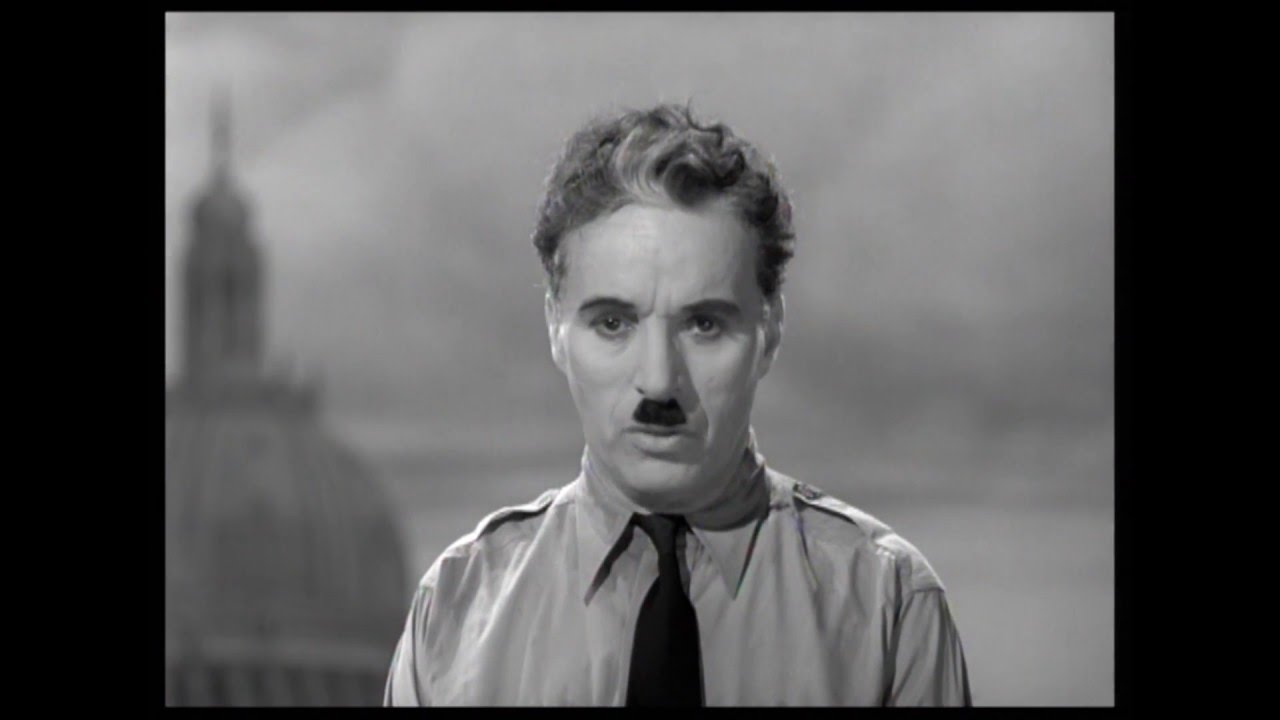
What was the historical context of The Great Dictator speech?
Filming for The Great Dictator began in September 1939, just days after World War II erupted in Europe. At the time, the United States was deeply isolationist, with many wanting to avoid another European conflict after the trauma of World War I. Powerful groups like the America First Committee, which had 800,000 members, actively campaigned to keep the U.S. neutral.
This made Chaplin’s movie a huge risk. He was taking a direct shot at Adolf Hitler, playing both a Jewish barber and the dictator Adenoid Hynkel, a biting parody of the Führer. To capture Hitler’s mannerisms, Chaplin meticulously studied Leni Riefenstahl’s infamous propaganda film, “Triumph of the Will.”
The danger was very real. The film was banned in several Latin American countries due to Nazi pressure, and even Britain considered blocking its release. Yet, when it premiered in London in 1941 at the Prince of Wales Theatre, audiences lined up to see it, hungry for a voice that dared to mock fascism.
We all want to help one another, human beings are like that.
What are the main themes and messages in the speech?
At its core, Chaplin’s speech is a powerful rejection of greed and hatred. He saw greed as a poison that barricaded the world with hate and led to misery. Instead, he calls for a world built on kindness and unity, where people of all races and religions can live by each other’s happiness, not misery.
The speech directly attacks the core tenets of Nazism promoted by figures like Joseph Goebbels. Where fascism demanded absolute power and control, Chaplin argued for returning power to the people. He envisioned a future where science and progress would lead to happiness for all, not just a select few.
These themes were not entirely new, echoing anti-authoritarian messages from films like Fritz Lang’s “The Testament of Dr. Mabuse.” However, Chaplin used the massive platform of a Hollywood talkie to deliver this message of hope directly to a global audience, urging everyone to build a future based on liberty.
Analysis of the Speech’s Content

Chaplin doesn’t use complicated language. He uses simple, direct words to talk about justice and hope, creating a clear line between kindness and cruelty. It’s a message that makes you think about the choices we all face, even now.
How does the speech convey a humanitarian and anti-fascist message?
I hear Chaplin’s words as a direct appeal to everyone suffering under oppression. He speaks to soldiers, workers, and people of every background, “Jew, Gentile, black man, white,” reminding them that they are united in their humanity. He doesn’t call for revenge but instead urges people not to give in to despair.
He argues that the misery in the world is just a temporary result of greed and the bitterness of those who fear progress. This message frames fascism not as an invincible force, but as a passing sickness. By stating that power will return to the people, he offers a vision of hope that directly counters the fascist promise of eternal rule.
His call to tear down national barriers and intolerance is a powerful humanitarian statement. It’s not about politics, it’s about the fundamental right of every person to live in freedom and safety.
You are not machines! You are not cattle! You are men!
What calls for unity and kindness are made in the speech?
Beyond simply attacking fascism, Chaplin’s words are a plea for brotherhood. He asks soldiers to see each other as fellow humans, not enemies to be conquered. He reaches out to every person listening, urging them to choose compassion over suspicion.
He also points to the technology of his time, like the airplane and radio, as tools that should bring humanity closer together. Their true purpose, he argues, is to cry out for “universal brotherhood.” This was a forward-thinking idea in 1940, seeing technology as a bridge for human connection rather than a weapon of war.
Chaplin’s vision of unity extends to social responsibility. He calls for a world that provides a future for the young and security for the old. To me, this is where his message feels most powerful. He argues that by working together and lending a hand, we can tear down the walls that greed builds between us.
How does the speech reject authoritarianism?
Chaplin’s call for unity flows directly into his fierce rejection of authoritarian rule. I can hear the anger in his voice when he calls out dictators who trick their people and treat them like cattle to be used as cannon fodder.
He doesn’t hold back. He says dictators enslave people while promising them freedom. In a bold move for 1940, he declares that “the Kingdom of God is within man,” not in one leader or a group of men, but in everyone. This line, borrowed from the Gospel of Luke, is a direct challenge to the god-like status that rulers like Hitler and Mussolini tried to create for themselves.
The speech draws a clear line in the sand. It champions democracy as the only path forward and insists that true power should belong to the people, not be used to crush them under the boots of tyrants.
Impact on Cinema and Society
This speech didn’t just end a movie, it sent shockwaves through Hollywood and the political world that we can still feel today. Ready to see how it all played out? Let’s keep going.
Why is this speech considered a revolutionary moment in political rhetoric?
Before 1940, Hollywood studios were terrified of offending foreign governments, especially Nazi Germany. The industry’s own censor, the Production Code Administration, often stopped films that were critical of Hitler. Chaplin defied all of that.
He financed the $2 million film himself, putting his own money on the line to ensure his message wasn’t silenced. This was a huge gamble, but it paid off. The film became his most commercially successful, earning $5 million worldwide in its initial run.
As biographer Jeffrey Vance noted, it was the cinema’s “first important satire” of politics. Chaplin risked his career to speak truth to power, looking directly into the camera and pleading for humanity. That single act changed what a movie could be, proving it could challenge the world, not just entertain it.
“We think too much and feel too little.”
How did the speech influence political discourse?
The speech’s impact went far beyond the movie theater. Its message of people-power has been adopted by movements for social change for decades. Activists from Occupy Wall Street, for instance, used lines from the speech on signs and in social media campaigns to fight against corporate greed.
Its words have also found a home in music. Over 40 songs have sampled the speech, with artists like Paolo Nutini and the metalcore band Stick to Your Guns using its power to connect with new generations. Even major bands like U2 and Coldplay have played the speech during their live concerts to massive audiences.
This enduring appeal shows how the speech has become a timeless rallying cry. Whenever people need to inspire courage against injustice, they still turn to Chaplin’s simple but powerful words.
What legacy has the speech left in popular culture?
Beyond politics, the speech has left a huge mark on pop culture. I’ve seen it pop up in a Lavazza coffee commercial and heard its echoes in the satirical tones of modern films.
Its influence is clear in movies that use comedy to tackle tyranny, including:
- “The Dictator” (2012): A modern satire that directly references Chaplin’s work.
- “Jojo Rabbit” (2019): Director Taika Waititi used a similar blend of humor and pathos to critique Nazi ideology from a child’s perspective.
- “The Interview” (2014): This comedy borrowed the spirit of Chaplin’s film to satirize a modern dictator.
The film itself continues to be recognized as a classic. In 1997, it was selected for preservation in the U.S. National Film Registry for being “culturally, historically, or aesthetically significant.” Every time I see a clip or hear a reference, I’m reminded that its spark never faded.
Criticism and Controversies

Of course, a film this bold didn’t escape its share of controversy. Some historians debate whether Chaplin borrowed his ideas, while critics at the time questioned its tone and message.
What are the allegations of plagiarism related to the speech?
After the film’s release, Chaplin was hit with a major lawsuit. A writer named Konrad Bercovici claimed that Chaplin had stolen key ideas for the film from a five-page script outline he had shared. Bercovici argued that he came up with concepts like Chaplin playing a dictator and the famous scene of Hynkel dancing with a globe.
The trial began in 1947 and attracted a lot of media attention. In the end, Chaplin chose not to go to trial and settled the case, paying Bercovici $95,000. In his autobiography, Chaplin maintained that he was the sole author but explained that he settled due to his “unpopularity in the States at that moment,” likely referring to the Red Scare and the FBI’s growing suspicion of him.
What historical and cultural critiques has the speech faced?
When the film was released, not everyone was a fan of the final speech. Some critics in 1940 found it out of place and preachy. A review in The New York Times by Bosley Crowther, while mostly positive, noted the film was a bit long, and other critics felt the speech was “completely out of joint” with the comedy that came before it.
Some also felt that making fun of Hitler was inappropriate as the horrors of the war were unfolding. An uneasiness was felt by some viewers who questioned if the man causing such destruction could truly be seen as comic.
Chaplin himself later expressed his own complex feelings. In his 1964 autobiography, he famously admitted that if he had known the true extent of the horrors in the Nazi concentration camps, he “could not have made fun of the homicidal insanity of the Nazis.”
Why the Legacy of The Great Dictator Speech Endures
So, why are we still talking about a speech from a 1940 movie?
Because its message is timeless. When Chaplin called out greed, hate, and the dangers of men who want to turn us into machines, he wasn’t just talking about his own time.
I see its relevance every time a new movement rises up to demand justice or when people use social media to fight for human rights across the globe. The speech reminds us that the fight for kindness and liberty never truly ends. Its selection for the National Film Registry in 1997 confirmed its lasting cultural value, ensuring new generations will continue to discover its power.
The legacy of Charlie Chaplin’s great dictator speech is a powerful reminder that one voice, speaking with honesty and courage, can still echo through history.
People Also Ask
What are the 6 vital truths in Charlie Chaplin’s The Great Dictator speech?
The speech champions freedom, kindness, hope, unity, courage, and humanity, forming a powerful message that I find still resonates today.
Why does Chaplin’s speech still matter today?
Chaplin’s words are timeless because the struggle against greed and intolerance is ongoing, making his 1940 plea for a world of reason feel just as urgent now. His message directly challenged the rise of fascism in his time and continues to inspire people to stand for liberty.
How does The Great Dictator speech use humor to share serious ideas?
In the film, Chaplin cleverly uses satire, like dictator Adenoid Hynkel dancing with a balloon globe, to expose the childish and absurd nature of tyranny. This humor makes the film’s serious condemnation of fascism and anti-Semitism more accessible and powerful.
Can you give an example of how one of these truths connects with real life?
Unity is powerfully demonstrated in widespread disaster recovery efforts, where strangers and communities come together to rebuild, showing our collective strength.